benlong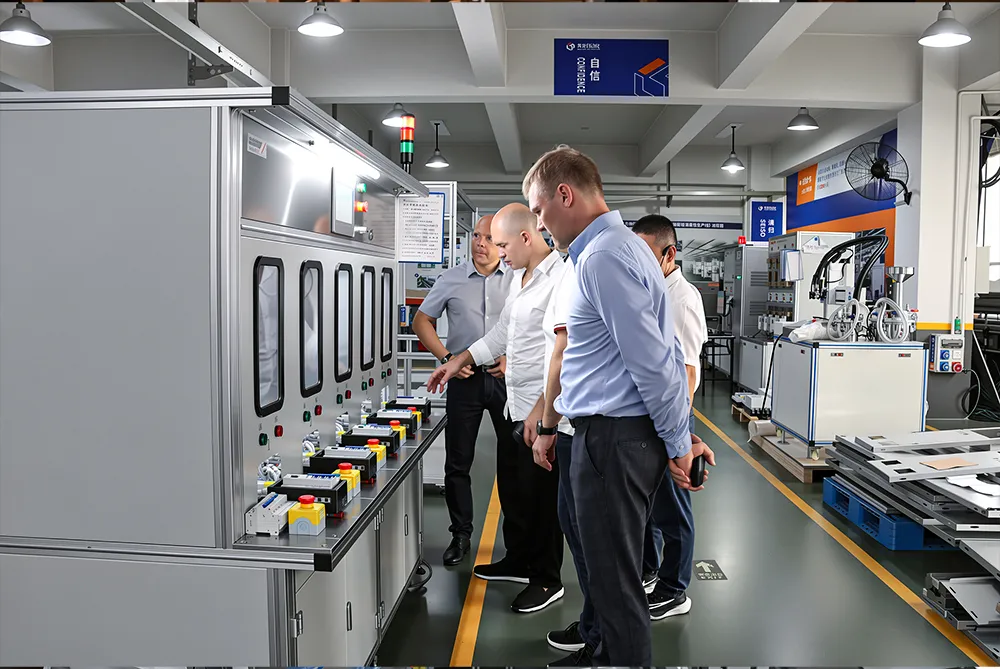

Electrical Equipment Manufacturing Poland 2026 Trends Challenges
Poland has stealthily risen to become one of Europe’s most important manufacturing hubs for electrical goods, and it is only in 2026 that the figures are expected to catch up with the reputation. The country’s growth has surpassed that of the EU average, the build of the grid is the biggest capital programme in Poland’s history and Polish producers’ investment priorities have changed in such a way that they determine the type of equipment they will procure.
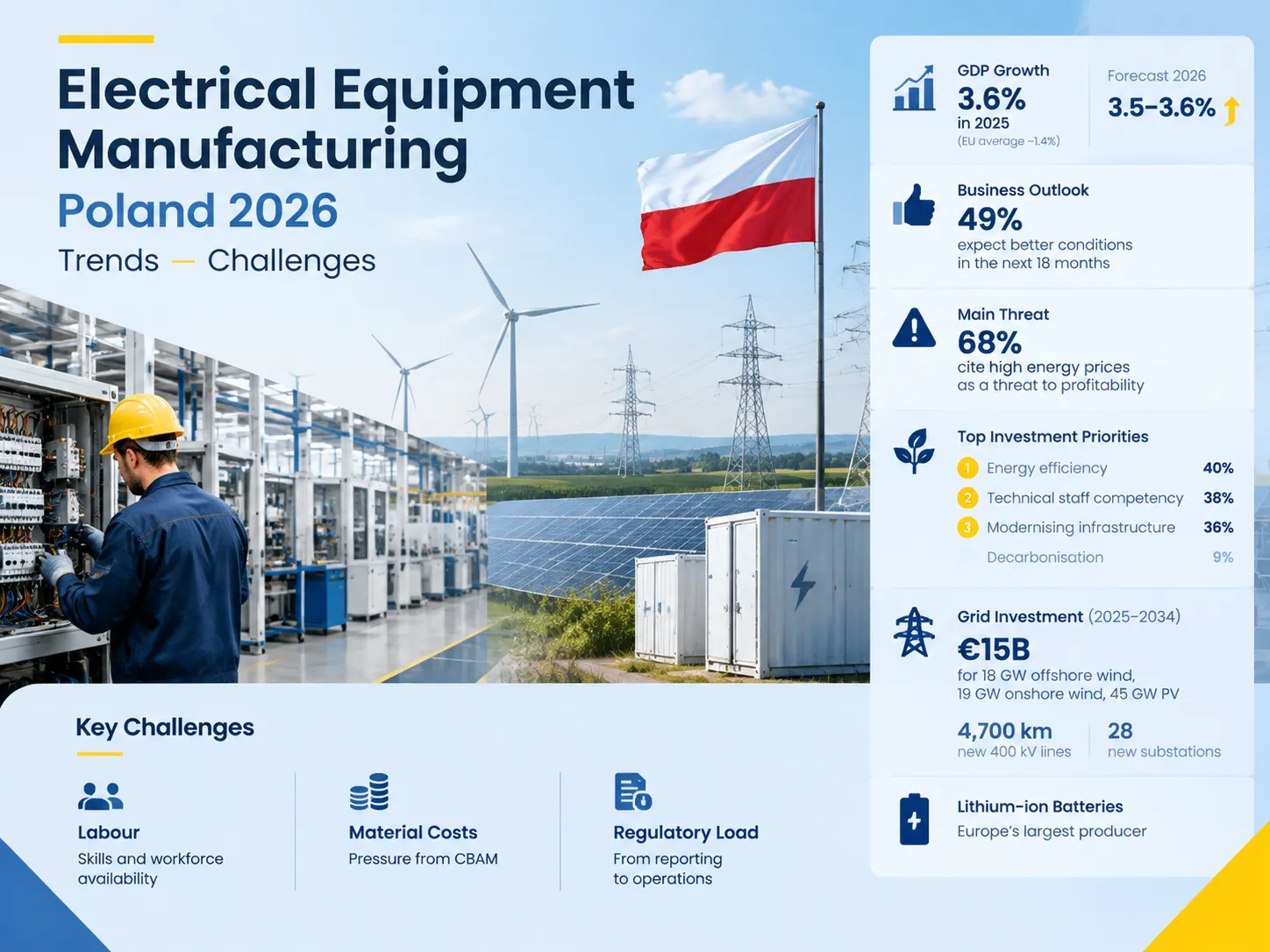
In 2025, Poland achieved a growth rate of about 3.6%, while the EU averaged around 1.4%. The outlook for 2026 sees growth rates of around 3.6%. An ABB study conducted in the spring of 2026 indicated that around 49% of Polish firms believed that conditions will improve in the next 18 months, while 68% of them mentioned high energy prices as a risk factor for profitability. The investment focus is on improving energy efficiency (40%), improving the staff’s expertise (38%), and modernising power infrastructure (36%), while decarbonisation is in the last place, with a score of 9%. The structural driver of the market is the grid since PSE’s plan for 2025–2034 entails around €15 billion of spending for building 18 GW of offshore wind capacity, 19 GW of onshore wind capacity, and 45 GW of solar power capacity, including 4,700 km of new power lines of 400 kV and 28 new substations. Additionally, Poland is the leader of the lithium-ion battery market in Europe. The key challenges of the market are labour issues, the cost of materials under CBAM, and the continuously evolving legislation from the reporting stage to actual implementation.
The Macro Backdrop
Poland no longer serves as a low-cost implantation destination. Rather, it is becoming an industrial economy with a consistently increasing labour cost base, which brings about a modification of the competition factor for various companies supplying equipment to the market.
| Indicator | Figure | Source period |
|---|---|---|
| GDP growth, 2025 | About 3.6% | Polish Central Statistical Office estimate |
| GDP growth forecast, 2026 | Above 3.6% (IMF 3.5%) | 2026 forecasts |
| EU average growth, 2026 | Around 1.4% | Comparison basis |
| Minimum monthly wage from 2026 | PLN 4,806 | Statutory |
| Minimum hourly rate from 2026 | About PLN 31.4 | Statutory |
| Electronics share of exports | Nearly 12.4% | Computers, electronic and optical products |
| Lithium-ion capacity share | About 6% of global capacity, first in Europe | As of 2024 |
The previously mentioned figures provide the context for everything else below. A market expanding at two and a half times faster than the average in the EU and now working with a workforce that is so costly that the introduction of automation systems becomes worthwhile behaves differently than the cost arbitrage market when it comes to equipment. Equipment that minimizes labour costs or reduces energy costs is easy to sell; however, equipment that provides only an enhanced capacity is not so easy to sell.This is the same shift that is reshaping automation investment globally, and the underlying dynamics are covered in this review of tailwinds in automation machinery manufacturing.
Trend 1: Energy Cost Is Now the Investment Driver
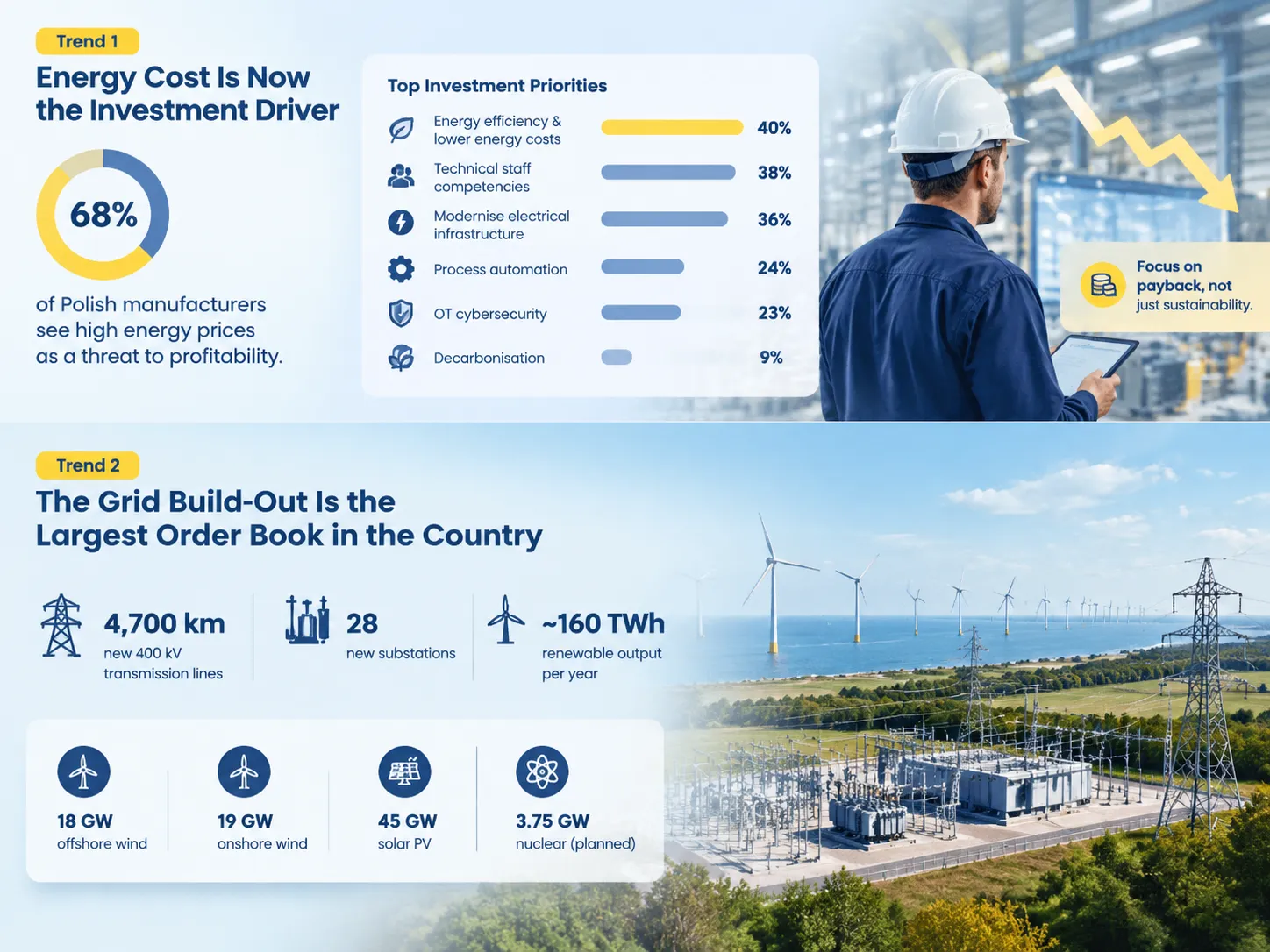
There’s something noteworthy about the 2026 Polish industrial data pointer. It’s not only the observation of optimism but also the conditions the optimism is based upon. ABB Trends 2026/2027 research that surveyed Polish companies in April-May 2026 states that high energy prices generate a threat for 68% of surveyed business operations.
Consequently, the priority list that follows points to recovering costs rather than tackling growth.
| Investment priority | Share naming it |
|---|---|
| Improving energy efficiency and reducing energy costs | 40% |
| Developing technical staff competencies | 38% |
| Modernising electrical infrastructure | 36% |
| Production process automation | 24% |
| OT cybersecurity | 23% |
| Decarbonisation | 9% |
Two important conclusions can be drawn, which are essential in commercial terms. Firstly, what will be sold to Polish market in 2026 will be extensive equipment that provides returns either in energy savings or in labour costs savings, not some hardware which has justification of being sustainable. Secondly, decarbonisation ranking in ninth position with 9% does not imply that Polish manufacturers are indifferent — they just put it at the end of the sequence, which has been confirmed with words of the head of the Polish division of ABB in the presentation: companies are first interested in decreasing energy expenses, enhancing the qualifications of employees and modernising the infrastructure; only afterwards do they focus on automation and AI-related activities.
Spending intentions support this conclusion. 35% of companies plan to increase spending for development in 2026–2027 compared to the previous year, roughly one third of entities claim that they will be able to keep the current spending level, while only around 20% see a cut in development expenditures. Small companies are the most optimistic — 52% of them evaluate their current condition as good or very good compared to 34% of medium firms and 42% of major corporations, as large entities face higher risk of energy price fluctuations, regulatory pressure and shortage of workforce.
Trend 2: The Grid Build-Out Is the Largest Order Book in the Country
If you deal with switchgear, transformers, protection or cabling, then the Polish grid development program is the biggest opportunity currently available in the market and one that is easier to quantify in kilometers than in euros.
PSE, the Polish transmission system operator, has published its development plan for 2025–2034 in which it announced that as much as €15 billion will be invested in projects guaranteeing the development of up to 18 GW offshore wind, 19 GW onshore wind and 45 GW PV, which together will produce around 160 TWh renewable energy a year, close to 70% of the total electricity generation volume in Poland. The required infrastructure consists of 4,700 km of new 400 kV power lines and 28 new substations. For the sake of comparison, 4,700 kilometers is the distance from Warsaw to Reykjavik, built in one country within nine years.
The first signs that something is happening have already appeared. Poland announced full readiness of its grid for offshore wind in January 2026. Together with the new Choczewo substation, the expanded Żarnowiec substation and the 400-kilovolt Choczewo-Zarnowiec line, the first offshore wind installations will usher in the era of Baltic Power, the country’s first offshore wind farm, which will generate 1.2 GW thanks to 76 wind turbines covering an area of approximately 130 km2, which is enough to produce around 3% of Poland’s electricity needs, sufficient to supply 1.5 million households. The total investment will amount to PLN 3.5 billion (approximately €800 million) financed by Poland’s National Recovery Plan. The next in line are Baltica 2 with a planned capacity of 1.5 GW and Bałtyk 2 and 3 with a combined output of 1.44 GW, and expected to be completed no later than 2027, followed by BC-Wind in 2028 with a 390 MW capacity. PSE’s connection register reveals nine offshore projects already prepared with an installed capacity of 8.76 GW and an approved connection.
The burden is equally significant in terms of the existing power system. As of April 2025, Poland had approximately 22.1 GW of solar PV and 10.9 GW of onshore wind, with the former contributing to about 64% of the total capacity generated from renewable sources, which resulted in overcrowding of the grid and production curtailment: almost 600 GWh of PV electricity was avoided in the first half of 2025. That creates requirements for storage, demand-side response and grid upgrades, which can be seen in the corresponding demand for storage projects — PSE’s registry shows 1 GW of batteries at Choczewo, 400 MW at Olsztyn Mątki and several projects in the range of 200–400 MW.
Nuclear power is an additional dimension of the situation. In December 2025, the European Commission gave its approval for state aid for the construction of Poland’s first nuclear power station, which will be a state-of-the-art 3.75 GW facility located on the Baltic coast, which is being constructed by Westinghouse and should start operating by the second half of the 2030s. Regardless the timing of the project, this is the task that needs to be completed in the framework of the transmission program.
Trend 3: Batteries and Electromobility
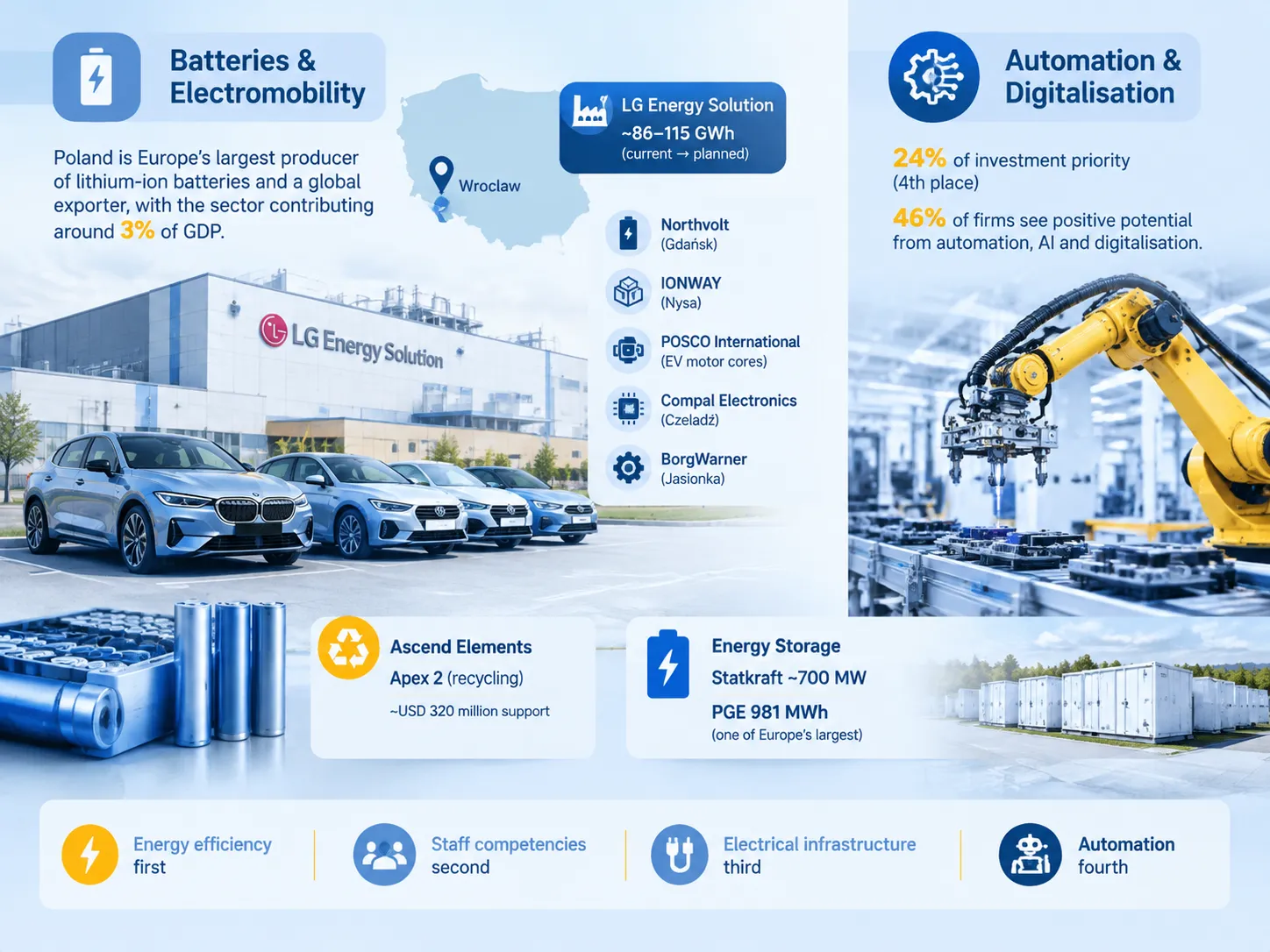
The development of Poland’s battery industry has left the stage of being regarded as a newsworthy topic and turned into one of the leading participants in the global battery market. The country possesses the status of being the largest lithium-ion battery producer in Europe and having a significant role in the worldwide battery manufacturing landscape, offering contributions of around 3% to Poland’s GDP.
The foundation for this industry is piloted by one of the largest lithium-ion battery factories operating near Wrocław, which belongs to LG Energy Solution, has the annual production capacity of nearly 86 GWh, which will eventually be expanded to provide 115 GWh of batteries yearly. The batteries manufactured there provide supply to Audi, BMW, Ford, and Volkswagen. As a specially designed project, the company involved in the operation and development of the factory has kicked off 46inEU project with the European Commission assistance, which implies the achievement of next-gen cylindrical battery outputs for electric cars.
Apart from that facility, the existing supply chain in the region has improved due to the opening of Northvolt assembly plant in Gdańsk, IONWAY joint venture having the aim of launching cathode materials plant in Nysa. POSCO International continues the ongoing production of electric motors and Compal Electronics is focused on forming automotive electronics operations in Czeladź, while the manufacturing of combustion components has moved to national facilities of BorgWarner in Jasionka.
While being responsible for the manufacture of previously described batteries, Polish industry has moved to a new stage, with Ascend Elements’ Apex 2 project intending to develop one of the largest battery waste recycling operations in Europe, a venture backed with more than $300 million of government funding and representing a wonderful example of the EU Critical Raw Materials Act implementation.
In terms of generation, it’s also worth mentioning the steadily growing popularity of storage industries being developed by international Norwegian company Statkraft as well as the planned PGE utility offering one of the largest battery storage facilities operating at the expected capacity of nearly 981 MWh with the help of LG batteries.
The equipment suppliers’ point of view focused on the importance of such powerful battery manufacturing plants emphasizes the fact that battery plants are obliged to comply with all electrical systems requirements, which stands as essential for automotive suppliers.
Trend 4: Automation and Digitalisation Come Second, Not First
The fourth place in Poland’s priority ranking among investments belongs to automation and reaches 24%. Although this arrangement is somewhat misleading, it doesn’t indicate disinterest at all, which is the case in fact.
Almost half of the companies surveyed (46%) see a positive effect of automation, AI, digitalization, and electrification on their business but they are financing the prerequisites first. In terms of logic, automating some processes without considering energy consumption or the outdated electrical infrastructure essentially means automating the problem. When energy prices and personnel skills are sorted out, the automation project will be justified.
What is changing is the understanding of the concept of automation. In the past, it was easy to define automation as a robot cell but in modern Poland, where labor costs are growing more rapidly than in the rest of the EU, automation gradually means equipment that eliminates manual labor from a process – automated assembly, hot testing, inspection, and the software that integrates these systems together.The trend lines in that market, including where the growth is actually coming from rather than where the marketing is, are covered in this look at industrial automation trends for 2026.
The reimbursement calculations are also evolving. The Polish minimum wage in PLN per month stood at PLN 4,806 from 2026, being around PLN 31.4 an hour. Each year this number grows, manual operation led by two workers appears less justified in comparison to the automatic station; thus, investments in automation tend to speed up during the period of scarcity of labor, even in times when the overall respective index decreases.
The Labour Squeeze and Why Lights-Out Manufacturing Keeps Getting Funded
Labour in Poland serves as both an obstacle and a spur to equipment suppliers and is responsible for both of these effects going in the same direction.
On the restrictive side of the issue, there persists a dire shortage of necessary professionals in the fields of engineering, construction management, electrical and mechanical installation, and power management. The population of working-age labour force is on the decline, while the fastest-developing industries, such as grid infrastructures, battery production, and defence industries, has been attracting specialists from the same pool of applicants. Thus, many employers say that there is no difficulty in finding orders, but there are many issues in recruiting and retaining the employees needed for their implementation.
On the spur side of the issue, a lack of trained workers lets large manufacturers consider a technological automation project as feasible. Among extremely popular concepts, Polish manufacturers are increasingly paying attention to the lights-out factory, where machines will work without human intervention. It is not achievable for most plants, and the honest examples of where it does work are more instructive than the aspirational ones — the real cases, including what each one actually automated and what it still cannot, are collected in this review of dark factories around the world.
For a vendor, the important lesson is that the business case in Poland now focuses on operator hours saved, not investment costs avoided. Equipment that eliminates a shift position can recoup its costs sooner in Poland than in most of Western Europe, since the position is more expensive than it was.
Trend 5: Moving Up the Value Chain
The main concept in the above passage is the change from using assembly services to the more costly manufacturing of products, in addition to referring to certain governmental initiatives which have plenty of funding.
- Semiconductors. A national program has been started by the Polish Investment and Trade Agency, allocating $1.5 billion to develop the semiconductor supply chain starting from design and finishing with production.
- Materials for batteries and recycling instead of just technologies for cell assembly. Now, plants for production of precursors for cathodes and active cathode materials are being constructed.
- Production of renewable equipment. For example, Vestas has started assembly of nacelles in Szczecin, the new rotor blades for its turbine is produced in Szczecin after the acquisition of ST3 Offshore foundation factory. Windar Renovables is working on wind turbine production in Szczecin. GRI Renewables and Baltic Towers are constructing production facilities for offshore towers in Gdańsk.
- Provision of Electronics services, where Scanfil is extending its business in Poland and GARO starts its production and logistics in Szczecin.
- Manufacturing of transmission and power supply systems which have been described beforehand.
The main implication of the described projects is that they bring about changes on the market in terms of the buyer’s profile. In other words, a commodity assembling plant has to compete only on price, but a supplier producing the components of batteries, nacelles or semiconductors should provide documentation, traceability and capabilities which are specific to buyers of these products. Hence, the requirements for qualification are increasing, thus raising the value of the provider able to satisfy these requirements.
The Challenges
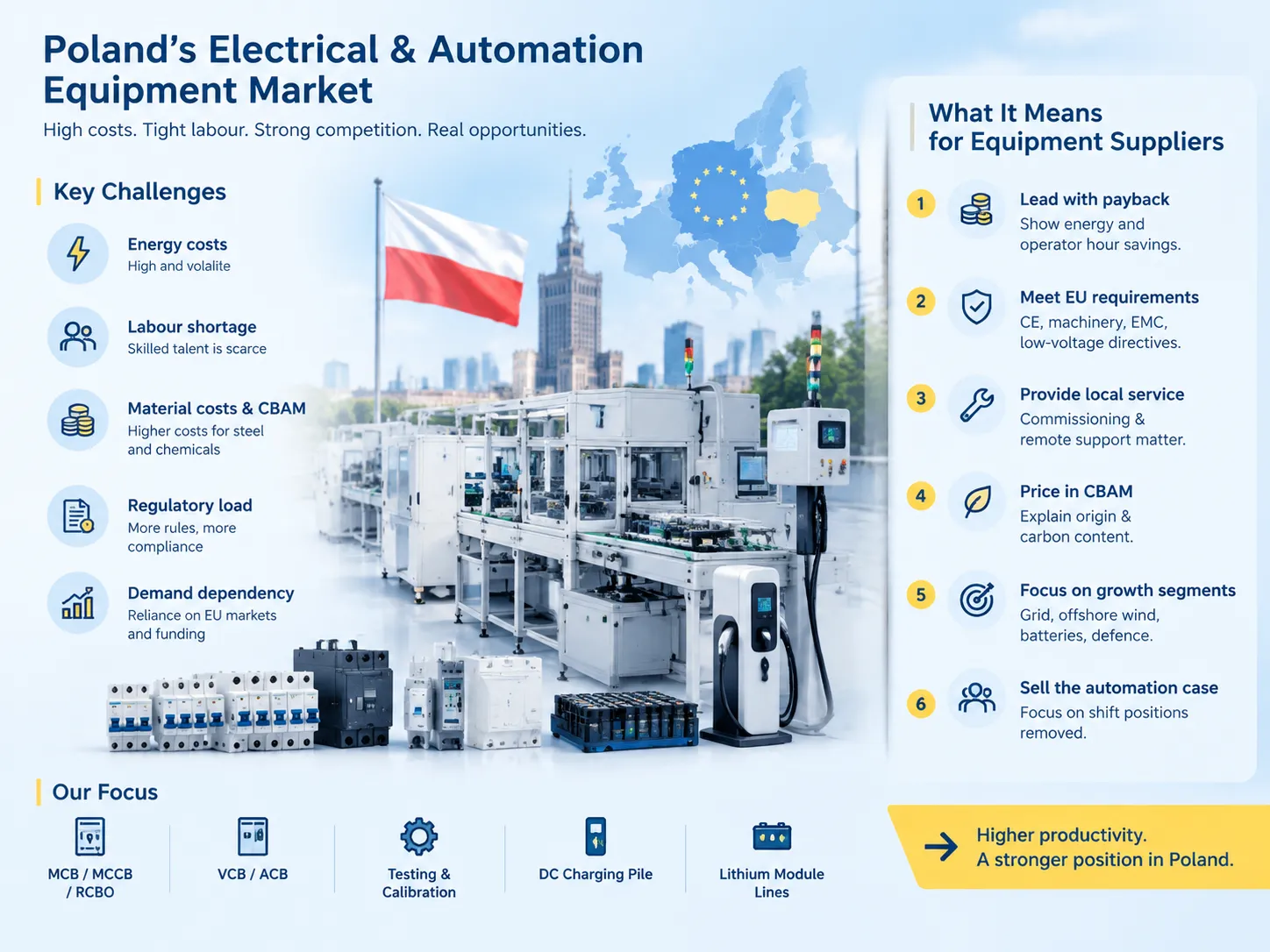
None of the above is frictionless. Five constraints are shaping the market, and they are worth pricing into a plan rather than discovering during execution.
| Challenge | Detail | Practical effect |
|---|---|---|
| Energy costs | High and volatile; 68% of manufacturers name it as a profitability threat | Energy payback equipment wins; capacity-only investments are deferred |
| Labour shortage | Acute in engineering, M&E and energy; ageing workforce; rising wage floor | Longer commissioning windows, competition for the same technicians, automation justified earlier |
| Material costs and CBAM | Carbon Border Adjustment Mechanism raises prices of metal and chemical semi-finished products from outside the EU | Steel-intensive equipment costs more; EU-origin content becomes a procurement argument |
| Regulatory load | ESG directives and new obligations in energy, construction, labour and AI shifting from reporting into operations and product development | Documentation and compliance become product features rather than overhead |
| Demand dependency | Heavy reliance on EU markets and EU funding; consumption-goods sectors exposed to weak EU demand | Order visibility is good in infrastructure and defence, weaker in consumer-facing manufacturing |
Two of those issues deserve further explanation. The impact of the CBAM is important for anyone in the business of selling any pieces of electrical equipment made up of steel or containing steel such as enclosures, busbar systems, and transformers: it changes the calculation with regard to the landed costs of the EU made and imported components which is independent of the existing exchange rates. The labor shortage changes the economics of projects rather than their cost: the supplier who can put together the equipment using a smaller team or commissioning equipment distant from their workplace becomes more valuable than the supplier who cannot because the problem in this case is not money.
It should also be noted that in terms of competitive environment things are quite serious. Polish manufacturers of electrical equipment are subjected to pressure from manufacturers from China and other countries of Asia in terms of prices and it can be seen in numbers: such firms can improve efficiency thanks to the utilization of their personnel or time than simply increasing the number of their employees.That is the same response described in this analysis of the challenges facing automation machinery manufacturing — rising costs on one side, price competition on the other, and the only durable answer being productivity.
What It Means for Equipment Suppliers Selling Into Poland
If you’re considering making a sale of electrical or automation gear to this market, be aware of the following six key aspects.
- Begin by focusing on payback. Your potential customer will want to know the cost of electricity and the number of man hours involved in operating the device under consideration. If you provide figures on any such efficiencies, your offer will likely be more appealing than a lengthy description of its inputs and features.
- Be advised that the buyer will want to get documentation regarding CE mark and a declaration of conformity from the EU. There may be technical documents required during the process as listed in machinery directive or EMC directive or low voltage directive in force for the equipment involved in the transaction. Document submission is mandatory rather than optional.
- Take into account the fact that the lack of qualified personnel will require the salesperson to ensure that there is technical support available either locally or via remote connection.Local presence may even be more desired by the buyers than the discounted price of the offered equipment.
- Keep in mind that this market suffers from high prices for steel parts and that all procurement officers become stressed buying equipment that causes more trouble than it should. The cost of your input may be high, but explaining precisely where it comes from and what was emitted during its production will ease the process.
- Target your sales at specific industries; do not waste your time trying to enter consumer-facing assembly market.
- Build the case for automation on the fact that the number of positions to be filled will decrease. Given that the minimum wage is rising each year, salespeople may find it much easier to find a buyer for a two-operator solution rather than looking for a solution with higher productivity.
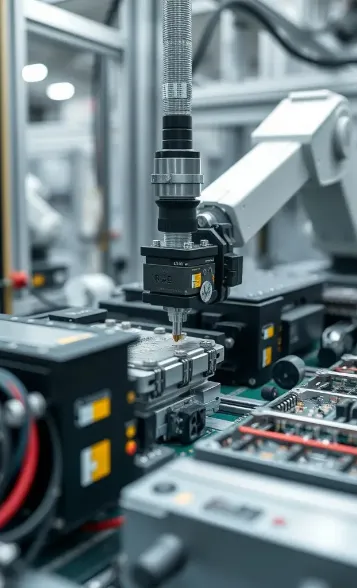
Benlong operates in the niche of automated assembly and process machines for electrical component manufacture. Production lines for MCB, MCCB, RCBO, VCB, and ACB, as well as production, testing, and calibration of DC chargers, and lithium modules, are also included. A good illustration of what that looks like commercially is the MCB automatic production line programme, where the equipment replaces a defined sequence of manual operations rather than existing as a general-purpose robot cell — which is the shape of investment Polish manufacturers are currently funding.
FAQ
Is Poland a good place to manufacture electrical equipment in 2026?
Indeed, it’s necessary for infrastructure-related and technologically advanced production, and not so much for labor-heavy assembly. Poland is expected to grow around 3.6% in 2025 as compared to the EU average of nearly 1.4%, while growth can be expected to be around 3.5 to 3.6% in 2026, and in addition to access to the EU market, Poland has a very good network of suppliers in the automotive and electronic industry that will make it possible to establish a multi-billion transmission capacity. However, there are counterbalances such as high energy costs, existing shortage of engineers, steadily increasing wages starting from PLN 4,806 minimum salary, and CBAM tariff incentive on steel and chemicals imported. One’s estimation of the location depends mostly on the proportion of the company’s expenditures related to labor and energy.
What are the biggest trends in Polish electrical manufacturing for 2026?
Energy cost reduction is the number one driving force for investment, identified by 40% of manufacturers. The PSE transmission project is investing around 15 billion euros in the construction of 4,700 km of 400 kV power lines and 28 substations. The development of batteries and electromobility is consolidating with Poland emerging as the largest lithium-ion battery producer in Europe, which is already valued at about 3% of the GDP. Funds are allocated for automation and digitalization, but these areas are placed after energy efficiency and employees’ skills with only 24% and 23% importance respectively. The industrial sector is shifting toward the semiconductors and battery materials, renewable energy components, and power grid equipment production.
How big is Poland’s grid investment programme?
Development programme of PSE for the period of 2025–2034 foresees an approximate investment of €15 billion which will allow the company to produce around 18 GW of off-shore wind energy, 19 GW of on-shore wind energy and 45 GW of energy from solar panels, bringing the total renewable energy production to nearly 160TWh of power annually. Approximately 4,700 km of transmission lines of 400 kV will be laid and 28 substations will be built together with other connections required for the first offshore wind farms and for the future nuclear power plant of 3.75 GW capacity. The size of the program is unparalleled in the industry in Poland.
What are the main challenges facing Polish manufacturers in 2026?
Between 2025 and 2034, the PSE development plan anticipates funding of around €15 billion to help generate about 18 GW from offshore wind, 19 GW from onshore wind and 45 GW from solar. The total yearly output from renewable energy will be approximately 160 TWh. Around 4,700 km of power lines at 400 kV will be stretched out and 28 control centers will be constructed, along with all other connections necessary for the initial offshore wind farms and for the future construction of a nuclear plant of 3.75 GW capacity. The scale of the project is unprecedented in the Polish market.
Why is automation only ranked fourth in Polish investment priorities?
Manufacturers are focusing on funding pre-requisites first. The main problems the sector is focusing on: for 68% of companies, energy prices are regarded as a threat to profitability while energy efficiency comes in second (40%), competencies of workers come in third (38%) and modernization of electric infrastructure is in fourth place. Automation occupies the fifth position with 24% and cybersecurity of OT is in sixth place with 23%. This is sequencing, not lack of interest: 46% of companies see opportunities in automation, AI, digitalization and electrification.
Is Poland still a low-cost manufacturing location?
Gradually becoming less so year by year. The minimum wage is expected to reach PLN 4,806 a month in 2026, and the hourly minimum of about PLN 31.4, while wage growth for in-demand jobs prevails over the rate of inflation. Poland is becoming less dependent on the low cost of labour on the EU market, as it has to compete in such areas as market access, length of supply chain, qualifications of workforce, and logistics. It follows logically that labour-heavy industries are getting more and more automated, whereas the top priority of the investors is becoming efficiency. Thus, in the eyes of the supplier, it means the so-called cost-benefit ratio will become less dependent on the capital costs.
References
- Statistics Poland (GUS) — economic and industrial statistics
- Instrat — Polish energy and grid analysis, including offshore wind grid readiness reporting
- Polish Investment and Trade Agency (PAIH) — investment and manufacturing sector reporting
- European Commission — Carbon Border Adjustment Mechanism
- International Electrotechnical Commission — electrical equipment standards applied in EU manufacturing
Conclusion
Poland in the year 2026 denotes the robust fundamentals and real limitations which give rise to the respective behaviour of the consumers in the market. The opportunity is marked with the growth of 3.6% against the cult European average approximate to 1.4%, the €15 billion energy grids project, Europe’s leading battery market and semiconductors project with an investment of USD 1.5 billion. The concern is indicated by 68% of energy costs, the lack of engineers, CBAM regarding the steel production and fast-growing regulatory burden.
The practical outcomes mean that Polish companies buy energy efficiency, manpower development, and electrical infrastructure rather than automation solutions, and when they buy automation, the focus is on replacing rather than adding labor hours. Thus, sell based on the fact, and the business will listen, versus if selling based on the capability, the project will be on the budget for the next year.
Three important figures to note: 40% of companies interested in energy efficiency, 36% of companies modernizing their electrical infrastructure and PLN 4,806 minimum wage that inches up starting from January.