benlong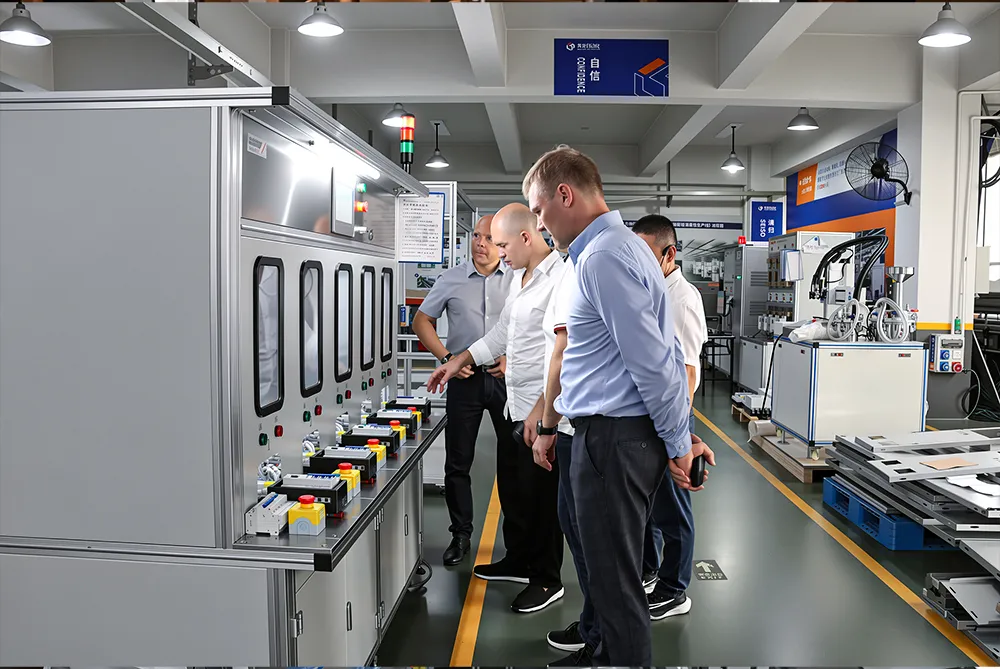

Famous Dark Factories Around the World: Real Examples of Lights-Out Manufacturing
Mount Fuji’s foot at three a.m. The parking lot is vacant, the food hall is shut down, and the manufacturing site is incredibly dim. Besides, robotic arm-type robots are still busy working on the stewing operations, fielding bearings, and offloading ready-made sets. Nobody oversees the operations: there is no need for it. In the morning the detectives will only see a line of newly-built robots that are ready for the last checks.
This is a so-called dark factory – also called a lights-out factory. Manufacturing continues without people at the shop floor; thus, it is unnecessary to operate lights, heating, or air conditioning. The concept has interested manufacturers since the 1980s, and now, with new generations of AI, machine vision, and humanoid robots, it is on the agenda of each industry conference.
Though there is a discrepancy between headlines and shop floor reality. Pure 100% dark factory practice is still far from being found. Most commonly cited factories are actually dark only in certain halls, sections, or shifts, while a small group of employees performs maintenance, quality control, or other exceptional tasks. It does not diminish their significance; rather, it makes them better subjects for learning how factory processes can operate independently.
In this report, we go through the most widely-known examples of dark factories located in Japan, Europe, North America, and Asia, indicating their locations, produced goods, operational level, and essential statistics. Then we discuss which factories and spheres may transform to dark factories in the near future, and what factories and spheres may never become dark.
Dark factories do exist, but they are not as common as one might think. FANUC trains robots to build robots in dark factories since 2001; ASE operates numerous lights-out semiconductor manufacturing plants; and Philips and Xiaomi also produce consumer products, involving only a handful of workers. In contrast, most plants, such as Siemens Amberg and Tesla, are simply highly automated plants, requiring a substantial amount of highly skilled workers.
What Is a Dark Factory? Lights-Out Manufacturing Explained
In simple words, lights out manufacturing means a manufacturing strategy where only raw materials enter and end products come out with close to no human presence at the factory. Robots, CNC machines, conveyors, automated storage systems, vision systems, and control software perform all operations, with PLCs, SCADA, and MES managing the processes and monitoring results. Since there is no personnel in the factory, energy savings by switching off lights and climate control system explain lights-out manufacturing event name.
The idea of lights-out manufacturing appeared earlier than people usually think. Science fiction writer Philip K. Dick anticipated the invention of self-operating robot factories in his short story Autofac written back in 1955, and by the 1980s General Motors and other companies heavily invested in the attempts to build automated facilities, working in the dark. Fortunately, almost all of the first attempts failed as robots, sensors, and software used at the time could not cope with the variety of real life. Today’s technologies are much more advanced, but the challenge of dealing with things that go wrong remains the same.
In reality, the term “dark” is better understood as a spectrum of three levels:
Lights-out shifts when a production facility has regular staff but some machines are worked overnight or during weekends without any employee on duty. That’s something that is widely practiced in CNC machining.
Lights-out cells and lines which means having a certain production unit, hall, or area functioning unstaffed whilst other parts of the shop remain manned.
And lights-out plants that mean the whole production processes run unstaffed for several days and weeks. There are very few functioning plants around the world that satisfy this standard.
This idea of spectrum should be kept in mind when reading the case studies below where some of the acknowledged names belong to level two and at least one of them is known due to the attempt to go too far too quick.
Famous Dark Factories Around the World
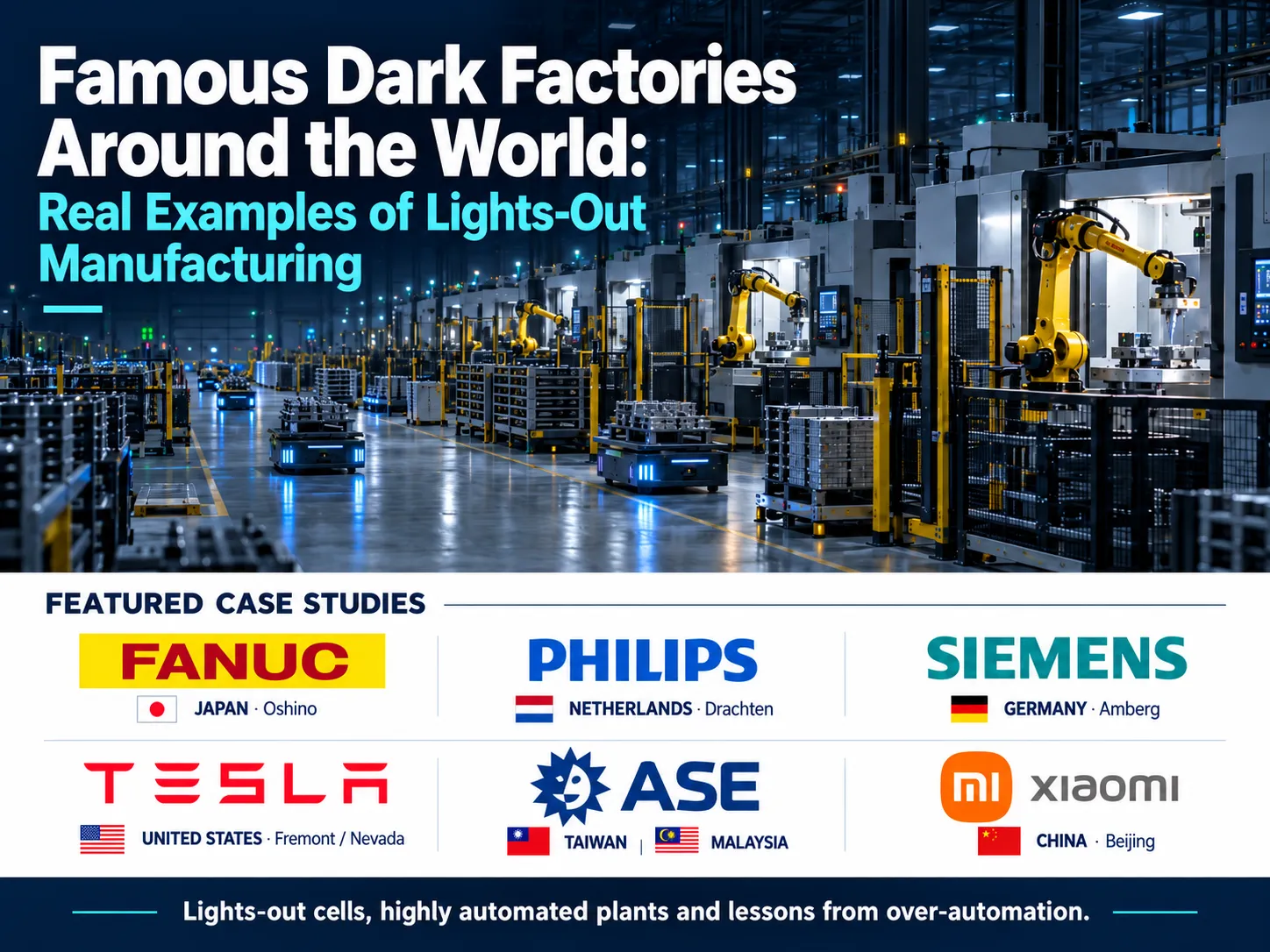
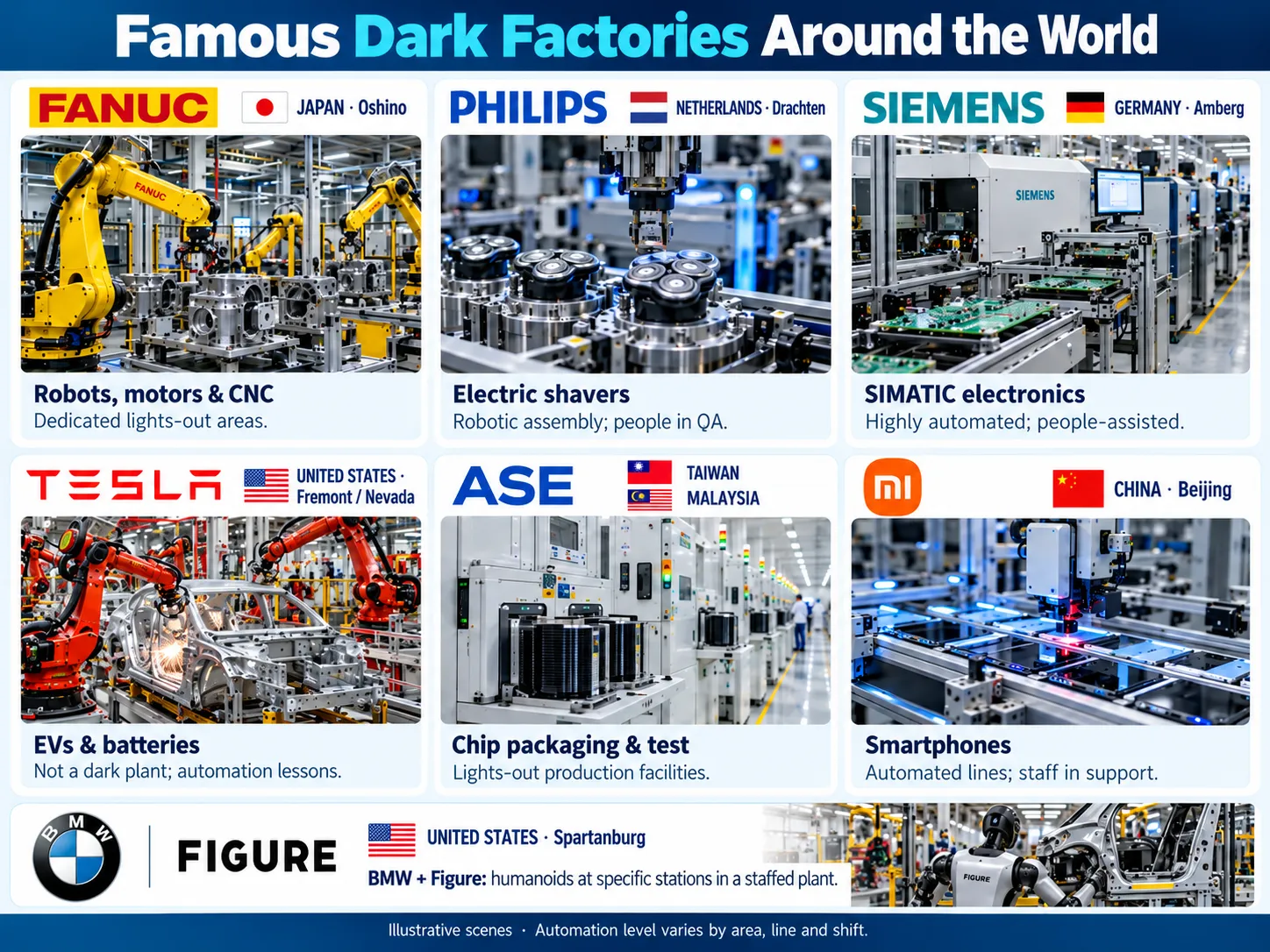
The following lights-out manufacturing examples are the ones most often cited by engineers, analysts and the business press. For each we summarise where it is, what it makes, how automated it really is and what makes it stand out.
1. Japan – FANUC, Oshino (Yamanashi Prefecture)
| Item | Details |
|---|---|
| Location | Oshino village, Yamanashi Prefecture, at the foot of Mount Fuji |
| Products | Industrial robots, servo motors, CNC systems and related components |
| Lights-out since | Around 2001 |
| Headline data | About 50 robots built per 24-hour period; can run unsupervised for up to 30 days |
| Automation level | Robot-built robots in dedicated lights-out production areas |
FANUC is where any conversation about dark factories begins. The Japanese company utilizes its own production processes to manufacture the world’s robots. In reports, it is stated that the company produces approximately 50 robots during one 24-hour shift, meaning that their assembly line can work without human interference for at least 30 days. Once, one of the FANUC executives mentioned that besides turning the lights off, they also turn the heating system and air conditioning off in those parts of the factory.
How does such phenomenon happen? First of all, it can be mentioned that the factory consists of separate stations where machines load and unload production cells with automatic warehouses where the company stores final and manufactured goods. Although humans regularly visit the site, it happens during the day in order to provide the maintenance, testing, and supervision of the work performed by robots.
What is important is the fact that a factory can work without being attended by people. This is only possible thanks to the constant product assortment that is produced in large quantities. The company implements a limited number of designs and is aware of the necessity of automation of the assembly process.
2. Netherlands – Philips Shaver Factory, Drachten
| Item | Details |
|---|---|
| Location | Drachten, Friesland, the Netherlands |
| Products | Premium electric shavers and shaving heads |
| Headline data | 128 robots on the flagship line, with only 9 quality-assurance workers |
| Output | Commonly cited at around 15 million shavers per year |
| Automation level | Highly automated flexible assembly; people concentrated in QA at the end of the process |
Philips has been manufacturing shavers at its Drachten plant since the 1950s. When it chose automated production for its high-quality products rather than moving to a country with lower production costs, that was considered the beginning of the reshoring trend. According to estimates, the plant employs 128 robots made by Adept Technology (currently part of Omron) for production, with only nine people being responsible for quality control. Following a description by the suppliers of automation solutions, the number of robots at the facility has increased to about 200 by now.
What is interesting about Drachten is the flexibility it offers. Instead of making a specialized line for a particular model, Philips has come up with the idea of a pick-and-place system, which is likely to be used for shavers’ production over the next ten years even though exact design of possible future models is not yet known. Moreover, the robots are reprogrammable, and the production tools can be easily modified, which means that it would be easy to adjust for the production of any new shaver model and avoid building a new factory from scratch.
To be accurate, the Drachten facility covers a big area and also serves as the home to Philips’ R&D department for shavers and employs around 2,000 workers in total. The number of nine persons refers to the robotic assembly operation and not to the entire facility.
3. Germany – Siemens Electronics Works Amberg (EWA)
| Item | Details |
|---|---|
| Location | Amberg, Bavaria, Germany |
| Products | SIMATIC programmable logic controllers (PLCs), HMIs, I/O and related automation products |
| Founded | 1989 |
| Automation level | About 75% of the value chain handled by machines and computers |
| Headline data | Quality reported at 99.9988% or better; around 1,200 product variants; about 350 changeovers per day |
Amberg is regarded as the leading smart-factory demonstration in Europe, and rightfully so. Siemens produces its own SIMATIC PLCs at this plant, with around 1000 or more SIMATIC controllers being used to facilitate the manufacturing process. Approximately 75% of the production process, as stated by Siemens, is performed by machines and robots, materials are automatically transported from warehouses to machines, and quality assurance in the manufacturing is estimated to be superb, at around 99.9988%, and even higher recently.
The most significant statistic is not a percentage, but the output growth above 8-times in recent years while the number of employees and factory area remain unchanged. The latest reports indicate an annual production of approximately 17 million units of SIMATIC hardware, about 1200 types of products produced by this plant, and approximately 350 manufacturing conversions per day, all arranged through digital twins and MES.
Although Amberg is not a totally automated factory and Siemens is not making any claims that it is, it surely demonstrates that high-mix production facility with manufacturing of more than a thousand variants can be very close to attaining full autonomy in its core processes. The company owns a sister factory in Chengdu, China built under the same principles, and it is now going to invest heavily in Amberg manufacturing to achieve self-learning production with AI capabilities.
4. United States – Tesla and the Limits of the “Alien Dreadnought”
| Item | Details |
|---|---|
| Locations | Fremont (California), Gigafactory Nevada and other Tesla plants |
| Products | Electric vehicles, battery packs, drive units |
| Ambition | A near-fully automated “Alien Dreadnought” factory for the Model 3 |
| Reality | Over-automation contributed to 2018 “production hell”; many robots were removed |
| Later status | Musk said in 2020 that most of the line was over 75% automated, except wiring harnesses and general assembly |
Various sources suggest that Tesla has been labelled as the first fully automated factory in the North America. The true story is somewhat more complex about and important for the understanding of manufacturing. For the Model 3, Elon Musk created a factory with the best level of automation available—it was supposed to resemble an alien spaceship. In reality, a range of technologies, including complicated conveyor systems and robots turned out to be unable to perform the same tasks that people did much easier. As a result of such complicated installation, the output is far below expectation. In April 2018, Musk admitted that too much automation was a mistake, speaking publicly, and the company started to roll back its automated production and employ more workers to take over some tasks.
However, they continued applying automation, as the time for battery packs manufacturing was reduced significantly, and in 2020 Musk stated that the majority of production was automated for more than 75 percent, excluding wiring and assembling processes. Tesla’s Gigafactories are among the most automated car factories, but they don’t belong to the category of dark factories, which is supported by the negative, but practical experience of Tesla.
Does the US have any fully automated factories located there? Yes, but at the shifting or cell level only. Most of the CNC machine shops have light-out shift at nights, while high-end electronics manufacturers could apply fully automatic solutions in some parts of their production. Overall, dark factories are quite rare, and the vast majority of the news stories regarding the US automation concern the robots that function by people’s sides, not instead of them.
One of the companies that have had a real success in it is BMW; thus, BMW Spartanburg plant managed to achieve a good breakthrough at the disposal of Figure AI terror – it allowed the robots to load almost 90,000 sheet-metal parts within the time of 11 months, which resulted in almost 30,000 produced BMW X3 vehicles. Since then, BMW used Figure’s updated robot for other purposes. This fact shows that robotization applies to specific stations, but cannot fully replace workers yet.
5. Taiwan and Southeast Asia – ASE Group Semiconductor Packaging and Test
| Item | Details |
|---|---|
| Locations | Taiwan (Kaohsiung and other sites), with expansion in Malaysia and elsewhere |
| Products | Semiconductor assembly, packaging and test services (OSAT) |
| First lights-out factory | 2018 |
| Headline data | ASE reports 56 lights-out factories in operation |
| Recognition | First OSAT factory in the World Economic Forum’s Global Lighthouse Network (2022) |
Upon looking at the number of facilities, it can be determined that ASE might be the largest user of dark production in its operations. The manufacturer composed the computer-integrated manufacturing committee in 2011, established robotic arms and carrier automations in 2015, and initiated its first lights out factory in 2018. Presently ASE claims to operate 56 lights out factories and has educated more than 700 engineers in AI and automation for the lights out factories.
The semiconductor packet business is well suited for the lights out production for three reasons: tiny devices which require great contamination sensitivity, highly organized process, and the use of standardized carriers, which can be operated by the transport systems and robots easily. The front-end wafer fabs share many advantages of this kind as the cleanroom handling is made without any manual interventions.
6. China – Xiaomi Smart Factory, Changping (Beijing)
| Item | Details |
|---|---|
| Location | Changping District, Beijing |
| Products | Flagship and foldable smartphones |
| Opened | July 2024 |
| Investment and size | About CNY 2.4 billion (roughly US$330 million); about 81,000 m² |
| Headline data | 11 production lines; capacity of about 10 million phones per year |
Changping plant of Xiaomi is an addition which has been put on the list of notable plants nowadays. The plant is introduced as a fully automated smart factory with 100% automation of its operational processes and continuous running of the lines. The plant is run by a self-developed production platform and Xiaomi claims to have developed the software of the factory and much of the equipment at the plant.
The slogan “one phone every second” requires some clarification. Activation of the production of 10 million phones evenly spread in a year implies that these phones will be produced every 3.15 seconds which is fast but not as fast as it could be. The team engineering as well as maintenance workers remains at the plant making sure there are smooth operations.
Other Notable Dark Factory Examples
- Semiconductor wafer fabrication plants have automated handling systems that enable near-full automation of rack movements in cleanrooms.
CNC machining workshops are able to operate without supervision for long hours with robot-based tools and tool management systems.
Completely automated storage and distribution centers only require minimal human input due to advanced logistics technology.
Siemens Electronics Works Chengdu is a replica of the Amberg facility, which produces SIMATIC products in China by using the same principles.
Dark Factory Examples Compared at a Glance
| Factory | Country | Products | Key figure | Truly lights-out? |
|---|---|---|---|---|
| FANUC Oshino | Japan | Robots, servo motors, CNC | ~50 robots per 24 h; up to 30 days unattended | Yes, in dedicated production areas |
| Philips Drachten | Netherlands | Electric shavers | 128 robots, 9 QA staff on the line | Largely; people in QA and support |
| Siemens Amberg | Germany | SIMATIC PLCs | 75% of value chain automated; 99.9988%+ quality | No – highly automated, people-assisted |
| Tesla Gigafactories | United States | EVs, batteries, drive units | >75% of line automated (2020, per Musk) | No |
| ASE Group | Taiwan / Asia | Semiconductor packaging and test | 56 lights-out factories | Yes, at many individual facilities |
| Xiaomi Changping | China | Smartphones | 10M phones per year; 11 lines | Largely; staff for supervision and maintenance |
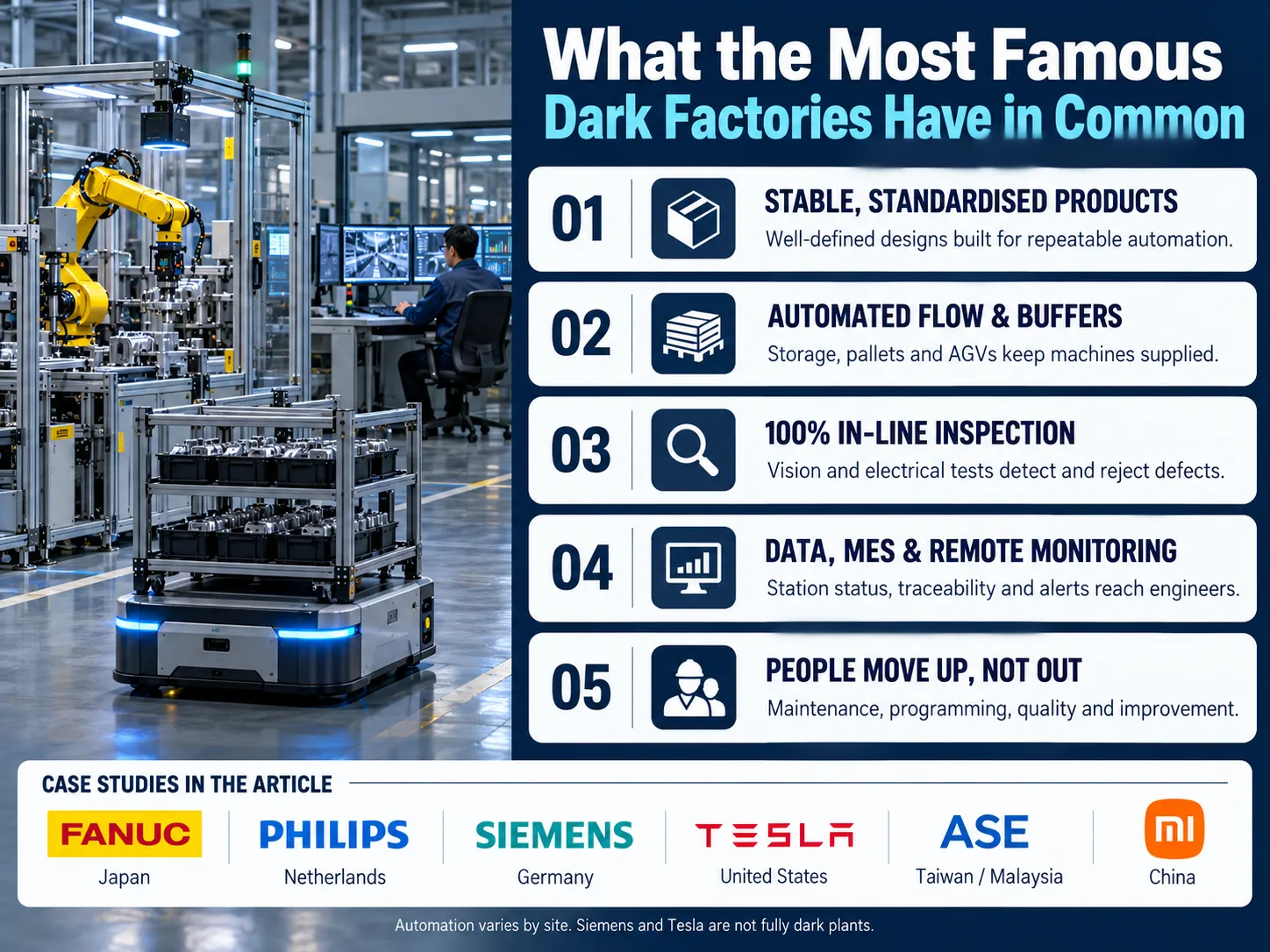
What the Most Famous Dark Factories Have in Common
There are universal conditions for success despite the widespread use of robots:
- Stable and standardized product lines: Fanuc robots, Philips razors, and ASE products are manufactured in huge quantities from stable designs. Automation of the assembly process is important as well as the acquisition of robots.
- Automated material flow and buffering: Automated warehouses, magazines, pallet systems, and AGVs allow machines to be fed for a long time. Without buffering, the production line stops at any time when there is nobody to replace materials.
- 100% in-line inspection: Vision systems and electronic tests do check every part, and the defective parts are automatically rejected without having to wait for human inspection.
- Data, MES, and remote monitoring: Every station has the ability to report its performance, thus enabling early detection of problems.
- People move up – not out: Employees leave the production process to act in the maintenance, programing, quality, and improvement sectors.
The True Story: Why 100% Dark Factories Are Still Very Uncommon
If operating without lights is that good, then why are there so few actual cases of that after many years of attempts by companies? The obstacles are more practical than technical.
Product Complexity
It is known that robots can perform accurate physical operations but when it comes to some complicated wiring, soft materials, tangled items and assemblies requiring decision-making they will still not achieve that goal. It is exactly why making wires and assembling cars are done manually even at Tesla.
Frequency of Changeovers
If a plant produces the same kind of product for weeks, it can work without any people during that time. If models change several times during a shift, some workers are needed to change attachments, check initial kinds of products and deal with a set-up. Amberg plant makes hundreds of changeovers daily with the help of advanced technologies but still employs workers.
Costs of Investment and Expenses
For instance, Xiaomi has recently invested around $330 million into a factory producing smartphones. In a lot of cases moving from a 90% level of automation to a 100% may be more costly than going from 0% to 90% as in this case it is might be necessary to accomplish the most difficult processes.
Exceptions, Repairs and Supply Variations
Machinery may jam, tools may wear out, sensors may drift and parts may differ from each other differ from the batch to batch. It should be noted that in a staffed plant people respond to such problems without delay while in a dark factory production may stop for hours unless it is done automatically.
Expertise and Organisation
To run a fully automated plant controls engineers, robot programmers, data experts and maintenance personnel are needed. Many factories find that hiring the right specialists is actually more difficult than purchasing the equipment used at a plant.
Which Factories and Industries Are Most Likely to Go Dark Next?
The optimal candidates possess the qualities of well-known samples: strong throughput, tiny and stiff components, standardized equipment and procedures capable of being automated. The description of the qualified fields follows:
Back-end semiconductors and wafer manufacturing – numerous manufacturing processes have already been automated to a high degree, the next step consists in interconnecting the processes and making use of artificial intelligence which will monitor equipment failures.
Electronic and PCB assembly (SMT) – the procedure of electronics assembly is already automated and the process of supply of materials is being automated.
Precision manufacturing – we can now obtain multi-day unattended production for repetitive parts owing to placing robots, overseeing machine tools and measuring processes.
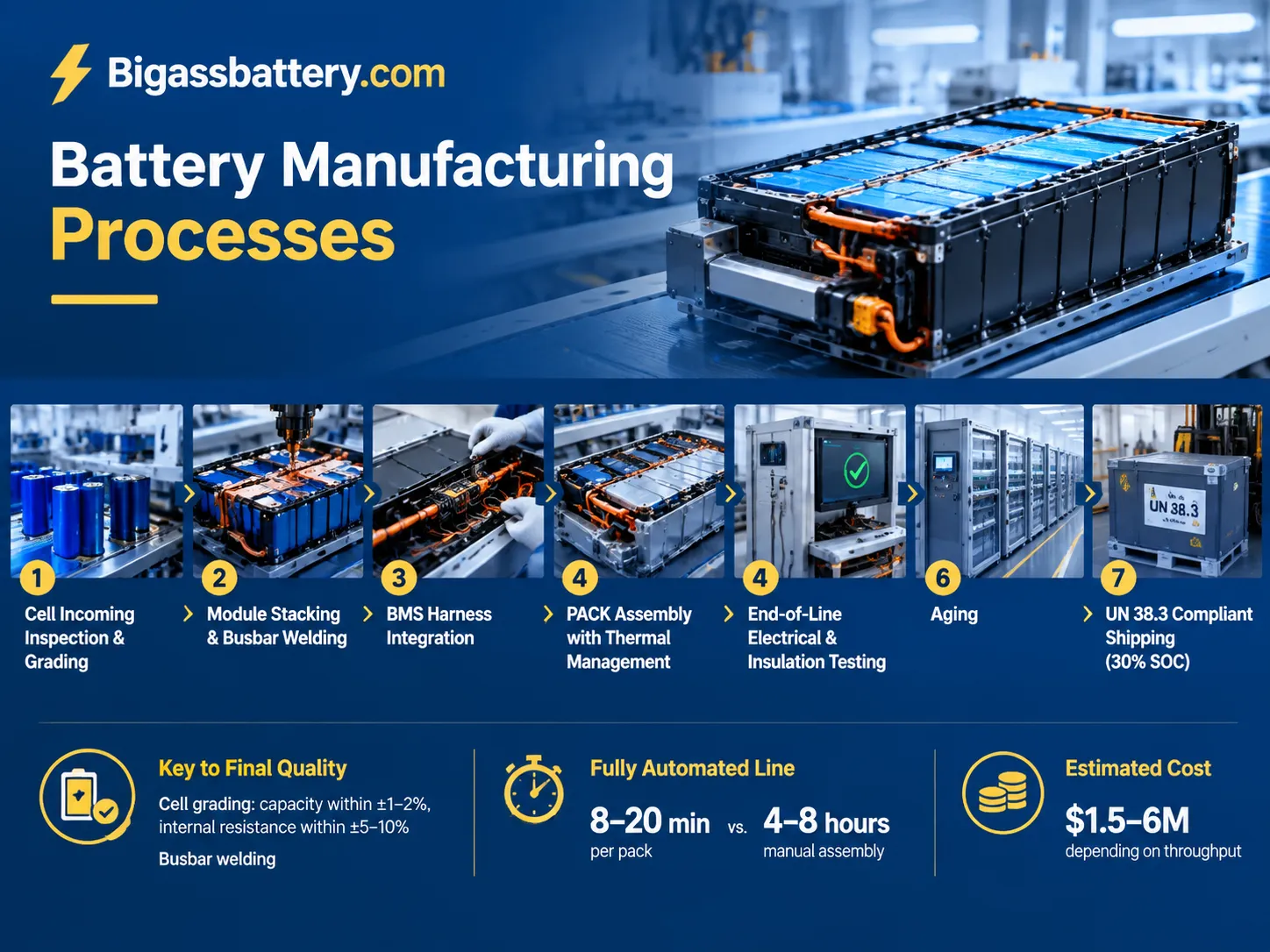
Battery manufacturing – battery manufacturing implies high production volumes and dangerous technologies, where automation does the trick, although material handling remains a challenge.
Low-voltage electrical elements – miniature circuit breakers (MCBs), relays, contactors and meters are small, firm, produced in **huge volumes and tested electrically for each item, which makes these elements potential candidates for automated manufacturing.
Pharmaceutical manufacturing – already highly automated procedures ensuring sterility.
Industries where dark factories will not be adopted totally are car manufacturing, furniture production, clothing production, custom-made machinery, and any products manufactured on demand in small quantities. In these industries, the goal is the increase of autonomy in specialized areas rather than total automation.
Humanoid robots are often considered to be missing pieces of the puzzle. While these machines will undoubtedly help execute tasks based on humans, BMW company’s practice provides a vivid evidence that currently existing robots can be operated efficiently in certain workplace conditions under the supervision of workers.
How Small and Mid-Sized Factories Can Move Toward Lights-Out Production
Most SMEs lack the budget and need for a FANUC type plant. Instead of trying to build a FANUC plant, manufacturers can look into creating high autonomy cells. This means manufacturing stations or production lines that are capable of carrying out operations for an entire shift without any operators’ involvement. Each cell is making its own profit, and all of them contribute towards achieving an autonomous factory.
- Stabilise the process first. It is always better to learn from Tesla’s mistakes regarding the introduction of automation into the unstable processes.
- Automate the bottleneck, not everything. Start with the process that causes the most production delays.
- Build in 100% inspection and automatic sorting. A cell can only work without supervision if it has the ability to identify defective production.
- Add material buffers. Equipment such as bowl feeders, magazines, stackers and output bins gives any fast machine the ability to function autonomously.
- Connect the data. All production line stations should be connected to either a manufacturing execution system (MES) or at least to a central dashboard.
- Trial one unattended shift. It is wise to run one well-established cell overnight before scaling it up.
Low-voltage electrical manufacturing is a good illustration of this path. A modern MCB automatic assembly line can assemble a breaker every 2–3.5 seconds with vision inspection at each station and quick changeover between 1P and 4P models, while an MCB automatic testing line can test and sort 1,800–2,400 units per hour with full data traceability. Lines like these, built by equipment makers such as Benlong Automation, are exactly the kind of high-autonomy cells that let a mid-sized breaker plant run longer with fewer people – without pretending to be a dark factory on day one.
If you are deciding which type of line fits your volume and product mix, our guide to choosing an automated production line explains fixed, programmable, flexible and integrated automation in plain terms, and our article on the efficiency benefits of industrial automation covers typical investment ranges and payback periods.
Conclusion: Dark Factories Are Real, but the Path Matters More Than the Label
FANUC’s facilities for robots’ manufacturing, Philips’ assembling lines, ASE’s factories for semiconductors as well as Xiaomi’s plants for making smartphones demonstrate that this idea of production when there is no need for factory workers to stay at the production site at all is actually possible. Siemens Amberg proves that a factory where people are present can have similar advantages and merits. Moreover, the story with Tesla serves as an example of how one company tried to pursue something that was impossible to reach at that moment.
For most production sites, the main lesson learned is that there is no point in trying to achieve so many things in the dark plant. What is necessary is to determine the production processes that can be done automatically, provide them with some safety devices and materials, and develop each process step by step.
References
- Wikipedia – Lights out (manufacturing) – overview of the concept with FANUC, Philips, Xiaomi and ASE examples.
- Siemens – Electronics Works Amberg – automation level, product variants, changeovers and quality data.
- ASE – Smart Manufacturing – lights-out factory count and smart-factory timeline.
- TechCrunch – Tesla pauses Model 3 production (2018) – coverage of Musk’s comments on over-automation.
- Figure AI – Figure 02 deployment at BMW Spartanburg – results of the 11-month humanoid robot deployment.
- TrendForce – Xiaomi smart factory opening – investment, floor area and annual capacity of the Changping plant.
Planning Your First High-Autonomy Line?
You don’t have to construct a high-tech factory to enjoy the great benefits. If you are involved in the production of MCBs, MCCBs, RCCBs, contactors, relays, or meters and want to operate longer with fewer people, all you need to do is to contact us by sending your product samples, production goals, and making an explanation of the technology you are using today. Our engineers will advise you on where to automate first, what kind of unattended operation is feasible for you, and when you can expect to get your investment back.