benlong
Top Custom Automation Companies in the USA for Scaling-Stage Startups (2026 Guide)
Consider an entrepreneur based in Ohio who started a hardware product one and a half years ago. That hardware works, the distributor has just increased the quantity of its order, and the investor report is due in a month. Six employees in the production unit check the hardware manually, first shift is overloaded, the second one makes more errors than the first one, and the entrepreneur does not have time to conduct the second round of investment due to working late in the evenings to reassemble the products that have been returned.
This is where custom automation answers the question of whether a company can survive at the stage of scaling production. A startup is large enough to stop using manual assembly but it cannot afford a production line worth a million dollars. At this stage, it is crucial to understand the number of companies specializing in automation in the U.S., why each of them is useful, how much the first automation should cost, and how the quotation should be evaluated.
This guide includes a list of well-known names in American automation industry such as manufacturers of robots, control systems, major integrators, and new companies making automation affordable for startups along with their addresses and phone numbers, as well as a proper comparison of companies introduced. The guide continues with practical questions that every company at the stage of scaling has to answer, such as when to start automation, the difference of semi-automation and full automation, whether to hire U.S. or international contractors, financing issues, or how to create the request for quotation.
Key takeaways
- Robot and control brands like FANUC, ABB, Yaskawa, and Rockwell typically approach small manufacturers through authorized integrators; large custom integrators like JR Automation, ATS, and CONVERGIX tend to do bigger projects with budgets accordingly.
Modular platforms (Vention) and robot-as-a-service providers (Formic) are making it easier to enter in the field of standard handling tasks.
Most scaling companies only need to automate one bottleneck or test step first, and then grow from there.
Compare landed costs, support, and company-specific experience rather than just price.
Custom Automation Companies in the USA at a Glance
The table below summarizes the nine providers discussed in this guide, grouping them according to their business model instead of ranking them. The rationale for selecting specific methods of operation for the startups is that picking the “best” is subjective and depends on many factors including the process that needs to be automated and the amount of money available. All types of providers described in the table show up in searches about the custom automation businesses in the USA.
| Company | Type | U.S. base | Best known for | Startup fit |
|---|---|---|---|---|
| Rockwell Automation | Control platform | Milwaukee, WI | Allen-Bradley PLCs, FactoryTalk software | Indirect, via integrators |
| FANUC America | Robot and CNC maker | Rochester Hills, MI | Industrial robots, CNC, ROBOSHOT molding | Via authorized integrators |
| ABB Robotics | Robot maker | Auburn Hills, MI | Industrial robots, cobots, RobotStudio | Via integrators; cobots for smaller cells |
| Yaskawa Motoman | Robot maker | Miamisburg, OH | Welding, handling and HC-series cobots | Via integrators; packaged cells |
| ATS Corporation | Custom integrator | Cambridge, ON (U.S. operations) | Life sciences, EV, consumer automation | Better for later stage |
| JR Automation | Custom integrator | Holland, MI | Large custom assembly and test systems | Better for later stage |
| CONVERGIX | Custom integrator | Auburn Hills, MI | Assembly, packaging, controls, vision | Mid to later stage |
| Vention | Modular platform | Montreal, QC (U.S. offices) | Online design, modular hardware | Strong for engineering-led startups |
| Formic | Robots as a service | Chicago, IL | Palletizing, packing, machine tending | Strong for cash-conscious teams |
Contact details below were taken from each company’s official website or industry association listing in September 2026. Offices and numbers change, so confirm on the official site before visiting.
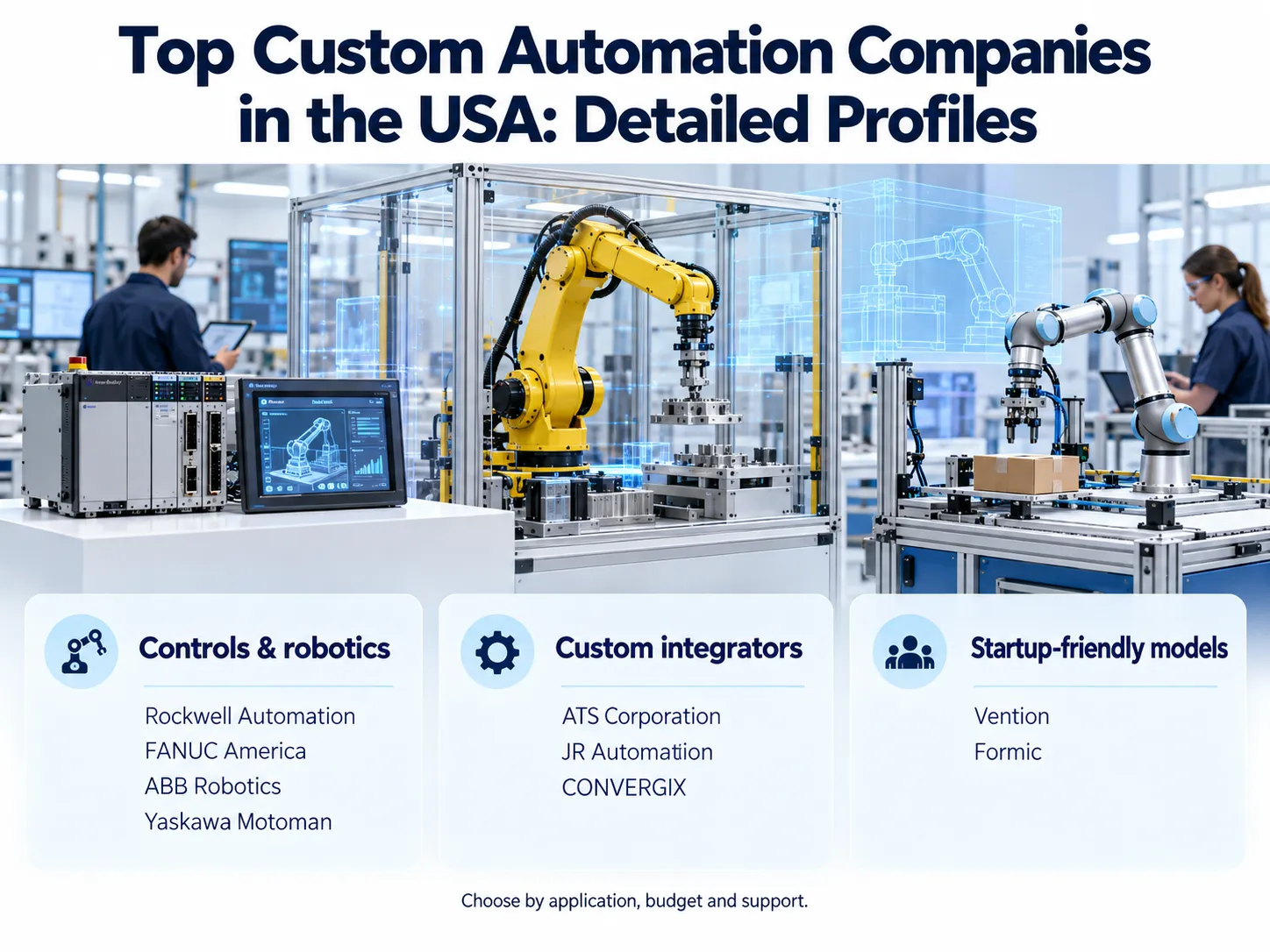
Top Custom Automation Companies in the USA: Detailed Profiles
Each profile lists headquarters, main phone and website, followed by what the company does, who it suits best, and what a scaling-stage buyer should keep in mind.
Automation platform and robot brands
These companies make the robots, controllers and software that most custom machines are built on. They sell large accounts directly, but smaller manufacturers usually buy their technology through authorized system integrators.
1. Rockwell Automation — the control platform behind many U.S. factories
- Headquarters: 1201 S. Second Street, Milwaukee, WI 53204
- Phone: 414-382-2000 (main switchboard)
- Website: rockwellautomation.com
What they provide: Established in the year 1903, Rockwell Automation is regarded as one of the largest industrial automation corporations based in the United States of America. The company makes significant use of Allen-Bradley programmable logic controllers (PLCs) and drives, FactoryTalk software, and provides LifecycleIQ services to many companies around the U.S. The company has also set its sights on industrial AI and digital transformation as part of its future strategy.
Who should choose this: Businesses looking to set their manufacturing units on an existing control system familiar to maintenance personnel are best suited to use Rockwell products.
Things to note: Rockwell provides a platform and not a custom machine. A small startup must work with an experienced integrator to use the services of Rockwell. Although Allen-Bradley products can be costlier than other brands, they provide easy access to local technical support.
2. FANUC America — one of the most widely installed robot brands
- Headquarters: 3900 W Hamlin Rd, Rochester Hills, MI 48309
- Phone: (888) 326-8287
- Website: fanucamerica.com
What is their function: FANUC America provides industrial and collaborative robots, computer numerical control machinery, and various types of automated machinery among their products. According to FANUC, over one million robots are being used globally and 25 service centers are set up in America.
Who to use: This Company is perfect for applications where reliability of robots and abundant technicians is of utmost importance.
What to know: Customizable products are usually designed by FANUC accredited system builders and selecting the right builder is extremely important for your project. FANUC Academy training programs will help your staff in learning to operate those machines.
3. ABB Robotics — broad robot and cobot portfolio
- Headquarters: 1250 Brown Road, Auburn Hills, MI 48326
- Phone: (248) 391-9000
- Website: abb.com/robotics
What they do: ABB has a portfolio of 6-axis industrial robots for manufacturing, welding, cutting and assembling tasks, as well as collaborative robots, autonomous mobile robots and RobotStudio simulation and programming software. RobotStudio makes it possible for an engineer to develop and test a cell even before its physical components arrive.
Best for: Electronics and small-parts assembly, and units that appreciate offline simulation and collaborative robots for small-volume operations.
Things to consider: In October 2025 ABB revealed it reached an agreement with sell its robotics division to SoftBank Group, which is expected to finalize in mid-to-late 2026. Make sure to check for the current ownership and support conditions when you ask for quotes.
4. Yaskawa Motoman — welding and handling specialist
- Headquarters: 100 Automation Way, Miamisburg, OH 45342
- Phone: 937-847-6200 (customer support: 937-847-3200)
- Website: motoman.com
What they do: Yaskawa’s U.S. robotics sector offers industrial robots for welding, handling and assembly purposes, collaborative robots from the HC Series, ArcWorld pre-engineered welding cells, bin-picking and palletizing programs, and MotoSim programming services.
Best for: Companies working on metal fabrication and welding as well as those who prefer pre-engineered cells over bespoke machines.
Things to keep in mind: With pre-engineered cells, lead times are reduced. However, they’re not as versatile as fully customized systems.
Large custom automation integrators
These firms design and build complete, product-specific assembly and test systems. They are the classic answer to “custom automation,” and their project scale reflects it.
5. ATS Corporation — global automation group with deep life-sciences expertise
- Headquarters: 730 Fountain Street North, Building #2, Cambridge, ON N3H 4R7, Canada (U.S. operations across several states)
- Phone: (519) 653-6500; North America service: (734) 522-1900
- Website: atsautomation.com
What the company does: ATS is an automated solutions company (listed on TSX and NYSE) providing solutions for various sectors such as life sciences, food and beverage, transportation, consumer products and energy. The company builds custom automated assembly and testing systems, delivers products to meet customer needs, and provides after-sales services.
Suitable for: The company is best known for work with regulated industries like medical devices and pharmaceuticals, as well as energy so-called energy programs that require systems of large volume and validation.
Considerations: ATS has its headquarters in Canada, but has major operations in the United States. It specializes in large-scale, complicated projects, and is probably not the best option for a project involving only a single station.
6. JR Automation — Hitachi-owned custom systems builder
- Headquarters: 13365 Tyler St, Holland, MI 49424
- Phone: (833) 800-7630
- Website: jrautomation.com
What they do: JR Automation, a member of Hitachi Group, designs and builds custom automated assembly, test, and material handling systems for the leading manufacturers and distributors. In 2025 it announced a new global headquarters in Zeeland, Michigan.
Best for: Companies that have access to good funding and are just starting their high-volume projects with a need to partner with a single source for complex multi-station systems.
Things to watch for: Engineering experience is evident, although project sizes and operations are formulated for experienced manufacturers rather than someone who has never done automation before
7. CONVERGIX Automation Solutions — multi-industry integrator with a wide U.S. footprint
- Headquarters: 900 N. Squirrel Road, Suite 300, Auburn Hills, MI 48326
- Phone: (248) 588-2738
- Website: convergixautomation.com
What they do: CONVERGIX offers automation for assembly, handling of materials, joining, removal of materials, and packaging including palletizing equipment, as well as control systems and integration of robots, computer vision, and AGV/AMR technology. Their website lists 17 offices in three continents, including some offices in the U.S. located in Michigan, Texas, Arkansas, Kentucky, and Pennsylvania.
Best for: Growing businesses in search of a single partner for machinery design, control system, and any engineering facility data that might be needed.
Things to remember: As it is the case with any major integrator, expect an orderly engineering approach and corresponding expenses. Make sure to define the office that will be managing your project and provide after-sales support.
Startup-friendly automation models
Two newer business models aim directly at companies that cannot justify a traditional custom project.
8. Vention — design-it-yourself modular automation
- Headquarters: 4767 Dagenais, Suite 104, Montreal, QC H4C 1L8, Canada (U.S. offices including Boston)
- Phone: (800) 940-3617
- Website: vention.com
What they do: Vention is a company that provides modular hardware consisting of parts such as extrusions, linear actuators, conveyors, and robotic arms, integrated with a controller and a web design application. The company allows customers to use its products in two ways: by supplying their own design or by contracting the company’s service. Vention claims that its customers make recouping investments in an average of 1.3 years and that over 28,000 of its devices are now in operation across the globe.
Best for: Startups that are designing their products and need assistance in making fixtures, test setups, and basic robotic systems.
Things to think about: Modular solutions are effective for many tasks, but for complex processes, custom designs will still be required.
9. Formic — robots as a service with no upfront capital
- Headquarters: Chicago, IL
- Phone: (855) 394-5464
- Website: formic.co
What they offer: The company Formic specializes in robotic technologies that provide palletization solutions for handling pallets, wrapping of pallets, packaging of cases, operation of robots called ‘mobile robots’. They provide the service for a fixed monthly price without upfront costs of the robots. They take care of the software updates, technical maintenance and installation, claiming 99.3% uptime during the last 12 months.
Best for: Manufacturers with small budgets who want to automate their working processes, namely end-of-line processes or robot tending processes in the sectors of consumer goods, food production, and metal fabrication.
Things to consider: The model is meant for standard applications where custom assembly and testing aren’t provided. Therefore, the long-term costs of the service should be compared with the full price of buying the systems.
Head-to-Head Comparisons
FANUC vs ABB vs Yaskawa: which robot brand?
| Factor | FANUC America | ABB Robotics | Yaskawa Motoman |
|---|---|---|---|
| Core strength | Reliability and 1M+ robots installed worldwide | Broad portfolio and RobotStudio simulation | Welding and handling, pre-engineered cells |
| Cobots | CRX collaborative series | Collaborative portfolio for small cells | HC-series with extended warranty |
| Training | FANUC Academy | ABB training programs | Yaskawa Academy |
| U.S. base | Michigan | Michigan | Ohio |
| Watch for | Integrator quality varies | Ownership change to SoftBank | Less focus on non-robot assembly |
For a scaling startup, the integrator matters more than the robot logo. All three brands are proven; choose the integrator with experience in your product type, then use the brand they support best and that your local technicians can maintain.
JR Automation vs ATS vs CONVERGIX: which large integrator?
| Factor | JR Automation | ATS Corporation | CONVERGIX |
|---|---|---|---|
| Ownership | Hitachi group | Public (TSX, NYSE) | Privately held |
| Stand-out markets | Large manufacturing and distribution programs | Life sciences, EV, energy, food | Life sciences, industrial, consumer |
| Footprint | Michigan HQ, global sites | Canada HQ, U.S. and global sites | 17 locations, strong U.S. regional presence |
| Typical project | Large multi-station systems | Validated high-volume systems | Assembly, packaging, controls and data |
Vention vs Formic vs a traditional integrator
| Factor | Vention | Formic | Traditional integrator |
|---|---|---|---|
| Payment | Buy hardware; optional services | Fixed monthly fee, no capex | Project price with milestones |
| Who designs | You, or Vention’s team | Formic | Integrator |
| Best tasks | Fixtures, gantries, simple cells | Palletizing, packing, tending | Product-specific assembly and test |
| Flexibility | High; reconfigurable | Standard applications | Highest for unique processes |
How to Evaluate a Custom Automation Partner
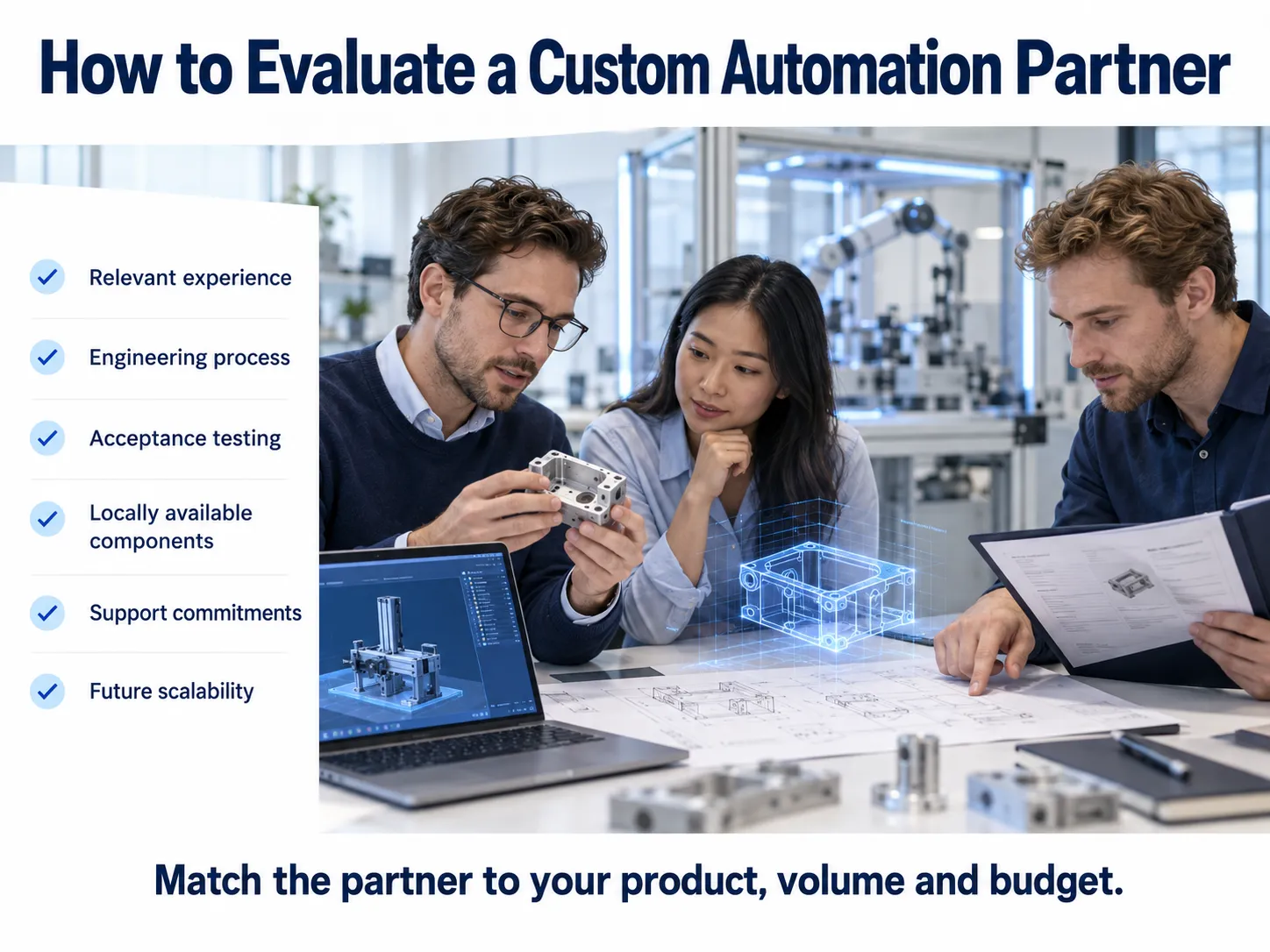
Brand recognition is a starting point, not a decision. Score every shortlisted supplier on the same six criteria:
| Criterion | What good looks like | Question to ask |
|---|---|---|
| Relevant experience | Several systems built for similar products or processes | Can you show a video of a comparable machine running? |
| Engineering process | Written specification, 3D design review, cycle-time simulation | What do we approve before you start building? |
| Acceptance testing | Factory acceptance test with your parts, measured against agreed cycle time and yield | What happens if the machine misses the target? |
| Components | Brand-name PLCs, pneumatics and sensors available locally | Which PLC and HMI brands do you use as standard? |
| Support | Named contact, response time commitment, spare-parts list | Who answers the phone at 2 a.m. when the line stops? |
| Scalability | First station designed to join a later line | How would this station integrate with future automation? |
Visit at least one installed system if possible, and speak with a customer of a similar size. A supplier that is excellent for an automotive OEM may not give a 30-person startup the attention it needs — and a small integrator may not have the depth for a validated medical line.
Why Scaling Startups Outgrow Manual Assembly
Before choosing a supplier, know the problem you want them to help you with. Almost all growing hardware companies face similar pain points.
- Capacity: Manual assembly of a small electromechanical component typically takes 15-20 seconds per assembly and can only be increased by adding personnel or work shifts.
- Yield: Trainees make mistakes that should not be made by experienced entrepreneurs, which leads to a constant 1-3% defect rate.
- Labor cost: BLS data on FRED website states that production and non-supervisory production worker hourly wage in August of 2020 was $30.37 without taking into consideration the benefits. The cost of four assembly workers in one shift is $243,000 per year.
- Recruiting staff: Every time someone leaves the team, they take long-term product knowledge with them. New hires need several weeks to get fully onboard.
- Traceability: Large clients and certification agencies want to have tests done on every product. Our explainer on what MES is in manufacturing shows how that data is captured.
- Time spent by the founder: The person best qualified to troubleshoot is usually one of the founders and should be focused on selling or fundraising.
When Should a Scaling Startup Invest in Custom Automation?
Volume threshold
| Daily volume (one product family) | Typical approach |
|---|---|
| Under 500 units | Better fixtures, error-proofing, one test bench |
| 500–2,000 units | Semi-automatic machine at the bottleneck step |
| 2,000–10,000 units | Several semi-automatic stations; automated testing |
| Over 10,000 units | Integrated assembly and test line with MES |
Design freeze
Custom tooling, feeders and vision programs are built around exact part geometry. If dimensions or components are likely to change in the next 6–12 months, automate testing first and assembly later. If you are still iterating, a prototyping partner is the better investment for now — see our guide to rapid prototyping companies in Georgia.
Payback on paper
- Annual labor saved = operators removed × hours per year × loaded hourly cost.
- Annual quality saved = units per year × defect reduction × cost per defect.
- Payback in months = total installed cost ÷ (labor saved + quality saved) × 12.
| Illustrative example | Value |
|---|---|
| Operators removed (one shift) | 2 |
| Labor saved (2 × 2,000 h × $30.37) | ≈ $121,500 per year |
| Quality saved (400,000 units × 1.2% × $4) | ≈ $19,200 per year |
| Total installed cost | $150,000 |
| Payback | ≈ 13 months |
This is where custom automation cost for startups should be judged: on total installed cost — equipment, change parts, freight, duties, installation, training, spares and your own engineering time — against savings, not on the quoted machine price alone.
Semi-Automatic vs Fully Automatic: Start With One Station
In many companies scaling up production, the first equipment that should be purchased is a semi-automatic device or testing bench that works best on the most serious bottleneck. In cases of small batches, it is good to have the operator doing loading while the machine works on the process affecting quality. A smart step would be to begin from testing and calibration, as the parameters of tests can be modified even if design is changed, while the hardware cannot.
- Automate the crucial testing or calibration step of the process.
- Automate the assembly step that has the longest time cycle or the most chances of failure.
- Add stations to make the process mostly about loading and transferring.
- Use conveyors, vision, and MES to connect the stations and automate the process once the design is stable and production volume has reached a certain level.
Check with each of your suppliers if your first station has an option of somehow transitioning to the full line without having to get replaced. For more detail, see our comparison of fully automated vs semi-automated production.
U.S. Integrator or Overseas Equipment Maker?
Beyond the brands above, many scaling companies also get quotes from product-specific equipment makers in Asia and Europe. A local automation integrator in the USA and an overseas specialist such as a China automation equipment supplier can both be the right answer.
| Factor | U.S. integrator | Overseas equipment maker |
|---|---|---|
| Price | Higher U.S. engineering and build cost | Often lower for similar scope, before duties |
| Duties | None | Section 301 and other tariffs may apply |
| Process development | Easy on-site iteration | Best when the process is already proven |
| Product know-how | Often generalist | May have built many lines for the same product |
| Commissioning | Local | Factory acceptance test abroad, then on-site or remote |
| Service | Same time zone | Remote diagnostics and shipped spares |
| Electrical standards | U.S. codes by default | Must be specified, e.g. NFPA 79 and UL 508A |
Industrial machinery from China is generally subject to Section 301 duties, commonly 25% for many machinery lines, and other tariffs may stack on top; USTR explains the limited exclusions on its machinery exclusions page. Confirm the current rate for your HTS code with a licensed customs broker, and compare landed cost rather than quoted price. Many companies combine both: a specialist builder for the product-specific stations — for example, electrical products makers often source breaker test benches from specialist suppliers — and a local integrator for packaging, palletizing and plant integration.
How to Finance and Find the Right Partner
Financing options
- Taxation: for applicable years of tax starting from 2026, Section 179 expensing limit is equal to $2,560,000, while 100% depreciation could be claimed in the case of eligible assets purchased and put into service after January 19, 2025, according to the Section 179 guide. Verify it with your tax consultant.
- Financing or leasing of the equipment so that savings suffice.
Robots as a service for usual tasks.
Milestone payments associated with approved designs, acceptance tests, and commissioning.
Where to find local integrators
The A3 system integrator directory lists member integrators by service and location, including certified robot and vision integrators. The NIST Manufacturing Extension Partnership has centers in all 50 states and Puerto Rico that give small and medium manufacturers independent advice on automation projects. Robot makers such as FANUC, ABB and Yaskawa can also refer you to authorized integrators near you.
RFQ Checklist for Scaling Startups
Whether you are comparing custom automation USA providers or overseas builders, a complete request produces faster, more comparable quotes.
- Final 3D models and prints along with tolerances.
20-50 production-grade sample sets and known faulty items for testing.
Output per each shift at present and after 2 years and total number of product variants.
Current assembly process sequence as a nice-to-have with a short video.
Necessary tests, provisions and passing/non-passing limits.
Plant utilities, floor area and electrical or safety requirements.
Data requirements: barcodes, records of each item, the connection to MES or ERP system.Then ask each supplier the same series of questions: How many systems have similar designs you created? May we visit it? What cycle time and yield you guarantee at acceptance? Which major components are applied in the device, are they locally available? What takes place if the device fails final acceptance test?
Choosing Your First Automation Partner
A single automation company cannot be called the best in the US. Companies like Rockwell, FANUC, ABB and Yaskawa manufacture the components on which most systems are based; companies like JR Automation, ATS and CONVERGIX create complex systems. The correct partner is the one who matches your current product, volume and budget. It is better to begin with one station, prove the efficiency of your solution and expand from there.