benlong

How to Select Industrial Automation Sensors for Manufacturing
All auto machines depend on the information they operate. A servo press works with an imperfect component, a robot works only with visible objects, and a calibration bench measures the temperature of its environment. Choosing industrial automation sensors is therefore not a line item to fill at the end of a project; it decides whether the machine catches defects or ships them. This guideline is addressed especially to the people responsible for developing the list of sensors for the project, and the person who has to buy them, compare supplier offers, and have a few additional sensors available.
This guide is based on our experience in selecting sensor types for automatic assembly lines and testing benches for circuit breakers other low voltage apparatus. In our practice we selected among the six types of sensor groups: pressure sensors, temperature sensors, photoelectric sensors, vision sensors, proximity sensors, and linear displacement sensors produced by major companies such as Omron, Keyence, Honeywell, Panasonic and SIMBATOUCH.
To select sensors for manufacturing, start from the job, not the catalogue: define what must be detected or measured, the target material and distance, the accuracy and response time the process needs, and the environment the sensor will live in. Then match the output signal to your PLC (PNP or NPN, 4–20 mA, or IO-Link), confirm the IP rating and mounting, and standardise on a small number of brands and part numbers. Most sensor failures on the shop floor come from a wrong specification or a poor installation, not from a faulty sensor.
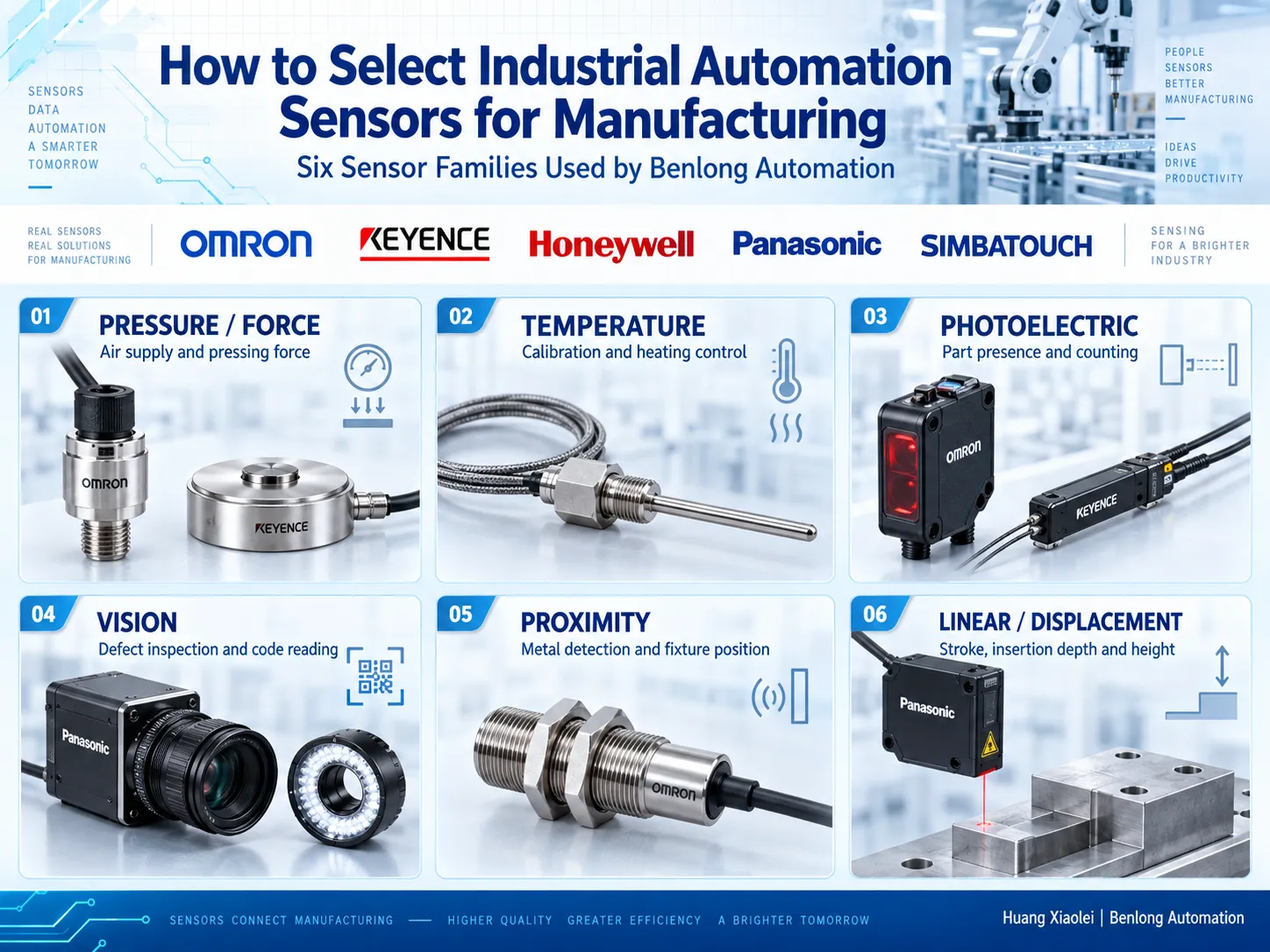
The Six Sensor Families Behind Most Assembly and Test Machines
There are dozens of types of sensors used in industrial automation, but an ordinary conveyor system or testing bench only uses six families of sensors. The table below shows the roles of each sensor in a real machine and also its important specification for writing in the BOM.
| Sensor family | What it does on the machine | Key specification to define | Typical output |
|---|---|---|---|
| Pressure / force | Monitors air supply, press force, clamping force; load cells in servo presses | Range, accuracy (% FS), overload capacity | 4–20 mA, 0–10 V, switch output |
| Temperature | Ambient compensation on calibration benches; welding and heating control | Sensor type (RTD, thermocouple), range, accuracy | RTD/TC input, 4–20 mA |
| Photoelectric | Part presence, counting, position; safety light curtains | Sensing mode, distance, spot size, response time | PNP/NPN, IO-Link |
| Vision | Missing, inverted or mis-seated parts; reading codes and marks | Field of view, resolution, inspection time, lighting | Ethernet, digital I/O |
| Proximity | Cylinder end positions, metal part detection, fixture confirmation | Sensing distance, shielded or unshielded, housing size | PNP/NPN, IO-Link |
| Linear / displacement | Insertion depth, stroke position, height and flatness | Measuring range, resolution, linearity | 4–20 mA, 0–10 V, RS-485, IO-Link |
Pressure and force sensors
The pressure sensing in the assembly of electrical components has two different applications. The first one is pneumatic: the majority of machines work on an air supply of 0.6MPa; a pressure switch or transmitter stops the machine before the low-pressure clamp allows any part to move. The second is related to the measuring of force when pressing, riveting, and inserting. On Benlong’s MCB magnetic iron core automatic assembly machine, a servo press inserts bobbins and pins at a programmable 10–200 N with force accuracy of ±5% and depth accuracy of ±0.05 mm, and a force-displacement curve rejects any part that deviates from the taught profile. Load cells and miniature force sensors from SIMBATOUCH and Honeywell are typical choices for this role.
Temperature sensors
Temperature matters most where physics depends on temperature. A bimetallic circuit breaker operates gear based on heat therefore, a calibration bench that overlooks the surrounding ambient temperature will cause wrong measurements from morning to afternoon shifts. Benlong’s MCCB long time thermal calibration bench records ambient temperature with every test and can adjust acceptance windows automatically, with an optional chamber holding 25 °C ±3 °C. For such measurement it is better to use an RTD (e.g. Pt100) instead of a thermocouple since it is more accurate and stable in the room temperature. The thermocouples are more effective in measurements that involve high temperature at such points like welding and heat staking.
Photoelectric sensors
Photoelectric sensors are the backbone of part detection. They can work in three modes of operation: through-beam, retro-reflective and diffuse-reflective; moreover, even in tight spaces, fibre-optic sensors can be used instead of standard sensors. On the MCB arc-chute semi-automatic assembly machine, optical sensors verify plate count and the height of stacks before the pressing operation and safety light curtains to protect the personnel in the loading area. The three leading manufacturers of optical sensors are Omron, Keyence and Panasonic.
Vision sensors
Where a photoelectric sensor answers yes or no, a vision sensor answers what, where and whether it is correct. On Benlong’s MCB automatic assembly line, which runs in 2–3.5 seconds cycle time, cameras at specified points check for missing blockages, misplaced parts, and poor fitting. One single specification is sufficient for camera capabilities i.e., image resolution but the overall assessment: field of image capture, maximum defect size, illumination, as well as total vision inspection duration must all meet operational cycle requirements. Keyence and Omron both produce vision sensors and complete machine vision systems.
Proximity sensors
Inductive proximity sensors are used to detect metal without any contact. They are the most chosen in terms of receiving cylinder end positions, index rotary tables, or check the presence of metal parts in fixtures. Capacitive ones find non-metal objects like plastic housings, but they are more affected by dirt and humidity. It also provides the sensing range with a tolerance: the specified range is applicable on a target made of steel and other metals like brass, copper, and aluminum significantly lower the sensors’ reach, which is especially important in detecting contacts and copper terminals.
Linear and displacement sensors
Linear sensors have the ability to measure position rather than merely detecting its presence. Examples of such sensors include the magnetostrictive position transducer, the potentiometric position transducer, the LVDT and the laser displacement sensor. In assembly machines they are used to measure the depth of insertion, press stroke, part height and flatness. When used with a force sensor, the linear sensor generates the so-called force-displacement characteristic which makes servo press an effective tool.
How to Select Industrial Automation Sensors: A Seven-Step Process
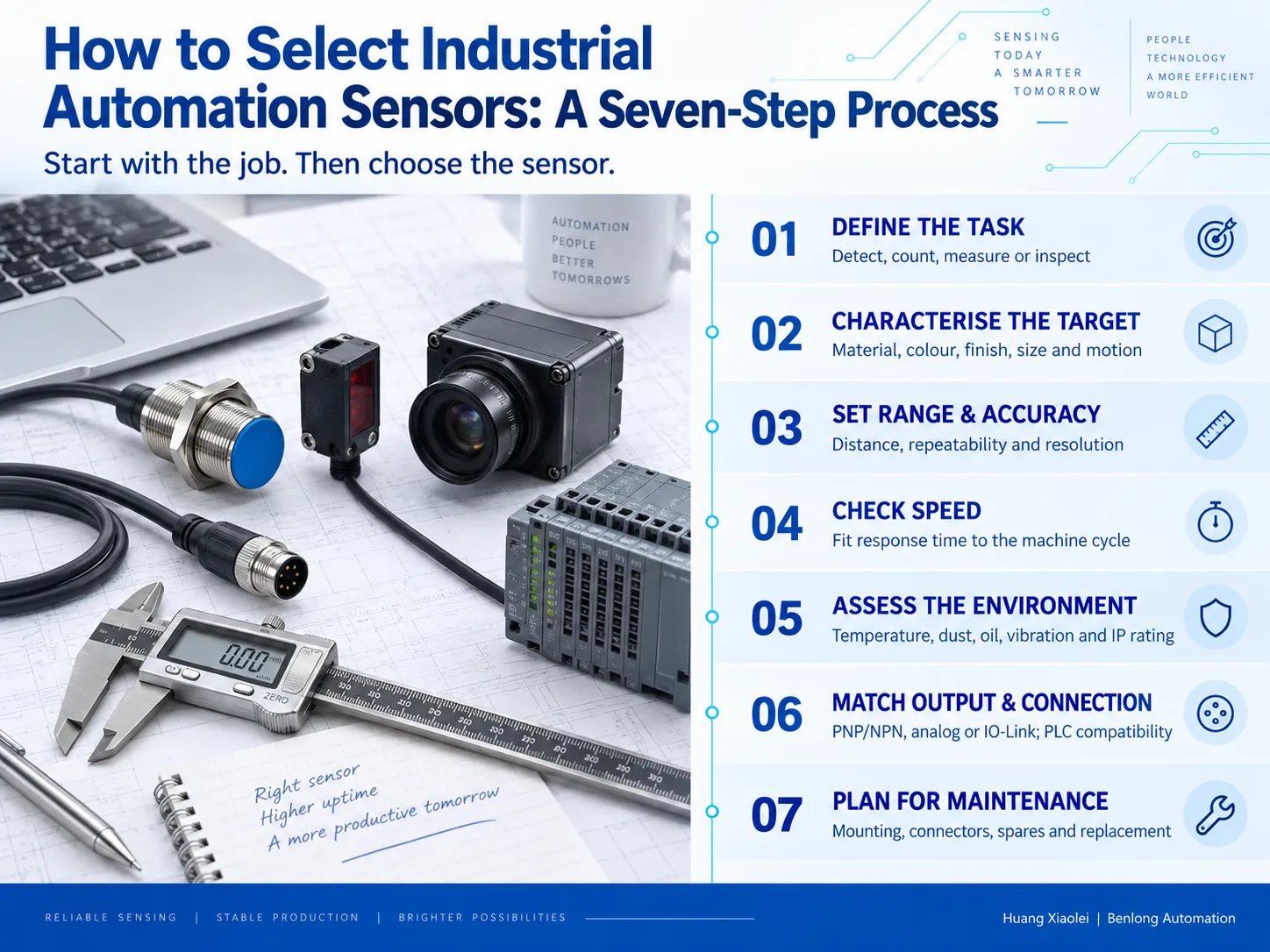
A solid methodology allows engineers to choose an industrial sensor more rapidly and buyers to verify its attributes more easily. These seven steps are universal:
①.Decide what to accomplish. Draft a one-sentence statement describing the aim of detection, counting, measurement or inspection in space and time. If you have trouble putting the idea into words, the requirements for the sensor are still not formalized.
②.Identify the target. This entails establishing what its material, colour, surface finish, dimensions and mobility are. As a rule, shiny, transparent and black targets are known to confuse optical sensors.
③.Calculate the distance. Define the working range of the sensor, and the required repeatability of measurements. Also, think of the smallest change that should be detected.
④.Focus on time. Make sure that the sensor’s response time matches the working time of the equipment; at 2 seconds of the working cycle, a slow sensor will cause a slowdown.
⑤.Evaluate environmental conditions. Be aware of factors like temperature, oil mist, coolant, metal dust and vibrations including electricity noise. Pick a suitable IP class and housing material based on the IP rating.
⑥.Determine your output and connection type. PNP or NPN should suit the input and analog type is characterized by the range (4-20mA or 0-10V).
⑦.Prepare for the maintenance. This consists of determining the type of connectors, cable lengths, availability of spare parts and whether the replacement can be made without re-teaching.
Output signals: the detail that causes most commissioning delays
Discrete sensors use either PNP or NPN technology, and it’s critical that the appropriate sensor be selected to match the PLC input module. A sensor with an incorrect polarity simply won’t work, which is one of the most common reasons for delays when imported equipment reaches its final destination. Meanwhile, analog sensors work by transmitting continuous measurements, with the 4-20 mA receiving preference over the voltage signals on long cable runs, because of their effectiveness against electrical noise and ease of detecting wire disruption. IO-Link, standardised as IEC 61131-9, keeps the familiar three-wire connection but adds two-way communication, so the PLC can read sensor diagnostics and download settings to a replacement unit automatically.
Sensor Specification Checklist for Engineers and Buyers
Most sourcing problems start with an incomplete line on the sensor list. Before a list of automation sensors goes to purchasing, each line should answer the following:
| Field | What to write | Why it matters |
|---|---|---|
| Function and location | Station number and task, e.g. “ST05 arc plate count” | Links the part to the machine drawing and spares list |
| Sensor type and mode | e.g. diffuse photoelectric, M12 inductive shielded | Prevents substitutes that fit but do not work |
| Range and accuracy | Sensing distance or measuring range, repeatability | Defines the performance the supplier must meet |
| Response time | Maximum value in ms | Must fit inside the machine cycle |
| Output | PNP/NPN, NO/NC, 4–20 mA, IO-Link | Must match the PLC input card |
| Supply voltage | Usually 12–24 V DC | Avoids damaged sensors at start-up |
| Connection | M8/M12 connector or cable, cable length | Affects maintenance time and spare stock |
| Environment and IP rating | e.g. IP67, oil-resistant cable | Determines service life |
| Brand and part number | Approved brand plus exact model | Lets purchasing compare like with like |
| Approved alternative | Second brand and model | Protects the project against lead-time problems |
Customers need to consider two commercial checks: verify whether the quoted component is genuine stock from an authorized distributor, and find out the lead time per sensor and not just an overall timeframe. For example, one back-ordered vision sensor can stall the entire production line being tested at the factory.
Sensor Brands Used in Benlong Automation Projects
Benlong standardises on a short list of brands so that customers receive machines with parts they can source locally and engineers can support. The comparison below reflects how each brand is typically used on assembly and test equipment.
| Brand | Origin | Strongest sensor lines | Typical role on Benlong machines |
|---|---|---|---|
| Omron | Japan | Photoelectric, fibre, proximity, vision, displacement, pressure | General detection; matches the Omron PLCs used on many lines |
| Keyence | Japan | Fibre, laser displacement, vision and measurement systems | High-precision measurement and vision inspection |
| Honeywell | United States | Pressure, force, temperature, position and switches | Pressure and force monitoring, temperature measurement |
| Panasonic | Japan | Fibre, compact photoelectric, area sensors, light curtains, pressure | Compact detection in tight fixtures, operator safety |
| SIMBATOUCH | China (Guangzhou) | Load cells, miniature force sensors, torque and multi-axis force sensors | Press, riveting and insertion force measurement |
When a customer specifies a different brand, for example to match an existing plant standard, the sensor list can be adapted during the design stage. Doing this before the machine is built costs little; changing sensors after factory acceptance means rewiring, reprogramming and retesting. Buyers in markets such as India who weigh local against offshore machine builders can find more on that decision in our guide to automatic assembly machine manufacturers in India.
From Sensor Signal to Quality Decision
The sensor’s output is only relevant when it has an impact on the actions of the machine. Every important sensor in a properly designed line influences actions taken by the machine: stop, reject, retry, adjust or log. This is the key distinction between automation that merely moves objects and automation performing quality control, a distinction explored further in our article on what automation is. When reviewing a machine proposal, ask for each sensor what happens when its signal is wrong. If there is no answer, the sensor is decoration.
- Reject on fault: force-displacement, vision and counting systems should prevent defective parts from passing through the line.
Record the value: keeping records of force peaks, temperatures and inspection results allows one to use data for audits and claims.
Supervise the sensor: IO-Link diagnostic system, signal strength data from photoelectric sensors and channel calibration allow detecting sensor’s malfunction before problems arise. 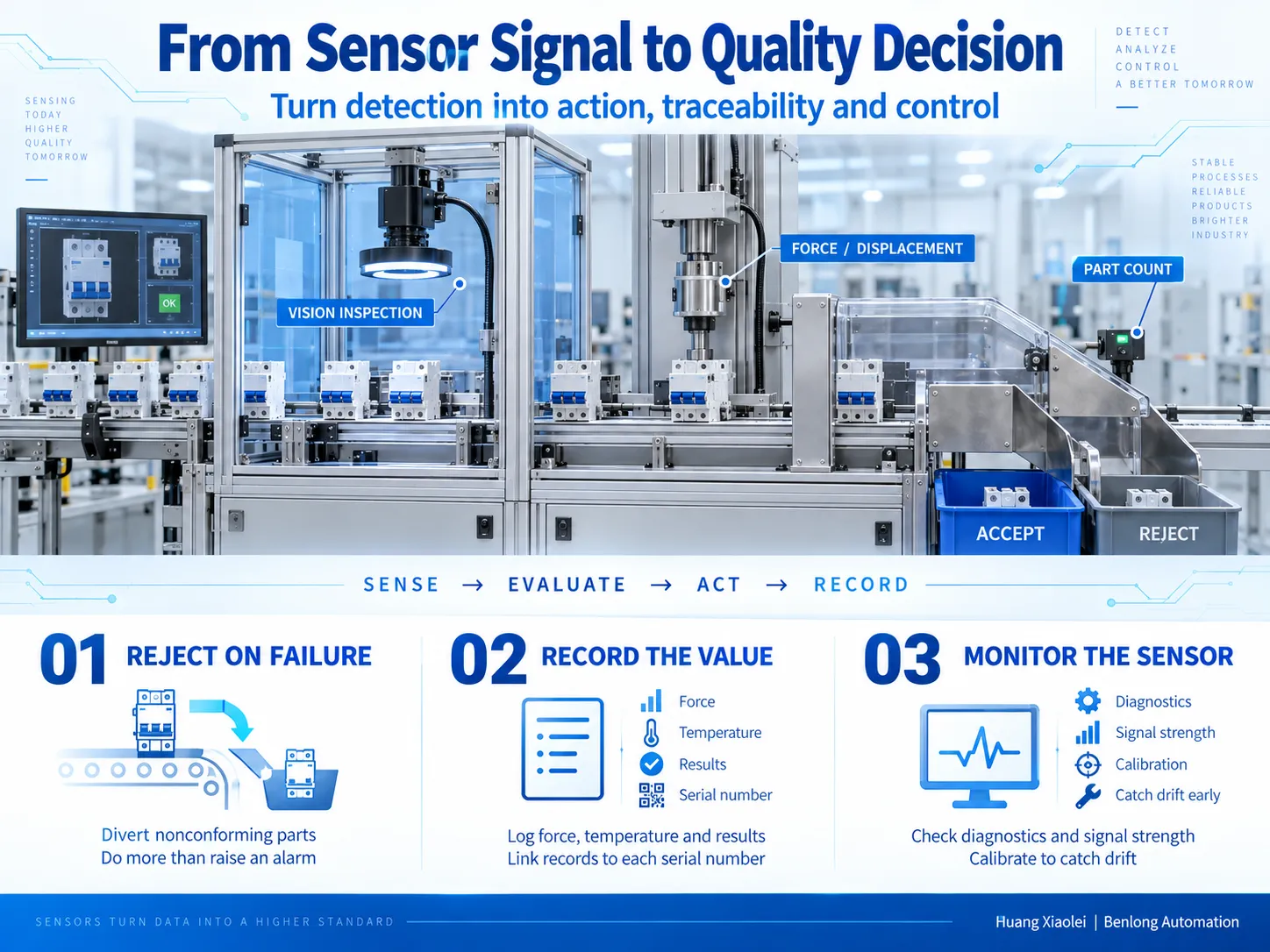
Frequently Asked Questions
What are the different types of sensors used in industrial automation?
The most common industrial sensors are proximity sensors (inductive and capacitive), photoelectric and fibre-optic sensors, vision sensors, pressure and force sensors, temperature sensors, linear and displacement sensors, ultrasonic sensors, encoders, level and flow sensors, and safety devices such as light curtains and laser scanners.
What are the four main types of sensors?
Though there exists no official list of types of sensors, they are classified into four broad categories in practice, which are temperature, pressure, position or proximity, and optical sensors. Collectively, these sensor types account for most of the required measurements and detections during manufacturing processes.
How to choose a sensor?
First, specify precisely what is required to be detected or measured, followed by identifying details of target material and distance, ensuring the desired level of accuracy and reaction time, defining the working condition and IP rating, and finally tuning the type of output signal to the controller. Lastly, it is important to select a manufacturer that can supply support to the project also by providing a suggestion for alternatives.
What types of sensors are commonly used in industrial robots?
Joint position is mainly monitored by means of encoders while vision systems are used for identification of parts. Assembly and polishing tasks are carried out with the help of force/torque sensors. Proximity and photoelectric sensors are used on grippers and end effectors. Safety can be ensured by the use of safety laser scanners or light curtains.
References
- OMRON Industrial Automation — Sensors product category
- KEYENCE — Sensor Basics: detection principles and sensor types
- Panasonic Industry — Sensors
- Honeywell — Sensing Solutions
- SIMBATOUCH (Guangzhou Sbatuo Electronic Technology) — force and pressure sensors
- IO-Link Community — IO-Link technology (IEC 61131-9)
Conclusion
Selecting sensors for a manufacturing project is a specification exercise before it is a purchasing one. Define the task, the target, the accuracy, the speed and the environment; match the output to the controller; and standardise on brands you can support. Benlong Automation applies exactly this approach to the pressure, temperature, photoelectric, vision, proximity and linear sensors on its assembly lines and test benches, so that every signal on the machine leads to a decision about quality.
Huang Xiaolei | Benlong Automation