benlong

What Is MES in Manufacturing?
Your Enterprise Resource Planning (ERP) system tells you about the work scheduled for next week. The machines tell you how fast they are currently running. However, who is conversing between the two and who truly knows what is going on in the factory at this moment, whether there are the right materials at the right places, if the quality is good, and where bottlenecks most likely are? This is where a Manufacturing Execution System (MES) comes in handy. With the Manufacturing Execution System, you can connect business management and the machine floor, converting production plans into reality and vice versa. Use our guide for more information on what MES stands for, what is does, how it is different from ERP or SCADA, when you need MES, what is its price, and what benefits one can get from its use.
MES refers to the Manufacturing Execution System, which is the software application used for managing and monitoring production processes on the floor in real time. It can be classified as being at the Level 3 of the ISA-95 standard, which is located between ERP, which is at Level 4, and SCADA, which is at Level 2. This means that MES participates in the execution of work orders, management of materials and labor, quality assurance, monitoring of machines, measuring of Overall Equipment Effectiveness OEE, and tracking of production processes.
What Is a Manufacturing Execution System?
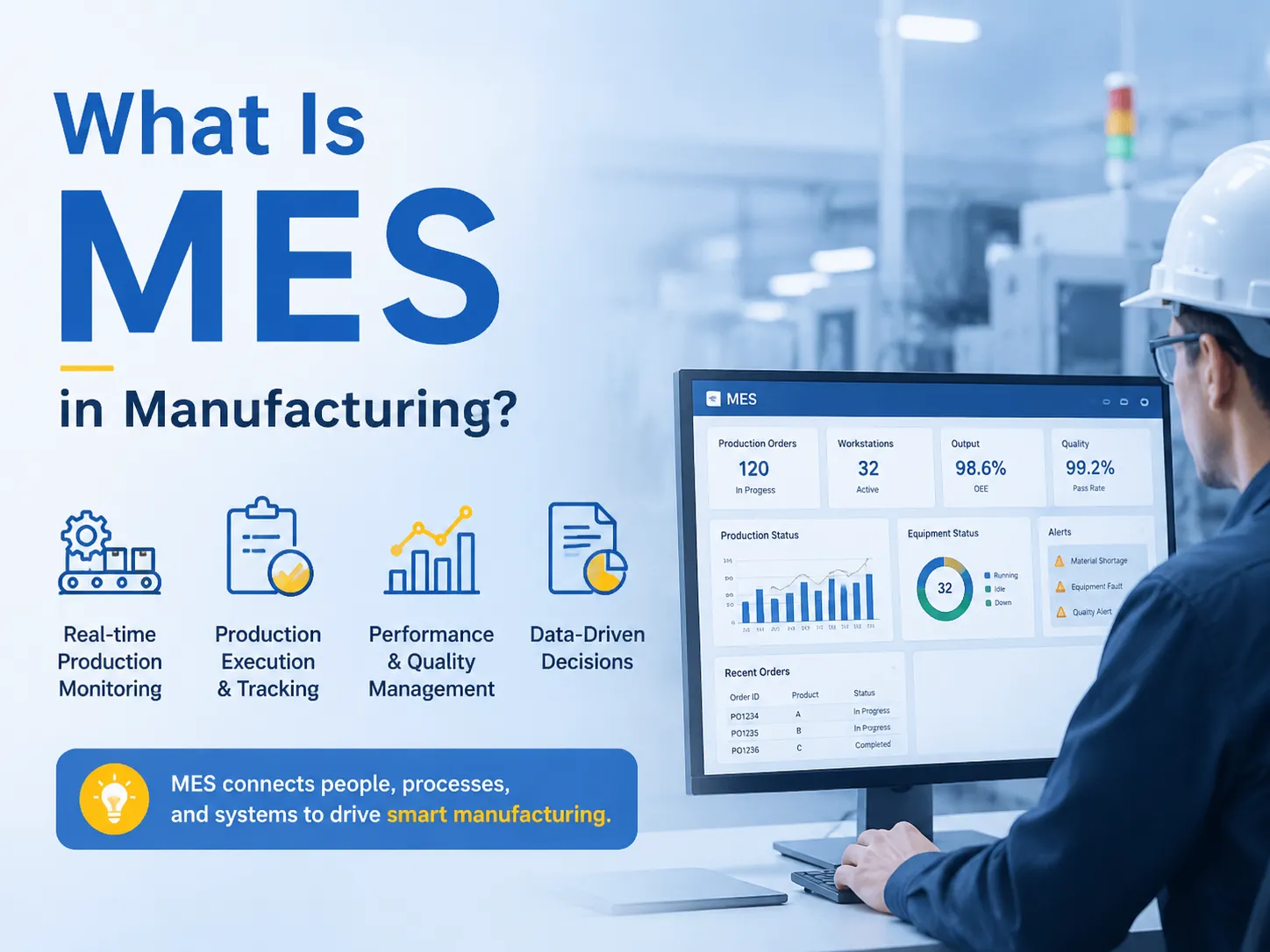
A Manufacturing Execution System (MES) is a software program that keeps track of production happening on the factory floor. MES covers the four main components of any production line – people, machines, materials, and methods – and documents everything it does.
Think of MES as a digital representation of the actual production process in your shop. MES knows what work order is being worked on in which production line, which operator is working at which stage of the production process, which component lot has been used to manufacture a finished product, what the bottleneck in production is, and so on. There are no more guessing, blackboards, and spreadsheets; MES replaces them with clean data and closed-loop processes.
MES connects both the business layer (ERP – “we need 10,000 parts by Friday”) and the control layer (machines – “I’m operating at 42 cycles per minute”). It turns a production plan into real production actions and passes real outcomes back to the enterprise.
The ISA-95 Framework: Where MES Lives
This discussion about MES naturally begins with the topic of ISA-95 (IEC 62264), which is an internationally recognized standard providing the definition for the information systems used in manufacturing regarding its five levels of existence.
| Level | Layer | Timescale | Question It Answers |
|---|---|---|---|
| L4 | ERP (business planning) | Days/weeks | What should we make, and when? |
| L3 | MES (production operations) | Seconds/minutes | How exactly are we making it right now? |
| L2 | SCADA / monitoring | Milliseconds | What is the machine’s temperature, speed, torque this second? |
| L1 | PLC / DCS (control) | Milliseconds | Actuate, regulate, interlock |
| L0 | Physical process | — | The machine itself |
Thus, MES operates at Level 3 of the ISA-95 framework since it manages production processes such as dispatching, executions, data collection, quality control, and others.
Core MES Functions
Characteristics of MES systems have many similarities irrespective of the industry in which they are used.
- Managing work orders involves the following activities: scheduling and monitoring work orders from the moment they were generated to work completion, change of instructions and approval through electronic means.
- Material management consists of making sure that the specified material lot is used at the right stage of the process. For these purposes, the step of RFID or bar code scanning and material retrieval process are introduced.
- In accordance with the quality management requirements systems must provide monitoring of quality including process control and identification of defects.
- Traceability can be explained as a reverse path from the product to the material that was used for its production as well as all parameters of the manufacturing process.
- Labor monitoring consists of gathering the information on who was responsible for each order and how much time was spent on its processing.
- Control of equipment includes monitoring its operational state as well as OEE which is calculated as the product of small losses times performance times quality.
- Triggers for maintenance work are used to detect problems with equipment.
Although not every MES has the capability to perform all the mentioned activities, it is still relevant for users looking for comparison of MES systems.
What MES Delivers: The Benefits
That which drives the factories to spend on MES — results shown in numbers:
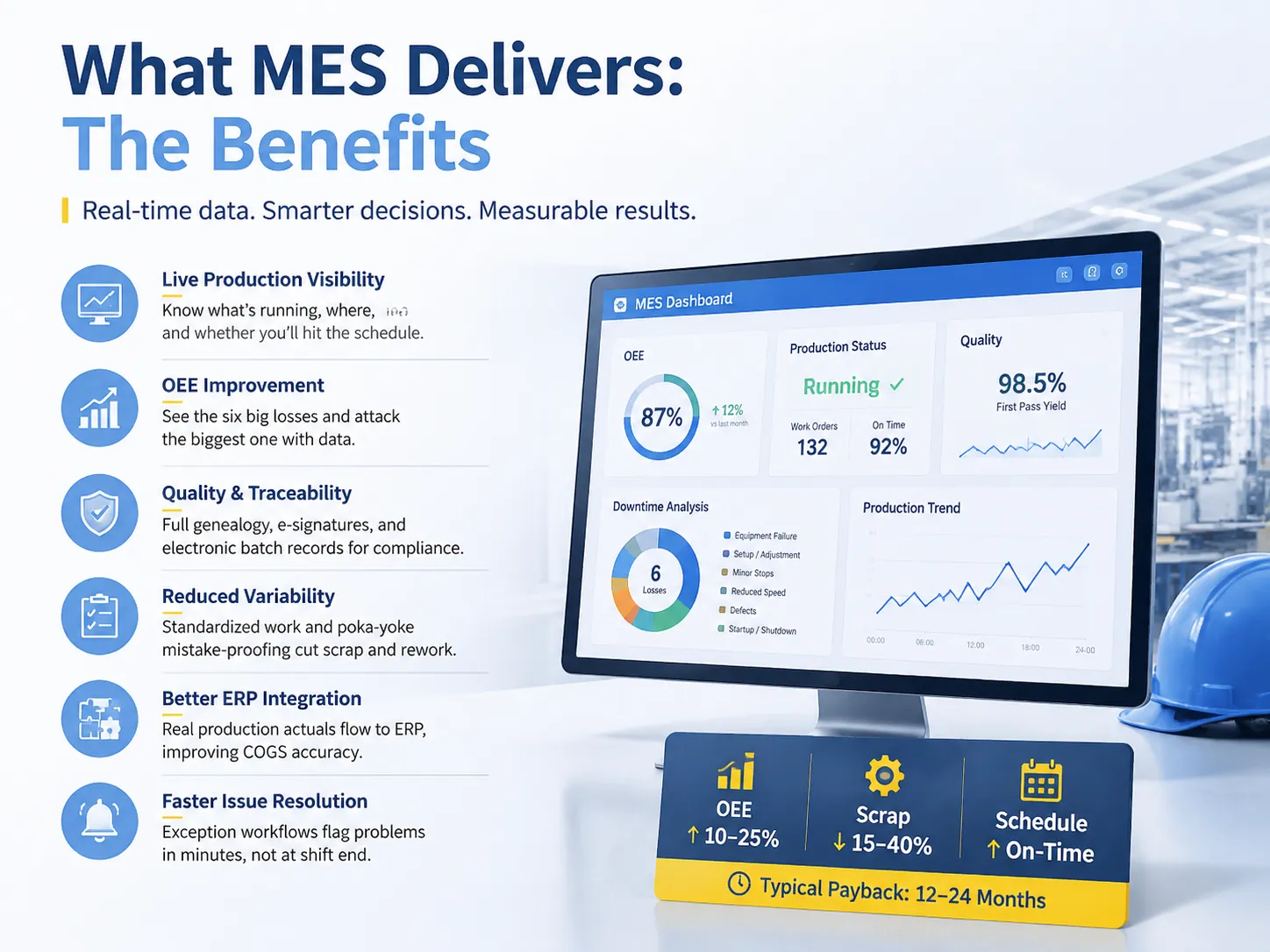
| Benefit | What It Means |
|---|---|
| Live production visibility | Know what’s running, where, and whether you’ll hit the schedule — no more 24-hour-late, hand-entered data |
| OEE improvement | See the six big losses (downtime, speed, quality) and attack the biggest one with data |
| Quality & traceability | Full genealogy, e-signatures, and electronic batch records — required for pharma/auto/aerospace compliance |
| Reduced variability | Standardized work instructions and poka-yoke mistake-proofing cut scrap and rework |
| Better ERP integration | Real production actuals flow to ERP, correcting cost-of-goods inaccuracies of 15-30% that standard-time assumptions cause |
| Faster issue resolution | Exception workflows flag problems in minutes, not at shift end |
Commonly reported achievement: Overall Equipment Efficiency increase between 10% and 25%, reduction of scrap between 15 and 40%, increase in schedule fulfillment with a payback period of project between 12 and 24 months.On the testing side of production specifically, the same data-driven logic applies: automated testing systems — whether standalone or fed by an MES — show the measurable payback analyzed in our automated vs manual testing payback analysis, and the quality checks in our circuit breaker testing guide are exactly the kind of in-process verification an MES records and traces.
MES vs ERP: The Key Differences
The most common confusion in manufacturing software is ERP vs MES. The clean distinction:
| Feature | ERP (Level 4) | MES (Level 3) |
|---|---|---|
| Purpose | Business planning & transactions | Shop-floor execution & tracking |
| Question | What should we make? | How are we making it right now? |
| Timescale | Days and weeks | Seconds and minutes |
| Data source | Sales orders, MRP, finance | Machines, operators, scanners |
| Key modules | Finance, procurement, inventory, HR | Dispatching, OEE, quality, traceability |
| Typical data lag | Daily/weekly | Real time |
In a nutshell, ERP chooses which products to make, while MES determines how to make them. Meanwhile, ERP lacking MES only formulates plans based on cultural beliefs and requires the knowledge of how the plan translates to reality; whereas MES operating independently of ERP might lead to transparency on the shop floor but fails to connect the various stages of value creation. The most effective solution would be one that incorporates both systems and uses ISA-95 B2MML standard for this purpose.
MES vs SAP: What People Really Mean
In the realm of “MES as compared to SAP,” the situation can rightly be depicted as “MES vs world’s foremost ERP supplier.” Being an ERP-based company, the company has developed its major products (namely S/4HANA, and earlier R/3), which are the main tools for performing finance, supply chain, manufacturing planning, and procurement activities. Although SAP may be considered as an ERP and not a typical MES, it still is able to provide the following modules related to manufacturing:
- SAP PP (Production Planning) – It is an ERP-based planning mechanism for production orders and production capacity activities.
- SAP Digital Manufacturing (SAP DMC) – It this case SAP’s MES performance is presented as a “studio” between SAP ERP and the production equipment, which provides some MES resources (dispatching, providing guidelines on how to operate the machines, OEE calculation, and quality management and implements it in S/4HANA.
In its turn, there are quite a number of MES systems made to support SAP – for example Siemen Opcenter, AVEVA or Rockwell are able to use B2MML and/or ABAP IDocs instead of APIs to establish the connections with SAP.Thus, the answer is that the decision-making process regarding the choice of “SAP vs MES” turns into the necessity to choose the MES system that is compatible with ERP as in most cases the same SAP system is taken among ERP alternatives. Plant that operates using the SAP system typically checks the compatibility with MES system solutions rather than using ERP solely.
MES vs SCADA: Signals vs Information
SCADA and MES are adjacent but different:
| Feature | SCADA (Level 2) | MES (Level 3) |
|---|---|---|
| Role | Monitor and control machines/processes | Manage production operations |
| Data | Process values: temperature, pressure, speed, runtimes | Order, material, labor, quality, performance context |
| Question | What is the machine doing this second? | Is production on spec, on schedule, traceable? |
| Output | Alarms, trends, control actions | OEE, genealogy, work instructions, reports |
In plain and simple words: SCADA gives signals and MES helps in using those signals. SCADA won’t provide data such as OEE, various reasons regarding downtime or production cost variations, however, MES is there to collect machine data and link it with purchases, products and quality to answer the above questions. Moreover, most MES solutions try to obtain the machine information through SCADA or through OPC UA/IOT connectors directly.
MES vs MOM: The Bigger Umbrella
MOM stands for Manufacturing Operations Management, which refers to all the systems used in the operations of a manufacturer. This includes MES, quality management, maintenance management, lab information systems, and inventory operations. If MOM refers to the overall picture of plant operations, MES would be the centre: the system that connects the entire operation process.
When Do You Need an MES?
Criteria to determine when to think about an MES:
- Real-time shop-floor visibility is not an option — production data is 24 hours old, entered manually into spreadsheets.
- Traceability is non-negotiable when regulatory compliance is involved and standards such as automotive (IATF 16949), aerospace (AS9100), pharmaceuticals (21 CFR Part 11 change records), food (HACCP-allergen traceability) need to be fulfilled.
- It’s unclear how to measure OEE — downtime sources and quality losses remain a mystery.
- ERP costing is inaccurate — standard-time assumptions can be a 15-30% understatement since the actual data is never available.
- Growing complexity means greater variety of products and product types — spreadsheets are becoming obsolete.
- Scaling operations across multiple sites means having the same metrics everywhere.
A Real Example of MES in Action
A factory making automotive components has received an order from the ERP system to deliver 10,000 parts on Friday. The following describes what the manufacturing execution system will do regarding the order:
- Dispatch: The manufacturing execution system will find an appropriate machine that can execute the order.
- Digital instructions: The operators on the shop floor will be able to see the digital instructions of how they should proceed with the manufacturing of the components, eliminating the use of paper based instructions.
- Material verification: The MES will scan the barcode on the components being supplied to verify if the right components in terms of ramp-up level are being supplied to the shop floor.
- Real-time tracking: The MES will make sure that the cycle counts, downtime and quality will be reported in real-time and reflected on the OEE dashboard.
- Quality gates: The MES will ensure that the manufacturing process is checked and controlled for possible issues in the beginning of the process, limiting the waste produced during the manufacturing process.
- Traceability: The finished components will be tracked back to the raw materials or components from which they were obtained including the machine used in the production process.
- Feedback to ERP: In the end, the MES will send feedback to the ERP system outlining which quantities and production times were achieved.
What Does an MES Cost?
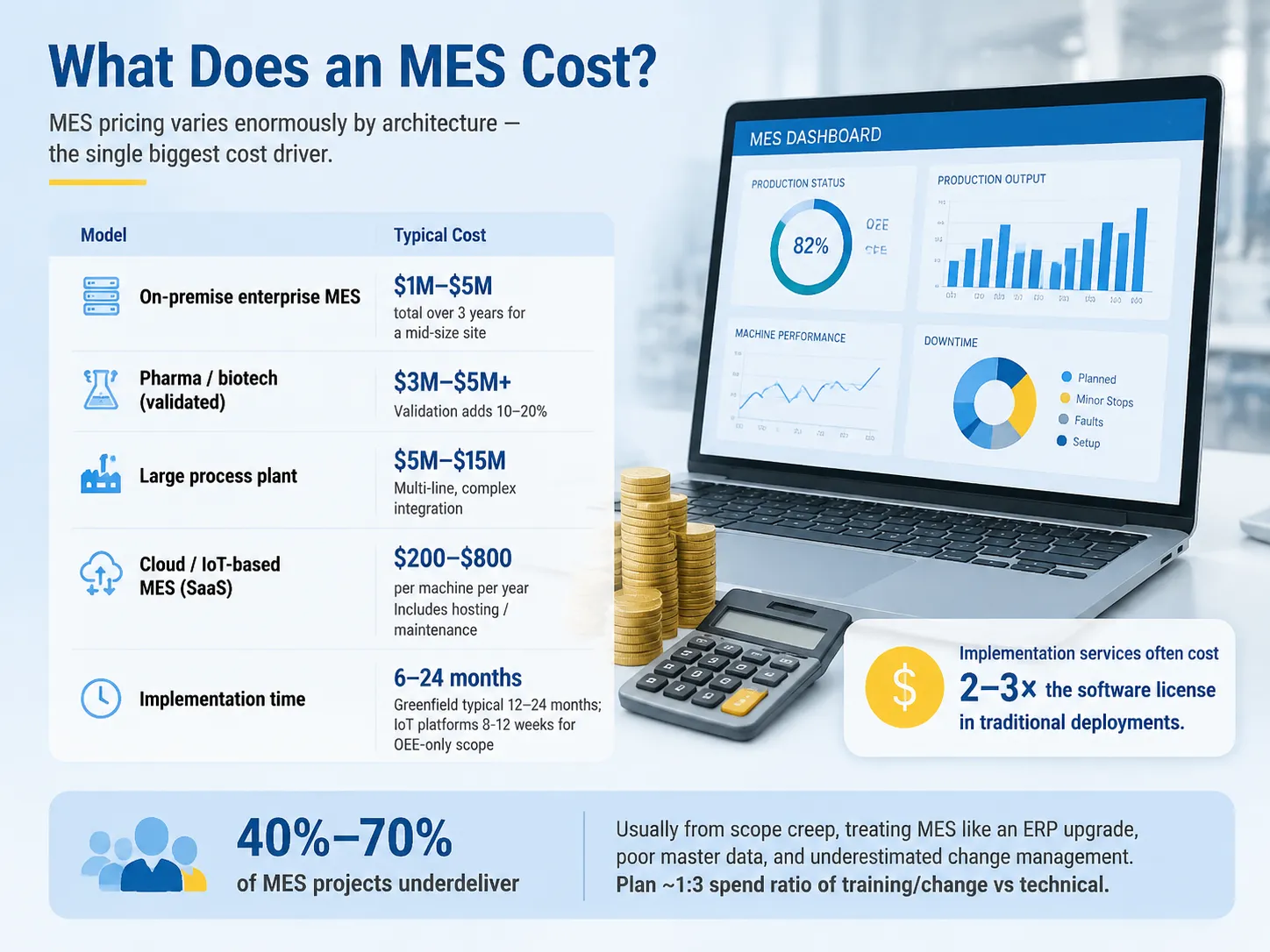
MES pricing varies enormously by architecture — the single biggest cost driver:
| Model | Typical Cost | Notes |
|---|---|---|
| On-premise enterprise MES | $500k+ software; $1M-$5M total over 3 years for a mid-size site | Licenses (25-40%), implementation (30-50%), integration, training; annual maintenance 15-22% of license |
| Pharma/biotech (validated) | $3M-$5M+ | Validation adds 10-20% |
| Large process plant | $5M-$15M | Multi-line, complex integration |
| Cloud / IoT-based MES (SaaS) | $200-$800 per machine per year | Deploys in days-weeks; no upfront CAPEX; includes hosting/maintenance |
| Implementation time | 6-24 months | Greenfield typical 12-24 months; IoT platforms 8-12 weeks for OEE-only scope |
Important fact: traditional providers charge two to three times as much for implementation services than for their software license. With a true cloud-native platform, it’s based on configuration rather than custom development, which changes this dynamic. It’s also worth nothing that about 40% to 70% of projects fail to deliver, mainly due to problems such as scope creep, treating MES as an ERP upgrade, wrong master data, and failure to account for change management (prepare for a spending ratio of 1:3 for training/change management vs technical).
The Main MES Vendors
The three most important platforms by strength are:
- Process industries (chemicals, food & beverage, refining): AVEVA MES, Honeywell, Siemens Opcenter Execution Process.
- Discrete industry (automotive, machinery): Siemens Opcenter Execution Discrete, RockwellFactoryTalk, Dassault Apriso.
- Pharmaceutical and biotechnology: Werum PAS-X, Siemens Opcenter Pharma, Rockwell Pharma Suite.
- Aerospace and defense: iBASEt Solumina, Dassault Apriso.
- Semiconductor: Critical Manufacturing cmNavigo, Siemens Opcenter Semiconductor.
- ERP-native: SAP Digital Manufacturing (for SAP-centric plants).
- IoT/OEE-first platforms: TeepTrak and similar solutions are effective solutions for fast deployment IoT and machine-agnostic sensors at SaaS rates.
All vendors in this space adhere to ISA-95 guidelines with connectivity, time to market, ease of integration with ERP systems, and compliance.
Implementation: The Roadmap & Risks
Pattern confirmed implementation:
- Strategy & Business Case (Months 1-2)—Establish your KPIs and scope.
- Vendor Selection (Months 2-4)—Rank against your seven selection criteria.
- Architectural Design (Months 3-6)—Define boundaries of ISA-95 standards, integration points, and zones.
- Configuration & Build (Months 5-12)—Use standard configuration instead of custom production wherever possible.
- Integration & UAT (Months 8-15)—Provide machines with connectivity (OPC UA/IoT) and integrate with ERP system (B2MML).
- Validation & Training (Months 12-18)—Validate legal compliance if necessary, and train operators for real change management.
- Go-live & Optimize (Months 15-24+)—Start with the pilot case (one line, 5-10 machines), prove value, and apply the templates for rollouts (30-50% of time saved with other sites).
Potential failure scenarios include scope creep, blurred borders of ERP-MES systems, bad master data, and forgetfulness with regard to operator change management. Address all of them at the very beginning of the project.
Frequently Asked Questions
What are the key differences between MES and SAP?
SAP is an ERP firm whose main products cover business planning, finance, procurement, and supply chain. Meanwhile, MES is a different software category used for controlling real-time execution at the shop floor. The main distinction between those two software programs is that ERP/SAP decides on which products will be manufactured, whereas MES controls the production process. SAP does provide manufacturing modules, for example, SAP PP for planning and SAP Digital Manufacturing, which is MES-related module, but many plants choose to use SAP in conjunction with dedicated MES software from Siemens, AVEVA, Rockwell, which works through B2MML, because SAP ЕRР includes planning modules only and does not have capability to provide real-time execution data on machines.
What is an example of MES?
In one case, auto manufacturing facility gets production requirements through the ERP system; the MES system sends it to the correct production line, provides electronic instructions to workers, checks materials by scanning barcodes, keeps track of production volume and unproductive time, registers production results by means of SPC, compares manufactured parts against the production order, and sends reports about physical production output back to the ERP. Some of the most common MES systems are Siemens Opcenter, Rockwell FactoryTalk, AVEVA MES, Werum PAS-X, and SAP Digital Manufacturing.
What is the difference between MES and ERP?
ERP (Level 4 in ISA-95) is responsible for planning business processes and executing transactions like sales orders, MRP, procurement, and finance daily or weekly which poses the question: “what do we need to manufacture?”. MES (Level 3) controls production processes on shop-floor level, like work order dispatching, materials, labor, quality, OEE, and traceability per seconds and minutes, asking the question: “how is the production being performed at this moment?”. ERP is theoretical, while MES is practical. They are not in conflict with each other, rather they complement each other.
What is MES vs SCADA?
SCADA (Level 2) is responsible for monitoring machines and processes. It acquires real-time data (e.g., temperature, pressure, speed, and time of operation) and acts according to the information received. Meanwhile, MES (Level 3) controls production processes. It relates the acquired information to orders, materials, labor, and standards to achieve OEE, quality, traceability, and report management. In short, SCADA provides signals while MES generates useful data. SCADA cannot provide you with OEE, while MES can.
References
- ISA-95 / IEC 62264 — Enterprise-Control System Integration Standard
- MESA International — MES Model and B2MML Standards
- Siemens — Opcenter MES Product Family
- Rockwell Automation — FactoryTalk ProductionCentre
- SAP — SAP Digital Manufacturing and PP Modules
- AVEVA — MES Solutions for Process Industries
Conclusion
The Manufacturing Execution System, or MES, is a system that processes production reports while they are taking place. MES is the third layer of the ISA-95 pyramid, placed between Enterprise Resource Planning (ERP) and control systems. MES generates orders, inspects the quantities of input materials and labor force, controls quality, calculates Overall Equipment Effectiveness (OEE), and ensures product traceability. The data obtained is sent to the ERP system. aiicaThe ERP defines what should be manufactured; MES defines the way of manufacturing and monitoring (SCADA analyzes machine signals). The implementation of MES is necessary in case the production facility acts as a black box, direct product traceability is required, or efficiency calculations are inaccurate. The costs incurred by the average-sized establishments vary from $500,000 to $5 million for traditional applications, and the prices range from $200 to $800 per year per machine for cloud applications. The process of implementation takes on average from one to two years.