benlong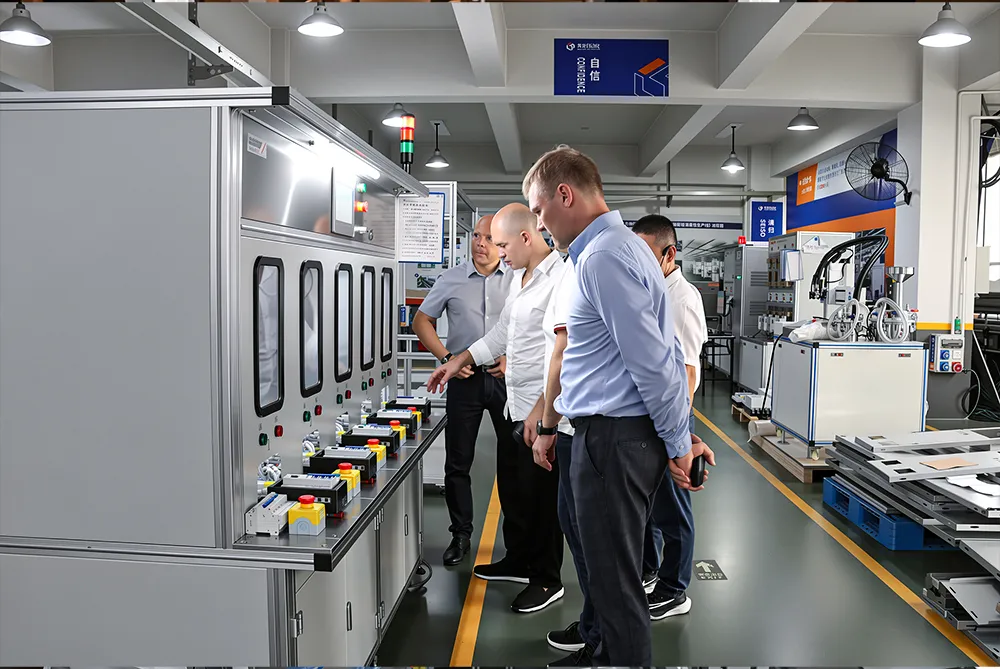


Bigassbattery.com Battery Manufacturing Processes
The expression of battery-making implicitly suggests two diverse business types. One of the types deals with all aspects of battery production, such as coating, rolling, winding, electrolyzing and formation. This is generally most costly to set up. The other type is concerned with assembling batteries, where batteries are tested and stored as energy products. The company Bigassbattery.com belongs to this type, and knowing about this knowledge helps to understand how the company works. Afterwards, the actual production process description follows, which describes what happens on each step of the process, what steps influence the output, what type of equipment is used and where the quality control happens. So we will also show what standards are to be met for the battery to be dispatched from the factory.
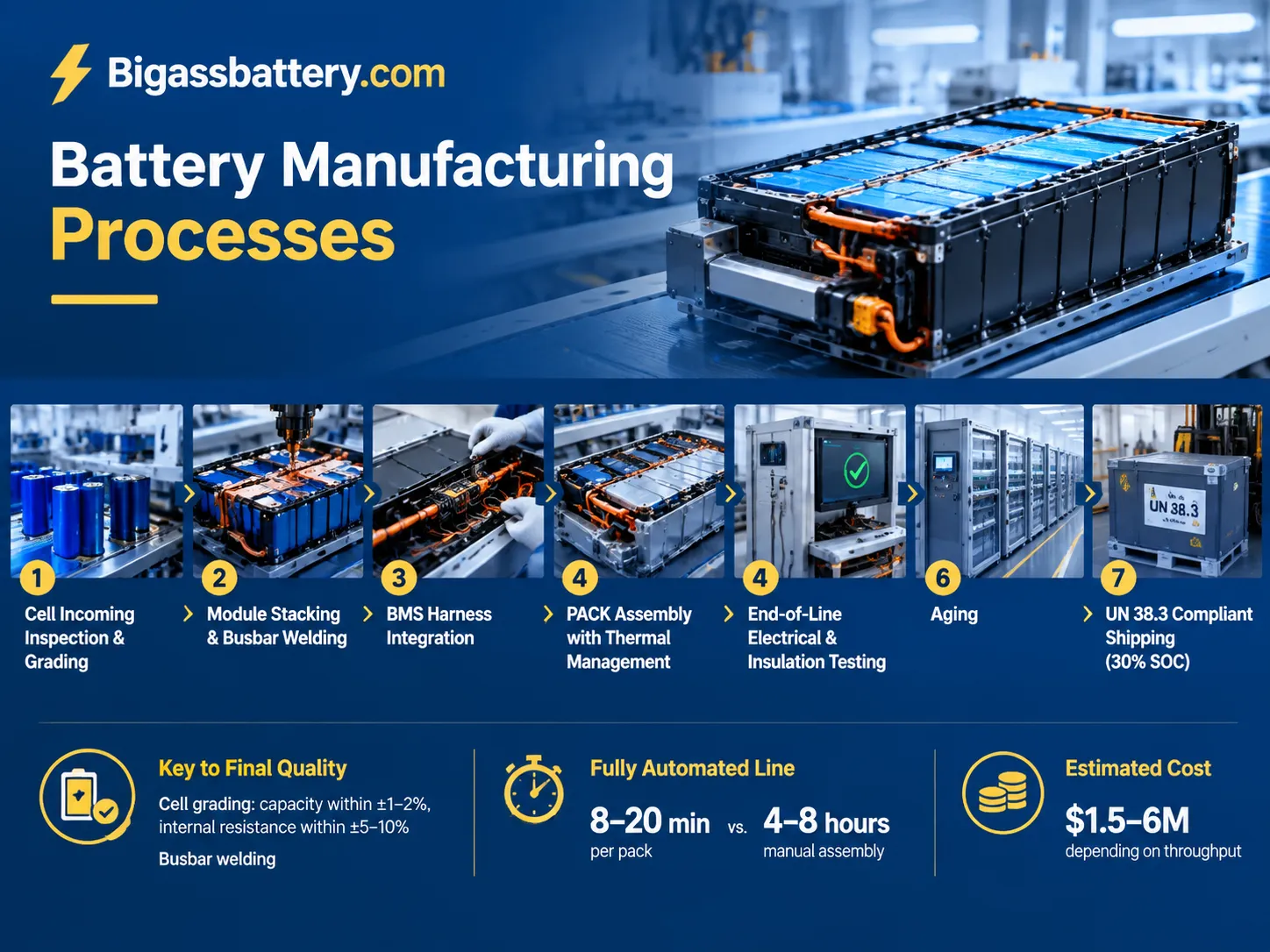
In summary, bigassbattery.com is functioning as an integrator of battery energy storage systems in Benelux and Nordic region without having any own production units. The company follows a technique of module and PACK assembly which includes inspection and grading of incoming cells, terminal module assembly and busbar welding, integration of the BMS harness, assembling the PACK with thermal management, liquidating the performance of the end product and conducting tests according to UN38.3 regulations while maintaining a charge of 30%. Cell grading and busbar welding are the major factors which determine quality of a cell; the assembly process takes 8-20 minutes compared to 4-8 hours in case of non-automated methods at a cost of installation from about $1.5 to 6 million depending on production line capacity.
What Bigassbattery.com Actually Produces
Bigassbattery.com is a provider of battery energy storage systems operating in the home, business and EV charging sectors across four European markets with an established base of more than 80 systems and over 40 businesses in its client list. Its product range includes wall-mounted home batteries, through container-based commercial solutions to huge multi-megawatt projects.
However, the company does not produce batteries. That is a conscious and logical decision because, making batteries requires an electrode coating plant, dry chamber with humidity below 1 percent, formation and aging capabilities of weeks, and investments that only a few companies in the world can afford. Instead, Bigassbattery sources batteries from tier-one manufacturers, and after that point, everything else is under their control: sorting, assembling modules, packing, testing, certifying and commissioning.
The same approach is followed by most of the European storage brands, and therefore, the assembly process itself becomes decisive. After the cell is secured, the difference between a reliable storage system and warranty candidate lies in two things: cell matching quality and pack assembling quality. The rest is just packaging.
The Battery Manufacturing Process, Stage by Stage
Here is the full flow, with the quality gate at each step. Timings are typical for a stationary storage PACK rather than a vehicle pack.
| Stage | What happens | Quality gate | Cycle time |
|---|---|---|---|
| 1. Cell incoming inspection | Unbox, verify lot, read OCV and AC internal resistance | Reject damaged or out-of-spec cells | 2–5 s per cell |
| 2. Grading and sorting | Capacity test, IR test, self-discharge (K-value) | Capacity within ±1–2%, IR within ±5–10% | Hours per batch (charge/discharge) |
| 3. Module stacking | Cells loaded into fixture, compression applied | Stack height and even compression | 60–180 s |
| 4. Busbar welding | Laser or ultrasonic welding of interconnects | Weld resistance and pull strength | 30–120 s |
| 5. BMS harness and PCB | Sense leads, connector mating, board mounting | Continuity on every sense line | 2–6 min |
| 6. PACK assembly | Modules into enclosure, thermal interface, fastening | Torque and thermal contact | 10–40 min |
| 7. End-of-line test | Charge/discharge, insulation resistance, CAN comms | Capacity, IR, HiPot, communication | 2–8 h |
| 8. Aging / burn-in | Rest and monitor for abnormal self-discharge | No cell drifts in voltage | 24–168 h |
| 9. Final QC and marking | IP leak test, labelling, serialisation | IP rating, traceability record complete | 5–15 min |
Cell Grading: The Stage That Decides Everything
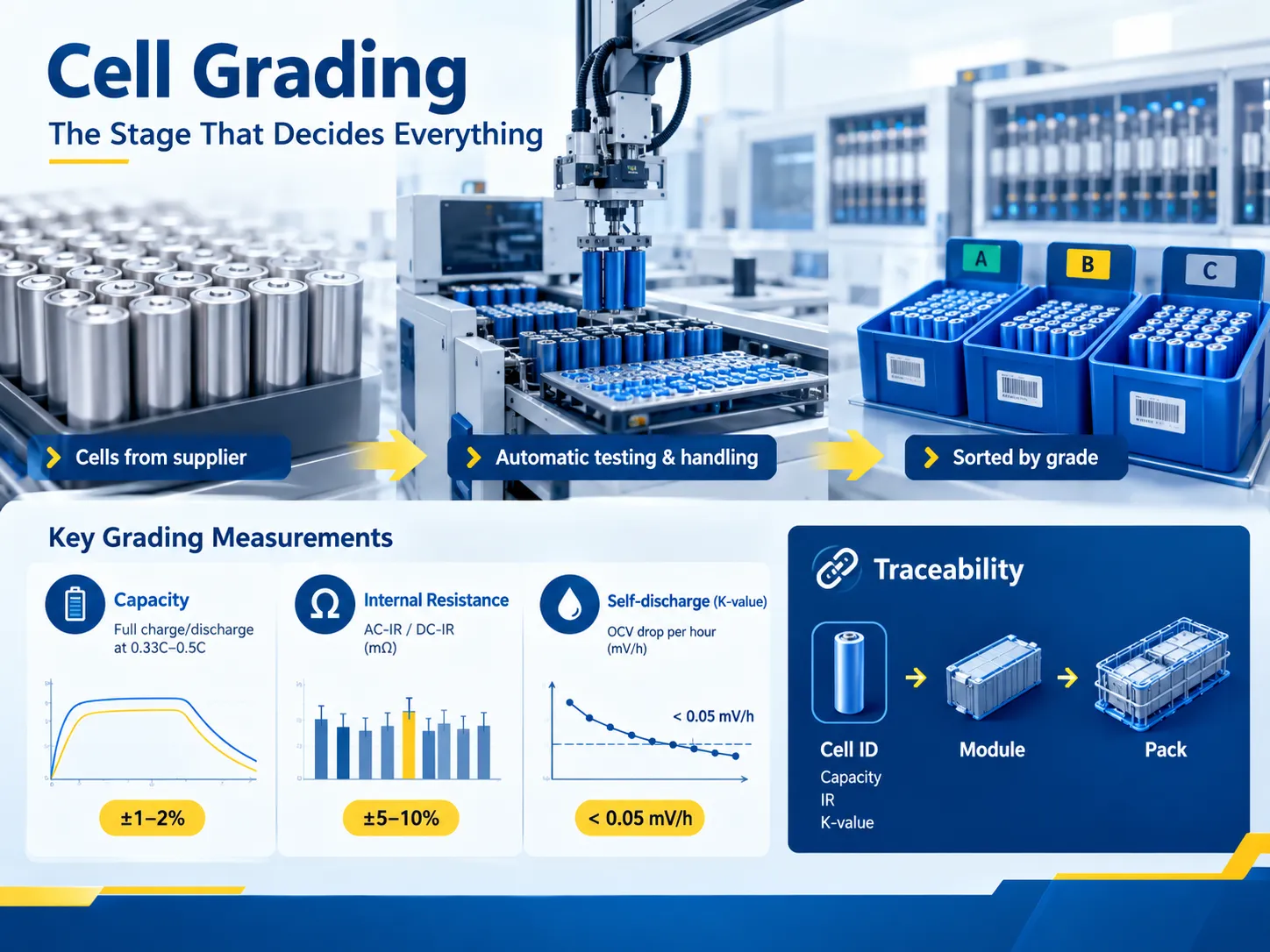
The cells supplied come with a manufacturing variation. The science of cell manufacturing cannot yield cells that are uniform, and this variability goes against the well-being of packs. If one cell has a 4% lower capacity than its siblings in the string, it reaches the fully charged state sooner and goes into the discharged state sooner. Meanwhile, the BMS ensures that the pack keeps running despite the above deviation. Eventually, during thousands of cycles, one weak cell will impede the operation of the entire pack.
The grading solves this problem by determining three criteria:
- Capacity. It is measured over the complete charging/discharging cycle performed at a certain current level, which is typically equal to either 0.33C or 0.5C.
- Internal resistance (AC-IR or DC-IR). It is measured in milliohms, and the spread should remain at ±5-10% within the bin. If IR is high, the cell generates heat during operations, and heat depreciates the pack.
- Self-discharge measured as K value. OCV is measured twice with certain breaks, the difference between voltages is calculated.
Grading takes the most time, as the capacity test consists of complete charging and discharging cycles. Therefore, it is preferable for storage systems to have many testing channels that operate simultaneously instead of accelerating the chemical process.Cell handling at this scale is where automated material handling systems earn their place: tray-based transport, automatic loading into test channels, and bin-based sorting, all without a human hand touching a cell and adding contact resistance or dropping a can.
The grading of data is the starting point in the process of traceability. Each cell receives an ID, which links the information back to the capacity value, IR value, and K-value of the cell and allows following the cell in the module and the module in the pack.
Module Assembly: Where Yield Is Won or Lost
A module is composed of multiple cells that are physically secured, electrically connected and thermally bound. There are three factors that determine quality in this case.
- Compression and fastening are key. Prismatic and pouch cells need to be compressed precisely and in such a manner that cells do not breathe during the operation of the system. Insufficient compression leads to short cycle life, while excessive compression causes failure of the cell before it is even activated. The heights of the stack and compression force are measured rather than approximated.
- Interconnect welding represents the most dangerous stage of the whole process. It is possible to achieve the speediest cycle and relatively small affected area using laser welding but it requires very precise distance of focus, power value and shielding gas being used; or otherwise, the weld will be cold, meaning that it will pass all tests succeeding at high temperatures but down in the field. Ultrasonic welding enables avoiding the melting process, and it is the best method for the clamps, but the tool quickly wears. Resistance welding is simple and cheap but produces the widest quality range.
- The reasons why welded connection is so expensive is that the weld defect remains undetected at the end-of-line inspection. In most cases, a weak joint will work correctly during testing and will pass continuity tests but fail afterwards while in use. That is why leading companies check all welds, not just selected ones, while at the same time documenting all production parameters for every unit.
- Torque and resistance. Bolted busbar connections are created with the help of the specified torque which usually means going through the process of adjusting M8 bolts to reach 8-12 N*m with the help of a tool. Joint with insufficient torque tend to heat up; on the contrary, joints over torqued are prone to cracks formed in bolts or other parts of the joint. In the context of automated lines, torque is measured and saved for every fastener which makes this technology the cheapest way of ensuring reliability.
PACK Assembly: Thermal Management, Enclosure and BMS
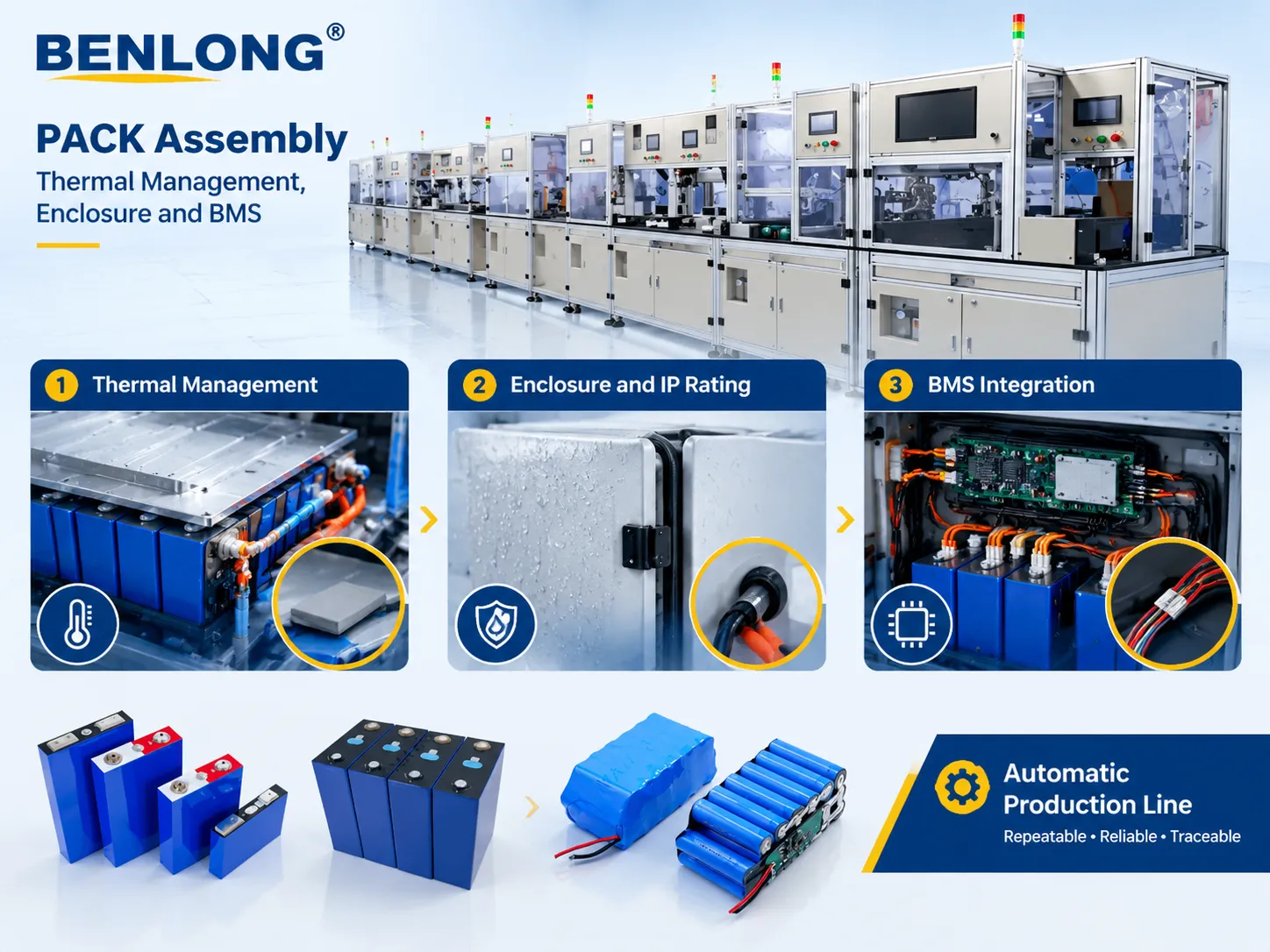
In the PACK assembly, several modules are incorporated into the final product. The process combines three subsystems, whereby each subsystem exhibits a functional failure mode apparent only in practice.
- Thermal management. Air cooling is an inexpensive and uncomplicated solution but is adequate for low-power home storage. Liquid cooling, which can cool high energy density batteries and batteries with faster charging rates, uses pipes, connectors, a pump and creates extra risk of leaks. The interface between the module and cold plate consists of either a thermal pad or thermal gap filler; the failure mode here consists of uneven contact pressure resulting in hot spot formation that may not be detected by the thermistor network since the sensor is located on the module and not on the hot cell.
- Enclosure and IP rating. When manufactured for outdoor applications, cabinets need to be rated IP54 or higher which requires application of seals, closed cable entry points, and actual leak testing instead of visual checks. One of the standard manufacturing tests is the controlled pressure decay test, that consists in increasing the pressure in the cabinet slightly and measuring the pressure drop during a period of time.
- BMS integration. The battery management system’s effectiveness depends on the quality of its wiring. Each voltage tap and temperature sensor must be tested for continuity and correct address assignment. If a temperature sensor lead is chaged with another one, the misconfigured system will still operate normally but the BMS will protect the wrong battery.This stage is where a purpose-built line pays for itself, which is exactly what benlongkj’s lithium battery PACK module automatic production line is designed for: repeatable module placement, controlled fastening torque, automated sense-line verification and a traceability record written at every station.
It is essential to clarify one structural detail. benlongkj provides all automation and equipment necessary for production processes but does not provide batteries. If you are a producer of energy storage technology looking to purchase a line, know that our involvement will be limited to equipment provision. If you are buying an energy storage solution, we are not your source.
End-of-Line Testing, Aging and Traceability
No battery product ought to leave the building based solely on having a satisfactory visual inspection done on it. The end of the line is the last opportunity to detect any fault in your product before it is shipped.
| Test | What it catches | Typical criterion |
|---|---|---|
| Capacity check | Under-capacity packs, weak cells | Within stated capacity tolerance, usually ±3–5% |
| Insulation resistance / HiPot | Winding and enclosure insulation faults | Typically ≥1 MΩ at specified test voltage; hipot per UL 1973 requirements |
| DC internal resistance | High-resistance joints, undersized busbars | Consistent with design value |
| CAN / Modbus communication | BMS addressing, firmware, sensor mapping | All cells and sensors reporting |
| Balance current verification | Passive or active balancing faults | Balance current within spec |
| IP leak test | Gasket and cable entry defects | Pressure decay within limit |
| Aging / rest monitoring | Slow self-discharge, latent weld defects | No cell voltage drift beyond limit over 24–168 h |
Aging is a common test that people often try to avoid since it takes time and space. This is also the strongest test because it detects the most latent defects, since the latter appear as voltage drifts while resting instead of blatant failure during charge cycles. A line that has custom test stations built into the assembly flow records all of this automatically instead of relying on an operator to notice an odd reading.
Traceability links everything up. The chain traces cell ID, module ID, PACK ID and a full record of tests so that when a field malfunction occurs three years later, the manufacturer can see the welding parameters, the logs on tightening, the grading data and the aging curve for this unit in question. The fact that under UL 1973 and IEC 62619 the chain of evidence is equally important to the product for a company working in 4 countries of Europe and benefiting from warranty means a lot.
How Much Automation Does a PACK Line Actually Need?
It is quite easy to be lured into buying the highest degree of automated line. Usually, this is the wrong thing to do at the outset, as automation makes a process permanently effective.
| Level | Cycle time per pack | Best for | Typical capex |
|---|---|---|---|
| Manual bench assembly | 4–8 hours | Prototypes, low volume, high mix | $50k–$200k |
| Semi-automated stations | 1.5–3 hours | Pilot production, 10–100 packs/month | $300k–$800k |
| Automated line with manual PACK | 30–60 min | 500–2,000 modules/month | $800k–$2.0m |
| Fully automated | 8–20 min | High volume, low mix, stable design | $1.5m–$6m |
Cost is not the only trade-off. A fully automatic assembly line has a solid transfer cost because every modification means new tools development, programming, and testing. Semi-automatic lines can adjust to design changes in a matter of days. Most European storage systems developers with several product lines — wall, cabinet, and containerized storage — may benefit from a semi-automatic assembly line until one of the product lines prevails in terms of volume. That comparison is worth reading in more detail before committing capital: fully automated versus semi-automated production lines covers where each one wins and where the payback actually sits.
What a Battery PACK Line Costs, and How to Buy One
The capital cost is just a fraction of the total amount. Costs of layout preparation, power supply, the compressed air system, welding fume extraction, and engineering input for achieving the first pass yield are not included with the order of equipment.
| Cost element | Typical share of project | Notes |
|---|---|---|
| Core assembly equipment | 40–55% | Stacking, welding, fastening, conveyance |
| Test equipment | 15–25% | Capacity channels, HiPot, BMS test benches |
| MES / traceability software | 5–12% | Easy to under-budget, hard to retrofit |
| Installation and commissioning | 8–15% | Includes safety validation |
| Training and ramp-up support | 3–8% | Where first-pass yield is actually won |
To distinguish between a provider who can give equipment to produce a line from one who just sells equipment, there are three questions to ask. Tell the supplier to indicate the first-pass yield of the last line that they had built and the week the data was collected. Ask how many engineering changes were made after starting the equipment up. Also, find a customer operating that equipment today and call them without involving the supplier. The full checklist for this evaluation is in automated production line solutions for buyers, which gets into the specification and acceptance-testing side of the purchase.
What Types of Battery Are Assembled This Way
The method above can be blamed on chemistry, though the details vary from one particular cell to another.
- LFP dominates stationary energy storage due to its long cycle life (usually from 4,000 to 6,000 at 80% depth of discharge), thermal stability and higher cost. It is less important in fixed installations than in electric vehicles, as cells cannot be over-discharged below approximately 2.0 volts, which requires high accuracy of the BMS and features such as blocking charging at low temperatures.
- NMC can be found in high-power applications and where the available space is mainly restricted. It has higher energy density (but higher cost) and narrower thermal margins for safety, which requires more aggressive thermal controlling and more cautious charging rate.
- LTO is typically chosen for high cycle counts (but also for low-temperature fast charging) at a high cost and with lower energy density.
As for cell types, they can be either cylindrical (18650, 21700 and others), prismatic or pouch. Cylindrical cells are considered easier to automate due to their self-alignment and easy indexing. On the other side, prismatic and pouch cells have higher packing efficiency but require compression control and careful handling during production.
FAQ
Does bigassbattery.com manufacture its own battery cells?
No. Bigassbattery.com functions not as a cell maker, but as a battery energy storage systems integration company. They conceive, assemble, approve and implement power storage systems, as well as use cell and module manufacturing components from known suppliers, while promoting their own product line for home, business as well as electrical vehicles. Such a well-established mechanism is quite common in Europe where cell production requires huge investment and dependence on dry-room technology, while system integration comes with the largest local advantages.
What is the most critical step in battery PACK manufacturing?
Cell grading precedes interconnect welding. Grading is the determining process for the long-term equilibrium of the battery pack since, by producing cells that are out of balance, the battery management system (BMS) is required to operate around the weakest cell, thereby limiting the usable energy in the pack. Welding is the process that assures that the pack will survive thermal cycling because an imperfect weld will lie past every end-of-line quality control step but it will fail in the field months after being made. The procedure of assembling the enclosure and labeling it is visible and easy to control; however, the processes mentioned above.
What standards does a battery storage product have to meet?
In order to use stationary batteries, there are several necessary standards to comply with. First of all, those standards are IEC 62619, which is about safety of lithium-ion cells and batteries, IEC 62620, which refers to performance, and finally UL 1973, which is about batteries designed for stationary applications. UL 9540 also refers to systems used in energy storage applications, while UL 9540A is for thermal runaway propagation. Transport regulations introduce UN 38.3, which consists of eight tests and requires transportation when battery’s SOC does not exceed 30%. In Europe, CE marking is required as well. In addition, IEC 62133-2 is important for small batteries.
How do you verify a battery PACK assembly line before accepting delivery?
Conduct an in-house testing of the product, instead of relying on the testing left on the supplier’s credibility to give correct details regarding the tests performed on their part. Measures to consider should include the first-pass yield on at least 200 units run, cycle time during stable state rather than ideal case, torque and weld parameters recorded properly, and time it takes to change over to another product type. You also need to ensure your system is able to track everything produced during testing, with three units randomly chosen and checked for completeness of records. Lastly, it is also essential to have a system with a detailed ramp-up plan with yield target for every week since most of the time it is the first month of production when the majority of line projects tend to fail.
References
- IEC — IEC 62619 and IEC 62620 Secondary Lithium Cells and Batteries
- UL Solutions — UL 1973, UL 9540 and UL 9540A Energy Storage Standards
- UNECE — UN 38.3 Recommendations on the Transport of Dangerous Goods
- U.S. Department of Energy — Battery Manufacturing and Materials
- NREL — Energy Storage System Integration and Safety Research
- Bigassbattery.com — Product Range and Company Information
- SAE International — Battery Module and Pack Assembly Guidance
Conclusion
The production of a battery produced by a company like bigassbattery.com is a very complicated and delicate process. Batteries have to be tested for their ability to hold charges and resist unfavorable conditions, welded together according to certain requirements, put together in packs after measuring properly the axle orientation and strengthened afterwards in order to discover defects that might not be immediately detected. Although none of the stages on its own is too difficult to accomplish and involve complicated processes, combined together they lead to a battery functioning for 6 thousands of cycles instead of failing after several years.
Taking into consideration the above-mentioned statements, one can draw three conclusions. You need to implement proper monitoring methods if you wish to succeed at cell grading or welding cell joins. You should understand that there are defects on joins at production that cannot be seen at the end of the process. When designing the line you need to select automatic systems according to the final result needed rather than making it overly automated, as the system needs to respond quickly to changes in technology. Finally, you need to start collecting data about failures with the very first batteries manufactured. If you plan to invest in such a line of operation, you may need equipment that is offered by benlongkj.