benlong

Say Plastics Inc. Products and Services
SAY Plastics is not a major corporation in the contract plastics sector in the U.S. market. However, this makes it all the more interesting. This company does not merely make thousands, or even millions, of the same product just like other manufacturers of injection molded parts. This company specializes in heavy gauge thermoforming and makes special items such as extra-large sheets, pieces in small and medium runs, and other products that could be produced in different materials rather than only plastic. This article will provide relevant information about the opportunities and processes of this company so that you will be able to define whether your product idea is suitable for this company’s technology.
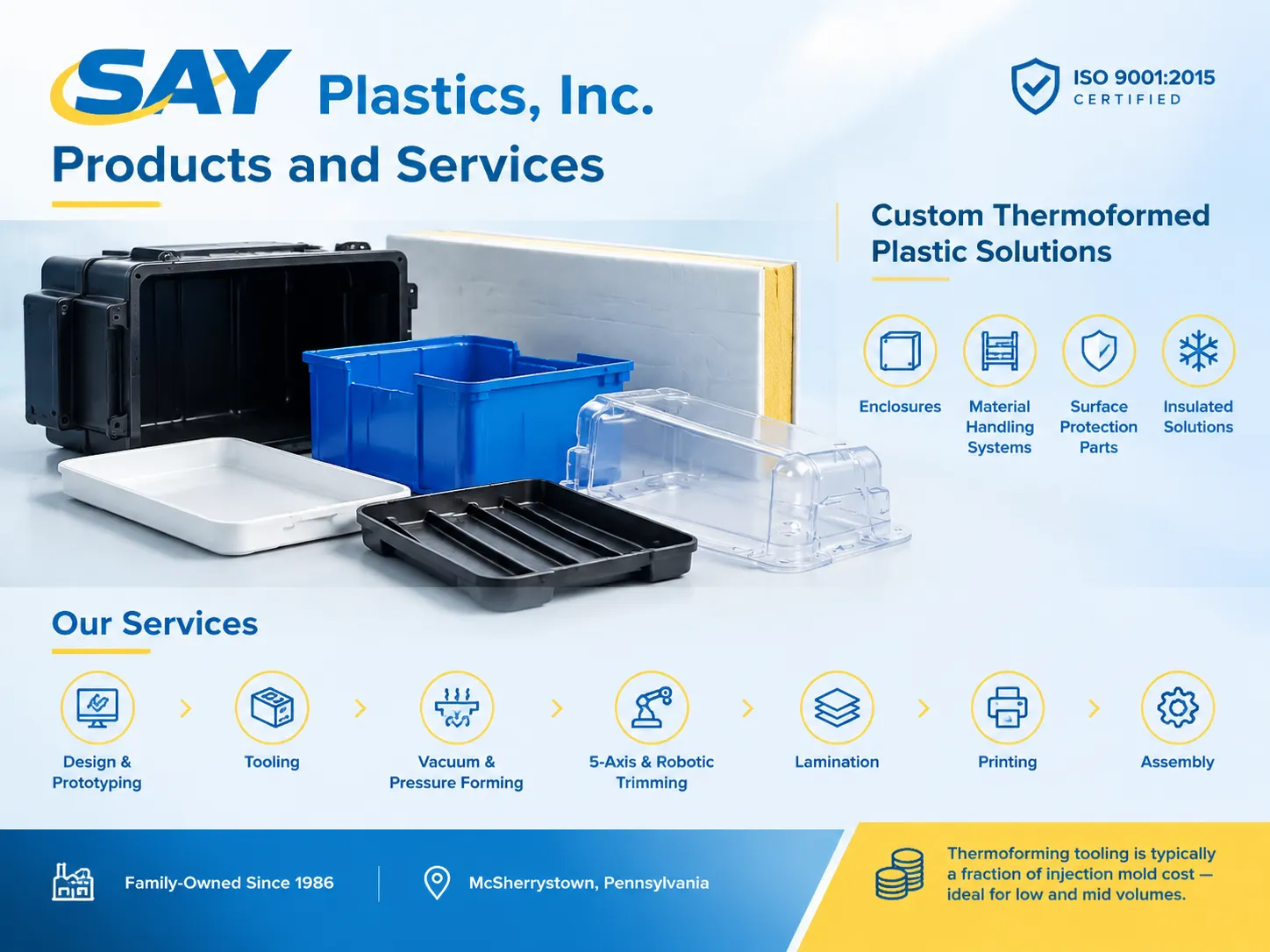
In short, SAY Plastics, Inc. is a family-run venture that manufactures thermoformed specialty products since 1986 in McSherrystown, Pennsylvania. It is also certified in compliance with ISO 9001:2015 standards in the areas of design and thermoforming along with assembly of plastic products. It specializes in producing durable thermoformed goods in a variety of areas such as machinery for material handling, insulation, surface protection, and more. Those services range from design to prototyping, tooling, and printing. The company has no relation to Sajar Plastics which is based in Ohio. Due to the cost-effectiveness of thermoforming molds compared to injection ones, it should be used for small and medium manufacturing projects.
Company Snapshot
Before the capability detail, the facts that decide whether a supplier is even in the right weight class.
| Item | Detail |
|---|---|
| Full name | SAY Plastics, Inc. |
| Founded | 1986 |
| Ownership | Privately held, family-owned, second generation of the Smith family |
| Headquarters | 165 Oak Lane, McSherrystown, PA 17344 |
| Facilities | Two production sites in McSherrystown, PA |
| Employees | 11–50, with third-party estimates up to 99 |
| Estimated revenue | $10M–$25M |
| Certification | ISO 9001:2015 — design, thermoforming and assembly of plastic products |
| NAICS codes | 326199 (All Other Plastics Product Manufacturing), 541420 (Industrial Design Services) |
| Federal identifiers | SAM.gov UEI C4BKF13Z5NJ6, CAGE code 3FP83 |
| Patent record | US 5,205,410, loose-egg transport panel, granted 1993 |
Two of the lines mentioned above deserve to be highlighted from many others. If the ISO 9001:2015 scope talks about design and assembly and not just forming, it’s of great importance because it implies even the design responsibility can be taken by the supplier and the task won’t fall back on you. The 11-50 employees range gives you an honest reason to trust the shop, as you’ll work with engineers who are aware of your part, rather than talking to someone from the call-centre.
Products: What They Actually Make
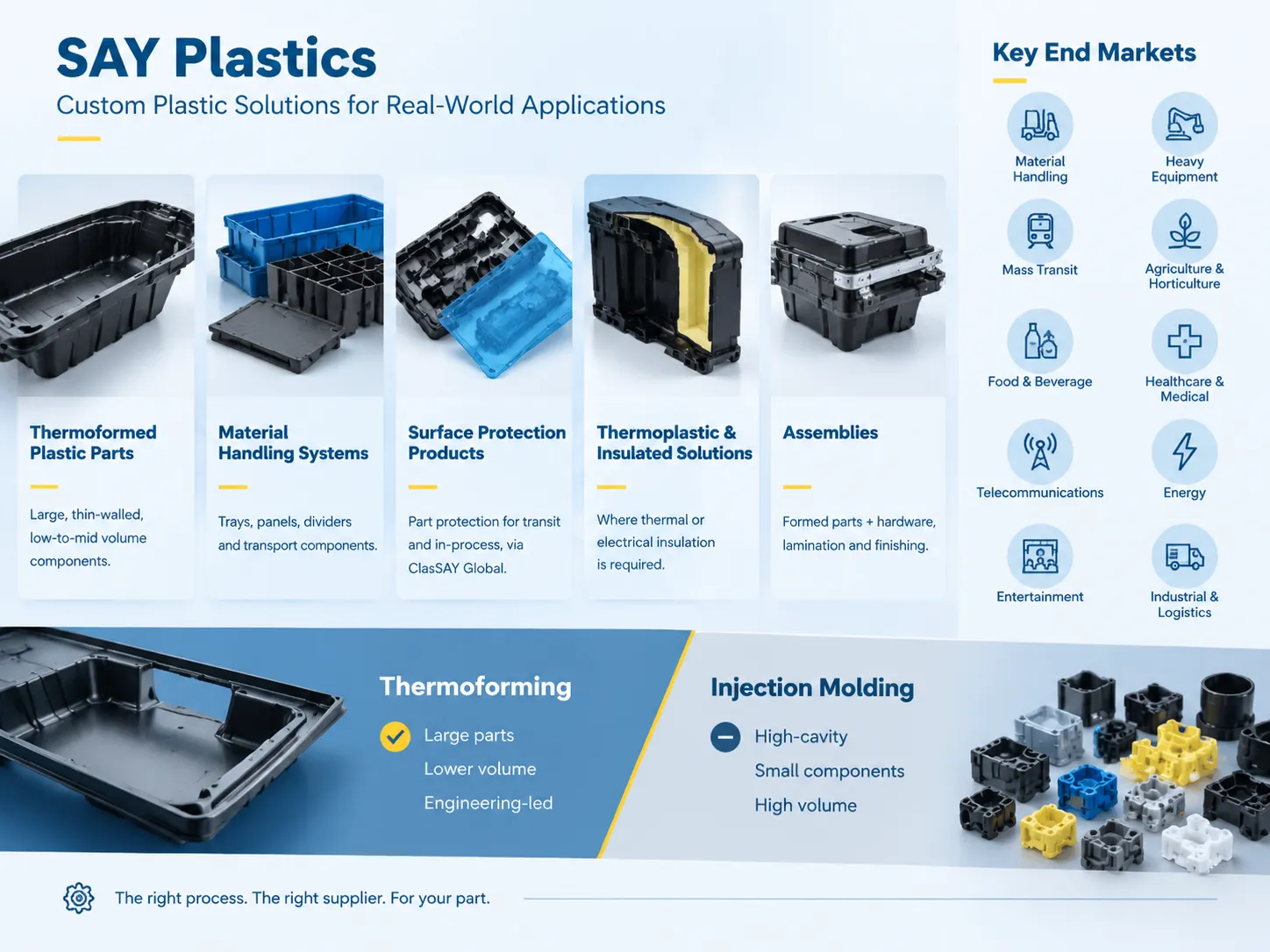
The product line offered consists only of four main product categories along with a service associated with surface protection.
- Thermoformed parts — the main line of business. In this process, thicker components are produced from sheets of material instead of injection. This method is appropriate for the production of parts that are large, flat, and composed of few details.
- Material handling systems — trays, panels, and dividers produced using this technology, and according to the patent history of the company, there is an extensive experience in making such products.
- Surface protection systems — protective means allowing safe transportation and making sure that parts do not get damaged during production operations. This group is also part of the ClasSAY Global group of services designed primarily for the automotive industry.
- Thermoplastic and insulated thermoforming — products where insulation is a required yet not optional characteristic.
- Assemblies — formed products along with hardware, lamination, finishing, and ready-made components.
- The targeted markets belong to those sectors where metal parts are either too costly or too heavy without a valid reason — handling of materials, construction, transportation and logistics, food and beverage industry, medicine, communications, energy, public entertainment, etc.
This indicates that the current project belongs to the opposite side of the spectrum compared to high-cavity injection molding. Volume injection is a different discipline with a different tooling investment and a different supplier set; the landscape on that side is mapped in our overview of the largest plastic injection molding companies in the world, and if your part is a high-volume small component, that is where it belongs.
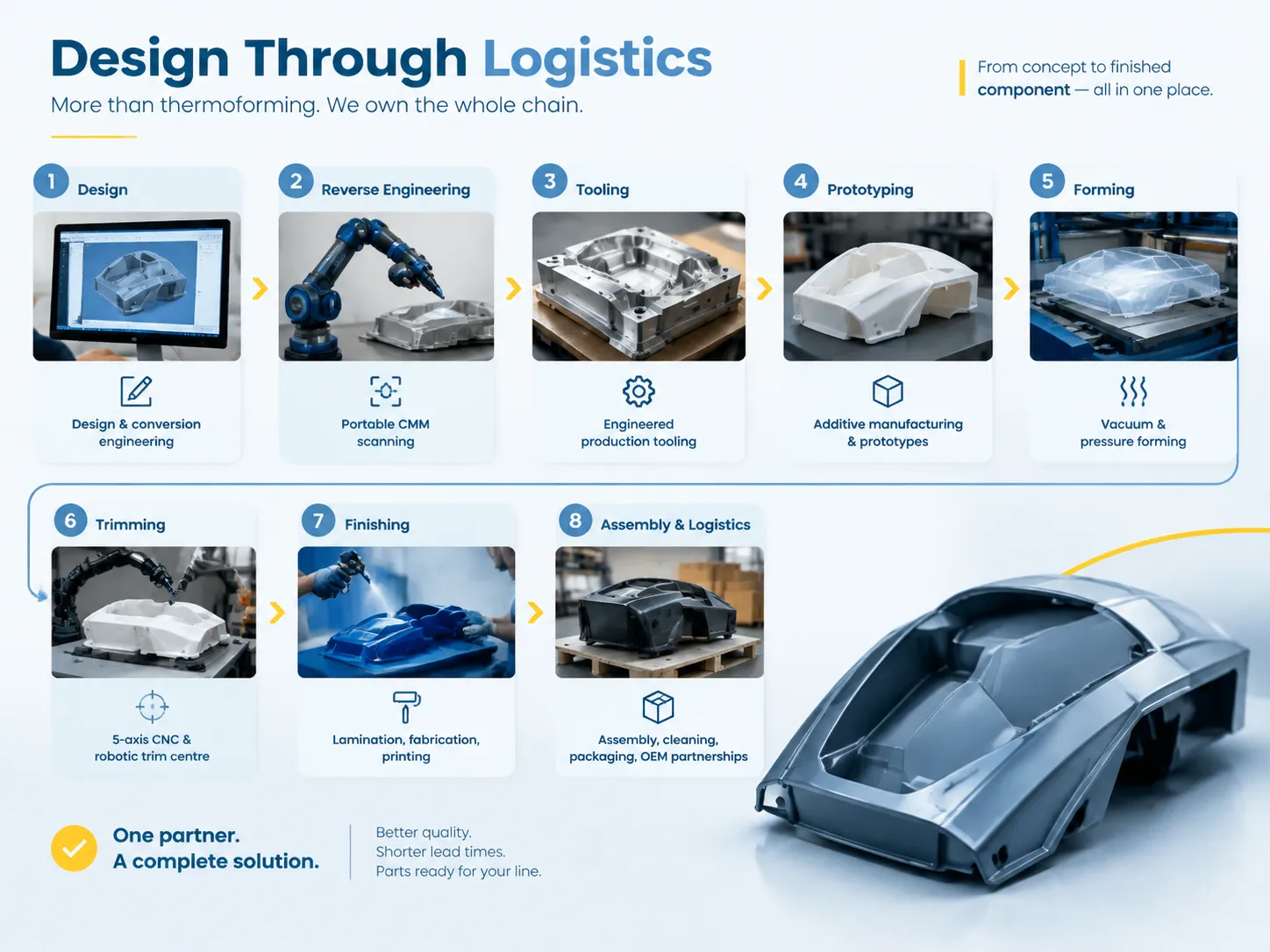
Services: Design Through Logistics
What separates a thermoformer from a plastic fabricator is how much of the chain it owns. SAY Plastics covers most of it.
| Stage | Service | Why it matters to a buyer |
|---|---|---|
| Design | Design and development, including conversion engineering | Draft angles, draw ratios and radii are decided before tooling is cut |
| Reverse engineering | Portable CMM (FARO arm) scanning of metal or FRP parts | A physical legacy part becomes a digital model without drawings |
| Tooling | SAYtooling system, engineered production tooling | Tooling cost and lead time are the main reason thermoforming is chosen |
| Prototyping | Prototype development and additive manufacturing | Validates shape, material and fit before production tooling |
| Forming | Vacuum forming and pressure forming | Pressure forming adds surface detail and sharper features |
| Trimming | 5-axis CNC trimming and a robotic trim centre | Trim accuracy after forming is where most thermoform scrap is generated |
| Finishing | Lamination, fabrication, silk screen printing | Colour, texture, graphics and bonded features in-house |
| Assembly and logistics | Assembly, cleaning, packaging, OEM partnerships | Ship a finished component, not a formed shell |
Robotic trimming centre is worth special notice, since trimming is one step of the process that determines yield. Formed parts leave irregular-edged tooling, and what is done to that edge not only affects dimensional consistency but also scrap rate. Automated trimming minimizes variances between the first and thousandth part, which is just what an OEM assembly line requires.
Assembly is the other service that changes the value of the order. If the supplier can bond, print, laminate and pack, the part arrives ready for your line instead of arriving as raw stock — the same logic that makes automatic assembly machinery worth installing in the first place, as described in this look at what a custom automated assembly machine manufacturer actually builds.
The “Metal to Plastics” Conversion Service
This is an important aspect of SAY Plastics’ offering, and it is also good to understand it in depth as it is actually the simplest form in which one can express the competitive advantage of the company.
This is a clear proposition: take a sheet metal or FRP part, re-engineer it into thermoformed plastic, and pocket the difference. The process consists of five steps: testing the current design, choosing the material, optimizing the design, testing the prototype, and creating the production tool along with quality control. If no CAD exists, the FARO portable CMM measures the geometry of the existing part.
The benefits claimed are typical of the approach taken, and the claims are valid: the weight is diminished, the production costs are lower than those of metal processing, even complex forms can be produced with one process and there is no corrosion or rust or peeling paint. The only limitation is structural and temperature sensitivity. Thermoformed plastic cannot be used as a substitute for a steel load-bearing bracket, and it will not survive extreme temperature. If the part is not a load-bearing member, then the technology is successfully utilized.
This calculation is worth making if you are an OEM with a mature metal-based product for any component that is large, has little to medium production volume, and is not critical from a structural view point. In most cases, it will be the cheapest engineering solution available.
Materials and Processes, and How They Compare
So, SAY Plastics specializes in plastics produced from thermoplastics, such as polyethylene and TPO, which comprise a large part of their products. In this regard, the specific method used by the company is the most significant factor in deciding its production process, so it will be useful to outline the two main methods to make a comparison.
| Factor | Thermoforming (vacuum / pressure) | Injection molding |
|---|---|---|
| Tooling cost | Low — typically a fraction of injection tooling | High — hardened steel or aluminium molds |
| Tooling lead time | Weeks | Typically several months |
| Economic volume | Low to mid — single digits to low tens of thousands | High — tens of thousands upward |
| Part size | Large panels and shells are practical | Size limited by press tonnage |
| Wall thickness | Relatively uniform, set by sheet gauge | Ribs, bosses and variable sections are easy |
| Detail and tolerance | Moderate; pressure forming improves surface detail | High, tight tolerances repeatable |
| Design changes | Cheap to make before tooling, expensive after | Expensive; often needs a mold modification |
The basic rule of thumb is that thermoforming is the best option economically when the annual volume is small enough that the cost of the making of an injection mold would be prohibitive, or if the part is too large to be practicable for making an injection mold. On the contrary, if the part is a small, intricate one, produced in high volume and with exacting tolerances, injection molding is the best option.The fundamentals of the second route, including cycle, tooling and defect behaviour, are covered in our guide to what injection molding is and how the process works — and note the contrast in tooling economics, because that is the number that should drive the decision.
Where They Sit in the Market
The practice of custom thermoforming in the USA is not a simple process; it is made up of small businesses depending on the location in which they operate, as they employ between 10 and some hundreds of employees and appeal to their clients through engineering support and tooling economics rather than by offering the lowest price.
There are two important facts that need to be mentioned.
The first fact is that SAY Plastics and Sajar Plastics should not be confused. Even though the names sound similar, the companies being named are not the same. While SAY Plastics is a thermoforming company in McSherrystown, Pennsylvania, Sajar Plastics is located in Ohio and specializes in custom injection molding.We have written about Sajar Plastics and its injection molding business separately, and if you are sourcing a part, checking which of the two processes your design actually needs is the first step, not a formality.
The scale of operations is intentionally kept at a moderate level. With a total employee count falling within the range of 11 to 50 and having two production units situated in Pennsylvania, SAY Plastics is not ready to undertake a project that requires a plant that is entirely devoted to a single client. This is a constraint for manufacturers engaged in high production volume and a benefit for others because smaller businesses are known to give equal amount of engineering time and effort according to the assignments.
Another important piece of information has to do with the place of such supplier within the larger supply chain. Manufacturers making thermoformed products usually belong to tier two of the supply chain meaning that the products supplied by them might find their way into a machine that has been assembled using an automatic production method.
Tooling and Lead Time Expectations
The present paragraph is intended for the reader’s consideration prior to undertaking scheduling. The figures presented below are representative ranges for heavy-gauge thermoforming tooling but not quotes and they are subject to change depending on the part size, material, quantity, and the requirement of the pressure forming process.
| Item | Thermoforming | Injection molding (comparison) |
|---|---|---|
| Tooling investment, simple part | Low single-digit thousands USD upward | Often five figures upward |
| Tooling investment, large complex part | Low-to-mid five figures USD | Six figures is routine |
| Tooling lead time | A few weeks | Several months |
| Bridge tooling | Common and cheap for pilot builds | Expensive; aluminium bridge tooling is a compromise |
| Design change after tooling | Moderate on aluminium tools | Usually a mold modification or a new mold |
For a pilot build or a low-volume programme, that gap is the entire business case. The same tooling economics explain why injection molds are quoted so differently across suppliers and finished-part complexity, which is covered in this description of our MCB injection mold development and production programme — the tooling cost and cycle time live in the mold design, not in the machine.
How to Evaluate Them as a Supplier
List of things to do that help your RFQ not go off track and thus makes the whole process smoother for any custom thermoformer.
- Verify whether the process is actually applicable to the part that you need to manufacture or not. Get such parameters as the size of the part, wall thickness, estimated yearly output and whether or not pressure forming is needed for your final result.
- Find out who the owner of the design is. For example, if you want the contractor to re-design the part, it is necessary for the relevant ISO 9001 scope to include the design part as it happens with SAY Plastics. If there is no such situation, you will have to take all the responsibility for design.
- Get to know the costs and time that will be needed to develop necessary tools before the budget for the project gets approved.
- Clarify whether trimming will be taken care in-house and which equipment will be used. If trimming is taking place by an outside third party, your supplier will not be able to control the manufacturing process properly.
- Make sure to define the materials you will use by their grade and not a name of their family.
- Clarify whether the tools will be returned after the job is done.
FAQ
Who owns SAY Plastics?
SAY Plastics is a company that is owned by the family and is privately owned, which means that it is in the hands of its second generation. The company was founded in 1986 in McSherrystown, Pennsylvania, where it continues to operate two locations. The company is not publicly traded and does not have a parent company.
What is plastics manufacturing?
Polymer raw material is changed into finished products, therefore, it incorporates various processes but it is not just one of them. The main processes are injection molding (where liquid plastic is injected in a mold that is closed in order to produce many complex items), thermoforming (where a thin sheet is heated and pressed over a mold), blow molding (used to make hollow products, e.g. a bottle), extrusion (to produce continuous sections with the required cross-section) and rotational molding (producing hollow objects). SAY Plastics is engaged in the thermoforming method complemented by CNC trimming, lamination, printing and assembly.
What are some common plastics used in manufacturing?
The major plastics that are used are polypropylene and polyethylene. Whether it’s polypropylene or polyethylene which includes LDPE or HDPE, they are used primarily for containers, covers, panels, and parts for handling materials. ABS is something that is used where you need to have impact resistance and appearance. Polycarbonate handles applications that need optical clarity as well as toughness. PVC is used for making pipes and profiles; nylon (PA) is used for gears, bushings, and cable ties; TPO and TPE are used for automobile applications and for parts which have the feeling of softness. SAY Plastics works primarily with thermoplastics including TPO and polycarbonate. When choosing the plastic to work with, some factors have to be taken into consideration such as temperature range, chemical exposure, ultraviolet exposure, impact requirement, and whether the part that one is going to make has a structural function.
What is the most commonly used manufacturing method for plastics?
Injection molding is by far the leading technique throughout the whole industry in terms of value produced, due to the massive number of small, highly detailed components with high production quantities. Thermoforming, extrusion, and blow molding all have their own niches, with thermoforming mainly employed for large volumes of sheet-like structures like panels; extrusion for long lengths of consistent shapes like sheets, pipes, and profiles; and blow molding mainly for hollow parts. So the process used is determined by size, shape, and amount produced rather than by the overall importance of each process.
Does SAY Plastics do injection molding?
No. SAY Plastics is a contractor involved in thermoforming and assembly, which operates several processes such as heavy-gauge forming, pressure forming, trimming by CNC or robots, lamination, printing, and assembly, in addition, to providing metal-plastic conversion services. Injection molding is a different operation and requires different tools and is hence done by another category of suppliers. If your part is a small component produced in high volume by injection molding, it should be produced by an injection molder and not by a thermoformer.
Can a thermoformed part replace a metal part?
Most likely, however, if it is a covering, clad, shroud, case, or transport element rather than a structural component. The common benefits are reduced weight, lower tooling and production costs, more freedom in design and shape, as well as the absence of corrosion, rust and painting. The drawbacks are the reduction of stiffness and failure of high-temperature. SAY Plastics turned this into a commercial transformation service, including 3D scanning of the current metal part by means of CAD.
References
- SAY Plastics, Inc. — thermoformed plastic components and assemblies
- We Make It Here Supply Chain Directory — SAY Plastics company profile
- NAICS Association — NAICS 3261, Plastics Product Manufacturing
- ISO — ISO 9001 Quality Management Systems
- Plastics Industry Association — industry data and process reference
Conclusion
As pointed out by SAY Plastics, the company benefits from its limited facilities. The company runs two manufacturing plants in Pennsylvania, has a small workforce, and possesses ISO 9001:2015 certification, which certifies quality from product design to delivery. Still, SAY Plastics lacks capabilities needed for engaging in a large-scale project for one client. On the contrary, the company does have the capability of dealing with complicated objects featuring small production volumes as it knows the technology, has the original metal object scanned, provides the service within a few weeks, and produces all necessary tools.
If you consider partnering with SAY Plastics, some recommendations can help you. First of all, find out whether your object can be manufactured by the process of thermoforming, which requires that the object be large and not subjected to certain pressure and technical requirements. When this is done, you should get a written confirmation of the costs prior to entering into a contract. Finally, you should keep in mind that even if the names of SAY Plastics and Sajar Plastics are similar, these companies are completely different.