benlong


Top 10 MCB Components Manufacturers in the World
There are many different manufacturers of class 2 circuit breakers in existence. Several manufacturers of high-quality and low-quality class 2 circuit breakers exist. However, there are also a number of manufacturers that sell both high and low-quality products.
An overview of the ten manufacturers that most people consider to be the most knowledgeable in this area is provided below. We included these manufacturers for the following reasons:1.Each Manufacturer Has the “Right Fit” For Your Product;2.Each Manufacturer Is Known For Their Equipment And Technology;3.Each Manufacturer Has A Proven Track Record;4.Each Manufacturer Has A Proven Reputation.
The Ten, and Where Each One Sits
Below is a list of the manufacturers that met the four criteria for inclusion in this list. If you are interested in purchasing a circuit breaker from any of these manufacturers, you will find valuable information on their websites.
- Arcata
- Alstom
- BayLynx
- Crompton
- Eaton Corporation
- Emerson
- Schneider Electric
- Siemens
- Wolfberg Associates
- Harris Equipment
The organization needs to manufacture a part that is within an MCB. In addition, it will need to supply parts that can be purchased by companies outside of the MCB manufacturing organization, either through trade or by selling directly to other circuit breaker manufacturers. In order for buyers to obtain technical specifications that will allow them to advertise products accurately, sufficient technical data needs to be published. In addition, in order for the buyer to advertise his/her product using the MCB manufactured part, it must be commercially viable. While some vending companies will manufacture parts and sell to their own internal manufacturing organizations, this will also eliminate many larger manufacturers that sell parts through other means.
Many of the manufacturers from Tier 1 manufacturers have in-house manufacturing of bimetals and contacts, with only raw material being purchased by these manufacturers for use in their manufacturing processes. Buyers seeking a second source of supply would generally speak to a specialty materials company.
This list of manufacturers is intentionally a mix of both; there are five circuit breaker manufacturers that have in-house component manufacturing, which is the largest segment of the global MCB component market, as well as five material/piece part suppliers that sell through trade channels. Buyers that are purchasing a specific piece part for their product need to seek out the second group, whereas buyers that are benchmark testing a completed product would need to be in contact with the first group.
What an MCB Is Made Of, Part by Part
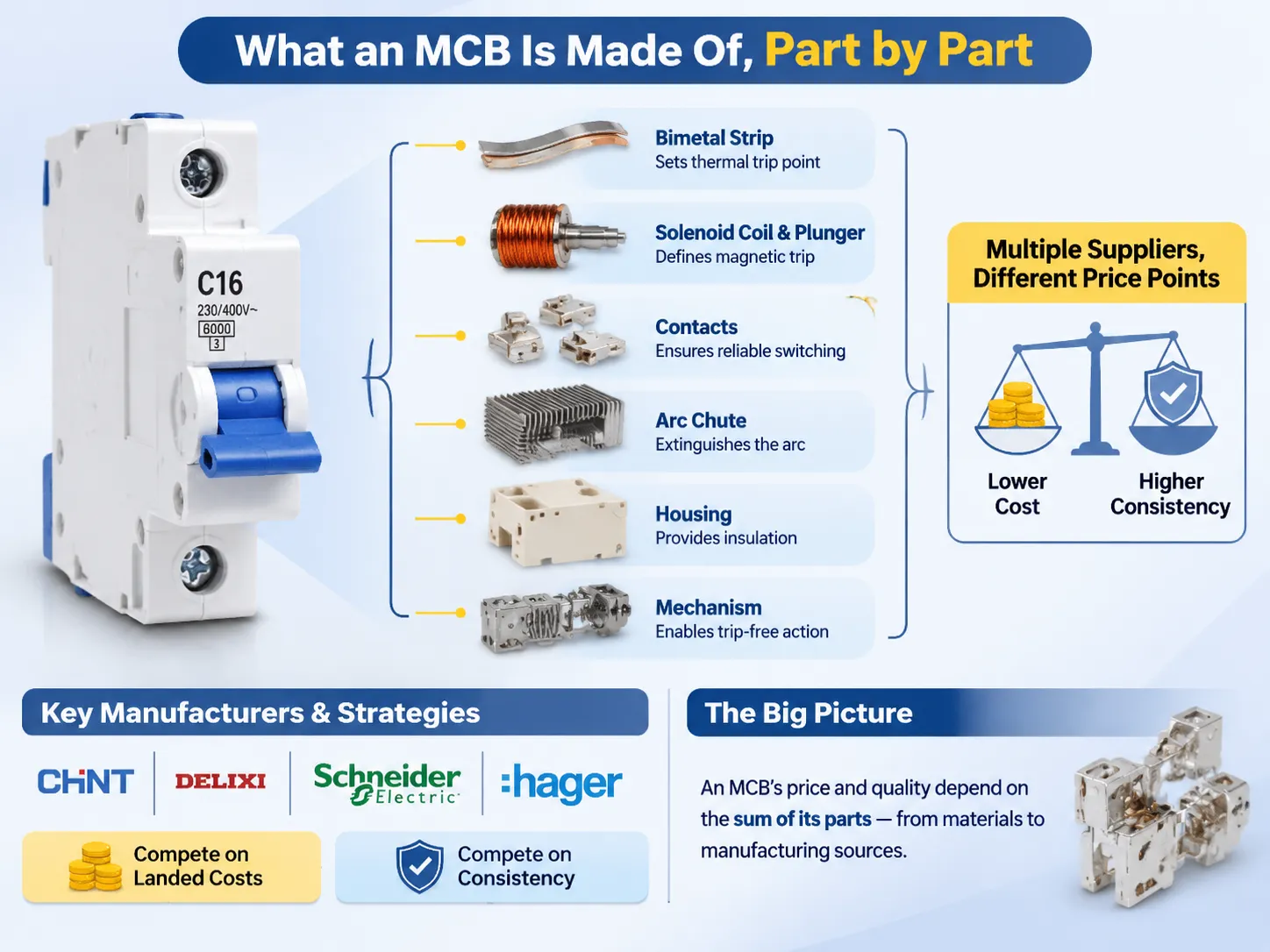
Six separate assemblies make up an MCB, which comes from various supply bases, thus causing differences of as much as three to one on pricing for what may seem to be the same item.
Supplies for parts of a circuit are made up of either preset components or manufactured. Circuit breakers will have either preset or manufactured supplies depending on the manufacturer. All circuit breakers have common components and all manufacturers offer a standard assembly of those common components to meet the needs of their customers.
Examples of parts of a component include the following:
| Assembly | Material | What it decides | Supply base |
|---|---|---|---|
| Bimetal strip | Thermostatic bimetal, copper or nickel alloy | Thermal trip point and its stability over 10,000 operations | Specialist strip mills |
| Solenoid coil and plunger | Enamelled copper wire, soft iron | Magnetic trip threshold, the B, C or D curve | Coil winders, often in house |
| Contacts | Silver nickel, silver tungsten, silver graphite | Contact resistance, weld resistance, life under load | Precious metal specialists |
| Arc chute | Zinc-plated steel plates, 7 to 11 per stack | Arc extinction and the rated short circuit capacity | Stamping shops |
| Housing | Thermoset BMC or phenolic, sometimes thermoplastic | Glow wire performance, dimensional stability, creepage | Moulding compound makers |
| Mechanism | Spring steel, acetal mouldings | Trip-free action and operating life | In house or contract |
The parts or components listed above are common components of the assembly of circuit breakers, however, each manufacturer has different price points for each common component. The price that a manufacturer charges for its component relates to the price charged by the industry for similar components (which is referred to as the price point). Each manufacturer’s price point relative to other manufacturers will determine the market share of that manufacturer’s circuit breakers.
- Price position is determined by all components in the assembly of the circuit breaker that a manufacturer makes.
- The assembly of circuit breakers with standard parts listed above and other common components is where each manufacturer’s price will be established.
- Each of the components listed above is how each manufacturer will be designated by the industry. Each component listed above will also determine the price position of each manufacturer within the industry.
- The integrity of the assembly’s manufacturer and price point will also determine each manufacturer’s price point.
- A component will be listed in a manufacturer’s catalogue as to the price of that component.
| Company | Location | Specialization | Price position |
|---|---|---|---|
| Chint | Wenzhou, Zhejiang, China | Complete device including contact materials, bimetals, mouldings, and stampings manufactured in house | High volume/Lowest landing costs |
| Delixi | Wenzhou, Zhejiang, China | Complete device with component manufacturing (stamping and moulding) done in house | High volume/Similar to Chint |
| Hager | Blieskastel, Germany | Manufacture complete device with assembly of in-house mechanisms and contacts | Premium European Brand |
| LS Electric | Anyang, Korea | Manufacture complete device and produce components in house | Mid to Premium Brand |
| Umicore | Brussels, Belgium | Manufacturer of silver contact materials and brazing alloys | Fabrication premium |
| Alleima, Kanthal | Sandviken, Sweden | Manufacture bimetal strip for thermostats | Fabrication premium |
| Heraeus | Hanau, Germany | Manufacturers of precious metal contact materials and tips | Fabrication Premium |
| Tanaka Kikinzoku | Tokyo, Japan | Manufacturers of precious metal contact materials and parts | Fabrication premium |
| Sumitomo Bakelite | Tokyo, Japan | Manufacturers of thermosetting moulding compounds for electrical housings | Fabrication Premium |
| Schneider Electric | Rueil-Malmaison, France | Manufacturers of complete device, with in-house components and published technical data | Premium Brand |
If you read this chart by columns only, note that the companies in the left column compete mainly on landed costs while those on the right column compete mainly based on consistency. The buyer who unknowingly combines these two aspects together may unknowingly be purchasing a device with contacts produced in Japan and housing compound manufactured in China, which are both acceptable products, provided that the specifications state so.
The Chinese Cluster and the Tier Structure Beneath It
The city of Wenzhou and its surrounding Yueqing district supply the largest number of miniature circuit breakers in the world. The component supply chain in Wenzhou is made up of hundreds of different suppliers rather than just one. An industrial avenue where a stamping facility, coil winding business, a contact welding company and three assemblers sell to an exporting customer base. Sellers within this industrial sector are independent companies that buy from one another.
The tier system of these companies is key for understanding pricing variances, which can sometimes seem random. The first tier includes Citizen, Delixi and other very large groups (with complete vertical integration, manufacturing tooling and conducting type testing to IEC 60898-1). Tier two consists of factory groups completing assembly (who buy contacts and bimetals, produce their own product designs using their unique moulder) and not operating a strip mill. Tier three consists of numerous job shops producing individual parts and selling them by the million to various manufacturers.
While a tier two manufacturing facility is able to manufacture product at a high level of quality comparable to a tier one manufacturing facility, a tier two facility does not provide, by and large, the same amount of completed type-tested product items, logical assembly process followed through all one million parts, and documentation for trace all manufactured items to utility customer specifications. This is what pricing indicates.
European and Japanese Suppliers: What the Premium Buys
European suppliers (Hager, LS Electric, Schneider) and Japanese suppliers sell their products for 2 through 4 times the price of comparable Chinese components, but it is not just the brand that you are paying more for; you are obtaining bulk as well as consistency of the materials manufactured for a strip or a compound between batches (consistency), material certificates for each lot and support data for all manufacturing using the components by their corresponding manufacturers.
The difference between materials used to make the contacts is measurable. A 90/10 nickel/silver, controlled grain structure tip has a stable contact resistance through 10,000 operations, while a cheaper tip with the same nominal composition may have significant drift due to porosity. Contact drift can create a situation in which a contact clips, which changes the thermal trip threshold of the device (e.g., a device that trips at 1.45 times rated current when it is manufactured can trip at as low as 1.30 times in two years).
When it comes to bimetallic strips, the premium paid for these products goes to the temperature stability of the products and tighter tolerances for resistivity. A bimetal strip is made from two different alloys that have different coefficients of expansion. When bimetal strips are manufactured, the calibration of the manufacturing equipment is based on the actual deflection of a given strip. If a given batch is 5 percent off of the standard calibration, the manufacturer will need to re-calibrate or live with a curve that is on the edge of the acceptable window.
Contacts and Arc Chutes: The Parts That Decide Performance
Contact parts and arc chutes are the primary components that determine how a circuit breaker performs.
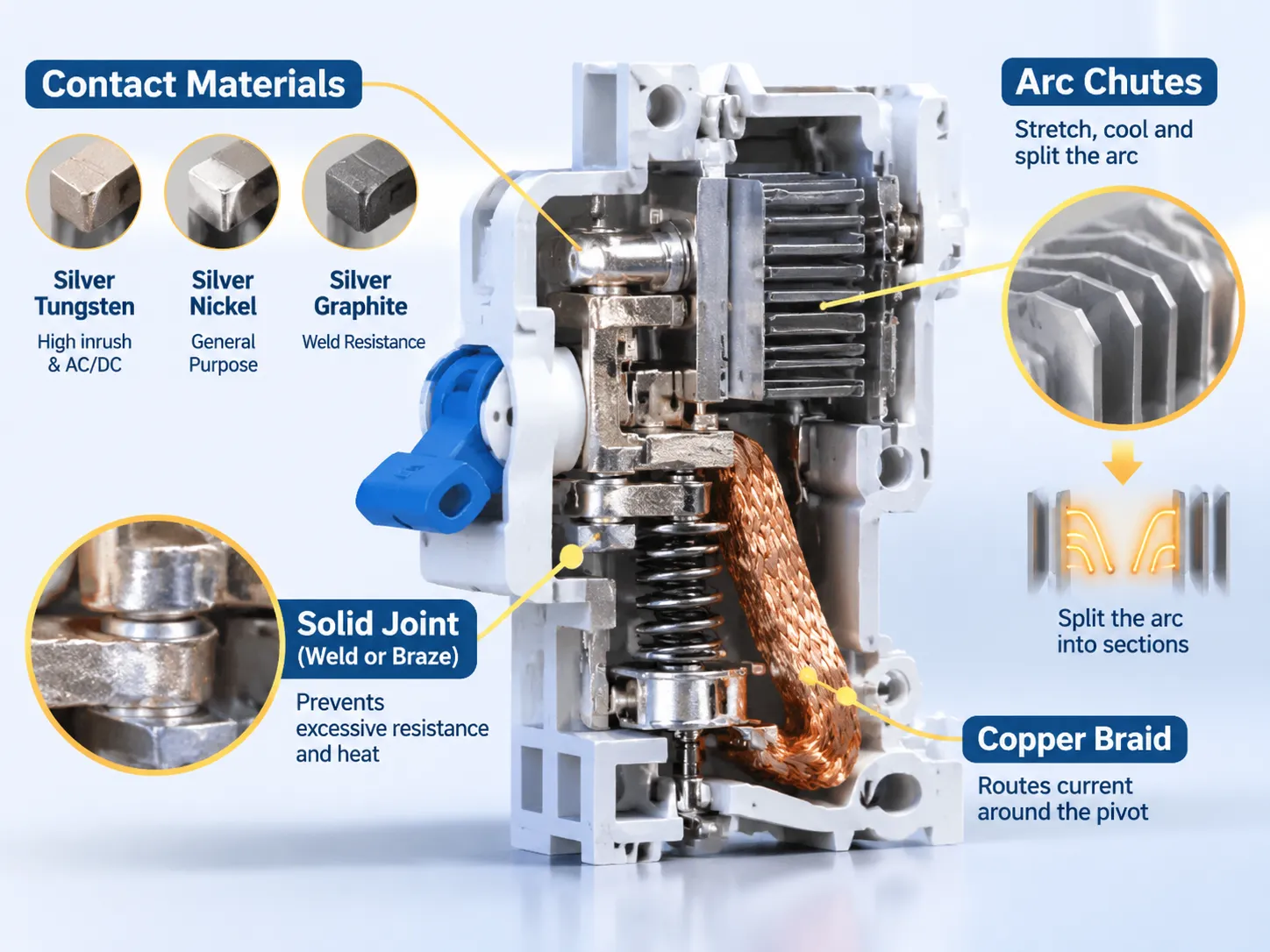
Contact parts determine two factors that customers care about: whether or not the product can withstand fault currents and whether or not it will weld shut due to the fault current. Silver tungsten is used in applications where high inrush current and/or AC and DC breaking currents are expected due to its resistance to welding and erosion. Silver nickel is used in general-purpose circuit breakers because it has a lower resistance than silver tungsten. Finally, silver graphite is used in applications where weld resistance is of greater concern than the life of the circuit breaker.
One of the most important manufacturing steps is the joint between the button and the contact arm (the point of contact). The method used to attach these components is either a resistance weld or braze. When there is a poor joint, resistance builds up, which creates heat. If the resistance at the contacts builds to a point where it begins to change the trip characteristics of the circuit breaker, it can create dangerous conditions.
Another reason for using copper braid in the moving contact assembly is that it allows current to flow around the pivot rather than directly through the pivot. A moving contact welding machine and the bimetal joint need to be the same on all units; the only way to achieve this in production is through machine brazing.
Arc Chutes serve a different purpose than moveable contacts. They are designed to stretch and cool the arc, then split the arc into separate sections before the current reaches its peak value. The number of plates, spacing of plates, and circuit breaker design determines the rated short-circuit rating of an MCB. The difference between a 6 kA and 10 kA rated device in the same family will be most evident in the stack.
The Housing, and Why the Mould Decides the Cost
Moulded thermoset housing is used in most reliable circuit breaker devices. Generally, it is either a bulk moulding compound, or a phenolic, either of which can potentially withstand temperatures above 960°C and also does not sustain combustion. The two major tests are the glow wire test and the tracking resistance of the external surface, of which both must pass in order for a thermoset house to be used. Compared to an ABS plastic that may appear the same, moulding thermoset house would have a higher kilogram cost.
Where to calculate mould costs for this industry is at the mould production level. Mould producing 2-cavity moulds may require a significant investment, while a family of devices with different pole configurations will require additional moulds.
Therefore, a factory with a tool room can produce new variants in a matter of weeks while a trading company cannot, and the MCB injection moulding programme is usually the first plant to be implemented in the case of a new breaker plant.
The quality of the mould affects the wall thickness around the arc chute pocket, which is the one aspect that no inspector looks at; if a thin-walled part passes dimensionally, it may fail glow wire testing, which will only show itself at the certification stage as opposed to production. This is where failure is the most costly to identify.
Calibration: Where the Trip Curve Is Set
All MCBs are calibrated after they are assembled, and this is the process that gives them the defined curve. Each device is run at multiple times its rated current until the deflection of the bimetal at that time is adjusted – generally through setting a screw or cutting a calibration plate so that the trip time falls within the parameters of the defined curve.
The curves are narrow. C curve devices must trip between five and ten times the rated current magnetically and in the defined band thermally, while any production line that calibrates closer to the centre of the defined band, as opposed to the actual edge of the defined band, will create a product that achieves a tolerance of 10 percent versus that which drifts out of that window. The calibration machine and associated mechanics (including the two-point check for most lines) determine the way the setting is made and reviewed.
Lastly, the calibration stage is where problems can be found with prior manufacturing stages.A line that needs to expand its adjustment range has a different bimetal strip than what it was using before, and a line that experiences an increase in magnetic failures has an issue with the coil or armature gap moving. How a factory reads the signals sent by these two types of changes gives it an advantage over an assembly shop.
What a Component Costs, and What Sets the Price
The prices below represent indicative cost ranges for bulk purchases at the factory level, and all prices will fluctuate with demand for silver and copper. They can be used to check the validity of a supplier’s quote, but not for developing a cost estimate for a factory or plant budget.
| Component | Cost per unit | What moves the price |
|---|---|---|
| Bimetal Strip (Calibrated) | $0.05 to $0.15 | Alloy, Strip Tolerance, Calibrated or Not |
| Contact Tip (Silver Nickel) | $0.03 to $0.12 | Silver Content, Tip Mass, and Welding Technique |
| Solenoid Coil and Plunger | $0.10 to $0.25 | Wire Gauge, Turn Counters, Mechanical Finish |
| Arc Chute (assembled) | $0.05 to $0.12 | Number of Plates used, Electro Tubing and Splitter Design |
| Thermoset Housing set | $0.10 to $0.30 | quantity of Compound to use, Degree of Cavitation, and Amortisation characteristics of the moulds. |
| Mechanism Sub Assembly | $0.08 to $0.20 | Mechanical Characteristics of Spring, Trip Free Design, Assembly method: |
| Finished 1P 32A MCB, 6kA | $1.20 to $2.50 | Curve Types, Breaking Capacity, Certification, Packaging and Margin. |
The arithmetic that backs those figures explains a lot about why companies conduct business the way they do. Components make up between 40 percent to 60 percent of the value of the manufacturing cost of a piece of Equipment, Assembly and Testing account for about 20 percent to 30 percent, Certification Packaging, and Margins account for the rest. If a quote to you as a buyer is 40 percent cheaper than average market pricing for parts, their supplier is not supplying them at a significantly lesser price for the components.
By utilizing a more minor, shorter arc chute or lower-grade flame retardant (one type of flame retardant), one (1) or all of these options will appear in service.
Lead Times, MOQ and the Tooling Question
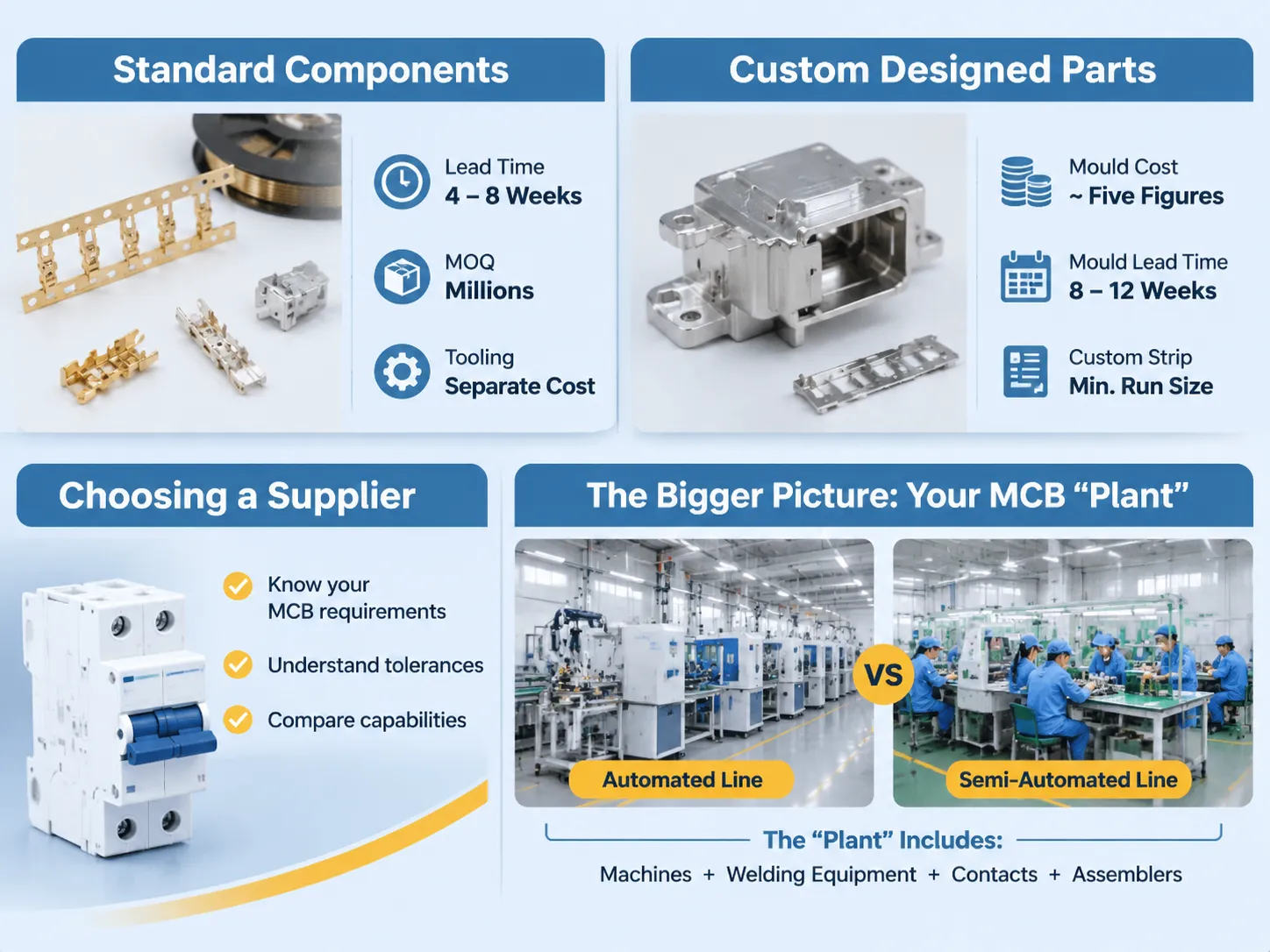
Lead Time, Minimum Order Quantities (MOQ) and the tooling question will be the same for all standard components. Standard components have a MOQ in order of millions, and the lead time is between four (4) to eight (8) weeks. The quantity associated with a MOQ, Depending on whether a standard component is being sold by the reel or box, Tooling costs are separate from MOQ; however, a quantity of contact tips sold would mainly be associated with quantity of contact points per order, with additional tooling costs charged per new designs on moulds.
For custom-designed parts, all of the math associated with standard parts will change. A customer who orders a new housing mould should consider the cost for the mould, which would typically be in the range of five figures (handling included), plus have the mould on-site for eight (8) to twelve (12) weeks. The customer would be charged for the mould, and the price will be either added to the order or a billable amount will be charged in advance. A custom bimetal will also require a strip mill run on its own, with an associated minimum run size that many small breaker manufacturers would be unable to absorb; typically, therefore, they specify a standard strip and do not design one.
The tooling ownership language is an important clause to discuss and agree upon prior to placing an order. Any mould paid for by a customer should specify the mould is owned by the customer, including the associated drawings, steel certificate, and a commitment to transfer the mould to the customer if they desired. Manufacturers that refuse to document this clause typically plan to use that mould for some other customer, and while they may have a legal right to sell it commercially, the customer for which a customer is using that mould has no legal recourse against that manufacturer.
Choosing by What You Are Building
Choosing a supplier is relative to the position of the customer based on the four different situations outlined below.
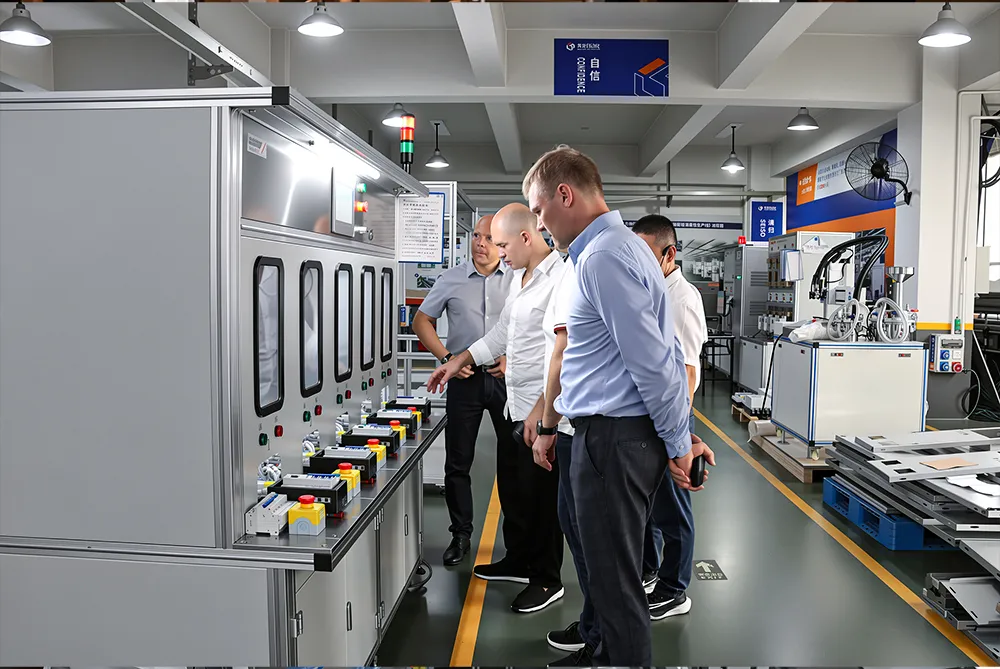
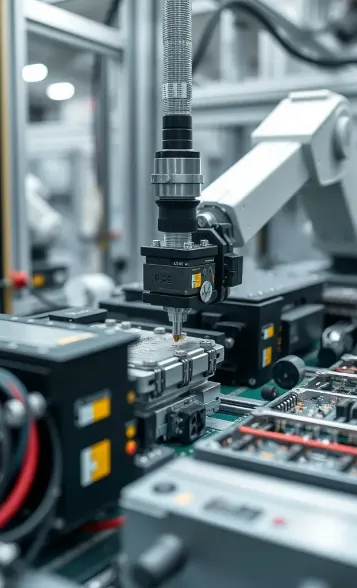
You have lots of MCB information that gives vendors the shock of their lives. The ‘plant’ for making MCBs is not just a building filled with machines, but rather it refers to the entire assembly and tolerance of the parts, i.e., the welding machine, the welding contacts and the assemblers are also a part of the plant. If you buy parts before you have established the tolerances of the line, you will probably buy them again. A picture of both automated and semi-automated MCB production shows how the “plant” will vary between the two.
Where Benlong Sits: The Machines Behind These Suppliers
Benlong manufactures all the manufacturing equipment for MCB vendors, including:
- bimetallic and moving contact welding machines
- arc chute assembly machines
- injection moulding machines
- calibration and test benches
- conveyor and inspection systems
There is only one reason why a buyer benefits from that position. The process that causes a device to fail a type test is usually due to drift over time, rather than from material being incorrect. The problem of drift is our side of the problem. A much more common cause of failure of contact resistance drift, calibration spread or arc chute misfeed occurs than the failure due to machine speed.
In terms of practical implications for the component buyer, the component specification will need to reflect the process window, as well as the drawing. A drawing of a contact tip showing composition and dimensions without reference to the welding method leaves the specification of the joint undefined; it is the joint which causes failure.
FAQ
Who are the largest MCB component manufacturers?
By volume, the vertically integrated Chinese breaker makers, led by Chint and Delixi in Wenzhou, make the most components because they consume them internally. Among companies that sell components to the trade, the largest are the silver contact material suppliers, Umicore, Heraeus and Tanaka Kikinzoku, and the thermostatic bimetal producers such as Alleima with its Kanthal range.
What are the main components of an MCB?
Bimetal strip, solenoid coil and plunger, fixed and moving contacts with a copper braid, arc chute, moulded housing, operating mechanism and terminals. The bimetal sets the thermal trip, the solenoid sets the magnetic trip, and the arc chute with the contact material sets the short circuit capacity.
How much does it cost to make an MCB?
Components account for roughly 40 to 60 percent of factory cost, and a finished 1-pole 32 A 6 kA device leaves a Chinese factory at about $1.20 to $2.50. Assembly and test add 20 to 30 percent, with certification, packaging and margin making up the balance.
Why is there such a price difference between MCB brands?
Four things: the contact material and its joint, the bimetal tolerance, the arc chute plate count, and whether the range carries type test reports. Two devices that look identical can differ by a factor of three in price because one has a thinner silver tip and a shorter chute.
References
- CHINT — Miniature Circuit Breaker Product and Technical Data
- Umicore — Contact Materials for Low Voltage Switching
- Alleima — Kanthal Thermostatic Bimetal
- Hager — Circuit Protection and Device Technology
- LS Electric — Low Voltage Circuit Breakers
Conclusion
The component question is really a question about which part you are buying. Contacts and bimetal decide the curve and the life, the arc chute decides the breaking capacity, and the housing decides whether the device passes a glow wire test. Everything else is assembly.
Two decisions carry most of the commercial risk. Whether the parts come from a specialist with lot certificates or from a job shop with a price, and whether the tooling belongs to you. Neither shows up in a sample, and both show up in the second shipment.