benlong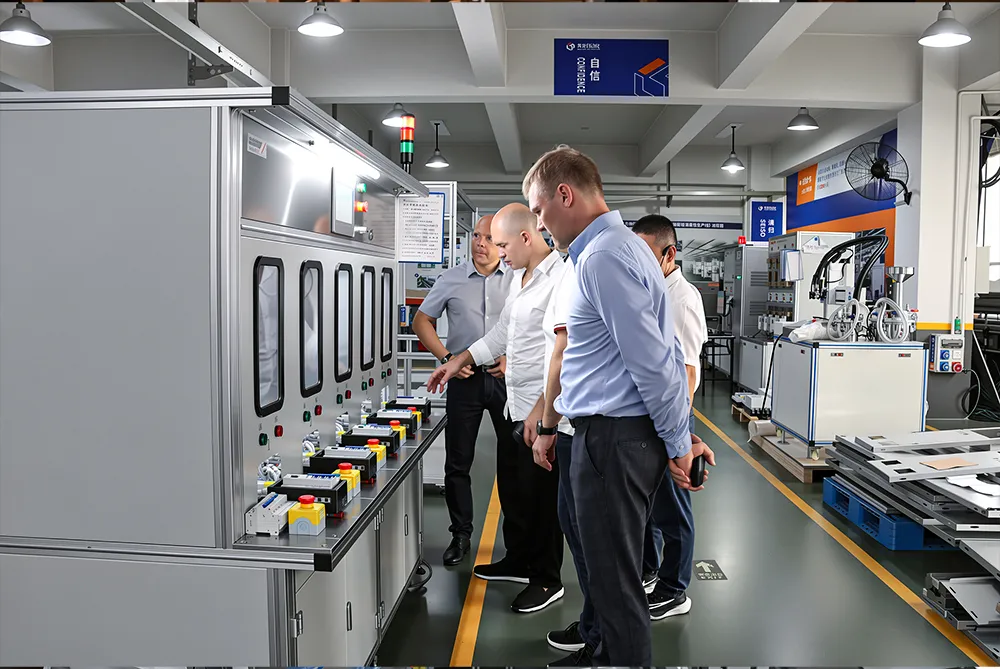

Automated and Semi-Automated MCB Production: Buyer’s Guide
Published: July 30, 2026 | By Huang Xiaolei
New manufacturers entering the miniature circuit breaker (MCB) market often show keen interest in automated production but frequently lack the relevant experience. Upon consulting industry suppliers, they are typically presented with two options: automated and semi-automated MCB production.
This guide provides an in-depth analysis of the fundamental differences between manual, semi-automated, and fully automated MCB assembly and testing lines. It outlines the ideal use cases for each model and offers a phased implementation roadmap to ensure that initial investments in automation align with actual order requirements. Our goal is not to sell you the most high-end equipment, but to help you select the production solution that best suits your needs.
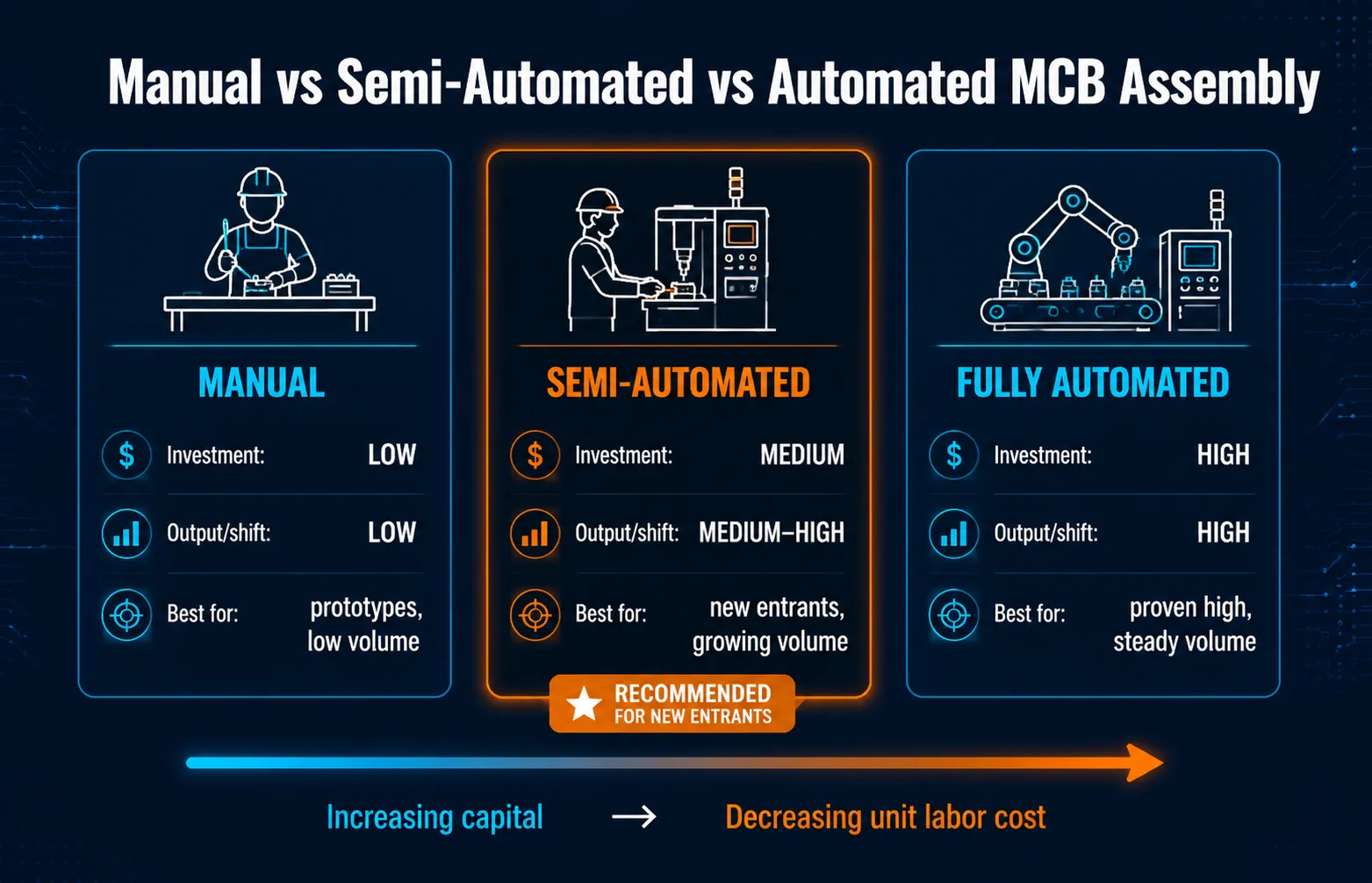
The Three Production Modes in MCB Assembly and Testing
Almost all miniature circuit breaker (MCB) factories worldwide employ one of the following three models—or a combination thereof. The three most common combinations are:
· Manual assembly – Manual testing
· Manual assembly – Semi-automatic testing
· Manual assembly – Fully automatic testing
Manual assembly, as the name implies, involves workers assembling all MCB components at a fixed workstation.
Manual testing entails a worker manually establishing an electrical connection between the testing instrument and the MCB, then observing the instrument’s feedback.
Semi-automatic testing involves the machine automatically performing the test, while the worker is responsible only for loading and unloading the MCBs.
Fully automatic testing refers to a system where the machine automatically moves the product into the testing station, discharges it in sequence upon completion of the test, and repeats the cycle.
Manual MCB Assembly: Where It Still Makes Sense
Manual assembly is the most traditional method, yet it remains a viable choice for certain enterprises. This is because properly trained workers are inherently more adaptable than machines when handling a wide variety of complex products, allowing the same assembly line to switch production seamlessly in response to changing orders.
However, the primary limitation of manual assembly is that product consistency relies heavily on the workers’ adherence to operational standards. Without strict process control, it is often difficult to ensure identical contact pressure or spring tension when two different workers assemble the same circuit breaker.
Semi-Automated MCB Assembly: The Pragmatic Middle Ground
Semi-automated assembly generally refers to a process where the magnetic trip set, thermal trip set, and mechanism assembly of an MCB are manually installed into the MCB base, while the remaining components are assembled by machine.
Currently, this is the most common type of MCB assembly line on the market. It is particularly prevalent in China and India—countries characterized by large populations, relatively low labor costs, and lagging standards regarding labor rights. Whether visiting major global corporations like Schneider, ABB, and Legrand, or local manufacturers in China and India, one will find that in seven out of ten factories, the shop floors are continuously operating with assembly lines that combine manual labor and machinery.
Fully Automated MCB Assembly
With the exception of the minimal manual assistance required for the initial feeding stage, the fully automated MCB assembly line represents the most efficient production configuration; after all, even the most capable workers require rest. While some factories employ a two-shift system to maintain round-the-clock production, this not only doubles labor costs but—as previously mentioned—makes it difficult to ensure consistent assembly quality. In contrast, a fully automated assembly line can operate continuously for over 20 hours while guaranteeing highly consistent precision in the assembly of every component.
Possessing one or more fully automated assembly lines serves as a powerful testament to the sales performance of a factory—and the enterprise to which it belongs. For suppliers in the MCB automation industry, the ability to develop and customize fully automated assembly lines capable of stable operation is the ultimate proof of their technical prowess. I once visited the MCB production facility of the Slovenian ETI Group, where I observed a fully automated MCB assembly line and testing line; I was deeply impressed by the advanced level of technology achieved by developed nations in this field.
MCB Testing: The One Area You Should Automate First
If you automate only one part of your operation early, make it testing. A miniature circuit breaker is a safety device, and every unit must be verified before it ships. Manual testing is slow, and worse, it is inconsistent: a tired operator cannot reliably confirm trip time, dielectric strength, and contact resistance to the tolerances that standards such as IEC 60898-1 demand.
Automated MCB testing equipment changes this. An automated tester runs a defined sequence, typically covering calibration of the trip curve, overload and short-circuit trip verification, dielectric withstand (hi-pot), insulation resistance, mechanical endurance sampling, and marking, then automatically sorts pass from fail with a full data record for each unit. Automated circuit breaker testing equipment gives you three things manual inspection cannot: repeatable pass/fail criteria, throughput that keeps up with assembly, and traceable data you can show customers and auditors.
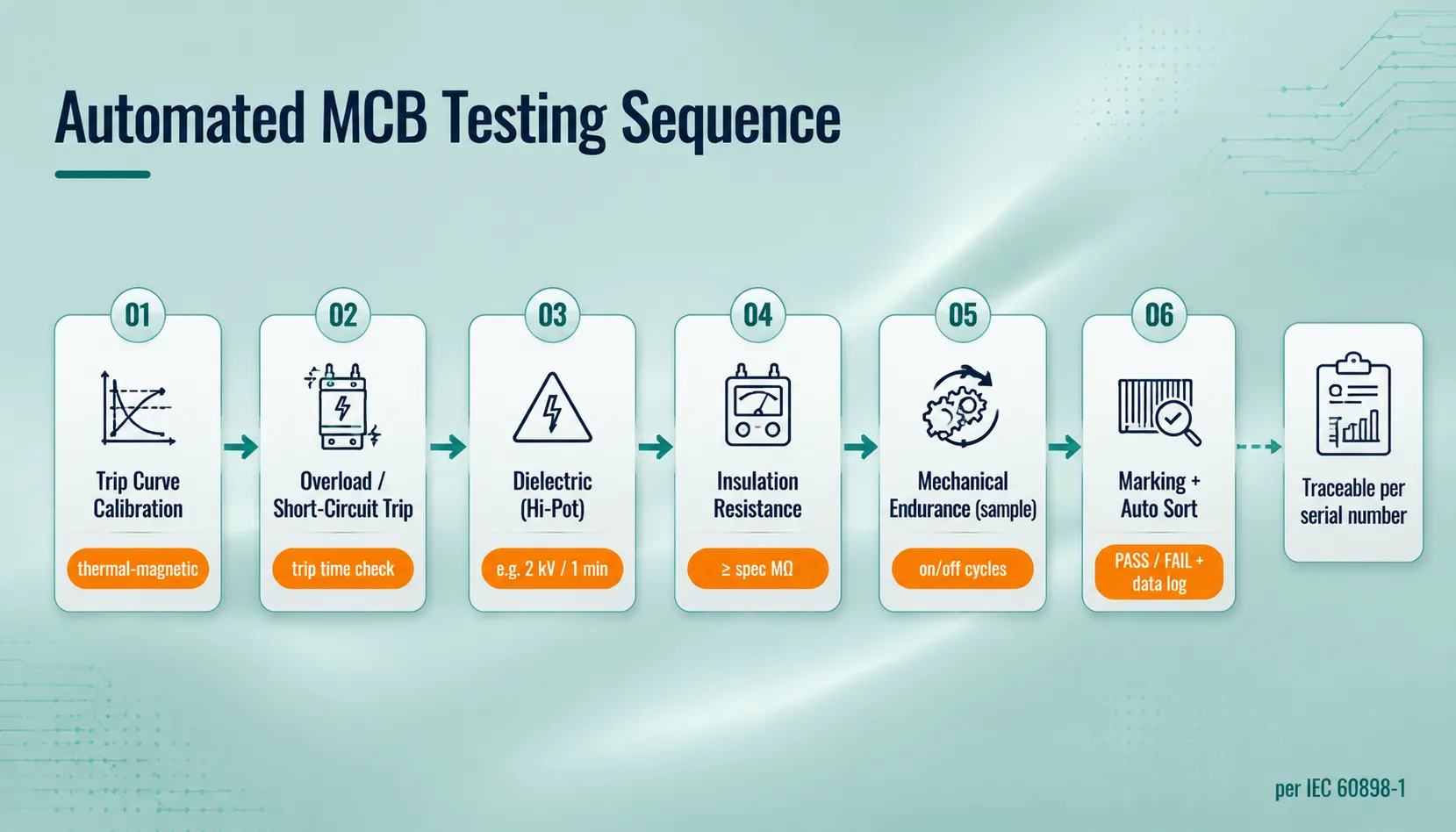
The data record matters as much as the pass/fail result. In global B2B tenders, procurement managers increasingly ask not just whether a breaker works, but whether you can prove it. Automated MCB testing equipment logs the measured trip time, dielectric result, and resistance for every serial number, so you can supply per-batch quality data, respond to a field complaint by pulling the exact unit’s record, and demonstrate process control during a customer audit. That traceability is often the difference between winning and losing a large order, and it is almost impossible to produce by hand.
This is why many new manufacturers pair a semi-automated assembly area with a more heavily automated testing section. Testing is where automation pays back fastest, because it converts directly into fewer field failures, fewer returns, and the documentation that wins B2B contracts.
How to Choose: Matching Automation Level to Volume, Labor, and Capital
There is no universally “best” mode. The right level of automation is the one that fits your numbers today with a clear path to tomorrow. Four variables decide it:
- Annual volume. Low and uncertain volumes favor manual or light semi-automation; high, steady volumes justify full automation.
- Local labor cost. The higher your fully loaded labor cost, the faster automation pays back.
- Product mix. A narrow, stable product family suits a dedicated automated line; a wide, changing mix suits flexible semi-automated cells.
- Available capital and risk appetite. Automation is a bet on future volume, so the money must be there and the demand must be credible.
The table below summarizes how the three modes compare on the factors that matter most to a first-time buyer.
| Factor | Manual assembly | Semi-automated assembly | Fully automated line |
|---|---|---|---|
| Upfront investment | Low | Moderate | High |
| Unit labor cost | High | Medium | Low |
| Output per shift | Low | Medium to high | High |
| Quality consistency | Operator-dependent | Good on automated steps | High and repeatable |
| Product flexibility | Very high | High | Limited to designed family |
| Best fit | Prototypes, low volume, custom variants | New entrants, growing or mixed volume | Proven, high, steady volume |
One warning worth stating plainly: do not choose your automation level from a competitor’s factory photo. A line that is right for a manufacturer shipping millions of identical breakers a year can bankrupt a new entrant shipping tens of thousands across several variants. Match the mode to your order book, your labor cost, and your product mix, not to the most impressive line you have seen. When in doubt, buy less automation than you think you need and leave room to grow, because it is far cheaper to add capacity to a semi-automated cell than to fill an empty automated one.
The Investment Case: CapEx, ROI, and Payback for New Entrants
Executives rightly judge automation as a financial decision, not a technical one. The core equation is simple: automation trades a large upfront capital cost for lower ongoing cost per unit. Whether that trade wins depends entirely on how many units you actually produce.
A useful way to frame it is the break-even volume. Below a certain annual output, manual or semi-automated work is cheaper per unit because you are not paying to keep expensive machines idle. Above that volume, the automated line’s low unit cost more than repays its capital. The mistake to avoid is buying capacity you cannot fill: an underutilized automated MCB assembly line can produce a higher cost per unit than a well-run manual shop, because depreciation and financing are spread across too few breakers.
For payback, treat it honestly. Add the machine price, integration, tooling, installation, training, and the cost of the learning curve, then divide by the annual saving in labor, scrap, and rework the automation actually delivers. For a well-matched investment, MCB assembly automation payback commonly lands in the range of a couple of years, but that figure is only meaningful if your volume assumptions are real. Semi-automation typically shows a shorter, safer payback for new entrants precisely because the outlay is smaller and the utilization is easier to reach.
A Staged Roadmap for Companies New to MCB Automation
If you are entering the market without deep automation experience, the safest path is not to pick one mode forever. It is to stage your commitment so each investment is justified by the results of the last. A practical progression looks like this:
- Stage 1, validate. Start with manual or lightly semi-automated assembly for the assembly steps, but automate testing from day one. This keeps capital low while you prove demand and learn your own process, and it guarantees quality where it matters most.
- Stage 2, stabilize. As orders firm up, expand semi-automation into the high-variability operations, contact welding, riveting, torque control, and trip calibration, so quality and output rise without a full-line bet.
- Stage 3, scale. Once a product family is proven and volume is steady, invest in a fully automated MCB production line for that family, and keep semi-automated cells for lower-volume or custom variants.
Chosen this way, automated and semi-automated equipment are not competing options but sequential steps on the same path. You buy automation as your order book earns it, which is exactly how experienced manufacturers protect their capital while still moving toward the unit cost that wins global contracts.
At Benlong Automation we build both semi-automated assembly cells and fully automated MCB assembly line systems, along with dedicated MCB testing equipment, and we help first-time entrants match the automation level to their real volume rather than to a catalog. If you are planning your first line, the most valuable conversation you can have is not “which machine is biggest,” but “which machine fits my orders this year and grows with me next year.”
Frequently Asked Questions
What is the difference between automated and semi-automated assembly?
In semi-automated assembly, machines perform the repetitive or force-sensitive operations while operators load, unload, and supervise. In fully automated assembly, an integrated line runs the whole sequence with minimal human intervention. Semi-automation keeps more flexibility and lower capital cost; full automation delivers higher output and lower unit labor cost at the price of a larger investment and less flexibility.
Should a new MCB manufacturer start with semi-automated or fully automated lines?
Most new entrants should start with semi-automated assembly plus automated testing. It keeps upfront capital manageable, lets you learn the process, and reaches high utilization more easily. A fully automated MCB production line is usually the right move once your volume is proven and your product family is stable.
Which MCB assembly steps are hardest to automate?
Steps involving delicate handling, frequent product changeover, or complex judgment are the hardest and least economic to fully automate early on. That is exactly why semi-automated assembly is attractive: you automate the repeatable, force-sensitive operations such as riveting, welding, and torque control, and keep the difficult or low-frequency steps as manual stations.
How long is the payback period for an automated MCB line?
For a well-matched investment, payback often falls within a couple of years, but only if your production volume is high enough to keep the line utilized. An underused line can cost more per unit than manual work. Semi-automation generally shows a shorter, lower-risk payback for new entrants.
What hidden costs do first-time buyers forget when budgeting an automated line?
Beyond the machine price, budget for integration, tooling and fixtures, installation, operator training, spare parts, and the productivity loss during the learning curve. New entrants also underestimate the cost of an underused line. These items routinely add a meaningful percentage on top of the quoted hardware price, so factor them in before you compare a fully automated MCB assembly line against a semi-automated assembly cell.
Can semi-automated MCB lines be upgraded to fully automated later?
Yes, and planning for it is wise. If you specify your semi-automated assembly cells with future integration in mind, you can progressively link stations, add conveyance and controls, and migrate toward a fully automated MCB assembly line as volume justifies it, protecting your earlier investment.
References
- IEC 60898-1, Electrical accessories, Circuit breakers for overcurrent protection for household and similar installations, International Electrotechnical Commission.
- International Electrotechnical Commission (IEC), standards and terminology for low-voltage circuit breakers.
Ready to plan your first MCB line the smart way? Talk to the Benlong Automation team about matching automated and semi-automated assembly and MCB testing equipment to your real production volume, and build a line that pays back and scales.