benlong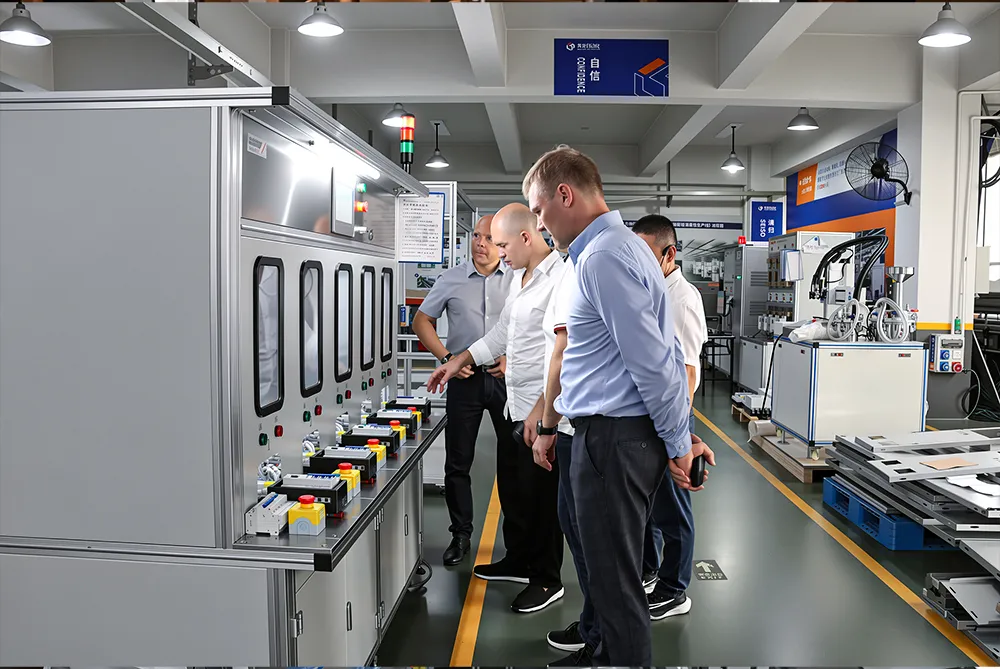
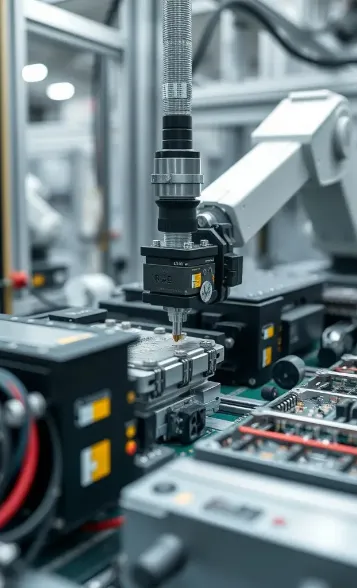


The most popular machine in Indian electrical factories: Arc chute assembly machine
By Huang Xiaolei · Published July 29, 2026
India has emerged as the fastest-growing market for MCB consumption and a key growth market for the manufacturing of MCBs and their protective components. As global electrical giants—such as Siemens, Schneider, and ABB—have established operations in India, a multitude of small and medium-sized enterprises (SMEs) have sprung up to serve as component suppliers to these industry leaders. Among the equipment used, the arc chute assembly machine—designed specifically for producing arc chutes—has become a standard choice for many Indian SMEs due to its high production capacity, ease of operation, and cost-effectiveness.
India is Benlong Automation’s largest export market; our customers are located across key industrial hubs, including Jalgaon and Nashik in Maharashtra, Vadodara in Gujarat, Haridwar in Uttarakhand, and Chennai in Tamil Nadu. In short, Benlong Automation’s customer base in India spans the country’s three major electrical industry regions: the West, the North, and the South.
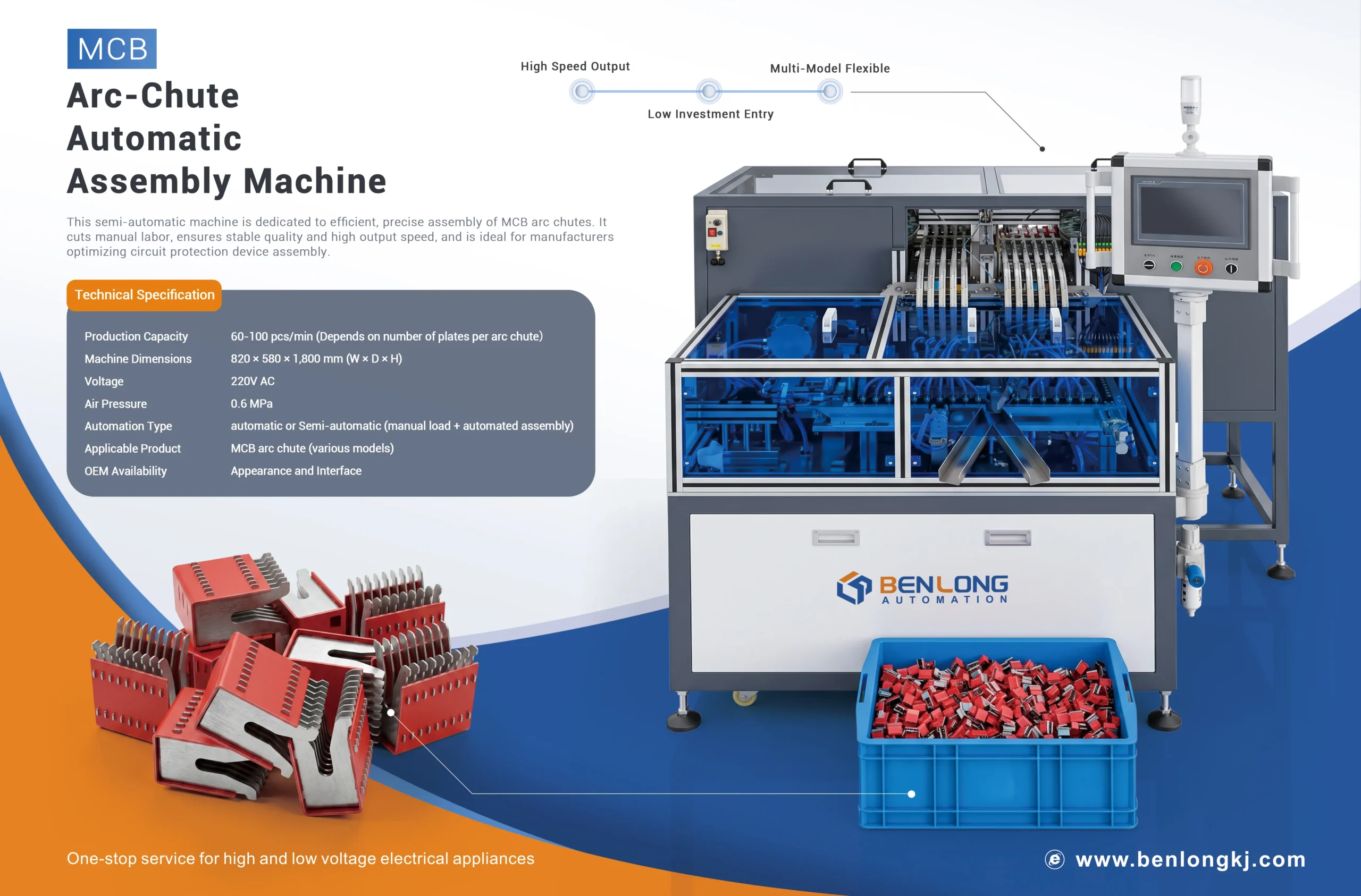
Details on the popularity of arc chute assembly machines in India
Countless Indian SMEs develop their own brands while simultaneously serving as component suppliers to large enterprises. These suppliers often face a unique dual challenge: meeting the rigorous quality standards of demanding OEM clients while securing orders in a market characterized by intense price pressure. In India, the suppliers that survive are often not those with the largest factories, but rather those capable of ensuring quality while consistently delivering products at the lowest possible unit cost.
For this reason, the arc chute assembly machine has become standard equipment for many Indian suppliers; a single investment enables them to address the aforementioned dual challenges. Furthermore, the ease of operation and maintenance saves these small and medium-sized factories significant training time, while high production efficiency allows them to recoup their investment costs quickly—laying a crucial foundation for future automation upgrades and expansion. A case in point is a Benlong customer in Haridwar: they initially purchased two semi-automatic arc chute assembly machines and became a reliable supplier to Siemens India. As their capital grew and their partnership with Siemens deepened, they subsequently acquired 2 MCB automatic testing line dedicated to the SINOVA 5TJ series MCB, achieving an OEM production capacity of 20,000 poles per day.
Industry analysts put the global miniature circuit breaker market at well over five and a half billion US dollars in 2024, growing at roughly nine percent a year through the early 2030s, with Asia-Pacific delivering the largest absolute increase in volume. Within that picture, India stands out: independent estimates value the country’s circuit breaker market in the region of a few hundred million dollars today, with steady multi-year growth driven by construction, infrastructure, and the electrification of everything from metro systems to warehouses. The residential segment alone is expanding as households replace old fuses with certified breakers, and as electrical-fire awareness pushes retrofit activity.
Just as important is where new manufacturing is being encouraged. Industrial-corridor developers in states such as Gujarat and Tamil Nadu are specifying MCB and MCCB infrastructure for new semiconductor, automotive, and logistics plants, and production-linked incentive frameworks reward local value addition. The message for a breaker manufacturer is simple: demand is rising, the government wants that demand met domestically, and the buyers who win tenders are the ones who can prove consistent quality at scale. Consistent quality at scale is precisely what an automatic arc chute assembly machine delivers, and precisely what a manual bench cannot.
From Assembler to Full Manufacturer: The Localisation Opportunity
There is a strategic layer to this that goes beyond a single machine, and it is worth spelling out because it changes how ambitious an Indian breaker producer can be. Many plants today assemble breakers from a mix of locally made and imported sub-components, and the arc chute is one of the parts most often bought in or assembled with the least process control. Bringing that operation in-house on a controlled arc chute assembly machine is a step up the value chain, not just a productivity tweak.
- Deeper local value addition. Owning the arc chute process increases the domestic content of your breaker, which aligns with production-linked incentive criteria and public-procurement preferences for locally made goods.
- Supply-chain resilience. Controlling a safety-critical sub-assembly in-house reduces exposure to component import delays, currency swings, and quality variation from third-party suppliers.
- Margin capture. Value that previously flowed to a component supplier stays inside your plant, improving the economics of every breaker you ship.
- Export credibility. A manufacturer that controls and documents its arc chute process can credibly serve export buyers in South Asia, the Middle East, and Africa who demand traceable quality.
In other words, the MCB arc chute assembly machine is a gateway investment. It is the point at which a plant stops being an assembler of other people’s parts and becomes a manufacturer that controls the feature customers care about most. For Indian firms trying to move from commodity competition toward tender-winning, export-ready production, that shift in identity is worth far more than the machine’s sticker price. It is the difference between competing on price for whatever volume is left over and competing on demonstrable quality for the volume everyone wants.
What an Arc Chute Assembly Machine Does, and Why It Decides Your MCB’s Breaking Capacity
To understand why this one station matters so much, you have to understand what the arc chute actuallydoes inside the breaker. When an MCB trips under a short circuit, the contacts separate, but current does notstop instantly. lonised gas keeps the circuit alive as a violent electric arc. The arc chute, or arc extinguishingchamber, is the component that kills that arc. It is a stack of closely spaced steel splitter plates that pull thearc in, each de-ion plate has a preset design profile to split the arc into multiple series of arc and to enhance the arc voltage to reduce the arc quenching time. break it into many small arclets, cool and deionise the plasma, and raise the voltage needed to sustainthe arc above the system voltage, driving the current to zero.
The physics has a direct commercial consequence. The breaking capacity of the finished MCB, the verynumber stamped on the case and verified in BIS testing, depends heavily on how well the splitter plates arepositioned. Get the stack right and the breaker interrupts a heavy fault cleanly. Get it slightlywrong and interruption is slower, the arc lingers, internal pressure spikes, plates erode, and the unit may fail its short-circuit test, or worse, fail in the field.
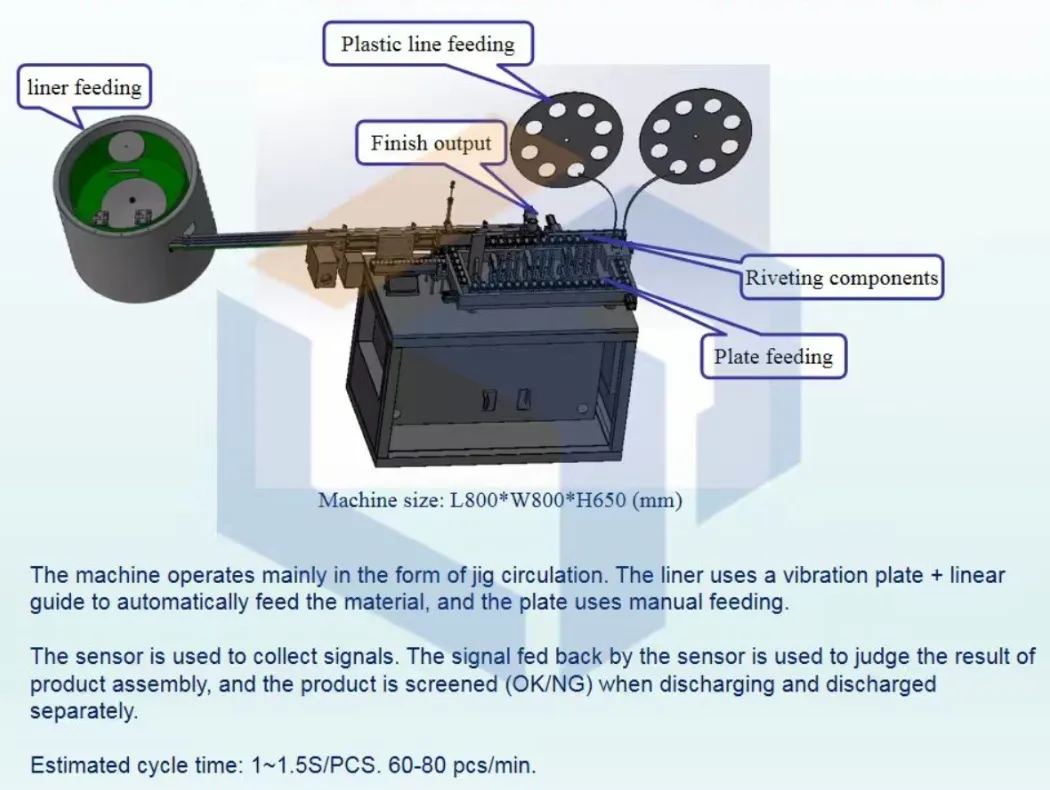
It is worth appreciating how tightly the arc chute interacts with the rest of the breaker. The silver-alloy contacts, the tripping mechanism, and the arc extinguishing chamber form a single interrupting system, and the chamber is the part that finishes the job the contacts start. If the contacts open cleanly but the arc chute cannot cool and split the arc fast enough, the interruption stalls, energy builds, and the breaker’s rated performance collapses. Conversely, a precisely stacked chamber lets a modestly specified breaker punch above its weight in the short-circuit test. The arc chute is, in a real sense, where the value and the risk of the whole product concentrate.
This is why the MCB arc chute assembly machine is not simply a labour-saving device. It is a quality-defining process. A dedicated machine loads splitter plates into the chamber body with repeatable spacing and orientation every single cycle, applies consistent insertion force, and verifies presence and position before the sub-assembly moves on. Compare that with a manual operator inserting plates by hand at the end of an eight-hour shift, and the variability is obvious. The arc chute assembly equipment removes the human variable from the one operation where variability is least forgivable.
- Repeatable plate spacing and parallelism across every unit, shift after shift.
- Consistent insertion depth and seating force, independent of operator fatigue.
- In-line detection of missing, skewed, or double-fed plates before they become defects.
- Traceable, uniform sub-assemblies that behave predictably in short-circuit testing.
How the Arc Chute Assembly Process Works, Step by Step
It helps to picture the actual cycle, because it shows exactly where consistency is won or lost. A typical arc chute assembly machine cycle moves through a defined sequence, and each step is a place where a manual operator would introduce variation and a machine does not.
- Plate feeding. Splitter plates are singulated from a magazine or vibratory feeder and presented in the correct orientation, one at a time, without the double-feeds and flipped plates that plague hand loading.
- Chamber positioning. The arc chute body or frame is indexed into a fixture that locates it precisely, so every insertion happens against the same reference.
- Plate insertion. Each plate is pressed into its slot to a controlled depth with a controlled force, holding the spacing and parallelism that determine arc-splitting performance.
- In-station verification. Sensors confirm plate presence, count, and seating before the part advances, so a defect is caught at the station rather than in final test.
- Transfer. The completed arc extinguishing chamber is released to the next operation as a known-good, uniform sub-assembly.
The point of walking through this is not the mechanics themselves but what they guarantee. Every completed chamber leaves the station with the same geometry, and geometry is what the breaking-capacity test rewards. On a manual bench, each of those five steps depends on an operator’s attention at that moment; on a machine, each step is identical on unit one and unit fifty thousand. That is the whole argument for a circuit breaker arc chute assembly machine compressed into a single cycle.
The Hidden Cost of Manual Arc Chute Assembly
Most breaker plants that still assemble arc chutes manually underestimate what it costs them, because the biggest costs never appear on a single invoice. They are spread across scrap, rework, warranty, failed certification runs, and lost tenders. Let us make them visible.
Inconsistent breaking performance is the most dangerous hidden cost. When plate stacking varies from unit to unit, so does interrupting behaviour. Some breakers clear a fault beautifully; others sit at the edge of specification. In BIS and IEC type testing and routine testing, marginal units drive up failure rates, and each failed sample can mean re-testing an entire batch. Every failed certification cycle burns time, laboratory cost, and credibility with the buyer waiting for delivery.
Labour cost and labour risk come next. Manual arc chute stacking is slow, monotonous, and hard to staff reliably. Output is capped by how many trained hands you can keep at the bench, and quality drifts as those hands tire across a shift. Scaling manual assembly means hiring and training more operators for the same variable result, exactly the wrong direction when demand is climbing.
Scrap and rework quietly erode margin. A misplaced or missing plate discovered downstream often means scrapping the sub-assembly, or worse, discovering the problem only in final testing after value has been added. With silver-alloy contacts and precision components already inside the breaker, late-stage scrap is expensive scrap.
Finally, there is the opportunity cost that never shows up in accounting at all: the tenders you cannot bid on because you cannot guarantee volume at a stated defect rate, and the OEM customers who will only work with suppliers that can demonstrate process control. In a market where buyers are consolidating around a smaller number of dependable, BIS-certified manufacturers, the inability to prove consistency is a strategic liability, not just a production inconvenience.
How a Semi-Automatic Arc Chute Assembly Machine Changes the Economics
Automating the arc chute station changes the arithmetic on three fronts at once: throughput, quality, and cost per unit. A well-designed semi-automatic arc chute assembly machine lets one operator supervise a station that outproduces several manual benches, while holding a defect rate that manual assembly cannot match.
- Throughput. Cycle time is set by the machine, not by operator stamina, so output is stable across the whole shift and predictable for planning.
- First-pass yield. In-station verification catches missing or skewed plates immediately, so defects are corrected at the station instead of surfacing as scrap in final test.
- Labour leverage. Fewer operators are needed for the same or higher output, and the operators you keep are supervising a process rather than performing a repetitive precision task.
- Certification confidence. Uniform sub-assemblies mean type and routine testing behave predictably, reducing costly re-test cycles.
The return-on-investment case is usually driven less by direct labour savings and more by yield and certification. When a plant moves from a variable manual defect rate to a controlled automated one, the value shows up as fewer scrapped units, fewer failed test batches, faster delivery against tenders, and the ability to quote larger volumes with confidence. For a manufacturer scaling toward a full MCB production line in India, the arc chute station is frequently the highest-leverage place to automate first, because it protects the most safety-critical parameter in the product.
A semi-automatic configuration is often the smart entry point. It captures most of the consistency and yield benefit of full automation at a lower capital cost, keeps a skilled operator in the loop for loading and supervision, and integrates cleanly with existing manual or semi-manual stations upstream and downstream. As volume grows, the same station design philosophy scales toward fuller automation without discarding the investment.
Building the Business Case: A Practical ROI Framework
Owners often ask how quickly a machine pays back. The honest answer is that it depends on your volume, your current defect rate, and your labour cost, so rather than quote a single figure, here is the framework we use with Indian manufacturers to build the case with your own numbers. The illustrative figures below are a worked example to show the method, not a promise of specific results.
Start by mapping four value streams, then apply your real data:
- Direct labour. Count the operators dedicated to manual arc chute stacking, multiply by fully loaded monthly cost, and compare with the single operator a semi-automatic station typically needs.
- Yield and scrap. Estimate your current arc-chute-related defect and scrap rate, value the scrapped sub-assemblies at the point they are discovered, and model the improvement a controlled station delivers.
- Certification and re-test. Add the cost of failed test batches and repeat submissions caused by inconsistent breaking performance, including laboratory time and delivery delay.
- Capacity and revenue. Value the additional volume you can quote and win once you can guarantee output at a stated defect rate.
As an illustrative example, imagine a plant running three operators on manual arc chute assembly, carrying a mid-single-digit scrap rate on that sub-assembly, and losing occasional test batches to marginal breaking performance. Moving to a semi-automatic arc chute assembly machine that needs one supervising operator immediately frees two operators for other stations, cuts sub-assembly scrap toward a low, stable figure, and reduces failed-test incidents. In most such models the combined saving from labour, scrap, and avoided re-testing recovers the machine cost within a period measured in months rather than years, and everything after that is margin. When you then add the tenders you can newly bid on, the case usually stops being about payback and starts being about competitive position.
The reason the arc chute station scores so well in this exercise is that it touches all four value streams at once. Many automation investments improve one lever; this one improves labour, scrap, certification, and revenue capacity together, because it sits on the product’s most safety-critical and most test-sensitive feature. That is why, when we help a manufacturer prioritise where to spend first on MCB manufacturing automation, the arc chute station is so often at the top of the list.
Meeting Indian Standards: IS/IEC 60898-1, IS 8828, and the BIS Mark
For any breaker sold in India, compliance is not optional, and it is closely tied to the quality of the arc chute assembly. Household and similar MCBs are governed by IS/IEC 60898-1, the Indian adoption of the international IEC 60898-1 standard, which superseded the older IS 8828 and covers construction, marking, temperature rise, and short-circuit breaking capacity for AC circuit breakers up to defined voltage and current limits. Industrial-type breakers fall under IEC 60947-2. To carry the ISI mark and sell into government, commercial, and public-tender channels, manufacturers must hold a BIS licence and pass the required type and acceptance testing under the supervision of the Bureau of Indian Standards.
The connection to your assembly process is direct. The short-circuit breaking-capacity tests in these standards are exactly the tests most sensitive to arc chute quality. A consistent, machine-assembled arc extinguishing chamber gives you the repeatable interrupting performance those tests demand. In other words, investing in an arc chute assembly machine is not only a productivity decision; it is a compliance strategy. It raises the probability that your samples pass on the first submission and that your routine-tested production units stay comfortably inside specification.
It is also useful to distinguish between type testing and routine testing. Type testing proves a design meets the standard, using a limited number of samples subjected to the full battery of tests, including the demanding short-circuit sequences. Routine testing then checks every production unit against a lighter set of criteria. A machine-assembled arc chute helps on both fronts: it raises the odds that your type-test samples represent your best, most consistent build, and it keeps day-to-day routine-tested production tightly clustered around the design intent rather than scattered across a wide band. When an auditor or an OEM customer reviews your process capability, that consistency is the evidence that persuades them you can be trusted with volume.
- IS/IEC 60898-1: household and similar AC MCBs, covering breaking capacity and construction.
- IS 8828: the earlier Indian standard now aligned with and largely superseded by IS/IEC 60898-1.
- IEC 60947-2: industrial-type circuit breakers with adjustable or higher ratings.
- BIS licence and ISI mark: mandatory for market access and public procurement in India.
Choosing the Right Arc Chute Assembly Machine Supplier
Once you decide to automate, supplier selection becomes the decision that determines your results. Not all circuit breaker arc chute assembly equipment is equal, and the cheapest quotation is rarely the cheapest machine over its life. Here is a practical checklist for evaluating suppliers, whether they are domestic or overseas.
- Process fit to your product. Can the machine be tooled to your specific arc chute geometry, plate count, and chamber design, rather than forcing your product to fit a generic fixture?
- In-station verification. Does it detect missing, double-fed, or skewed plates in real time, or does it simply place parts and hope?
- Cycle time and yield data. Ask for realistic throughput and first-pass-yield figures on parts like yours, not brochure ideals.
- Line integration. Will it connect cleanly to upstream contact-riveting and downstream calibration and testing stations, so it becomes part of a coherent line?
- After-sales support and spares. How are commissioning, operator training, remote support, and spare-part lead times handled for an Indian plant?
Sourcing from an experienced Chinese automation builder such as Benlong gives Indian manufacturers a well-understood advantage: mature, field-proven MCB arc chute assembly machine designs at a capital cost that local build-to-order tooling struggles to match, backed by remote commissioning and documented processes. The right partner does not just ship a machine; it transfers a repeatable process, helps you tool for your exact breaker, and stays available when you scale the line.
Common Mistakes When Moving From Manual to Automated Arc Chute Assembly
Automation succeeds or fails on the details of the transition, not just the machine. These are the mistakes we most often see manufacturers make when they move from a bench to an automatic arc chute assembly machine, and how to avoid them.
- Buying on price alone. A cheaper machine without in-station verification simply automates the placing of parts while leaving your defects undetected until final test. The verification step is where the real value lives; do not trade it away to save on the quotation.
- Ignoring plate quality upstream. A machine assembles what it is fed. Inconsistent incoming splitter plates, burrs, or dimensional drift will defeat even excellent tooling, so incoming plate control must improve alongside the station.
- Skipping product validation. Accepting brochure throughput instead of insisting on trials with your own arc chute parts leads to unpleasant surprises at commissioning. Always validate on your geometry.
- Treating the station in isolation. If the calibration and testing stations downstream are still uncontrolled, some of the gain from a consistent arc chute is lost. Plan the line, not just the one machine.
- Underinvesting in operator training. The value of a supervised semi-automatic station depends on operators who understand what the verification signals mean and how to respond, so commissioning must include real training, not just a handover.
None of these are reasons to hesitate; they are simply the checklist that separates a smooth automation project from a frustrating one. A supplier who raises these issues with you before quoting is usually a supplier worth working with.
Preparing Your Plant for Installation and Commissioning
A little preparation before the machine arrives shortens commissioning and gets you to stable production faster. For Indian plants installing an arc chute assembly machine, we recommend having the following ready in advance.
- Utilities and footprint. Confirm floor space, power supply, and compressed-air requirements against the machine specification so nothing stalls on the installation day.
- Sample parts. Provide representative arc chute bodies and splitter plates well ahead of time so the station can be tooled and dry-run to your exact geometry.
- Line layout. Plan where the station sits relative to upstream sub-assembly and downstream calibration and testing, and how work-in-progress will flow between them.
- Operators and training slots. Identify the operators who will run and supervise the station and reserve time for their training during commissioning.
- Acceptance criteria. Agree in writing what throughput and first-pass yield count as a successful acceptance test, measured on your parts, so both sides share the same definition of done.
With these in place, commissioning becomes a validation exercise rather than a discovery exercise, and many manufacturers reach stable, in-specification output within days of installation. A capable supplier will provide a pre-installation checklist and support the acceptance testing remotely or on site, so the plant is never left to interpret the machine alone.
Integrating the Machine into a Complete MCB Production Line
An arc chute station rarely lives alone. It sits inside a chain of operations, and its value multiplies when the whole chain is designed to work together. A typical low-voltage breaker line runs from thermal-magnetic sub-assembly and contact riveting, through mechanism assembly and arc chute insertion, into calibration, tripping-characteristic setting, and finally routine electrical testing before packing.
Because the arc chute defines breaking capacity and the calibration stations define tripping behaviour, these are the two zones where automated consistency pays back fastest. When you standardise the arc extinguishing chamber with a dedicated machine and feed those uniform sub-assemblies into automated calibration and testing, the whole line becomes more predictable, and your yield curve steadies. That is why we encourage manufacturers to view the arc chute assembly machine not as an isolated purchase but as the anchor of a broader MCB manufacturing automation strategy.
If you want to see the specific machine this guide is built around, including configuration options and technical parameters, review our MCB arc chute semi-automatic assembly machine product page. And if you are mapping the wider automation ecosystem in India, our overview of the top industrial automation companies in Bangalore is a useful companion read for benchmarking local integration partners and support options.
Why Indian MCB Manufacturers Work With Benlong
Benlong Automation is a Wenzhou-based builder of assembly and testing equipment for the low-voltage electrical industry, focused entirely on MCB, MCCB, RCCB, and related breaker components. We are not a general machine shop that occasionally makes breaker tooling; the arc chute, the contact, the mechanism, and the test bench are our core domain. That specialisation is why our automatic arc chute assembly machine and semi-automatic arc chute assembly machine systems arrive already tuned to the realities of breaker production rather than adapted from unrelated industries.
We work with manufacturers across Asia, the Middle East, and Europe, and India is our largest export market. Our engagement model is designed for buyers who are automating for the first time: we tool to your exact arc chute design, validate throughput and yield on your parts, support commissioning remotely, and stay involved as you extend from a single station toward a fuller line. For an Indian producer trying to win larger tenders and pass BIS testing reliably, that combination of breaker-specific expertise and export-proven support is the practical difference between buying a machine and buying an outcome.
Frequently Asked Questions
What is an arc chute assembly machine and what does it do?
An arc chute assembly machine is dedicated equipment that loads and positions the splitter plates inside an MCB’s arc extinguishing chamber with repeatable spacing, orientation, and insertion force. Because the arc chute determines how effectively a tripped breaker interrupts a fault, this station directly controls the breaker’s breaking capacity and its ability to pass short-circuit testing.
Why should Indian MCB manufacturers automate arc chute assembly first?
The arc chute is the single most safety-critical sub-assembly to get right, and manual stacking is where variability hurts most. Automating it stabilises breaking-capacity consistency, improves first-pass yield in BIS and IEC testing, and lets a plant quote larger volumes at a stated defect rate, which matters directly for winning tenders in India.
What is the difference between an automatic and a semi-automatic arc chute assembly machine?
A fully automatic machine handles loading and assembly with minimal operator intervention and suits high, steady volumes. A semi-automatic arc chute assembly machine keeps a skilled operator in the loop for loading and supervision while the machine controls the precision steps, offering most of the consistency benefit at lower capital cost, which makes it an ideal entry point for plants scaling up.
Which standards apply to MCBs sold in India?
Household and similar AC MCBs are covered by IS/IEC 60898-1, the Indian adoption of IEC 60898-1, which superseded the earlier IS 8828. Industrial breakers fall under IEC 60947-2. Manufacturers need a BIS licence and the ISI mark to sell into commercial and public-tender channels, and the short-circuit tests in these standards are highly sensitive to arc chute quality.
Can the machine be tooled to our specific breaker design?
Yes. A capable supplier tools the station to your exact arc chute geometry, plate count, and chamber design rather than forcing your product onto a generic fixture, and validates throughput and first-pass yield on your own parts before delivery.
How quickly does an arc chute assembly machine pay for itself?
Payback depends on your volume, current defect rate, and labour cost, but because the station improves labour, scrap, certification pass rates, and quotable capacity at the same time, most manufacturers model the recovery period in months rather than years. Build the case with your own figures using the four value streams of labour, yield, re-testing, and revenue capacity.
Do I need a fully automated line, or can I start with one station?
You can start with a single semi-automatic arc chute assembly machine and integrate it with existing manual stations. Because the arc chute is the most safety-critical sub-assembly, automating it first captures the highest-leverage benefit, and the same design philosophy scales toward a fuller MCB production line in India as your volume grows.
References
- Bureau of Indian Standards, IS/IEC 60898-1 and IS 8828 circuit-breaker requirements: bis.gov.in
- Global and regional miniature circuit breaker market outlook, Global Market Insights: gminsights.com
- MCB and MCCB market growth and India policy context, Market Research Future: marketresearchfuture.com
- India manufacturing and investment climate, India Brand Equity Foundation: ibef.org
- Domestic manufacturing incentives, Make in India: makeinindia.com
Ready to Automate Your Arc Chute Line?
If you are building or expanding an MCB plant in India, the arc chute station is where automation protects both your product safety and your margin. Benlong Automation will help you specify the right arc chute assembly machine, tool it to your exact breaker, and integrate it into a line that passes BIS testing and scales with your order book. Contact our engineering team for a tailored configuration and quotation, and tell us your target breaking capacity, arc chute geometry, and monthly volume so we can size the right solution for your factory.