benlong

Industrial Automation Products Factory Efficiency
People who set up automatic equipment expect the production to go up. However, very few of them know just how much the production increased and why. This aspect is important because production can scarcely be defined by one figure, as it consists of at least six other indexes, some of which can be affected greatly, while some not affected at all. This is the point the article is written about.
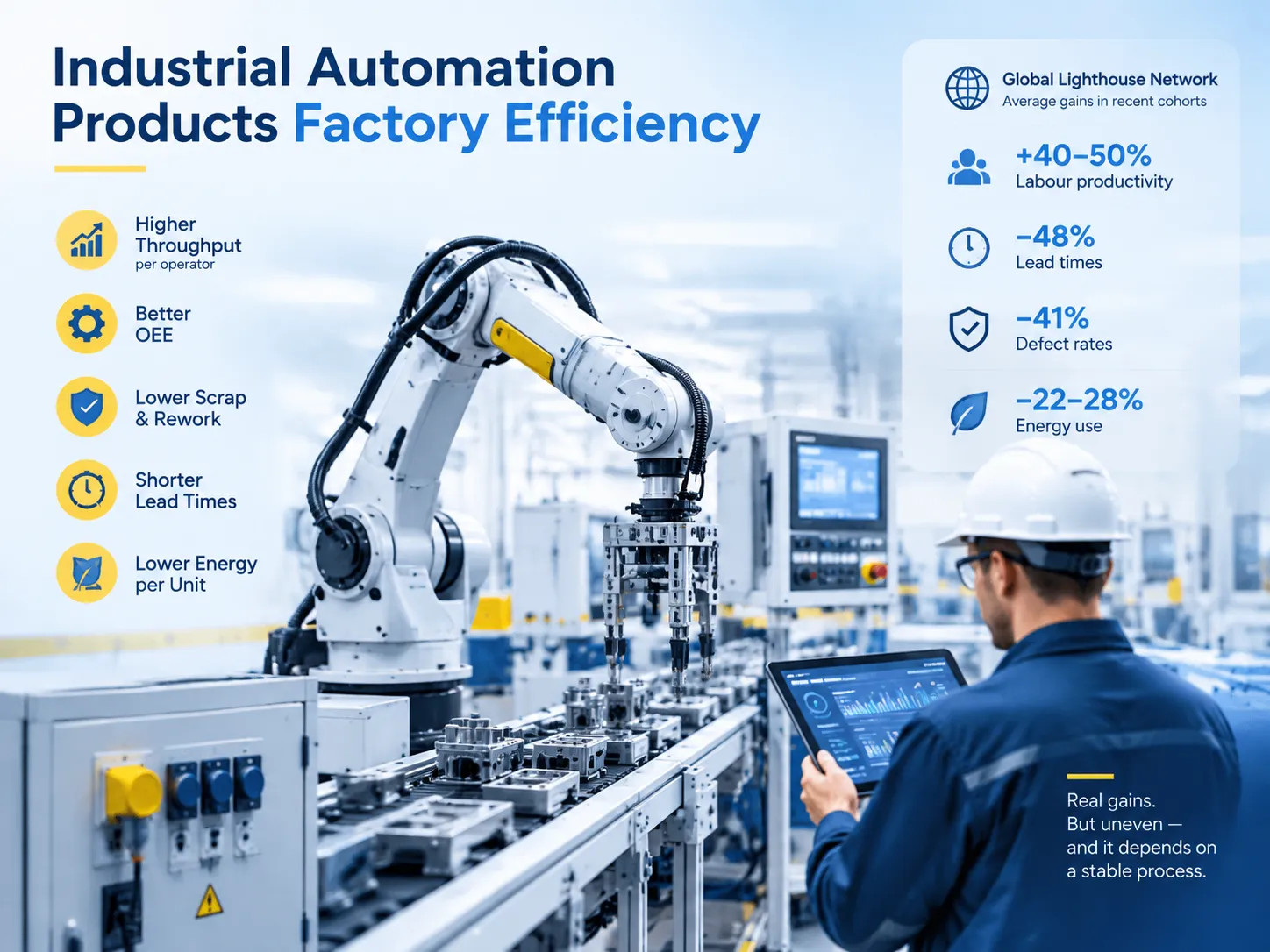
To summarize, the productivity of factories rises due to tools that automate processes improving operator throughput, OEE as well as reducing the volume of materials recycled after production, production lead times, and energy consumption of the final product. With regard to factories which belong to the Global Lighthouse Network of the World Economic Forum, labor productivity increased by approximately 40-50% while lead times fell by almost 48% and defect rates decreased by approximately 41% and energy consumption was cut by about 22-28%. Although those changes are real and exist only in parts, they depend on the fact that the process is smooth enough to be automated.
What “efficiency” actually means on the floor
The terminology differs when managers and engineers utilize it because the two professions not typically intersect in daily practice. It is well known that six measurements are sufficient.
- Throughput or produced quantity per hour and produced quantity per operator. The second parameter determines wages.
- OEE comprises threeing figures: availability multiplied by performance multiplied by quality. It can tell you the actual degree of utilization of your theoretical capacity.
- First pass yield and scrap rate represent everything that requires processing or disposal. It means that someone already has paid for it.
- Lead time and work-in-progress can be used to hide defects and opportunities for idle cash as they indicate the amount of time spent from the moment the order has been placed up to a time of its delivery.
- Energy consumed on producing one unit of product and material utilized for the production of a unit product can be named the costs altered by automation just as a by-product.
- Changeover time is irrelevant in the case of single product production.
Automation affects production lines differently. A properly-utilized production line is able to double its efficiency in a year. However, it does not improve a defective production process to produce defective parts at an increased rate.
The gains that show up most reliably
Analysis of recorded practical situations reveals several factors that keep repeating. OEE improvement is normally in the range from 2% to over 30%, depending on the plant initial situation. The increase in labor productivity can be achieved in a much broader range (between 4% and 50%) for particular plants. As far as the early Lighthouse cohorts are concerned, the average labor increase here has exceeded 100%. The same trend concerns the reduction of costs. The cost of a product has decreased by about 30% in the fullest case, while in terms of quality-related expenses the reduction is much higher when the producer automates the inspection process.
The logic of these figures is clear: automation eliminates variability. Robots do not feel tired after some hours of work, do not twist screws differently on Monday morning, and do not skip tests due to delays. As soon as the process is automated, everything that depends on it improves instantly. If you want the breakdown of which benefits appear in which order, this summary of industrial automation efficiency benefits walks through them plant-side.
Where the numbers come from
The highest authority on the topic is the World Economic Forum’s Global Lighthouse Network. There have been 238 factories recognized by the institution as successful implementers of Industry 4.0 technology. These sites have the benefit of having their results audited and verified.
The statistics from the old factories are mind-blowing. The productivity changes in the original cohort resulted in a 100% increase in output, 150% increase in productivity, and 80% boost in overall equipment effectiveness (OEE). The costs decreased by about 30%, while the energy consumption reduced by 60% and lead time shortened by 90%. However, cohort results are more realistic. For instance, a group of factories added in September 2025 managed average increases in labor productivity of 40%, 48% reduction of lead time, 41% lower defect rate, and 28% less energy consumed.
Investment returns are higher than two-three times during three years and reach four or five times after five years. This is a good result, yet one must keep in mind that the result is not instant. Factories that succeed do not treat the automation program as a capital investment, however.
What world-class automation looks like on the floor
In theory, efficiency is a simple concept to discuss. However, when it comes to practice, it is much better to analyze companies providing efficiency at its best – the “lights-out” factories, where there is no need for any light because nobody is working there. Such factories are mainly connected to manufacturing of electronic goods and components due to the reason that the processes carried out there possess the needed stability level and high production volume enabling the companies to be commercially attractive.
The commonly cited examples are well documented, including the dark factories operating around the world — from Fanuc’s robot-builds-robot plant in Japan to fully automated electronics lines in China and Korea.The core that links them is the discipline rather than the technology: standardised product and processing, along with a maintenance system that ensures the whole line operates almost unnoticed by operators.
This point may not be understood for its importance, as a lights-out line doesn’t save costs because of absence of people, but because of total absence of variability, and that it only uses engineers and not operators in very limited number.
Efficiency in electrical component and electronics assembly
Since our field is circuit breaker production, we will consider it in detail and not just give an abstract instance of this area. Circuit breaker manufacturing is an excellent example since it involves accuracy assembly, functional testing, and compulsory 100% checking — areas where human labor is slow, erratic, and not economical.
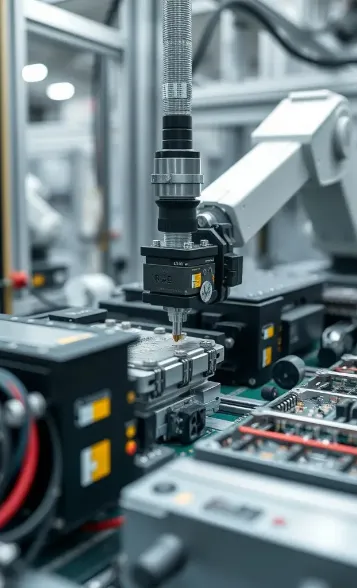
A typical MCB or MCCB automated production line includes manual or semi-manual assembly, testing, and marking of the products in a chain. Efficiency is achieved owing to three main factors: the assembly speed does not exceed two seconds of producing one pole, full calibration of every piece in a machine instead of the attention of the operator, and the collection of the test data automatically. Lines of this type are what we build for the MCB automatic production line projects, and the same architecture applies to MCCB, RCBO, air circuit breaker and vacuum circuit breaker production.
The broader issue here is that, in this industry, gains in efficiency tend to come less from speed in general and more from eliminating labor-intensive testing and calibration procedures. These operations require skilled personnel, create documentation, and give rise to conflict if a product fails inspection before being accepted by the customer.
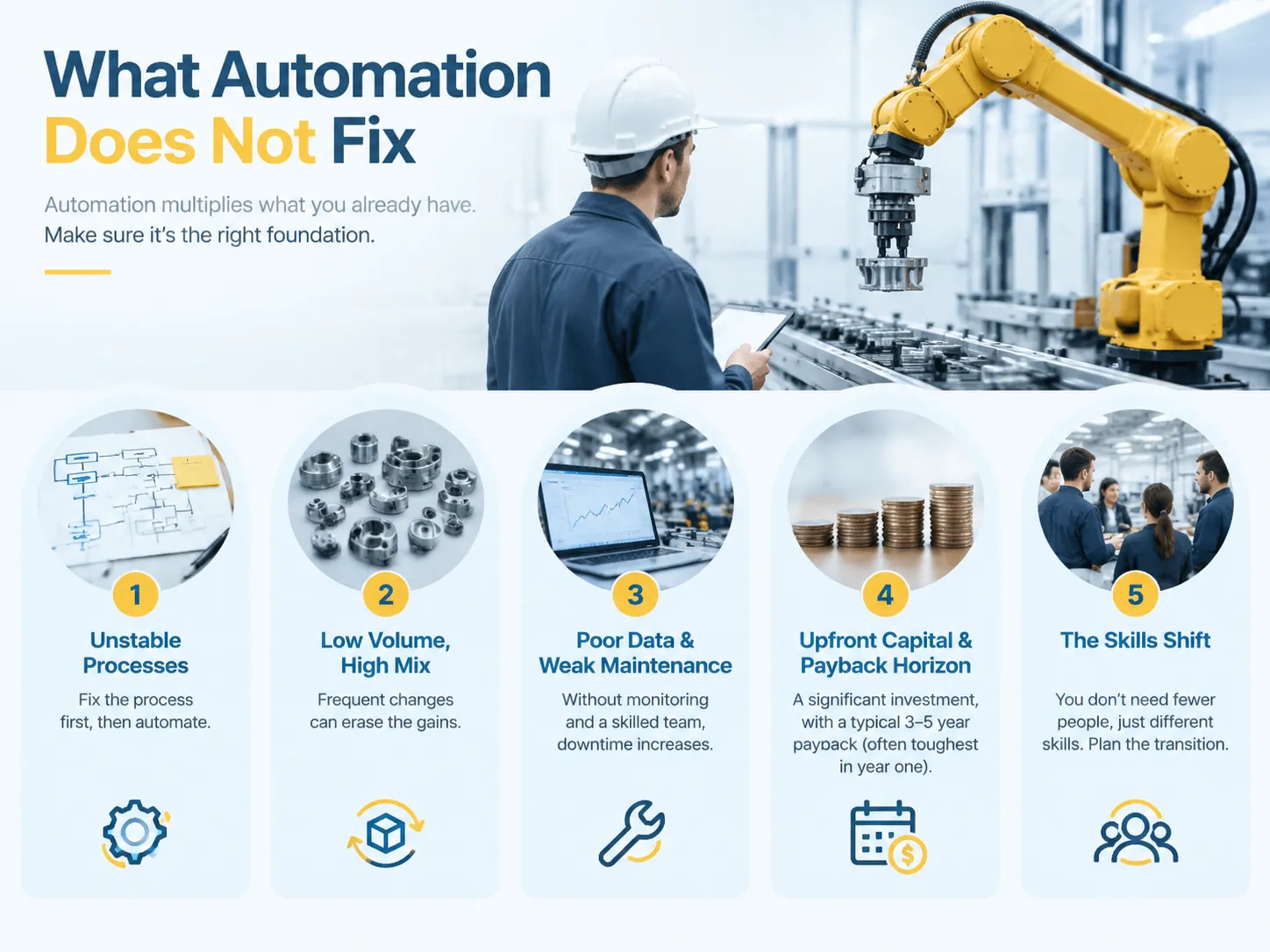
What automation does not fix
This is the part that most supplier content does not cover but decides whether a project is profitable or not:
- Instability of process. If a manual process leads to results that vary due to disagreement on how it should be done, then automating it locks in that wrong solution. You should fix the process first and then automate it.
- Low volume and high mix. Automation is efficient only if the product is quite stable. If you have to change the product every week, the changeover costs may eat away all your profit.
- Inaccurate data and insufficient maintenance. An automated line fails differently than a manual one. In the absence of condition monitoring and troubleshooting experts, the downtime will increase.
- Initial investment and payback period. A fully automated line implies a huge investment. The payback time is usually three to five years, and the first one is hardly profitable.
- The issue of skills. It is not that you need less employees but employees with different skills.
To put it simply, automation takes your process and multiplies it. If you have a good method well documented, it can give good results multiplied by automation. If you do not have such a method, it gives you something.More on that balance in this look at what you can realistically expect to gain from automation.
Measure it before and after, or you will not know
The essential step to guaranteeing the success of an automation project lies in verifying your data beforehand. For a period of a least a full quarter, gather data on OEE, first-pass yield, percentage of scrap, production per worker, time to deliver the product and energy consumed per unit. Calculate these parameters in the same way after the project has been accomplished.
Defining what each of these terms means is more important than you might think. If OEE is calculated with planned downtime excluded prior to the project and included afterward, they will demonstrate a significant failure that actually did not occur. Write down the formulas, agree with the finance department and do not change them.
This is also where an MES comes in — not as a tool for managing the process, but as the means of gathering the figures with full independence of people and without relying on timesheets. If the term is new to you, this explanation of what MES does in manufacturing covers where it sits between the machines and the ERP system, and why that layer is what makes the measurements trustworthy.
Frequently asked questions
How much does industrial automation improve factory efficiency?
The point of origin is a key factor. The figures that have been stated for different plants show that they can achieve about 2% to over 30% improvement in the OEE figures alone and 4% to over 50% improvement in the overall productivity figures of the workforce, whereas Lighthouse plants show much more progress. The plants showing a low starting point with a stable process receive the most significant benefit.
Which efficiency metric should be improved first?
In most cases, first pass yield has no meaning whatsoever. Simply multiplying throughput with increasing scrap rate is pointless, and quality losses are present in labor, materials, energy and warranty cost all together. After the yield has been stabilized, The improvements in OEE lead to an actual increase in output.
Does automation reduce energy consumption?
Generally, yes, though for surprising reasons. The direct savings originates in servo drives and motors as well as in the absence of idle operation. The bigger indirect savings result from the lower number of parts scrapped – all scrapped parts consumed their full energy and material inputs. According to the reports of the lighthouse plants, energy savings reach 20 to 60%.
What is the payback period on an automated production line?
The traditional range is between three and five years with three-year ROI of around 2-3 times stated in the various cases documented by Lighthouse, while the five-year ROI is 4-5 times. The ROI is shorter when the line supersedes qualified high-cost human labour, such as in calibration and testing applications, whereas it would take longer when the environment is low-flow and high-mix.
References
- World Economic Forum — Global Lighthouse Network and advanced manufacturing impact
- McKinsey & Company — Operations insights on manufacturing productivity and the Lighthouse programme
- ISA — ISA-95 enterprise-control system integration standard
- ISO — ISO 22400, Key performance indicators for manufacturing operations management
- Plastics Industry Association — Automation and efficiency benchmarks for component manufacturing
Conclusion
Factory processes can become more effective with the help of industrial automation technologies, but they work on a narrow list of parameters. The processes they help to improve include reliability of production, capacity of one operator, effectiveness of production along with the amount of work done and amount of energy used. Industrial automation does not make patterns of ineffective production and does not solve particular production problems of plants with small amounts of output. The results were achieved due to the fact that the companies managed to reach stability of the process before automating and measuring the outcome.
In case you deal with electric products including circuit breakers, energy distribution systems, etc. we can develop production lines that will include all the necessary equipment for the assembly, production and testing of circuit breakers, including MCB, MCCB, and other items. All you need is to provide the maximum cycle time and the amount of required products. Then we will equip the production line with the help of real calculations instead of brochure’s approach.