benlong

What Benefits Can We Derive from Automation?
Automation is one of the terms that could have so many different definitions because of its capability of referring to totally different things. For example, it could refer to the usage of robots in automobile assembly plants, it can mean PLCs sorting packages, software being used for invoice reconciliation, and even the usage of AI in classifying customer support tickets. No wonder every person has their definition of what automation actually means; however, they all share some things in common like “higher productivity,” “improved efficiency,” or “better quality.” In this manual, I’m going to give you an understanding of the different benefits of automation using numbers.
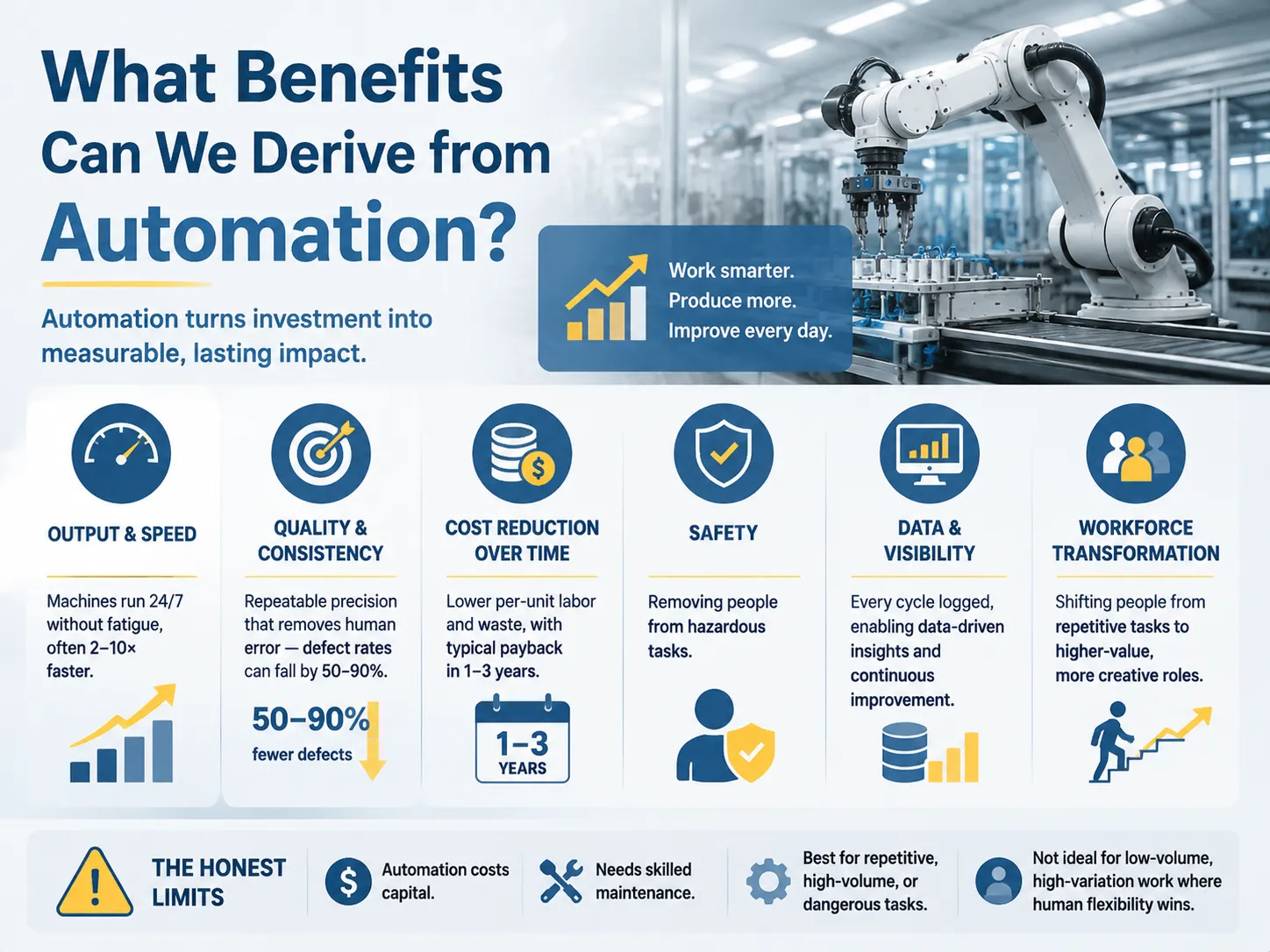
Summarizing briefly, there are 6 measurable aspects where the industry benefits from automation such as productivity and speed, quality and consistency, decreased costs, safety, information and visibility and transformation of workforce. In the production aspects including manufacturing, automation results into reduced time taken to produce goods, stabilized quantity of products produced, reduced number of defective goods, and now it takes care of inspection function and making decisions as well which only human beings were capable of doing in the past. However, there are some adverse conditions for using automation.
What Automation Actually Changes
The only thing that removing the automation and technology does is offer repeatable machine efforts instead of inconsistent human efforts. This unique substitution has a predictable effect throughout an organization and therefore it is important to comprehend the mechanism behind the substitution before evaluating the advantages:
- Machines will neither suffer from fatigue nor sickness. Their cycle times will remain the same in every work shift.
- Machines will repeat the same operation with its previous accuracy. The production will always be the same within the allowed tolerances.
- Machines will continue performing their operation even when humans are absent and hence the production will not stop at the end of a work shift.
- Machines will keep account of what it is doing, and all operations, cycles, and tests will be recorded into some database.
These four mechanisms are responsible for all advantages stated below. If someone asks about the advantages that can be gained from automation, the answer would be that one which arises out of replacing variability with the concerned repeatability. The manufacturing automation solutions guide shows how those mechanisms are engineered into real production lines.
The Six Measurable Benefits
| Benefit | What It Looks Like in Practice | Typical Scale |
|---|---|---|
| Output and speed | 24/7 operation, faster cycles, no shift-based limits | 2-10× throughput on automated steps |
| Quality and consistency | Repeatable precision, fewer defects, less rework | 50-90% defect reduction on automated lines |
| Cost per unit | Lower labor content, less waste, predictable yield | Payback typically 1-3 years; 20-50% unit-cost cuts |
| Safety | People removed from hazardous, repetitive, or ergonomic-risk tasks | Injury rates near zero on automated cells |
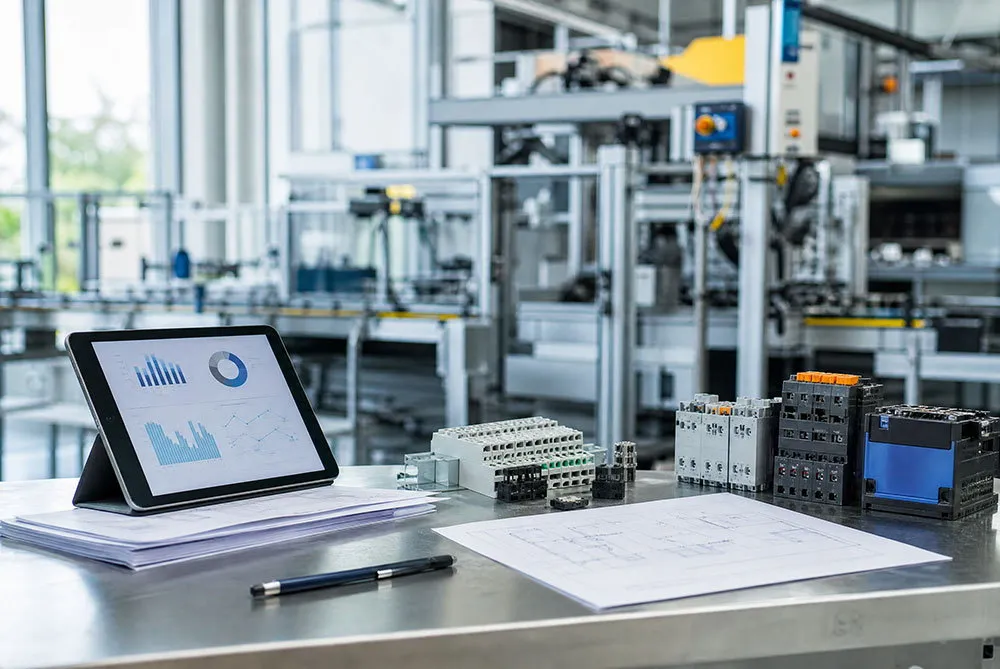
| Data and visibility | Every cycle logged; OEE, yield, and downtime measurable in real time | Continuous improvement becomes data-driven |
| Workforce transformation | People move from repetitive work to setup, maintenance, and improvement roles | Higher retention and skill levels |
It is interesting to note what automation does not do, which is to eliminate jobs. Rather, it decreases the work that is done repeatedly and raises the need for technical jobs. A company that does a good job of automating will reassign employees rather than firing them, and, in the process, it will retain the expertise needed to operate the machines.The industrial automation efficiency guide walks through these benefit categories with factory-floor examples.
Benefits by Industry
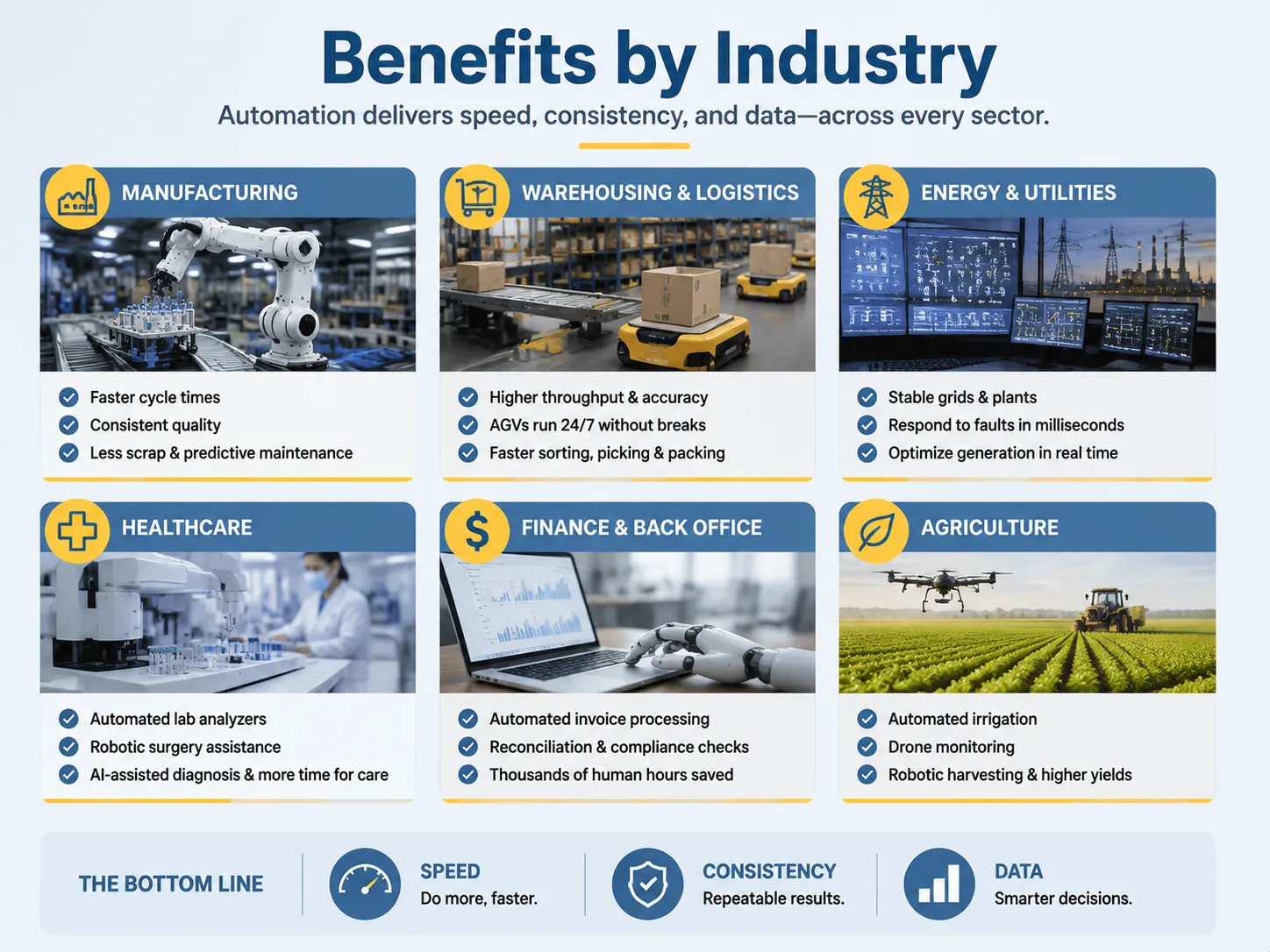
Automation offers a variety of advantages, but the impact varies depending on the industry:
- Manufacturing has experienced the most significant advantages with reduction in cycle times, consistency in quality, elimination of scrap, and the ability to predict maintenance delays.
- Warehousing and logistics uses automation in sorting, picking, and packing in addition to automated guided vehicles (AGVs) working all day, every day, to attain faster service and accuracy.
- Energy and utilities utilize automated control systems for grid and plant stability, quick response to faults, and to ensure that generation is optimized in real time.
- Healthcare benefits through the use of automated lab analyzers and robotic surgery assistance with AI diagnosis as it allows for improved accuracy and frees up time for care givers to care for patients.
- Finance and back office have benefited enormously through the use of robotic process automation (RPA) for billing purposes ensuring accuracy and efficiency that previously consumed thousands of hours of staff effort.
- Agriculture uses automated irrigation, drone monitoring, and robotic harvesting capabilities to deal with labor shortages while improving yield precision.
Thus, across all industries there is a trend in automation whereby speed, consistency and data must be tackled depending on which of the three is the most beneficial to the industry.
Deep Dive: Manufacturing and the Factory Floor
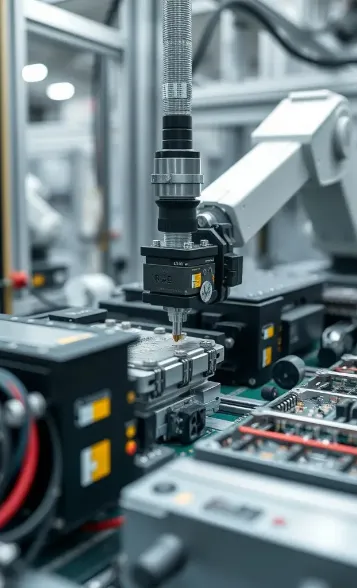
Automation is widely regarded in manufacturing as the industry sector where automation has its greatest advantages, and is where the economics can be quickly validated. In certain automated assembly lines:
- Cycle times are improved. In an example, an automated robotic cell assembles one component in 10 seconds, whereas without automation the manual equivalent may take 45 seconds, translating to 4.5 times more units produced for that cycle.
- Stability and quality are achieved. In this example, the use of a test system permits defects to be identified within automated manufacturing so that they do not reach the marketplace. So, for example, visual machine inspection can identify defects far beyond that which the normal human eye may see shift after shift.
- Scrap and rework is reduced. Automated assembly machinery is more precise in its placement and its operations, so that there is a total control over the processes, as identified in the yield statistics.
- Setups become information driven. With a recipe-centered approach, there is no longer any need for a long changeover process.
The capital payback issue is real — automation is an expensive piece of capital equipment — and the tool that makes it work is proper project scoping: identify high-volume, high-variability, or high-risk elements of the operation to be automated, and payback will be clear. For buyers evaluating suppliers and running the payback math, the automated production line buyer’s guide is the practical checklist — and manufacturers like benlongkj, which build automated assembly lines and injection-molding production systems, exist to make that step accessible to factories of every size.
The AI Layer: What Changed in the Last Decade
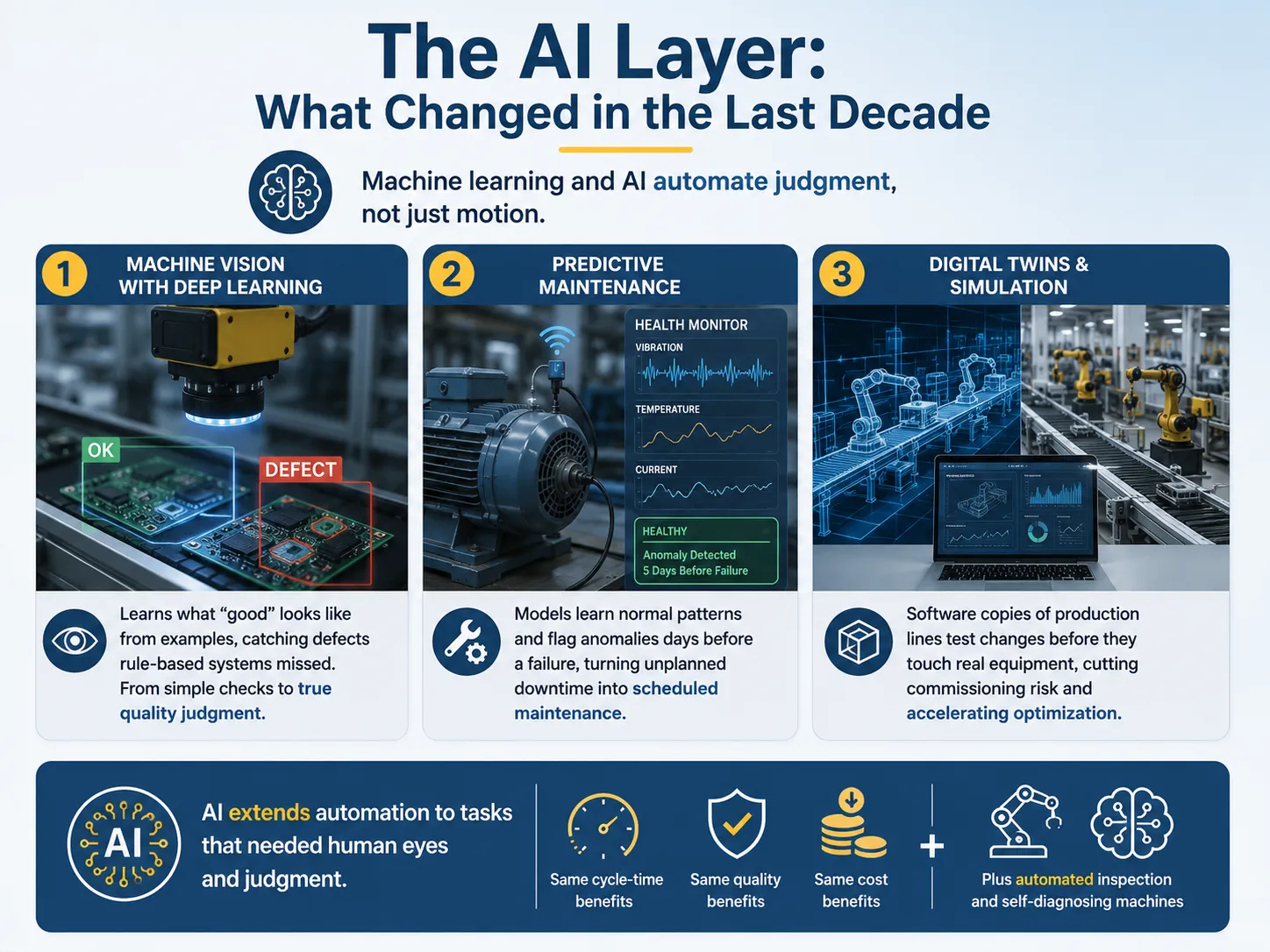
Over the last ten years, we have added another layer of automation: machine learning and artificial intelligence, which can automate judgment as well as motion. Three major developments have caused this:
- Machine vision with the use of deep learning existing inspection processes have gained machine learning capabilities allowing them to learn what “good” means and help identify defects that previous inspections were unable to spot.
- Predictive maintenance adaptive models analyze existing engine data to develop parameters for normal engine operation and notify engineers about any abnormalities way before they lead to system malfunction.
- Digital twins and simulation companies have created digital copies of their production processes in software allowing them to carry out experiments before making any changes in the real environment.
Key point: AI did not replace the advantages associated with automation; instead, it extended them to the areas that previously required a human Being’s judgment. As a result the factory operating in 2026 will be able to benefit from cycle time, quality, and cost advantages of automation as well as from machine self-diagnosis and inspection features.What is coming next — from human-robot collaboration to AI-driven line scheduling — is covered in the industrial automation trends 2026 article.
What Problems Automation Solves (and Does Not)
Understanding what each side of the equation can do is crucial because it leads to avoiding mistakes that could prove to be costly.
Automation solves the problems presented below: labor scarcity in repetitive roles, quality inconsistency caused by human errors, production bottlenecks in high production steps, exposure to unsafe working conditions for those people doing hazardous work, lack of visibility and data on production, etc.
Some of the issues automation cannot solve are vague specifications — this means that automating a bad process only allows for faster creation of bad parts; low volume and high variability types of work where the flexibility of humans can win in this regard; low demand for products — it is important to remember that automation is about improving capacities but not demand; presence of low maintenance skills — if one is unable to maintain a machine, automation will prove unhelpful.
There is one more issue to address: automation changes jobs but does not eliminate them — automated lines require setup, programming, maintenance, and constant improvement and those who work in those positions are usually getting higher salaries than the operators they replaced. The human-side design of automated systems — keeping people in the loop where judgment matters — is explored in the human oversight in industrial automation article, which makes the case that the best systems are partnerships, not replacements.
FAQ
Why is automation so important?
Automation is necessary in the sense that it turns non-standard human efforts into standard machine efforts, producing rapid speed, uniformity, and data that cannot be produced otherwise. At this time of shortage of labor and international competition means that automation is what distinguishes those businesses that grow profitably and those that are limited by the number of employees they have.
What are the pros and cons of automation?
The advantages of automation are: increased output, uniform quality, lower production costs, improved safety, and the availability of real-time data. The disadvantages of automation are: low initial cost, specialized skills necessary for maintenance, a chance of introducing automated processes without properly functioning procedures, and the need to consider the application of automation in low volume or variable processes.
What are the benefits of automation in the workplace?
Automation in the workplace takes away repetitive and dangerous jobs, standardizes quality assurance and cycle time, gives data for continuous improvement, and allows employees to work in ensuring safety rather than doing repetitive work at a lower pay rate.
What are 10 advantages of automation?
1) Increased speed and output; (2) 24 hour service; (3) Standardized quality; (4) Reducing defects and rework; (5) Decreasing unit cost in time; (6) Better safety for workers; (7) Availability of real-time data; (8) Preventive maintenance; (9) Possibility of scaling up without increasing workforce at pre-determined ratios; and (10) Giving employees the opportunity to work in more valuable areas.
What is a benefit of automation?
The greatest advantage that automation offers is consistency. The advantage lies in the fact that every automated process operates in an identical manner every time and does not vary like humans do in their performance.
References
- McKinsey — The Future of Work and Automation
- World Economic Forum — The Future of Jobs Report 2025
- International Federation of Robotics — Robot Demographics and Impact Reports
- Robotics Business Review — Automation Economics and Case Studies
- Australian Government — Advanced Manufacturing and Automation Policy
Conclusion
The utilization of automation in various manufacturing processes eliminates the unpredictability of human intervention and instead replaces it with consistent productivity of machines. The results from automation application entail various advantages such as speed enhancement, quality improvement, cost reduction, safety increase, effective data collection, and change of labor forces. For instance, manufacturing is the best example because in its case the period of production cycle is significantly shortened, defects are reduced by 50%-90%, and ROI from the purchase of the equipment takes about1-3 years. Besides, when automation and artificial intelligence are used in combination, the methodology has started to be adopted for inspection and evaluation procedures. It is also necessary to take into account the time to decide whether to automate or to involve human efforts into this series of events.