benlong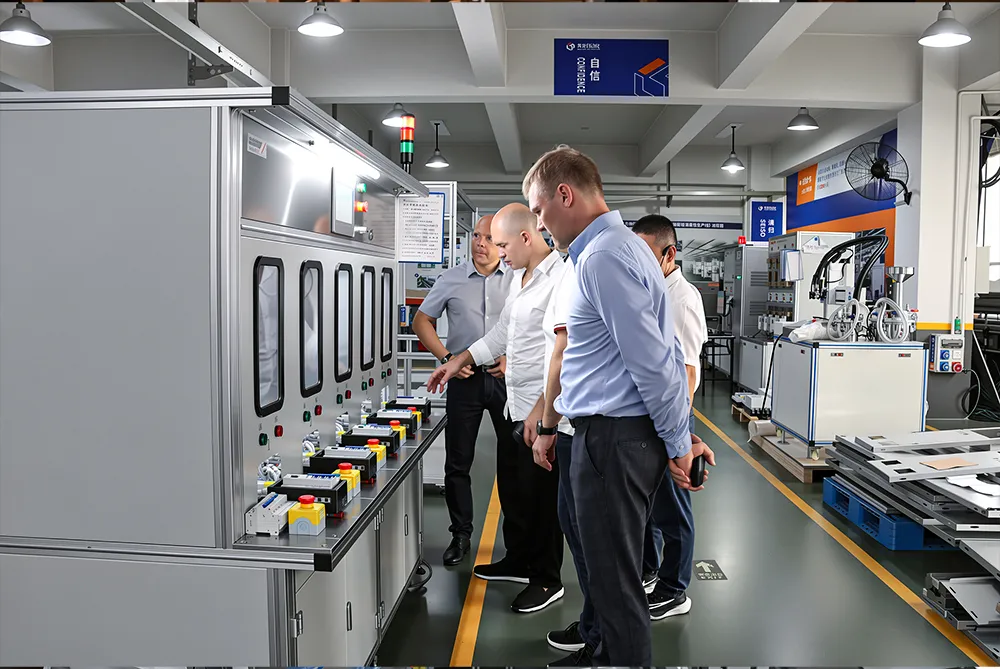

Agentic AI in Manufacturing: How AI Agents Are Changing the Factory Floor
The time is 2:40 in the morning, and a supplier has sent an email notifying that a batch of copper coils will be delivered with a delay of two days. In most manufacturing plants, this message simply lays in the inbox until a planner arrives at the factory at eight o’clock. By that time, however, workers on the night shift, having already begun their production jobs featuring these coils, will realize that the line will cease operations by noon, forcing someone to complete the manual re-scheduling of processes for the day.
Let’s now imagine an alternative night. A software agent reads the incoming email, checks which orders depend on the missed coils, as well as what supplies are left in stock, and creates a new timeline of operations, which the factory might follow devoid of the coils. It checks equipment availability through MES data, pinpoints two orders that will be delayed, and sends the planner a message outlining the newly-planned timeline.
This second scenario is what people refer to when speaking of agentic AI in manufacturing. It is indeed not only about a smart dashboard but about agentic AI’s capabilities when it comes to planning all the actions required, utilizing factory software tools, and completing the production process on their own.
The concept of agentic AI has quickly moved from being an intriguing idea to a part of suppliers’ roadmaps. In the spring of 2026, for instance, IBM published a guide indicating that autonomous quality management, dynamic scheduling, and end-to-end process optimization should be the leading applications of agentic AI technologies. In March of the same year, Siemens declared that industrial AI systems were becoming agentic; it was also introducing the orchestrator agent supervising specialized agents acting with the help of its Industrial Copilot program. In that month, Microsoft even referred to 2026 as the turning point for AI, where governance as well as the reversing abilities would be among the key success factors of AI implementation.
The current guide will provide the information on what agentic AI is, where it is already utilized, and how to implement the technology without creating new risks. Moreover, we will take you through an example of its usage in the circuit-breaker testing process.
Quick answer: Agentic AI in manufacturing is described as AI systems capable of working toward achieving set targets through planning the needed actions, taking information from data systems like MES, ERP and maintenance software and performing actions with minimal human involvement. The main applications of agentic manufacturing AI technologies include quality investigation, dynamic scheduling, maintenance coordination and rescheduling of the supply chain. In most effective production units, agents operate under clearly defined authority limits: safety logic resides in PLC, whereas higher-risk actions are accompanied by the necessity of human approval.
What Is Agentic AI in Manufacturing?
The majority of factories have utilized forms of “intelligence” already. PLCs calculate logic operations at very high frequencies—every second, it performs this activity thousands of times. Vision systems remove defective ones. Predictive models show that the bearing is degraded. The question is: What is new here?
What actually differs is the closing of the loop in question. Predictive models deliver some information while agentic systems are able to act on it. According to Siemens, agentic systems represent AI that utilizes several data sources and tools to provide solutions and solve multi-step problems without anyone making every click. IBM describes it in terms of shop floor activities. Agentic systems are able to change machine settings when they see the defect instead of only reporting about it.
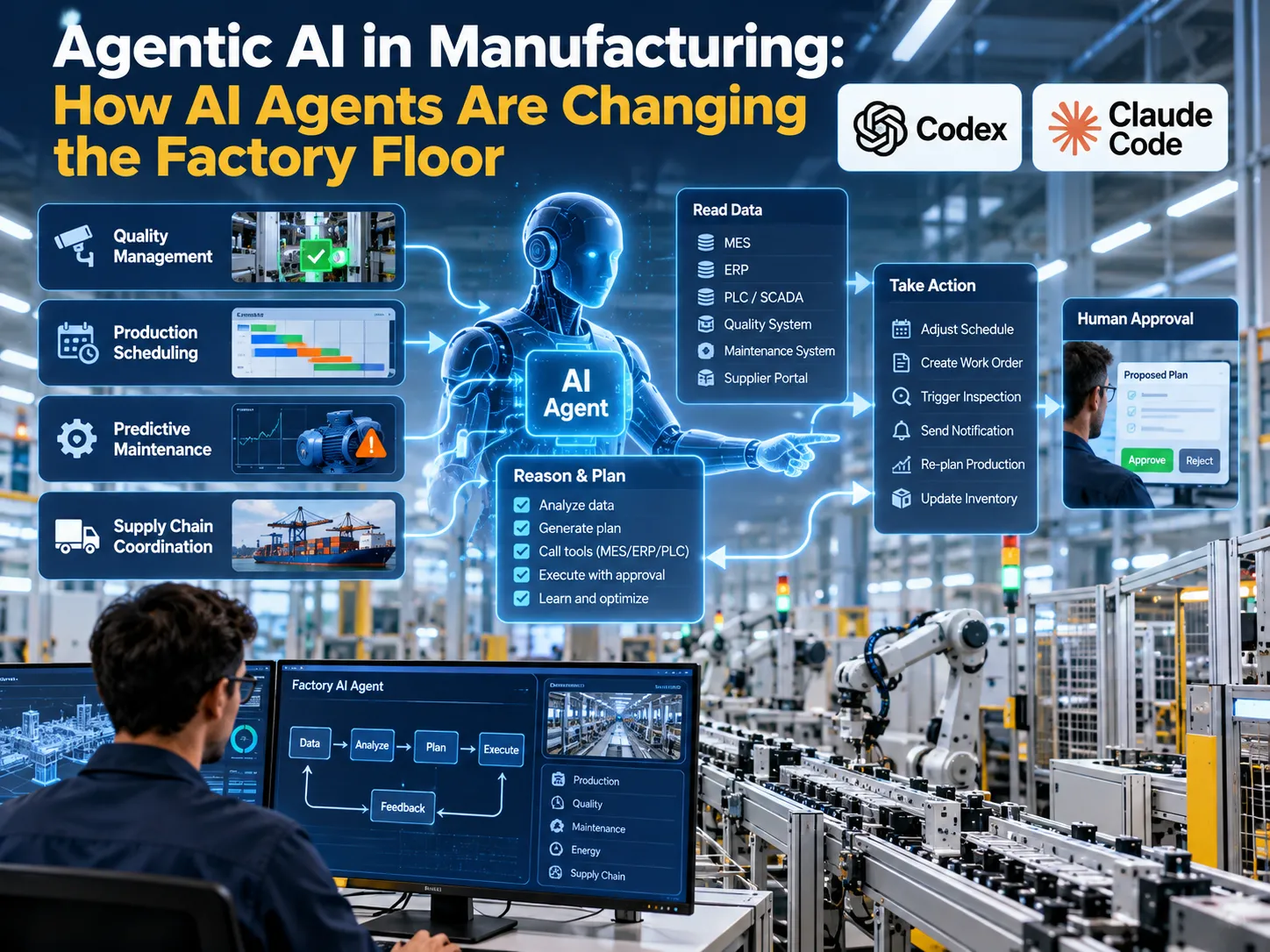
In reality, AI agents in manufacturing can be treated as computer programs that perform three functions: have a purpose (maintain the output target on line 3 and address the quality alarm), have certain accesses to tools (read MES, create work orders on equipment maintenance, find out the stock level of suppliers), and be guided with the rules concerning their actions.
AI Agents vs Traditional AI vs Automation
The terms get mixed up constantly, so here is how they compare on a typical production floor.
| Technology | What it does | Factory example | Who acts on the result |
|---|---|---|---|
| Rule-based automation (PLC, robots) | Executes fixed logic exactly as programmed | A press-fit station rejects a part when force exceeds its limit | The machine, within fixed rules |
| Predictive / analytical AI | Finds patterns and forecasts outcomes | A model predicts a spindle failure in ten days | A person reads the alert and decides |
| Generative AI copilot | Answers questions and drafts content on request | An engineer asks for PLC code or a fault explanation in plain language | A person, after every prompt |
| Agentic AI | Plans and carries out multi-step work toward a goal using tools | An agent sees the failure prediction, finds a low-load window, books the technician and orders the part | The agent, within approved limits; people approve higher-risk steps |
Notice that agentic AI does not replace the other three. It sits on top of them. The PLC still runs the machine. The predictive model still produces the forecast. The agent is the layer that turns those signals into action.
How an AI Agent Works on the Factory Floor
Up to four major algorithms are set to run the core of most industrial agents:
1.Perception of real-time and historic information gathered from machine states observed in SCADA or PLC, operational test results stored in MES or ERP orders, and updated purchase requisitions through supplier portals or emails.
2.Reasoning. Use a language model plus domain rules to understand the situation and work out a plan, for example, “trip results are drifting; first check whether one test fixture is responsible.”
3.Activation. Call tools: run queries, create work orders, update schedules, and send messages. Each call created has a log.
4.Learning. Look at the outcome and compare it with what was expected; then, adjust the next decision.
Losing a one-size-fits-all agent is rare for big plants. They embraced several specialized agents with an orchestrator in charge. This is exactly what Siemens refers to: its Industrial Copilots are the conversational front end, whereas the orchestration agent chooses whichever expert agent completes which part of the job. IBM refers to the same model as a multi-agent system that works across workflows instead of being stuck engaged in an isolated task.
What IBM, Siemens and Microsoft Are Saying
The three companies approached the subject from different perspectives; this is helpful because it means that all of them cover the various aspects of strategy, and industrial software and cloud infrastructure.
IBM sees agentic AI as a persistent decision-making process that evaluates cost, quality, and delivery simultaneously. The company’s 2026 overview presents eight sectors of application ranging from quality and scheduling to sales and supply chain, and it adds a Gartner prediction that by 2028 agentic AI will be used in 33 percent of enterprise software applications compared to less than 1 percent in 2024.
Siemens is concentrated on the industrial value chain, including design, planning, engineering, operation, and servicing. When promoting its agentic AI at Automate 2025, CEO Rainer Brehm called this technology a move “beyond the question-answer paradigm,” to systems able to complete workflows. The company claims to provide an increase of productivity of up to 50 percent, and assures that customers are in control of the tasks they hand over to agents.
Microsoft concentrates on orchestration and trust. Its article published in March 2026 describes three shifts—systems, data, and work—with the tools that allow users to work with assistants to be replaced by the agent that performs tasks. According to the company, once artificial intelligence grows from providing recommendations to executing tasks, the need for management of models, control of access, data, OT, and explainability of decisions arises.
Agentic AI Use Cases in Manufacturing
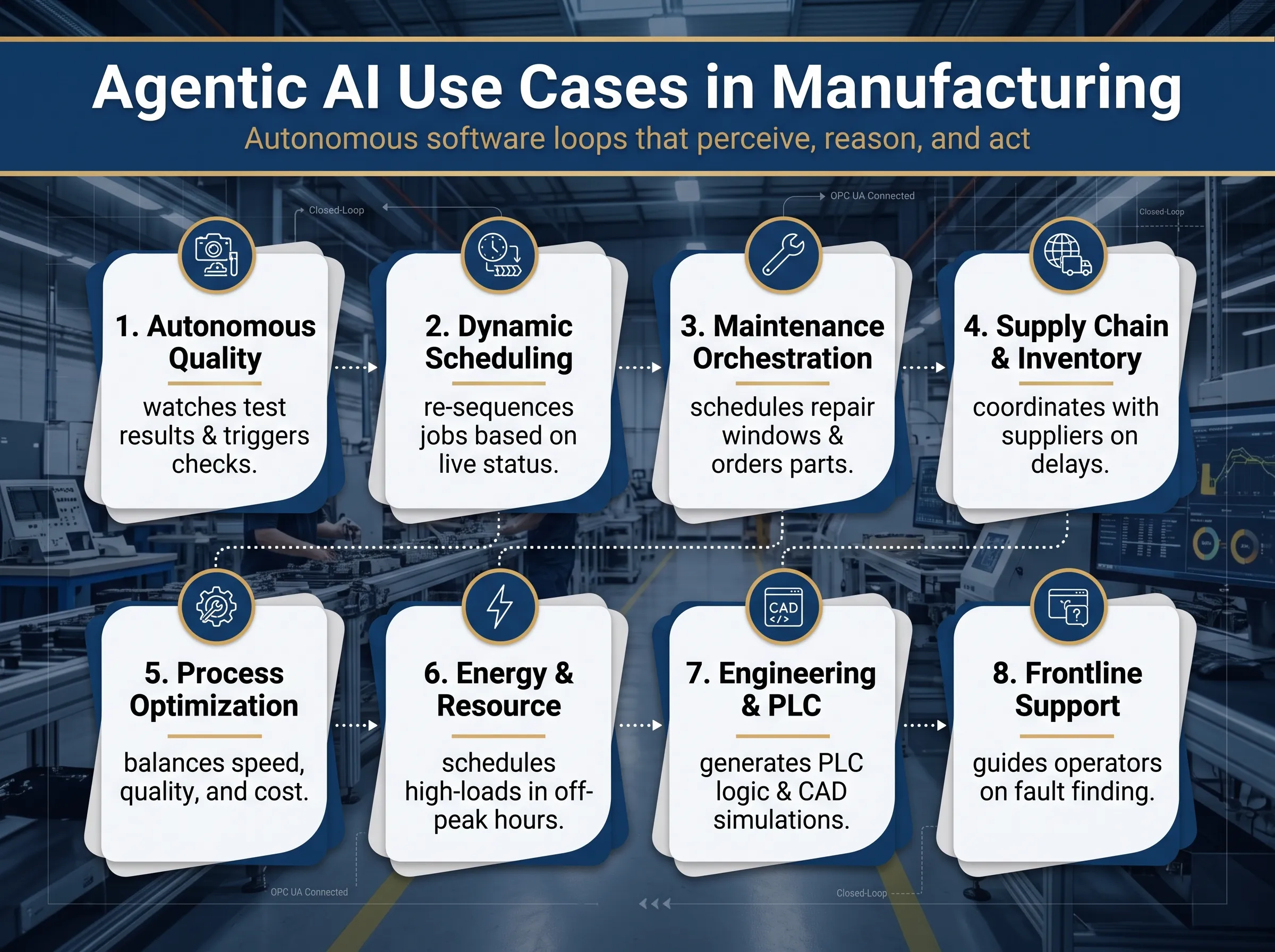
This is where the conversation gets practical. Below are the agentic AI use cases in manufacturing that come up most often in vendor material and early deployments, with the kind of work an agent actually does in each one.
1. Autonomous Quality Management
Because the information is already available, quality is the starting state in this case. Any number of inspection cameras, test benches or gauges all produce numbers and most of the time these numbers are only looked at once.
Unlike other systems, however, a quality agent is constantly monitoring the data. This implies that once the agent notices any anomalies in the data (such as increasing defect rates, approaching limits or bunches of failures on a particular shift), it does not just record the anomaly. It investigates such questions as which production station or fixture produced such results.
As an example here comes IBM with the electronic domain: once the system detects a recurring defect when soldering, it has the capacity to correct the temperature and timing on the equipment or launch targeted testing of all recently soldered boards.
In case of safety-critical products, normally the function of the agent is limited to investigation whereas any change of the process is subject to approval of a licensed engineer.
2. Dynamic Production Scheduling
The moment a production schedule is created, it begins to fall out of date. This may be due to machine malfunction, a rush order, or a delivery issue. This means that workers will constantly have to be re-scheduling everything on their spreadsheets above all during the day.
Scheduling agents keep on re-scheduling orders using live information about order status, machines, labor availability, and material availability. IBM provided an example where in a car factory production is suspended due to some key component delivery delays. However, instead of switching off the production, a scheduling agent can easily reorganize the production process, order vehicles that do not need the delivery to be manufactured first, and balance the workload between the line workers.
This approach can be applied just the same through most manufacturing processes. Even a small breaker manufacturer making several different models can benefit from reduce the number of need changeovers.
3. Predictive Maintenance Orchestration
Predictive maintenance has existed for a long time, but the challenge has always been what happens after the prediction. Someone needs to pick up the alert, check the timeline, find a technician, order the needed part and negotiate the downtime with the production.
This job is handled by agents. IBM describes agents as those who are capable of scheduling work during expected production downtime, ordering replacement parts, assigning technicians and temporarily changing loads with other machines. The same approach has been adopted in Siemens’s Senseye Maintenance Copilot project. According to Siemens, pilot clients decreased the time spent on reactive maintenance activities by an average of 25%.
4. Supply Chain and Inventory Coordination
Microsoft believes that the early supply-chain AI only generated reports and dashboards, after which it is up to the people to take action based on the insights received. The next stage is to have AI that has the ability to act by coordinating with suppliers, triggering resourcing or re-planning, and managing any potential logistics problems.
IBM refers to its own research which, done in partnership with Oracle and Accelalpha, indicates that 62% of supply chain executives claim that AI agents enhance action speed. Meanwhile, 76% of heads of supply chains expect agents capable of solving routine tasks with speed that is better than humans to help achieve better efficiency in operational processes.
For a specific factory, the practical version is that the agent understands that one of the suppliers is late, determines which orders will suffer and suggests another supplier or material for the order in question. It is the 2:40 a.m. narrative outlined before.
5. End-to-End Process Optimization
In conventional process improvement initiatives, optimization occurs solely at one station. It is possible to take each of the parameters of the process into consideration while making the trade-offs between speed, cost, and quality of the process.
This was demonstrated by a case with IBM’s consumer goods. The agent discovered that a decrease in the process speed would lead to a substantial decrease in the defect rate thus lowering the overall cost of manufacturing. The changes were implemented immediately and continuously optimized in the process. An experienced engineer could have arrived at the same conclusion, although after months of data analyses, not in just a few days.
6. Energy and Resource Optimization
Heavy industrial facilities have the capability to control flexible load shifting, allowing for cost savings. The use of agents in steel and chemical production enables energy-intensive processes to occur when electricity prices are lowest without sacrificing yield.
Manufacturers of electrical devices have their own examples of flexible load in the form of burn-in testing of electrical components. A good example is IoT smart MCB production line, where aging tests are performed for several days under load conditions.
7. Engineering, PLC Programming and Product Development
Some of the most advanced agentic technologies can be found in engineering rather than on the production floor. Siemens’ Engineering Copilot for TIA Portal allows automation engineers to develop PLC code from simple instructions, while in NX CAD, its Design Copilot functions. Siemens reports that at thyssenkrupp Automation Engineering, engineers have noted improved code quality and faster development.
IBM represents agents that divide the complicated engineering task into smaller parts, develop design variants, and control simulations, frequently in a digital twin, long before any physical object appears. Shorter production cycles imply faster commissioning for any consumer of automation.
8. Frontline Operations Support
Microsoft believes that frontline teams using multimodal copilots will independently solve more problems and thinks that these processes involving humans and AI will eventually turn into operational agents. The Operations Copilot from Siemens follows a similar principle, as operators and technicians use machine data to get troubleshooting guidance in an easy-to-understand language.
For facilities that experience high staff turnover – a common occurrence in many emerging export markets – this may be the fastest way to reap benefits, as it allows every new employee to benefit from the expertise of a senior technician.
Agentic AI Applications in Manufacturing at a Glance
The table below summarizes the main agentic AI applications in manufacturing, the systems each agent typically connects to, and where a person usually stays in the loop.
| Use case | What the agent does | Systems it connects to | Typical human checkpoint |
|---|---|---|---|
| Quality management | Spots trends, traces root causes, triggers extra inspection | MES, test benches, vision, SPC | Engineer approves any process change |
| Production scheduling | Re-sequences jobs when orders, machines or materials change | ERP, MES, planning software | Planner approves changes that move delivery dates |
| Maintenance orchestration | Books work in low-load windows, orders parts, assigns technicians | CMMS, condition monitoring, MES | Supervisor confirms the downtime window |
| Supply chain coordination | Responds to supplier delays, adjusts orders and plans | ERP, supplier portals, email | Buyer approves new suppliers or extra spend |
| Process optimization | Tunes speed and setpoints inside approved ranges | MES, historian, approved machine interfaces | Process owner sets the allowed range |
| Energy management | Moves flexible loads to cheaper periods | Energy meters, MES, tariff data | Facility manager sets the limits |
| Engineering | Generates PLC code, design variants and simulations | TIA Portal, CAD, PLM, simulation tools | Engineer reviews and tests all code |
| Frontline support | Answers operator questions, guides fault finding | Manuals, MES, machine data | Operator decides what to do |
Agentic AI in Discrete Manufacturing
Industrial process operations like refineries and chemical plants have long utilized advanced process control technologies. In contrast, the advent of autonomous AI technology has opened a field for discrete manufacturing, as discrete manufacturing plants confront various asymmetries that conventional systems cannot handle effectively.
Consider a plant producing electrical devices – circuit breakers, starters, or measuring devices. The production unit operates with dozens of versions of electrical devices with many options and modifications each of which may result in plenty of production errors. Every time production is switched from one operation to another there is a higher chance of utilizing an incorrect production plan. Production part tracking in this case is complicated and shaped by innumerable variables, presenting an excellent opportunity for an intelligent “solving” agent that employs advanced technologies.
The efficiency demonstrated by top producers working with a wide variety of products proves this. Rockwell Automation Singapore produces over 1,000 various products the majority of which undergo numerous changes during the year due to the deployment of over 50 digital and AI technologies, one of which is AI for quality control. Siemens Amberg and Eaton Changzhou tell a similar story, and we covered how they got there in our guide to factory lighthouse examples from Schneider, Siemens and Eaton.
Example: How an AI Agent Could Respond to Quality Problems on an MCB Testing Line
This is an example of how agent-based AI may operate with test data. It does not state the operation of an actual agentic AI system that has been put into the service of Benlong.
Picture a high-speed MCB automatic testing line running C16 breakers. Each device goes through tests on an instantaneous (magnetic) trip at the level of 5-10× In, thermal calibration at 1.13× and 1.45× In, and contact resistance. The line performs 1,800-2,400 units a per hour, and for each unit the result appears together with a serial number and timestamp, and sends the data to the MES being connected via OPC UA or Modbus TCP.
In over two shifts the magnetic trip results for one batch began to approach the tolerance limits. Still each of the MCBs is operating normally. The traditional system sees no problem as everything appears to be in order.
An agentic quality control AI, having the access to the same data, shall read the trend in a different way. Thus it may do the following:
1.Compare the batch with the historical results of similar rating in order to make sure that the drift is for real and not just a normal variation.
2.Identify whether the shift is related to the assembling process, like a station, fixture or a change of operators, or if this is connected somehow to the upstream lot of materials (like a new reel of coil wire or a yoke supplier).
3.Examine the data obtained from the testing station to check if the measurement error has taken place, for instance, assessing the increase of the contact resistance in the testing fixture.
4.Prepare the recommendations: increase sampling of the affected lot and carry out the fixture measuring.
5.Notify the engineer about the issue, so that they could approve the actions, which will be taken.
Once the engineer gives his/her approval, the MES creates the inspection task and the hold. The agent then starts monitoring subsequent units to see whether the drift stops, documenting everything for possible inspections in the future.
There are some things the agent should never do. In particular, it should not increase the limits of the trip operation or ignore any safety requirement or change any of the calibration parameters on its own. All the responsibilities for the pass/fail decisions are on the capable test equipment. The role of the agent is to find the problem and improve the response time of the people in charge.
How Are Manufacturers Using AI Agents in Production Today?
One may wonder how authentic all of this information is. One can find an honest answer to this question by stating that much of this information still relates to the copilot stage, which means the AI system cooperates with the human being, thus making the process of creating autonomous agents gradual. The facts that are accessible should be mentioned:
Siemens claims its Industrial Copilots contribute good results both in production facilities and for its customer. One of its plants (the motor plant in Bad Neustadt) uses the Insights Hub Production Copilot for processing data and translating it into actionable information. Besides, Siemens is planning to launch a platform that allows different systems (both its own and third-party ones) to work in synergy.
Siemens Digital Industries Software has developed the Microsoft Teams application to be used in the Teamcenter PLM system for processing voice reports made in different languages and retransmitting them to relevant experts.
Körber decided to migrate its PAS-X MES system to Microsoft Azure to integrate MES, ERP, and supply chain data for its employees.
Rockwell Automation’s plant located in Singapore has been awarded the title of Global Lighthouse in June 2026. The plant implements many AI systems and has cut the time needed for training new employees by 67%.
Siemens’ Nanjing plant was designed virtually and runs more than 50 operations driven by AI taking orders in 78% less time.
The World Economic Forum made an announcement in June 2026, according to which the number of Global Lighthouses has reached 238 and now they are transforming AI into the key operating capability.
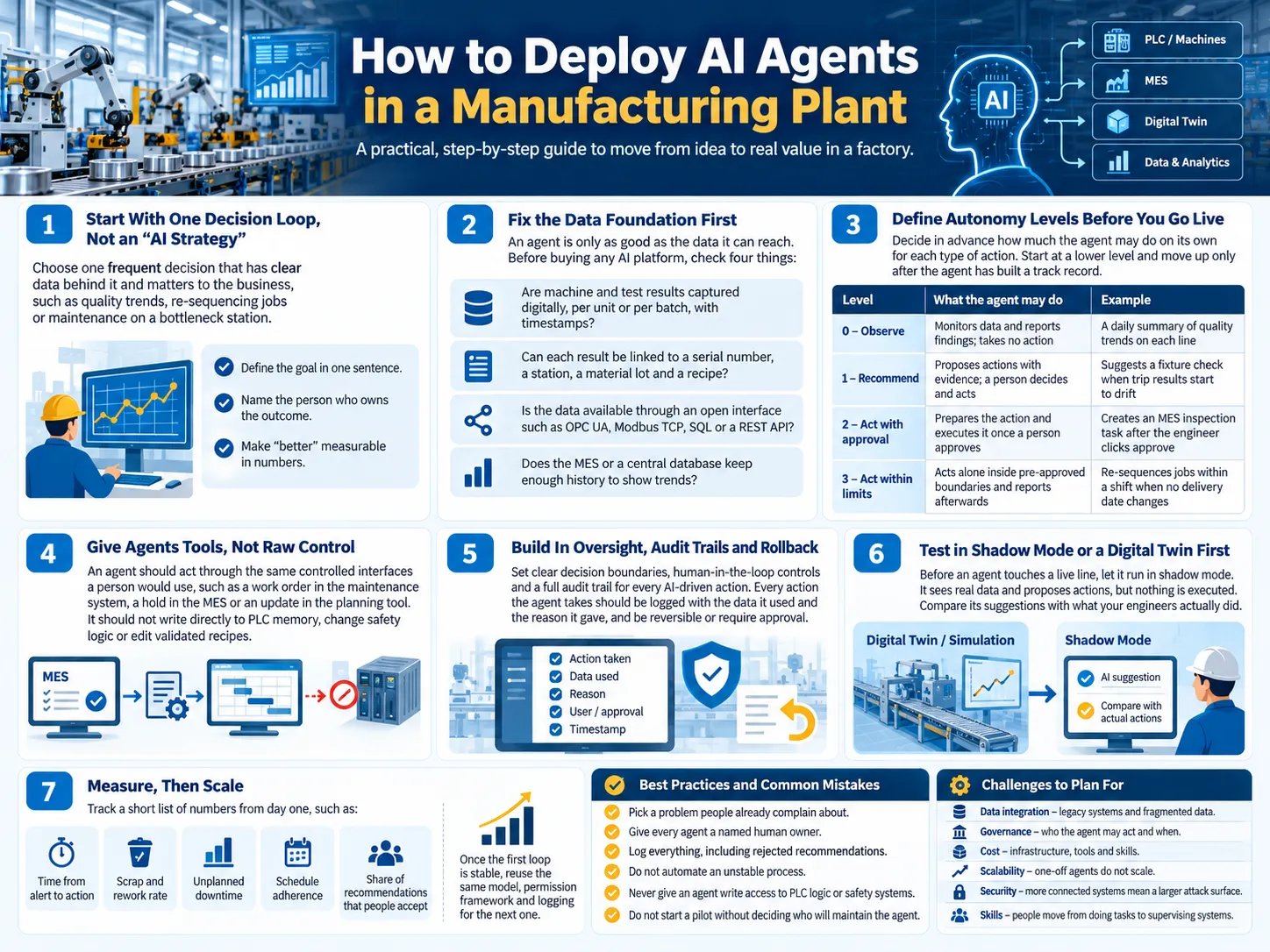
How to Deploy AI Agents in a Manufacturing Plant
The vast majority of unsuccessful factory AI projects fail due to reasons other than the shortcomings of the algorithm. The failure can be attributed to poor quality data and responsible person not being assigned for the project. According to Microsoft, you should keep in mind the “rule of thumb” established by KPMG, explaining the reasons for successful projects – 10 percent is due to the algorithm, 20 percent is due to technology and data, and 70 percent in connection with people and processes.
Here is a practical sequence for how to deploy AI agents in a manufacturing plant, written for a mid-sized factory rather than a global corporation.
Step 1: Start With One Decision Loop, Not an “AI Strategy”
Select one common decision that a person currently faces and has measurable results. For example, you could look at how to react to quality fluctuations on an assembly line, how to rearrange jobs after a stoppage of a machine, or how to manage the maintenance at a bottleneck. However, a poor decision can be anything that relates to safety activities or to the one that happens only twice in a year.
Put the decision down in one sentence, name who is responsible for the outcome (who owns it now), and explain what “better” is in numbers.
Step 2: Fix the Data Foundation First
A machine’s effectiveness depends on the data that it can access. Before you purchase any AI platform look for the following:
1. Are results stored as digital records, per unit or batch, with timestamps?
2. Can each result be identified by its machinery number, location, material lot, and recipe?
3. Is the data available and outside of the machine, such as through OPC UA, Modbus TCP, SQL, or a REST API?
4. Is MES or a central database capable of storing enough records to reveal patterns?
IBM states that data integration and legacy systems represent the first hurdle facing agentic AI, advising companies to identify the highest-value sources of data first rather than trying to integrate all data at once. Our article on totally integrated automation explains how the PLC, HMI, MES and ERP layers fit together.
Step 3: Define Autonomy Levels Before You Go Live
This is the step most teams skip, and it is the one that keeps them out of trouble. Decide in advance how much the agent may do on its own for each type of action.
| Level | What the agent may do | Example |
|---|---|---|
| 0 – Observe | Monitors data and reports findings; takes no action | A daily summary of quality trends on each line |
| 1 – Recommend | Proposes actions with evidence; a person decides and acts | Suggests a fixture check when trip results start to drift |
| 2 – Act with approval | Prepares the action and executes it once a person approves | Creates an MES inspection task after the engineer clicks approve |
| 3 – Act within limits | Acts alone inside pre-approved boundaries and reports afterwards | Re-sequences jobs within a shift when no delivery date changes |
Most plants should start at Level 0 or 1 and move up only after the agent has built a track record. Safety-related functions stay out of the agent’s reach at every level.
Step 4: Give Agents Tools, Not Raw Control
It is essential for an agent to operate utilizing the same controlled interfaces that would be used by a human being, for example, a maintenance system’s work order, an MES hold, and a planning tool’s update. An agent must not interact directly with the PLC memory, modify safety logic, or change approved recipes.
Begin with read-only permission and then add write permission for every tool with its specific limits and logs.
Step 5: Build In Oversight, Audit Trails and Rollback
According to Microsoft, there are four trust capabilities that must be in place for manufacturers when AI goes to work: model governance, data and access control, OT and endpoint security, and the ability to explain, constrain and reverse decisions. The same principle is echoed by IBM which recommends to have clear boundaries for the decisions made, include a human in the loop, and make sure it is recorded every time such AI-driven action happens.
In other words, any action taken should be accounted for through logging of the data used and information on the reason provided for the decision made. Moreover, every action should either be reversible or pre-approved.
Step 6: Test in Shadow Mode or a Digital Twin First
It is best to test the agent on the operation without touching the equipment. The agent sees everything that is going on, makes decisions, and issues suggestions, but nothing happens. Make comparisons of its advice with the actions taken by your engineers and concentrate on the inconsistent points.
If you have the simulation model of the line at hand, make its use as well. Our guide to digital twins for production lines explains how Siemens, Schneider Electric and ABB use simulation and virtual commissioning, and how smaller plants can start with a single line.
Step 7: Measure, Then Scale
From the very beginning, keep a record of a few numbers: time taken from the alert to the action taken, rates of scrap and rework, unplanned downtime, adherence to the schedule, and percentage of recommendations made that the users would go ahead and follow. After the first loop proves to be effective, reuse the data model, permission framework, and logging from the previous loop.
Microsoft refers to the findings from the MIT and McKinsey research that emphasizes that organizations with a prominent governance model and unified data can achieve up to four times more transformational results and in a period of time that is twice shorter compared to the companies lacking the data and governance framework. What scales is the foundation, not the individual pilot.
Best Practices and Common Mistakes
- Identify a concerned issue people frequently express grievances about. It is feasible for the agent to solve the challenge whenever the agent finds an existing problem more.
Assign each agent its own proprietor.
Document everything from rejections of suggestions; that’s what you want to learn from.
Do not develop an agent in an uncertain environment. If the process behaves erratically, it will merely learn deviances.
An agent should never be granted write access to PLC logic or safety systems.
In advance of initiating a pilot project, define who will be responsible for the maintenance of the agent after the project team discontinues its involvement.
Challenges to Plan For
IBM is straightforward that agentic AI requires effort to implement. The challenges outlined are important to evaluate in the context of your own situation:
Data Integration: the current level of technology makes the integration of data and various incompatible sources inefficient.
Governance: not clear as to when the system is allowed to act independently and when human intervention is required.
Cost: the technology has high cost of implementation but the incremental approach eliminates the risks.
Scalability: an agent created for a particular task cannot be replicated; our approach mitigates this challenge.
Security: the integration of a higher number of systems creates conditions for greater number of attacks which need effective control measures.
Skills: people shift from performing their duties to managing the systems which requires special training.
AI Agents, PLC, MES and the Smart Factory
One of the most common worries we hear from automation engineers is simple: “Is this thing going to start writing to my PLC?” The short answer is that it should not. To see why, it helps to look at where agents sit in the automation stack.
Where Agentic AI Fits in the Automation Stack
| Layer | What it does | Role of AI agents |
|---|---|---|
| PLC and field devices | Deterministic real-time control, interlocks and safety functions | Read data only; no direct control of motion or safety |
| SCADA / HMI | Visualization, alarms and operator commands | Explain alarms and guide operators through fault finding |
| MES | Orders, recipes, quality records and traceability | The main working surface: inspection tasks, holds, work orders |
| ERP / supply chain | Demand, purchasing, inventory and finance | Re-plan orders, flag supplier risk, propose purchases |
| Agent and orchestration layer | Coordinates specialist agents, enforces permissions, logs actions | Sits above MES and ERP, outside the real-time control loop |
The PLC is meant to control everything that happens within milliseconds often ensuring safety of people and machines. The activities of the agents rely upon taken decisions in minutes/hours and shifts meaning all the major production processes are already over. This division helps factories in ensuring safety as AI is used only when it is needed by humans the most.
That is why it is important to pay attention to quality of the MES connection. The production line passing the test results, alarms and updates to MES through open protocol is the safest one. The automated line that is closed to HMI is effective, but safety is of an average level.
Digital Twin and Agentic AI: Simulate First, Then Act
Digital twins and AI systems both provide answers to distinct questions:
A digital twin is responsible for understanding and representing the condition of a machine, building, or production facility. The work of a digital twin can be summarized in the question, “what would happen if we made a change?”
On the other hand, agent AI is a system that organizes work based on available information and resources, where the information being used comes from the goals that have to be achieved and other tools that have been authorized for the use. The agent AI answers the question, “what is the next step and can it be done?”
The two approaches make up a safe cycle. The agent proposes a change like a change in the sequence of works done or a new cycle time. The work of the intelligent digital twin is to test if the proposed change is worth applying in reality. Only when the digital twin proves that the result of the new operations is in line with the requirements in terms of positive outcome and compliance with the established limits, it is implemented either in the system or sent to a person for approval.
IBM demonstrates this approach in creating a product where the work is done by the agents that coordinate the work of digital twin before launching a project for production. Microsoft mentions this idea at the level of the enterprise while stating that factories should be prepared for the agent AI age if they rely upon the concept of digital twins and digital threads in their planning and realization of the production process. If your plant is just getting started, our article on digital twin lessons from leading electrical manufacturers is a good place to begin, with real results from Siemens Erlangen, Schneider Electric Wuxi and ABB RobotStudio.
From Lighthouse Factories to Everyday Plants
The least accessible plants along the route are the WEF Global Lighthouses, and none of them is managed by AI alone. These are facilities where people monitor increasingly independent systems. Even the well-known lights-out factories such as FANUC and ASE still depend on people for maintenance and anomalies, as would be noted through the real dark factory examples.
A medium-sized manufacturer in the electrical equipment sector should take the following practical approach: eliminate the bottleneck, test every product in the process, link every plant with the MES, add a digital twin for planning purposes, and recruit agents to analyze information for making decision-making processes faster.
Conclusion: AI Agents Are a Workflow Change, Not a Software Purchase
IBM, Siemens, and Microsoft are all on the same page regarding the trajectory of Artificial Intelligence at factories. According to them, AI is evolving at factories from being a tool that simply responds to inquiries to acting as an agent that helps in planning and executing duties related to operations management in quality management, scheduling, maintenance, and supply chain tasks. Siemens stated that they are working toward automating the entire automation process. Microsoft stated that 2026 will be the year for technology to move from the pilot phase to large-scale implementation. IBM envisions factories where regular adjustments are made toward the objectives without constant instruction from the operator.
Said companies are also in agreement about the preconditions for using AI at factories. The automation agents require good and connected information. They need clear parameters within which they would act. They need a person who is responsible for the outcome and can revoke the solution if necessary. They also need machines that have the capability to measure everything and send the information out in the correct format.
The primary action that the manufacturing companies should take would not be the purchase of the AI platform but ensuring that each workstation and every process generates data that can be used for the agent’s purpose. If this is accomplished, moving on to AI agents will be much easier.
Frequently Asked Questions
What is agentic AI in manufacturing?
Agentic AI in manufacturing means the artificial intelligence which accomplishes some goals in production by creating a plan, extracting information from the systems like MES, ERP, and maintenance software, and taking appropriate actions through these systems, for example, through creating inspection tasks or rearranging the sequence of jobs. Agentic AI differs from dashboards and chatbots in the sense that it takes actions until the task is fulfilled but only under the conditions and rules set by people.
Is agentic AI used for automation?
Yes, but at a different level than traditional automation. PLCs and robotics still take care of real-time machine control and safety functions. Agentic AI automatizes decisions and coordination in relation to these, for instance, responding to quality trends, reimplementing schedules after machines have stopped, and organizing maintenance. Siemens refers to it as automating the process of automation itself with AI agents executing complete workflows in design, engineering, operations and service.
Which AI is best for the manufacturing industry?
No single AI solution can be crowned the best AI for production. While machine vision is perfect for the inspection process, predictive models are suitable for maintenance, generative AI copilot helps engineers and operators in finding necessary information, agentic AI is well suited for multi-layered tasks such as quality investigation, scheduling, and supply chain coordination. Some of the most common solutions are Siemens Industrial Copilot, IBM WatsonX Orchestrate, and Microsoft Azure AI. The choice of ideal AI solution depends on the quality of the data at hand, PLC and MES systems already used, and the task that has to be optimized.
How does agentic AI differ from automation?
Conventional automation operates according to predetermined rules: when some value crosses a threshold, the machine refuses the part. Agentic AI is target-oriented. In contrast to traditional automation, it evaluates the situation, determines the plan of actions, utilizes tools and adapts to changing conditions. A properly built production facility can make use of both: the PLC will maintain the safety and control functions, while the AI agents will work on MES and ERP.
How is artificial intelligence (AI) being used in manufacturing?
Companies apply the use of artificial intelligence in order to contest vision-based quality inspection, predictive maintenance, production scheduling, energy optimization, and supply-chain planning. The World Economic Forum awarded leading sites such as Rockwell Automation’s Singapore plant and Siemens’ Nanjing fabric sites for the use of products that are equipped with more than 50 AI solutions. The trend now becomes clear over time, moving from isolated AI pilots to agents who lead efforts across systems in 2026.
References
- IBM – How agentic AI in manufacturing drives transformation (April 2026) – definition, eight use-case areas, supply-chain statistics and implementation challenges.
- Siemens Blog – The future of Industrial AI is agentic (March 2026) – the perceive-reason-act-learn model, orchestrator agent and industrial foundation models.
- Siemens – Siemens introduces AI agents for industrial automation (May 2025) – Industrial Copilot agents across the value chain, productivity target and customer results.
- Microsoft – Manufacturing at the 2026 inflection point (March 2026) – the three shifts, trust and governance capabilities, and the 10-20-70 rule.
- World Economic Forum – New Global Lighthouse sites demonstrate how AI is rewiring manufacturing (June 2026) – network total of 238 sites and results for the new cohort.
- Rockwell Automation – Singapore site named a Global Lighthouse (June 2026) – AI-driven quality control and predictive maintenance in a high-mix plant.
Building an AI-Ready Assembly or Test Line?
AI agents can only act on the data your equipment produces. If you make MCBs, MCCBs, RCCBs, contactors or energy meters and want lines that test every unit, tie every result to a serial number and feed it to your MES over OPC UA or Modbus TCP, send us your product samples, target output and a short description of your current process. Our engineers will propose a line concept that delivers full traceability today and leaves you ready for AI-driven quality tomorrow.