benlong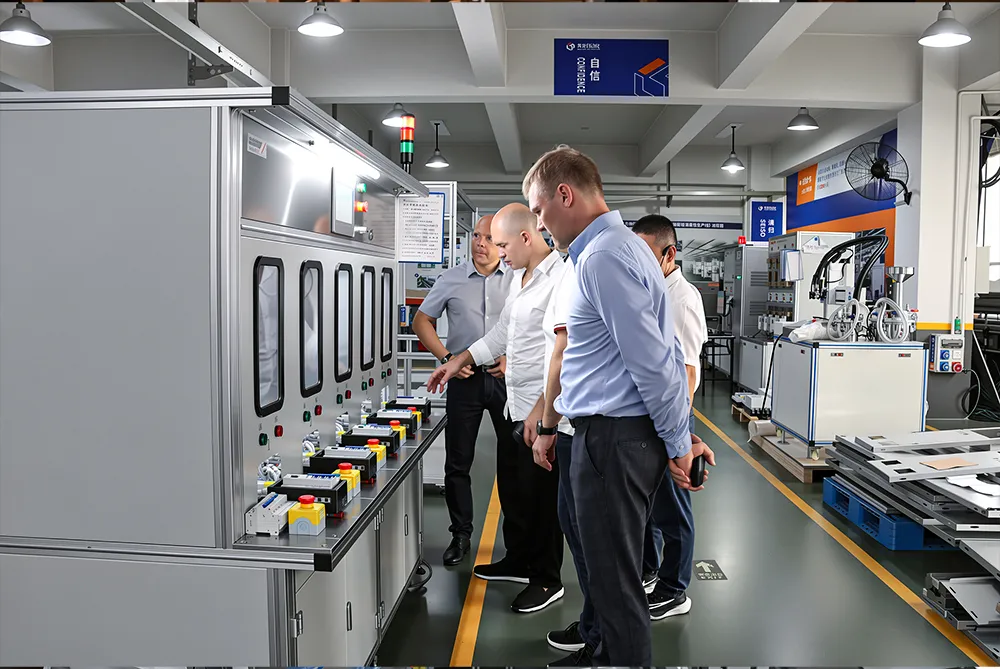
What Is Totally Integrated Automation?
When one company from the pharmaceutical sector in Switzerland installed a new line for packing tablets, it involved state-of-the-art machines. There was a seamless combination of a high-speed blister packing machine developed by a German manufacturer, a carton packing machine developed by an Italian company, and a case packing machine provided by a local integrator. The equipment itself operated with exceptional efficiency. Nevertheless, the manager of the facility experienced problems trying to gather information related to the functioning of the production line all together, and he only had separate platforms of control for each of the machines together with different types of information presented in different formats. Although all of the machines were automated, the entire packing line did not operate entirely in integrated manner what is exactly aimed at solving the problem of completely integrated automation. It means providing the system with one system that is not only a product but also a design philosophy and engineering platform ensuring that every element of the production system including controllers, drives, sensors, energy indicators and others work together on the basis of common set of information and knowledge.
What Totally Integrated Automation Actually Means
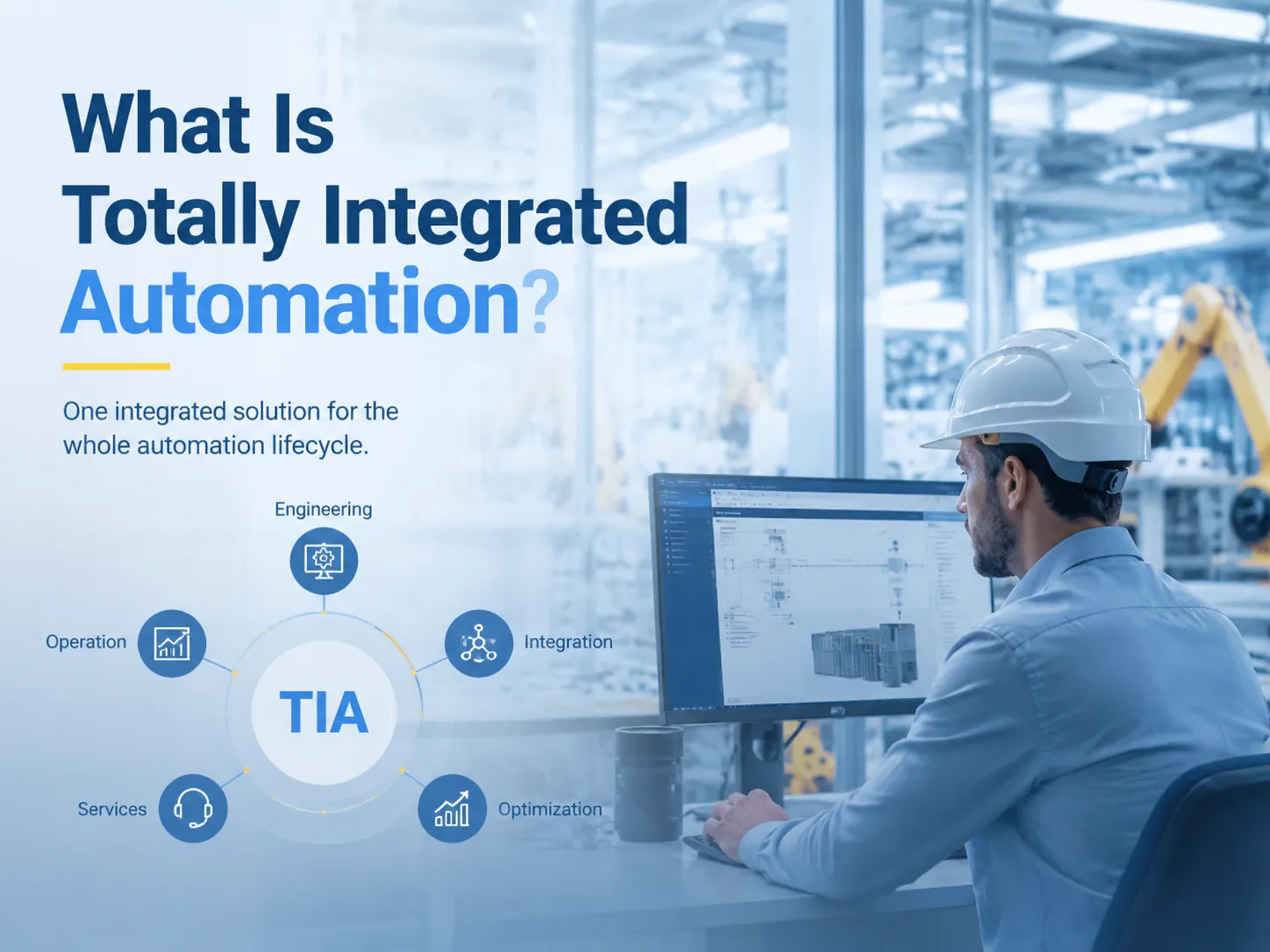
Siemens is the company most commonly linked to the phrase Totally Integrated Automation (TIA), which it developed as part of an integrated engineering framework around the TIA Portal software platform. TIA refers to a systematic and all-encompassing approach to industrial automation, including hardware, software, communication and data, and is not limited to any particular vendor. TIA revolves around three major elements. The first is a unified engineering environment, or the same software platform to configure, program and commission each device in an automation network, namely PLCs, HMIs, motors, safety devices, RFIs, and communication processors without using multiple tools, re-inputting information or dealing with incompatibility of versions of different programs. The second is integrated communication, which means that every device in this network uses the same language, i.e. PROFINET or PROFIBUS within Siemens’ framework, but also any other open standards such as OPC UA and MQTT. The controller does not require special drivers to operate the motor while the HMI does not need a separate tag database for getting information on the sensors. The third is integrated data and diagnostics, which means that every device processes information about its work, namely motor current, count of cycles, failure codes and energy consumption, but this information is available from one single point and does not get stuck inside a proprietary device.
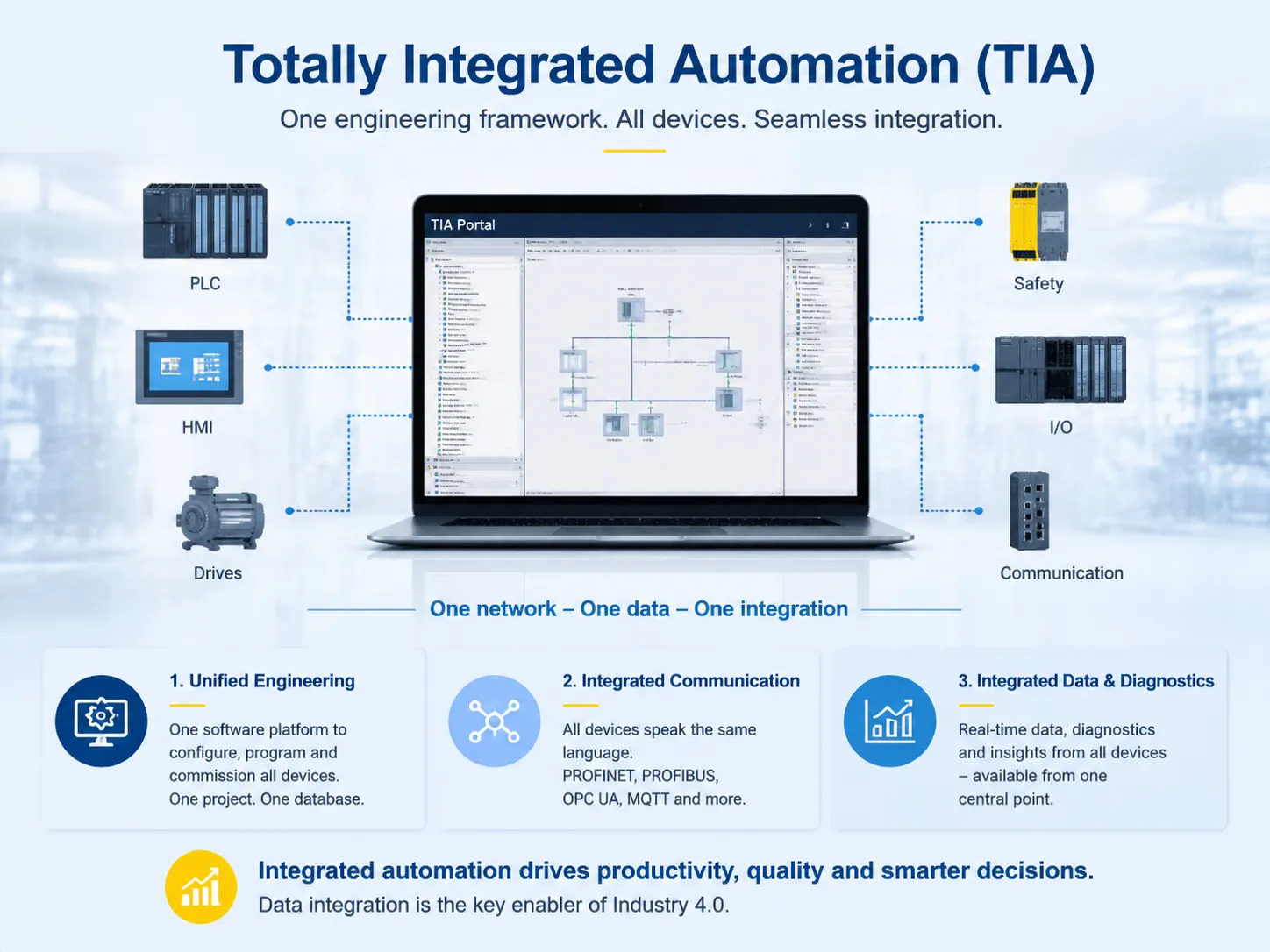
TIA Portal: Siemens’ Implementation of Totally Integrated Automation
“Totally integrated automation” is mainly about Siemens TIA Portal. The TIA Portal is the software engineering solution where all devices of Siemens automation technologies become part of a unique development environment. There used to be individual utilities, with STEP 7 for programming Siemens S7-300 PLCs and WinCC flexible for configuring the HMIs. All software had different interfaces, tag databases, and versions. TIA Portal made everything simple and unified. The engineer can create one project, which will have all types of creation of the plc program, the hmi screens, the drive data, and safety logic. A single tag is used once in the PLC to programme it and quickly displayed on HMI.
It is crucial to differentiate between TIA Portal and the more general idea of integrated automation. While TIA Portal is a specific product of Siemens, integrated automation is the concept that TIA Portal implements. For example, even if there is not a single Siemens device in a factory, there can be integrated automation if all the devices in this factory use standard protocols for communication and a common data model. Conversely, it is quite possible to have a factory full of Siemens devices that are not integrated because the machines were commissioned individually and not connected. Therefore, the tool is not the goal but rather the production system in which all devices can be accessed and controlled from a central point while data is flowing between the production and business systems. Research from McKinsey & Company on digital manufacturing consistently identifies data integration — the ability to collect, contextualise, and act on production data in real time — as the single most important enabler of the productivity and quality improvements that Industry 4.0 promises.
The Core Components of a Totally Integrated Automation Architecture
A totally integrated automation system is not a single box. It is a layered architecture in which each layer builds on the one below it, and in which the integration between the layers is what creates the value. The table below summarises the core components and their roles in the integrated whole.
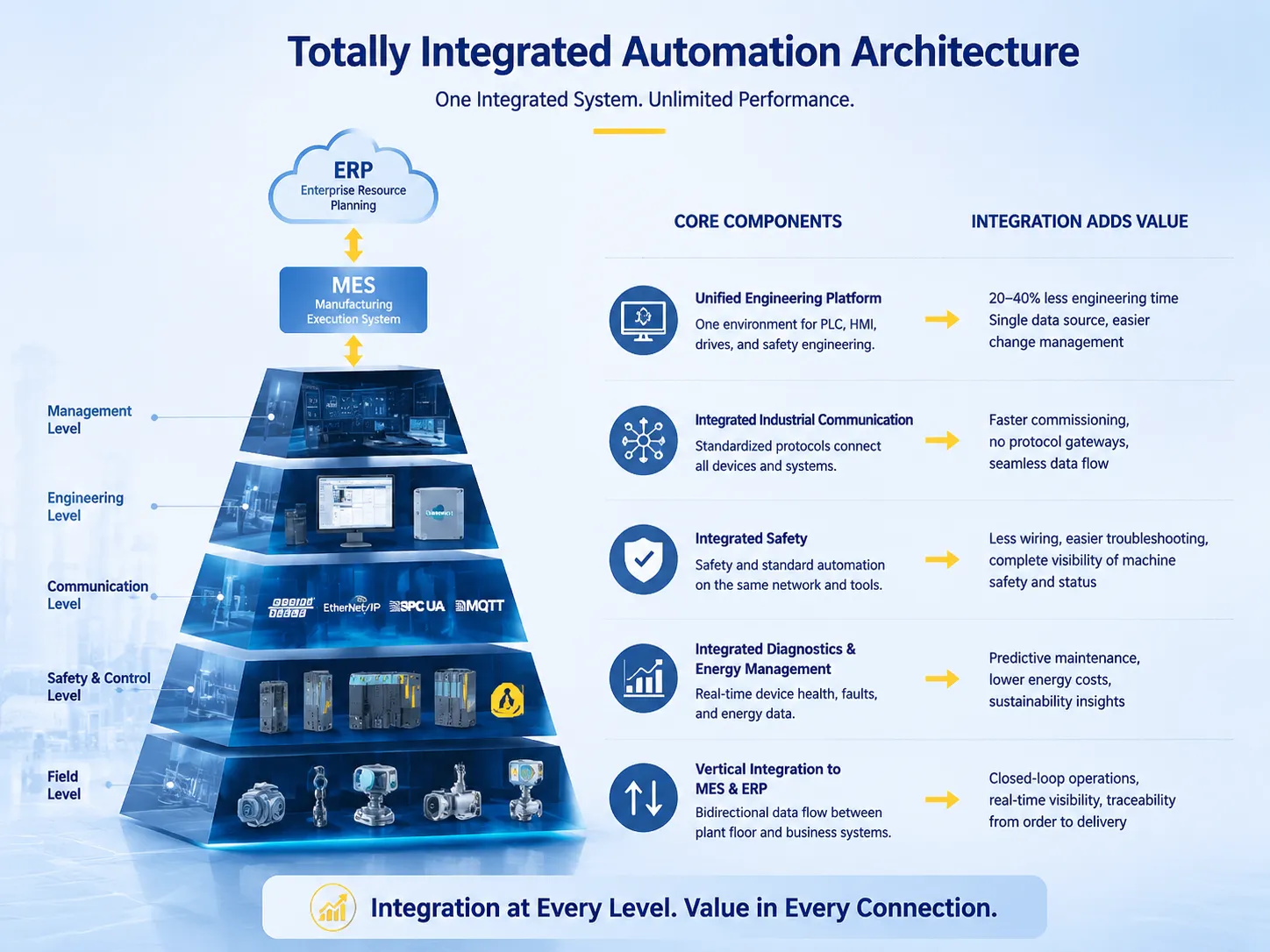
| Component Layer | What It Does | How Integration Adds Value |
|---|---|---|
| Unified engineering platform | Provides a single software environment for programming PLCs, configuring HMIs, setting up drives, and managing safety logic. In the Siemens world, this is TIA Portal. Other vendors have their own platforms; open architectures rely on standardised tools and protocols rather than a single vendor’s environment. | Eliminates data re‑entry between tools. Reduces engineering time by 20–40% compared with multi‑tool environments. Simplifies change management and version control. A tag defined once is used everywhere. |
| Integrated industrial communication | PROFINET, PROFIBUS, EtherNet/IP, OPC UA, MQTT — the protocols that carry data between devices. In a TIA architecture, the communication is configured automatically from the hardware configuration, not manually mapped. | Guarantees that every device can talk to every other device and to the supervisory systems. Reduces commissioning time and eliminates protocol‑translation gateways that add cost and latency. |
| Integrated safety | Safety controllers, safety I/O, and safety drives that operate on the same network as standard automation, using the same engineering tools. Safety logic is programmed alongside standard logic, not in a separate, isolated system. | Reduces wiring, simplifies troubleshooting, and allows safety functions to be modified without changing physical wiring. A safety fault is reported alongside standard diagnostics, giving the operator a complete picture of the machine’s state. |
| Integrated diagnostics and energy management | Every device reports its operational status, fault codes, and energy consumption to a central system. The data is standardised and accessible without proprietary software or a direct connection to each device. | Enables predictive maintenance by trending motor currents and cycle times. Reduces energy costs by identifying idle loads and optimising process sequences. Provides the data foundation for sustainability reporting and carbon accounting. |
| Vertical integration to MES and ERP | The automation layer communicates production data — counts, quality results, downtimes — to the Manufacturing Execution System (MES) and from there to the Enterprise Resource Planning (ERP) system. The communication is bidirectional: an ERP order can trigger a production recipe change on the plant floor. | Closes the loop between business planning and production execution. Reduces manual data entry, eliminates latency in production reporting, and enables real‑time order tracking and traceability. |
What Totally Integrated Automation Delivers to the Factory
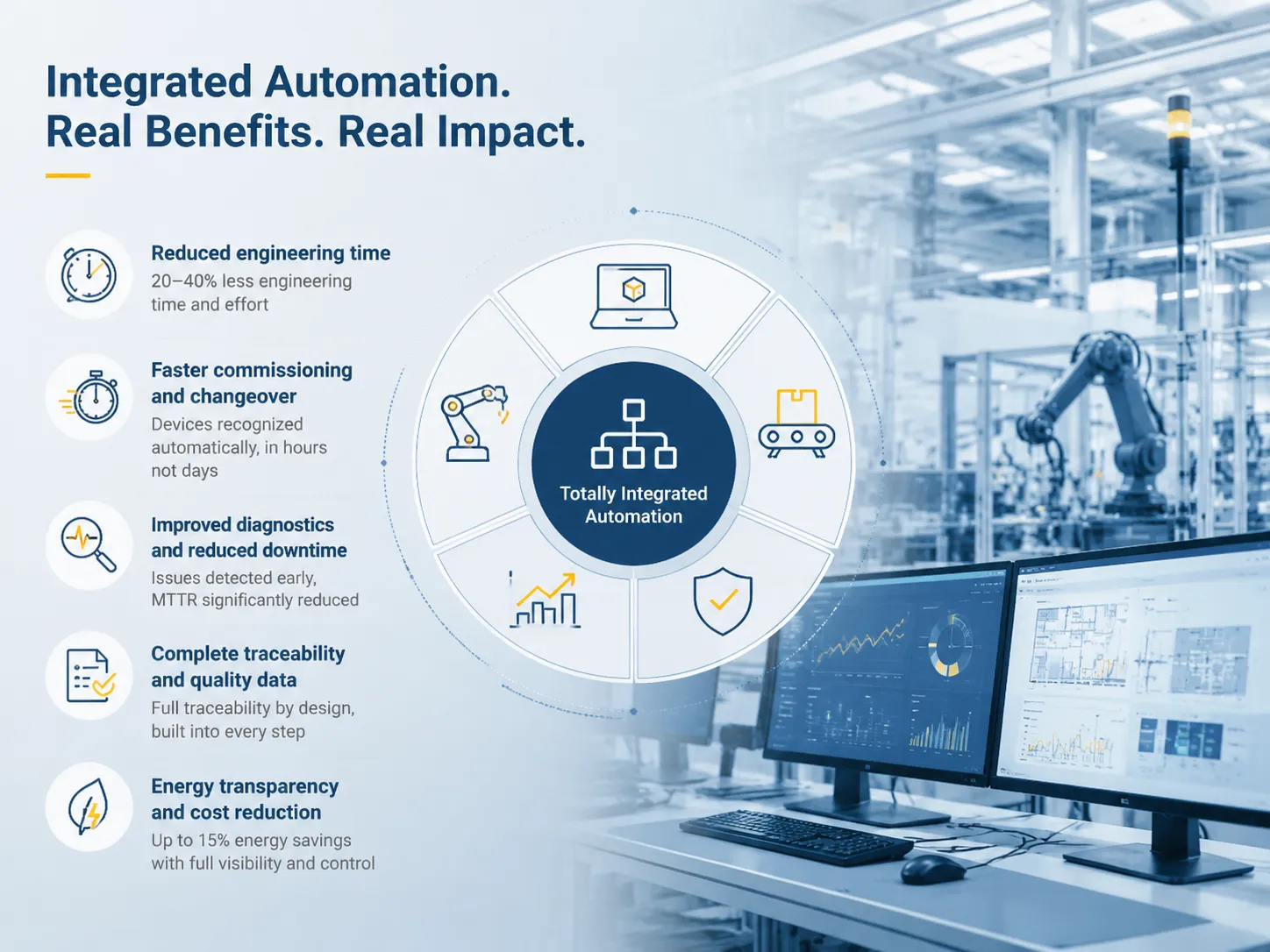
Benefits of full integration of automation are not mere theoretical concepts. They are practically visible. One can see the positive effects of automation on production processes such as at the shop floor, in the engineering department, and in the maintenance division. Among the major benefits obtained from the transition from isolated to integrated forms of automation mentioned by the manufacturers are the following ones.
- Reduced engineering time. An integrated engineering environment eliminates the necessity of recreating the data in the PLC, HMI, and drive tools. Any modification in design is directly propagated. A medium-sized automation project uses this approach to minimize the engineering hours by 20-40% less than would be the case in a multi-tool, multi-vendor environment.
- Faster commissioning and changeover. Integrated communication refers to a situation in which a new device such as a remote I/O block, a drive, or a safety sensor is automatically recognized by the controller while being set up from the main engineering platform. The process which normally would have taken a long day of network configuration and tag mapping becomes just only a few hours of work.
- Improved diagnostics and reduced downtime. The maintenance department can diagnose problems without even having to go over to the device when all machines send information about their faults and performance to a central location. A servo drive consuming current exceeding the reference value can prompt a maintenance request even before the breakdown happens. This leads to the reduction of Mean Time to Repair (MTTR), because the information is available right away.
- Complete traceability and quality data. For businesses in the regulated sectors of pharmaceuticals, medical devices, and food and beverage, traceability throughout the manufacturing process—from the source of the raw material through to the final shipping dock—is a necessity dictated by regulatory bodies. Utilizing an integrated automation system that links all production process stages to a unique serial number ensures traceability as a by-product of the production process rather than being achieved through accumulation of information after the fact.
- Energy transparency and cost reduction. When energy is monitored on a device basis by means of integration, the plant manager is capable of knowing exactly how much energy is consumed, as well as the equipment and stage when this activity happens. A manufacturing line that is built with automatic energy shutdown of equipment, which is inactive during production breaks, is able to decrease energy consumption up to 15% without affecting output levels.
Is Totally Integrated Automation Right for Every Manufacturer?
Choosing to go with a fully integrated automation policy, may that be through Siemens TIA Portal or an alternative open-architecture platform is not a black and white option. For example, if a company has only one machine that is loaded and unloaded manually, then they do not require a full engineering platform, and a basic PLC and HMI will suffice. Conversely, if the company has a complicated production line that has many machines, engineering platforms and regulatory standards regarding traceability, then integration will be profitable. In assessing the situation practically, it’s important to establish how many control platforms are in operation now and how much time is spent trying to integrate them, and whether the enterprise has a need for getting information from production regarding the order of the production process. For those companies that are now becoming investors in a new product line, such as automated production and testing lines, it is better to choose their automation from the design stage of the whole system. A line created to follow the approach of integration from the start and to be based on such communication protocols as PROFINET or OPCUA etc will be easier to telecommand, Tconnect to its MES or to reconfigure as it goes. Conversely, it will be hard to make a line operated before so if it was built in isolation. Benlong’s automated lines, including the MCB automatic assembly line and the AC contactor automatic assembly and testing production line, are designed on open, integrated control architectures that support the data visibility and the remote diagnostics that a modern, connected factory demands.
Frequently Asked Questions
What is totally integrated automation?
Totally integrated automation (TIA) is all about having a common way in which the components of industrial automation process such as PLCs, drives, HMI devices, safety equipment, and communications are designed and controlled through a single software platform. Although the concept is closely associated with the TIA Portal developed by Siemens, the concept of integrated end-to-end automation architecture is equally applicable to all manufacturers and systems that abide to international standards.
What is Siemens Totally Integrated automation Portal?
Siemens TIA Portal stands for Totally Integrated Automation Portal, which refers to software engineering framework based on Siemens automation products. This means that it can work with SIMATIC PLCs, SINAMICS drives, SIMATIC Human-Machine Interface devices, and SIMATIC Safety. Thanks to the software, it is possible for an engineer to program, configure, and launch all devices from a single project along with the tag database and communication settings.
What is integrated automation?
Integrated automation Wide-ranging idea which involves linking all devices and systems within a factory. This means that the devices transfer information between them, communicate through uniform protocols, and can be controlled from one place. Fully integrated automation is what corresponds to this concept and is a solution provided by a particular vendor, but it does not make this concept depend on any particular vendor.
What is the difference between Siemens TIA and AX?
Siemens TIA Portal Totally Integrated Automation Portal (TIA Portal) is the engineering platform developed for Siemens’ SIMATIC PLC, HMI and drive families. AX is a new cloud-native engineering platform created by Siemens that is aimed at IT – OT convergence, web-based accessibility and implementation of modern software development practices. AX does not supersede TIA Portal; it acts as a complementary platform for those applications which need cloud connectivity, remote engineering and IT-oriented development.
References
- Siemens — Totally Integrated Automation (TIA) Portal. The official product page for the Siemens TIA Portal engineering platform, describing its architecture, integrated components, and application across industries.
- McKinsey & Company — Digital Manufacturing and Industry 4.0. Research on the importance of data integration and unified engineering environments in achieving the productivity and quality benefits of digital manufacturing.
- International Society of Automation (ISA) — ISA‑95 and Automation Integration Standards. The international standards for integrating enterprise and control systems, defining the data models and communication interfaces that underpin integrated automation architectures.
- Rockwell Automation — Integrated Architecture and Connected Enterprise. The Rockwell Automation equivalent of the integrated automation concept, providing a comparison point for vendor‑specific implementations of the unified engineering principle.
Totally integrated automation is not a product that a manufacturer buys off the shelf. It is an engineering discipline — a decision to design the production system so that every device, every controller, and every software tool works together as a single, coherent, data‑transparent whole. For the plant manager, it indicates that when a production order is placed in the ERP system, it can directly pass through to the plant floor without any interruptions or delays. This means that a fault in the quality of a product in the production line can be tracked back to a particular batch of raw material. For an engineer, this means that the modifications made in the design will have a ripple effect, meaning the modified design will be implemented everywhere. And for the maintenance technician, this means that an out-dated actuator will issue warnings about its failure before collapsing again and needs servicing again. The assembly and testing lines of Benlong Automation are developed based on this integrated principle of open, connected, and originally designed to be a part of a bigger factory system and not just the isolated systems.