benlong
Digital Twin for Production Lines: Lessons from Leading Electrical Manufacturers
Consider this: you are about to begin a new circuit breaker production process. Before any machinery can start welding or cables start connecting, you could see the whole process playing out on the screen. You would see it from the moment raw materials are introduced, fed into the machine, and till the final product is transferred to packers. You would identify the bottleneck station, modify the production line’s setup, and test your PLC program with different products before building up the device. Just imagine how much time, money, and effort you would save! That’s what the digital twin technology offers the manufacturing industry. The digital twin is a virtual representation of a product, device, or line created with the help of software products. It has the ability to connect with its real counterpart through the transmission of data.
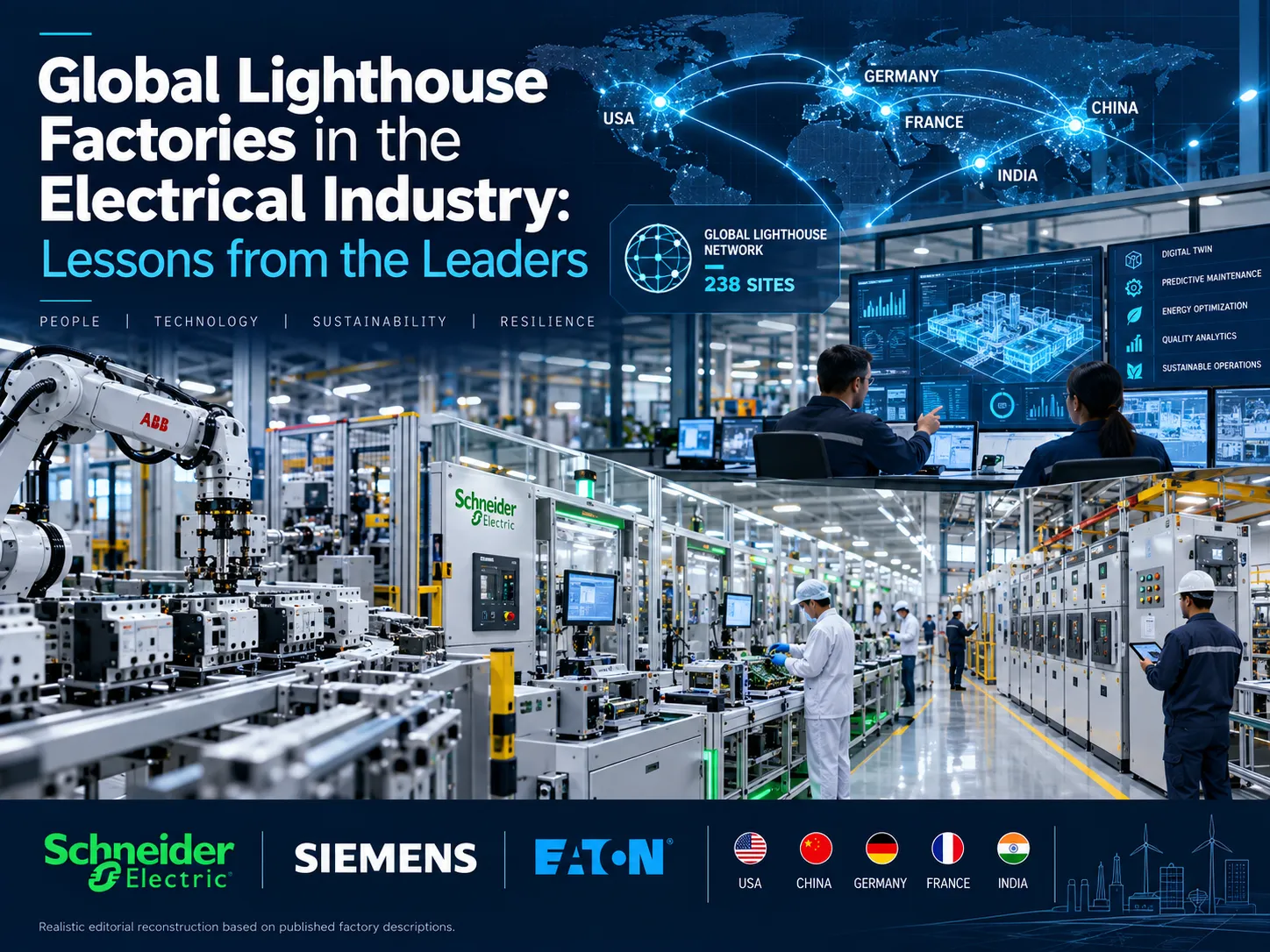
Some companies such as Siemens, Schneider Electric, ABB, and Eaton have already introduced twin technologies and shared their results: reduced production time, faster market placement, reduced material moving time by almost 40%, reduced commissioning time by 80%, and reduced lead time by half.This guide will help to explain the notion of the digital twin as it applies to the manufacturing industry, what companies use this technology, and how it can be beneficial for small and mid-sized companies that want to implement automated assembly lines and testing
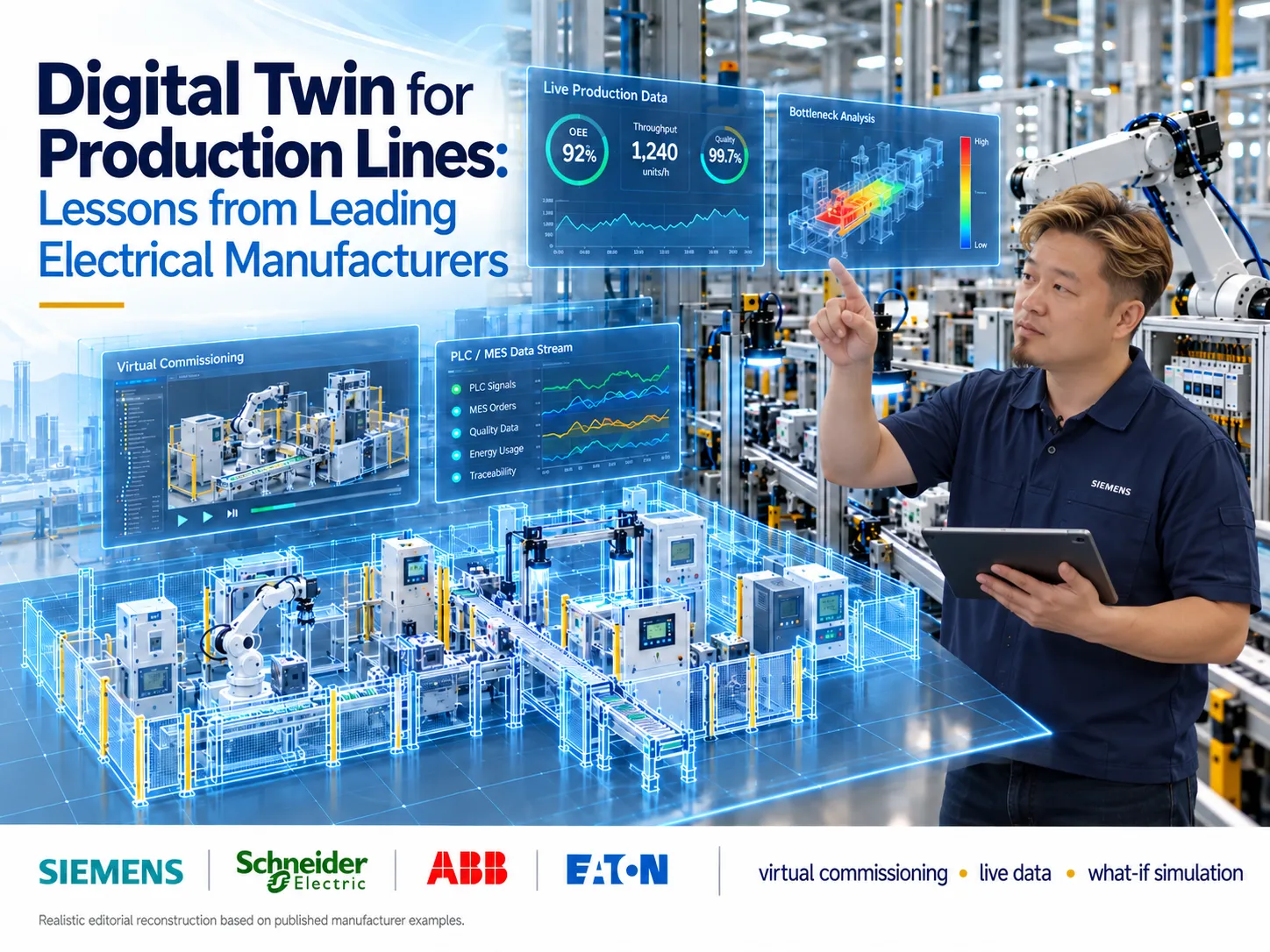
In its simplest terms, a digital twin can be defined as an online model of a product, machinery, production line or manufacturing plant that is linked to actual data and can mimic the performance of a real-life object. The technology is utilized by companies for the purposes of process simulation and testing before the production process begins (virtual commissioning), revealing any bottlenecks, predicting maintenance needs, and confirming product changes. According to Siemens, Schneider Electric, and ABB, adopting this technology enables a reduction of time-to-market by more than 40%, energy consumption by 32% and commissioning time by up to 80%.
What Is a Digital Twin? How Manufacturers Understand It
What exactly is a digital twin? It refers to the virtual representation of a physical object or process that comprises its features and specifications. The following three characteristics help in making a digital twin different from a standard CAD model and/or generic modeling technique.
- Firstly, a digital twin models processes instead of geometry. It means that a digital twin can track the circler’s motion, calculate the time required to perform a measurement or find out what happens with a faulty part.
- Secondly, a digital twin gets real-time data. The data from a sensor, PLC system, MES, and information concerning quality are transferred to a digital model from the information obtained from the real system.
- Lastly, a digital twin serves for making informed decisions. Simply put, an engineer asks the digital twin a series of “what if” questions and selects a response that makes sense regarding production.
Modern digital twin technology unifies 3D modeling software, physics and logic simulation software, industrial IoT, and the use of artificial intelligence. For this purpose, we can mention several companies, such as Siemens (NX, Tecnomatix Process Simulate and Plant Simulation), ABB (RobotStudio), Dassault Systèmes, Rockwell Automation, and NVIDIA (Omniverse).
The Three Layers of a Manufacturing Digital Twin
When it comes to a factory, it can be useful to think about manufacturing digital twin as composed of three different layers. Siemens and other suppliers apply similar types of structure.
| Layer | What it represents | Typical use in electrical manufacturing |
|---|---|---|
| Product twin | The product itself: design, materials, tolerances, performance | Simulating a breaker mechanism, trip behaviour or heat rise before building prototypes |
| Production / process twin | Machines, stations, robots, conveyors, PLC logic and material flow | Layout planning, cycle-time balancing, robot path checks, virtual commissioning of an assembly or test line |
| Performance twin | Live operating data from the real line | OEE monitoring, energy tracking, predictive maintenance, quality trend analysis |
The real benefit comes from the link between three layers, where a change in the product twin causes an update of the process twin and performance information from the line is fed back to them.
The Four Types of Digital Twins by Scale
One more commonly used method for classifying digital twins can be based on their size.
- Component twin refers to a unit such as a bimetallic strip, spring, or contact.
- Asset twin deals with a complete machine or device.
- System twin involves several units working together as in an MCB assembly line.
- Process twin means the whole line of the production process along with logistics, planning, and energy supply.
Usually manufacturers either start with the use of system or asset twins, since it is the easiest type of twins to work with.
How Leading Electrical Manufacturers Use Digital Twins
Examples of digital twin factories are mostly seen in the production of electrical and automation equipment where companies demonstrate their success by citing their own factories as examples. You may use the data taken from various company’s websites.
Siemens: From product digital twin to factory digital twin
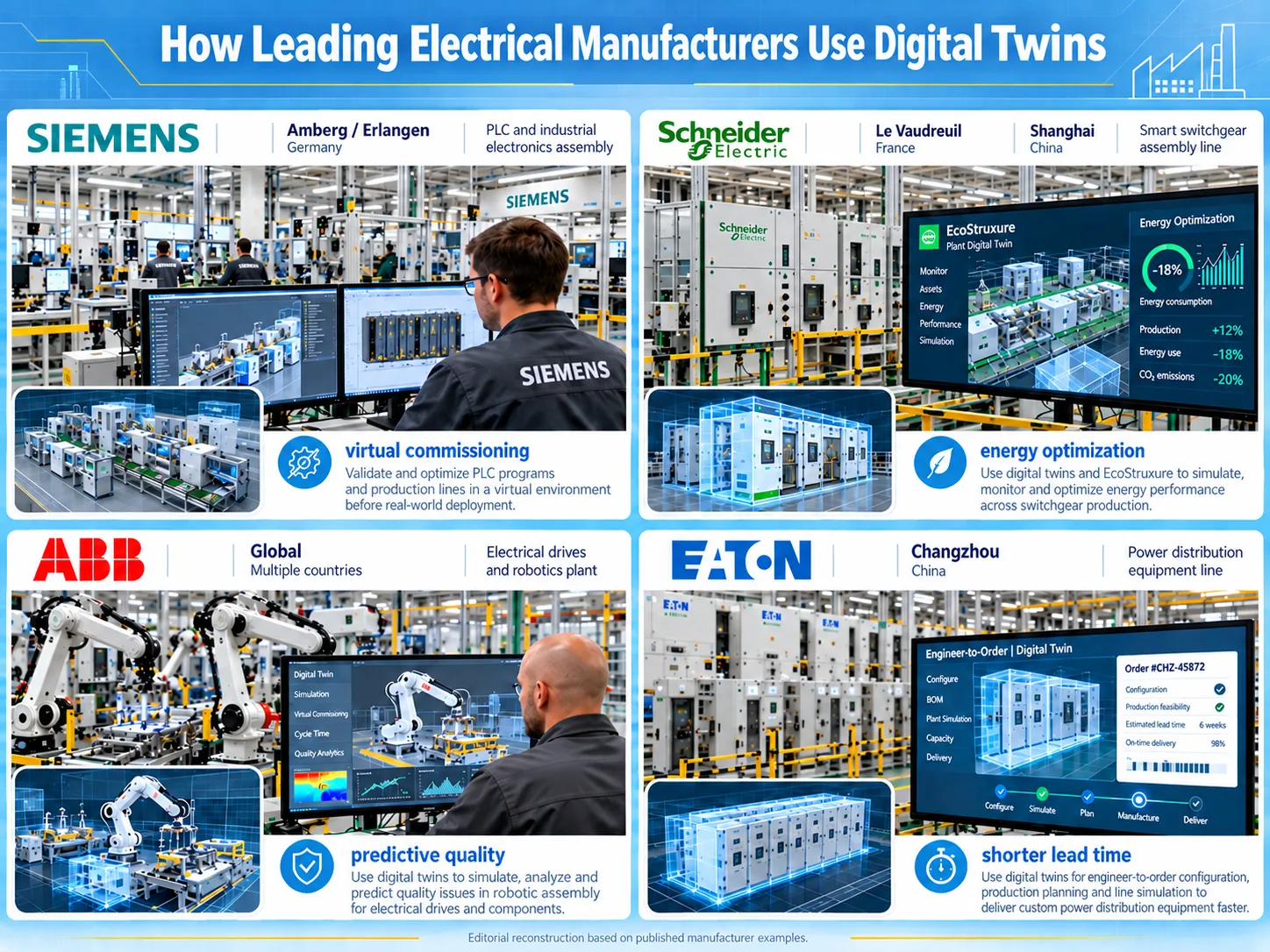
Erlangen, Germany – material flows and automated guided vehicle (AGV) operations. The Siemens Erlangen electronics factory is producing SINAMICS frequency converters. Using Tecnomatix Plant Simulator and Process Simulate programs, engineers can now track how AGVs operate on the shop floor and transport materials, resulting in an almost 40% drop in material circulation rate through process simulations in the twin rather than on the production floor. Furthermore, Siemens uses the digital twins of robots, containers, and parts to train AI systems to use simulated robots for material handling instead of manually programming every robot for every part. By using both IT and OT as well as industrial AI, Siemens managed to increase productivity by 69% in four years and to reduce energy consumption by 42%.
According to Siemens, the reason the company has managed to meet the target production cycle time of about eight seconds is the creation of its digital twin. Siemens’ Chengdu plant in China has been created as a digital twin of the factory in Amberg in order to carry out the same processes in a different region.
Nanjing, China – a virtually existing factory. The Siemens Numerical Control factory located in Nanjing specializes in the production of CNC machines, drives, and motors. Before being built, the entire manufacturing facility was designed and tested in virtual space, first. The factory is now 73,000 sq. m. large and is engaged in more than 50 AI-driven operations. Starting from 2022, the efficiency of operations has increased by 78%, while failures reduced by 46%. The factory was named the Global Lighthouse by the World Economic Forum Board (WEF) in January 2026.
Schneider Electric: Digital Twins for Energy, Operations and Speed
The application of the digital twin technology in the EcoStruxure platform has enabled Schneider Electric to connect its plants to its energy and IT solutions by equipping its smart factories with unique expansion tools. The company uses digital twins in many manufacturing facilities leading to great benefits:
Wuxi, China – application of digital twins has led to 32% savings of heating and ventilation costs. The newest developments used by the company with the help of 5G that has enabled robot performance have resulted in 30% growth of timely deliveries and 25% decrease in time-to-market in this factory.
Le Vaudreuil, France – one of the first Lighthouses that provides EcoStruxure Augmented Operator Advisor application that involves AR technologies, energy consumption, and predictive maintenance. That lighthouse has allowed saving 25% of energy and reducing emissions by 25%.
Lexington, USA – the use of IoTs and predictive analytics allows receiving real-time data and enables to decrease energy consumption by 26%.
Shanghai, China – the factory has implemented machine learning technologies in engineering and GENAIC that helped it to reduce the order delivery period by 67% as well as increase productivity by 82%
In all cases Schneider Electric declares savings between 10% and 30% in energy consumption and reducing maintenance costs by 30%–50%. Moreover, the example of Shanghai is very illustrative for low-voltage products producers.
ABB: Virtual Commissioning With Robot Digital Twins
ABB launched RobotStudio simulation software in 1998. In March of 2026, RobotStudio HyperReality was launched, incorporating the advances of NVIDIA Omniverse and the concept of product, environment and robot twins. The company emphasizes that the platform makes it possible to achieve correlation between the simulation and the real robot in approximately 99%, as well as reduces the time of commissioning by 80% and costs of development by 40%. One of the main reasons for this result is that ABB uses the same firmware in the virtual controller and the physical robot controller.
Eaton: Simulator and Digital Twins in Production
Changzhou plant of Eaton in China processes 164,000 SKUs and approximately 5,000 new designs every year. The implementation of digital twins, simulation, Artificial Intelligence, and robotics has enabled the company to achieve a 39% reduction in time, 50% improvement in efficiency and 129% increase in revenue.
Digital Twin Results Compared
| Company / site | Digital twin use | Published result |
|---|---|---|
| Siemens Erlangen | Material flow and AGV simulation; AI training in simulation | ~40% less material circulation; ~40% shorter time-to-market |
| Siemens Amberg | Process twin for high-mix PLC production | Target cycle time ~8 s across ~1,200 variants |
| Siemens Nanjing | Whole factory designed and tested virtually | Lead time −78%; field failures −46% |
| Schneider Wuxi | Twin of HVAC and building systems | 32% energy improvement |
| Schneider Le Vaudreuil | AR operator advisor with live data | ~25% energy optimisation; ~25% CO₂ reduction |
| ABB RobotStudio | Robot and cell virtual commissioning | Up to 80% shorter commissioning; ~99% sim-to-real correlation |
| Eaton Changzhou | Simulation and digital twins for ETO | Lead time −39%; efficiency +50% |
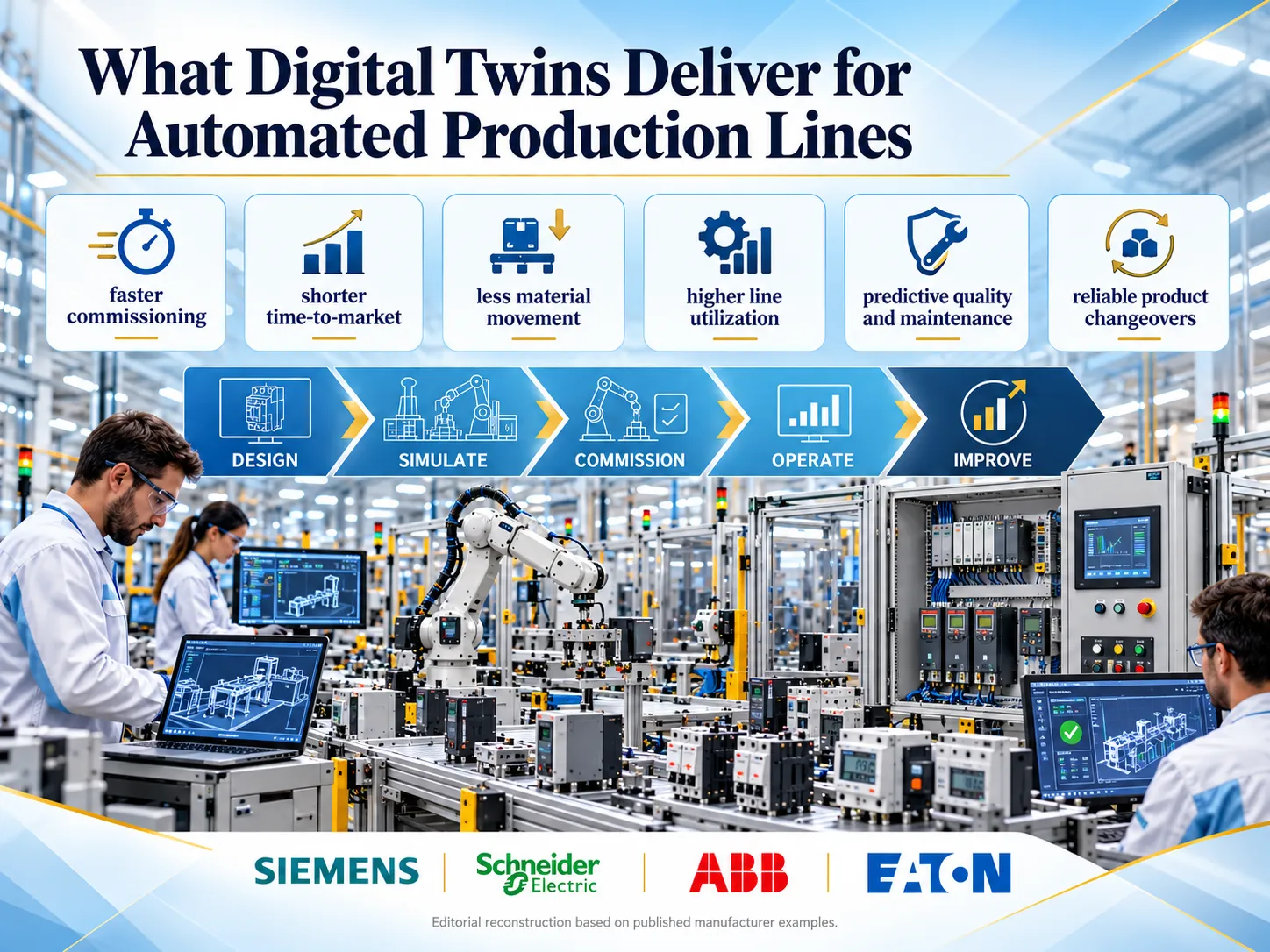
What Digital Twins Deliver for Automated Production Lines
For a manufacturer buying or upgrading an automated assembly and test line, the benefits of a digital twin are practical and measurable. Four stand out.
1. Shortened Start-up through Virtual Commissioning
When examining the process of virtual commissioning, one can see that before the physical machine equipment is available, its real PLC program is connected to the virtual version of the machine. Engineers can test sequences, interlocking, safety logic, handling the HMIs and fault management, reducing the programming failures from previous production. The percentage of reductions can be, for example, 80% while using high-fidelity robot models. Even when it comes to basic simulators, a great part of start-up confusion is alleviated.
2. Capacity and Bottleneck Simulation
Every automation station is as fast as the slowest among them. With the help of a simulation of the actual productive process, engineers can optimize the working time of each station before making it physically. Consider a circuit-breaker example: an MCB automatic assembly line running at 3 seconds per unit produces about 1,200 breakers per hour, while an MCB automatic testing line can test 1,800–2,400 per hour. The simulation allows to conclude that assembly is more process-limiting than testing.
3. Maintenance Prediction and Closed-Loop Quality
After the line starts its work, performance twin can provide such information as counts of cycle counts of cylinders, current of motors and forces of pressing. Then the trends are analyzed and help to see wear of the line before its breaking or qualitative deviation. For instance, the long-term alteration of trip-time results at calibration means failure of parchment before the device reaches the limit of IEC 60898-1.
4. Quick Execution of Changeover and Verification
Manufacturers from the field of low voltage applications can see a constant need for adding new voltage ratings and other parameters. On an MCCB automatic production line covering 100–1,600 A, where frame-size changeovers take 30–60 minutes with quick-change tooling, validating each new recipe virtually protects that changeover window.
Typical Pain Points in Breaker Assembly and Test Lines
| Pain point | How a digital twin helps |
|---|---|
| Actual cycle time slower than quoted | Station-by-station simulation reveals the real bottleneck before build |
| Long on-site commissioning | PLC and HMI logic tested virtually; fewer surprises at start-up |
| Changeover errors between ratings and poles | New recipes and fixtures validated in simulation first |
| Weak test-data traceability | Performance twin links every test result to serial number, station and time |
| Unplanned stops from worn components | Wear trends monitored and maintenance scheduled in advance |
How Small and Mid-Sized Manufacturers Can Start
Siemens and Schneider case studies involve huge teams and multi-year initiatives. Most mid-sized factories do not need a full-plant digital twin to benefit. Such initiatives can start small and go through much of the development process, as explained below:
- Pick one line or one critical station. Carry out 3D modeling of the chosen station(s) as well as the conveyor belt system and then connect the real PLC program for virtual commissioning.
- Build a 3D model with motion and logic. Run the actual product sample and find bottlenecks and changes.
- Simulate capacity and variants. After operating the line, time intervals, failures and tests should be sent to MES or providers’ storage so everything operates as anticipated.
- Connect live data. Once the line runs, stream cycle times, faults and test results into MES or a database so the model reflects reality.
- Add maintenance and quality analytics. Now it is possible to determine when equipment should be serviced by analyzing the above data.
- Scale to the next line. Reuse the models, libraries and data structures for the next project.
Honesty is the key in terms of cost. The introduction of simulation programs, modeling, and data integration takes time and incurs expenses, and if your cousins lack useful data at their disposal. For background on how automation layers fit together, see our articles on totally integrated automation and running manufacturing operations; for investment ranges, see the efficiency benefits of industrial automation; and for selecting a line type, see our guide to choosing an automated production line.
Conclusion: Digital Twins Have Become a Competitive Tool
By implementing digital twins, Siemens has succeeded in reducing the material circulation process in Erlangen by 40% and creating a virtual model of its plant in Nanjing before its actual construction. Schneider Electric has achieved the reduction of energy consumption in its Wuxi facility by applying digital twin technology and enhancing its workflow efficiency at other smart factories. ABB claims to have cut commissioning time by up to 80%. These gains are true performance results rather than just marketing innovations.
For companies that want to improve the productivity of their technology implementation process by modernizing their production line, a digital twin can be an essential solution.
References
- Siemens – The digital twin at Electronics Factory Erlangen – material circulation, AGV simulation, AI training and time-to-market.
- Siemens – Erlangen named Digital Lighthouse (2024) – productivity and energy results.
- Siemens – Electronics Works Amberg – variants, changeovers and digital enterprise data.
- Siemens – Nanjing named Global Lighthouse (2026) – virtually designed factory and AI results.
- Schneider Electric – Lexington and Wuxi Lighthouse recognition (2021) – digital twin energy results and IoT energy management.
- Schneider Electric – Shanghai and Monterrey Lighthouses (2024) – products, technologies and results.
- Assembly Magazine – Inside Schneider Electric’s smart factory – augmented reality and company-wide energy and maintenance savings.
- ABB – RobotStudio HyperReality (2026) – sim-to-real correlation and commissioning time.
- Eaton – Changzhou smart factory joins the Global Lighthouse Network – simulation and digital twin results.
Planning a New Assembly or Test Line?
Prior to confirming a new production line for MCBs, MCCBs, RCCBs, contactors, or meters, ensure you inquire about the cycle-time balance, changeover plan, and commissioning approach. Provide us with your product samples, target output, and variants list, and our engineers will come up with a feasible line concept that takes into account realistic takt times, testing and data traceability.
Request a free line assessment →