benlong

What Is a Factory Lighthouse? Real Examples from Schneider, Siemens & Eaton
What does the most cutting-edge electrical manufacturing facility in the world actually look like? Not a concept video or an exhibition stand, but a real factory that sends circuit breakers, switchboards, drives, and control panels every day – and can substantiate, with audited figures, that it operates faster, cleaner, and more efficiently than almost all the companies in its sector.
The best public answer is provided by the WEF. Beginning in 2018, the WEF and McKinsey have been selecting a small number of manufacturing sites for the Global Lighthouse Network. The factory only qualifies to become a lighthouse if it has implemented Fourth Industrial Revolution technologies at a scale and achieved quantifiable outcomes. Following the June 2026 announcement, there are only 238 sites in the world using these upgraded technologies from the hundreds of thousands of factories across the globe.
Electrical producers are especially represented. Schneider Electric has seven Lighthouse sites, Siemens has five, and Eaton entered this list in 2025 with its Changzhou plant. Their results are publicly available and specific: almost doubling the on-time delivery from 61% to 97%; reducing lead times by 78%; increasing revenues more than twice without increasing the number of employees.
In this guide, we present an overview of the Lighthouse plants, including the brands of the products produced, the dates of establishment and technologies and outcomes based on public sources. Subsequently, we identify the common characteristics and translate them into a step-by-step path for small and medium electrical producers who are unlikely to apply for the WEF award, however, would like to achieve lighthouse performance in their manufacturing activities.
The prompt response: A lighthouse factory is defined as a manufacturing location that has been chosen by the Global Lighthouse Network of the World Economic Forum due to its application of AI, digital twins, IoT and automation for achieving gains in productivity, customer service, supply-chain resilience, sustainability or workforce development. There were 238 lighthouse factories in operation as of June 2026; among them are major players from the electric equipment sector Schneider Electric (11), Siemens (5) and Eaton (1).
What Is a Factory Lighthouse?
A lighthouse factory refers to a type of production or logistics facility recognized by the World Economic Forum as a world leader in digital innovation. The term “lighthouse” is applied purposely, as the factories serve as models that issue signals regarding contemporary technology achievements when its applications are employed in every aspect of the operations rather than in isolated proof-of-concept projects.
To be classified as a lighthouse factory, the facilities must submit an application and undergo evaluation by an autonomous committee while demonstrating real-life achievements and outcomes that are evident in genuine production.
The Five Recognition Categories
The WEF currently recognises Lighthouses for leadership in one of five areas:
| Category | What the site must prove | Typical metrics |
|---|---|---|
| Productivity | Lower cost and higher quality through better use of assets, people and materials | OEE, labour productivity, defect rate, conversion cost |
| Customer centricity | Faster speed-to-market and more customisation using technology | Lead time, on-time delivery, new designs per year, NPS |
| Supply-chain resilience | Better service and agility across suppliers, logistics and planning | Forecast accuracy, inventory days, response time |
| Sustainability | Large reductions in energy, emissions, water and waste | Scope 1, 2 and 3 emissions, energy per unit, water use |
| Talent | A safer, more skilled and more engaged workforce | Onboarding time, attrition, share of staff upskilled |
A site known to be a sustainability site is often referred to as a sustainability lighthouse. Several electricity-producing plants have this designation in addition to or instead of the label of a productive or customer-oriented site.
Lighthouse vs Smart Factory vs Dark Factory
These three notions are commonly confused with one another, but they mean something else:
- Smart factory – any facility utilizing connected devices, data, and software to improve its operations. There are many thousands of such facilities, and there exists no formal certification.
- Dark (lights-out) factory – a factory or area moving with little or no staff on the production floor. This is a measure of the degree of automation rather than a measure of its effects.
- Lighthouse factory – a smart factory that has gone through independent evaluation and proven exceptional business success on a large scale. Many Lighthouses still employ hundreds or thousands of people as the measure of its success is based on achievements rather than the reduction of the workforce.
In short, being a Lighthouse means that a company is assessed according to its results. Some of the most well-known electrical Lighthouses have been acknowledged for the way they deal with their employees.
Why the Electrical Industry Is Well Suited to Lighthouse Transformation
Producers of electrical equipment are forced to reckon with the pressures that digital solutions address effectively:
- Very high product variety. One plant can handle tens of thousands of SKU cases. For example, Eaton’s Changzhou plant has 164,000 SKU cases plus thousands of customer-specific ETO designs each year.
- Strict safety and quality requirements. Circuit breakers, contactors, and switchgear must keep people and property safe. Every unit must comply with certain standards like IEC 60898-1 or IEC 60947-2, which makes 100% testing and traceability necessary.
- Strong digital foundations. Companies like Schneider Electric and Siemens produce PLs, drives, MES software, and energy management systems, thus making their own factories a showcase of their products.
- Energy intensity and decarbonisation targets. It is expected of electrical producers to set an example in energy efficiency, which explains the existing of so many of them with the title of sustainability Lighthouse.
Electrical Industry Lighthouse Factories: Brand-by-Brand Case Studies
Below are the most important WEF lighthouse factories from the electrical and industrial-automation sector. All figures come from the World Economic Forum or the companies’ own published announcements.
Schneider Electric: 11 Lighthouse Sites Worldwide
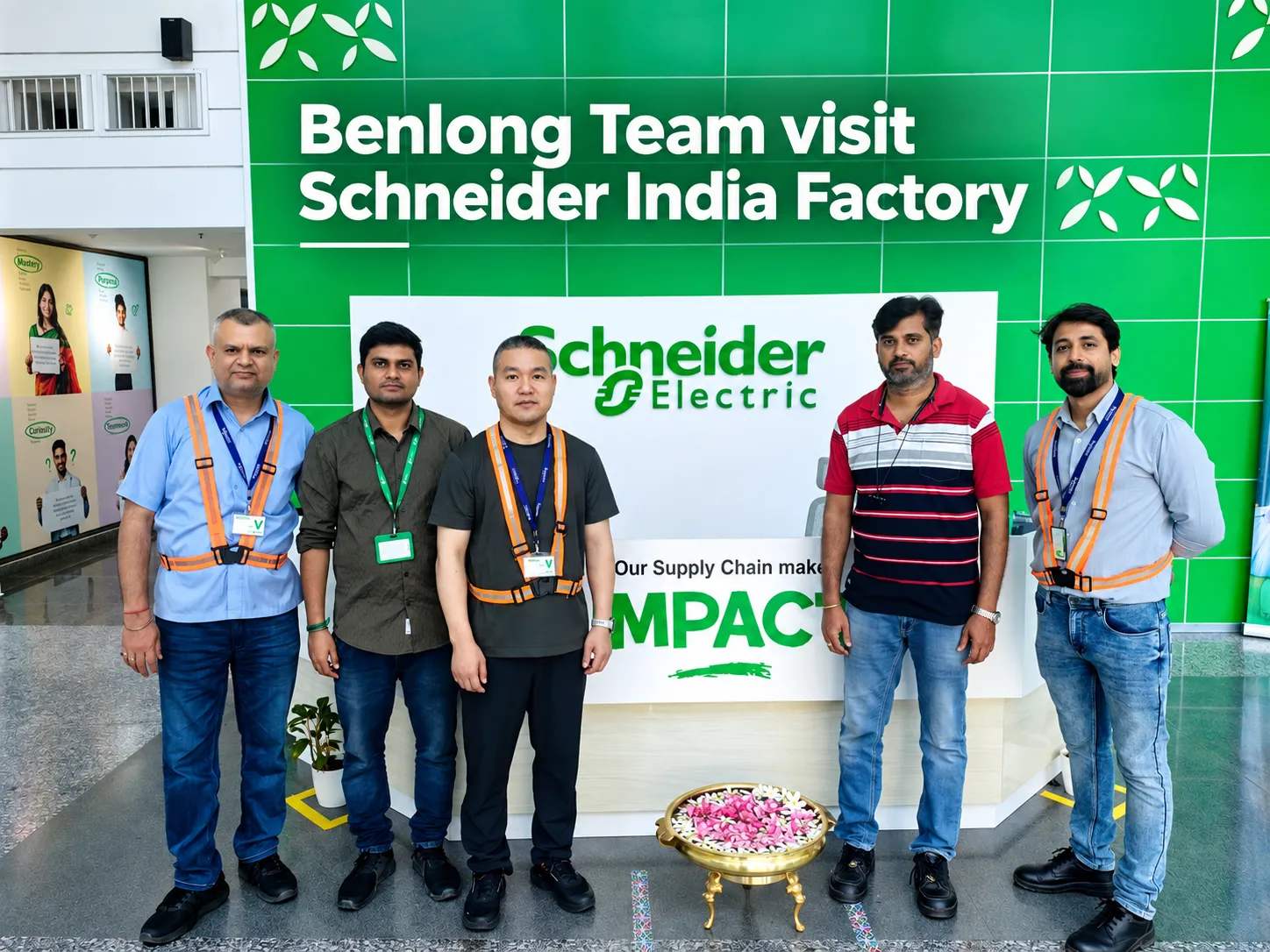
Schneider Electric, based in the headquarters located in Rueil-Malmaison, France, has built the world’s largest portfolio of lighthouses among electrical companies. Following the addition of two more sites in June 2026, Schneider Electric has expanded its number of lighthouses to eleven across the world including locations in the USA, China, France, Mexico, India, and Indonesia. The various products manufactured by Schneider Electric includes medium and low-voltage distribution equipment, industrial automation, circuit breakers, and energy management software, and most of its lighthouses use cases rely on its EcoStruxure platform.
| Site | Country | Recognised | Focus | Headline published results |
|---|---|---|---|---|
| El Paso | USA | 2026 | Customer centricity (ETO) | On-time delivery 61% → 97%; lead time up to 35% shorter; US$43M backorders eliminated |
| Beijing | China | 2026 | Sustainability | Scope 1 emissions −65%; Scope 2 eliminated; Scope 3 −43%; energy efficiency +36% |
| Wuhan | China | 2026 | Talent | Onboarding cut from 75 to 15 days; 56% of workforce upskilled |
| Evreux | France | 2025 | Sustainability | Single-use plastic −40%; energy consumption −18% |
| Wuxi | China | 2025 | Sustainability | Net-zero Scope 1 and 2; Scope 3 −65%; water use −15% |
| Shanghai | China | 2024 | Productivity / AI | Speed-to-market +63%; lead time −67%; productivity +82% |
| Monterrey | Mexico | 2024 | Productivity | Defects −20%; water consumption −30% |
| Hyderabad | India | 2023 | Sustainability | Energy −59%; CO₂ −61%; water −57%; waste −64% |
| Le Vaudreuil | France | Early member | IoT / sustainability | Energy optimised 25%; CO₂ −25%; water use −64% |
| Lexington | USA | 2021 | Sustainability | Energy −26%; net CO₂ −30%; water −20% |
| Batam | Indonesia | 2020 | Productivity (IoT) | Predictive maintenance reduced maintenance time and material waste |
Recognition years for some earlier sites vary between sources; the table follows the summary published by Manufacturing Digital in 2026.
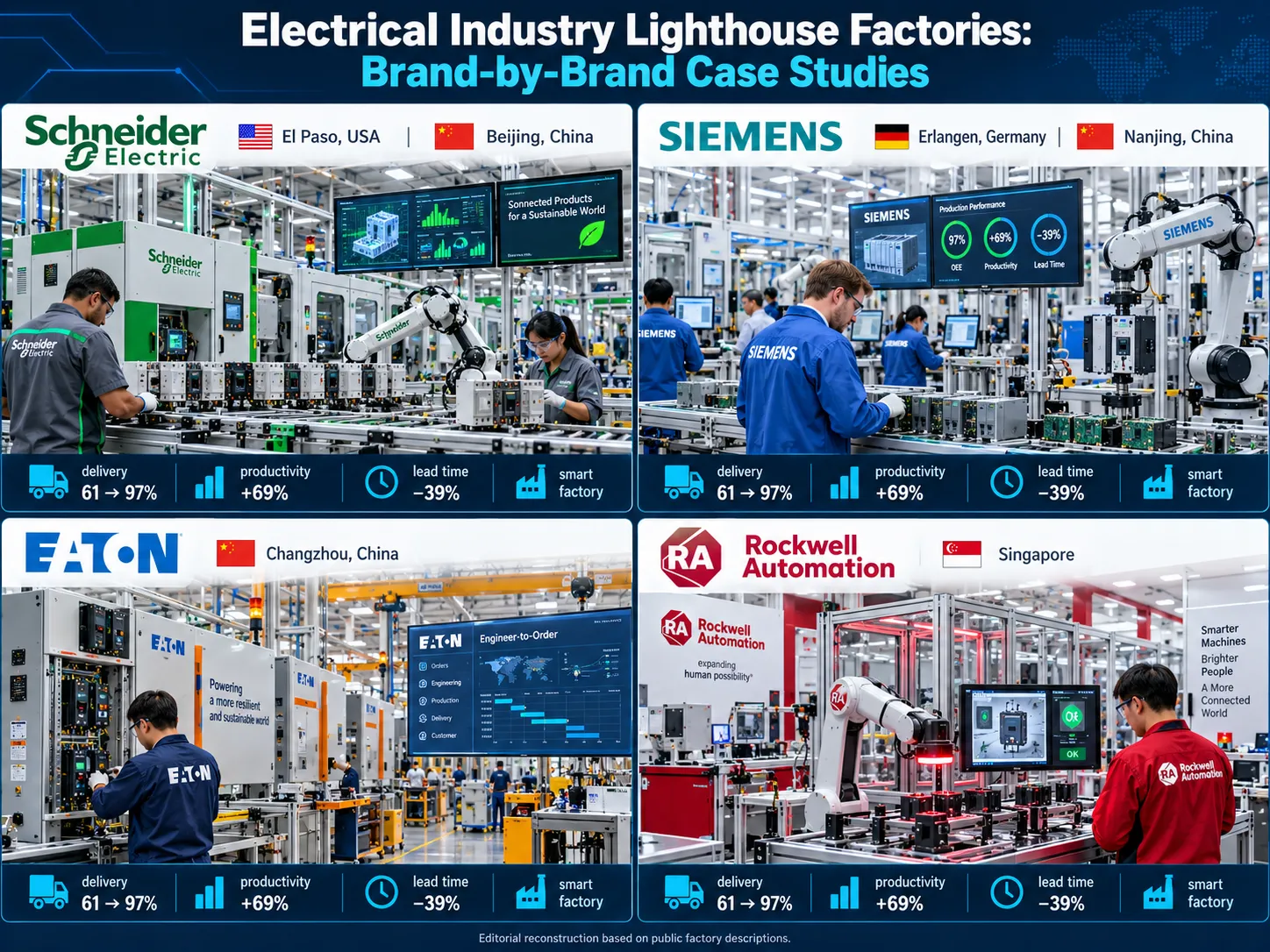
El Paso, Texas – the engineer-to-order benchmark. The El Paso facility produces customized electrical power distribution systems for use in industrial, commercial, and residential institutions. ETO is notably complex due to each product being unique in its specific order; for this reason, the company employs various technologies such as IoT, AI, and advanced analytics in the areas of pricing, engineering, and production processes. As a result, the El Paso plant became the first company site recognized with the ETO Lighthouse and also became the first site in the United States to be awarded this recognition. The results speak volumes with the on-time deliveries increasing from 61% to 97% and production times decreasing by 35% while backorders dropped from US$ 43 million to zero.
Beijing – decarbonising SF₆-free switchgear. The Beijing facility produces medium-voltage switchgear that does not utilize SF₆ by means of ETO and discrete production technologies. Furthermore, the facility has managed to reach a zero Scope 2 emissions outcome, as well as to reduce Scope 1 emissions by 65% and Scope 3 emissions by 43%.
Shanghai, Wuxi and Wuhan – China as a Lighthouse cluster. The Chinese plants prove that the same plant can be given the status of a Lighthouse for completely different reasons. Thus, the Shanghai plant increased productivity by making use of AI and automation. The Wuxi plant was the first plant to reach the zero level of Scope 1 and Scope 2 emissions. Finally, the Wuhan plant was recognized as an eminent Electronics plant that managed to use digital training for talent development and improved automation by 55% while achieving the 239% increase in the product portfolio.
Siemens: Five Lighthouses in Germany and China
With its headquarters located in Munich, Germany, Siemens AG has five Lighthouse sites to its credit, namely: Amberg, Erlangen, and Fürth in Germany, along with Chengdu and Nanjing in China. Siemens makes use of its own automation hardware and the Siemens Xcelerator software in all its factories; hence, every site is both a site for production and a working reference for its customers.
| Site | Country | Recognised | Products | Headline published results |
|---|---|---|---|---|
| Amberg (EWA) | Germany | 2018; Sustainability Lighthouse 2023 | SIMATIC PLCs and automation products | ~75% of value chain automated; quality around 99.999%; ~1,200 product variants |
| Chengdu (SEWC) | China | Sustainability Lighthouse, 2023 | SIMATIC automation products | Digital twin of Amberg; recognised for sustainable production |
| Erlangen | Germany | 2024 | SINAMICS frequency converters, power semiconductors | Productivity +69% and energy use −42% over four years |
| Fürth | Germany | 2025 (Sustainability) | SIMATIC HMI panels | Energy per unit −64%; CO₂e per unit −70%+ since 2019; output +145% |
| Nanjing (SNC) | China | 2026 (Productivity) | CNC systems, drives, electric motors | Lead time −78%; field failures −46%; time-to-market −33%; carbon −28% |
Amberg – the classic benchmark. The Siemens electronics factory in Amberg has been producing SIMATIC programmable logic controllers since 1989 and was one of the first factories in the Lighthouse network in 2018. It produces around 1200 different products, performs hundreds of product transitions per day, and where 75% of the value chain is handled by machines and robots. In early 2023, it became the first Siemens Lighthouse to fulfill the requirements of sustainability.
Erlangen – AI at scale in electronics. The Erlangen factory produces state-of-the-art SINAMICS converters and has its own semiconductor manufacturing. According to Siemens, there are over 100 AI applications used, digital twins, robotic systems as well as a fully operative e2e data platform together allowing a 69% increase in productivity and a 42% reduction of energy consumption within four years. The production of semiconductors took only 11 months and takes around half of space and energy compared to a traditional solution.
Fürth – sustainability through data. Founded in 1954 and employing around 1700 workers, the site produces SIMATIC HMI panels used in several factories all over the world. It has over 350 energy meters in place supplying data to the energy management system helping the plant achieve a reduction of energy by 64% and a reduction of CO2 emissions by over 70% since 2019 while increasing its turnover by 145%. The site also produces equipment operating for selfrepair needs to prolong the service life of the products in use.
Nanjing – designed in a digital twin. Siemens Numerical Control is the fifth Lighthouse. The Nanjing plant produces CNC systems, actuators and electric machines at the area of 73 000 m2. The plant is built based on the findings of virtual model. It has launched more than 50 artificial intelligence solutions allowing cutting down the lead times by 78%, cutting failures in operation by 46% and reducing the carbon footprint by nearly 28%.
Eaton: Changzhou, China
| Item | Details |
|---|---|
| Company | Eaton (power management), HQ Dublin, Ireland |
| Site | Eaton Electrical Equipment, Changzhou, Jiangsu, China |
| Recognised | 2025, customer centricity category |
| Business model | Engineer-to-order; 164,000 SKUs and around 5,000 new designs per year |
| Published results | Lead time −39%; efficiency +50%; revenue +129% without adding headcount |
| Technologies | AI, generative AI, simulation, digital twins, robotics |
Eaton’s Changzhou plant has been operational for about two decades and was among the first locations in the Industry 4.0 smart-factory initiative of Eaton, which was launched in 2024. Its problem is high complexity: around 164,000 SKUs and approximately 5,000 new designs each year, most of which are custom-made for each customer.
Eaton has applied AI and generative AI, which sped up the designs, simulations and virtual twins to optimise production, while achieving automation of assembly with the help of robotics. The output was acknowledged by the WEF in 2025 and resulted in 39% shorter lead times, 50% greater efficiency and a 129% increase in revenues without enlarging the staff. Now Eaton claims to have opened nine more smart factories in Brazil, China, Europe, Mexico and the United States using the experience gained in Changzhou.
Other Electrical and Automation Lighthouses Worth Knowing
- Rockwell Automation, Singapore (2026) – received recognition for productivity due to increase in the output rate per person by 43% while decreasing defects by 35%.
- Mettler-Toledo, Changzhou (2025) – the instrument maker demonstrated achievement in that the on-time delivery rate reached 98.4% and the lead time decreased by 22% in the sphere of customer-oriented affairs.
- Hitachi Vantara Manufacturing, Norman, USA (2026) – reduced inventory by half and decreased lead times by 77%.
- Phoenix Contact, Germany – the company that specializes in connectors and automation was one of the first Lighthouse members when the network started functioning.
The abovementioned companies, combined with Schneider, Siemens and Eaton, illustrate how significant the sector of industrial automation and electrical engineering is presented in the network concerning its size.
Electrical Lighthouse Factories Compared
| Plant | Company | Category | Best-known result |
|---|---|---|---|
| El Paso, USA | Schneider Electric | Customer centricity | On-time delivery 61% → 97% |
| Beijing, China | Schneider Electric | Sustainability | Scope 2 emissions eliminated |
| Shanghai, China | Schneider Electric | Productivity | Productivity +82%; lead time −67% |
| Amberg, Germany | Siemens | Productivity / sustainability | ~1,200 variants at around 99.999% quality |
| Erlangen, Germany | Siemens | Productivity | Productivity +69%; energy −42% |
| Nanjing, China | Siemens | Productivity | Lead time −78%; field failures −46% |
| Changzhou, China | Eaton | Customer centricity | Revenue +129% with no extra headcount |
| Singapore | Rockwell Automation | Productivity | Productivity +43%; defects −35% |
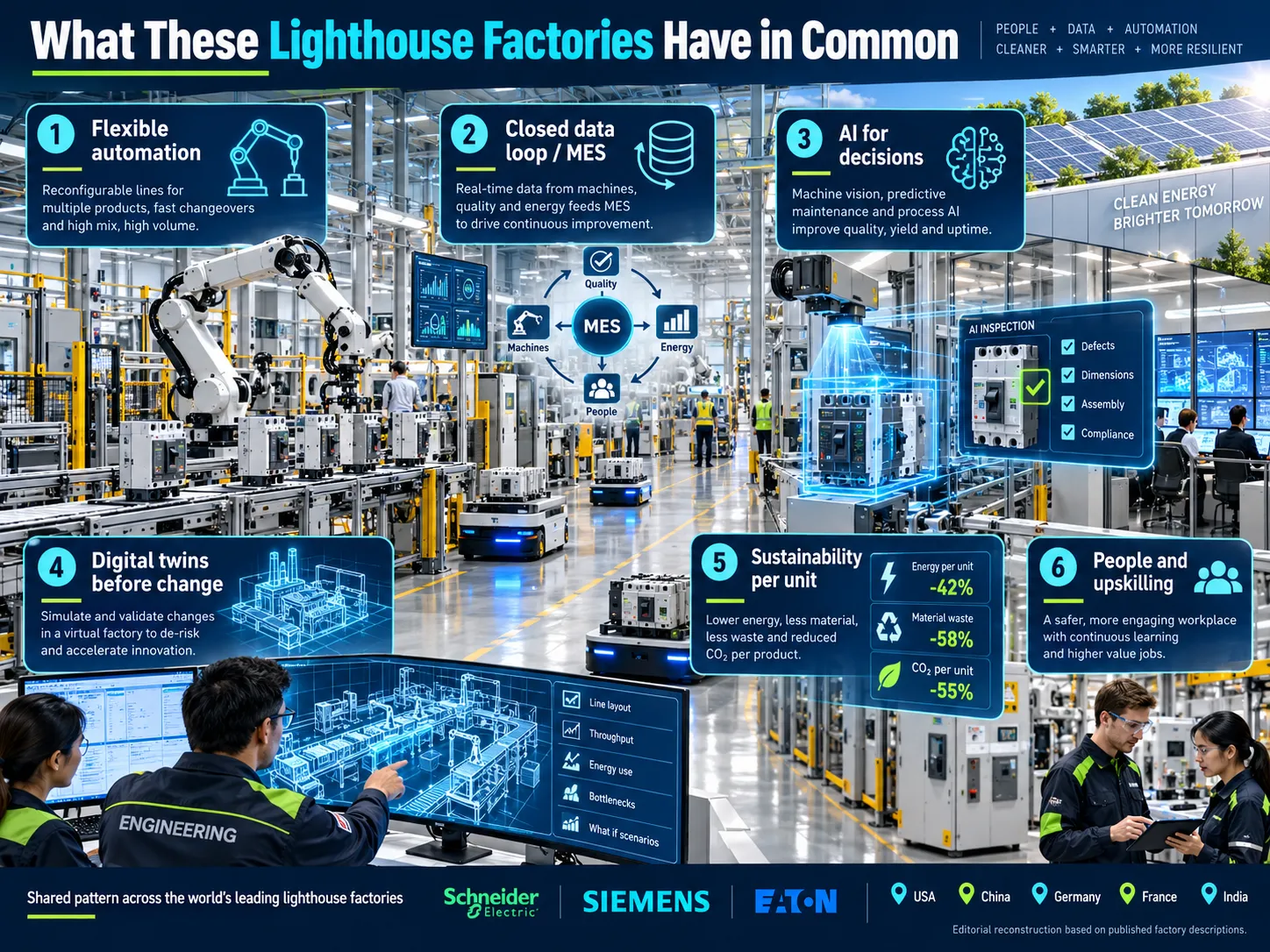
What These Lighthouse Factories Have in Common
Regardless of which sector, nation or production sectors one might study, the following aspects can be traced back:
- Flexible automation, not rigid automation. Companies such as Amberg or Eaton perform hundreds of product changes daily or even thousands of innovations each year.
- A closed data loop. Each station processes energy consumption and quality improvement data, so feedback is sent to planning, repair and design departments.
- AI where decisions are frequent. Scheduler and cost calculator applications appear to be among frequent examples of AI being applied to processes.
- Digital twins before physical change. Before those changes take place physically, they will be tested in the virtual realm. Nanjing is built in a 3D simulation before anything is done in practice.
- Sustainability measured like productivity. Producers track energy consumption and emissions with the same diligence. That is the reason electrical stations have sustainability awards.
- Investment in people. The examples of Lutsk onboarding program and electrical equipment manufacturer processes show that plants reassign people rather than lay them off.
Lessons for Small and Mid-Sized Electrical Manufacturers
The main idea regarding lighthouse manufacturing is that it consists of several ways of operating instead of being just a purchase of technology. For the mid-sized company producing MCBs, RCCBs, relays, or meters, it is not necessary to have 100 cases of using AI or have a new building; it can do the following on a smaller level:
- Automate the highest-volume, most repetitive assembly steps first with modular cells that can change over between ratings and pole counts quickly.
- Test every unit in-line – trip ability, contact resistance, dielectric strength – and register the results.
- Collect data from day one through an MES or at least have it in a database so that it would be possible to trace back problems and mark trends.
- Design for fast changeover with recipe-driven equipment, because product variety will only increase.
How Ordinary Manufacturers Can Move Toward Lighthouse-Level Performance
Most lighthouse factories took five to ten years of steady improvement to get where they are. The same staged approach works for smaller plants, and it lets each step pay for itself before the next one starts.
Stage 1: Single Workstation
Select the operation that has the highest potential of limiting output or creating defects. It could be any manual processes like riveting, calibration, or testing, and rectify the operation through installing a standalone machine for data collection. Typical investment for a single automated workstation is in the range of US$30,000–100,000, with payback often within 12–24 months, depending on labour cost and volume. For more detail on typical ranges, see our overview of the efficiency benefits of industrial automation.
Stage 2: Connected Production Line
Link automated stations with conveyors, in-line testing and automatic sorting so that good parts flow straight to packing and rejects are isolated automatically. In circuit-breaker production, for example, an MCB automatic assembly line can reach 2–3.5 seconds per unit with vision inspection at every station, while an MCB automatic testing line can test 1,800–2,400 breakers per hour and log every result. Full lines typically require US$250,000 or more and a payback of two to three years, so choosing the right type of line matters; our guide to choosing an automated production line compares the options.
Stage 3: Data Integration Across the Factory
Connect lines to MES and ERP so that orders, test data, energy use and maintenance history live in one system. This is the stage where Lighthouse-style benefits – shorter lead times, better on-time delivery, lower energy per unit – start to appear. Our articles on totally integrated automation and running manufacturing operations explain how the layers fit together.
Stage 4: Analytics and AI
The process of data preparation is the most crucial part to value-added initiatives of AI – predictive maintenance, AI vision for quality control, intelligent scheduling for mixed orders. Starting from AI, without check-points leads to failure in digital translation projects.
Be realistic about timelines. In three to five years, an average-sized plant that passes through these stages could get results similar to those reported by the Lighthouses – shorter lead time, fewer defects, less energy used per unit produced.
Conclusion: Lighthouse Is a Capability, Not Just a Label
Schneider Electric, Siemens and Eaton’s Changzhou plant prove that the electrical industry is one of the strongest instances of digital manufacturing. The figures they announced show that they achieved in their operations a 97 percent on-time delivery, lead times that are 78 percent shorter, and a doubled revenue while having the same number of employees. Such successful indicators can hardly be attributed to some advanced technology but rather the result of the application of flexible automation systems and the available data.
The same principles scale down. Any company that automates its bottlenecks, tests all pieces of its equipment, and gathers and uses information is already on the path of the Lighthouses.
References
- World Economic Forum – New Global Lighthouse sites (June 2026) – network total of 238 sites; Schneider El Paso and Beijing, Rockwell Singapore.
- World Economic Forum – 23 new Lighthouse sites (January 2026) – Schneider Wuhan and Siemens Nanjing.
- World Economic Forum – Global Lighthouse Network 2025 (September 2025) – Eaton Changzhou, Schneider Evreux and the five recognition categories.
- Schneider Electric – El Paso and Beijing Lighthouse designations – official results for both sites.
- Manufacturing Digital – Inside Schneider Electric’s 11 Lighthouse factories – summary of all Schneider sites.
- Siemens – Electronics Works Amberg – automation, variants and quality data.
- Siemens – Erlangen named Digital Lighthouse (2024) – productivity and energy results.
- Siemens – Fürth Sustainability Lighthouse (2025) – energy and emissions data.
- Siemens – Nanjing named Global Lighthouse (2026) – lead time, field failure and AI data.
- Eaton – Changzhou smart factory joins the Global Lighthouse Network – SKUs, lead time, efficiency and revenue results.
Want to Build Lighthouse-Level Capability Into Your Lines?
You do not require a WEF title in order to reap the same benefits from the same methods. If you produce MCBs, MCCBs, RCCBs, contactors, relays, or energy meters and wish to cut down lead time, reduce defects, and enjoy complete traceability of production, contact us with your samples for the product, the output you want to get, and a brief description of the process you currently use. Our engineers will help you choose the first station to be automated, tell how to connect it to the data systems, and explain when you will get a payback.