benlong

Automated Factories in Maharashtra: A 2026 Guide for Manufacturers
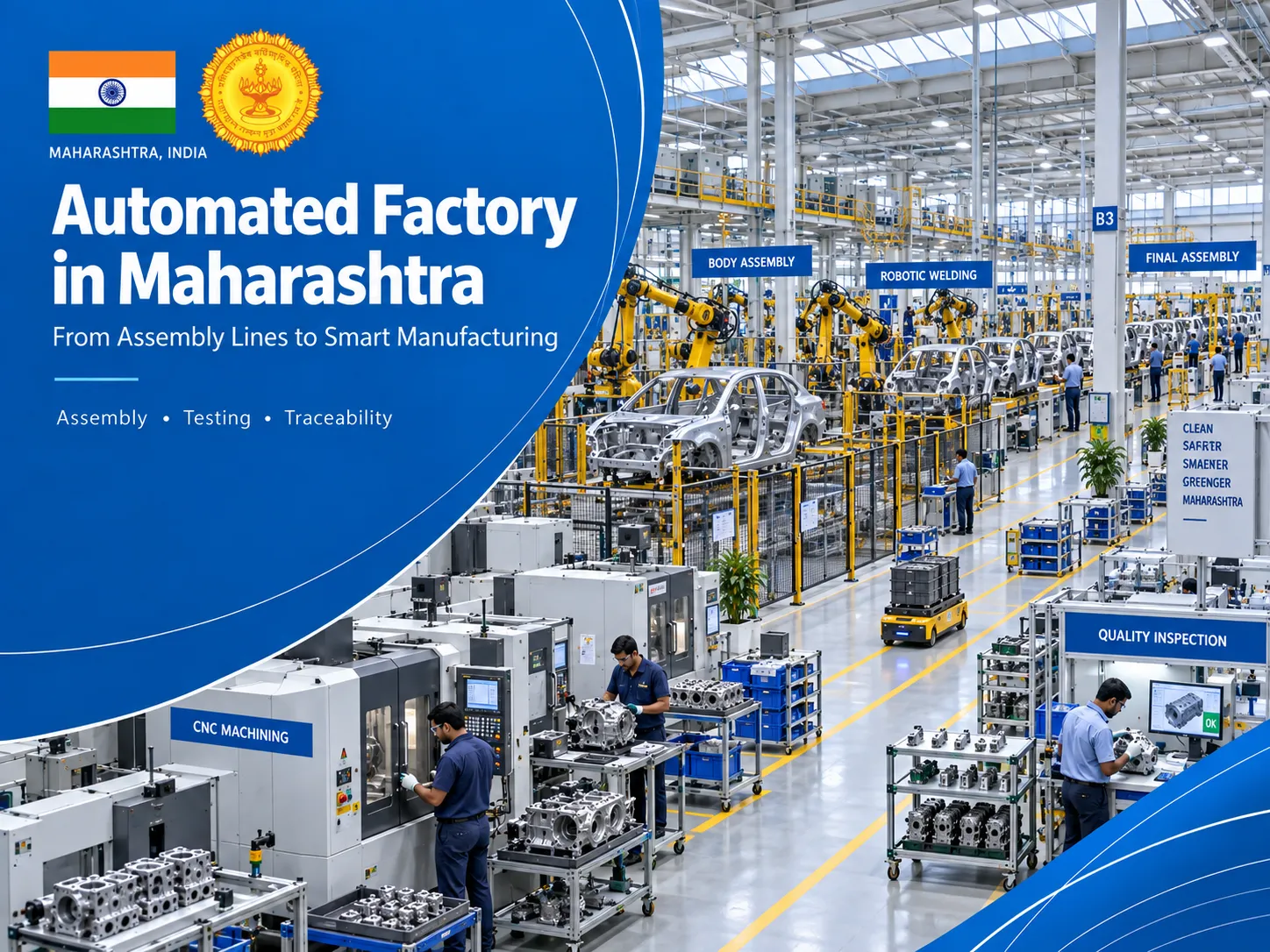
If one can name the true industrial heart of India, it is certainly Maharashtra. According to the Maharashtra Industrial Development Corporation, the state generates 15.5% of the overall industrial output of the country and has accounted for around 31% of the foreign direct investments (FDI) into India since 2000, which corresponds to nearly 15% of all national exports. Visiting the industrial zones of Chakan, Waluj, Satpur, or Butibori today, one will see robotics welding cells, vision-controlled assembly lines, and MES dashboards operating right next to traditional production facilities. For those who are going to establish an automated plant in Maharashtra, the question is no more if automation works here; the main question is what industrial corridor to choose, how much automation to deploy, and who to partner with for maintaining the plant for the next 15 years.
This article will show where automated manufacturing is concentrated in the state, what automation looks like in the major industries in Maharashtra, and what does the process of moving from a manual plant to connection of a smart plant include. We rely on our direct project experience, with India being the top exporting country for Benlong Automation and our assembly and testing solutions used in electrical production facilities in Jalgaon and Nashik.
Reasons for Success of Maharashtra in Factory Automation
The state benefits from its scale. As stated in the Economic Survey of Maharashtra 2025-26, the nominal gross state domestic product (GSDP) of Maharashtra in 2025-26 will be ₹51 lakh crore, which is more than in any other state in India, with the industrial sector growing at 5.7% backed by manufacturing and infrastructure investments. The new Maharashtra Industries, Investment, and Services policy aims at ₹40 lakh crore investments and creating 5 million jobs, offering the maximum incentives for the least developed districts. According to MIDC, Maharashtra leads in the production of automobiles and auto components with a 23% share in production, pharmaceuticals and medical equipment at 22%, and electronics at 22%.
Apart from that, the state has all necessary resources in terms of infrastructure and human capital. MIDC has built around 300 industrial estates on around 1.01 lakh hectares since 1962, thus becoming one of the major land banks in the country. There are 891 engineering colleges and 1,006 ITIs, which is crucial since an automated plant needs maintenance technicians, PLC programmers, and quality engineers rather than a multitude of assembly workers. This is supported by the fact that the state has two major ports, including Jawaharlal Nehru Port in Mumbai, and has the highest level of installed capacity among all Indian states.
The pressure to automate is also stronger here than in most of India. Wages in the Mumbai-Pune corridor are higher than the national average, export customers expect unit-level traceability, and Bureau of Indian Standards Quality Control Orders have made certified, repeatable production a condition of market access for products such as circuit breakers. Our overview of circuit breaker manufacturers in India explains how those rules reshaped the electrical sector, and the structural forces behind the wider investment wave are covered in our article on automation machinery manufacturing industry tailwinds.
The Industrial Belts Where Automated Factories Cluster
Maharashtra is not one industrial market but six or seven distinct belts, each with its own sector mix, labour pool, land cost and incentive zone. The table below is a practical starting point for site selection.
| Industrial belt | Key industrial areas | Leading sectors | Typical automation profile |
|---|---|---|---|
| Mumbai-Thane-Raigad | Taloja, Khalapur, Thane-Belapur | Chemicals, pharma, engineering, auto components | Process control (DCS/SCADA), filling and packaging lines |
| Pune-Chakan-Talegaon-Ranjangaon | Chakan, Talegaon, Ranjangaon, Bhosari | Automotive, auto components, ESDM, data centres | Robotic body shops, welding and painting robots, AGVs, MES |
| Nashik-Sinnar-Ahilyanagar | Satpur, Ambad, Sinnar | Electrical equipment, engineering, medical equipment, food | Switchgear assembly and test lines, CNC cells |
| Chhatrapati Sambhajinagar-Jalna | Waluj, Chikalthana, Shendra, AURIC Bidkin | Two-wheelers, auto components, pharma, textiles | Assembly lines, pharma MES, plug-and-play greenfield plants |
| Nagpur-Vidarbha | Butibori, Hingna | Textiles, food processing, engineering | Process and packaging automation |
| Jalgaon (North Maharashtra) | Jalgaon MIDC | Electrical components, plastics, agro-processing | Semi-automatic assembly and testing stations |
Pune, Chakan and Talegaon: the automotive heart
Chakan has rightly earned the title of Motor City of India with car manufacturers like Volkswagen, Bajaj Auto, Mercedes-Benz, Hyundai making their products in the area. Mahindra and Mahindra’s Chakan unit is on about 700 acres with an investment of about $1 billion and is built around automated processes right from the beginning. Pune is also home to the C4i4 Lab, an Industry 4.0 experience centre created under the SAMARTH Udyog programme to enable manufacturers especially MSMEs see connected production in action before investing. Honeywell Automation India has its registered office in Hadapsar in Pune placing a leading supplier of process automation in close proximity to its customers.
Nashik: the electrical and switchgear corridor
Nashik has emerged into a heavyweight in electrical manufacturing. ABB has been in Nashik for almost four decades producing medium-voltage products like vacuum interrupters and circuit breakers and has opened a new smart factory to produce gas-insulated switches. Around these multinationals is a network of fabrication and sub-assembly companies in Satpur and Ambad. The semi-automated assembly and automated testing processes at this level are where OEMs obtain their best returns because their focus is on processes.
Chhatrapati Sambhajinagar and AURIC: the greenfield future
Aurangabad Industrial City (AURIC) spreads over 10,000 acres in the Shendra Bidkin area and is one of the first greenfield industrial smart cities in India as part of the Delhi-Mumbai Industrial Corridor project. About sixty percent of the land is set aside for industry and the plots offer underground plug and play services. By September 2025 it had given away 323 plots and 78 units had already begun operations with another 62 units under construction. Finding an automated factory site like AURIC removes much of the risk associated with infrastructure since the electricity, water and fibers required for construction and setting up the plant will be readily available in the premises.
Nagpur, Butibori and the incentive zones
Butibori, the five-star MIDC estate near Nagpur, is one of the biggest industrial areas by area. It is a part of Vidarbha and Marathwada along with other areas which enjoy incentives to promote investment in economic activity.
Three Levels of an Automated Factory
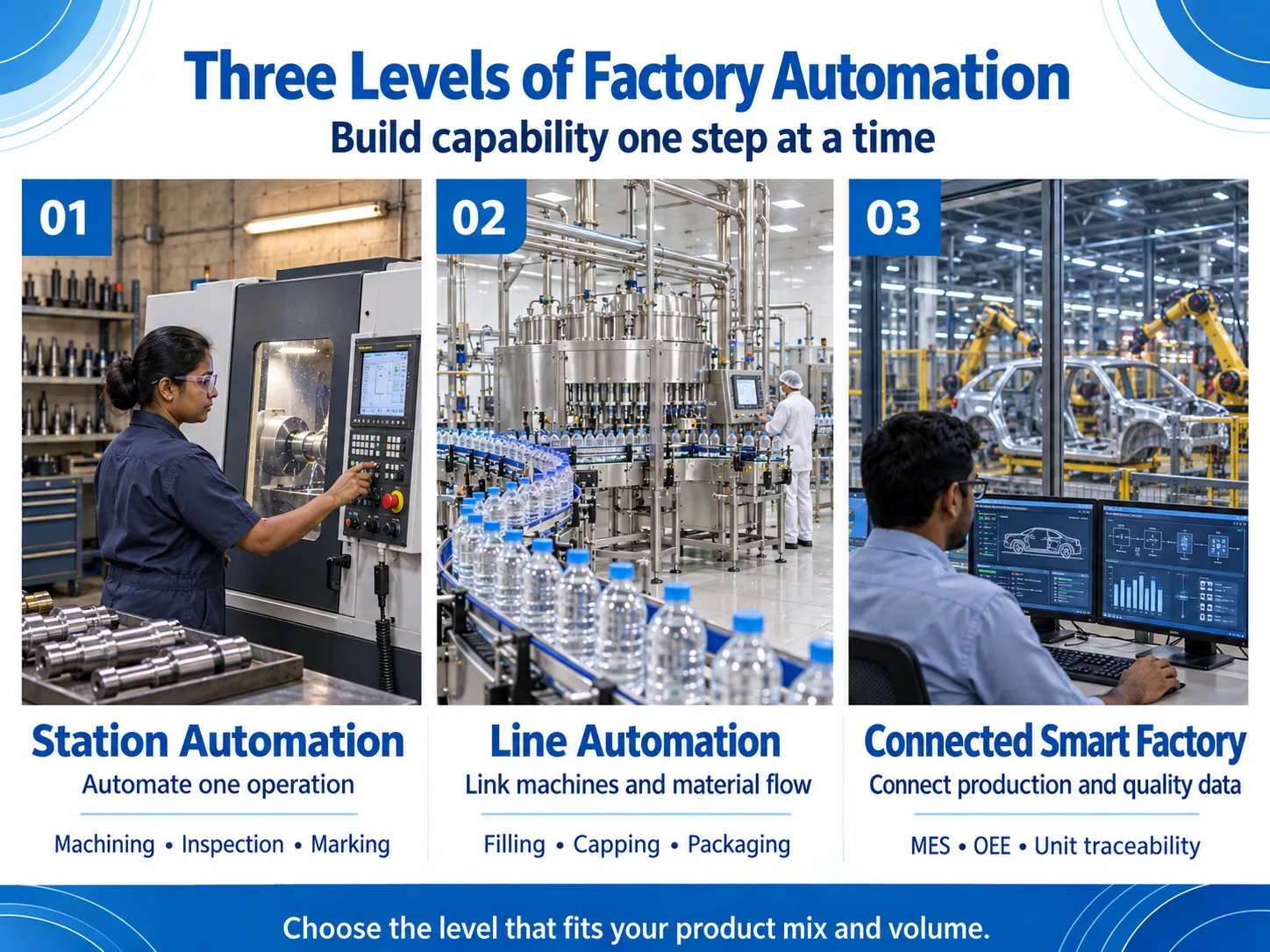
“Automated” covers a wide range. Most plants in Maharashtra sit at one of three levels, and many run a mix of all three on the same shop floor.
| Level | What is automated | Typical investment profile | Common users in Maharashtra |
|---|---|---|---|
| Station automation | Single operations: riveting, welding, calibration, testing, marking | Low to moderate; one machine at a time | SMEs and Tier-2 suppliers in Jalgaon, Nashik and Waluj |
| Line automation | Linked stations with conveyors, in-line testing and automatic sorting | Moderate to high; justified by steady volume | Mid-size OEMs and Tier-1 suppliers |
| Connected smart factory | Lines plus MES, OPC UA data flow, OEE dashboards and unit-level traceability | High; the software and integration budget grows | Multinationals and export-focused plants |
The practical lesson from our Indian projects is that the jump from level one to level two is where most of the productivity sits, while the jump from level two to level three is where the commercial value sits: audit-ready data, fewer disputes with customers and access to export tenders. The shift toward software-defined, interoperable plants is covered in our look at industrial automation trends for 2026, and the choice between partial and full automation for a new entrant is laid out in our guide to automated and semi-automated MCB production.
Automation Inside Maharashtra’s Leading Sectors
Automotive and auto components
The automotive industry is the most mechanised in the country. The body-in-white plants use a large number of robotic welders; the painting plants have become almost completely robotic, and the assembly of engines and transmissions is now done using torque controlled fastening, where all measurements are recorded. P&S Intelligence, a market research company estimates that Maharashtra accounts for approximately 20% of the smart factory share in India, and also mentions that Tata Motors and Bajaj Auto are among the companies located in Pune, which are actively adopting AI and automation solutions. Any serious look at industrial automation in Maharashtra therefore starts with the auto supply chain.
Electrical equipment and switchgear
Electrical products combine high quantity ratios with safety-critical performance making them the perfect candidates for automation. Every miniature circuit breaker has to trip at its time-current curve, and every contactor has to endure its rated mechanical and electrical endurance. Manual calibration and sampling testing cannot guarantee such things at scale, hence Nashik and Jalgaon clusters are moving from manual benches to semi-automated stations and then to fully automated assembly and testing lines, as will be explained in the case section below.
Pharmaceuticals and chemicals
In the Mumbai-Thane vicinity, as well as in Chhatrapati Sambhajinagar and Nashik, pharmaceutical manufacturing plants have implemented automation technologies not primarily to reduce labor costs but for regulatory compliance purposes. Technologies such as electronic batch records, serialization, and MES systems exist in the pharmaceutical industry as a result of the demands imposed by regulatory authorities in export markets. The production sites belonging to the chemicals industry that are located along the coast rely on distributed control systems, with investment in automation being mainly targeted on process control systems, safety instrumented systems, and management of tank farms.
Food processing, textiles and electronics
Food processing and textiles, strong in Vidarbha and Marathwada, automate filling, packaging and material handling first. Electronics system design and manufacturing (ESDM) is growing fastest in the Pune and Nashik belts, where surface-mount lines, automated optical inspection and functional test stations form the core. Across all of these, a smart factory in Maharashtra is defined less by robots than by whether production data flows from each machine to a system where someone acts on it.
Case in Focus: Automating a Circuit Breaker Factory in Maharashtra
A circuit breaker plant shows clearly how an automated factory is assembled step by step. Most Indian breaker makers begin by automating the sub-assembly that most affects safety: the arc chute, which decides breaking capacity. Our article on the arc chute assembly machine explains why this machine became standard equipment in Indian electrical SMEs. From there, the typical expansion path adds complete assembly, testing and data layers.
| Line module | What it does | Key performance data |
|---|---|---|
| MCB automatic assembly line | Feeds the case and inserts the mechanism, trip unit and arc chute, then mounts the cover with vision checks at each station | 2 to 3.5 s per piece; 1P to 4P changeover in under 30 minutes |
| MCB automatic testing line | Thermal calibration at 1.13 and 1.45 In, instantaneous trip for B/C/D curves, contact resistance, automatic sorting | 1,800 to 2,400 pieces per hour; timing accuracy of ±1 ms |
| MCCB automatic production line | Servo riveting, torque-controlled fastening, ETU calibration (L-S-I-G) and hi-pot testing to IEC 60947-2 | About 30 s per piece; 100A to 1600A frames |
| IoT smart MCB production line | IoT module assembly, Wi-Fi, Zigbee and RS485 protocol tests, remote switching and aging tests | 800 to 1,500 units per shift |
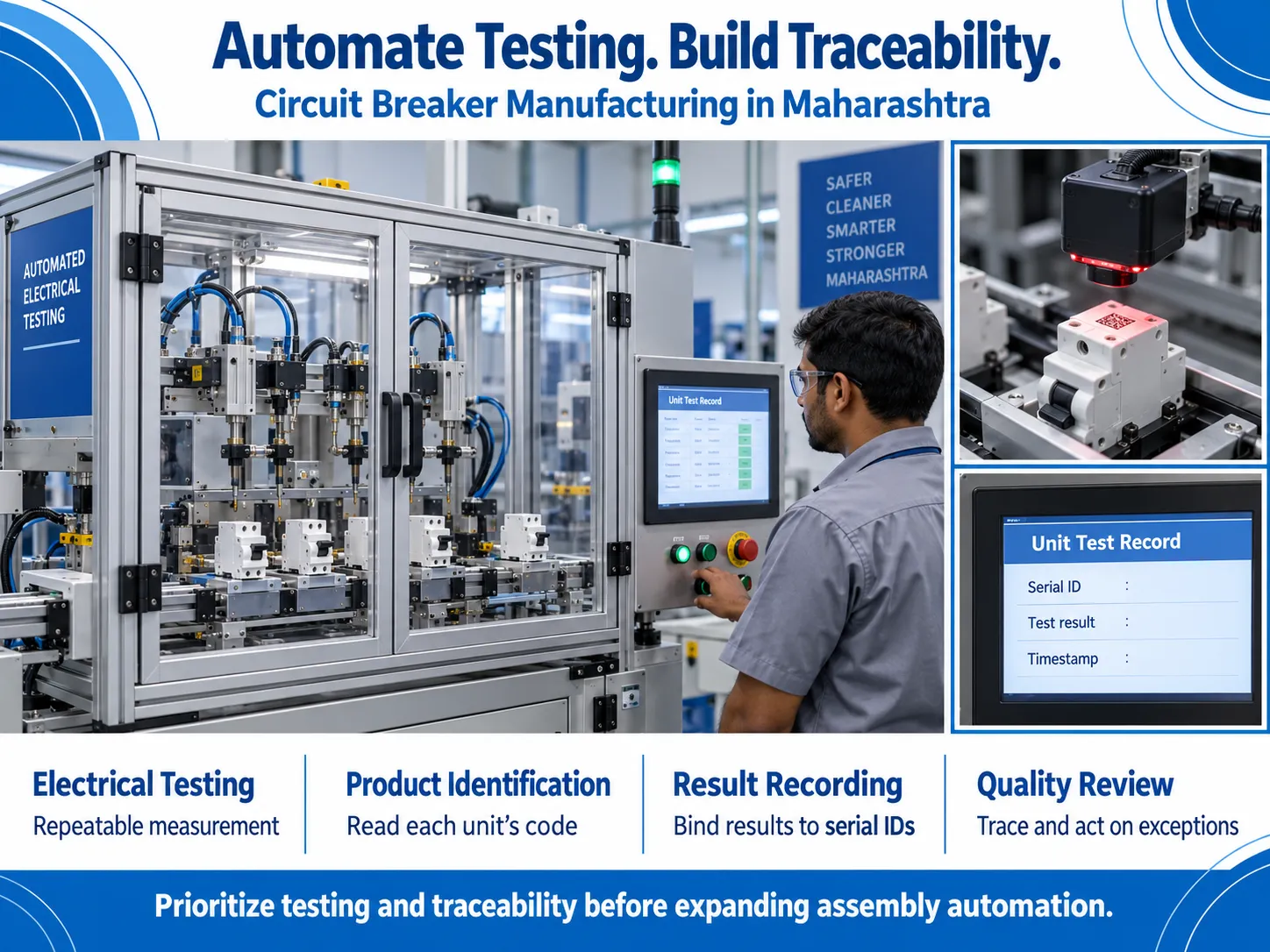
There are two rules that should be kept in mind while making an investment. To begin with, testing needs to be automated prior to automating the process of assembly completely. This is due to the fact that testing is normally the point where a manual plant fails the BIS audit, and it is also the place where field returns emerge from, and also it is a method of automatic testing that gives the data record per unit.
Secondly, one needs to utilize open data interfaces right from day one.
The points above contribute to achieving results with the use of OPC UA or Modbus TCP in such a way that the information about trip times, torque values, and serial numbers can later be transferred into MES, removing the necessity to change production equipment of the plant.
Hence, the so-called breaker plant that implements this order can grow from a few semi-automated working stations to a whole connected production line without sacrificing any previous equipment pieces.
How to Build an Automated Factory in Maharashtra: A Practical Roadmap
The risk of purchasing the incorrect line can be minimized using the following steps, irrespective of whether the project is a new development in AURIC or an upgrade of an old unit in Nashik.
- Select the conveyor based on the supply chain first and incentives afterward. The proximity to customers and parts manufacturers often costs less in total over ten years than the cost of subsidy given in the beginning. Verify the current zone classification of any shortlisted real estate with MIDC before taking decision as incentive levels differ significantly across zones.
- Specify the product mix and realistic volume and ensure the level of automation corresponds to the order book. Stable high-volume family of products justifies the need for a dedicated line, whereas flexible semi-automatic cells are suited for varied and changing product mix.
- Validate the product before freezing tooling. Line fixtures and feeders are built around exact part geometry, so the design should be proven through prototypes and pilot runs first; the same selection discipline we describe for rapid prototyping companies applies to choosing an automation partner.
- Automate testing and traceability early. This protects certification, reduces field failures and creates the data customers audit.
- Specify open communication and MES readiness. Require OPC UA or Modbus TCP, recipe-based changeover and serial-number data binding in the tender documents.
- Plan utilities for automated equipment. Stable three-phase power, clean compressed air at about 0.6 MPa and climate control for test areas during the humid monsoon months are basic requirements that are easy to underestimate.
- Compare local and offshore suppliers on total landed cost. Automation companies in Maharashtra offer proximity and fast service, while specialised offshore builders often offer deeper product-specific experience at lower capital cost. Our reviews of automatic assembly machine manufacturers in India and industrial automation companies in Bangalore help frame that comparison.
- Insist on FAT, SAT and training. A factory acceptance test at the supplier’s site with your own engineers, a site acceptance test measured against written targets, and real operator training decide whether the line reaches rated output in weeks or in months.
Challenges to Plan For
- Technical expertise. There is an abundance of operators, however, when it comes to hiring technicians who can perform troubleshooting of PLC logic, servo drives and vision systems there is a lack of them. Train at least two technicians on every major production line as part of the training plan.
Quality of electricity supplied. Due to the presence of voltage drops and harmonics sensitive testing devices can malfunction. Making voltage stabilisation and earthing the part of the project budget is a good idea.
Service for foreign production lines. When signing the contract, it is necessary to check such questions as remote diagnostics, the presence of spare parts in the local market and the guaranteed time of getting a response.
Cost of real estate in comparison with benefits. Pune is a region with a rich ecosystem but with high costs of land acquisition while Marathwada and Vidarbha offer much bigger benefits and have no suppliers in the area.
Data discipline. MES can create value if one reviews the data and takes action accordingly. Make sure there is a team responsible for OEE and quality dashboards from the beginning of production.
References
- MIDC: About Maharashtra. Official figures on the state’s share of industrial output, FDI, exports and sector production.
- MIDC: About MIDC. Industrial areas, land bank and focus clusters of the Maharashtra Industrial Development Corporation.
- Economic Survey of Maharashtra 2025-26: Highlights. Directorate of Economics and Statistics, Government of Maharashtra.
- IBEF: Maharashtra State Profile. India Brand Equity Foundation data on GSDP, exports and FDI.
- AURIC: About the Aurangabad Industrial City. Official profile of the greenfield smart industrial city in Shendra-Bidkin.
- ABB: New Nashik factory for power distribution products. ABB announcement on its Nashik smart facility.
- World Economic Forum: Global Lighthouse Network. Recognition programme for the world’s most advanced factories.
The automated factories in Maharashtra that work successfully have a common tread; they are located in the region in accordance with their supply chain. They are also ones that carry out tests and everything related to data processing before going for the speed of the line. They cooperate with those who know their product well as well as technology. One must remember that the region provides all necessary resources. As for execution, Benlong Automation helps implement processes in the electrical industry by creating and installing assembly and testing lines for MCBs, MCCBs, RCCBs, and contactors as well as cooperating with manufacturers from Maharashtra and other Indian regions in order to take into account the volumes and certification requirements of the market and provide appropriate solutions.