benlong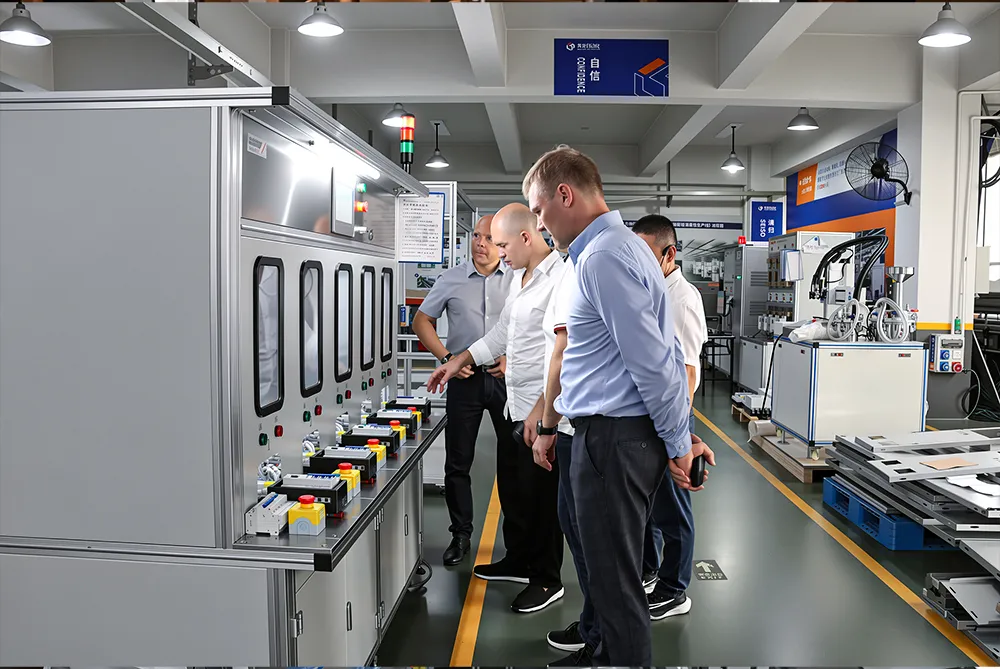
What Is Automatic Test Equipment? Types, Industries and Costs
Automatic Test equipment is described as the equipment that uses stimuli to establish if the tested product works or not. It means that Automatic Test equipment provides the input, measures the output, and decides whether the product has passed the testing without any human intervention. That definition means a lot of various tools from testing machines checking cable assemblies to testing devices for semi-conductors worth millions of dollars. This is the reason why people confuse the term ATE when coming across it in different industries because it does not only mean a certain type or kinds of devices in one industry but rather a very broad category. The guide below provides all needed information about automatic test equipment including how the types of automatic test equipment differ from each other, what automatic test equipment is able to do, what industries use it, its price, and how to specify an automatic test equipment.
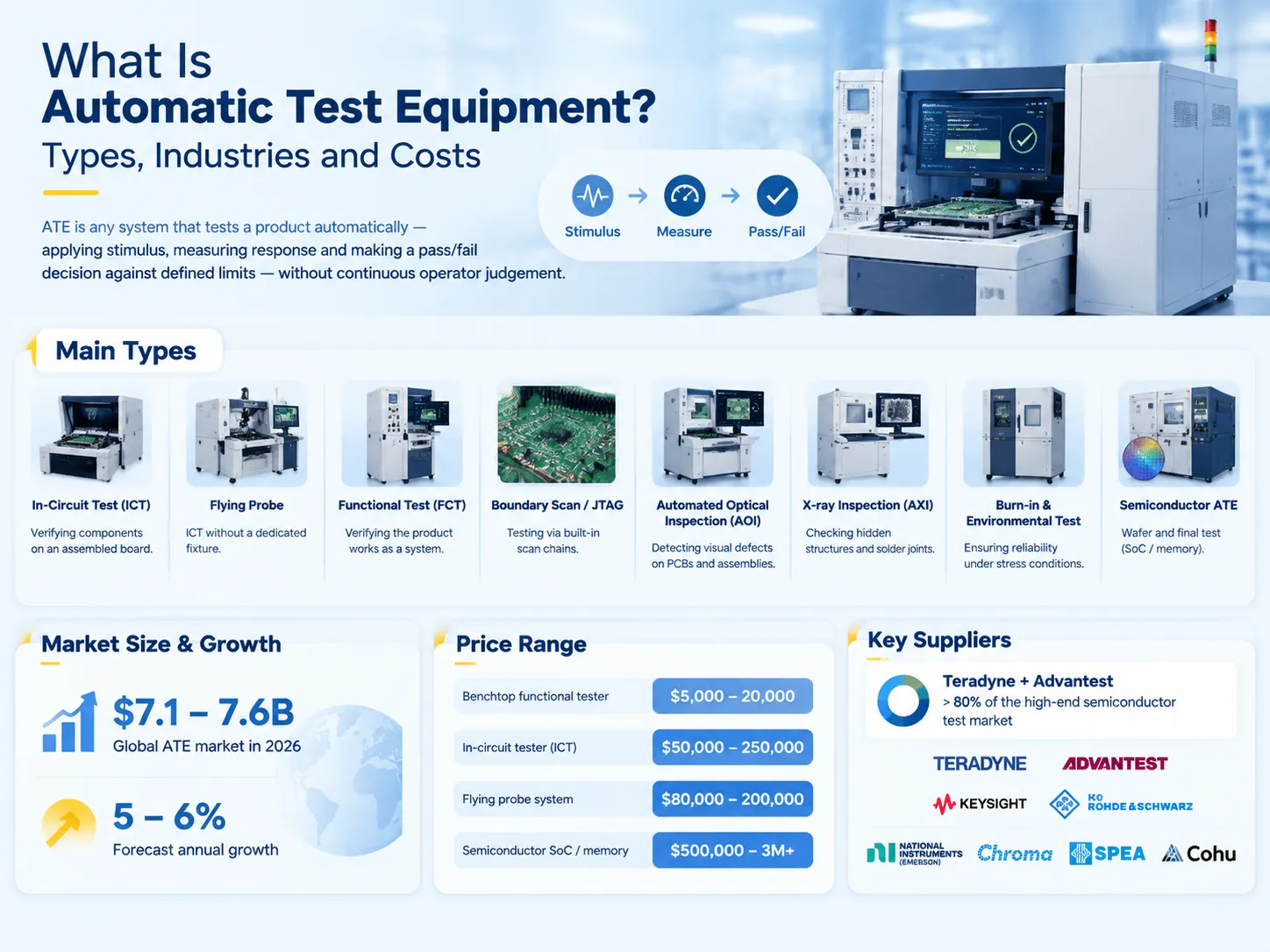
Automatic test equipment (ATE) refers to any device that can carry out product testing without human supervision and automatically by means of applying stimuli, measuring responses, and making decisions based on the results obtained. ATEs can be categorized into several major groups, including ICT (test of the assembled board), flying probe (an ATE system that does not require a testing fixture), functional testing (FCT, where the whole product is tested), boundary scan, JTAG, automated optical inspection (AOI), X-ray inspection, burn-in tests, and environmental tests. According to forecasts, the ATE market will amount to about 7.1 mills and in 2026 will grow at an average rate of 5 to 6 percent almost all over the world. The price of ATE varies significantly: from $5,000 to $20,000 for a basic version and $50,000 to $250,000 for an advanced ATE device. However, Teradyne and Advantest account for more than 80% of ATE devices sold.
What Automatic Test Equipment Is
No matter the sector, automated testing follows a four-step process: stimulus, measurement, comparison, and decision. The system generates the input to the Device Under Test (DUT), takes the reading, and compares the result with the predetermined limit before forming a conclusion. The dissimilarities among the systems rest in the type of stimulus that is used and its measurement method, number of test points, required speed, and working conditions.
One can know that ATE is different from inspection as inspection means mere looking at a product while ATE involves testing the product. ATE is complementary to inspection, meaning that both processes should be used together. Also, ATE should not be confused with data acquisition, which means gathering the results without testing.
Automated tests have the following features that manual testing cannot have: Repeatability — this means that once a product is tested it can be tested again either by another operator or on another machine, but the outcome will still be the same; Speed — this feature means that automated testing takes milliseconds while manual tests take seconds; Coverage — the number of test points can reach a thousand and the productive process won’t stop; Traceability — means that every piece of equipment’s result can be tracked by its serial number.
Why Automated Testing Exists
The adoption of automated testing equipment (ATE) is driven by three forces that apply not only in electronics.
- Volume. For production runs of a few hundred units per year, manual testing makes sense and is perfectly feasible. However, with production runs in the hundreds of thousands, it is no longer feasible to rely on manual testing. The reason is that it is impossible to meet the necessary test volume for every unit in the time available, even if operators could test every unit in a matter of days or even hours. Thus, automation is a game-changer for testing – moving from the world of sampling to that of 100% testing.
- Cost of failure. In industries where the cost of remediating defective units is high, the cost of failure incurred in the field is many times higher than that of testing. When electric circuit breakers fail to respond, or medical devices fail to read a sensor, or control units go down, one has a problem leading to an expensive product recall, lawsuits, and damaged brand reputation.
- Documentation. It would be impossible to sell products on the regulated markets even if they functioned perfectly well if no documentation proving that they functioned as expected were available. Automated testing, in turn, produces such documentation as a by-product of the testing process.
The economic aspect can be quantified and is typically where any factory begins its assessment of potential cost savings. The return on investment from automating a production line’s testing process instead of doing it manually can be quantified based on throughput figures, the defect escape rate, and labor cost for each produced unit.Our analysis of automated versus manual testing payback for circuit breakers works through that arithmetic on a real product.
The broader returns from automation — throughput, quality consistency, and labour cost per unit across a whole production process rather than a single test step — are covered in our guide to how industrial automation delivers efficiency benefits.
The Types of ATE
Most of the systems currently in commercial use can be classified as belonging to one of the specific categories listed here. However, one particular production line may initiate the different processes represented by several of the categories discussed above.
| Type | What it tests | Typical speed | Notes |
|---|---|---|---|
| In-circuit test (ICT) | Individual components on an assembled board — resistance, capacitance, junctions, continuity, shorts | Seconds per board | Requires a dedicated bed-of-nails fixture per board design; highest fault coverage at board level |
| Flying probe | The same faults as ICT, accessed by moving probes rather than a fixed fixture | Tens of seconds to minutes | No fixture cost, so it suits prototypes, low volume and high-mix production; slower than ICT |
| Functional test (FCT) | The product working as a system — powering up, communicating, performing its function | Seconds to minutes | The largest category by unit volume; closest to real operating conditions |
| Boundary scan / JTAG | Interconnects and devices through their built-in test access port | Fast | Effective where physical probe access is impossible, such as dense BGA assemblies |
| Automated optical inspection (AOI) | Solder joints, component placement, polarity, markings | Seconds per board | Inspection rather than electrical test; catches assembly defects ICT cannot see |
| X-ray inspection (AXI) | Hidden solder joints — BGA, QFN, through-hole barrels | Seconds to minutes | Essential where joints are not optically visible |
| Burn-in and environmental test | Operation under temperature, voltage and load stress for hours or days | Hours to days | Removes infant mortality; often combined with functional monitoring |
| Wafer prober | Individual die on a wafer before packaging | Milliseconds per die | Semiconductor-specific; the highest-throughput category |
| Final test / device handler | Packaged semiconductors at speed and temperature | Milliseconds to seconds per device | The classic high-end ATE application |
| System-level test (SLT) | The chip in a realistic system context — booting, running workloads | Minutes | Growing fast as advanced packaging makes chip-only test insufficient |
| Power electronics and electrical test | Breakers, contactors, transformers, motors, power supplies, batteries | Seconds to minutes | Trip-curve verification, dielectric strength, contact resistance, calibration |
| Cable and harness testers | Continuity, shorts, miswires, connector position | Seconds | Low cost, very high throughput; standard in harness manufacturing |
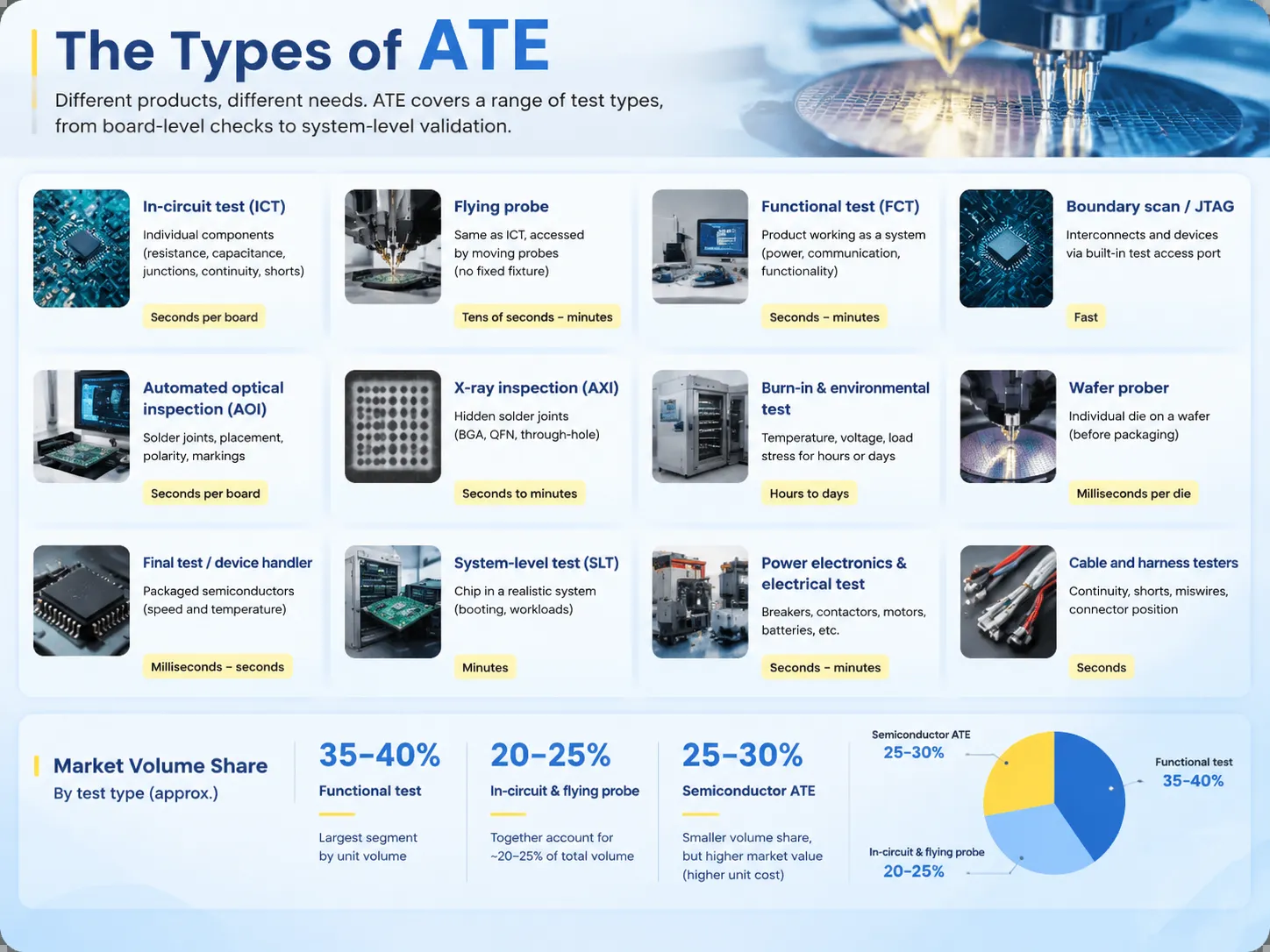
In terms of volume, functional testing is the largest segment, making up nearly 35-40% of the total units sent. In-circuit and flying probes together account for around 20-25% of the total volume. Semiconductor ATE has a smaller volume market share with a 25-30% market value since the price of one unit is higher than the cost of bench testing for a whole manufacturing facility.
What It Achieves
It is necessary to explain the benefits of specific advantages of the procedure, as the term “better quality” cannot be considered a viable business case.
- Complete testing. Every single unit is tested, which means that the possible failure is dictated only through the existence of testing rather than by chance.
- Uniform decisions. The automated machinery enforces the same limitation to all units, thus upholding the consistency of the results, and the same advantage is lacking if the process is completed manually.
- Shortened cycles. Today’s hard wares can be equipped with machine learning-powered failure detection systems, which can result in the reduction of the test duration by nearly 30%, along with the minimization of diagnostic downtimes due to the involvement of AI.
- Transparent documentation. The test results linked to particular serial numbers allow to simplify warranty and trend analyses as well as audits.
- Early detection of any deviations. Since everything is tested, it allows noticing changes in behavior before the actual failures.
- Increased capacity without increasing the workforce. Where it is difficult to find specialists, automation can replace the manual inspection.
- Calibration and quality compliance. The results of testing conducted according to a particular standard (ISO 17025) can be trusted by customers and regulatory bodies, with the associated costs amounting to 15-25% of the whole sum.
Industries That Depend On It
Automated testing technology is not restricted to electronics. The following examples illustrate where it is already widely applied.
| Industry | What is tested | Why automation is required |
|---|---|---|
| Semiconductors | Die at wafer level, packaged devices, systems-in-package | Volumes in the billions; test must run in milliseconds per device |
| Automotive | ECUs, ADAS sensors, battery management systems, power electronics, harnesses | Functional safety requirements and recall exposure; automotive is among the fastest-growing segments |
| Aerospace and defence | Avionics, radar, communications, guidance electronics | Extreme reliability requirements and mandatory documentation trails |
| Medical devices | Implantables, diagnostic imaging, patient monitoring, infusion systems | Regulatory approval depends on documented verification; the cost of a field failure is measured in harm |
| Electrical and electronics manufacturing | Circuit breakers, contactors, relays, transformers, switchgear, panels | Trip curves, dielectric strength and calibration must be verified on every unit, not sampled |
| Consumer electronics | Phones, laptops, wearables, displays | Volume and cost pressure; the largest single application area |
| Telecommunications and 5G | RF modules, base station electronics, optical components | High-frequency characterisation requires instrument-grade measurement |
| Energy and power | Inverters, PV modules, battery packs, grid equipment | Safety certification and performance guarantees; battery testing is expanding rapidly |
| Appliances and white goods | Motors, controllers, complete units | Production volumes make end-of-line functional test mandatory |
| Industrial automation | Drives, PLCs, sensors, I/O modules, safety relays | Reliability expectations and configuration verification per unit |
The commonality between the fields lies not in the technology but the consequences of failures. If you are dealing with a defective item that is inexpensive and harmless, sampling inspection makes sense. When this is not the case, testing ceases to be a cost centre and becomes part of product specifications.
What It Costs
The price differs in various categories, so stating just one price does not help much without knowing the context in which it applies. The bands provided below should only serve as indicative figures depending on the region and specific application/configuration.
| System | Indicative price | What drives the price |
|---|---|---|
| Benchtop functional tester | $5,000-20,000 | Instrument count, measurement accuracy, software |
| Full functional test system | $50,000-150,000 | Channel count, fixturing, custom test software, integration |
| Cable and harness tester | $3,000-30,000 | Test point count and connector matrix size |
| Flying probe system | $80,000-200,000 | Probe count, speed, board size capability |
| In-circuit tester | $50,000-150,000 | Test point count, measurement capability |
| In-circuit tester with advanced boundary scan | $100,000-250,000 | Multichannel architecture and JTAG capability |
| AOI or AXI system | $20,000-150,000 | Resolution, throughput, 2D versus 3D, X-ray power |
| Burn-in chamber with monitoring | $30,000-500,000 | Chamber volume, temperature range, channel count |
| Semiconductor ATE (SoC or memory) | $500,000-3,000,000+ | Pin count, speed, RF subsystem, handler, software environment |
| Custom production test line | $50,000-1,000,000+ | Station count, integration, throughput target, automation level |
There are three elements of expense that are often underestimated. The first one is fixturing: the custom bed-of-nails fixture for the in-circuit tester has an eight to twelve-week lead time and it has a separate cost taking only one design of the board into account. The second is software and integration: connecting the test system with a manufacturing execution system, data historian, or enterprise quality system is a project by itself. Thirdly comes calibration and servicing: it can add around 15-25% from the cost of ownership of the system. The servicing aspect of the systems has getting more costly by the year now. Although agreements on volumes with the big clients may influence the price, it rarely has an impact on the service aspect.
Platforms and Vendors
The supply base can be divided into three levels and there is little competition.
The high-end semiconductor ATE market is largely dominated by two companies, Advantest and Teradyne, who together have controlled more than 80% of the high-end market for SoC and memory testing. Their platforms are used for instruments with the largest number of pins and with the highest data rates, so that one installation may even cost over $2 million!
The Instrument and Modular segments occupy the middle of the market. Companies like Keysight Technologies, Rohde & Schwarz and National Instruments (included in Emerson today) produce testing devices (including PXI, VXI, LXI architecture) used for functional and mixed-signal testing. LabVIEW and TestStand operate these devices and provide significant possibility for their configuration.
Specialist and regional companies fill the remaining part of the market. Chroma ATE company based in Taiwan is well known for its power electronics and battery tests, while Spea and Seica produced in-circuit and flying probe systems. Cohu, Hioki, Yokogawa, Shibaura serve narrow niches, while Chinese manufacturers such as Hangzhou Changchuan Technology and Huagong Tech produce cheap functional tests and ICT systems and export them. The middle segment lacks a dominant player, as here operates a variety of small regional companies without unique advantage and many of them face significant competition.
Two things about this market should be of interest to buyers. First, the replacement cycle is short: high-end ATE is often replaced every five-seven years, while functional ATEs and the in-circuit ones – every three-five years due to the fast software obsolescence. In the mature markets replacement and retrofitting amount to 40-50% of all shipments, which means that the second-hand markets are large. Secondly, technology is, paradoxically, becoming more complicated: it takes much longer to test modern semi-conductors compared to previous years.
How to Specify a System
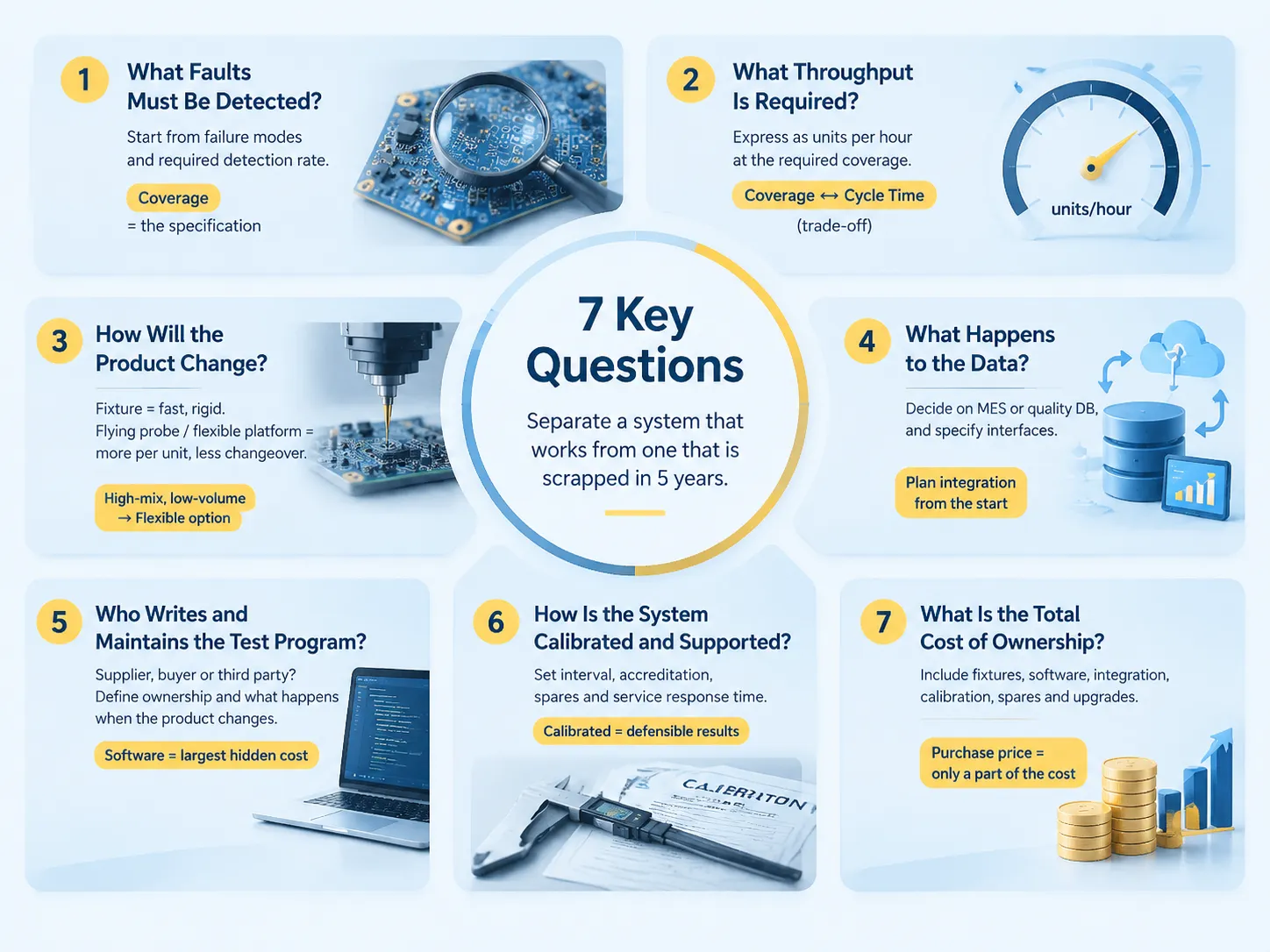
Seven questions distinguish between a functioning system and a system discarded after five years.
- What faults must it identify? Start with failure modes and detection rate requirements, not with vendor features. The coverage is the requirement; everything else is just a tool to achieve it.
- What is the required throughput? Express it in terms of units per hour at that coverage, since higher coverage usually involves longer cycle times. There is a trade-off between the two.
- How will the product evolve? Fixture-based in-circuit testing is fast, but may require different fixtures for each board revision. In contrast, flying probe or configurable functional platforms may be slower, yet more universal in terms of the number of changes in products.
- What will happen with the data? Determine in advance, whether the results will be input into manufacturing execution system or quality database and define the interfaces. Retrofitting data integration is more expensive than designing it in.
- Who develops and maintains test software? This is often the largest hidden cost and the source of delays when installing the system. Find out who owns the test software and how will it evolve as the system evolves.
- How will the system be initialized and maintained? Determine whether calibration is done on an ongoing basis, whether this is done with amiable certification, whether spare parts and service response times are guaranteed.
- What is the total cost of ownership? It should include fixtures, software, integration, calibration and spares and upgrades. The purchase price is usually a controversial part of the estimate.The discipline of evaluating capital automation this way is the same one set out in our guide for buyers evaluating automated production lines.
Test Inside a Production Line
A key distinction that should be made is between purchasing a testing equipment and incorporating testing in a production process. A stand-alone testing machine can be described as operating at the output end of a production process while an integrated station is part of the process and provides input for its operations.
In terms of return on investment, integrated testing has the highest performance. Success does not come from the testing itself, though. When all the items produced and tested, the failure information may serve as production management signal. The fact that a certain parameter has shifted indicates that some action has to be taken at an upstream station before the fault rate starts changing. Thus station-level integration simplifies handling, saves production space and eliminates delays between production and testing, which mean better return on investment.
This is exactly the niche in which benlongkj operates: automated manufacturing line and production systems for electrical components including production lines with in-line automated testing and calibration rather than a stand-alone testing step added to the end process.Manufacturers evaluating that approach are weighing the same trade-offs as any automation project, and the wider landscape of options is set out in our overview of manufacturing automation solutions.
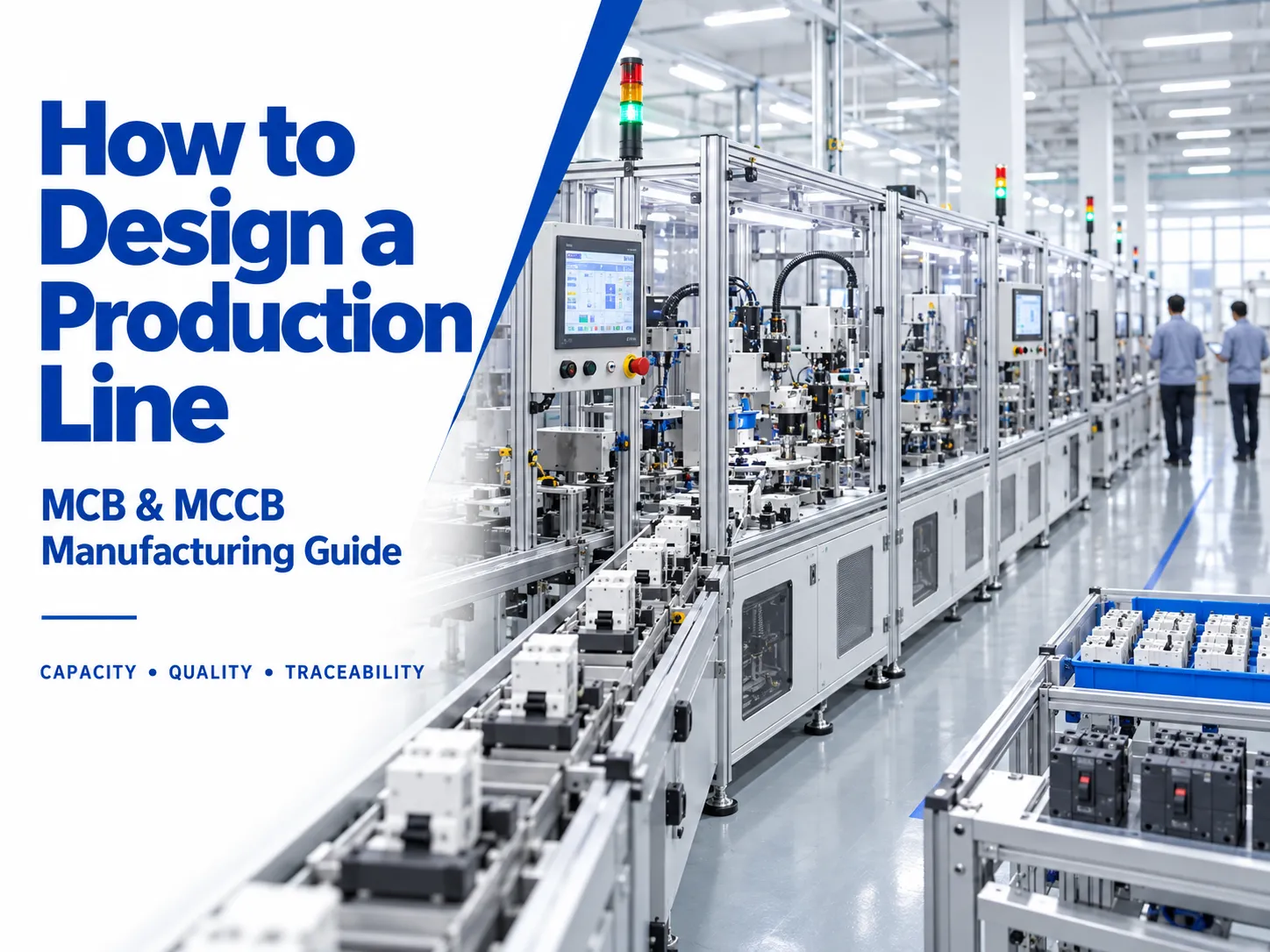
A concrete example of an integrated line — where assembly and test are one continuous process — is the MCB automatic production line, which builds trip-curve verification and calibration into the manufacturing sequence rather than treating it as a downstream inspection.
The advice for any buyer is to make an early decision about the model needed. If the requirement occurs for product verification, a standalone ATE system is the best choice, with the criteria mentioned above being applicable. If the need is to incorporate testing at the start, one must contrive the test part of the system from the very beginning because subsequently adding inline testing to an already existing line is hugely more complex than building it from a scratch taking into account its specifications.
FAQ
What are examples of automated test equipment?
Examples can be found throughout the spectrum. In electronic assembly, the in-circuit tester tests the components of a populated PCB, while the flying probe system achieves the same testing procedure without fixtures. On the product level, the functional test system powers the assembled product and verifies that the functionality is carried out. For components, the harness tester checks for continuity, and the power electronics testing system tests trip curves, dielectric strength, and contact resistance at the circuit breakers and other devices. On the high end, the semiconductor ATE systems test the chips at wafer and packaged device levels at high speed and under extreme temperatures, and the system-level testing systems test chips in a reasonably realistic mode.
What is the purpose of automatic testing?
The aim is to render a uniform and documented pass/fail decision on each unit as opposed to forming an opinion about some samples. This achieves four goals in one: repeatability, where the same unit yields the same result irrespective of the person conducting the tests; swiftness, leading to complete testing at production speed; coverage, providing for the testing of thousands of testing points; and traceability, where every result of testing is associated with a serial number. Thus, businesses will detect defects in factories rather than the customers, which, in its turn, will result in the availability of the necessary evidence for the warranty claim.
What is automatic test equipment (ATE)?
Automated Test Equipment (ATE) is the name used for systems that employ automatic measures to test products through stimulating the product, measuring how it reacts, and then comparing the result against specifications.. ATE is often referred to in the field of semiconductors as these systems test both wafers and packaged devices. However, ATE also refers to in-circuit testers, flying-probe systems, functional test platforms, boundary scan tools, optical inspection, and x-ray inspection, burn-in systems and power electronic test benches.
What are the top 5 automation testing tools?
The response varies based on the type of testing since the tools used in software test automation differ from those used in hardware test automation. In the case of hardware, the typical systems mentioned will be Teradyne and Advantest platforms for semiconductors and other types of electronics testing, Keysight systems for RF and mixed-signal testing, LabVIEW and TestStand from National Instruments for layout testing, and Chroma ATE for battery testing, while the role of SPEA, Seica and Cohu will be in-circuit testing, flying probe, and device handling respectively. In the case of software testing, the common automation tools used are Selenium, Playwright, Cypress, Appium, and Robot Framework. Any supplier that offers a product list that includes the two groups does not know what is being asked.
Do I need automatic test equipment if my production volume is low?
More often than not, it should be made clear that using a dedicated system at low volume does not make financial sense, and it might be smarter to use manual testing, ensuring all necessary records are kept. One of those occasions, when the use of automation may be justified at low volume, is when defects have serious consequences as in the case of medical devices, aviation products, safety devices, or in case the test cannot be performed manually due to technical limitations regarding precision and reproducibility. In cases of low volumes and a diverse range of products, the use of a flying probe system or some type of functional platform appears to be the best solution because they do not require changing tooling in case of a product change.
References
- Teradyne — Semiconductor and Electronics Test Systems
- Advantest — Automated Test Equipment for Semiconductor Devices
- Keysight Technologies — Electronic Test and Measurement Instruments
- National Instruments (Emerson) — Automated Test Platforms and TestStand Software
- ISO — ISO/IEC 17025 Calibration and Testing Laboratory Accreditation
- IPC — IPC-9252 Requirements for Electrical Testing of Unpopulated Printed Boards
Conclusion
Automatic test equipment answers the simple question: how to ensure that a certain item works correctly? With automatic test equipment you get each item tested reliably and documented as per its pass/fail result in less time and with higher coverage than in manual inspection. Automatic test equipment can be a bench harness tester that is cheap, or an expensive semiconductor test platform costing millions of dollars, but the principle behind it is the same: create some stimulus, measure the response, compare and make a decision. Automatic test equipment revolutionizes the whole testing process by making a previously obligatory sampling procedure now unnecessary, therefore, with the help of automatic test equipment you get 100% product verification instead of sampling, your test is not based on judgment, but on readings. By the way, the price of testing systems varies from a few thousand dollars for functional testing to million-dollar semiconductor testing while having some extra 5-25% for additional hardware, software integration and calibration. Choose from the failure modes you want to detect, deliberately choose between coverage and cycle time, or decide whether this testing system will be a stand-alone method or an integral part of the production line, and calculate all expenses instead of pricing the purchase.