benlong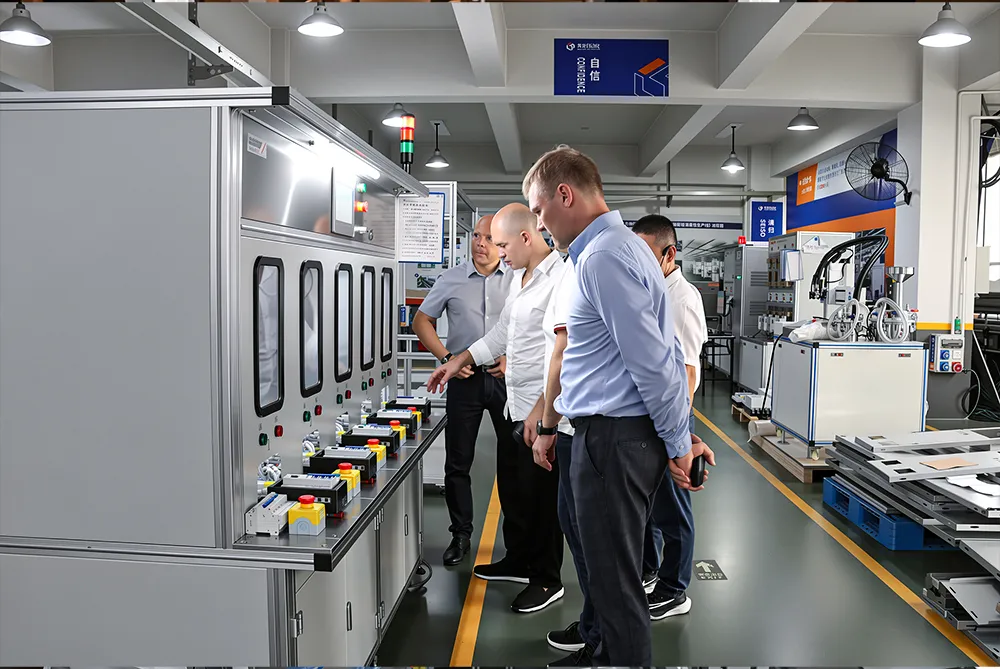


How to design a Circuit Breaker Production Line?
For a factory engaged in the production of miniature circuit breakers, the idea of high-capacity production line is no longer considered a competitive luxury but rather a necessity. With a properly designed line, not only is there increased production and reduced labor costs, but there is also satisfactory information for the auditors who check if the factory can get certified for quality: the processes must be repeatable, results must be documented and units must be traceable. Knowing how to design a production line, however, means working through a set of very practical constraints: necessary capacity, product characteristics, route of production and the area of the building must be taken into account.
The guide explains how to design the production line from the beginning, indicating the methodology on the example of the production lines for miniature circuit breakers and moulded-case circuit breakers elaborated by Benlong Automation and analyzing the experience of the best factories of the world. It is meant for plant owners, project engineers and procurement departments in India and the Gulf countries who are going to start a new factory producing circuit-breakers or upgrade the existing one.
The production line is the continuous sequence of workstations, conveyors and testing equipment through which the components move in one direction. The design of the line consists in the coordination of this sequence with the production target, structure of the product and area of the plant.
What a Breaker Production Line Has to Deliver
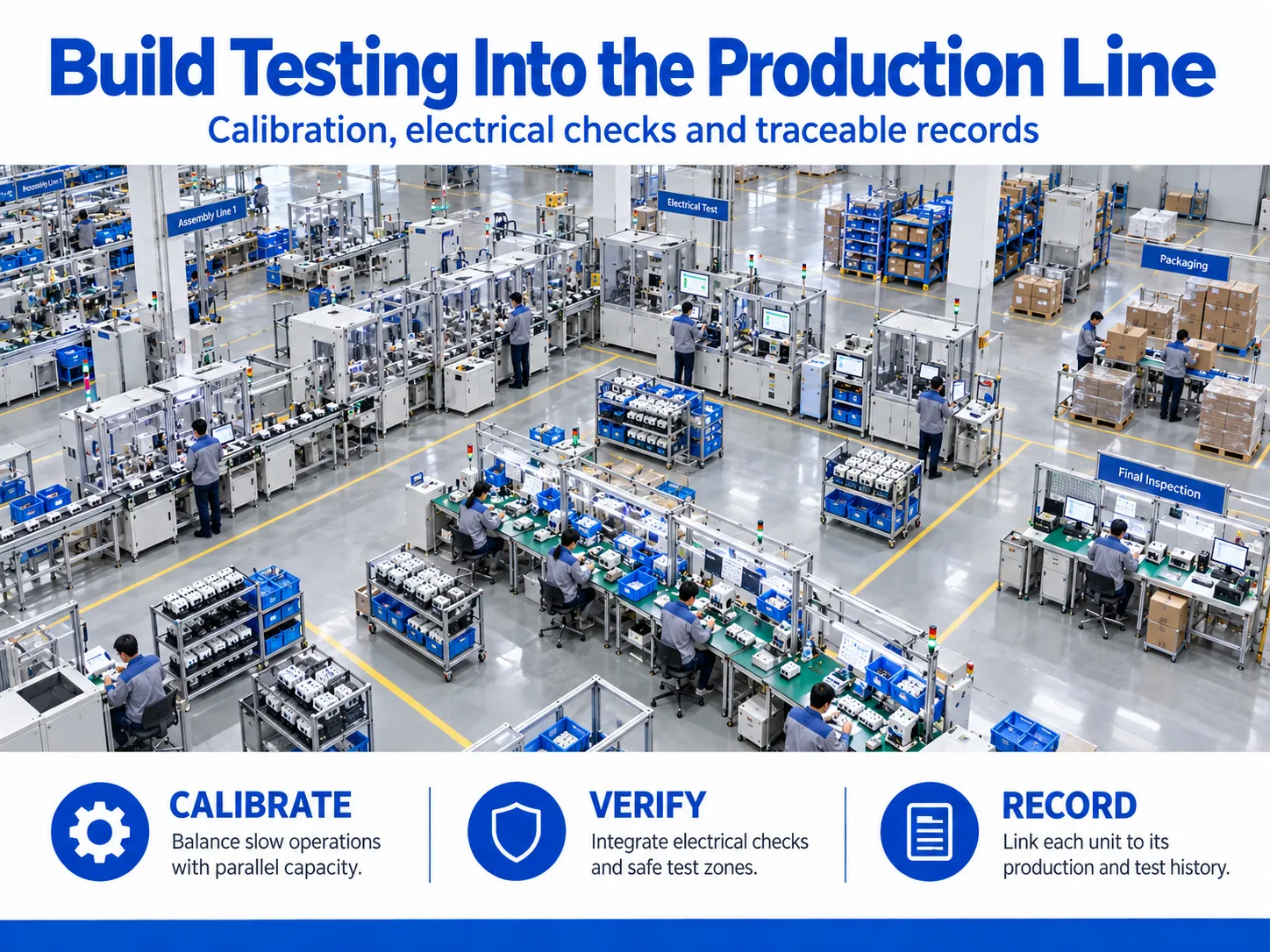
Before starting any layout, the line should have a well-defined concept of what the job entails. For low-voltage circuit breakers, the concept is three-fold, and each component has the same significance:
Capacity – the outputs of the line expressed in terms of the quantity of manufactured breakers per each shift, month, and year. It also includes the breakdown of the output by 1-pole, 2-pole, 3-pole, 4-pole divisions as well as their curves (B, C, and D).
- Quality: every MCB built to IEC 60898-1 has to pass routine tests such as trip characteristics and dielectric strength. On a production line, these tests are part of the process, not an inspection step added afterwards.
- Traceability – distributors and utility companies are requesting the testing records per product. A line that is able to link calibration and hi-pot results will allow factory audits based on data rather than paperwork.
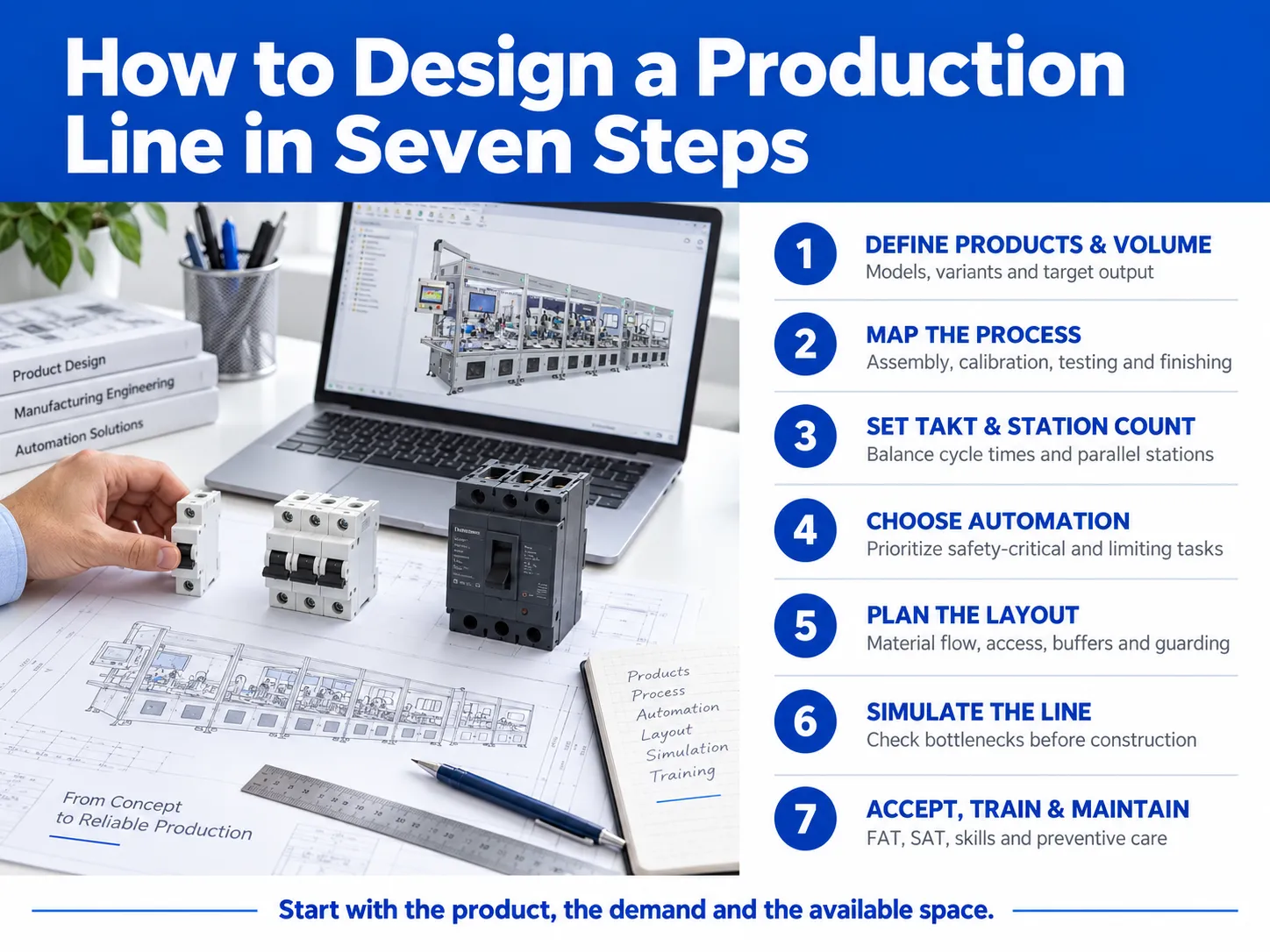
How to Design a Production Line in Seven Steps
The method below combines the planning sequence used by layout specialists such as Visual Components with the lessons Benlong’s engineers apply when they scope a breaker plant. The order matters: each step feeds the next.
Step 1: Fix the product family and the volume
Begin with actual examples and an accurate estimation. Identify any type of model the line should carry out, number of poles, current range (for instance, current from 6 A to 63 A) and the expected number of units per year of every one of models. The mixture of the above parameters will help you to decide whether a flexible or dedicated line is needed.
Generally, a plant with 200,000 to 800,000 MCBs per year can successfully operate using a compact integrated machine system, while plants with one million or more a year warrant a full-fledged line. Adopting the present volume in the design is a mistake; layout experts suggest allowing for 20-40% increase in capacity.
Step 2: Map the process route
Break the product down into operations and put them in order. For a standard thermal-magnetic MCB, the route typically looks like this:
| Stage | Typical operations | What to watch |
|---|---|---|
| Sub-assembly | Thermal trip welding, magnetic coil assembly, contact riveting | Weld consistency and bimetal position |
| Main assembly | Case feeding, mechanism, trip unit and arc chute insertion, cover fastening | Missing springs, inverted arc plates |
| Calibration | Thermal trip calibration and adjustment | Usually the slowest operation on the line |
| Electrical test | Instantaneous (magnetic) trip, on-off check, hi-pot, contact resistance | Test accuracy and operator safety |
| Finishing | Pad printing or laser marking, vision check, packing | Label accuracy and rejects sorting |
Step 3: Calculate takt time and station count
Takt time refers to the time available for production divided by the demand for the product. Takt time defines the speed of all stations.
Example: if the manufacturing unit needs to produce 2,000,000 pieces during a year and operates for 250 days on two shifts of 7.5 effective hours, we will have the output of 8,000 pieces a day divided by 54,000 seconds. The takt time will be 6.75 seconds per piece. Any operation which requires time greater than the calculated takt time should be split or performed in parallel. For example, a calibration procedure that takes 40 seconds would require six operations to be performed in parallel.
This calculation explains why calibration and test procedures require much time and space for the whole production line of the breaker.
Step 4: Choose the level of automation for each station
Automation is considered to be the best option for increasing productivity. However, labour costs can lead to confusion about this point. For example, when there is some volume and labour costs are cheap, the combination of manual input and automatic assembly/testing can often be most effective. In cases where the volume is high and the customer wants data, full automation becomes a very profitable choice. Our earlier guide to automated production line solutions explains the four automation classes in more detail.
A practical rule: automate the operations that decide product safety first (calibration and electrical testing), then the operations that limit output.
Step 5: Draw the layout
Good line layout design starts with people and materials, not machines. Packaging-line specialist nVenia recommends placing operator interfaces and forklift access points apart to avoid congestion, and grouping machine controls so one operator can reach them quickly. The same principles hold for a breaker plant:
- Identify the area where parts are brought in and also where the goods are dispatched and carry out the line from those points.
Put buffering in place in front of stations with slow speeds or high malfunction risks so that a brief stop doesn’t block the line. If space is a problem, buffers can be vertical.
Make sure that areas where high current and hi-pot testing take place are not next to walkways and provide safeguards right from the design stage.
In case of significant space limitations, semi-automated or integrated equipment can perform the same operations with minimum footprint.
Step 6: Simulate before you build
Modern production line design software lets engineers build a scaled 2D or 3D and fit in actual machines in the obtained model. Popular software includes AutoCAD for the design of 2D floor layouts, SolidWorks and Inventor to create 3D models of the equipment and software for discrete-event simulation like Siemens Plant Simulation, Visual Components, FlexSim and AnyLogic for throughput analysis.
Simulation allows one to see bottlenecks in the process even before any production has started. Essentially, according to Visual Components, the layout project for Midea shows that having conducted simulation of the design, it resulted in the 10% smaller facility footprint and a 10% increase in capacity, thus saving around $879,000. However, the study also suggests that complete specifics of the simulation are crucial to achieving accurate and precise figures.
Benlong incorporates cycle-time estimation and 3D design of the line in its design steps, which may involve from two weeks to one month in duration.
Step 7: Accept, train and maintain
A line is only finished when it performs in your building. Plan a pre-acceptance test (FAT) at the supplier’s factory with your own samples, followed by site acceptance (SAT) after installation. Then build a preventive maintenance schedule covering wear parts, fixtures, sensors and test-source calibration. Lean tools such as 5S, Kanban and Kaizen keep the line performing after the commissioning team has left.
The Four Types of Production Layout
Every factory uses one of four basic layouts, or a combination. Choosing the right one is the foundation of any production layout decision.
| Layout type | How it works | Best for | Breaker-plant example |
|---|---|---|---|
| Product (line) layout | Machines arranged in the order of operations | High volume, stable product | Full MCB assembly and test line |
| Process (functional) layout | Similar machines grouped by function | High variety, low volume | A welding shop serving several product families |
| Cellular layout | Small cells, each making a family of similar parts | Medium volume, several variants | A U-shaped cell for thermal trip sub-assemblies |
| Fixed-position layout | Product stays in place; people and tools come to it | Very large or heavy products | Switchgear panels and large ACB assembly |
Most breaker plants run a hybrid: cellular or process areas for sub-assemblies and moulding, feeding a product layout for final assembly and testing.
Assembly Line Layout Examples From Benlong Automation
The following assembly line layout examples come from Benlong’s production line projects. They show how the same design method produces very different lines depending on volume, product and space.
| Line | Output / cycle | Footprint or scope | Suited to |
|---|---|---|---|
| MCB automatic assembly line | 2–3.5 s per piece, up to 1,800 units/hour | Vision inspection at each station; 1P–4P changeover under 30 min | High-volume MCB plants |
| MCB automatic testing line | 1,800–2,400 units/hour | Parallel trip, calibration and contact-resistance testing with automatic sorting | Plants where testing is the bottleneck |
| MCB mini production line | 3,000 pieces per 8-hour shift | 5.93 × 1.83 × 2.44 m, integrated riveting, trip test, hi-pot and calibration | 200,000–800,000 units/year, limited space |
| IoT smart MCB production line | 800–1,500 units/shift | Adds module assembly, protocol and remote-switching tests, aging | Smart-home and smart-grid breakers |
| MCCB automatic production line | About 30 s per piece | 29.0 × 2.0 × 2.2 m, ETU calibration and MES traceability | 100 A–1600 A frame MCCBs |
A production layout example for a growing Indian plant
Here is a production layout example of how a plant can grow in stages. For starters, a model MCB manufacturer starts with more compact mini line as a standalone MCB production facility where the production capacity reaches about 750,000 pieces annually on a single shift. Once the discover it can produce over one million pieces a year, the plant goes on and adds second shift and assemble the full-featured production line with integrated automated testing line arranged in straight or L shape movement through the component warehouse into the packing section.
The key design decision at stage one is to reserve the floor space and power capacity for stage two, even if it stays empty for two years. For plants that need multi-standard mixed production from day one, Benlong also offers a flexible assembly and testing production line with one-key model switching.
What Lighthouse Factories Teach About Line Design
The World Economic Forum’s Global Lighthouse Network recognises the world’s most advanced production sites. In June 2026 the network grew to 238 sites, with artificial intelligence, human-machine collaboration and sustainability as the main themes of the newest cohort. Several members make the same kind of electrical products that Indian and Gulf manufacturers produce.
- Schneider Electric, Hyderabad (India): recognised as an Advanced Lighthouse in 2022 and as a Sustainability Lighthouse in 2023. The factory runs a cloud-based manufacturing system built on IoT devices and real-time data. Schneider has at least seven lighthouse factories worldwide, including Shanghai and Monterrey.
- Siemens, Nanjing (China): named a lighthouse in January 2026. Siemens describes it as a digital-native factory that was designed and tested virtually before construction. Its line configurations change about every four weeks, and lead times fell by 78% compared with 2022.
- Siemens, Amberg, Erlangen, Fürth and Chengdu: earlier lighthouse sites. Erlangen reports a 69% productivity gain and 42% lower energy use from AI, digital twins and robotics.
- The Gulf: Aramco has five facilities in the network, and the September 2025 cohort added a site in Qatar, QatarEnergy and Shell’s Pearl GTL plant.
Three lessons carry over directly to a breaker plant of any size. First, design the line digitally before building it. Second, build flexibility into the layout, because product mix will change faster than the building. Third, collect data from every station from day one, since AI and analytics can only work with the data a line already records.
Planning Notes for India and GCC Buyers
- Power Supply: Power supply in India and in UAE and in Qatar and Oman and Kuwait operates on 50 Hz, whereas electricity supply in Saudi Arabia works on 60 Hz frequency. It is recommended to get the current and voltage confirmed at the quotation level given the fact that all current sources and motors are designed in accordance with them.
Weather: High air temperature and dust hamper various vision systems, pneumatic systems, and thermal calibrating processes which necessitate the establishment of such facilities for calibration and establishing precision tests.
Use of workers and automatisation is ideal in the region when the skilled labour is inexpensive because the semi-automatic load and pre-treatment processes combined with the automated testing are most efficient and yield the quickest payback.
Start With Your Samples and Your Numbers
The fastest way to a reliable line design is to send your product samples, target output and available floor plan to an engineering team that builds breaker lines every day. Benlong’s engineers can review your process route, run the takt and layout calculations, and propose a staged plan with a return-on-investment analysis. Contact Benlong Automation to start the discussion.
References
- IEC 60898-1:2015 – Circuit-breakers for overcurrent protection for household and similar installations
- World Economic Forum – New Global Lighthouse sites demonstrate how AI is rewiring manufacturing and supply chains (June 2026)
- Siemens – AI-powered Nanjing facility named World Economic Forum Global Lighthouse Factory
- Visual Components – How to plan and design a manufacturing plant layout
- nVenia – How to design layouts to optimize production line footprint
- Benlong Automation – MCB automatic assembly line: 2–3.5 s cycle time, vision inspection and in-line testing