benlong
Automation System Upgrades Services
When visiting any factory constructed before 2010, it becomes evident that the PLC managing the production process is outdated. Moreover, the stock of spare parts may be negligible. The SCADA software may have no compatibility with modern software applications. The only engineer who knew the obsolete software code might have left years ago. As per industrial studies, most unplanned shutdowns in factories are caused by outdated automation solutions. The gravity of the problem is growing every year since its spare parts increase in price by 30-50% per year, while old technologies prevent implementing any Industry 4.0 initiatives.
This book will highlight the importance of the service, the need for automation upgrade in factories and the different migratory ways of the main systems (Siemens, Rockwell, Schneider, etc.), their costs and their partnerships.
Automating upgrades: New solutions enable to enhance out-of-date industrial control systems by performing a set of processes including old PLCs migration, SCADA/HMI systems enhancement, modernization of industrial networks, replacement of control panels, automation software upgrade etc. This is done in a formal way ensuring that downtime is minimized.
What Are Automation System Upgrade Services?
Automation system upgrade service refers to engineering services that renew or replace obsolete automation and control systems (the software, hardware and communication systems that run a plant), while the plant is still running. Amongst the service provided are:
- Legacy PLC migration: replacing control logic from obsolete PLC platforms into modern ones (for example, from Siemens S5 to S7-1500, Allen-Bradley PLC-5 to ControlLogix).
- DCS modernization: upgrading distributed control systems (like Emerson DeltaV, Honeywell, ABB, Yokogawa) to the latest versions using modern software and controllers.
- SCADA platform upgrade: transferring SCADA systems (like Wonderware, iFIX, Ignition, WindCC) to modern platforms that can provided current protection and security.
- HMI redevelopment: redeveloping operator stations/screen using modern visualization software (FactoryTalk View, WindCC Unified, Ignition Perspective).
- Industrial network modernization: changing older networks into Ethernet networks (include EtherNet/IP, PROFINET, OPC UA).
- Control panel replacement/refurnishment: redeveloping old panels using the latest switches, controllers and breakers.
- Replacement of obsolete hardware, I/O upgrading and automation software redevelopment.
- Cybersecurity enhancement — new supported OS and network protection according to IEC 62443.
- Site commissioning, testing, training, and documentation.
In other words, the service is to take an old “black-box” control system and put a new modern, documented and secure one in place without stopping the plant for months.
Why Do Automation Systems Need Upgrading?
The reasons are concrete and compounding:
| Driver | What Happens if You Wait |
|---|---|
| End-of-life hardware | Controllers fail and cannot be replaced; unplanned downtime climbs; a single board failure can idle the plant |
| Spare parts scarcity | Discontinued parts cost 30-50% more each year and take months to source from brokers |
| Unsupported software | SCADA/HMI won’t run on modern Windows; no vendor patches — a growing cybersecurity exposure |
| Lost engineering knowledge | The engineer who wrote the logic retires; nobody can troubleshoot the old system |
| Regulatory and quality pressure | FDA, ISO, and audit requirements demand documented, validated control systems |
| Integration limits | Legacy systems cannot connect to MES, ERP, IIoT, or cloud platforms — blocking Industry 4.0 |
| Data blindness | No historian, no OEE, no analytics — you cannot improve what you cannot measure |
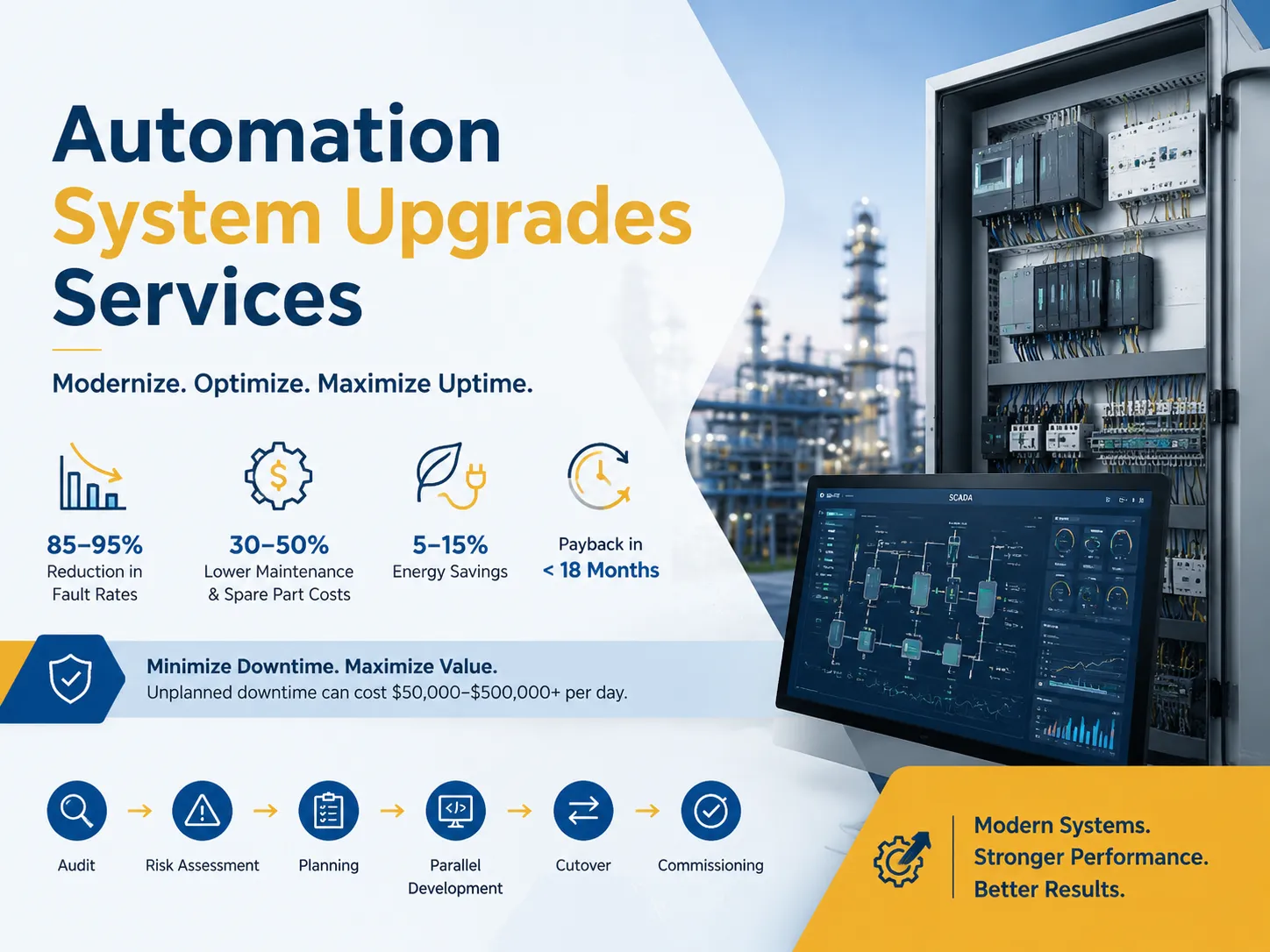
The economics are so clear-cut: every day of downtime costs $50,000-500,000+ for many sectors, and thus, avoiding just one unwanted day of breakdowns would cover the cost of the upgrade. Hence, most properly designed upgrades can pay back in under a year and a half.For manufacturers weighing this against broader production investments, the same payback logic applies to the automation equipment itself — as shown in the automated vs manual testing payback analysis we’ve published for production line equipment.
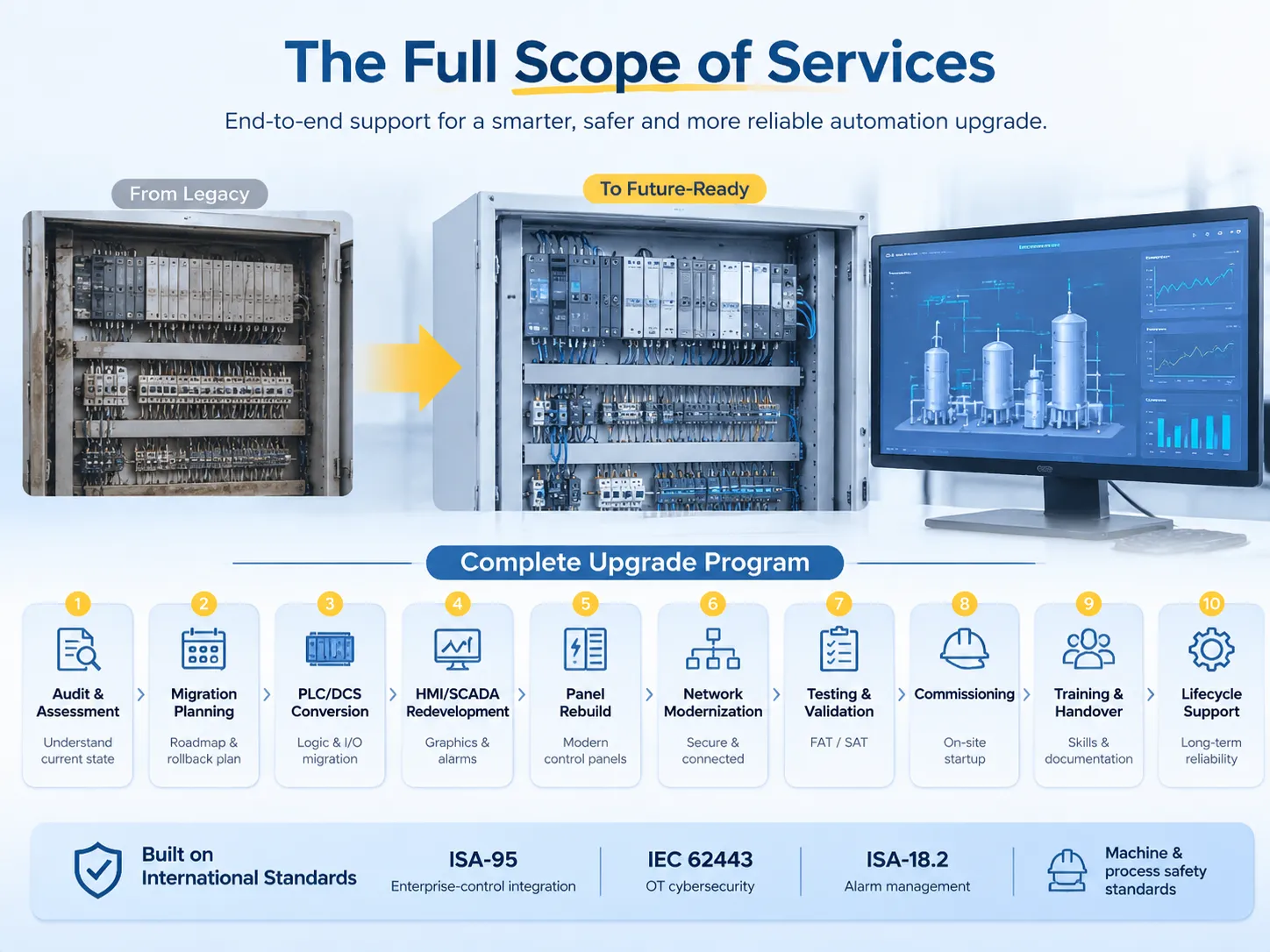
The Full Scope of Services
In a program for complete upgrading, a lot more is included than merely replacing the controllers. The standard service scope:
| Service Area | Typical Deliverables |
|---|---|
| System audit & assessment | Current-state review: hardware, software, network architecture, operational dependencies, risk register |
| Migration planning | Upgrade roadmap, architecture design, schedule aligned to maintenance windows, rollback plan |
| PLC/DCS conversion | Logic conversion, program redevelopment, controller replacement, I/O mapping |
| HMI/SCADA redevelopment | New graphics, alarm management (ISA-18.2), historian, dashboards, remote access |
| Panel rebuild | New control panels with modern breakers, drives, terminals; documentation updates (drawings, I/O lists, P&IDs) |
| Network modernization | Industrial Ethernet, switches, firewalls, secure remote access, OPC UA integration |
| Testing & validation | Factory Acceptance Test (FAT), Site Acceptance Test (SAT), simulation, functional verification |
| Commissioning | On-site cutover, startup, tuning, performance validation |
| Training & handover | Operator and maintenance training, as-built documentation, operating manuals |
| Lifecycle support | Post-go-live support, optimization, future upgrade planning |
The best upgrade providers already comply with various global standards like ISA-95 (Enterprise Control Integration), IEC 62443 (OT Cybersecurity), ISA-18.2 (Alarm Management) and other safety standards related to the machine or process.
Platform Migration Paths by Brand
The most common legacy platforms and their modern targets:
| Legacy Platform | Modern Target | Notes |
|---|---|---|
| Siemens S5 | S7-1500 / TIA Portal | The classic migration; S5 is long discontinued, conversion tools exist but logic must be reviewed |
| Siemens S7-300/400 (old versions) | S7-1500, WinCC Unified | Hardware and software modernization with modern HMI |
| Allen-Bradley PLC-5 | ControlLogix / CompactLogix | Rockwell’s standard migration path; preserves I/O wiring in many cases |
| Allen-Bradley SLC 500 / MicroLogix | CompactLogix / Micro800 | End-of-life platforms with well-trodden conversion paths |
| Modicon (Schneider) legacy | Modicon M580 / EcoStruxure | Schneider’s modernization route |
| GE Fanuc 90-30 / 90-70 | ControlLogix, PAC systems, or modern GE platforms | Acute spare-part shortages drive these projects |
| Wonderware InTouch (legacy) | Ignition, AVEVA, WinCC | Common SCADA migration; modern platforms offer web-based access |
| Legacy DCS (DeltaV, Honeywell, Yokogawa) | Current DCS versions with OPC UA | Controller + I/O + software modernization, phased by area |
| Unsupported Windows/XP/7 SCADA servers | Modern servers, virtualized or cloud | Security-driven migration |
Usually, a well-executed migration will see 80-90% of existing field instrumentation stilling being utilized while a lot of the I/O wiring will remain intact, with only the logic changed and controllers replaced, resulting in much lower expenses.
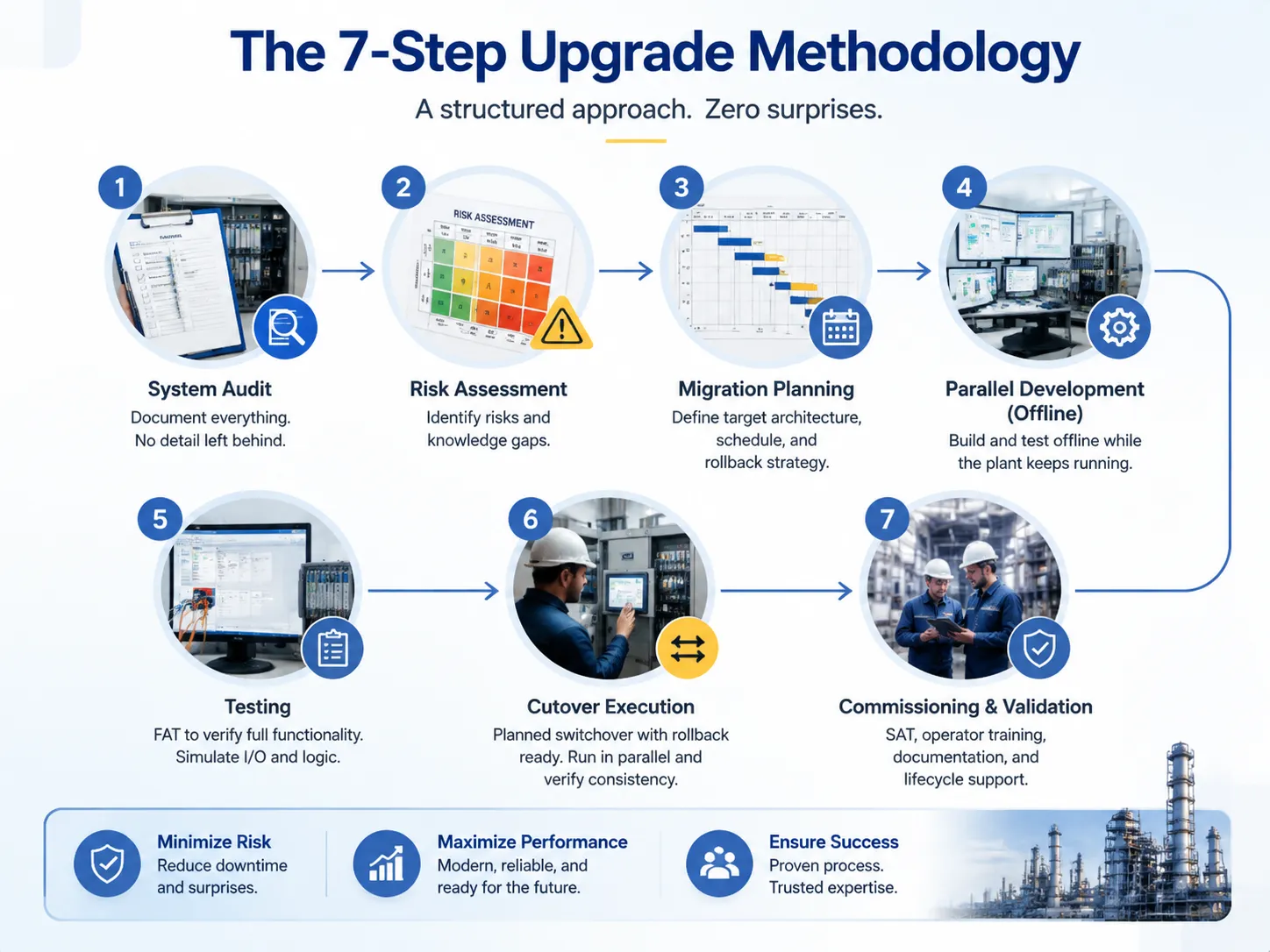
The 7-Step Upgrade Methodology
Professional improvement service providers adopt an organized method that aims at avoiding any unexpected outcomes:
- Step one: assessing the system. Make an inventory of the software and hardware, networks, and dependencies. Create the list that contains an item number, all the necessary documentation and the backed-up copies.
- Step two: risk evaluation. Identify all the main possible risks. Mark the unsupported components, areas of single failure, possibilities of downtime and questions of safety.
- Step three: migration planning. Describe the new system to be implemented and design the step-by-step plan of its introduction and action plan.
- Step four: parallel works. Develop and test the new system while the old system is used at the factory.
- Step five: testing. Perform the FAT to be sure that the system is ready to be installed.
- Step six: cutover. Make necessary changes during the downtime with rollback plan in hand.
- Step seven: commissioning. Get the necessary documentation and launch the plant.
The same staged discipline applies whether you are upgrading an entire plant or just one machine’s controller — and it mirrors the thinking behind choosing between fully automated and semi-automated lines: match the approach to the risk and the production reality.
Upgrade Strategies: Phased, Parallel, or Big-Bang?
Three implementation strategies exist, and choosing correctly is most of the battle:
| Strategy | How It Works | Best When |
|---|---|---|
| Phased / incremental | Upgrade area by area over months or years, using planned maintenance windows | Multi-area plants; budget constraints; risk aversion — the most common choice |
| Parallel operation | Run new and old systems side by side, verify logic consistency, then cut over | Critical single-line processes where any interruption is unacceptable |
| Big-bang (single cutover) | Replace everything in one shutdown window | Small systems, scheduled plant shutdowns, or where the old system is beyond saving |
Phased approach with simultaneous validation is usually recommended by the majority of vendors: major pieces of hardware first and then the area-by-area conversion of logic with offline testing of the new system to be done during maintenance windows. This enables to distribute the cost, minimize production risk and allow operators to gain experience gradually.
Measurable Benefits and ROI
Various industries show the following points in terms of data from the field:
- The improved products cut down the chances of any faults by about 85-95% (failures due to obsolescence have been eliminated almost entirely).
- The need for spare and maintenance parts reduced by about 30-50% (current models are based on working with common supply chains).
- The costs for energy went down by about 5-15% thanks to the logic optimization process and up-to-date drives/actuators.
- The periods of equipment downtime decreased by 30-60% due to improvements in diagnostics, managing alarms, and enabling remote monitoring.
- The ways of cybersecurity operations have been restored (modern operating systems, patched applications, and systems of network segmentation according to IEC 62443 standards are in use).
- The readiness for the Fourth Industrial Revolution (Industry 4.0) was achieved (the connection of units based on OPC UA/industrial Ethernet provides the possibility to apply MES, ERP, IIoT, predictive maintenance, and analytics).
- Operator performance became higher than before (modern HMIs with intelligent alarm filtering helped avoid unnecessary shutdown and speeding up the response time).
For production line equipment specifically, the efficiency gains from upgrading the automation layer compound with the gains from the machinery itself — our overview of industrial automation efficiency benefits quantifies what modernized systems deliver on assembly and testing lines.
Upgrade costs scale with scope and risk. Typical 2025-2026 ranges:
| Project Type | Typical Cost Range |
|---|---|
| Single PLC migration (small machine, lab-built) | $15,000 – $60,000 |
| HMI/SCADA redevelopment (single site) | $30,000 – $150,000 |
| Full line control upgrade (medium factory) | $100,000 – $500,000 |
| Multi-area DCS modernization (large plant) | $500,000 – $5,000,000+ |
| Annual maintenance and support after upgrade | 5-10% of project value per year |
Cost drivers include the number of input/output (I/O) points, the level of complexity of the platform, whether the cabinets are to be re-used or rebuilt, the size of the safety system, any special documentation requirements and the commissioning schedule. The cost of engineering and commissioning work (excluding the cost of hardware) is generally 50-70% of the total cost, which is what makes it more important to select a qualified partner than to be focused on the unit price. If you are also replacing production machinery, pairing the control upgrade with modern automated equipment — like the automated assembly and testing lines used in breaker manufacturing — can consolidate the investment into one program.
How to Choose an Upgrade Partner
- Evaluate platform expertise. Inquire about a list of migration projects conducted on your specific legacy platform (S5? PLC-5? DeltaV?), not vague assertions.
- Insist on an audit conducted in writing. A trustworthy company will start with a paid or credited audit, resulting in written documentation of the scope and risk register and will not provide you with a rough estimate.
- Confirm their approach. They should discuss FAT/SAT, parallel development, roll-back procedures, and maintenance window matching before you ask this question.
- Look for independence. Companies that work with Siemens, Rockwell, and Schneider are in a position to advise on the platform without pushing one specific brand.
- Make sure the company speaks the language of standards. ISA-95, IEC 62443, ISA-18.2, and safety standards compliance (IEC 61508/62061) must be on their lips.
- Collect references and visit a project. Talk to a factory that had an upgrade done 12 months ago or more as you will see how this project performs in the field.
- Ask about the support strategy. Postcommissioning support, training, documentation, and planning of future upgrades should be contractually bound, not based on verbal promises.
Frequently Asked Questions
Why should I upgrade my automation system if it still runs?
Because “still runs” is not the same as “safe to run.” Controllers not supported will fail for no apparent reason, spare parts can be acquired months later with typical inflation of 30%-50% per year, outdated software is a huge cybersecurity risk, and this system is not able to connect to the necessary data platforms. Each year the risk increases because one unplanned day of downtime can cost from $50,000 to $500,000 and more – you could have spent this upgrade cost instead.
How long does an automation system upgrade take?
The timeline varies according to the project scale. A basic migration of the PLC with concurrent design and a pre-arranged cutover will usually take between four to 12 weeks for the engineering process, after which only a few hours to a few days of downtime would be required for its implementation. More complicated full-scale DCS overhaul requires from 12 to 24 months for the gradual modernization process. The main point here is that the majority of operations take place remotely and production is only halted at the time of the cutover.
Can my existing sensors, valves, and wiring be reused?
Typically, the answer is yes — which is a tremendous cost savings. Migrations that are done right, preserve approximately 80-90% of the field instruments that also include the majority of the I/O wiring and replacing only controllers, logic systems, HMIs and networks. The 4-20 mA inputs, thermocouples and other discrete I/O inputs used in existing systems can be transferred into a new system, whether to reuse or replace components depends on the condition and age of the components as observed during the audit process.
What is the difference between a PLC migration and a DCS modernization?
PLC migration refers to replacing a discrete/logic controller (Siemens S5→S7, PLC-5→ControlLogix) typically employed in discrete manufacturing and machine control. DCS modernization improves a distributed control system (Emerson DeltaV, Honeywell, ABB) used in continuous process industries — refineries, chemical process, power generation industries, etc. where multiple loops are in operation simultaneously.
References
- TIESA Process — Automation system upgrades (scope and methodology)
- Scada Primacipta — System migration, upgrade, retrofit and modernization
- SIS Automations — Control system upgrades and legacy migration services
- Axis Engineering — Control system upgrades & PLC modernization
- Etowon Auto — PLC replacement and DCS modernization ROI data
- ISA-95 — Enterprise-control system integration standard
- IEC 62443 — Industrial automation cybersecurity standards
Conclusion
The modernization of a specific industrial facility through automation systems can be categorized among the most costly types of investments since it alleviates many risks associated with obsolescence, enables better maintenance, reduces failure frequency by 85-90% percent, decreases expenses for spare parts by 30-50%, and solves all cybersecurity problems. The modernization allows the facility to leverage connectivity for a proper use of Industry 4.0 technologies and pays back in a period no longer than 18 months, which will eliminate costs for at least one day of unplanned downtime.
The process is systematic; first, an audit ought to take place, then comes the phase of planning, and so on and so forth. The vendor with sufficient expertise concerning the specific type of a platform should be chosen, as well as the fact that proper documentation and training should be included into the terms of contract because the upgrade will be considered complete only after the training of personnel of the enterprise is finished.