benlong
How Does a Vibratory Bowl Feeder Work? Actuator Types Explained
A vibratory bowl feeder is the quiet workhorse behind almost every automated assembly line. It takes a loose pile of small parts — screws, rivets, terminals, silver contacts, springs — and delivers them one at a time, correctly oriented, to the next station without an operator touching them. If you have ever wondered how does a vibratory bowl feeder work, the short answer is controlled vibration: a drive unit shakes the bowl many times per second so that parts hop along a spiral track and line up in single file at the outlet. The component that generates that vibration is the actuator, and the vibratory bowl feeder actuator type you select determines feed speed, orientation accuracy, noise level, energy use, and how gently the machine treats fragile components. For manufacturers of low-voltage electrical products, where a single MCB or contactor can contain dozens of tiny parts, the feeder and its actuator are decisive for line throughput. This guide walks through the working principle step by step, then compares the main actuator types used in modern feeding systems.
By Huang Xiaolei | Benlong Automation
What Is a Vibratory Bowl Feeder?
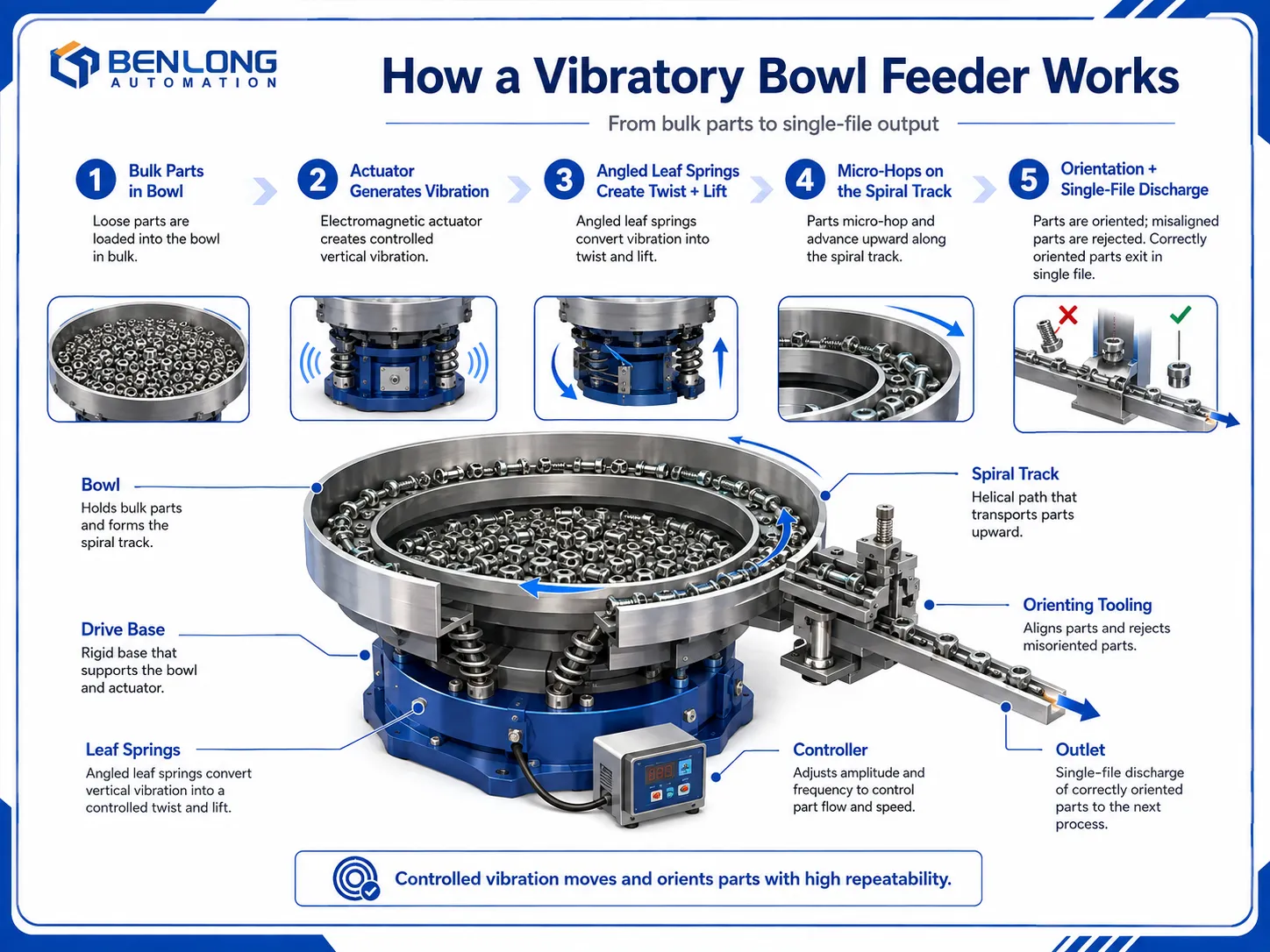
A vibratory bowl feeder is a fully contained device designed to feed parts from a circular bowl. It consists of a contact surface called a spiral track that is equally offered the circular bowl. You fill the center of a bowl with the unprocessed bulk part before the vibration pushes the parts on the spiral track to egress where they will be processed. The feeder consists of five major components:
Bowl and spiral track: the tube-shaped container that holds the parts.
Orienting tooling: features found on the spiral track of a vibratory bowl designed to only allow correctly oriented parts to pass.
Drive base: the bottom part of the feeder is designed to keep the feeder from the ground by its heavy nature.
Leaf springs: these are special types of springs that are employed to connect the bowl to the base of a feeder.
Controller: provides its user with the capability of adjusting the amplitude and frequency of the vibration.
How Does a Vibratory Bowl Feeder Work?
The principle behind it is quite easy. An actuator sends rapid pulses to the bowl with the help of leaf springs. The springs are set at an angle, thus, each pulse moves the bowl both upward and round. The bowl does not only move violently up and down, but it also rotates somewhat on its axis, while lifting. When the pulse ends, the springs again bring the bowl to the initial position, and this process continues many times a second.
As to the objects on the track, the fast rolling motion creates many small jumps. In every cycle the track moves forward and upward so quickly that a tiny object comes out of the surface for some time, and moves forward in the air. Thus, thousands of times a minute these little jumps bring the details forward along the spiral.
In particular, there are two key factors that impact the process: frequency and amplitude. The frequency means how many times the bowl shakes at a second, while the amplitude shows the distance for each shaking.
The Actuator: Where the Vibration Comes From
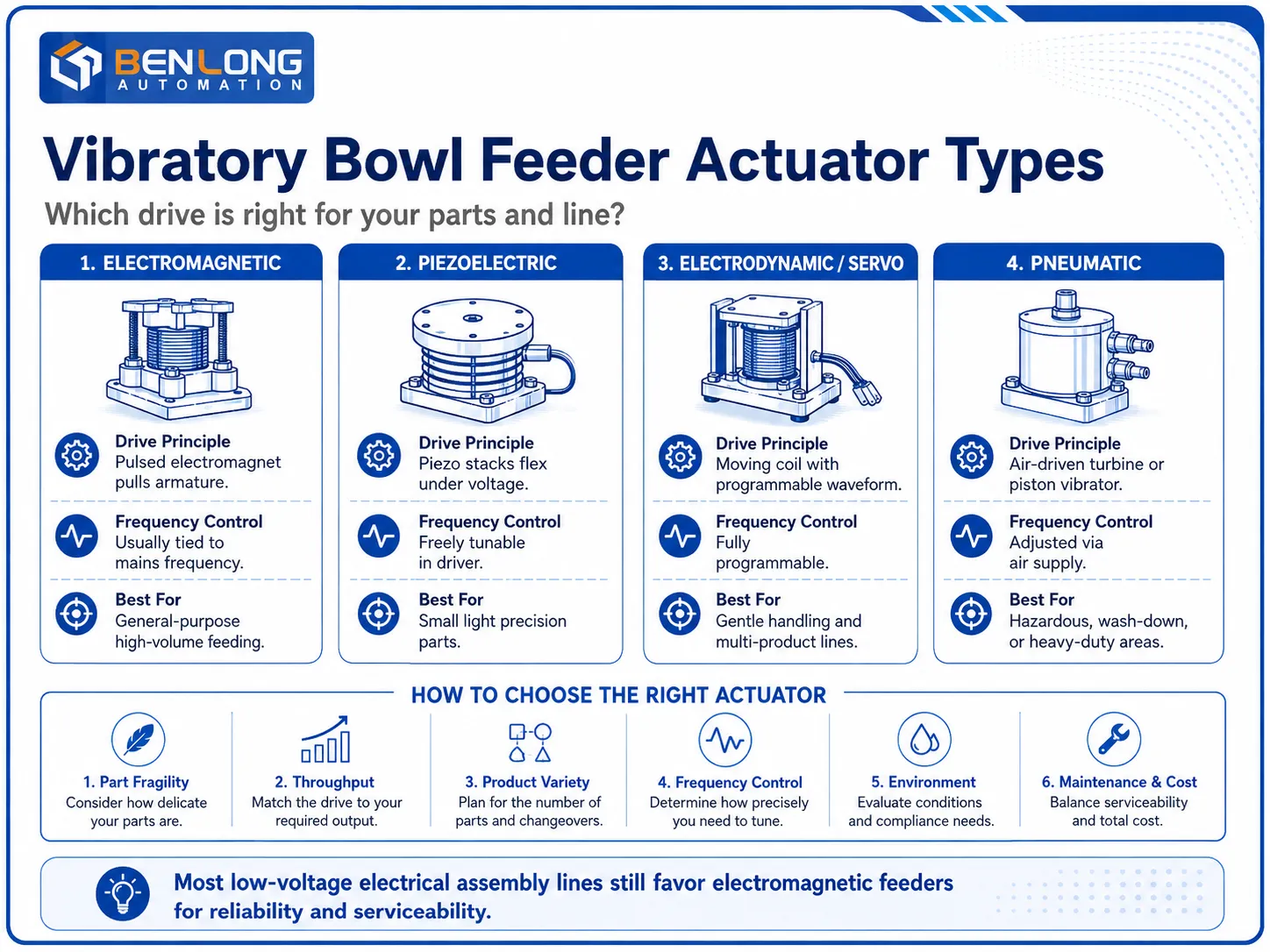
The function of the actuator — the component that turns electricity or air pressure into vibration — is fundamental to the device. The actuator is installed in the base of the feeder and connected to the bowl of the feeder. The actuator has to produce clear timed pulses at the correct frequency and strength. In other words, its characteristics determine the capabilities of the feeder: if the actuator provides a rough fixed-frequency drive, the feeder would be unable to operate at any frequency – the same applies to the programmable drives for accurate specific motion of parts in handling. The illustration below shows the different types of actuators available today which cover almost all applications of vibratory bowl feeders.
Vibratory Bowl Feeder Actuator Types
| Actuator type | Drive principle | Frequency control | Best suited for |
|---|---|---|---|
| Electromagnetic | Pulsed electromagnet pulls an armature | Usually fixed to mains (100/120 Hz) | General-purpose, high-volume feeding |
| Piezoelectric | Piezo elements flex under applied voltage | Freely tunable in the driver | Small, light, precision parts |
| Electrodynamic / servo | Moving coil driven by a programmable waveform | Fully programmable | Gentle handling, multi-product lines |
| Pneumatic | Air-driven turbine or piston vibrator | Adjusted via air supply | Hazardous or wash-down areas, heavy duty |
Electromagnetic actuators are by far the most common. An electromagnetic vibratory bowl feeder uses a coil energized by pulsed current; each pulse pulls a steel armature attached to the bowl, and the springs snap it back. Driven from rectified mains power, the coil typically pulses at 100 Hz on a 50 Hz supply or 120 Hz on a 60 Hz supply, and a thyristor controller varies the amplitude by adjusting how much of each half-cycle reaches the coil.
These devices are durable, cheap, and easy to repair which is the reason why their use in ordinary feeding operation is so widespread. The biggest disadvantage is that the frequency is connected with the mains supply unless variable frequency controller is introduced, so the mass-spring design should be adjusted mechanically. Piezoelectric actuators use the same principle of piezoelectric elements bending due to the applied voltage in place of the coil. Piezoelectric vibratory bowls weigh less, use much less power, create not much heat, and react very quickly making them suitable for light and fragile items or for cleanroom installation and in combination with small feeders. The frequency is determined by the electronics which allows unlimited tuning to resonance. The price, however, is low driving force nowadays only suitable for types with less size.
Electrodynamic actuators or servo motors include a moving coil using the long and complicated principle of a loudspeaker and managed by a programmable amplifier. It can be considered the most flexible device of its kind since all parameters of the vibration bowl feeder can be programmed. This allows great flexibility in handling but raises the price considerably.
Pneumatic actuators produce vibrations due to the usage of compressed air, thus electricity is not needed in operation. They are mainly used in hazardous situations and for heavy-duty feeding applications where electrical devices are hard to install. They are simple and reliable but hard to control.
How to Choose the Right Actuator Type
Selecting the right actuator involves the tradeoff between throughput, part sensitivity, environmental factors, and cost. The following rules may help you in this situation:
Part harmlessness: delicate contacts, fine wires, or coated parts go well with piezoelectric or servo drives which allow soft throws.
Throughput level: in large-scale operations, rugged electromagnetic drives serve as outstanding solutions.
Variety of products: the lines with frequent switching of parts use the recipe control approach.
Frequency control: in case you need a refined feeding performance without being limited by the mains frequency, opt for piezoelectric or servo technologies, not for an electromagnetic drive.
Environment conditions: operations in potentially explosive or dusty premises may make you abandon standard actuators in favor of pneumatic ones.
Noise and energy consumption: piezoelectric and servo devices are normally less noisy and energy-consuming than large electromagnetic drives.
Maintenance and costs: if you need the most straightforward and cost-effective solution regarding purchasing and maintenance, use electromagnetic feeders.
In reality, the vast majority of low-voltage assembly plants tend to prefer electromagnetic feeders due to their reliability and safety of operation and thus save piezoelectrics and servos for the dissemination of super-sensitive elements.
Vibratory Bowl Feeders in Low-Voltage Electrical Assembly
On an assembly line for MCBs, MCCBs, RCCBs, and AC contactors, a final product can consist of several tiny parts, all of which have to be correctly positioned at the required stage of the assembly. Some parts which need to be correctly oriented are terminal screws, bi-metallic strips, moving contacts, fixed contacts, springs, rivets, arc runners, and small plastic parts. Each of these parts is supplied using a different kind of a feeder which has been made specifically for that particular part.
The actuator type matters here for two reasons. First, several of these parts — silver contacts, thin bimetal, coated terminals — are easily marked or deformed, so a gently tunable drive protects part quality. Second, feed rate has to match the cycle time of the assembly head; an under-fed station starves the line, while over-feeding causes jams. Matching the actuator and its controller to the part and the cycle time is a core part of designing a reliable feeding system, whether it supplies an MCB automatic assembly line or feeds fasteners to an automatic screw feeding machine.
The designs of the tooling and the choice of their actuators are interrelated because a track profile that is suitable for light plastic clips will not be able to consistently supply a heavy metallic component with the same amplitude. Therefore, the driving systems are designed considering the component they are going to carry. At Benlong Automation, the feeding systems are developed based on particular components of every low voltage device instead of using general catalog-based feeders.
Common Problems and How to Fix Them
Frequent maintenance is required even by an advanced feeding machine. Common problems may include the following:
Feeding happening slowly or stopping completely: this can happen because of a low setting of amplitude or problems with spring quality. It is recommended to examine the spring and reset the amplitude.
Stuck piece in the tooling: this usually means that some adjustments must be made or that there are too many pieces in the bowl. Decrease the number of pieces in the bowl and look at the feeding track.
Too much bouncing: if amplitude is too high, the pieces can fall out of the track; thus, one needs to lower it until the feeding takes place without any issues.
Overheating coil on electromagnet drives: one needs to measure the gap between coil and armature and check parameter settings.
Drifting feed rate means that the coiling material has changed due to heating.
Short daily inspections allow avoiding most of the problems described.
Conclusion
Knowing how a vibratory bowl feeder works is a matter of one principle: through angled springs, the trouble-free signal from the actuator is converted into a rotating jump that moves objects along a spiral piece of equipment to a perfect single line. The actuator is the main part of the mechanism. The type of feeder actuator, i.e. electromagnetic, piezoelectric, electrodynamic, or pneumatic, determines the performance of the feeder in terms of speed and precision. An electromagnetic drive is the most commonly used option for low voltage electrical assembling, whereas piezoelectric or servo actuators belong to delicate or variable assembly parts.