benlong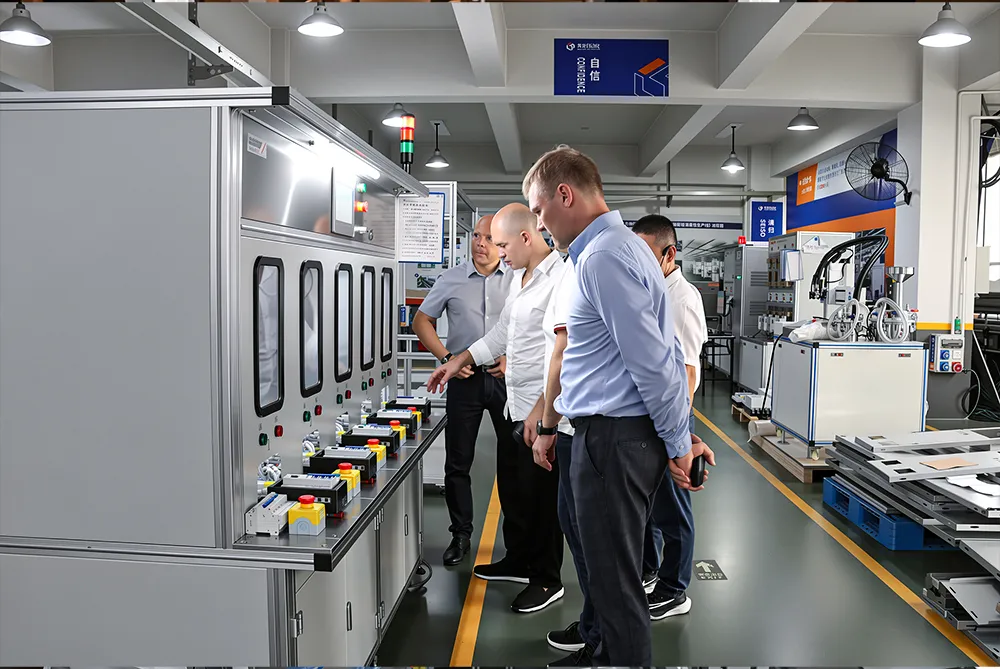
Mechanical Contracting Services
When a data center needs 40,000 tons of cooling, when a hospital needs its operating rooms at the right pressure and humidity, or when a brewery needs a process piping system that keeps beer flowing without contamination, the people who make it happen are mechanical contractors. Mechanical contracting is the industry that designs, installs, and maintains the “guts” of almost every building on earth — heating, ventilation, air conditioning, plumbing, process piping, fire protection, and building automation. It is also a very big business: mechanical and electrical contracting in the United States alone generates roughly $550 billion in annual revenue, according to estimates from Comfort Systems USA, and the top firms in the field now report multi-billion-dollar backlogs driven by data centers, healthcare, and advanced manufacturing.
This guide explains what mechanical contracting services actually include, profiles the world’s leading mechanical contractors — who they are, what they build, and which markets they serve — gives you realistic cost ranges, and walks through how to choose the right contractor for your project. Whether you are a facility owner, a developer, a procurement manager, or an engineer specifying a system, this is the working knowledge you need before signing a contract.
To put it simply, mechanical contracting consists of the following components: HVAC, plumbing, process piping, fire protection, and building automation for projects in commercial, industrial, as well as institutional organizations. The cost of mechanical works varies per project type and complexity of the project; it ranges from $15 to $45 per square foot on commercial systems.
What Is Mechanical Contracting?
Mechanical contracting refers to the branch responsible for designing, fabricating, installing, and servicing the mechanical systems of a construction or facility — the systems responsible for transporting the air, water, steam, gases, and fluids. The scope of the mechanical contracting is defined by the fact that each owner encounters this branch of the industry during every construction project:
- HVAC — heating, ventilation, and air conditioning, which includes chillers, boilers, air handlers, duct work, and roof units;
- Plumbing — domestic water supply, drainage, and venting;
- Process piping — the pipes made of stainless and carbon steel utilized for carrying steam, chemicals, food products, and utilities;
- Fire protection — sprinklers and standpipes;
- Building automation and con8xtr0ls — systems comprising the controllers, sensors, and software producing the work of mechanical systems;
- Mechanical service and maintenance — consists of the operation and repairs after the construction.
A mechanical contractor can perform the delivery of the project in three ways: design-build, where the contractor designed and installed the mechanical systems of the project; plan-and-spec, when the contractor designed and constructed it based on the engineering design; or design-assist method where the contractor joins the design team at the early stages of the design process. The industry is moving towards the method of design-build because it allows achieving cost certainty and speed of the schedule.
Why Mechanical Contracting Matters: The Case for This Market
Mechanical systems account for around 30%-40% of the construction budget of a building, and they are also the systems that face the most failures, consume energy and always need modernizing. Three forces are pumping demand for mechanical contractors today.
To begin with, the data center boom that is going on. Every hyperscale data center represents a huge cooling plant with a computer room attached. According to EMCOR, the company already entered 16 data center markets which increased from 4 one year ago, and data center business has become the company’s main growth engine. Similarly, Comfort Systems USA has noticed the effect of technology on its business diversification with respect to income. Thus, in 2025, the company got 46% of revenue generated by technological work with respect to data centers, which is an increase from the previous year’s 34%. It is safe to say that cooling requirement has never been as high as what was seen with this kind of work in practice.
The second force is electrification and energy transition. Heat pumps, EV charging infrastructure, grid modernization, and building decarbonization transform the work that used to be categorized as “electrical” or “energy consulting” to a new type of mechanical installation work. One can particularly refer to MYR Group’s growing backlog on the transmission and distribution sector which is in high demand due to grid-upgrade and clean energy needs.
Third, reshoring and advanced manufacturing. The new semiconductor fabs, battery plants, pharmaceutical facilities, and food processing plants being built in the country have to do with huge piping works in clean rooms. The backlog of Comfort System is record $8.1 billion which means high activity in one of the fastest-growing industries.
The mentioned statistics underline the main point: the ENR 2025 Top 50 mechanical companies had double-digit growth year over year even at billion-dollar scale, while other companies in the sector are growing even faster.
The World’s Leading Mechanical Contractors (ENR 2025)
The ranking of Specialty Contractors by Engineering News-Record is widely recognized as the industry benchmark. Below is the list of the leading mechanical contractors based on revenue accompanied by their specialization and location of operations:
| Rank | Company | Country | Revenue | Core Capabilities | Primary Markets |
|---|---|---|---|---|---|
| 1 | EMCOR Group | United States | $6.85B (mechanical) | HVAC, electrical, plumbing, piping, facilities services | Data centers, healthcare, industrial, commercial |
| 2 | Comfort Systems USA | United States | $4.64B | HVAC, plumbing, piping, controls, modular/prefab | Data centers, semiconductors, advanced manufacturing |
| 3 | Southland Industries | United States | $2.74B | MEP engineering, HVAC, plumbing, building automation | Commercial, healthcare, mission critical |
| 4 | ACCO Engineered Systems | United States | $2.15B | Design-build HVAC, refrigeration, process piping | Industrial, commercial, food & beverage |
| 5 | Apollo Mechanical Contractors | United States | $1.20B | Commercial/industrial HVAC and plumbing | Northwest US commercial and industrial |
| 6 | Legence | United States | $1.05B | Energy efficiency, decarbonization, building systems | Data centers, healthcare, universities |
| 7 | Harris | United States | $0.99B | HVAC, plumbing, piping, prefabrication | Commercial, institutional |
| 8 | EQUANS | France | $0.85B (US) | Energy services, facilities management, infrastructure | Europe, global energy services |
| 9 | Cerris Systems | United States | $0.80B | MEP contracting (mechanical, electrical, plumbing) | Commercial, healthcare |
| 10 | BMWC Constructors | United States | $0.74B | Industrial mechanical, process piping, EPC services | Industrial process plants, heavy industry |
While these companies are undoubtedly the leaders in the industry, one should realize that there is much more than the top ten: thousands of mechanical contractors are actively serving local commercial and industrial markets, and even companies like The State Group and MSS Solutions have been growing rapidly due to the same market trends. What is common for the leaders is the ability to do the jobs themselves (without subcontracting), knowledge of design and build construction and development of off-site prefabrication (for example, Comfort Systems has been developing modular construction facilities that would total 3 million square feet).
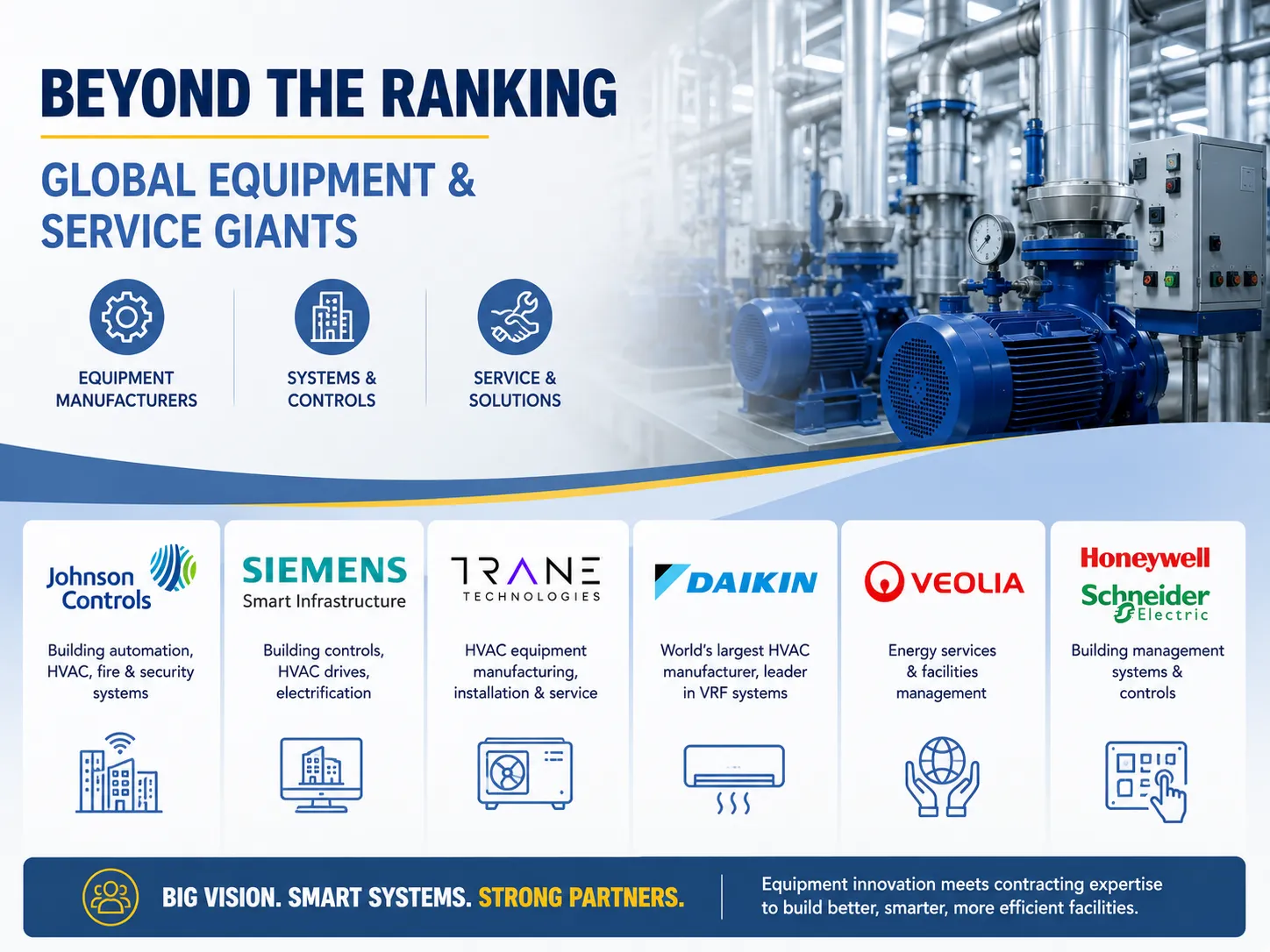
Beyond the Ranking: Global Equipment and Service Giants
The ENR ranking is focused on specialty contractors from the USA. Globally, there are international groups that perform similar functions as those as they produce equipment, manage the overall processes or provide mechanical systems ready for use in large volumes.
- Johnson Controls (Ireland/USA) performs building automation, HVAC systems, security and fire systems installation; it operates all over the world, including the Asian and Middle Eastern market.
- Siemens Smart Infrastructure (Germany) is specialized in building controls, drives, electrification and is a key player in commercial buildings located either in Europe or Asia.
- Trane Technologies (USA) is a company operating in the HVAC equipment manufacturing sector with the revenue of 19.8 billion dollars and developed commercial channels.
- Daikin Industries (Japan) is the biggest HVAC company in the world, the company is strong in the VRF systems across Asia and Europe.
- Veolia (France) is working in the field of industrial energy services and management of facilities, it provides mechanical services as a part of long-term energy-based contracts.
- Honeywell and Schneider Electric work within the area of building controls, which are utilized by mechanical contractors during the installation of equipment.
For customers, the major difference between specialty contractors and equipment companies is the scale of works. That is why, to complete the project successfully, it is necessary to engage both.
Core Services: What a Mechanical Contractor Actually Does
Besides the system categories, mechanical contractors bring a variety of expertise for clients to purchase throughout different stages of a project, including:
- Preconstruction and estimating — budget, value engineering, and Constructability reviews prior to the onset of building
- Design-build engineering — mechanical system engineering performed under a single contract
- Fabrication and prefabrication — duct work, pipe spools, and modular skids constructed in factories for quick and effective installation
- Installation — field labor for setting equipment, ductwork, pipes, and controls
- Commissioning — testing and balancing of the installed system to ensure that it operates as expected
- Service and maintenance — scheduled maintenance, 24/7 emergency service, and energy efficiency retrofitting
- Building automation integration — hooking up chillers, boilers, and air handlers to a central computer with the ability to monitor operations.
For industrial customers, mechanical contractors offer the processing systems such as sanitary food piping, high-purity piping used in pharmaceutical production, and utility piping for power generation and manufacturing.
Industries and Markets Served
Mechanical contractors are present at sites where there is a need for climate control, fire protection, or fluid distribution. The existing demand map is as follows:
| Industry | Typical Mechanical Scope | Demand Trend |
|---|---|---|
| Data centers | Chilled-water plants, CRAC/CRAH units, liquid cooling, containment | Fastest-growing segment; 16+ US markets served by EMCOR |
| Healthcare | HVAC with HEPA filtration, medical gas piping, isolation room pressure control | Steady growth; aging hospital infrastructure |
| Semiconductors / advanced manufacturing | Cleanroom HVAC, ultrapure water, process exhaust, chemical piping | Strong, driven by reshoring and fab construction |
| Commercial office & retail | Packaged rooftop units, VRF, plumbing, fire protection | Moderate; retrofit and decarbonization work growing |
| Industrial / food & beverage | Process piping, sanitary stainless systems, refrigeration, steam | Steady; automation and plant upgrades |
| Energy & infrastructure | District heating/cooling, thermal energy storage, grid-support cooling | Growing with electrification |
How Much Mechanical Contracting Costs
Mechanical costs differ depending on the type of project, location, and complexity of the system. Nevertheless, the data below is based on actual practices and reports of contractors.
| Scope | Typical Cost Range | Notes |
|---|---|---|
| Commercial HVAC-only retrofit | $8-20 per sq ft | Packaged rooftop or VRF replacement, no plumbing |
| Full mechanical package, new commercial building | $15-45 per sq ft | HVAC + plumbing + fire protection + controls |
| Healthcare or lab HVAC | $40-100+ per sq ft | Filtration, pressurization, redundancy add cost |
| Data center cooling plant | $500-1,500+ per kW | Chilled-water and liquid-cooling infrastructure |
| Process piping (industrial, per installed foot) | $50-250 per ft | Carbon steel low end; sanitary 316L stainless high end |
| Union labor, journeyman (US, hourly) | $45-90 / hr | Varies sharply by region and trade |
Two planning guidelines can be useful for construction managers in managing their budgets. The first guideline relates to the fact that mechanical costs constitute about 30-40% of total construction costs. The second guideline suggests that it is sensible to invite mechanical contractors at the pre-design stage to be able to save 5-15% on total project costs.
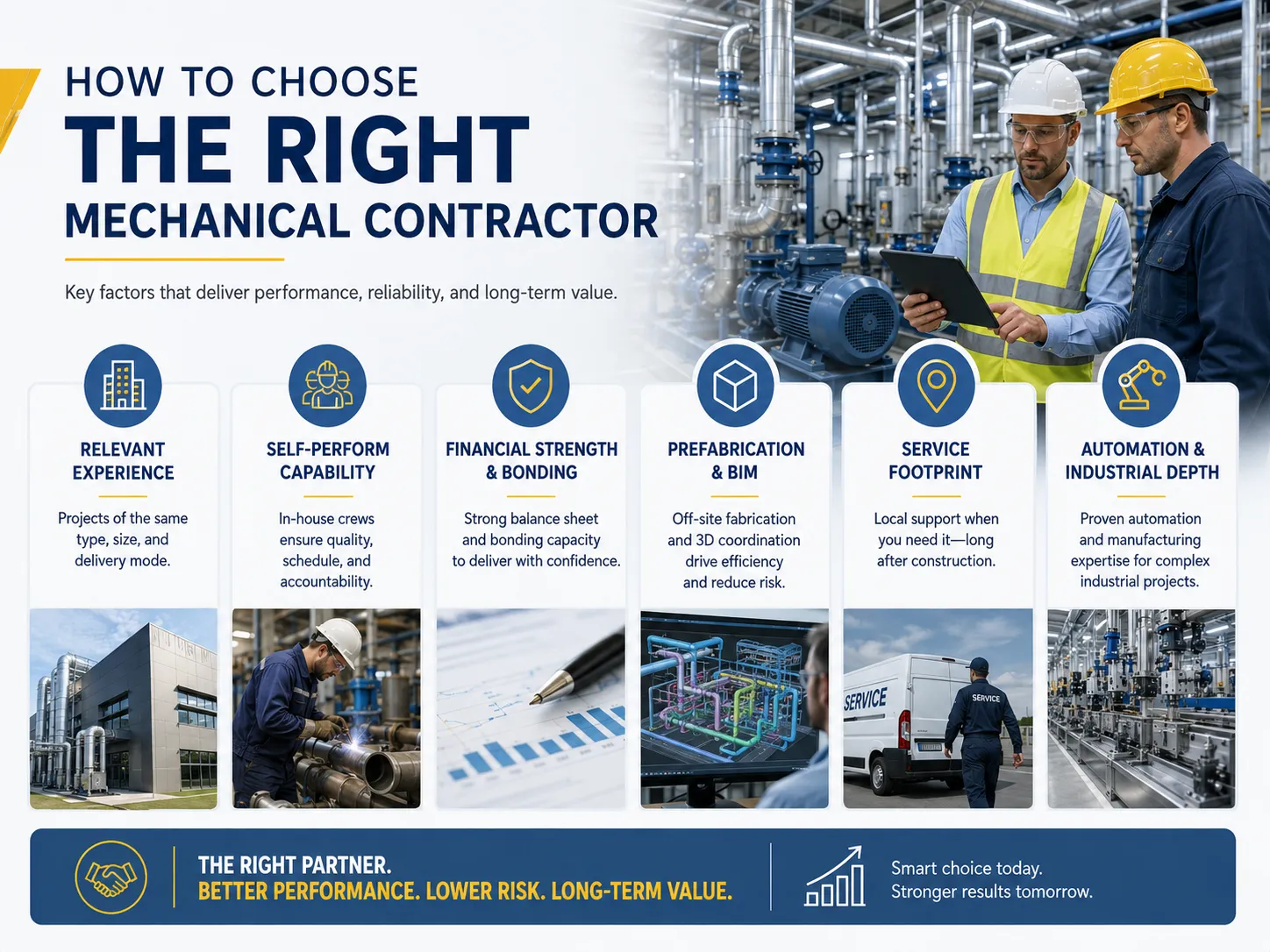
How to Choose the Right Mechanical Contractor
The owners making the most costly error in this situation is opting for the lowest bid. Running systems usually have lifespans that range from 20 to 40 years. Additionally, the operating performance, energy efficiency, and dependability of the running systems depend on the quality of the installation more than the quality of the equipment itself. The following pointers should be used to compare and contrast various subcontractors.
- The importance of effective experience. If a contractor has completed only three drywall jobs, their experience doesn’t compare favorably to that of a contractor who has completed a hundred office projects. Care needs to be taken to verify the experience of every contractor in regards to completing similar projects.
- The self-performing capabilities of the contractor. Contractors who are using their teams for sheet metal work and piping are more capable of meeting the project deadlines while maintaining the quality of work in comparison with contractors who extensively rely on subcontractors.
- The financial strength of the contractors. Mechanical packages are generally costly; that is why it is critical to establish whether the contractor has the capacity to bond and cash flow the construction project. A backlog report for public companies such as EMCOR or Comfort Systems shows the capacity available in the construction industry.
- The degree of prefabrication and BIM. The absence of on-site prefabrication can significantly hinder the efficiency of the construction process. The level of prefabrication needs to be determined beforehand.
- The service footprint of the contractor. If a certain contractor is to be required again in the future, it is essential to choose a contractor that operates in the region that the construction is taking place.
The Supply Chain Angle: Automation in Mechanical Manufacturing
One of the key dividing line between top tier mechanical contracting and the rest is the standard of manufactured parts and assembly machines that go into the systems. Mechanical contractors do not produce circuit breakers, control boards, valves or assembling devices that make them; they procure them, and that is what impacts how proper electrical and control infrastructure works in the building. This is where such companies as benlongkj come into play in the ecosystem, supplying automation assembly lines, injection molding tools and such production automation systems for electrical components as MCBs (miniature circuit breakers), providing the very parts which will be used by mechanical and electrical contractors in the installation.When a contractor can source breakers and control gear from factories with documented automated production — consistent quality, traceability, and repeatable testing — the finished mechanical system inherits that reliability. Our guide to manufacturing automation solutions explains how production-line automation improves component consistency, and the challenges facing automation machinery manufacturers are the reason rigorous supplier selection matters. For owners building new facilities, asking where the electrical and control components come from — and whether they are produced on automated, tested lines — is a legitimate due-diligence question. Benlongkj supports this ecosystem as a custom automated assembly machine manufacturer, partnering with contractors and OEMs who need dependable production of the components their systems depend on; the automated production line buyer’s guide covers how to evaluate such suppliers when you are on the buying side.
Frequently Asked Questions
What does a mechanical contracting company do?
A mechanical contracting firm is responsible for the design, manufacture, installation, and maintenance of different mechanical systems of a building, including HVAC (heating, ventilation, and air conditioning), plumbing, process piping, fire protection, and building automation and control. It can be involved in a project as a design build or a design assist and many larger contractors also provide maintenance service after the construction work is finished.
What services do mechanical contractors provide?
Mechanical contractors are engaged in such core activities as estimating preconstruction costs and providing value engineering services, designing mechanical systems, performing off-site fabrication tasks and installation of equipment, piping, duct work, and controls, testing and commissioning of systems as well as providing maintenance and energy rehabilitation. It is not uncommon when industrial mechanical contractors have to do the process piping for food and beverage plants.
Who is the largest mechanical contractor?
EMCOR Group holds the title of the largest mechanical contractor in the United States with the revenue from mechanical construction and facilities of about 6.85 billion dollars (according to ENR 2025) followed by Comfort System USA with 4.64 billion dollars. In the world, EMCOR is the first name appearing in responses to this question; however, manufacturing giants such as Johnson Controls, Siemens, Trane, and Daikin are more successful companies if thinking about the revenues.
Is a mechanical contractor the same as HVAC?
No, HVAC is only a part of a mechanical contracting industry with its different systems including plumbing, process piping, fire protection and automation.
References
- Catalyst SA — Facility & specialty contracting nationals report, Q3 2025 results
- ENR 2025 Top Mechanical Contractors ranking — top 10 snapshot
- MarketScreener — Comfort Systems USA: momentum driving modular expansion
- Under the Hard Hat — The largest HVAC companies in the US
- ENR Top 50 mechanical firms — 2024-2025 growth analysis
Conclusion
Mechanical contracting represents the biggest single segment of the construction industry—$550 billion annually in the U.S. alone, helped by demand for data center cooling and electrification, as well as reshored high-tech manufacturing. When it comes to leading players in the field, EMCOR, Comfort Systems, Southland, and EQUANS are all reporting double-digit growth while carrying billions in backlog. The key takeaway for owners is to understand they should budget 30%-40% of construction cost toward mechanical, bring contractors at the design stage rather than at the end of it, and choose based on experience/self-perform capabilities/financial viability rather than pricing alone. A great mechanical system will always be associated with the long chain of manufacturers of the parts whose quality will depend on the contractor, thus manufacturing automation of the type practiced by benlongkj in electrical manufacturing is quietly becoming one of the ways owners can minimize project risks.