benlong

Why Choose an MCCB Contact Welding Machine for Your Industrial Needs
Real production headache: The manually soldered silver contacts on our MCCB terminals have a failure rate of 0.8% due to intermittent high resistance, with occasional contact loss from the MCCB terminals during the dielectric test. We required an inspectable and repeatable process. — Manufacturing Executive, a switchgear manufacturer in Southeast Asian Region.
A machine called a MCCB contact welding machine doesn’t just operate like a generic spot welder. It is specifically designed as an automated system for the purpose of joining silver-based alloy contacts (either stationary or moving) to copper terminals or braids in Molded Case Circuit Breakers (MCCBs) that generally range from 100A – 1600A frame sizes. Since purpose-built machines produce consistent weld strength, allow for low contact resistance (<100 µΩ) and provide complete traceability as opposed to manual or semi-automatic welding machines, there are many advantages when making the strategic decision to upgrade to an automated MCCB contact welder, which will yield a return on investment in less than one year.
This article covers:
- Four critical problems solved by an MCCB contact welding machine
- Key technical specifications you should verify
- Real customer case: defect reduction from 0.8% to 0.05%
- How such a machine integrates into your existing MCCB production line
- FAQs from process engineers and plant managers

Why contact welding is the most critical process in MCCB assembly
The contact welding step directly determines:
- Contact resistance – too high causes excessive heating; too low (cold weld) leads to mechanical failure.
- Mechanical strength – a poorly welded contact can detach after a few thousand operations.
- Thermal behavior – inconsistent welds create hotspots that affect thermal trip calibration.
According to IEC 60947-1 Annex F welded contacts must pass a pull test at 100N without separating from their original position; this is often an issue with manual welding due to operator fatigue, electrode wear and/or incorrect current.
Four key advantages of an automated MCCB contact welding machine
Repeatable weld energy (±3% per shot)
In manual welding, the foot pedal timing of the operator and the pressure applied to the electrode are responsible for welding speed. In contrast, an automatic machine uses a closed-loop inverter control to measure voltage, current and time for each weld in order to produce a weld with less than ±3% variation; making it possible to produce identical performance from multiple contactors (3 or 4 contacts).
Built-in weld quality monitoring (force & resistance)
The new MCCB contact welders use dynamic resistance monitoring to determine whether the weld pulse is healthy. When quality welds are created, there will be a characteristic drop in dynamic resistance at the fusion point of the weld. If the resistance curve of the weld being made does not show a drop, or if the drop occurs too rapidly, the working cell will reject that weld and not place it into production. Because of this capability for 100% in-process inspection of the weld, there is no longer a need to perform destructive pull tests.
Automated electrode dressing and life tracking
The weakening of copper electrodes occurs after every weld creates changes in both contact levels and levels of current density. The highest quality machines have an automatic electrode milling station that is used to dress (grind, or apply some material) the tip of the electrode every 100-200 welds. In addition, this system monitors the life of the electrodes (in terms of number of welds, e.g., after 50,000 welds) and alerts the operator when it is time to replace them, thus removing one of the causes of gradual deterioration in quality.
Full data traceability per contact point
The parameters of each weld (including the current, voltage, duration, dynamic resistance and how many times the electrode has been used) are recorded in a log that corresponds to the MCCB serial number. This information can be transferred to your MES for batch traceability and SPC. Therefore, if you get a field failure from a customer, you can look up the exact parameters on that weld; this gives you a substantial competitive advantage.
Real customer case: from 0.8% defects to 0.05% in 3 months
Customer: The Indian MCCB Manufacturer (Name not disclosed) manufactures 50,000 units of 250A and 400A frame types monthly. The Issue of manually welding the moving contacts has created variability in contact resistance, leading to an average of 0.8% field returns due to detached contacts. The Solution is to integrate a dedicated MCCB welding machine (dual-head, Inverter-controlled) onto their semi-automatic assembly line. The Results of three months of use (as stated in the Customer Quality Report):
| Metric | Before | After |
|---|---|---|
| Contact weld defect rate | 0.8% | 0.05% |
| Contact resistance variation (σ) | ±35 µΩ | ±6 µΩ |
| Monthly rework cost (welding only) | ≈ $5,200 | ≈ $320 |
| Payback period for machine investment | 7 months | |
The customer has since ordered three more machines for their 630A and 800A frame lines.
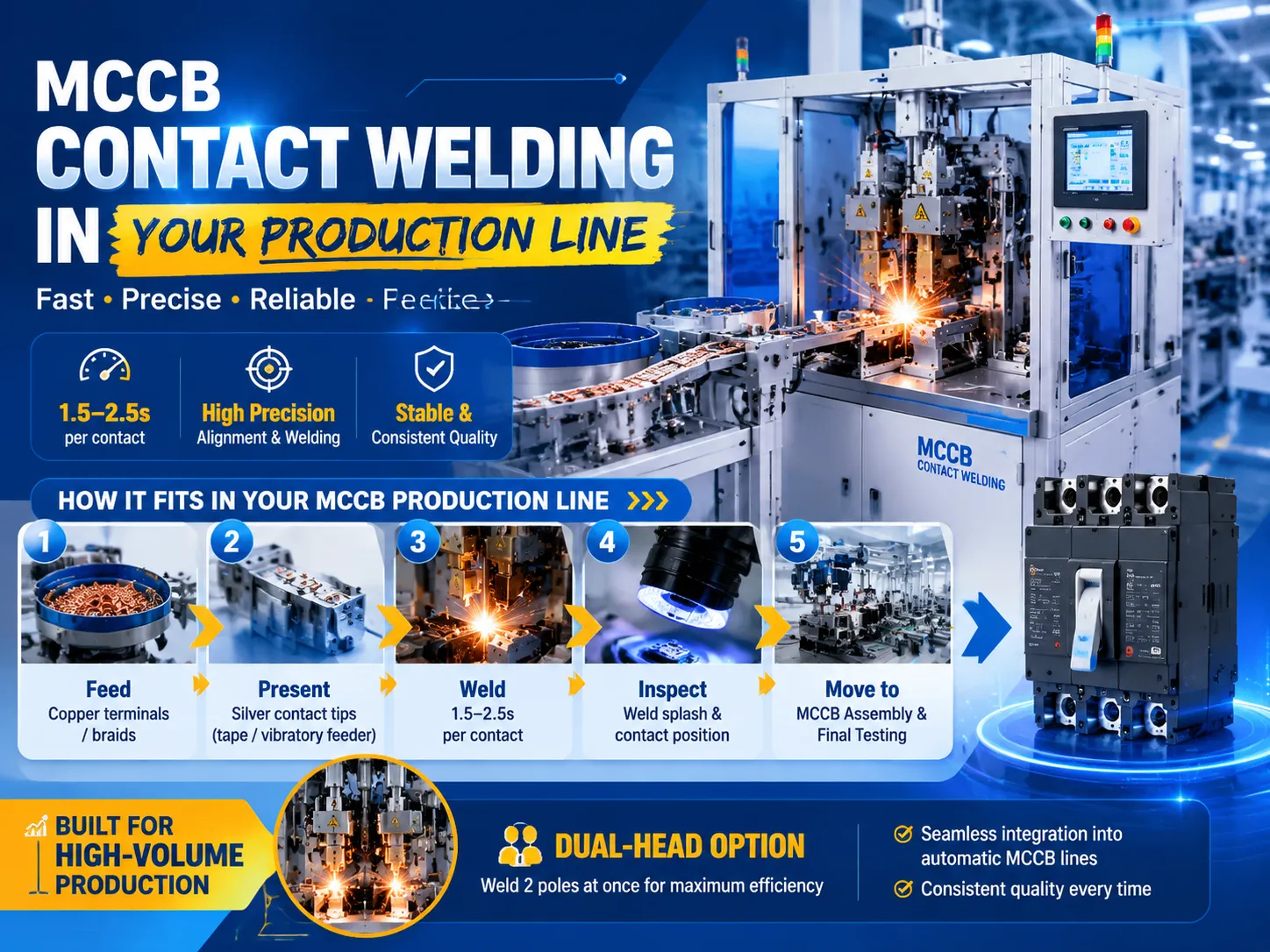
How an MCCB contact welding machine fits into your production line
This machine is typically placed before the assembly and testing stages. The process flow:
- Copper terminals / braids are fed from a vibratory bowl or strip.
- The silver contact tip is presented via a tape feeder or vibratory feeder.
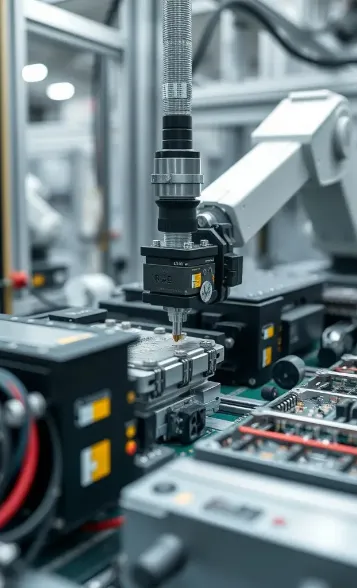
- The welding machine picks, aligns, and welds the contact in 1.5–2.5 seconds per contact.
- An optional vision system inspects the weld splash and contact position.
- Then they will be moved onto an MCCB (multi-circuit breaker) assembly line, where the insertion of the moving parts and springs will occur as well as undergoing final testing at the MCCB test bench to verify calibration and trip time.
If you require high-volume production, you can opt for a dual -head machine that will weld 2 poles at once. We have a lot of customers integrating these machines into their current MCCB automatic production lines (such as those found on our products page).
Technical specifications to demand from any supplier
- Weld current range: 2kA – 20kA (for silver contacts up to 12mm diameter)
- Weld energy accuracy: ±3% over 100 consecutive welds
- Electrode force: 50N – 500N, programmable
- Dynamic resistance sampling rate: ≥5 kHz (to capture fusion formation)
- Electrode dressing frequency: user‑programmable (e.g., every 150 welds)
- Data export: CSV, SQL, or OPC UA to MES
Have suppliers conduct a weld strength test using 30 samples, with an average weld strength ≥200N for typical MCCB contacts and a standard deviation of ≤15N.
Frequently asked questions (FAQ)
What is the difference between a spot welder and an MCCB contact welding machine?
A standard general use spot welding machine is commonly used on sheet material; however, the MCCB contact welding machine has been specifically developed for this purpose. With its fine-pitch electrodes for use with small silver contacts (less than 12mm), a variety of programmable force profiles to reduce the cracking of brittle contact alloys, and built-in weld monitoring capabilities to identify incomplete fusion and/or contamination, the MCCB contact weld machine provides superior performance to both machines.
Can the machine handle different contact tip materials (Ag/CuO, Ag/Ni, Ag/SnO₂)?
Certainly. The contemporary inverter welders contain a multitude of sets of weld “recipes” which can store one for every individual material; you could store the appropriate current, force, and duration as well. Then, using barcode reader or the operator’s choice the welding machine will automatically select the corresponding weld “recipe” based upon the material being welded. It is highly recommended that you perform a test of the weldability of the actual contacts and terminals prior to purchasing.
What maintenance does the machine require?
Wipe the electrodes and examine the cooling water flow on a daily basis. Every week will consist of performing an automatic electrode dressing cycle. Each month will involve measuring the weld force by using a force gauge. When reaching 500,000 welds, replace the electrode tips and inspect all the cables. The machine tracks this information on maintenance counters.
How do I know if my contact weld quality is degrading over time?
You can expect your unit to give you trend graphs of dynamic resistance and weld expansion. If you see a trend of ever-increasing resistance at a constant energy setting, it may be due to either electrode wear (which can be corrected with dressing) or degraded cables. Without the use of data logging, you would likely discover problems due to field failures.
What is the typical return on investment (ROI) for automating contact welding?
The payback period for an installation with 50+ units has been ranging between 6 to 12 Month. Reason for this savings is due to less need to do rework/scrap (1-2% of the value), or a labour savings due to 1 operator able to produce 2-3 Machines at Same Time… and avoiding Warranty Claims. A plant making 50,000 MCCB’s /month will realise savings of much more than $50,000/year.
Investing in an automated MCCB contact-welding machine can help you to achieve product dependability, cut expense on manufacturing and meet traceability requirements of your largest customers. These four features — closed-loop current control, weld quality analysis, automatic electrode dressing and, data collection — overcome issues with manual (or generic) welding. Actual historical data shows a potential drop in defects by more than 90% with a return on investment in less than one year. When researching suppliers, require them to conduct a weld assessment with your parts and seek certification for the weld strength CPK. Purchasing a contact-welding automation system means you are also investing in the reputation of your brand as being of good quality.