benlong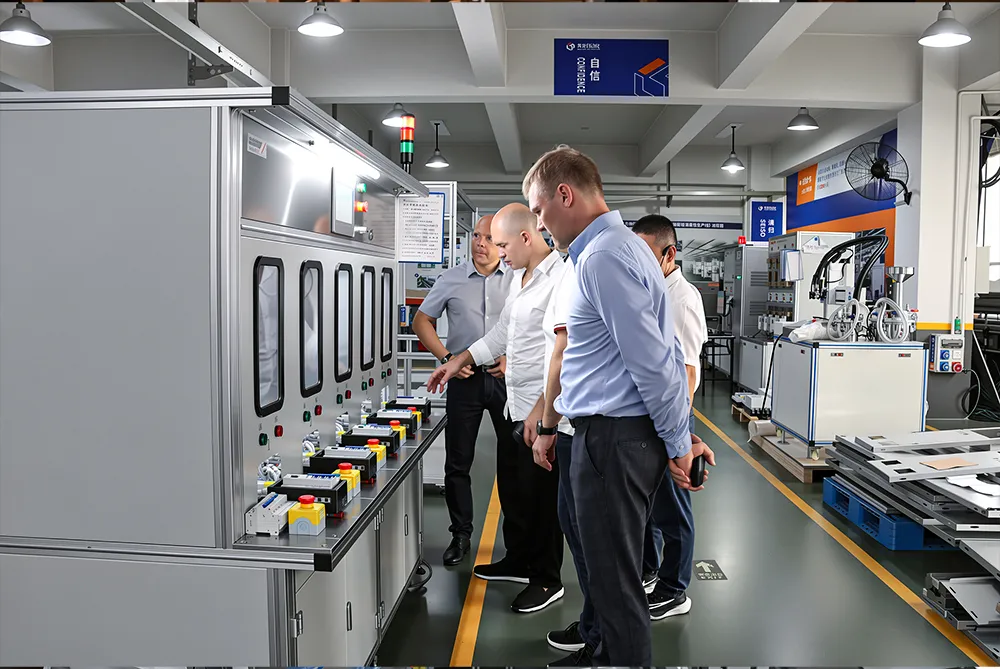


MCCB Testing Equipment: A Technical Guide for Laboratories
In 2024, a molded case circuit breaker manufacturer located in Southeast Asia sent a new series of 250 A molded case circuit breaker to an independent testing laboratory for the IEC 60947-2 type test. The tests failed the temperature-rise test at the rated current. The engineering team was perplexed since the same circuit breakers had previously passed the same test in its own laboratory just two months earlier. After investigating, they discovered that the problem was not with the circuit breakers but with the testing system in the manufacturing facility. The factory’s AC source was not able to maintain a stable output of 250 A over the entire thermal-equilibrium process, the position of the thermocouple was incorrect according to the standard of the terminal measurement, and the ambient temperature changed by 4 degrees Celsius during the testing. It turned out that the product was okay and the only thing that was not okay was the testing equipment responsible for its verification. The process of re-certification took four months and cost a six-digit sum of money in successive station rental fees.
The unfortunate truth regarding MCCB testing apparatus is that it provides reliability information based solely on the organization that conducted the tests. This is not a matter of concern for the engineers working at the facility or for the procurement personnel as the test facility is regarded in-house as being the most reliable essential element of the whole certification process. This manual will provide the details of the test process according to IEC 60947-2, types of equipment used to implement the testing, and all relevant specifications of the bench that is capable of presenting certifiable data.
What IEC 60947-2 Requires: The Complete MCCB Test Regime
Any molded case circuit breaker sold into a regulated market must comply with a product standard and be verified. The relevant product standard is normally IEC 60947-2 in the rest of the world and UL 489 in North America. The standards describe not only the type tests, performed on a representative sample only once for verification of the design, but also routine tests, performed on each unit or a statistical sample in the process of production. Each type of test requires certain types of laboratory equipment with particular technical specifications. The table below collects the main types of tests used for the verification of a thermal-magnetic MCCB, thus forming a checklist for the future buyers of any MCCB.
| Verification | What It Proves | Laboratory Equipment Required | Key Technical Parameters |
|---|---|---|---|
| Tripping characteristic — thermal (overload) | The bimetal releases within the time-current band published on the datasheet, typically verified at conventional non-tripping current (1.05×Ir) and conventional tripping current (1.30×Ir) | Thermal trip calibration bench with precision AC current source, per-pole timing measurement, and controlled ambient reference | Current accuracy class 0.5 or better; stable output over test durations up to 2 hours; timing resolution of 10 ms or finer; ambient reference held at the declared calibration temperature |
| Tripping characteristic — magnetic (instantaneous) | The electromagnetic release operates within the declared tolerance of the instantaneous setting Im (commonly ±20%) | Magnetic trip test bench with high-current pulse injection and trip-time capture | Pulse currents up to 5–10×In and beyond; controlled current rise; half-cycle discrimination to avoid thermal pre-heating of the bimetal |
| Temperature-rise verification | Terminal and accessible-surface temperature rises stay within standard limits at rated uninterrupted current Iu | High-current injection station with multi-channel thermocouple data acquisition | Continuous rated current until thermal equilibrium; thermocouple placement per standard convention; millivolt-drop measurement across poles |
| Dielectric withstand | Insulation integrity between poles, between live parts and frame, and across open contacts | High voltage test bench with leakage-current threshold detection | Test voltages typically 2.5–3.5 kV AC depending on rated insulation voltage Ui; calibrated trip threshold on leakage current; ramp and dwell timing control |
| Rated breaking capacity (Icu / Ics) | The breaker interrupts its rated ultimate and service short-circuit currents and remains serviceable per the standard’s post-test sequence | High-power short-circuit laboratory (certified station) | Prospective currents from 25 kA to 100 kA and above at rated voltage and declared power factor; not economically feasible in-house for most manufacturers |
| Mechanical and electrical endurance | The operating mechanism survives the declared number of operations with and without current | Endurance test rig with motorized actuation and cycle counting | Operation counts from 8,000 to 20,000 and above depending on frame size; load banks for the current-carrying portion of the sequence; contact-resistance trend logging |
Type Tests vs Routine Tests: Where the In-House Laboratory Fits
The key distinction in creating an MCCB laboratory is the differentiation between type testing and routine testing, as this affects the choice of equipment to purchase or lease. In particular, tests for short-circuit breaking capacity, more commonly known as Icu and Ics, require access to a highly powerful laboratory capable of producing current levels as high as 100 kA at the specified voltage and power factor. Setting up this type of lab can cost millions of dollars, which is only justifiable by the largest circuit breaker manufacturers in the world. All the rest simply book the time in accredited third party laboratories. This is the correct economic position, and the purchasing managers have no reason to think otherwise.
However, everything else in the process of testing is done by the company itself. Thermal trips and magnetic trips are always done, as well as verifying temperature rise and monitoring the millivolt drop during working procedures. Companies that choose to farm out their processes instead of keeping them in-house will unnecessarily add numerous weeks to their production. However, there have been cases, when a manufacturer had no control over their certification sample and failed to meet the requirements.
The Four Pillars of an In-House MCCB Test Laboratory
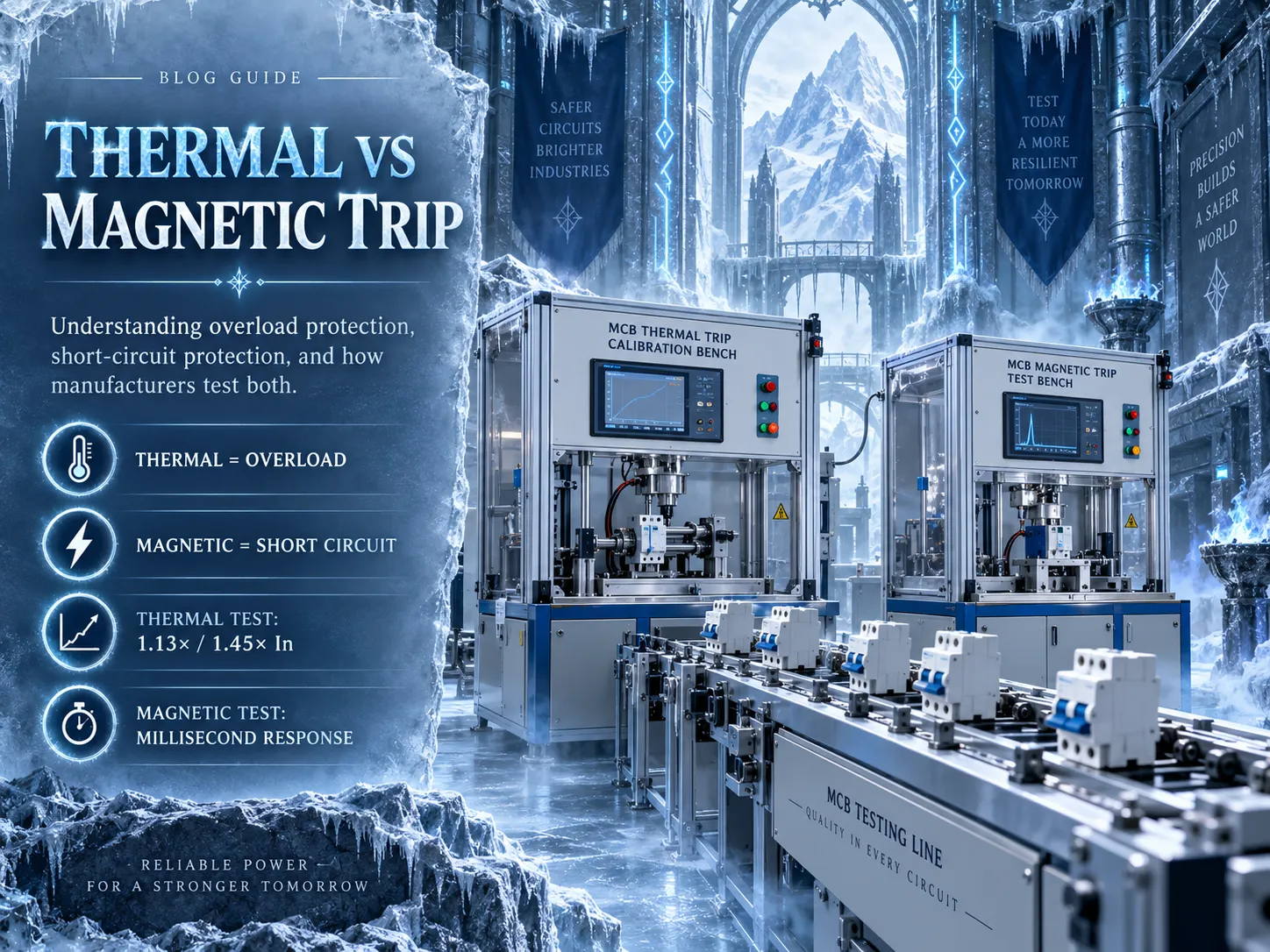
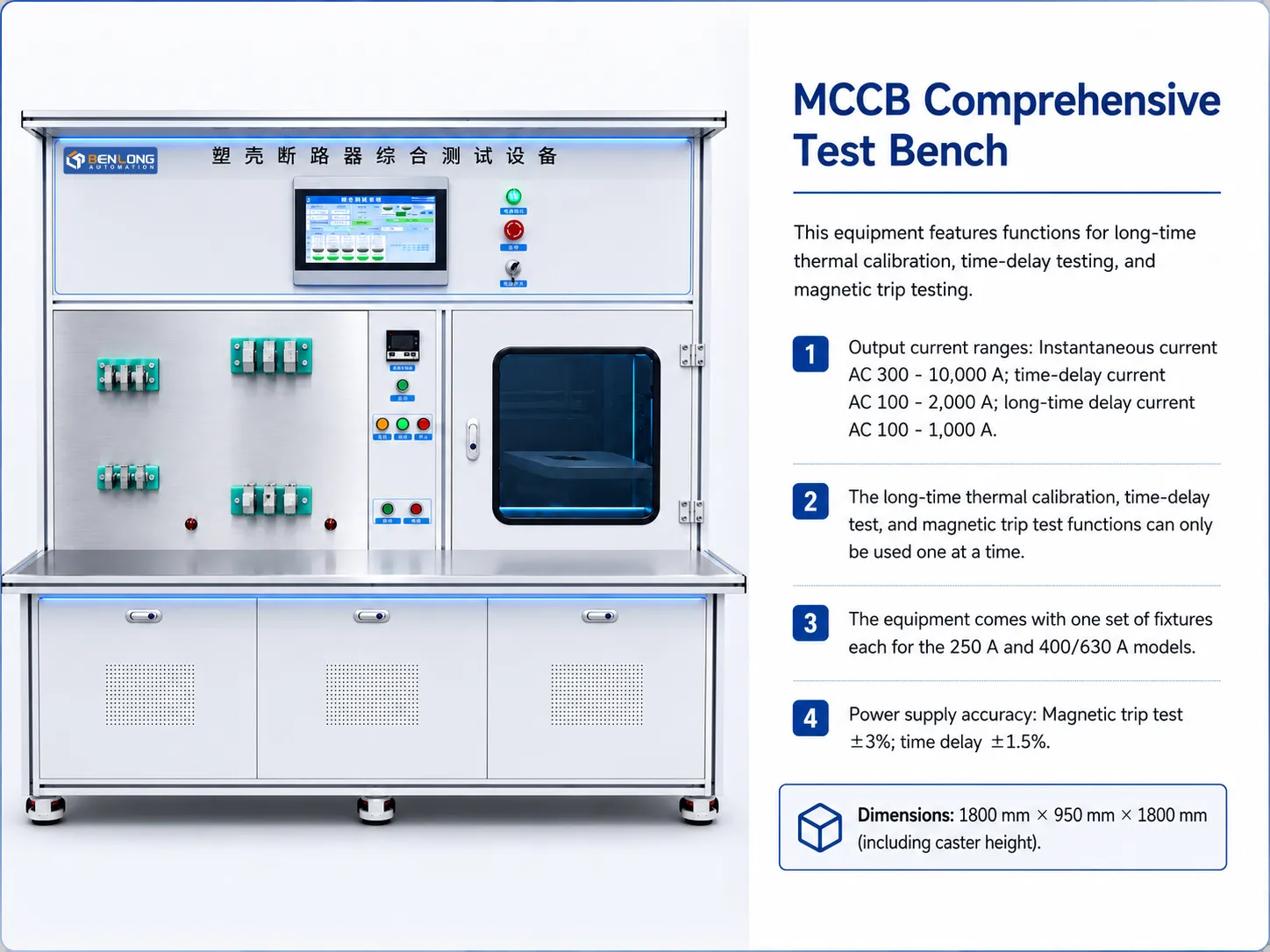
Thermal trip calibration benches the “workhorse” of the day and it is also the category of instrument where specification failures incur the biggest cost. The laws of physics are indifferent, where the deflection of the bimetal element is dependent on the energy supplied to the bimetal element which depends on RMS amperage and time. A current source with 2% ripple or drift will result in a scatter of trip times that is indistinguishable from authentic product variation. Therefore, the laboratory cannot distinguish whether the problem results from calibration or from faulty device. The specifications to be included in the request for quotation comprise: accuracy of current (class 0.5 or higher), independent pole-wise injection which allows for the testing of the three pole circuit breakers on a pole-by-pole basis as per the standard requirement, and the temperature controlled environment since the bimetal calibrated at uncontrolled 22 degrees will not trip at the correct value when the temperature of 40 degrees is used for verification. In practice the category splits into two complementary machines: a manual thermal calibration bench for development work and short verification runs at 1.30×Ir and above, and a multi-station long time thermal calibration bench for the conventional non-tripping and tripping current tests, where a single verification can occupy a station for one to two hours and batch capacity determines laboratory throughput.
Magnetic trip test benches verify the instantaneous release, and their defining technical challenge is separating magnetic behavior from thermal behavior. Injecting a test current of 10×In for too long begins heating the bimetal, which can cause a thermal trip that masquerades as a magnetic one and produces a false pass. A properly engineered MCCB magnetic trip test bench uses controlled short-duration injection with programmable current in the 5–10×In range and millisecond-class trip-time capture, because the difference between a release operating at 9×In and 11×In may be a single half-cycle. For procurement, the specification points to confirm are the maximum frame size the busbars and clamping fixtures are rated for, whether four-pole simultaneous testing is supported, and whether auxiliary contact verification is included.
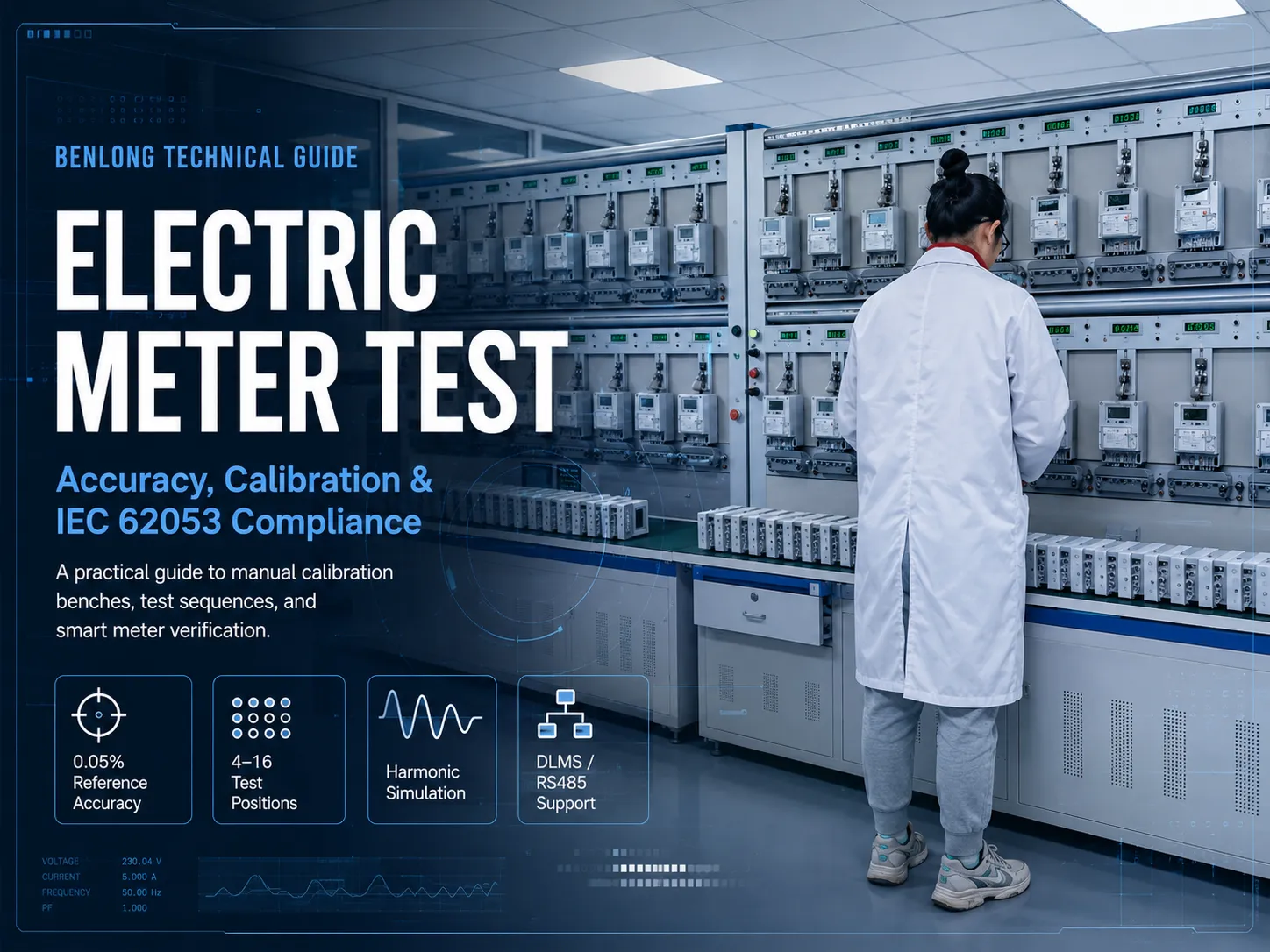
Temperature-rise and millivolt-drop stations have two jobs that have one source of power. The temperature-rise test sets the rated current in the circuit breaker until it reaches thermal equilibrium and checks the increase in temperature against the limits; the millivolt drop is same read-out method in the factory since the contact resistance is the most significant reason for heating. The upward change in the millivolt drop recorded in production lots can be the first sign of the contact material or riveting process deviation, and that is why this method should be used on every test line, not only in the lab.
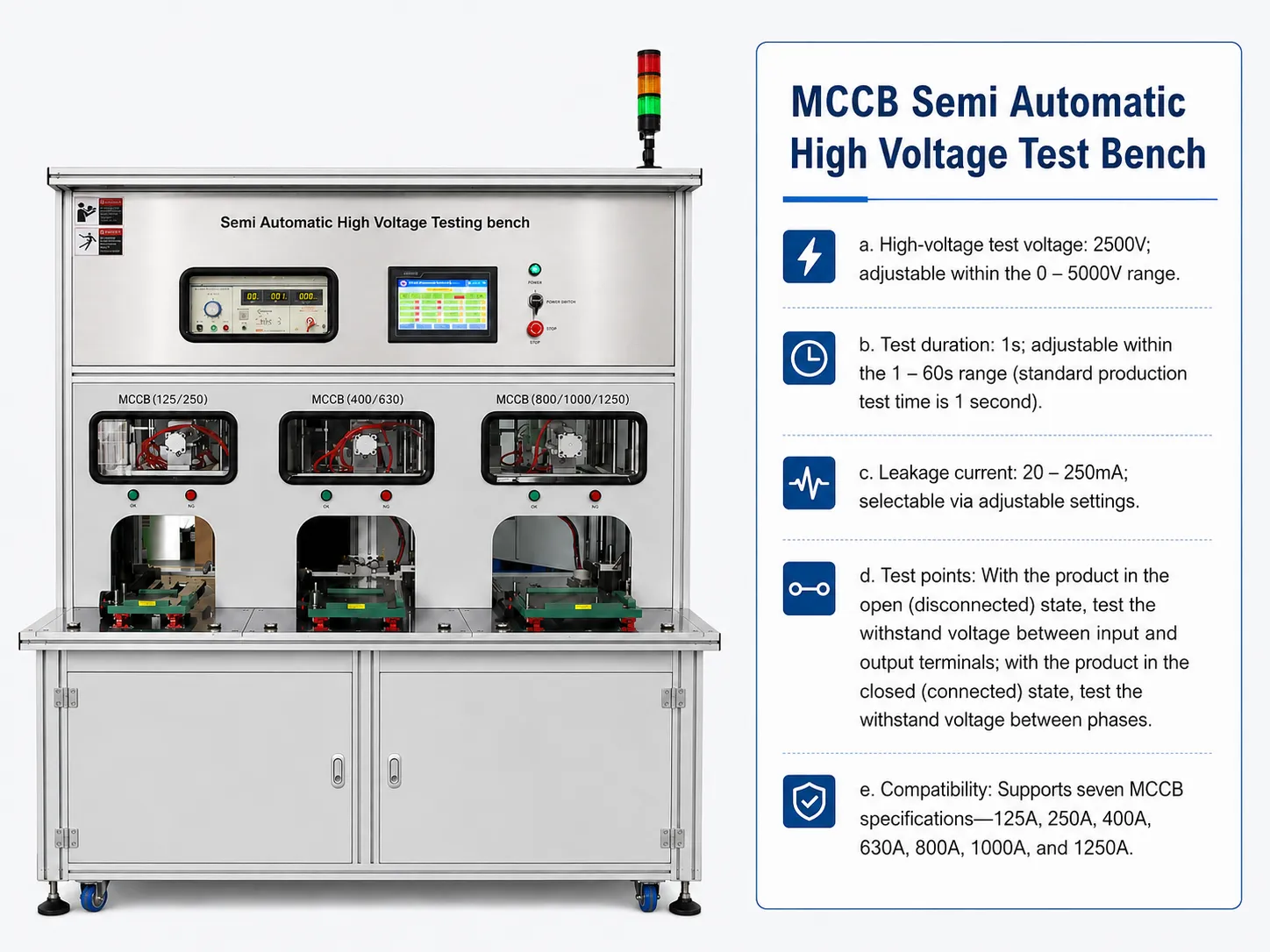
High voltage test benches The dielectric withstand tests belong to the simplest among the four categories. However, they are the most important for safety purposes. The characteristics that differentiate high-quality hipot equipment from commercial-grade material relate to the ability of the equipment to maintain the stability of the test voltage in the presence of the breaker’s capacitive load, very precise leakage current trip point calibration, and programmable ramp-dwell-ramp sequences. Equally important is operator protection and repeatability of contact: a semi-automatic high voltage test bench with guarded fixturing and automated test sequencing removes both the safety exposure and the contact-reliability problem that manual probing introduces — a dielectric test with intermittent probe contact is a test that proves nothing.
From Individual Benches to an Integrated Laboratory
The laboratory and the production line run the same tests at different volumes, and the equipment strategy should reflect that continuity. In development, engineers need flexible benches with full parameter access — adjustable injection currents, raw timing data, thermocouple mapping. As verification volume grows, floor space, operator handling time, and data consolidation start to dominate the cost equation, and the argument shifts toward integration: combining magnetic trip testing, thermal calibration, and long-duration thermal calibration into a single station such as an MCCB laboratory integrated testing bench, where one loading operation and one data record cover multiple verifications. For a procurement team, the integrated route reduces the number of suppliers, fixtures, and calibration contracts to manage; for the laboratory engineer, it eliminates the re-clamping between tests that is itself a source of measurement variation. The engineering constants across that migration are the ones this article has emphasized: current accuracy, thermal control, timing resolution, and contact reliability. Integration changes the throughput and the footprint; it must never change the measurement.
Frequently Asked Questions
What equipment is needed to test an MCCB in-house?
An exhaustive laboratory contains four divisions: a thermal trip calibration bench with an accurate current generator , a magnetic trip testing bench with regulated pulse introduction , a temperature increase and millivolt-drop station with a system for collecting thermocouple data , and a high voltage testing bench for dielectric endurance. Testing for short circuit breaking capacity is an exemption to this rule in that it requires a certified high power laboratory which is usually hired to complete it.
What is the difference between type tests and routine tests for MCCBs?
Type tests are conducted on selected samples only to validate that the specific design complies with the applicable standards such as IEC 60947-2 or UL 489, which may include destructive tests like breaking capacity tests under short-circuit conditions. Routine tests are performed along the production line on each product, including trip calibration verification, dielectric withstand test and functional tests to ensure that all products have the correct characteristics and specifications.
Why does ambient temperature matter in MCCB trip calibration?
The thermal release is a device that contains bimetal material effectively used to indicate the trip point dependent upon total heat, including the room temperature. The circuit breaker regulating its trip point according to 40-degree ambient temperature reference will trip at higher current value in the environment with 20-degree ambient temperature. Therefore, special laboratory conditions are created to control the room temperature since without them there will be no comparisons in testing results.
Should a laboratory buy separate test benches or an integrated testing bench?
Standalone benches are suitable for development laboratories requiring full access to parameters and performing various tests simultaneously. An integrated bench that includes magnetic tripping, thermal calibration, and long thermal calibration is for laboratories in which the volume of regular verifications, available space in the building, and traceability of individual results are more important than anything else. Several companies have both of these setups available for their use: flexible individual benches in R&D, and integrated setups for verification and audit testing.
References
- IEC — International Electrotechnical Commission. Publisher of IEC 60947-2, the international product standard for circuit-breakers, defining the type-test and routine-test regime referenced throughout this article.
- UL — UL 489 Standard for Molded-Case Circuit Breakers. The North American safety standard covering MCCB construction and test requirements.
- NEMA — AB 4 Guidelines for Inspection and Preventive Maintenance of Molded Case Circuit Breakers. Field-testing guidance widely used for verifying MCCBs in service, including millivolt-drop and trip testing procedures.
- IEEE — Standards and Research on Low-Voltage Circuit Protection. Technical literature on circuit-breaker performance verification and test methodology.
Specifying MCCB testing equipment is ultimately an exercise in metrology, not machinery. The precision class of the source of the testing, the precision of the timing system, the temperature control of the room in which the calibration takes place, and the level of repetition of the fixture will determine whether the data produced is suitable for verification at the certification authority. The development engineers who put these numbers into the specification provide the procurement department with the data that is justifiable during each verification. Benlong Automation manufactures calibration benches, magnet trip stations, and integrated test benches for circuit breakers on this principle and has therefore ensured that the apparatus performing its functions must meet higher standards than the breaker itself.