benlong

What are the differences between algorithms, automation and artificial intelligence?
Common confusion in manufacturing: “Our new assembly line is utilizing artificial intelligence, however, it appears to just be following rules of automation. Is this an example of automation or artificial intelligence? Additionally, where do algorithms fit in there?” – Production Manager after the implementation of a new automated assembly line.
In industry, “automation” and “artificial intelligence” (AI) are sometimes used in the same way as “algorithm” (in manufacturing). However, they refer to entirely different concepts. If you’re trying to evaluate production equipment, whether that’s a piece of software, an algorithm, or how to implement them over time, it is imperative to understand the differences. This guide will explain the three terms using elementary English, will give examples from actual factories where these technologies were used in their manufacturing processes, and will help you determine which technology is right for your case.
This guide covers:
- What is an algorithm? (Definition and factory example)
- What is automation? (Fixed, programmable, flexible, integrated)
- What is artificial intelligence? (How it differs from automation)
- Side‑by‑side comparison: algorithm vs. automation vs. AI
- How the three technologies work together in modern production lines
- Frequently asked questions about algorithms, automation, and AI
1. What is an algorithm? (The recipe)
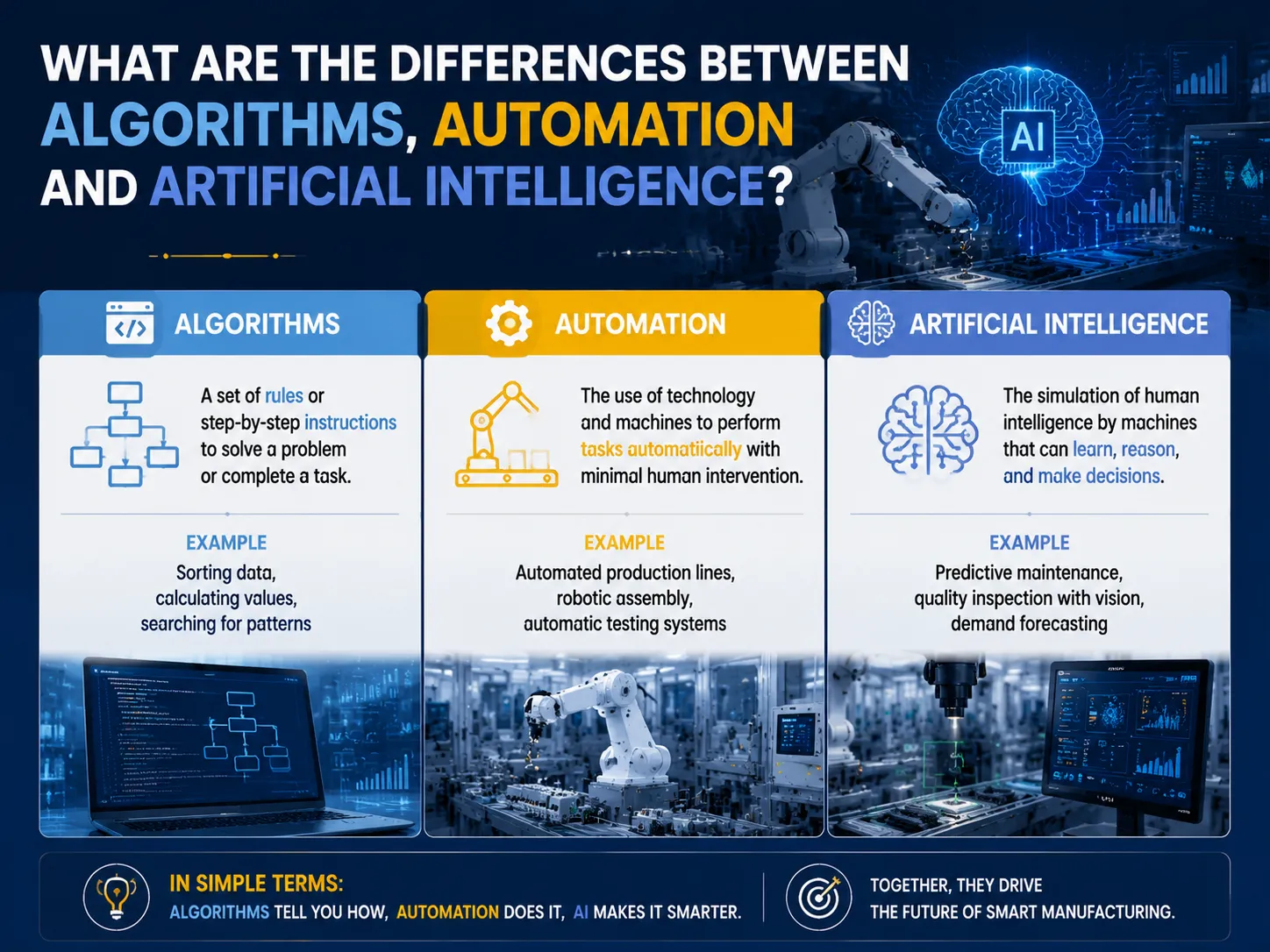
An algorithm consists of an ordered sequence of steps for achieving an objective, which could be a solution to a problem or a method for accomplishing a task. It is analogous to a recipe because you can replicate the result by following the recipe in the same way. Therefore, an algorithm is not dynamic; it is static in its execution based on pre-defined logic.
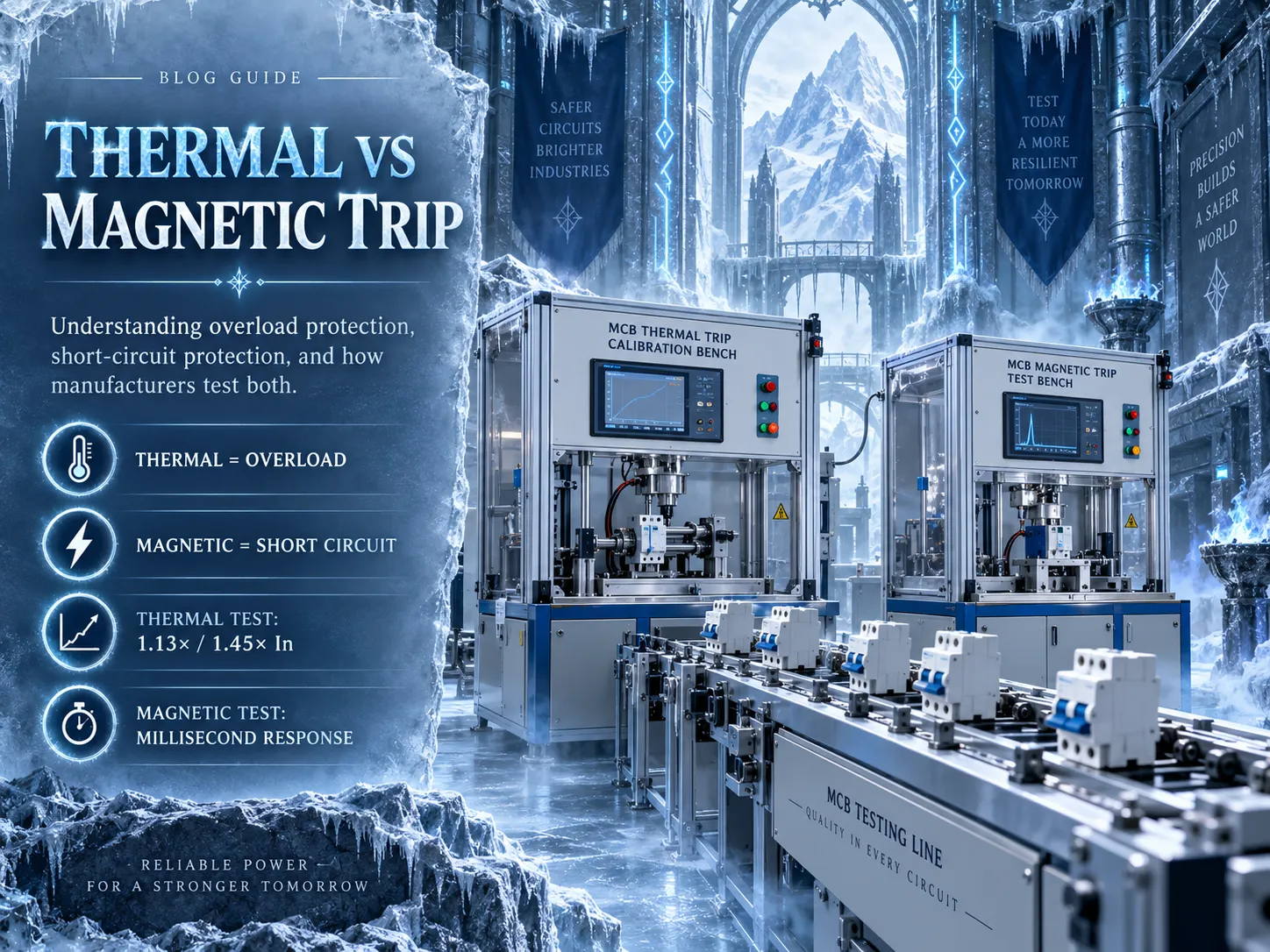
Example in manufacturing: The thermal calibration bench’s temperature control program takes its current thermal reading from a sensor. If the temperature is found to be less than optimal, it will trigger the heater to turn on for a predetermined amount of time. The program continuously executes the same set of commands at regular one second intervals.
Key characteristic: Deterministic — given the same input, it always produces the same output.
2. What is automation? (The executor)
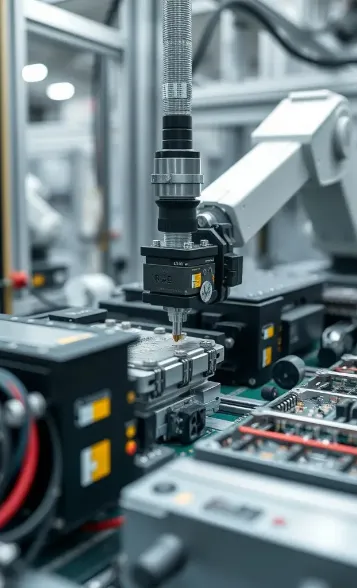
Automation Automation refers to the use of computer software, machines, or control systems to perform an activity with limited input from a human operator. Unlike artificial intelligence, automation does not make any decisions outside the parameters established by fixed algorithms—the automation of production and workflow processes typically involves doing the same thing over and over again at high speed with great accuracy.
The four common types of industrial automation are:
- Fixed (hard) automation: A production system with one end product (example electric circuit breaker assembly line with one electric circuit breaker). Changeover from the end product to another is costly and time-consuming.
- Programmable automation: Able to be configured to manufacture various products by way of batch (example: A fixture that is able to switch between the production of 1 pole and 4 pole MCB’s as a result of changing of product run recipe).
- Flexible (soft) automation: Quick transformation from one item to the next makes it appropriate for producing many different types of things at the same time (like an IoT intelligent circuit breaker production line making several smart circuit breakers).
- Integrated automation: A central control (MES) fully synchronizes the entire assembly line, connecting all of the “assembly” operations, as well as testing, welding, and packaging stations.
Example in manufacturing: A completely automated circuit breaker testing process applies 1.45 times rated current and determines when to reject any circuits that fail. This entire process occurs without the need for any intervention by an operator. While it has an algorithm that will reject any breaker that has a trip timeout greater than 60 seconds, it does not have the capability to learn or adapt.
Key characteristic: Rule‑based, repetitive, no learning.
3. What is artificial intelligence? (The learner)
Artificial intelligence (AI) Artificial intelligence (AI) is described as machines that complete tasks that require human intellect, such as recognizing patterns, making forecasts, or optimizing decisions, but can also improve their abilities through experience-based learning from a data set and adapt to situations without having to be explicitly instructed or programmed for each task.
Machine Learning (ML) is the most popular form of AI used by manufacturers in today’s industry. In ML, a set of algorithms is developed for the purpose of generating predictions about future events based upon historical data (e.g., the prediction of future machine failure, the classification of welding defects based upon visual images, etc.).
Example in manufacturing: The use of AI to perform inspections of MCB Housings for cracks. This is achieved by developing an inspection system that utilizes a vision inspection technology, and utilizing many photographs of both acceptable and unacceptable parts to train an AI system to recognize more subtle flaws than would be achievable with traditional rule-based systems (for example: “any pixel value over 200 is a defect”). The AI will continue to improve in its ability to detect these types of defects through continuous updates to the database of images.
Key characteristic: Data‑driven, adaptive, can handle variability.
4. Comparison: Algorithm vs. Automation vs. AI
| Definition | Step‑by‑step instructions | Machines performing tasks with minimal human help | Systems that mimic human intelligence and learn |
| Learning ability | None (deterministic) | None (follows fixed rules) | Yes (improves with data) |
| Flexibility | Only does exactly what it was programmed for | Depends on type (fixed = rigid; flexible = adaptable) | Highly adaptable to new scenarios after training |
| Example | PID control loop for temperature | Automatic MCB calibration bench | Vision‑based defect detection that improves over time |
5. How algorithms, automation, and AI work together
In a modern factory, these three technologies are often layered:
- Algorithms form the lowest level — the specific rules that control a motor, a heater, or a test sequence.
- Automation Uses its algorithms to perform tasks without the need for any human input or use of software (moving things, performing operations and checking)
- AI On the top level of the system, analyzing data from the automated procedures to support higher-level decisions (e.g., predicting maintenance scheduling, optimizing production schedules, or modifying test limits based upon past yield).
Example: An AI system can analyze thousands of trip time records and predict when the calibration station will require maintenance, or automatically adjust pass/fail conditions according to the drift of ambient temperature, which is not possible with a fixed algorithm. An automated MCB testing line encompasses algorithms to apply 1.45× current to the MCB under test and measure the trip time (the time it takes to trip).
6. Frequently asked questions (FAQ)
What is the difference between automation and artificial intelligence?
Automation executes a task according to predetermined and established rules with no human involvement. There is no learning or adjustment in automation processes. AI processes data to identify patterns, predict outcomes, and optimize decisions related to future actions. AI can be adaptable to change and continue to develop over time. A manufacturing robot will consistently weld in the same place, whereas an AI can determine that a new crack has occurred through the use of image processing/vision technology on parts coming off the production line.
What 3 jobs will not be replaced by AI?
Although Ai can do many tasks it cannot perform tasks in one of three categories left that are mainly done by humans: Skilled trades (Electrical workers, welders, mechanical workers) that require a physical skill and problem solving at the time of the job; Creative positions (Engineers inventing product) which require original thought; and Human contact (Sales people, management, customer services) that require empathic behaviour/behavioural negotiations. Ai has aid in performing these jobs but does not take away from them.
What is the difference between an algorithm and artificial intelligence?
An algorithm is a pre-determined method of completing an activity (if X happens then do Y). Whereas the traditional way of writing an algorithm is to tell the computer what you want to do with the data, machine learning uses the data to create an algorithm that can ‘learn’ from previous experiences. For instance, a conventional sort algorithm uses a sequence of operations that will sort the numbers by their numeric values (i.e., from 1 to 10). An example of how an AI (artificial intelligence) system will learn to identify defective items is that it will show it many examples of defects until it can develop an algorithm to accomplish this without being specifically programmed by a human being.
What are the 4 types of automation?
There are four different types of automation used in the manufacturing industry. They are:
1. Fixed (hard) automation (used for high volume single products).
2. Programmable automation (reprogrammable for batches).
3. Flexible (soft) automation (quickly changing between multiple products).
4. Integrated automation (fully synchronized with MES control on centralised lines).
These different types of automation allow manufacturers to balance production volume, variety in product and changeover flexibility.
When considering the purchase of production machine/software you must understand how the terms algorithm, automation and artificial intelligence differ. For example, algorithms give specific instructions on how to complete a process step by step; automation takes these instructions and uses them to consistently and quickly perform a function (process); while AI builds on top of automation and algorithms by providing a learning and adaptive capability that enables a system to deal with changes in the environment and improve the decision-making capabilities over time. Due to the level of automation and embedded algorithms used on most of today’s industrial production lines, new AI applications such as predictive maintenance and quality inspection are being used as additional support on top of existing automation. When talking with suppliers who say their machine “uses AI,” be sure to specifically ask if the machine is capable of learning from data, or simply using fixed rules; based on this answer will determine if you are purchasing automation or true intelligence.