benlong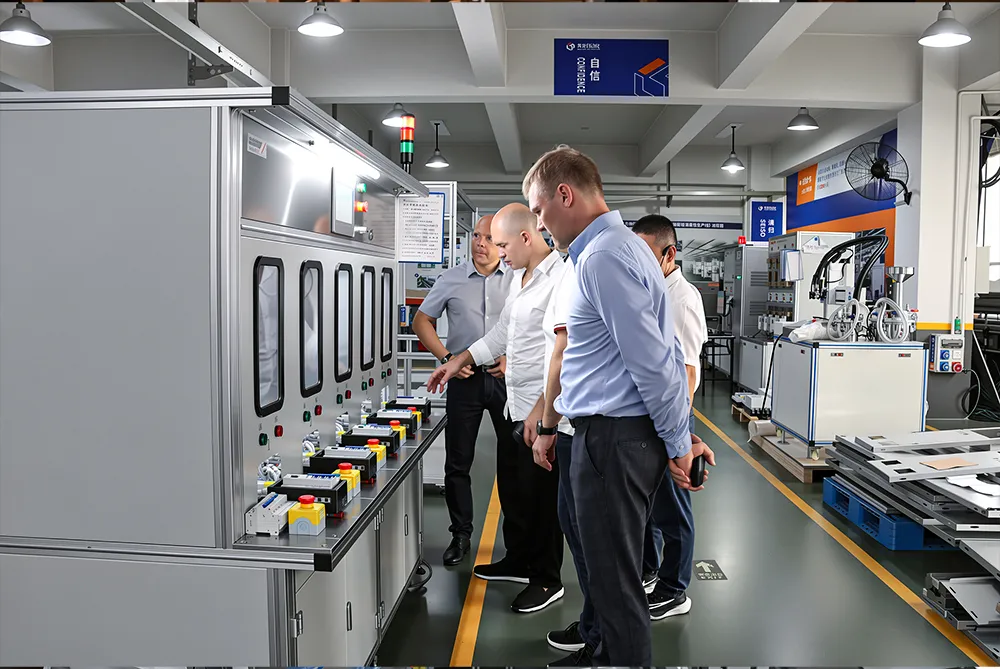


What is a MCB Calibration Machine and How Does it Work?
Real production headache: During the final testing phase, we were rejecting 8% of our MCBs due to thermal trip drift. The reason for the issue with the MCB’s circuit was that the calibration bench that we were using did not hold stable current for time periods greater than 30 minutes. There was no way to verify the proper adjustment of the bimetals with our previous calibrations. — Quality Manager, mid- sized electrical manufacturer
MCB calibration machines are specialized instruments used to test and make adjustments to the thermal or overload trip characteristics of miniature circuit breakers. Calibration benches have the ability to apply precise, stable overloads (typically between 100% and 135%) while measuring the trip time of circuit breakers (+/- 0.1%) to help get the bimetal strip adjustment set to cause circuit breakers to trip within a very tight window (e.g., 45 – 55 seconds at 135% In). This guide describes how to properly use an MCB calibration machine; listing the types of machines (manual, semi automatic, long time), as well as providing information on how to select the right machine for your production laboratory or manufacturing facility.
This guide covers:
- What a MCB calibration machine is and why it’s different from a tester
- The working principle: thermal trip simulation, current control, and timing
- Types of calibration benches: manual, semi‑automatic (Type‑A/B), and long‑time benches
- Key specifications to evaluate (current range, accuracy, stability)
- How to select a calibration machine based on volume and precision needs
- FAQs: MCB calibration, correct operation test, and the 80% rule
1. What is a MCB calibration machine? (Definition and purpose)
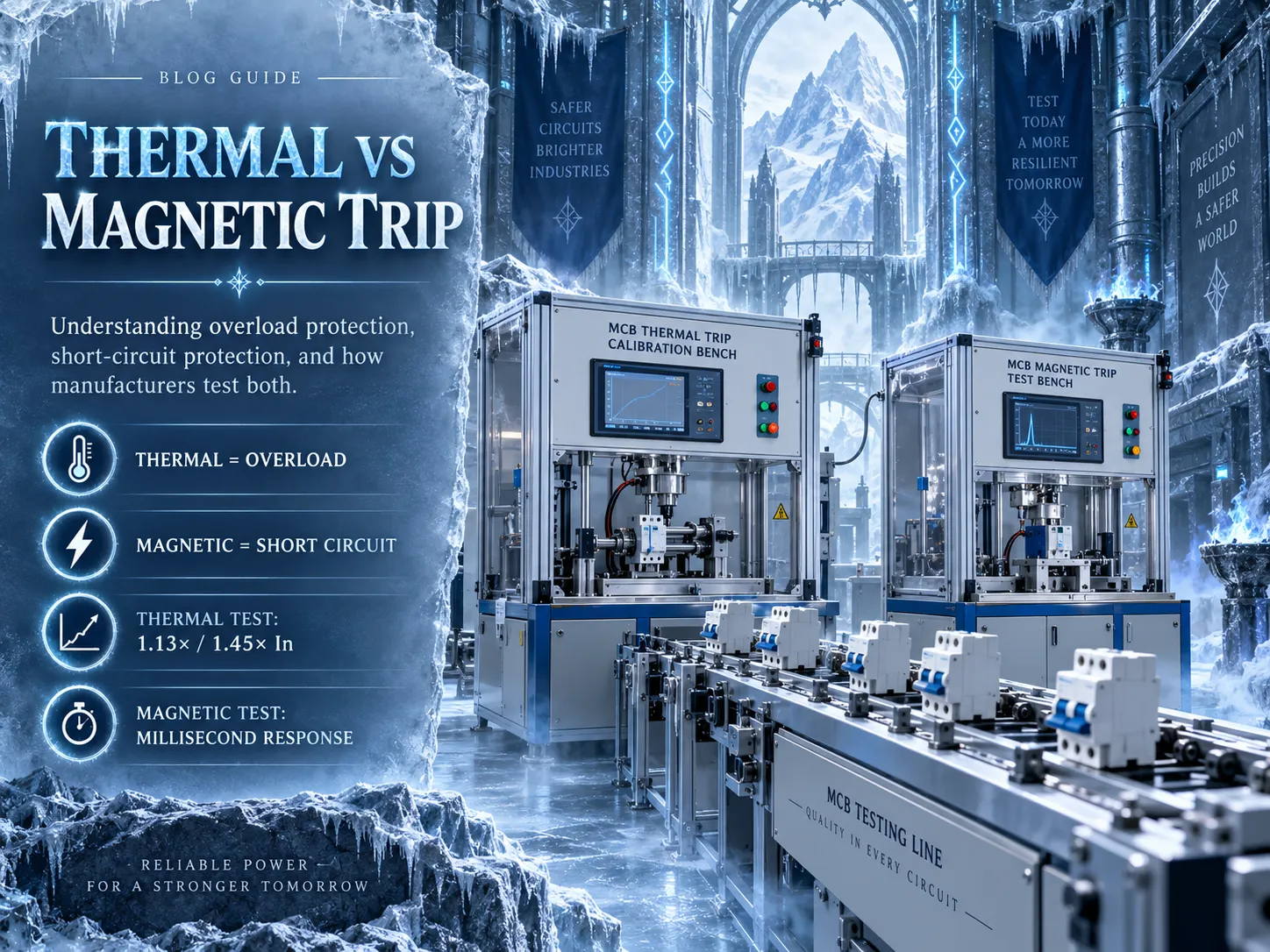
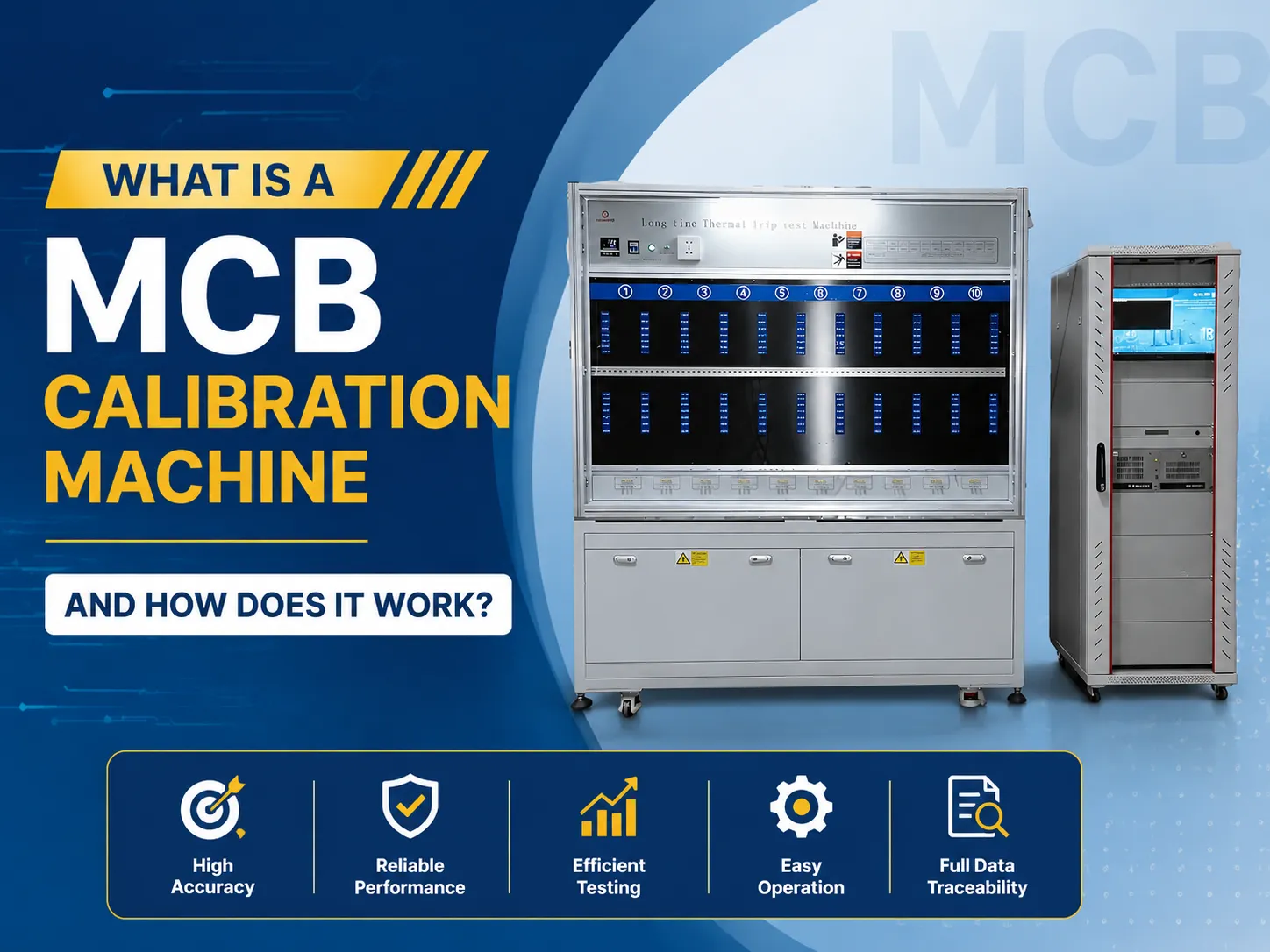
A calibration machine for MCBs (also referred to as Thermal Trip Calibration Benches) has been designed to calibrate the thermal overload element of a Miniature Circuit Breaker. Within each MCB, there is a bimetallic strip which bends due to heating from the overload current passing through it. If the strip bends too soon or too late it will trip outside of its published time-current characteristic (in accordance with IEC 60898-1). The calibration machine will apply a stable current (1.45× rated current for Type B/C/D) to the MCB being calibrated and measures the actual time it takes to trip. Once the trip time is obtained if outside of the acceptance window, the operator (or an automatic adjustment station) will turn a calibration screw to adjust the deflection of the bimetallic strip by either increasing or decreasing its deflection. Once adjusted, the trip will be retested until it falls within the correct specification. This process ensures that every MCB will provide the same level of protection once it leaves the manufacturer.
Examples of products from Benlong Automation include: the most suitable (for new entrants) MCB Manual Thermal Trip Calibration Bench (entry level) and the Type A Semi-Automatic Bench With Shift Mechanism For Different Types Of Design Features of MCBs.
2. How does an MCB calibration machine work?
The basic principles of operation consist of 3 main subsystems: generating current, measuring timing and supporting fixturing.
2.1 Stable, programmable current source
The apparatus produces an adjustable AC electric current between a few Amperes and 500 Amperes, depending on the model. Calibration requires that the Current be set at 135% of the In rating of the MCB (Miniature Circuit Breaker) being calibrated. The thermal calibration Current for a Typical MCB rated for 10 Amperes would be set at 13.5 Amperes for thermal (long term) trip functioning. The Current must also be maintained within ±2% tolerance over a period of one hour; if not, the time for tripping will drift and produce inaccurate results. The Benlong MCB long time thermal calibration bench, using an IGBT (Insulated Gate Bipolar Transistor) or Thyrister controller to maintain constant Close Loop Feedback of CW (Constant Wave) stability will result in the required Calibration Current stability. The technical performance specifications include: Rated Power per Station = 1 kVA, Maximum Output = 500 Amperes, Maximum Output Waveform Distortion = < 3%.
2.2 High‑precision timing and trip detection
An embedded timer is part of the test machine; it begins counting down when current flows into the MCB under test and continues until all the contacts of the MCB trip open. Timing is important in the context of long-time tests (1 to 60 minutes) ±0.1%, so that, for example, the allowable error for a 60-second trip will be no more than 0.06 seconds. The datasheet for MCB long-time thermal calibration bench specifies a timing accuracy of ±0.1%, with time display ranges of 1 second to 9 hours, 59 minutes. In order to increase throughput, multiple stations (typically 4 to 10) will simultaneously test multiple MCBs.
2.3 Fixturing and adjustment mechanism
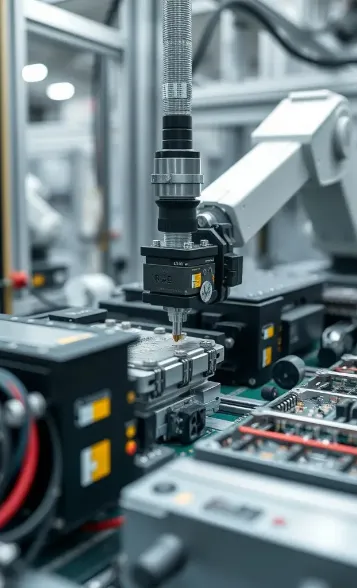
When used to calibrate MCB’s, Manual Benches – like those designed for use with MCB’s using a thermal trip calibration Bench – have the arbor-mounted operator loading the manual trip of the MCB and using a digital measuring display to record the time of the thermal trip of the MCB, at which point the operator adjusts the calibration setting of the MCB using a screwdriver before performing a second test. The Semi-Automatic Bench Types A & B have pneumatic clamps and motorized calibration adjustor as device features, with the operator solely loading and unloading and having the machine perform the test and adjust the trip time to an acceptable range using multiple repeat tests and providing the results to the operator without needing additional interaction from the operator. The Type-B Bench is equipped with interchangeable cards for multiple testing capabilities, including MCB from multiple manufacturer families.
3. Types of MCB calibration machines
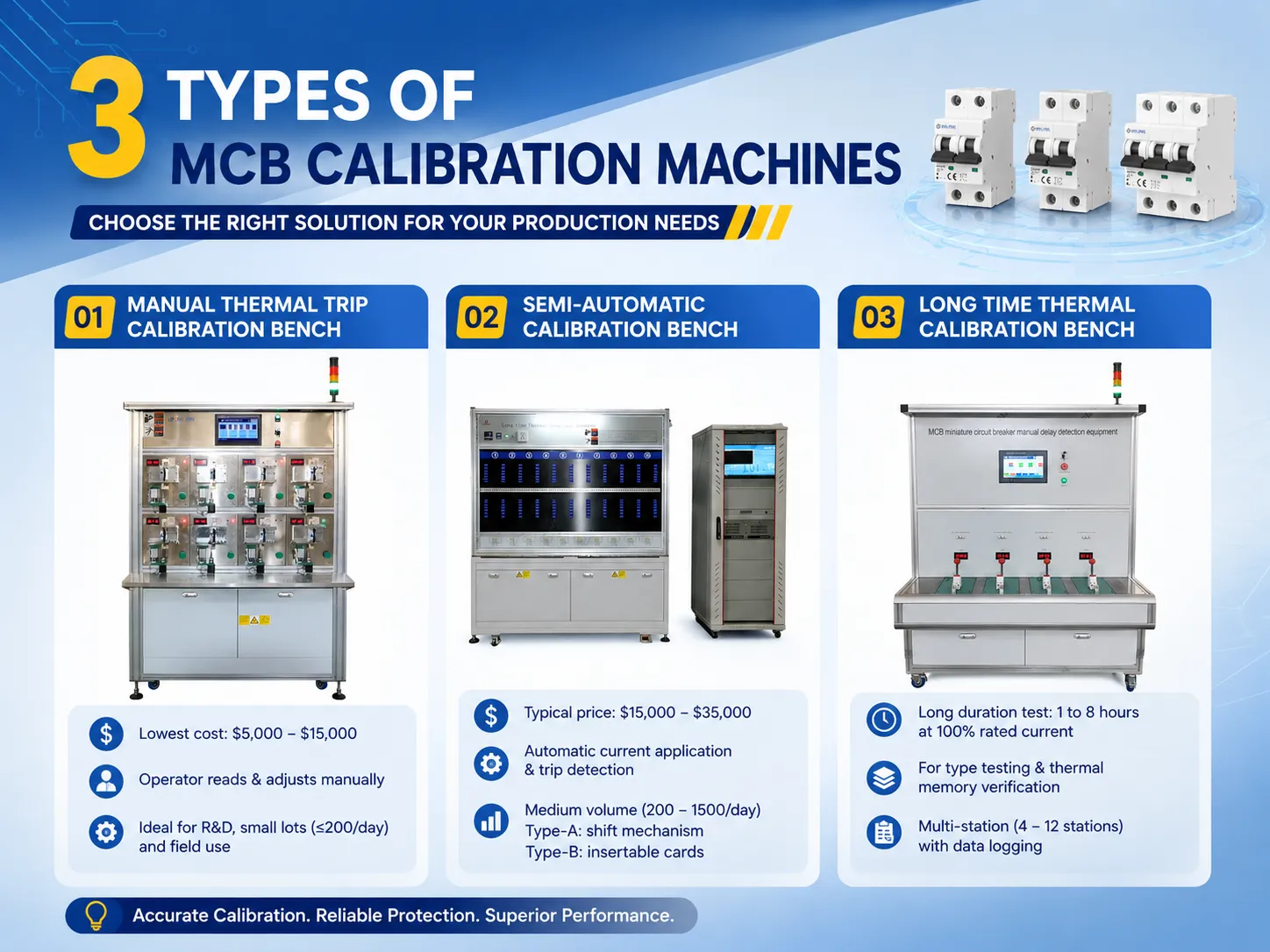
Based on the level of automation and test duration, there are three common types:
- Manual thermal trip calibration bench: The lowest-cost option is between $5,000 and $15,000. The operator will read the trip time to manually change the screws during production. This is good for research and development, small lots (up to 200) and for field use.
- Semi‑automatic calibration bench (Type‑A / Type‑B): Typical price range from $15k-35k; usually includes automatic current application (for required amount of electricity) & trip detection (when trip happens) as well as sometimes motorize adjustment (to accommodate load/unload); operator loads/unloads; most used in medium volume (200 – 1500 products/day); type ‘A’ includes a shift mechanism to accommodate different types of (MCB) designs; type ‘B’ uses insertable cards for fast changeover.
- Long time thermal calibration bench: Designed to run for extended periods at 100% rated current (1 to 8 hours). Used to perform type testing (to prove the rated electrical characteristics) or verification of thermal memory effect. May contain more than one independent test station (4 to 12) and may offer data logging.
4. Key specifications to evaluate (with real data)
When comparing MCB calibration machines, ask for these documented values:
- Output current range and accuracy: The Benlong long term bench provides the ability to measure from 0.01 to 500 Amps per station, with an uncertainty of 1%. The MCB rating (s) that can be taken into account will range from 1 – 63 Amps or in some instances, up to 125 Amps.
- Timing accuracy: ±0.1% or better. For long‑time tests, drift over 8 hours should be <0.5%.
- Number of test stations: 1 to 12. More stations increase throughput but require more floor space.
- Waveform distortion: <3% (THD) – higher distortion affects bimetal heating.
- Insulation resistance: >10 MΩ (safety).
- Compliance with standards: IEC 60898‑1 (for MCBs) or customer‑specific test plans.
5. How to choose the right MCB calibration machine for your factory
Use this decision guide based on your daily output and accuracy requirements:
| Daily production volume | Recommended machine | Key advantage |
|---|---|---|
| < 200 units | Manual thermal trip bench | Lowest investment |
| 200‑1000 units | Semi‑auto Type‑A or Type‑B | Balance of speed & cost |
| >1000 units | Multi‑station long‑time bench | High throughput, data logging |
In considering your needs, you should think about whether you will need to test thermal trips only or magnetic trips only. The majority of calibration benches are designed for thermal (long‑time) trip testing only. You would require an additional instantaneous tester for your magnetic trip, although there are some advanced models that provide both features. The calibration benches that we have previously disclosed in this article will be perfect for the dedicated calibration of any of the above two trip types.
Frequently asked questions (FAQ)
What is MCB calibration?
MCB calibration Calibrating a miniature circuit breaker involves making adjustments to the thermal trip mechanism (the bimetal strip). The purpose of this adjustment is to ensure that the circuit breaker trips within a defined period when there is an overloaded current passing through it. The overload current will be set at 1.45 times rated current as specified by the IEC60898-1 standards for Types B, C & D (i.e., it will be 1.45 times In). Typically, a dedicated calibration machine will be used to perform the calibration of the circuit breaker. The calibration machine will apply precise and stable current to the breaker, measure the tripping time, and permit the operator or an automated system to adjust the calibration of the trip over a range until the trip is met within the limits stated in the standards (e.g., the tripping time of a 10A breaker @135% In should be between 45s and 55s). The successful completion of this process enables the circuit breaker to provide reliable protection from extended overloads.
How to test if an MCB is operating correctly?
In order to determine if a miniature circuit breaker is working properly, you must carry out a thermal (overload) test and a magnetic (short-circuit) test. For the thermal test, use a calibration machine or a primary current injection set to apply 1.45 times rated current, and record the trip time. The MCB should trip within 1 hour (for >10A) or 1 minute (for smaller ratings). For the magnetic test, apply 5-10 times rated current (depending on the curve: B, C, D)—the MCB should trip within 100 milliseconds. Check contact resistance (<5 mΩ typical) and insulation resistance (>100 MΩ at 500V) to be sure the MCB meets ANSI standards. A simple field test, using a push-to-trip button, only demonstrates the mechanical linkage, but does not confirm electrical calibration.
What is the 80% rule for breakers?
According to NEC 210.20 the 80% rule prohibits continuous loading of a circuit breaker above 80% of its rating(current rating). As an example if a MCB has an ampacity of 20A that means that it can only carry an ampacity of 16A for over 3 hours due to thermal buildup. The assumption is that nuisance tripping caused by thermal buildup will occur on circuits that are overloaded continuously. Calibration does not have a direct relationship with the 80% rule, but the calibration procedure ensures that the breaker will trip correctly when overloaded (135% of the rated) even when the breaker has been loaded continuously at 100% on the circuit violating the 80% rule. Over time, due to the growth of the bimetal, there is a possibility of a nuisance trip from the breaker; therefore, it is very important that the calibration confirms that the trip occurs within the standard timeframe. Some manufactures make an exception to this standard by making breakers with the same ampacity rating for special applications as well as other manufacturers.
What is MCB and its function?
The MCB’s main purpose is to safeguard low-voltage electrical circuits with an amp rating through 125A by protecting them against damage from overloading (an extended interval of high current) or short circuits (extremely high current). An MCB has a thermal unit (bimetallic) that detects an overload situation, and an electromagnetic unit that detects a short circuit scenario, which is essentially a fault occurring within the circuit due to an overcurrent. When there is any fault in the circuit to which an MCB is connected, it trips automatically and discontinues supplying power to the faulty circuit, which in turn protects against fires and preventing damage to the equipment connected to the faulty circuit. An MCB also has the ability to be reset after the fault has been cleared, unlike a fuse, which must be replaced when it is blown. The testing or calibration of the MCB is performed to ensure that the thermal unit will trip at the appropriate level of current and also within the defined time frame set forth in IEC 60898-1.
MCB Calibration Machines are used by manufacturers, Testing & calibration labs, and Maintenance Departments for the purpose of verifying and making required adjustments to the thermal overload protection of MCBs (miniature circuit breakers). MCB Calibration Machines work by applying a constant, precise current (usually 135% of the MCB rated current) to the MCB/miniature circuit breaker and measuring how long it takes to trip (with very high accuracy, ±0.1%).
MCB Calibration machines come in various formats; manual type machines are used when low volume of work is required (ie: research and development); Semi-Automatic (Type, A and Type B) type machines are designed to increase productivity by handling medium volumes of work; and long time type machines that run automatically will handle large volumes.
When evaluating what types of MCB Calibration Machines will suit your needs, consider the following specifications Very important Specification to consider includes; Maximum Current Range (max. 500A), Very high accuracy time measuring in the tripping operation, Number of MCBs/calibrations you will like to run per day, and compliance with IEC 60898-1.
When selecting MCB Calibration Machines, keep in mind your daily production volume and budget, and the level of Automation you require. Properly Calibrating an MCB will assist in ensuring that MCBs will trip under overloading conditions. Proper calibration will protect both equipment and personnel.