benlong
Assembly Automation Equipment for Sale
Searching for assembly automation machinery yields a plethora of identical listings featuring; a frame, some cylinders, a conveyor and a touchscreen. The listings are not the problem. The problem is “assembly automation equipment” is a category name, which includes such machines of different classes that they differ by fifty times in price and have different application capabilities.
This guide clearly classifies the different types of machines, provides the figures, which determine what type of machine is needed in each case, and shows what a Benlong quote looks like and how it is generated. If you are looking for a production line for low-voltage electrical products, electrical equipment or simply for mechanics, the second part of this guide is yours.
The assembly automation machinery can be categorized into seven categories, starting with a simple conveyor and including a fully automated production line for one type of product. The selection must be made using four figures and does not depend on the manufacturer data sheet: yearly volume, the number of varieties, production time, and the defect cost. An automatic machine designed for one purpose is considered efficient when producing more than 200,000 units a year; otherwise, it cannot compete with modular manual systems equipped with machines. Benlong produces all of the above, from testing machines to welding machines placed between the two systems.
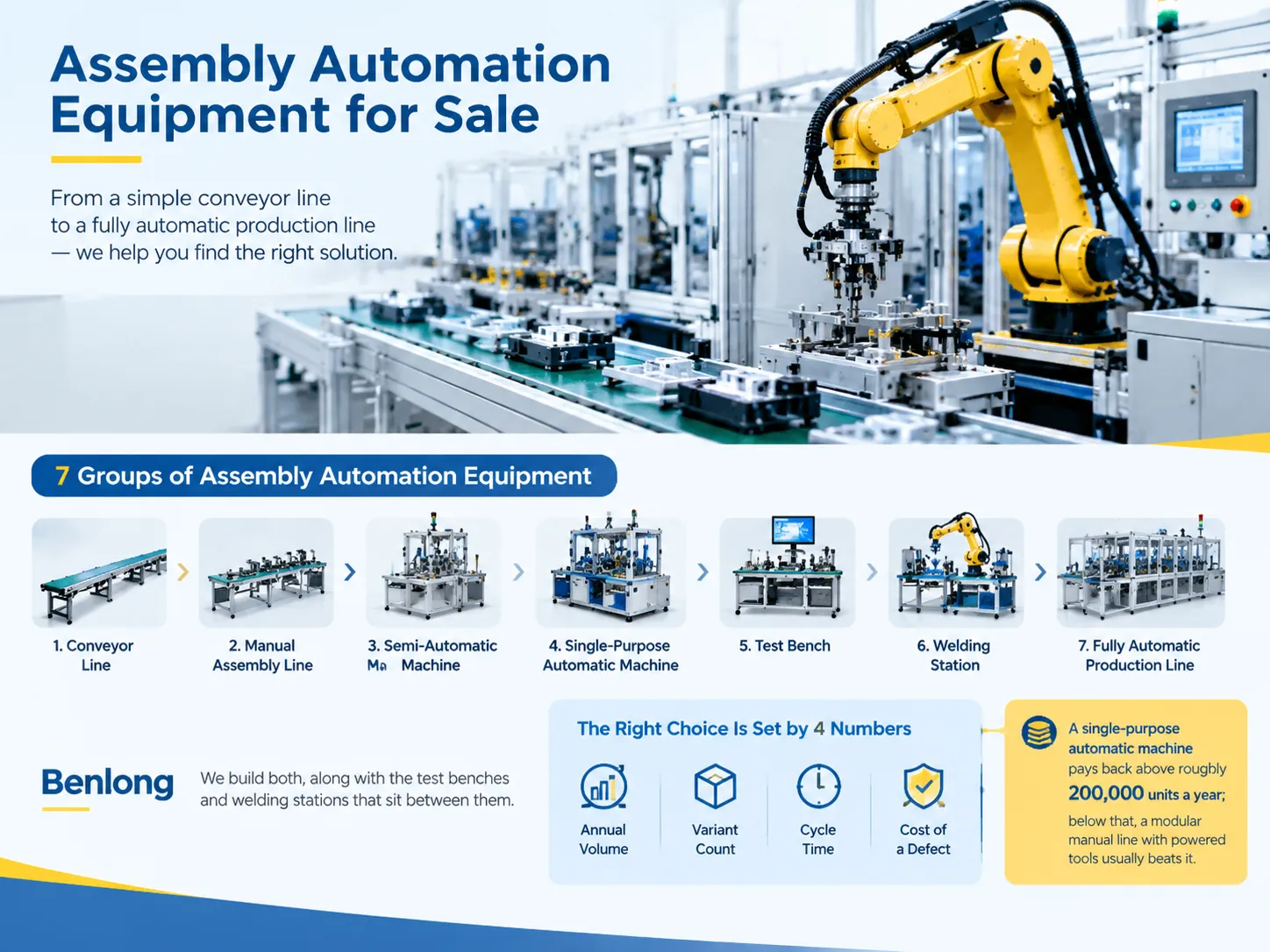
The Seven Categories People Mean by “Assembly Automation Equipment”
All available machines can be classified under one of the seven categories. Establishing if the supplier fits into the correct category is the quickest way to narrow down options since most manufacturers are only capable of producing two or three kinds of equipment.
- Manual and semi-automatic conveyorized machines. Different mechanisms like belts, transfers, and chains are used along with equipment and tools. People do the actual work.
- Indexing rotary dial equipment. A rotating table moves fixtures from station to station.
- In-line indexing technology. This concept is similar but implemented along a straight line. Most automated assembly equipment for electrical devices utilize this technology.
- Robotic cells have one or more robotic arms servicing the fixture.
- Joining works utilize methods like ultrasonic welding, resistance welding, riveting, fitting, or gluing of components to create a product.
- Testing stations ensure the proper functioning of equipment through functional testing, hipot testing, calibration, vision inspection, and leak testing.
- Integration and logistics systems utilize vibrating feeders, tray feeders, and shuttles for transporting components.
The problem is getting group four machinery while what is needed belongs to group two. For example, robotic cells can cost much more than a cam-driven indexing machine used for the same task.The scope questions that separate a real custom build from a catalogue machine are set out in this guide to working with a custom automated assembly machine manufacturer.
Four Numbers That Decide the Machine Before You Ask for a Price
Varying quotations from suppliers can indicate a difference of 300% when one looks for prices for the same part. The reason does not lie in some hidden expenses but in different designs made based on different assumptions, and these assumptions rely on four pieces of information that must be ready before drafting the first call.
- Annual volume and batch size. If a machine processes a certain product in 6,000 hours a year, it may be built in accordance with the speed. But if the machine runs 40 batches a year, then it needs to have changeover time that does not exceed 30 minutes, otherwise it will be idle when waiting for a certain part. Therefore, these types of machinery are different and are priced accordingly.
- Variant count. It must be noted how many part numbers have one and the same tool. At the level of six variants, the usage of hard tooling ceases making sense and even if one did not want to have servos, he or she has to use one anyway.
- Cycle time. By cycle time, it is meant the speed of the process. It is not appropriate to use fast. If there is a need to obtain one product every 4.5 seconds, this must be stated. Moreover, if one has to have 900 pieces produced per hour at the level of 92%, then the acceptance test should be written down according to these parameters.
- Cost of a defect. A scratch on a bracket is much less risk than a loose connection of a bus bar because the second type of defect implies in-process torque monitoring and a 100% check of the quality of electricity. The cost of such solution may add 15-25% to the cost of machinery, but the expenses are justified.
The overall picture needs to be considered in this issue. According to the International Federation of Robotics, there were 542,000 industrial robots installed in 2024, while the overall operating stock was 4,664,000 at the end of the period, which implies an increase in the amount by 9% in a year, with the majority of installations located in Asia.
What Benlong Builds, and What We Quote Against
Benlong Automation specializes in the production of assembly lines, automated assembly machines, test benches, welding and soldering stations, and necessary accessories, primarily for manufacturers of low voltage electric appliances. Rather than describing this in general terms, the following provides detailed specifications of our modular assembly lines, as this is the product that customers inquire about most frequently.
| Parameter | Standard build |
|---|---|
| Conveyor types | Belt, plate chain, double-speed chain, roller, modular plastic belt |
| Transmission | Synchronous (forced pace), asynchronous (buffer-enabled) or mixed |
| Belt materials | Anti-static, high-temperature, food-grade, general purpose |
| Workstation height | 750 ± 20 mm, adjustable |
| Workstations | 2 to 50+, modular and expandable |
| Auxiliary equipment | LED task lights, fans, sockets, tool balancers, air ports |
| Control | PLC or manual, MES connectivity over OPC UA / Modbus |
| Power supply | 380 V ± 10% 50 Hz, or 220 V to customer specification |
| Delivery | 30 to 60 days, custom length and station count |
The table shows two numbers doing more commercial work than others. According to the numbers, component pre-assembly and modular design allow reducing the number of fasteners by 20% to 25% as well as 15% of assembly time, and one can calculate this number in advance. The rest of the group of devices based on modular assembly technology differs in frame variations only, which means that no matter whether one chooses synchronous or asynchronous type, the result is the same because this is the biggest drive of the throughput in case of mixed production. Full configurations sit on the modular assembly line product page.
A recent construction illustrates the performance of the system. A contractor needed a production system that relaxed the manufacturing processes across 20 distinct families of products of variable dimensions and cycle times. Benlong provided a modular asynchronous system, comprising 15 workstations that operate via two speeds of the chain conveyor and the screwdriving controlled by torque. After four months of the system running, we have 25% reduced direct labor, 30% improved throughput in mixed mode production, 15% increased speed of subassembly, 11 months of return on investment. The system was not redesigned during the change of product mix, which is the primary reason for buying asynchronous.
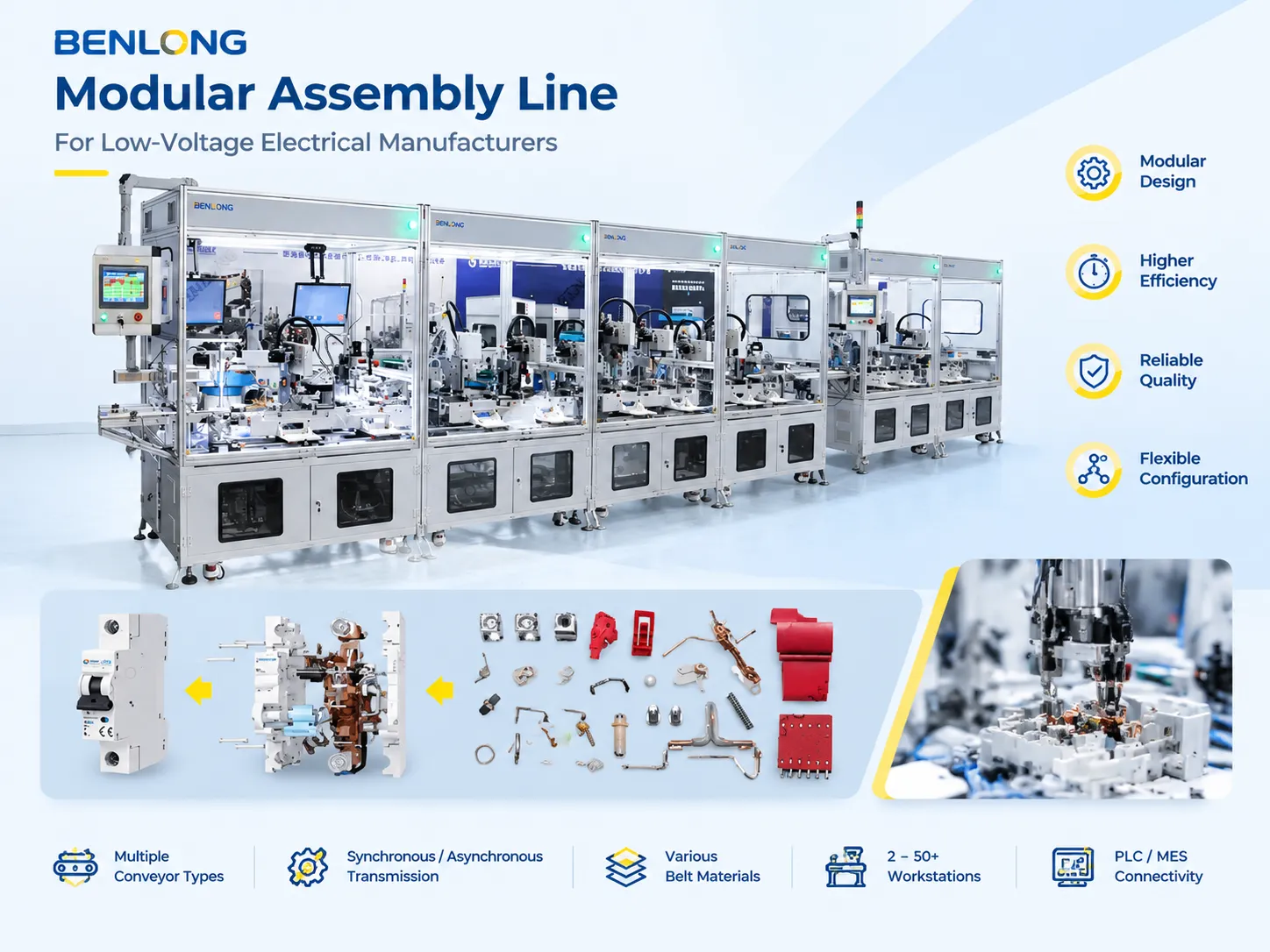
The Low-Voltage Electrical Niche Benlong Knows Best
The majority of our inquiries are not related to general assembly. Instead, they consist of inquiries on specific jobs such as assembling a microswitch, a contactor, welding an arc chute, performing a test on an ACB, and calibrating a trip unit. This specialization explains the form of our catalogue and the reason behind the fact that engineering starts from the component instead of following a predefined platform.
Take the contact system. The contactor and breaker assembly consists of a moving contact, a fixed contact, a spring, the retaining system, and often a braid. It is important to ensure correct contact force and gap during the assembly. Doing it manually results in variation in force depending on the capacity of the operator’s wrist. The AC contactor automatic contact insertion machine exists to remove that variation: parts are fed, oriented, inserted and checked in one cycle, and the force is set by the tooling, not by the person.
The same argument is applicable to the rest of the product array. The arc chute assembly is made of a series of different plates of steel that must be always arranged at the required pitch without burrs or interleaving mistakes; it is a question of welding and staking parts but not assembling them. The method of testing being used is consistent with the specification applicable to the product and the hipot test is conducted at the prescribed voltage level instead of some round number.
If you manufacture a switch, breaker, contactor or meter, you will get a working machine right from the start. If your product is a pump, gearbox or piece of furniture, we are not your manufacturer.
Fixed Indexing Line, Robotic Cell, or Both?
This choice brings about more reprocessing than everything else connected with the project. The right answer to this question will depend on how the future of the product will look like in 5 years, not how it is now.
- Choose a fixed indexing line when the family of products is firm, the cycle time is low, and the process consists of simple and straightforward operations. Cam driven stations index in the range of 0.3 to 0.8 seconds. They are accurate up to a few hundredths of a millimeter, and are much cheaper than robot cells. Cam driven units can have a lifetime of normal usage for twenty years.
- Choose a robot cell when either the process requires an installation, not just coordination, or the number of possible variants is both unexpected. The integration component is much more expensive than the metal mechanism. The arm might cost as much as 25%-35% of the price of the installation.
- Choose both options when the production volume is large and the number of variants is high. The layout where a fixed indexing mechanism produces materials with a robot feeding components to the end of the process is one of the most economical available today.High-speed lines built this way are covered in this note on high-speed automation solutions.
When circumstances arise when larger volumes are involved, yet various mixes of varieties are of significance, two highly beneficial solutions discussed earlier can be employed together. A very popular means of dealing with this situation is to resort to fixed indexation solution when dealing with stable high-volume activities because in this case, we can say that both methods complement each other perfectly.
Screwdriving, Dispensing, Welding: The Stations That Decide Quality
The focus of consumers shifts from the conveyor to the robotic arm and then they realize that the issue lies with the screwdriver. This is not unusual. A torque-controlled screwdriver with data monitoring costs about $3000 more than a clutch screwdriver per spindle, but it allows for the detection of a hidden failure.
There are three sorts of workstations that are worth every dollar spent:
- Torque monitoring screwdrivers. The angle and torque curves are recorded for every unit of product. They help to identify defective screws such as cross-threaded screws, broken screws, or missing screws, which opens doors to solving customer complaints six months after they are filed.
- Visual inspection. Checking the presence and orientation of screws or labels at line speed is now possible with modern devices of the new generation. The number of operations performed has increased to 30-60 checks of one camera per minute.
- Joining stations with continuous monitoring of process parameters: resistance welding with current and displacement curves, ultrasonic welding with energy and length of distance; press fitting with force-displacement curves.
These workstations are the source of the majority of acceptance disputes because the phrase “the screw is tight” cannot be tested.
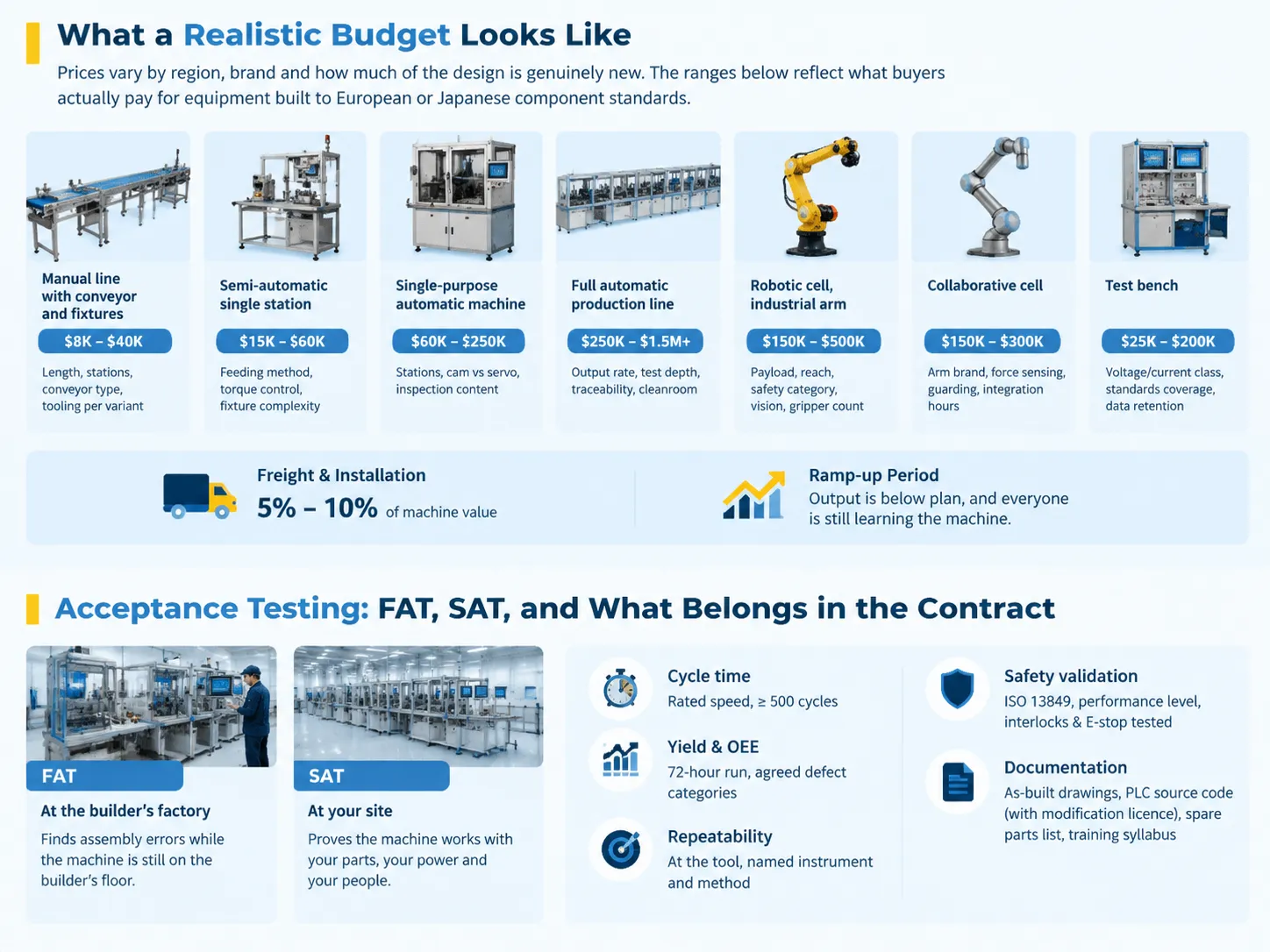
What a Realistic Budget Looks Like
Prices are based on the region, on the brand of components and on the degree of design innovation involved. The quoted ranges represent the actual prices paid by customers for equipment manufactured according to either European or Japanese component standards; these ranges are wide, by design.
| Category | Typical capital cost | What moves the number |
|---|---|---|
| Manual line with conveyor and fixtures | $8,000 to $40,000 | Length, station count, conveyor type, tooling per variant |
| Semi-automatic single station | $15,000 to $60,000 | Feeding method, torque control, fixture complexity |
| Single-purpose automatic machine | $60,000 to $250,000 | Number of stations, cam versus servo, inspection content |
| Full automatic production line | $250,000 to $1.5 M and up | Output rate, in-process test depth, traceability, cleanroom |
| Robotic cell, industrial arm | $150,000 to $500,000 | Payload, reach, safety category, vision, gripper count |
| Collaborative cell | $150,000 to $300,000 | Arm brand, force sensing, guarding, integration hours |
| Test bench | $25,000 to $200,000 | Voltage and current class, standards coverage, data retention |
There are two things that fall outside of these ranges and can shock first-time purchasers: transport and installation, which tend to equate to between 5% and 10% of the machine’s price, and the internal expense of the ramp-up period, when production is lagging to some degree and learning is underway.
Acceptance Testing: FAT, SAT, and What Belongs in the Contract
Include acceptance criteria in PO instead of email. A machine that satisfies an unstated expectation, is still a machine that does not pass acceptance.
Cycle time measurement is based on a steady run of at least 500 cycles, not by the stopwatch on 3 parts. Yield and OEE measurement should be performed during a 72-hour run, with the agreed classification of defects before running. Repeatability measurement is to be done at the machine tool with method and equipment mentioned in writing; if only the result is mentioned, you will not be able to defend your position in a year.
Then there are the two skipped. Safety validation per ISO 13849, marking of the performance levels, control of the interlocks, and timing of the emergency stop function. And documentation should include schematics, PLC source code with modification rights, spare part list with lead times, and training curriculum.
Pre-FAT conducted at the manufacturer’s site and SAT held at yours are two distinct events. The first is aimed at detecting assemblages errors when the equipment is still at the manufacturer’s site, the second one shows operation of the equipment using your components, power source, and staff.
Lead Time, Installation and the Costs Nobody Quotes
In the case of a modular production line, a practical lead time will be around 7 to 15 days for need assessment, 10 to 20 days spent on layout and conveyor choice through 3D CAD and material flow simulation, as well as 30 to 60 days for production, 5 to 10 days for installation, and several more days for final acceptance testing. Overall, it would take around 3-4 months, provided that the fixtures will have already been defined and the parts have been stable.
The lead time of automatic single-purpose machines is longer because the design cannot be reused anywhere else. The whole process usually takes around 6 to 9 months, and the time period is chiefly determined by the number of newly-constructed mechanisms.
As for the costs, they differ significantly:
First of all, you have to arrange for power supply and compressed air. Make sure that your machine will be supplied with power beforehand. The standard input power for the equipment is 380 V ± 10% at 50 Hz, however if there are servo packing stations, a chiller, or a machine compressor, there is a need for a dedicated input channel. Plan the area the machine will be placed in: the size of the door, the lifting capability of the elevator, and the weight of the machine will make the decision whether the machine will be able to get into the room or not at all.
The annual cost for spares is around 3% to 5% of the machine price, the initial spare kit should be purchased at the same time with the machine as the parts are still inexpensive and can be remembered by the manufacturer. Finally, individuals are another important cost item, although usually it is ignored in budgeting: it is recommended to have an engineer who will possess the PLC source and have received the needed training.
Buyers comparing turnkey line proposals will find the trade-offs between scope, price and risk laid out in this review of automated production line solutions, which is worth reading before you sign anything.
FAQ
What is automated assembly equipment?
Machines that execute part or all the stages of creating a product. It can be anything from a powered conveyor with tools where someone has to do the assembly to a fully automated process automated line with feeding, assembly, joining, testing and packing taking place in an automated way with operators just overseeing the work.
What are assembly automation systems?
The entire system includes the machine, the stations, the materials supply, the transport systems, the engineering systems used for control, the safety systems and the information processing architecture. While two suppliers may give the same supply of machines they will have completely different systems, because it is the interaction of systems which makes it possible for the equipment to work at the claimed productivity.
What are some examples of automated equipment?
An automatic contact insertion machine, a MCB automatic assembly line, a stacking and welding of arc chutes station, a capper that can handle 40 to 120 bottles per minute, a robotic screw driving work cell, an ACB full test bench, and a vision inspection station at the end of the line are all here because either one of the tasks involved was too uncertain, too slow, or too unsafe to do manually.
What are the five D’s of automation?
Boring, Messy, Harmful, Hard and Costly. Any monotonous task that exposes people to dirt, hazards and requires not a clarifying human touch or is simply difficult enough to be extremely costly is a good candidate for automation. The technology is outdated, but nonetheless the best in providing a list of suitable tasks for the companies’ estimation.
References
- International Federation of Robotics — World Robotics 2025: Global Robot Demand Doubles Over 10 Years
- A3 — Association for Advancing Automation
- Rockwell Automation — Control and Information Architecture for Assembly Lines
- Universal Robots — Collaborative Automation for Assembly and Machine Tending
- item Industrial Applications — Modular Profile Systems for Assembly Workstations
Conclusion
A product that you evaluate using comparison tools available online is not an assembly automation tool. There are seven categories of product classification, and the category mainly depends on the four important parameters. They are volume, variants, takt, and cost of defect in that order.
These four figures must be collected before making any request for quotes, after which the number of available options gets limited. Provide us with the figures along with your drawings, and we will assist you with the category, cost, and whether the automation is applicable at this volume.