benlong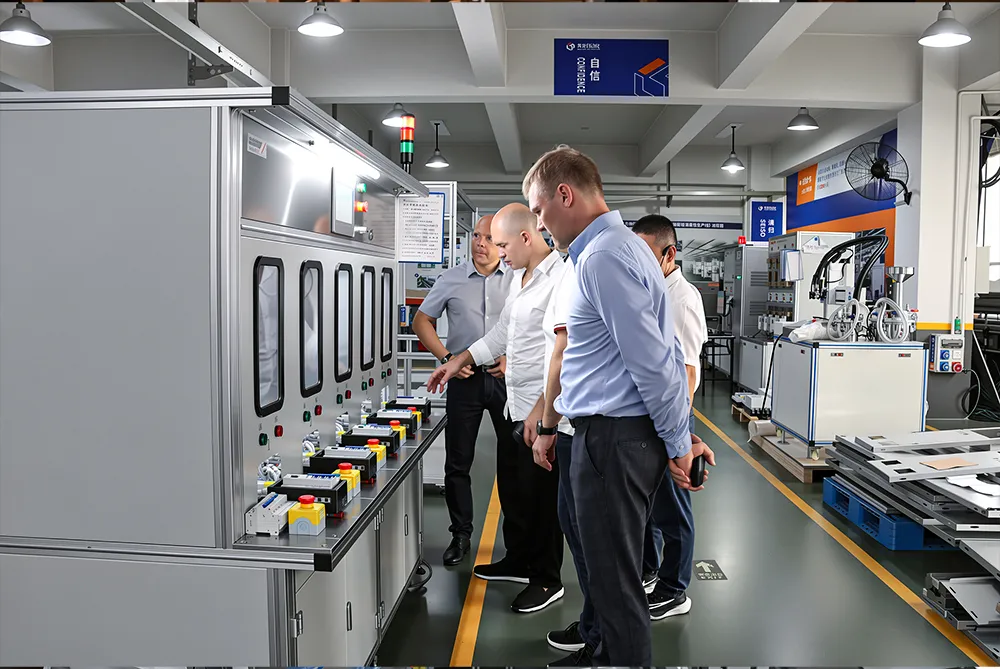
Top 10 Small Assembly Machine Manufacturers
The term “small assembly machine” has two meanings. First, it refers to a small assembly machine designed for the assembly of small parts such as connectors, valve bodies, sensors, circuit breakers, and so on. The second meaning refers to a bigger and custom-made machine for assembling big items that meets a particular takt time. The capacity of both types of the discussed machines is much lower in comparison to ordinary car assembly plants. These machines are supplied by manufacturers operating in this field, be it a small company with 40 employees or a big firm employing 1000 engineers.
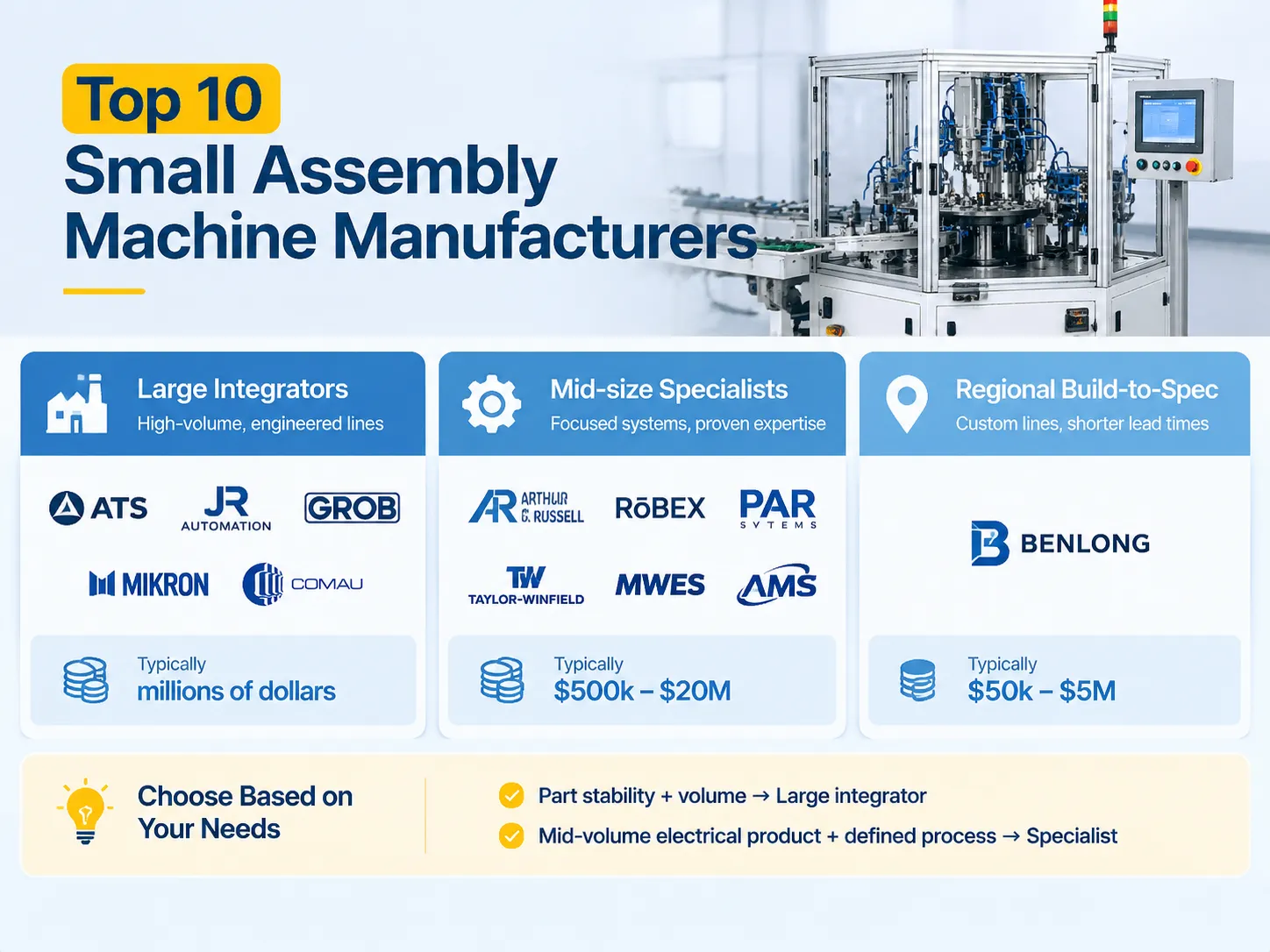
To summarize: The industry is split into three large segments. The first segment consists of big companies such as GROB, Comau, JR Automation, ATS and Mikron and involves the production of customized high volumes of products requiring investments of hundreds of thousands of dollars. The second segment includes medium-sized manufacturers like MWES, AMS, RōBEX, PAR Systems and Arthur G. Russell, which produce assemblies with values ranging from $500,000 to $20 million. Finally, in the small-scale segment, there are companies that provide services for amounts ranging from $50,000 to $5 million and with minimum involvement of decision-makers.
What a Small Assembly Machine Actually Is
The custom automated assembly machine is programmed to follow a series of steps — feeding, orienting, inserting, fastening, welding, inspecting, labeling and final packaging — without requiring an operator at every work station. Whereas a robotic workcell can be reconfigured for several different production lines, a custom machine is made for only one item or one family of items. As a result, every fixture, sensor and station exists simply because it is needed for a particular component.
This specific feature determines everything about how these machines can be purchased. There is no catalog, no list price and no comparison between quotations unless both suppliers use the same technical document. The machine delivered to the client is not simply a machine but rather a proven manufacturing system capable of producing at an appropriate takt time with a fixed quality and cost per item.
The difference between a true manufacturer and a trading company lies in the ability to engineer three fields: feeding and orienting of small parts, joining (press, ultrasonic, riveted and spun) and in-line verification.That distinction, and what a turnkey custom build actually involves, is set out in this guide to what a custom automated assembly machine manufacturer does.
The Ten Manufacturers Worth Knowing
Listed by the scale of programme they normally take on, not by rank. The right choice depends on the part, the volume and the tolerance — not on a league table.
| # | Company | HQ | Known for | Typical project range |
|---|---|---|---|---|
| 1 | ATS Corporation | Cambridge, Ontario, Canada | Complex engineered high-volume assembly, EV and life sciences | $5M–$100M+ |
| 2 | JR Automation (Hitachi) | Holland, Michigan, USA | Full assembly systems end to end, micron-level placement | Mid to high eight figures |
| 3 | GROB-WERKE | Mindelheim, Germany | Modular custom assembly stations, design-to-implementation integration | Mid to high seven figures |
| 4 | Mikron Group | Boudry, Switzerland | G05 and MAIA modular platforms for high-precision small parts | High six to eight figures |
| 5 | Comau | Turin, Italy | Automotive-grade assembly and joining at scale | Eight figures |
| 6 | Arthur G. Russell | Bristol, Connecticut, USA | High-speed assembly, medical disposables, consumer products | $1M–$20M |
| 7 | PAR Systems | Shoreview, Minnesota, USA | Vision and motion control for small precision parts, medtech | High six to eight figures |
| 8 | RōBEX | Perrysburg, Ohio, USA | Robotics integration, packaging and material handling | $500k–$10M |
| 9 | Taylor-Winfield Technologies | Youngstown, Ohio, USA | Robotic assembly with welding and riveting, repeatable small parts | $1M–$10M |
| 10 | Benlong Automation | Wenzhou, China | MCB/MCCB/ACB assembly and test lines, electrical manufacturing automation | $50k–$5M |
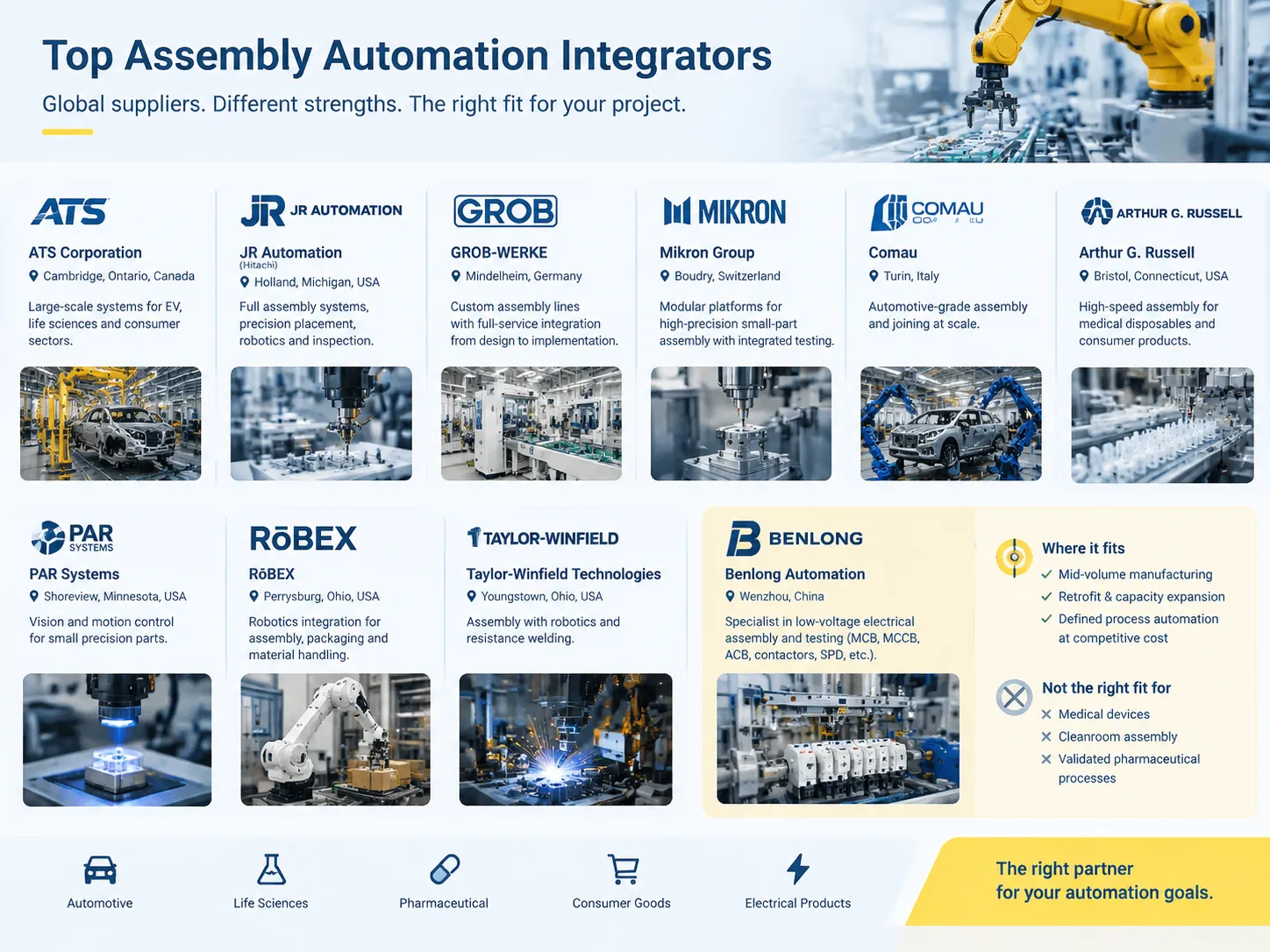
ATS Corporation — Cambridge, Ontario, Canada
It is one of the biggest assembly automation integrators in the world which creates in its factories elaborate engineered systems that allow to completely automate the assembly process in the production of electric vehicles (EV), in life sciences and consumer goods. The automation integrator is suitable for operations that are standardized and require a customized line for mass production. It is not recommended for the production of machines with unusual shapes and high variety of parts.
Certifications and practices: ISO 9001 certifications, CE marking for deliveries to Europe and UL/NFPA 79 regulations for deliveries to North America.
JR Automation — Holland, Michigan, USA (Hitachi)
Complete assembly systems include everything from single cells to large lines, featuring expertise in microns placement and inspection through robotics. Being part of Hitachi, Anders has the resources to manage cross-continental operations. In September 2025, the company revealed its new global headquarters in Zeeland, Michigan, which cost USD 72.8 million.
GROB-WERKE — Mindelheim, Germany
Customized and modular assembly stations and lines designed and fully integrated from planning to commissioning. The German engineering approach is intended for clients who require a documented process specification and a manufacturer willing to take the responsibility for an entire line instead of merely different stations.
Mikron Group — Boudry, Switzerland
The G05 and MAIA series are scalable modular systems that can be used for specific or separate distilling tasks in industries such as pharmaceuticals, electronics, and consumer goods. Due to the use of modular platforms, the development cycle is reduced compared to traditional custom machines, and hence the solution is suitable for customers planning to invest in several similar systems later on.
Comau — Turin, Italy
Automotive assembly and joining performed at enormous volumes, with the engineering capabilities for demanding high-volume operations. Focused on scaling up rather than on the use of high-mix or short-run processes.
Arthur G. Russell — Bristol, Connecticut, USA
Assembly at high speed for medical disposable devices and consumer goods, boasting a long experience in continuous motion rotary systems. A specialist in the market, as well as related pricing defined accordingly.
PAR Systems — Shoreview, Minnesota, USA
Custom assembly using vision and motion control for precision small parts, especially in medical equipment and life sciences. Strong in applications requiring closed-loop positioning instead of hard tooling.
RōBEX — Perrysburg, Ohio, USA
The integration of robotics includes assembly, packing, and handling of materials. For those who want a robot cell with tooling rather than a custom-made indexing machine, this is a middle-range integrator.
Taylor-Winfield Technologies — Youngstown, Ohio, USA
Automated assembly integrated with robotics and resistance welding, for repeatable small-part production where joining is the critical process.
Benlong Automation — Wenzhou, China
More of a builder rather than a generalist engineer with a specialty area which is limited: automatic assembly and tests for low-voltage electrical products. Based in Wenzhou, a city in China that specializes in low-voltage electrical industry, making MCB and MCCB and ACB and contactor and SPD and others since 2008.
The portfolio is unusually specific: automatic assembly lines for circuit breakers and electrical devices, arc chute assembly machines, case erectors, contact insertion machines, ACB and MCCB test benches, ageing benches, and calibration stations. For a manufacturer of electrical protection devices, that specificity is the whole value proposition — the supplier has already solved the feed orientation of a moving contact and the force profile of a bimetal calibration, which a generalist integrator would bill as development.
The areas in which Benlong operates include medium-sized production for electric goods, retrofitting and increase of capacity, and customers who have defined processes that should be automated and whose costs cannot be met by a general equipment supplier. The areas in which Benlong does not operate include medical devices, cleanroom assembly, or anything involving validated pharmaceutical processing.
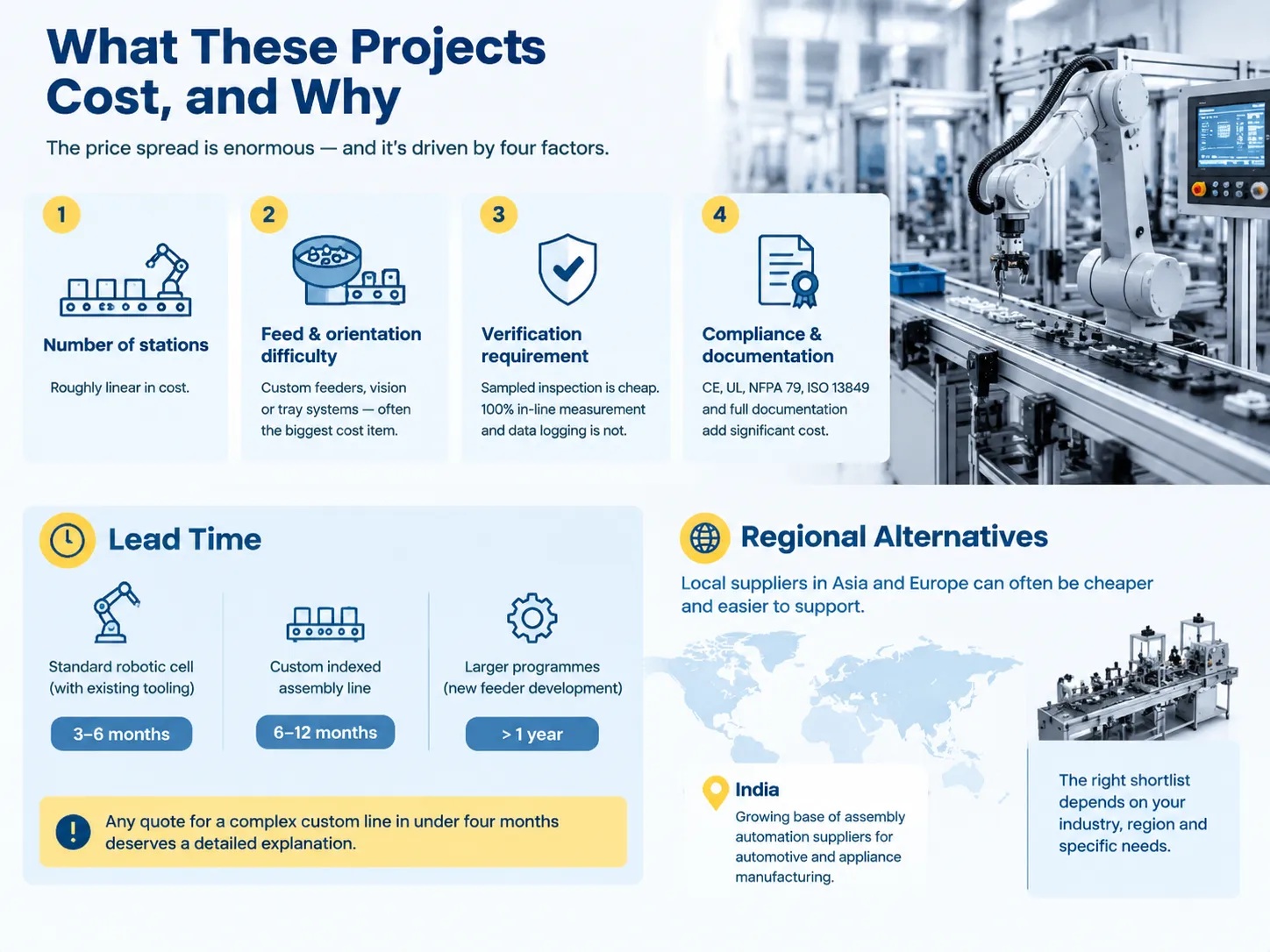
What These Projects Cost, and Why
There is a huge discrepancy in prices in the area of components. There are four key factors that need to be taken into account, as follows.
- Number of working stations. The price is very much linear in nature. For example, a line with six working stations is several times more expensive than a cell having two working station even before the analysis of the other factors.
- Difficulty of feed and orientation. Complicated feeders and custom vision-guided pickers are oftentimes the largest item in the estimates of prices.
- Verification requirement. It is very cheap to perform sampling inspection, but continuous measurements with data logging is not. In regulated industries, the verification cost may even overtake that of assembly.
- Compliance and documentation. The expenses related to CE marking, UL listing, safety validation and other aspects are not visible in the specification sheets.
Again we can see a strong correlation with lead time. A standard robotic cell can be delivered within three to six months. A custom assembly line needs to be ordered in advance (the lead time of six to eighteen months is required). If the lead time is less than four months, it is likely that some important aspects of the project have been omitted in the quotation.
Regional Alternatives Worth Considering
The above-mentioned list primarily features North American and European companies, indicating the fact that the biggest integrators are located there instead of revealing the location of the potential value. The regional areas have their specialized manufacturers, so for a buyer from Asia or Europe, their local manufacturers will often be cheaper and provide better after-sales services.
India is starting to become a sector for supply of assembly automation solving the problems of automotive Tier 1 and appliances manufacturing, and the terms of operation differ dramatically from those imposed by European integrators.The landscape there is set out in this overview of automatic assembly machine manufacturers in India.
The important thing is that “top 10” refers to “the top 10 according to how the author constructed the list.” A buyer from Vietnam obtaining an MCB line has very little in common with a Michigan company purchasing a cleanroom cell and thus has a totally different top 10 list.
How to Choose: Ten Questions That Separate Suppliers
- Have you manufactured this family of products in the past? Not this kind of machine—this particular product. A manufacturer with three comparable designs would meet a lower price and a quicker delivery.
- What is the realistic cadence? A station-by-station analysis of the lead time is needed and not just the aggregate time.
- What is the yield of the manufacturing process? A production line that achieves its designed rate but generates an 8% rejection rate still has unresolved issues.
- Who manufactures the feeders? Do they do it in-house, or is it outsourced, and how long does it take to develop a part?
- How do you complete the full product verification process? Sampling-based verification is a different product than the one with full traceability.
- What is the time needed for a machine to switch to a new process? Does it require a change of tools and software, or even a new machine?
- What safety standards are used and how is it assessed? For example, ISO 13849, IEC 62061 for machinery, NFPA 79 for electric equipment and CE mark if needed.
- What is the scope of commissioning and training processes? How long is the technical support during launching and who pays for travel?
- What is the guarantee on parts and technical service? How long is the time needed for repair and what machine components are available?
- Can I see the working reference line? Not a video, but rather a visit to the site. This is the most valuable step in the whole process.
These ten questions may help you to compare seemingly incomparable offers. If two suppliers have provided the same answer to all ten questions, it means that they are actually offering the same process and equipment. If only three questions are properly answered by two suppliers, their offer is based on different equipment and technology.The broader comparison framework for automated line purchases, including how to structure a specification, is set out in this guide to choosing the best automated production line solutions.
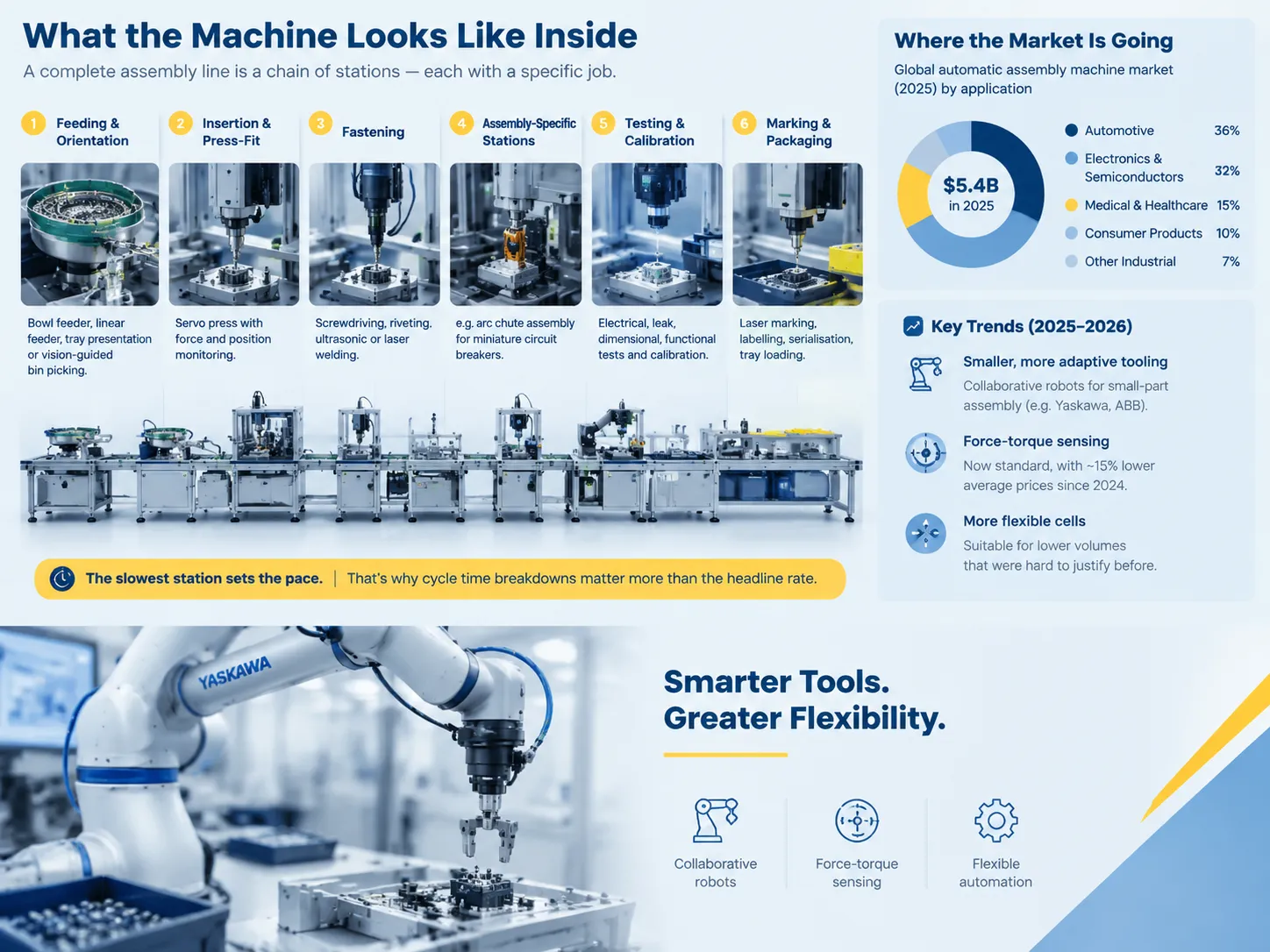
What the Machine Looks Like Inside
Comprehending the type of stations helps the quotes become comprehensible.
- Feeding and positioning. Bowl feeder or linear feeder with presentation trays or machine vision technology – this is the most difficult stage for the majority of projects.
- Insertion and fitting. The use of a servo press with force and position monitoring – each joint receives its own identification, which means that there is no simple QA.
- Fastening. Screwdrivers with torque control, riveting, ultrasonic or laser welding are used depending on the specifications of the joint.
- Assembly Operations. Some devices require special processes – such as arc chute assembly, contacts insertion, or bimetal calibration for circuit breakers. The arc chute station is a good example of how product-specific these get: arc chute assembly machinery for miniature circuit breakers handles a part that no general-purpose feeder can present reliably.
- Testing and calibration. This includes electrical test, leak test, checking dimensions, functional test and calibration where relevant to a measured value as opposed to being done on a bin level.
- Marking and packaging. This involves laser marking, labelling, serialisation and tray loading.
A line is a series of these and the throughput of the entire line is determined by the slowest station. Hence the station-by-station cycle time details discussed in question two is of greater significance than the headline rate.
Where the Market Is Going
Two changes are seen in numbers for 2025 and 2026. To start with, there is a change in demand structure: among potential buyers of universal assembly machine worth $5.4 billion in 2025, automotive industry accounts for about 36%, electronics and semiconductors for 32%, medical industry for 15%, consumer goods industry for 10%, and for other industrial sectors for about 7%. Electronics is the most active sphere because defect costs grow sharply with the loss of yield due to the nature of small-sized delicate parts.
Secondly, tooling is becoming smaller and more flexible. For assembly of small parts appeared collaborative robots. In 2025 Yaskawa’s small cobot for medical devices and ABB AI-based cobot for precise assembly were developed. Force torque sensors became affordable to the extent that six-axis force control is now the norm instead of the luxury line and the price for them dropped around 15% since 2024.
FAQ
What do small assembly machine manufacturers actually build?
Customized machines tailored for performing one or more production steps, which include feeding and orientation, assembly station welding, inline inspection, marking, and packing. A customized machine differs from a robotic workcell because it is engineered to work with a specific product, and thus all components and processes around it are driven by the same product. For example, some creators like Benlong build equipment only to be used in low-voltage electrical apparatuses and create all stations from production to testing.
How much does a small assembly machine cost?
Starting from a price of around $50,000 for a small simple cell to prices extending to $5 million and more for a fully indexed system. The systems developed by the larger integrators usually go from a few million dollars. The cost is determined by the number of stations, the difficulty of handling the feed and positioning the part, the verification needed, and the compliance paperwork requirements, in that order. A quotation can be compared with another quotation only if both quotations are based on the same specification of the process.
How long does delivery take?
Using existing tools, it may take three to six months to build an ordinary robotic cell, while it may take six to twelve months to construct a customized indexed line. Increased time is often required, especially when there is a requirement for new feeder design or large-scale program implementation. The commissioning and validation process take additional time once installation is completed, especially if 100% of the checking and traceability is required.
Which is better, a large integrator or a specialist builder?
It depends on the part and the volume. A large integrator will bring engineering depth and programme management for high-volume, well-defined products for a fee. A specialist builder who has worked through your family of products will offer you a lower quote, faster time to market and get the feed orientation right first time. For a mid-volume electrical product with a defined process this specialisation is typically more valuable than the scale of the integrator.
References
- ATS Corporation — custom automated assembly systems for life sciences, energy and consumer products
- JR Automation — automated assembly lines and systems for OEMs and Tier 1 manufacturers
- GROB-WERKE — modular custom assembly stations and full-service integration
- Mikron Group — G05 and MAIA modular assembly platforms for high-precision small parts
- Comau — automotive-grade assembly and joining systems
- PAR Systems — custom automated assembly using vision and motion control
- A3 — Association for Advancing Automation, industry resource for robotics integration and assembly
- ISO — ISO 9001 quality management, the certification most integrators quote in tenders
Conclusion
Small assembly machines manufacturers have nothing in common so before a list can be useful one must define their group. Leading integrators specialize in stable and high-volume products with well-defined requirements while mid-category specialists are required in cases when the production processes are precise and tolerances are strict. Local businesses like Benlong are suitable for high-volume electrical manufacturing projects where knowledge of the product matters more than the scale of the project. Therefore, determine which category to consider in answering the ten questions and check the manufacture before making the final decision.