benlong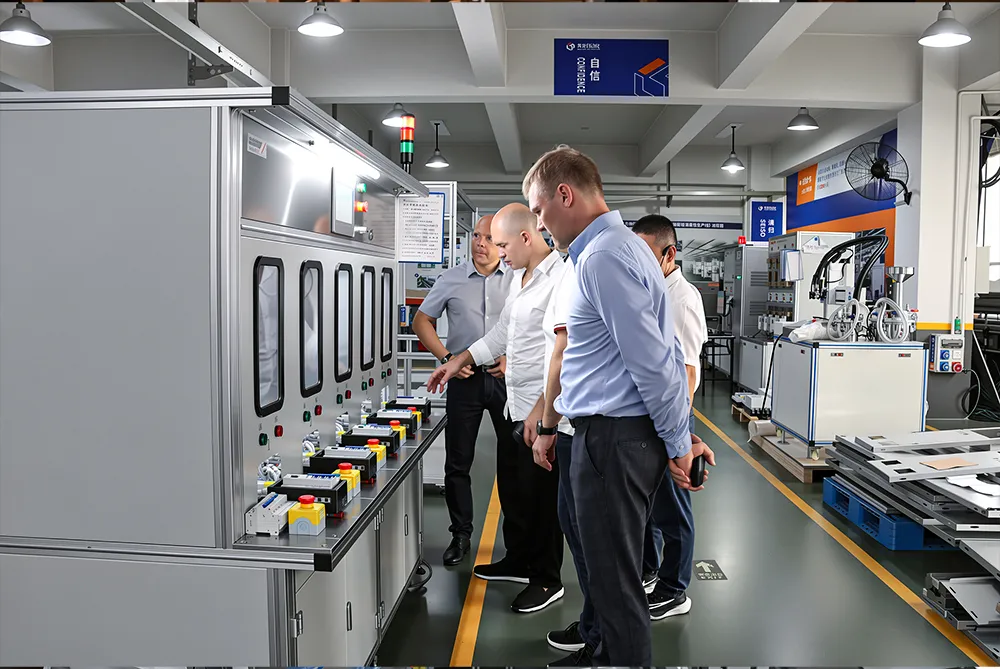

Performing Manufacturing Operations: A Practical Guide to Running a Factory Floor
FIP is an acronym for Female Iron Pipe, and refers to the internal-thread female part of the conventional North America tapered pipe connection. It has NPT threads together with MIP (the term which is used for male fittings) devices and can be made from brass, stainless steel, PVC, copper and galvanized metals. The process of determining what type of connection has to be applied is called IPS or Iron Pipe Size. Different abbreviations FIP, MIP, IPS etc. represent different connections belonging to the same family.
Thus there are certain requirements in practice that tell that a person has to define the female gender of the connection by simply looking from the inside. This means that when the threads are found inside, the connection is known to be FIP. It is necessary to pay special attention to the dimensions of the connection since sizes have to correspond and sealant has to be used for male connection.
Concise response: Manufacturing operations involve the processes that are used to manage daily activities and convert raw materials into actual products, which includes production planning and scheduling, machines operation, quality control, processes of readiness of materials, maintenance operations, employment of workers and project management with relevant measurement of the efficiency. The standards of ISA-95 divide the manufacturing operation into four distinct categories: production, quality, maintenance, and material management. The companies that use the principles of lean (removal of waste, continuing development) measure their performance in several KPIs, such as OEE, throughput, time cycle, first pass, and MTBF/MTTR.
What Is Performing Manufacturing Operations?
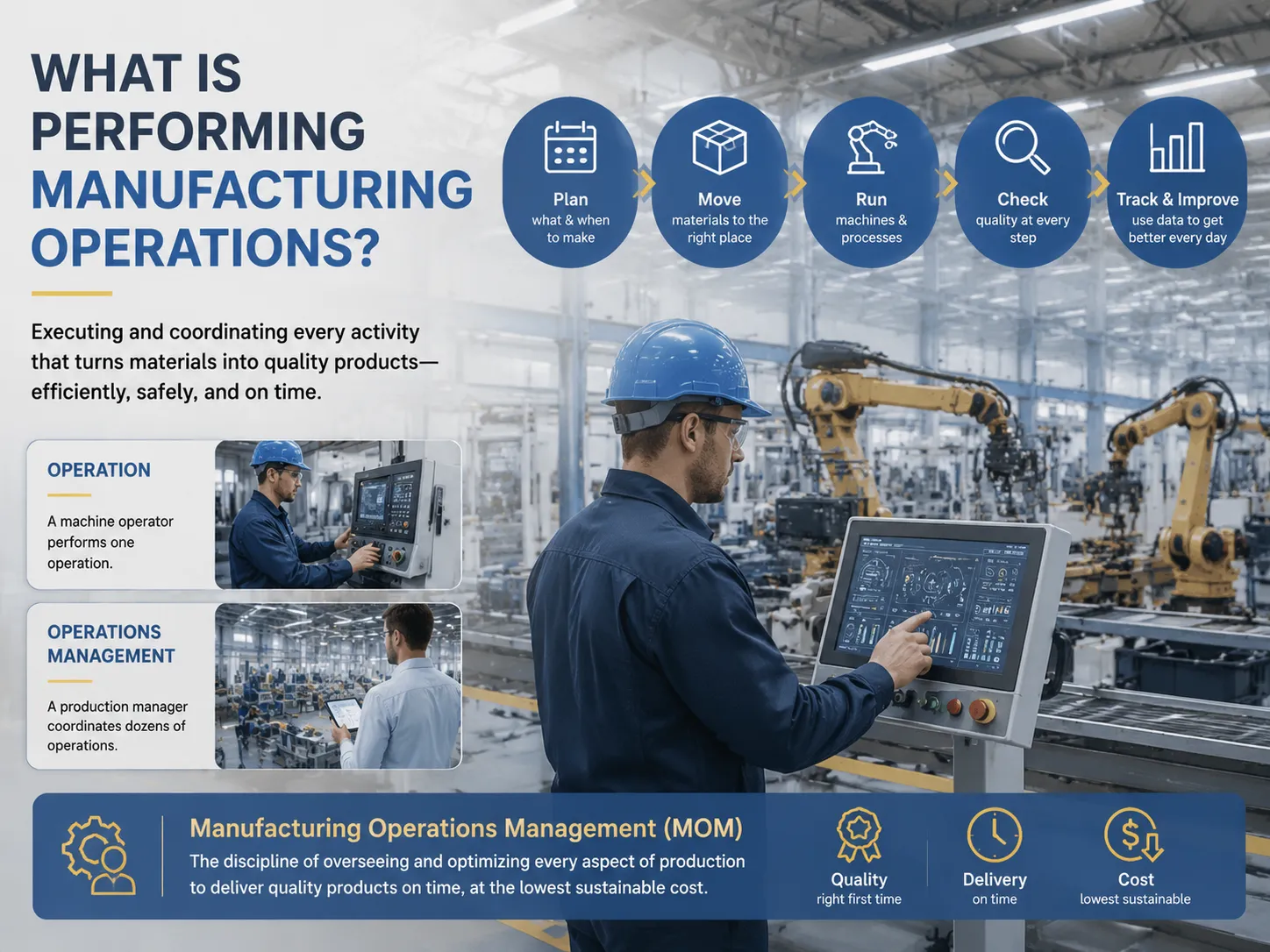
Manufacturing operations include every step taken in a factory floor to produce goods. Performing manufacturing operations means putting these steps into action and carrying them out on a daily basis. In other words, it means deciding on the product to be manufactured and determining when to produce it, ensuring that all materials are transported to the right station, operating equipment properly, maintaining quality, preserving operative capacity of machines, and keeping track of everything that occurred in the production process and utilizing that information to improve future processes.
Manufacturing operations cover more than just operating the machine. An operator of a machine performs one small part of operations, while the operations manager performs operations management. The two functions are interrelated, as both of them play an important role in the process of manufacture. The concept that embraces both manufacturing operations and operations management is called Manufacturing Operations Management (MOM), which regulates and improves all processes in production in order to maximize the quality of manufactured products and reduce the costs at the same time.
The Core Components of Manufacturing Operations
Each manufacturing facility, even if it is the tiniest metal shop or a plant worth more than a billion dollars, performs the same functions – although it does so in different volumes. They can be defined as building blocks.
| Component | What It Does | What Goes Wrong Without It |
|---|---|---|
| Production planning & scheduling | Decides what to make, in what quantity, and when; sequences work against capacity | Missed deadlines, idle machines, overloaded lines |
| Inventory management | Controls raw materials, work-in-progress (WIP), and finished goods | Stockouts that halt production, or excess inventory tying up cash |
| Quality management | Inspects and controls processes so products meet specifications | Defects, scrap, rework, customer complaints, recalls |
| Maintenance management | Keeps machines running with preventive and corrective maintenance | Unplanned downtime, breakdowns, shortened equipment life |
| Workforce management | Puts the right skills on the right job at the right time; trains operators | Bottlenecks, errors, safety incidents, low morale |
| Process control | Uses sensors, automation, and controls to keep processes within parameters | Inconsistent quality, safety risks, wasted materials |
| Performance analysis | Measures KPIs and feeds insights back into planning | Repeating the same mistakes, no improvement |
| Supply chain coordination | Aligns suppliers and material flow with production needs | Shortages, delays, overstocked shelves |
The Four Operational Domains (ISA-95)
In case you are looking for the framework that is accepted across the industry, the ISA-95 / IEC 62264 standard describes the field of manufacturing operations management through the four symmetrical domains of the area which are located between enterprise-level (ERP) and machine-level (PLC/SCADA):
| Domain | What It Manages | Typical System | Key KPIs |
|---|---|---|---|
| Production operations | Order execution, dispatching, data collection, traceability | MES | OEE, throughput, cycle time |
| Quality operations | Inspection, SPC, non-conformance, release control | QMS / LIMS | First-pass yield, scrap rate, complaint rate |
| Maintenance operations | Work orders, preventive scheduling, spare parts | CMMS / EAM | MTBF, MTTR, planned/unplanned ratio |
| Inventory operations | Material tracking, stock levels, WIP, consumption | WMS | Inventory turns, stock accuracy, WIP days |
The sophisticated aspect of this framework is that every domain has to follow the same activity loop – set rules → manage resources → timetable → allocate → perform → collect information → monitor → analyze efficiency → go back to definitions. What was found to be common in many factories is the fact that they often fail to implement the whole loop – monitoring data is being carried out but feeding it back into planning never happens. If a factory has dashboards and does not improve its operations as a consequence, the whole activity is meaningless.
The Five Stages of Manufacturing
The actual process which occurs in any manufacturing facility — making MCBs, food items, or furniture — follows five steps:
- Raw materials: Raw materials, parts, and sub-assemblies are brought into the factory, tested, and stored.
- Preprocessing/fabrication: The raw materials are shaped into parts through some manufacturing processes.
- Assembly: The parts are assembled manually, with automatic assistance, or automatically.
- Testing and quality control: The final product is inspected, and tested and compared with the required specifications.
- Packaging and shipping: The finished products are packed, marked, stored, and shipped.
Each of these steps has its operations, risks, and important measures. The bottleneck is the slowest of the five stages, according to which the efficiency of the entire operation is measured. For a closer look at how these stages are engineered into real production lines, our guide to industrial automation solutions and their efficiency benefits explains how fabrication, assembly, and testing are linked into a continuous flow.
What Successful Manufacturing Operations Look Like
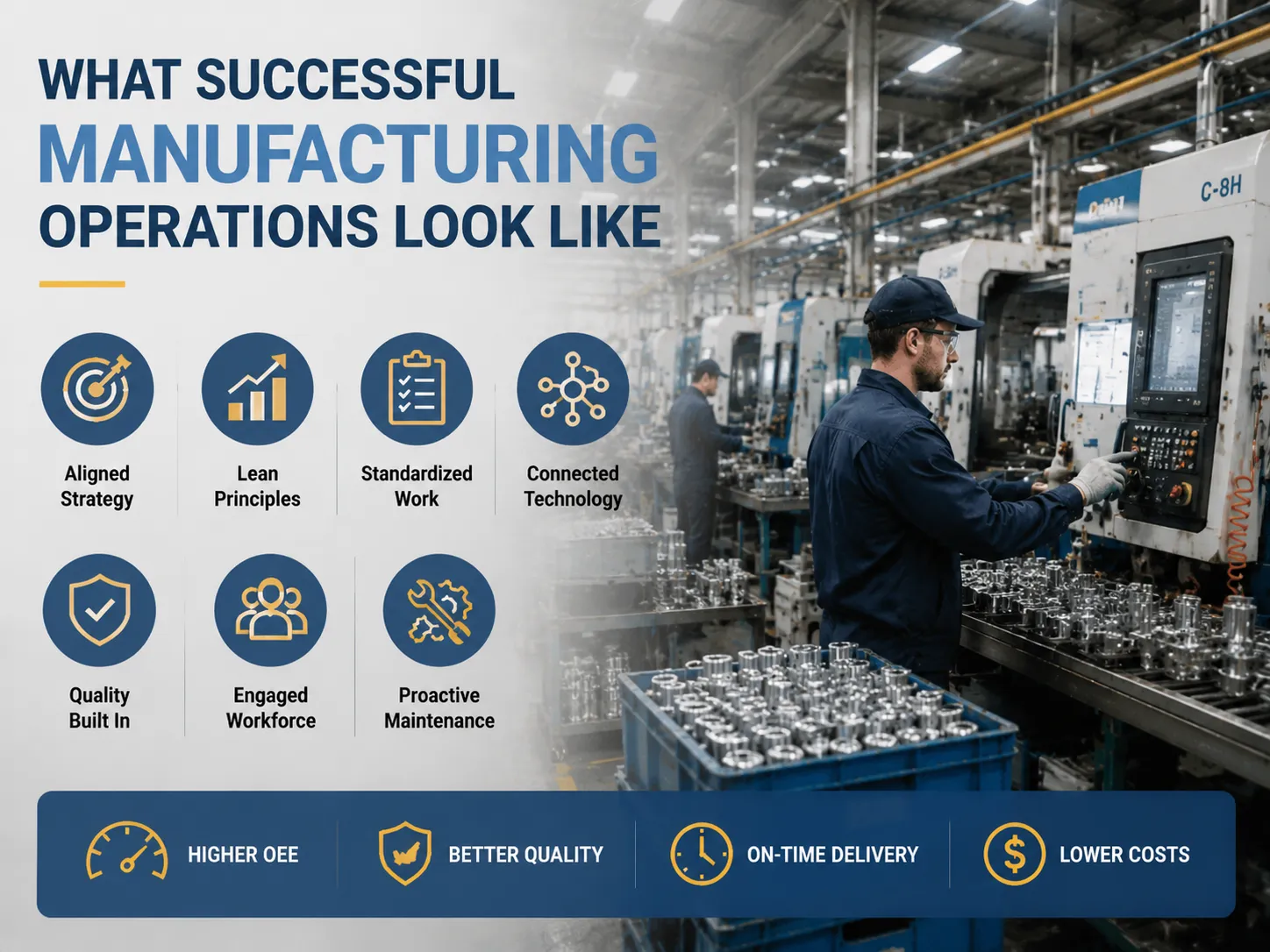
The features of successful factories have a specific pattern in common. High-performing plants differ from the average ones in their methods of work organization:
- Strategy based on business goals. Management decisions about operations (like capacity, automation, quality) must meet the requirements for cost, quality, and time.
- Lean manufacturing. There is a constant process of eliminating waste (including waiting time, excess production, errors, extra movement, and surplus of material).
- Standardized work. Each activity has a written instruction.
- Technologies that connect. The systems of MES, ERP, CMMS, and IIoT exchange data.
- Quality is designed into the product and not checked after production. Control measures are designed to detect defects before final inspection.
- Qualified personnel. The process organizers are trained in innovation processes and have enough powers to stop operation if a defect is revealed.
- Maintenance is not reactive but proactive.
Key Performance Indicators That Matter
You can’t improve what you don’t measure. These are the KPIs every operations team should track:
| KPI | What It Measures | Why It Matters |
|---|---|---|
| OEE (Overall Equipment Effectiveness) | Availability × performance × quality of equipment | The single best gauge of how well machines are used (world-class ~85%) |
| Throughput | Units produced per hour/day | Direct measure of line output |
| Cycle time | Time to complete one unit or operation | Reveals bottlenecks and improvement potential |
| First-pass yield (FPY) | % of units that pass without rework | Quality health; low FPY = waste and hidden costs |
| Scrap & rework rate | % of material lost or reworked | Directly hits cost and sustainability |
| MTBF / MTTR | Mean time between failures / to repair | Maintenance effectiveness and downtime risk |
| On-time delivery (OTD) | % of orders shipped on time | Customer satisfaction and credibility |
| Inventory turns / WIP days | How efficiently stock is converted to sales | Cash flow and leanness |
| Labor productivity | Output per operator hour | Workforce efficiency |
What Good Operations Management Delivers
A factory can expect various expected outcomes when its production processes are in order.
- More quality products: There will be less wasted material, less rejected product, and better consistency in products.
- Lower costs: Waste will decrease, raw material consumption will increase, and emergency maintenance will be minimized.
- More efficiency: There will be more products manufactured with the same workforce and machines.
- Faster delivery: Following production schedules will allow an easy shipping process.
- Better compliance: The ability to track every step of the production and their documentation will make sure that the strictest regulations are upheld.
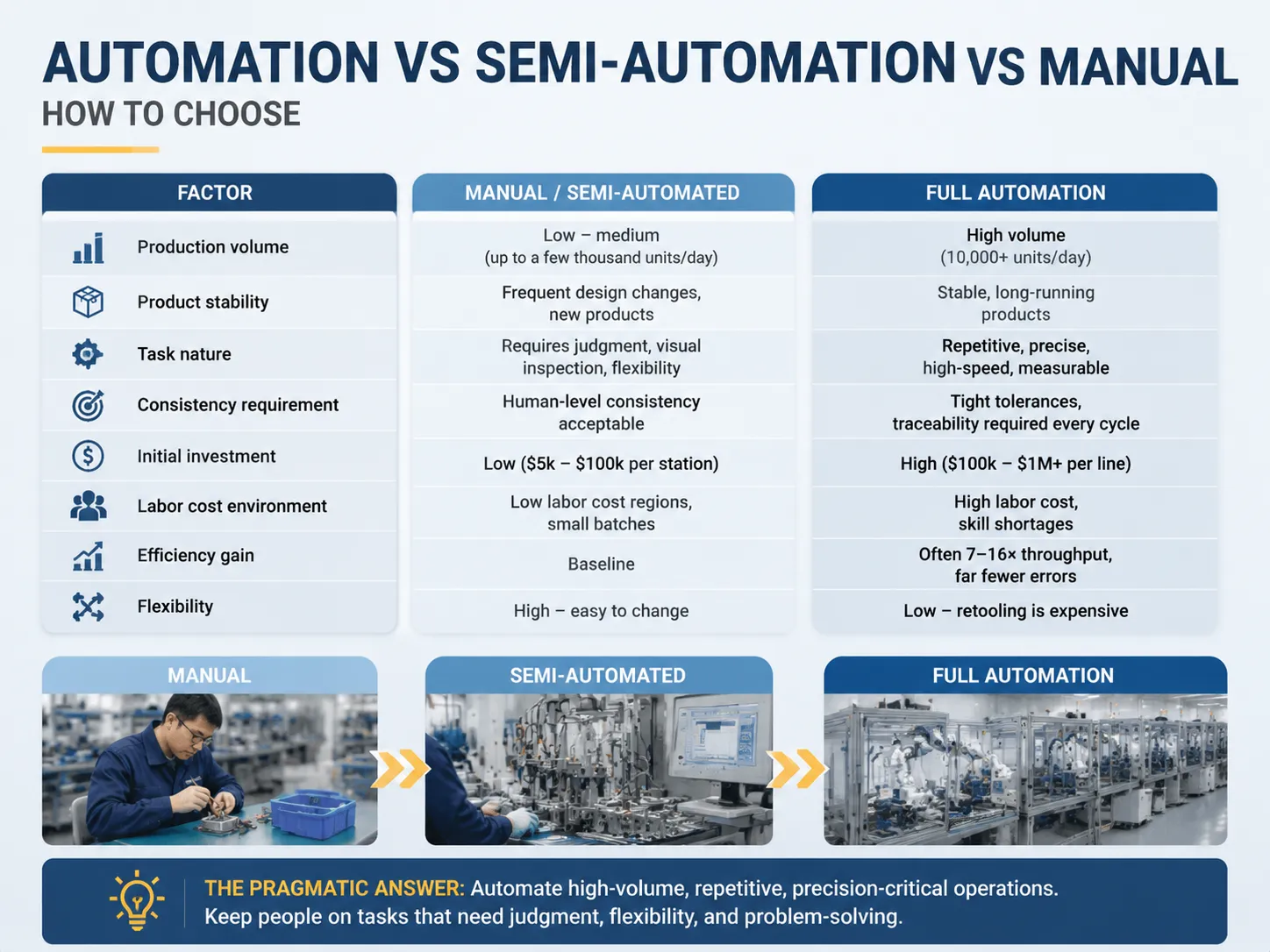
Automation vs Semi-Automation vs Manual: How to Choose
One of the most significant options available for making decisions regarding operations relates to the extent of automation. There is no one-size-fits-all answer to this issue as the situation depends on several variables, including volume, product consistency, labor costs, and quality requirements. FAirly speaking, here is how to approach the issue:
| Factor | Choose Manual / Semi-Automated | Choose Full Automation |
|---|---|---|
| Production volume | Low – medium (up to a few thousand units/day) | High volume (10,000+ units/day) |
| Product stability | Frequent design changes, new products | Stable, long-running products |
| Task nature | Requires judgment, visual inspection, flexibility | Repetitive, precise, high-speed, measurable |
| Consistency requirement | Human-level consistency acceptable | Tight tolerances, traceability required every cycle |
| Initial investment | Low ($5k–$100k per station) | High ($100k–$1M+ per line) |
| Labor cost environment | Low labor cost regions, small batches | High labor cost, skill shortages |
| Efficiency gain | Baseline | Often 7–16× throughput, far fewer errors |
| Flexibility | High — easy to change | Low — retooling is expensive |
In most factories, hybridization is a workable solution, including the automation of high-volume, repetitive precision-critical operations and the use of human labor for tasks that require judgment and skill, such as the production setup, inspection, troubleshooting, and ramping up of new product lines. This is the approach of the MCB and MCCB production lines.If you’re evaluating this for your own plant, resources on fully automated vs semi-automated production, the payback analysis of automated vs manual testing, and the role of human oversight in industrial automation show how real factories weigh the trade-off with numbers and experience.
The Two Basic Types of Manufacturing Operations
Manufacturing processes can be grouped into two groups based on their production methods:
- Make-to-Stock (MTS) — production is prepared before the order is made; items are placed in stock and dispatched from it. This method fits standard products with predictable demand. Handling demand forecasting and inventory system will help avoid surplus or shortage of stock.
- Make-to-Order (MTO) — production begins only after the order is received. Applied to the production of custom products with low volumes. This method requires quick assembly process and flexibility in scheduling.
Most plants use a hybrid system — normal items produced beforehand are dispatched to stock while customized products are produced upon order.
How to Improve Manufacturing Operations
Improvement can be described as a cycle rather than a definitive task. A basic overview of the sequence of actions to be taken is as follows:
- Identification: define 3–5 performance indicators such as OEE, FPY, throughput or OTD through methodical review of the existing performance indicators.
- Identify the limitations: The bottleneck is the weakest link in the process, so any improvement will be meaningless if it does not touch the bottleneck.
- Implementation of standards: Make sure that the best practice is in place, and everyone is aware of it.
- Improving the process: The team should request the assistance of professionals that will help them to eliminate waste using 5S, Kaizen, and other practices.
- Implementation of automation: The team should actively use automation only when necessary and collect data.
- Collection of the data: Once the data are collected, make sure to use it for the further rounds of the process improvement.
Frequently Asked Questions
What is performing in manufacturing?
“Performing” in manufacturing refers to the implementation of operations designed to convert raw materials into final products — all activities of producing, assembling, testing, and packaging must be conducted as prescribed and additionally include quality control, maintenance, stock accounting, and planning. In the terms of the phrase “performing manufacturing activities,” the term simply means completion of daily operations of production. “Performing,” however, may also mean the fact of how well a machine, factory, or process is doing its work.
Can you give me an example of a manufacturing operation?
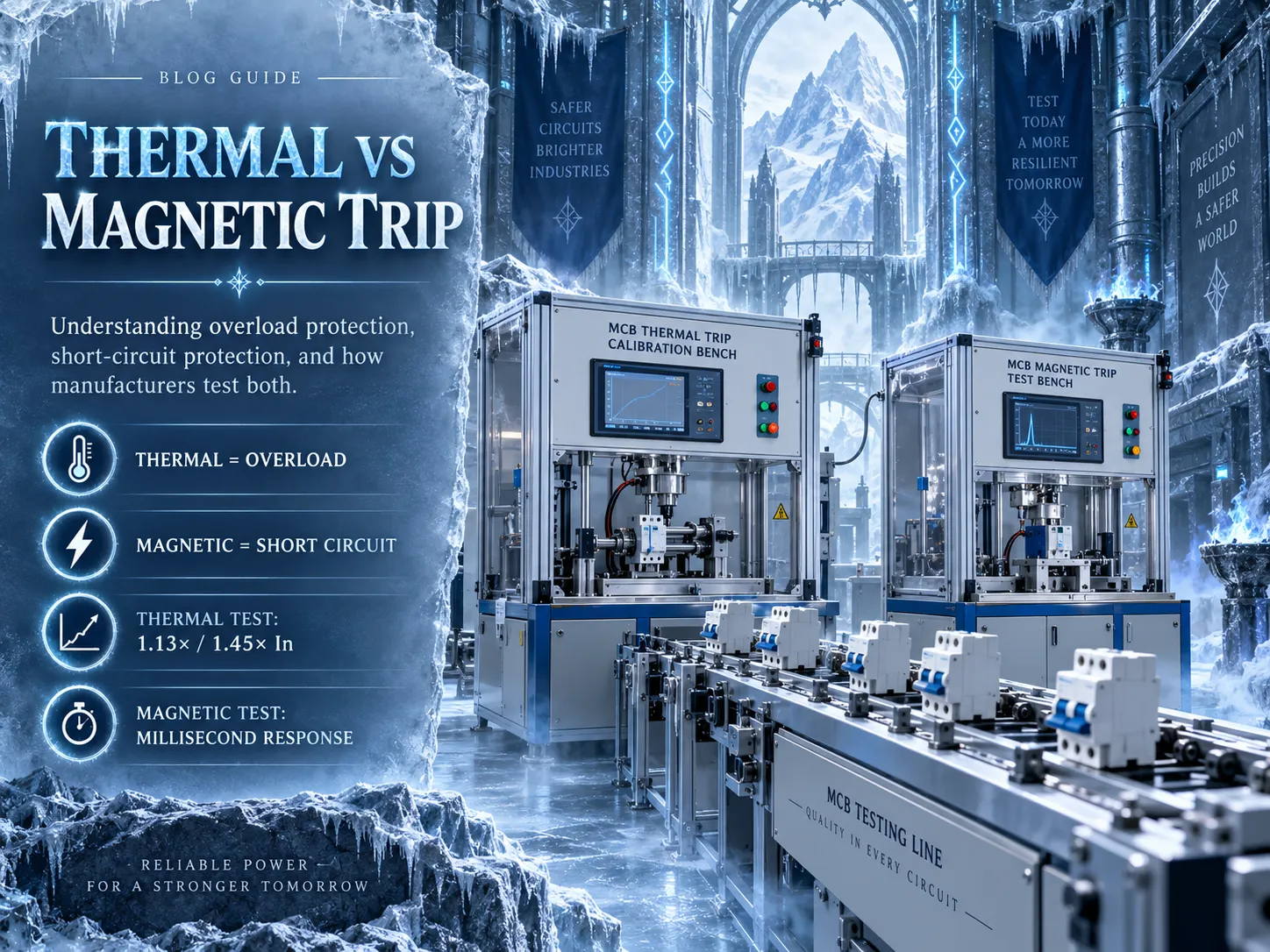
Certainly. Let’s take a look at a practical example. In the case of a circuit breaker factory, a manufacturing operation can mean a particular manufacturing step. Some operations at a production line can be described as “commitment of the contact assembly to the breaker case through riveting,” or “testing MCBs at 1.13× rated current in order to check for thermal tripping.” The operations used for production include molding the casing, stamping contacts, riveting, assembly of an arc chamber, calibrating, testing, labeling, and packing. Each operation has its own equipment, operator, work standards, and quality checks. Manufacturing operations management provides coordination of all the processes occurring in the chain in order to ensure that the production line produces not 10,000 parts stuck on the bottleneck, but rather 10,000 good breakers daily.
What are the five stages of manufacturing?
The five stages of manufacturing are as follows: (1) raw materials — receiving, checking, and storing raw materials; (2) pre-making — cutting, molding, stamping, or shaping parts of the product; (3) assembly — putting the parts together; (4) testing and quality control — checking if the products meet the standards; and (5) packing and shipping — putting packaging products in the appropriate place and sending them away. All plants perform these five stages in one or another way, each stage having its risks and costs.
What are the two basic types of manufacturing operations?
Depending on the trigger of production, there are two main types: Make-to-Stock (MTS) — where standard products are produced in advance based on forecasts and then stored until they are shipped from inventory — and Make-to-Order (MTO), which begins only after a customer places an order, usually for a special product. MTS is tailored towards predictable high-volume standard goods. In contrast MTO is more suitable solution for custom-designed products and rare commodities. Some factories opt for MTS-based production for standard good while MTO is chosen for individual pieces.
References
- ISA-95 — Enterprise-Control System Integration standard (IEC 62264): the MOM framework
- ISO 9001 — Quality management systems: process approach and continuous improvement
- OEE — Overall Equipment Effectiveness definition and calculation
- Lean Enterprise Institute — lean manufacturing principles and Kaizen
- Augmentir — Manufacturing Operations Management: A Complete Guide
- Symestic — Manufacturing Operations Management (MOM): ISA-95 Definition and domains
- MESA International — Manufacturing Enterprise Solutions Association
Conclusion
Manufacturing operations are defined as the continuous work of converting raw materials into goods in a cost-efficient, safe, and profitable manner. Covering the likes of job planning, production process, quality control, maintenance, inventory, and labor management, several fixed stages are undergone while dealing with them in manufacturing operations. They consist of production, quality control, maintenance, and stockpiling of goods at the warehouse. The measurements used to evaluate operations include OEE, throughput, and yield, among a number of others. Good operational management makes a difference between succeeding factory and merely surviving one.
For those buyers searching for a manufacturer, it is very important to analyze their operations first, rather than their equipment. For starters, they inquire them about their OEE level and approaches to quality control and traceability of the order, and automation of their production process.Benlong (benlongkj.com) builds automated assembly and testing lines for low-voltage electrical products like MCBs, MCCBs, and contactors — a working example of how manufacturing operations are engineered for consistency, traceability, and throughput in the real world.