benlong


How to test AC Contactor easy:Simple, fast, and low-cost.
If you have held a set of AC contactors and questioned if they will perform correctly when connected to a starter motor or control panel, you are asking one of the most important questions about AC contactors. How to test AC contactor? It is a small device, but when it does not operate correctly, it can halt all production processes, damage the electric motor, or cause the shutdown of the company. The fortunate thing is that you do not have to invest in a costly automated system in order to answer this question. You can learn how to properly check AC contactors using a simple manual bench which may be operated by almost anyone.
This manual is meant for individuals who are inquisitive and capable but unfamiliar with contractor testing — an engineer who is establishing a small government or university research facility or a proprietor who operates a small factory and intends to inspect the raw material or products without investing heavily. If you already run high-volume production and need traceable, automated data logging, our companion article on the AC contactor comprehensive test machine covers that path in detail. Here, we focus on the practical, budget-friendly, hands-on approach.
Why Testing an AC Contactor Matters
An AC contactor can be defined as a switch that is controlled electrically, consisting of a coil that pulls the moving contact set into position for current transmission to the load, and releases it upon deactivation of the coil. Given that the contacts are expected to open and close thousands of times under load, it is subjected to wear and tear, arcing, welding and mechanical fatigue. Failure of the coil may occur with time and it may pull so late that there will be no load on its release.
Testing enables one to identify these problems in contactors before they get installed. For small manufacturers, this translates into lesser returns under warranty and strengthening the reputation with customers. This also means that the laboratory can verify the rating of the product and issue a report that is credible.
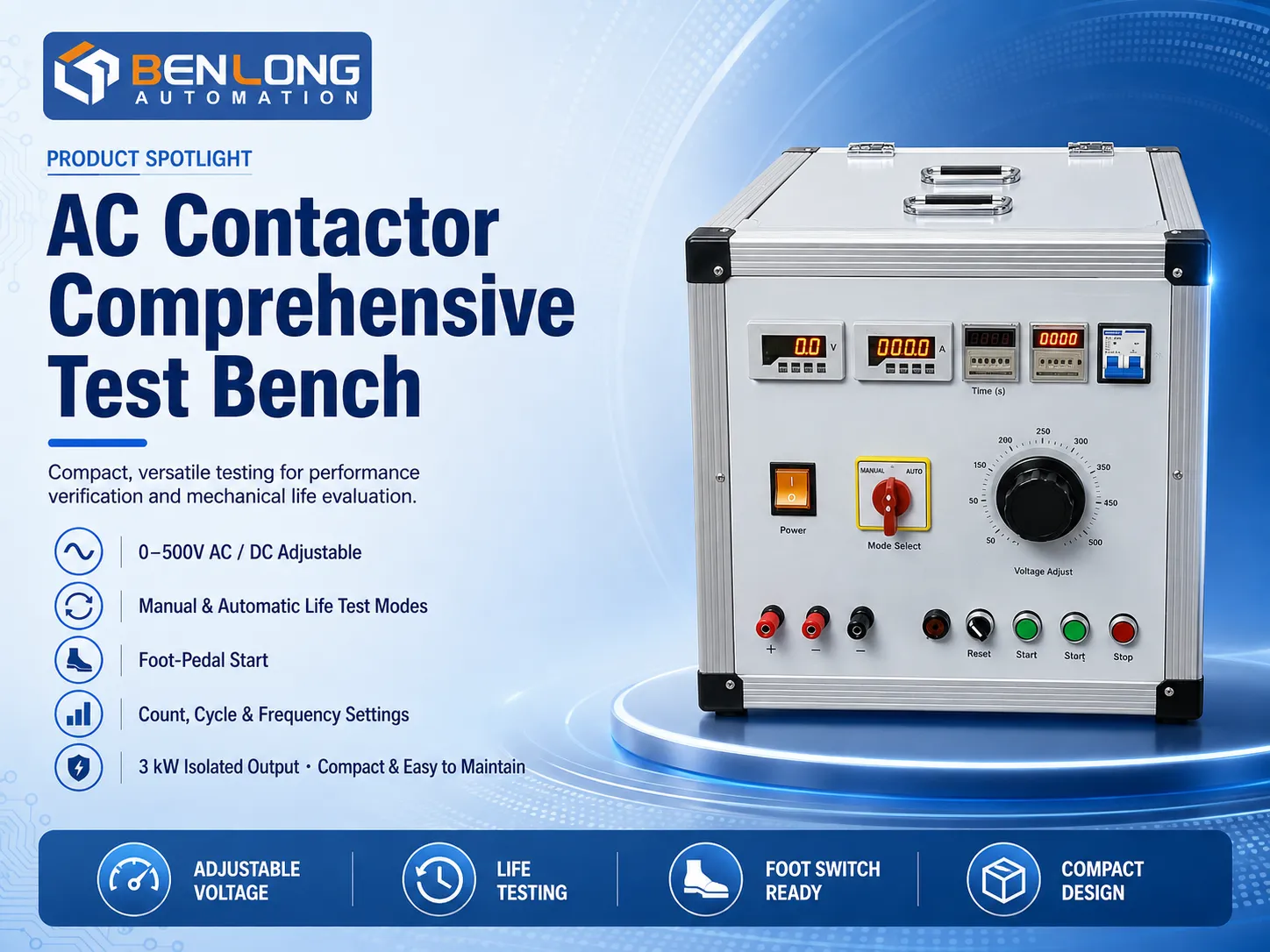
What a Manual AC Contactor Test Bench Is
A manual testing bench is a small and independent position that consolidates everything required to use a contactor and assess its performance without using any automation systems and robots. You attach the contactor, plug in the coil and main terminals to the bench and use the switches, dials, and meters available in the cabin for conducting the tests on your own.
From the perspective of a budget-oriented buyer, this is a very simple decision since the bench will allow a person to learn to operate in just one day instead of a week. The bench contains fewer components that may fail thus ensuring inexpensive maintenance and easy availability of spares. Since there are no complex control systems, its cost is also significantly lower than the cost of a fully automated line. Thus, companies must choose between speed, simplicity, and low costs where low or medium operating volume is very important.
A well-structured manual bench usually gives an opportunity to apply adjustable AC voltage to the coil, apply a load through the main contacts, measure contact resistance, as well as to perform insulation withstand-voltage tests.
How to Test an AC Contactor: A Step-by-Step Manual Method
Here is a sequence you should adhere to. Follow the steps one after the other and at all times remember the safety instructions that apply to your workbench; some of the checks involve the usage of live voltage.
Step 1: Visual and Mechanical Inspection
Prior to activating the unit, inspect the contactor thoroughly for cracked casings, loose screws, deformed or discolored contacts, or indications of past overheating. You can confirm whether the contactor works properly by manually activating the moving armature while not energized; it should move easily without sticking or causing any grinding sounds!
Step 2: Coil Pull-In and Drop-Out Voltage
This is one of the most important tests, and it is where a manual bench shines. Using the adjustable voltage supply, slowly raise the voltage on the coil and note the point at which the contactor “pulls in” — the moment the contacts snap closed. Then slowly lower the voltage and note the “drop-out” point where it releases. A healthy contactor pulls in comfortably below its rated coil voltage and drops out within its specified range. If it needs excessive voltage to pull in, or refuses to release, the coil or mechanism is suspect.
Step 3: Contact Resistance and Continuity
With the contactor energized and holding closed, measure the resistance across each set of main contacts. You are looking for a low, consistent reading across all poles. A high or erratic reading points to pitted, oxidized, or partially welded contacts. Comparing the three poles against each other is a quick way to spot a weak one, because a good contactor should read almost identically across all of them.
Step 4: Insulation and Withstand-Voltage Check
Insulation testing confirms that current only flows where it should. A basic manual bench can apply a test voltage between poles, and between the contacts and the frame, to confirm there is no leakage or breakdown. Follow your bench’s rated procedure and never exceed the contactor’s specified test voltage. This step protects the end user from short circuits and is often required for any product that will be exported or certified.
Step 5: Make-and-Break Operation Under Load
Now exercise the contactor the way it will actually be used: opening and closing while carrying current. Operate the coil repeatedly and watch and listen. The contacts should close firmly with a clean, consistent sound, and open decisively without excessive arcing. Chattering, a buzzing hum, or a sluggish close all indicate a problem with the coil, the magnetic core, or the mechanism.
Step 6: Endurance and Cycle Counting
To conduct a simple test for durability, cycle the contactor several times and keep track of how many times it gets cycled. Although you cannot run it through millions of cycles, you can still run the contactor a few hundred times manually to detect any problems that might arise in the mechanics such as contact bounce or overheating coils. For smaller manufacturers this simple test is usually all that is required for quality assurance.
Understanding the Wiring: The Bench Schematic
The transparency of the wiring makes a manual bench an acceptable choice for novices. You can follow every wire visually, making it a good educational and diagnostic device. The diagram below shows how the coil circuit, the main circuit, and the measuring devices are linked on a complete manual bench.
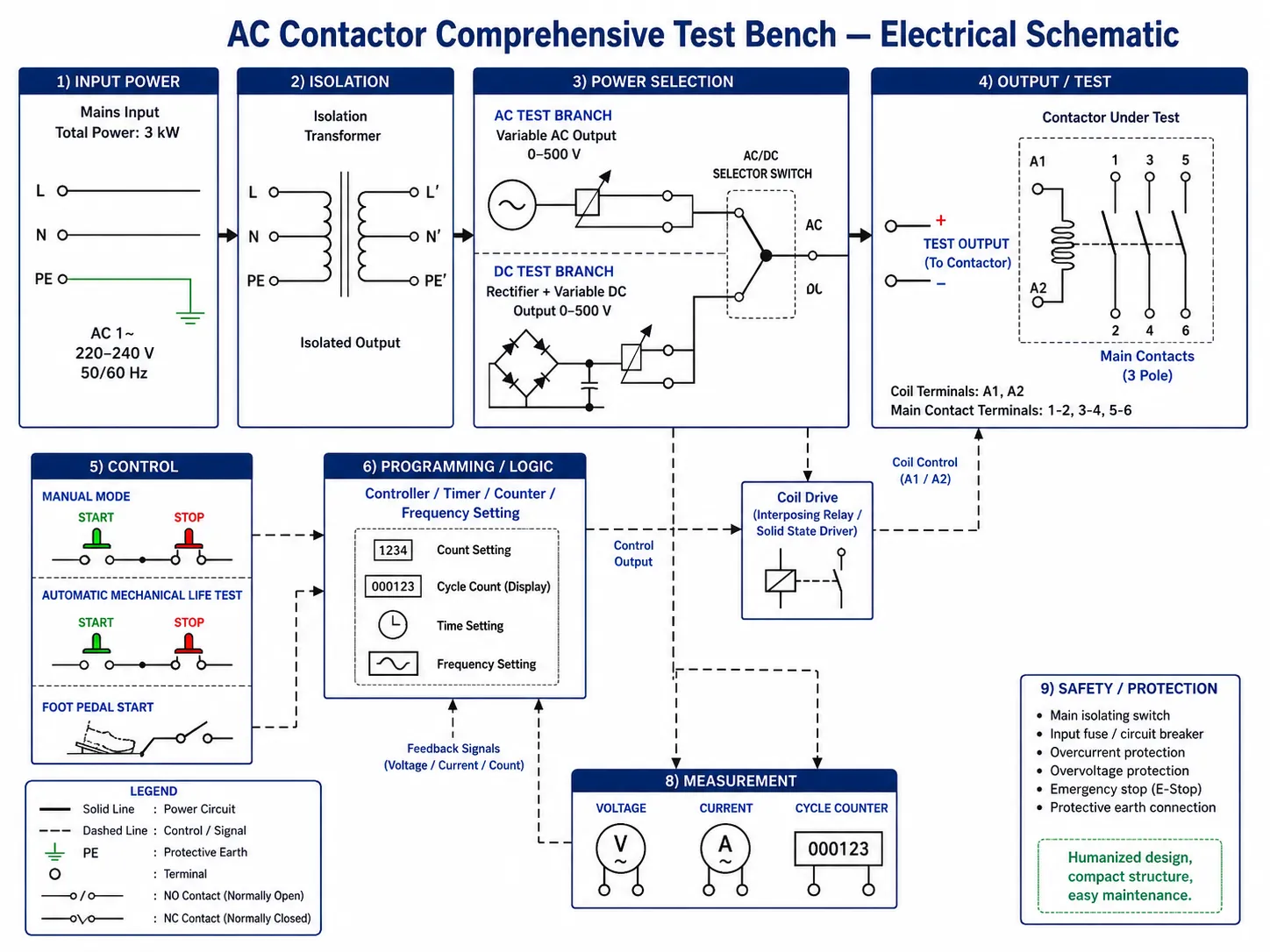
Spend a little time with this diagram before your first test. Identify where the adjustable voltage feeds the coil, where the main contacts sit in the load path, and where each meter taps into the circuit. Once you understand the layout, every step above becomes intuitive rather than mysterious, and you will be able to diagnose an unexpected reading instead of just recording it.
Manual vs. Automated: Choosing the Right Approach
It is worth being honest about the trade-offs so you can make the right decision for your situation. An automated comprehensive test machine performs many checks in one cycle, logs precise data automatically, and removes operator variation — which is ideal when you are testing thousands of units and need traceable records for large customers. If that describes you, read our detailed look at the automated AC contactor comprehensive test machine.
In contrast, manual benches are cheaper, easier to operate, and can be easily repaired. It requires one operator per each testing, and is not as fast but provides the same basic electrical information about the contactor at a much lower cost. For laboratories preparing periodic reports, shops testing the delivered parts, or small factories checking their production this ratio of low cost and easy usage can be ideal. Many companies use manual benches for a long time before switching to automation which become profitable when there is a big volume of production.
Who Benefits Most From a Manual Test Bench
Two types of organizations benefit the most from this method. First, there are the small manufacturers – company-owners looking for a cost-effective method to maintain quality control without hiring specialists or spending on expensive equipment. The second group consists of institutional laboratories – government laboratories and universities looking to lower their costs while doing quality control tests.
These needs are prevalent particularly in South Asia, Africa, and other emerging regions that have little capital but high are strict regarding quality. The manual bench fits that bill perfectly – it is affordable to buy and operate, simple to master, and durable. You will obtain the quality assurance of experts without spending much.
What to Look for When Choosing a Manual Bench
Not all manual test benches are the same; therefore it is necessary to pay attention to certain specifications. You should start by finding a bench that has completely adjustable control voltage, as it is necessary to ensure that voltage can be varied smoothly for pull-in and drop-out testing to be effective. You also need to pay close attention to meters, their clarity, intelligibility, and labeling, since a confusing control panel can create a huge number of errors. Ensure the bench terminals and holders can accept all sizes of contactors for connections not to be improvised. Prioritize the sturdy bench construction and availability of spare parts since it is what makes a bench work for years even in busy or dirty environments. Lastly, make sure that the supplier gives you a clear connection diagram and basic operator training as proper documentation can help a new operator start working.
Common Mistakes Beginners Should Avoid
A few simple habits will keep your results trustworthy. Always confirm the contactor’s rated coil and load values before testing, so you know what “normal” should look like. Never skip the visual inspection, because it catches obvious faults for free. Compare all three poles against each other rather than judging a single reading in isolation. Keep contacts and terminals clean, since dirt and oxidation can mimic a genuine fault. And most importantly, respect the safety procedures for every live-voltage step — a careful operator is an accurate operator.
Frequently Asked Questions
Can I really test an AC contactor without an automated machine?
Yes. A manual test bench lets you verify coil pull-in and drop-out, contact resistance, insulation, and operation under load — the checks that determine whether a contactor is fit for service. Automation adds speed and automatic data logging, but the underlying electrical tests are the same.
How long does it take to learn to use a manual bench?
Most new technicians become comfortable within a day. Because the wiring is visible and the controls are simple switches and dials, the learning curve is gentle compared with software-driven systems.
Is a manual bench accurate enough for a test report?
For many laboratory and small-manufacturer purposes, yes. As long as your instruments are properly calibrated and you follow a consistent procedure, a manual bench produces credible, repeatable results.
Conclusion
Learning how to test ac contactor does not have to mean a large investment. A well-built manual test bench gives small labs and workshops a clear, affordable path to verifying quality — from a quick visual check to coil voltage, contact resistance, insulation, and operation under load. It is simple to operate, cheap to maintain, and ideally suited to budget-conscious buyers who still refuse to compromise on reliability.
If you are ready to start testing with confidence, our team can help you choose a manual AC contactor test bench sized to your needs and budget. And when your volumes grow, we are here to help you scale up to automated testing as well. Contact us to discuss the right test bench for your laboratory or factory.