benlong

Difference Between Manual and Automation Testing
When a medium-sized manufacturer of miniaturized circuit breakers in Pune landed a big export order to Germany, the technical specifications contained a requirement they had never faced before: every circuit breaker was to have a digital calibration certificate with unique serial number and trip-time information. The current quality testing process in the factory involved a team of ten engineers where each one tested circuit breakers in separate benches. They were proficient in their work, quick, and consistent, but did not generate a single digital record. The manufacturer faced a very difficult decision: employ an army of data-entry operators to record the test results or set up an automated testing line that would automatically capture all data. The latter choice was made, and six months after the line launch, it was both able to fulfill the documentation requirement and drop the defect escape rate by 80%. The lesson learned was that there is more than just speed and cost involved.
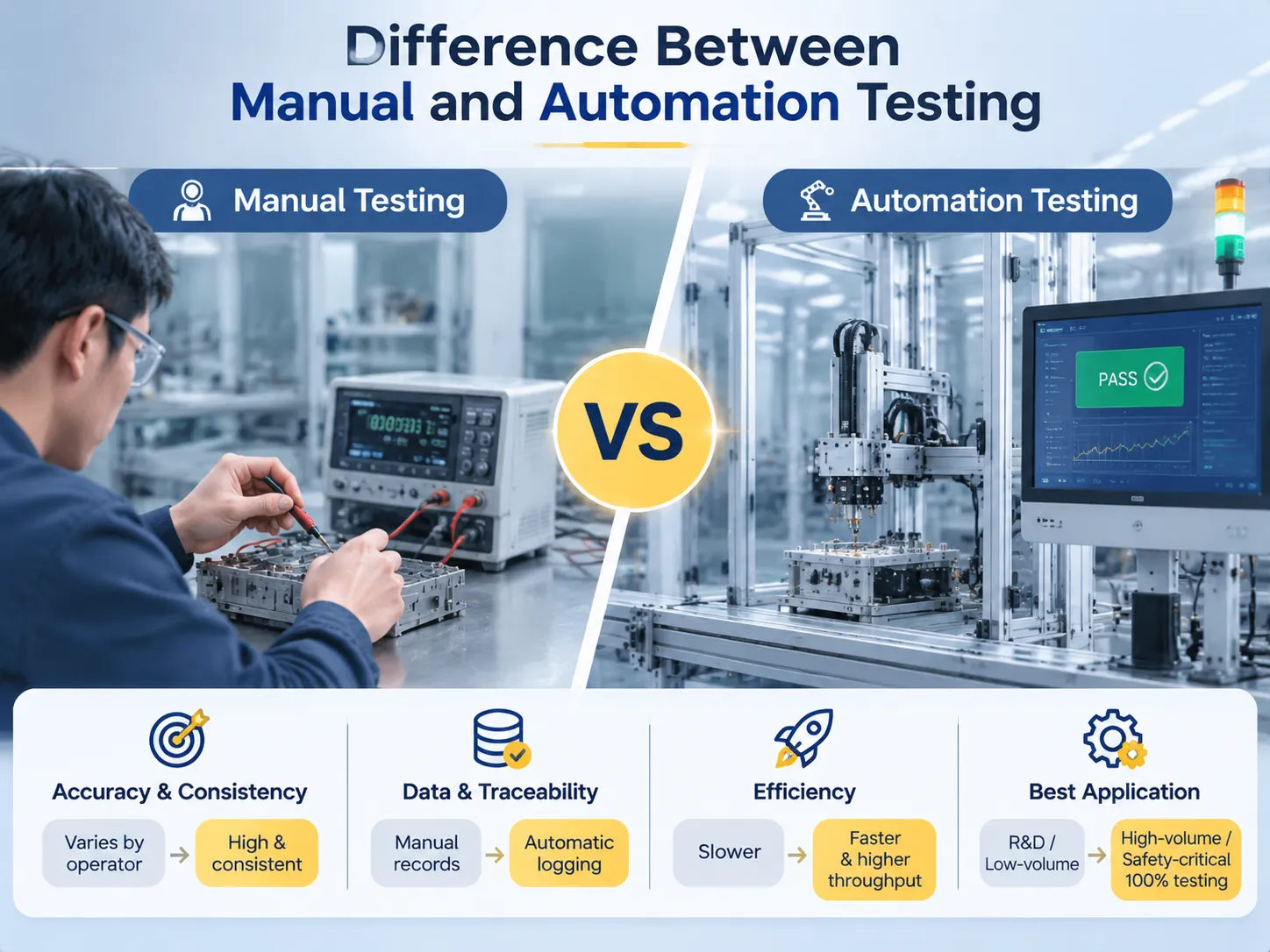
Summary: To arrive at conclusions about testing manufacturing choices there’s no need to think in terms of choosing whether you want hand testing or automated testing, as the best method will usually combine the automated testing of high-precision, high-volume tests with manual testing for low-volume, investigative or quick-changing processes. Thus, the implementation of testing will not involve the complete removal of humans from the process of testing; instead, instead of performing a test, they will be analyzing the results generated by automated systems.
Defining the Two Approaches: What Manual and Automation Testing Mean in a Factory
Manual testing is the process of someone executing each of the test procedures themselves, working with the object, which can be for instance a circuit breaker, a contactor or a connector. The individual takes the product from the production line and places it to the test fixture or test bench according to the prescribed procedures. At the same time, he/she applies the force and observes the performance of the tested object. As far as this procedure is concerned, the outcome is recorded on paper, in a spreadsheet, etc.
The role of automated testing is to remove the human being from the process. The PLC controlled testing department automatically receives the product and applies the pressure force, measures the response and logs the information obtained.
It should be mentioned in this respect that the use of technology in not always about its absence or presence. For example, manual test bench may involve a digital timer, ammeter, high-voltage tester, etc. But the timing aspect and quality control is really dependent on the human being. The software employed in case of automated testing assumes that the timing procedure used here is controlled by the software.For a deeper understanding of how automated testing stations are integrated into a complete production line, our guide on what an MCB automatic testing line is explains the individual stations and the data architecture that connects them.
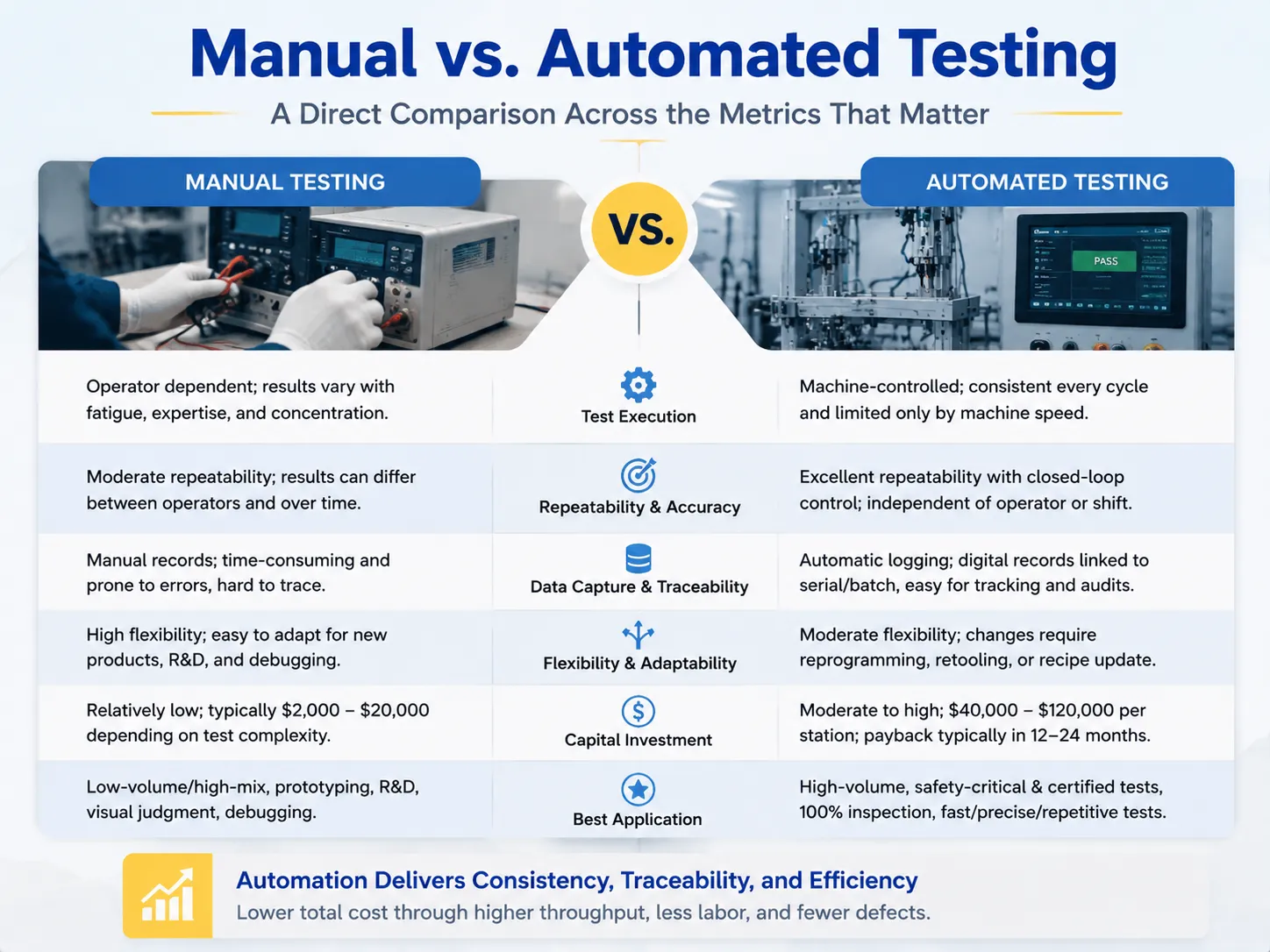
Manual vs. Automated Testing: A Direct Comparison Across the Metrics That Matter
| Characteristic | Manual Testing | Automated Testing |
|---|---|---|
| Test execution | Dependent on operators: an operator performs all activities of loading, testing, observing, and documenting. The effectiveness varies along with fatigue, expertise, and concentration.Dependent on operators: an operator performs all activities of loading, testing, observing, and documenting. The effectiveness varies along with fatigue, expertise, and concentration. | Machine-controlled: the PLC executes the test sequence identically every cycle. Throughput is limited only by the machine’s cycle time, not by human endurance. |
| Repeatability and accuracy | Moderate: in principle, it is possible for an experienced operator to achieve good repeatability, but this will undoubtedly deteriorate during a shift. Thus, two operators working at the same testing bench might end up obtaining different results. | Excellent: the test stimulus and the measurement are controlled with closed-loop feedback. The result for a given product is independent of who loaded the part or which shift is running. |
| Data capture and traceability | Manual documentation takes quite a while and involves many errors, making the identification of an exact unit difficult. The documentation on paper is hardly ever searchable or analyzable at scale. | Automatic: every test result is logged digitally against a serial number or a batch code. The data is stored in a database and is available for real-time dashboards, historical trend analysis, and certification audits. |
| Flexibility and adaptability | High: humans can learn a new product or method, or react immediately to an unexpected observation, creating a significant advantage of manual testing in R&D, prototyping and debugging. | Moderate: an automated station is programmed for a specific product or a specific test. Changing the product or the test requires reprogramming, retooling, or recipe adjustment. Flexible automation architectures reduce this limitation. |
| Capital investment | Relatively low: manually operated testing equipment usually costs between $2000 and $20 000, depending on the complexity of the tests and measurement devices used. | Moderate to high: a single automated test station costs $40,000–$120,000, and a fully integrated line with multiple stations, automated handling, and central data logging can exceed $500,000. The payback, however, is typically achieved in 12–24 months through labour savings, increased throughput, and reduced scrap and warranty costs, as documented by research from McKinsey & Company. |
| Best application | Low-volume and high-mix production; prototyping and R&D testing; tests involving the use of human judgment or visual assessment at instances when vision technology is generally not trained; debugging and root cause finding. | High-volume production; safety-critical and certification-required testing (MCB calibration, contactor pull-in voltage, hipot testing); any process where 100% inspection and digital traceability are required; tests that are too fast, too precise, or too repetitive for a human to perform consistently over a full shift. |
The Economics of Automated Testing: When the Investment Justifies Itself
The decision to move from manual to automated testing is fundamentally an economic one. A manual test bench that costs $5,000 and is operated by a technician earning $25,000 per year may be the correct choice for a factory producing 5,000 units per month. The cost per test is low, and the capital is not at risk if the product changes. For the same factory producing 200,000 units per month, however, the manual testing labour cost alone would be unsustainable—and the variability in the test results, with ten technicians operating ten benches across three shifts, would create a quality risk that the factory’s customers would eventually detect. The crossover point—the volume at which automated testing becomes less expensive per unit than manual testing—depends on the labour cost, the test cycle time, and the capital cost of the automated equipment. Research on manufacturing automation from the International Federation of Robotics (IFR) confirms that automated quality inspection and testing is one of the fastest-growing segments of industrial automation, driven by the combination of rising labour costs, falling sensor and vision-system costs, and the increasing demand for traceability in global supply chains.
The economic case for automated testing is not only about the labour saved. It is also about the cost of the defects that manual testing misses. A single batch of circuit breakers that fails a certification audit—because the calibration drifted on one operator’s bench during a long shift—can cost far more than the automated calibration station that would have prevented the drift. A single warranty claim on an automotive connector that was not tested for insertion force can trigger a recall that dwarfs the cost of the automated force-displacement tester that would have caught it. These avoided costs—the defects that never happen, the recalls that never occur—are the hidden return on an automated testing investment, and they often exceed the visible return from labour savings alone. For a manufacturer who is considering the move to automated testing, the calculation should include both the direct cost savings (labour, throughput, scrap) and the avoided costs (warranty, recall, certification failure). When both are included, the payback on an automated testing station is typically 12–24 months, and the return over the 10–15-year life of the equipment is substantial. Industry research from Deloitte on digital manufacturing consistently finds that investment in automated quality control delivers among the highest and fastest returns of any automation investment category.
When Manual Testing Still Wins: The Limits of Automation
Regardless of how much benefit automated testing may provide, there are instances when manual testing is not only appropriate but may even be better than its automated counterpart. Among those instances is exploratory testing and R&D. As a new product is being developed, the test procedures are still to be created. The engineer doesn’t even know what the acceptable range of a calibration variable is, what the failure modes are like, etc. Automated testing systems can only measure things they have been programmed to measure, while an engineer can observe them and draw conclusions. Another situation is ultra-low volume/high complexity production. A manufacturer producing five complex switchgear assemblies a month, with each having unique configuration and testing requirements, can’t make any justification for having some dedicated automated testing station for every single variant. The third instance is when tests require subjective judgment. For instance, visual inspection checking for a minor flaw, the specification of which hasn’t been detailed enough for a vision system to detect it, or test that implies listening to some unusual sound or requires specific tactile sensation on the part of the operator – such tasks may prove difficult for automation to handle.
Most successful manufacturing processes do not choose between manual and automated testing; they employ both means. For instance, an enterprise may apply automated calibration and hipot testing for safety-critical units thus complying with certification requirements without renouncing final manual visual examination for cosmetic flaws or sample-type measurements in order to carry out process control procedures. Automation deals with repetitive, precise and data-intensive tasks, while professionals take care of tasks requiring investigation, judgment and special approach.
This is the idea behind Benlong Automation equipment design: automated unit must execute calibrated, repeatable and documented test of every product under test, while the operator monitors the production line, analyses and interprets the results received from the automated system.
Frequently Asked Questions
What distinguishes manual testing from automated testing?
The most prominent distinction between manual testing and automated testing is the factor which runs the tests. Manual testing means a human person does every aspect of the test from loading the product to making observations and logging results. Automatic testing means that a programmable logic controller runs the tests, the measurement is done by an automatically calibrated sensor or vision system, and data is gathered automatically without the involvement of a human operator. Although automating tests makes repeatability, speed, and integrity better, it makes a test less adaptable to any surprises.
Is Selenium manual testing or automated?
Selenium is a software automation tool designed to automate the testing of web applications by simulating user actions such as clicking buttons, filling in forms, or switching web pages. It depicts the instance of automated testing in a software domain. In an industrial setting, the equivalent of Selenium would be a programmable logic controller (PLC) factory testing station which performs automatic tests of some physical product like a circuit breaker or contactor.
Manual vs automated processes. What is the difference?
If we talk about manual processes as opposed to automated ones, the difference consists in having or not having a person carrying out the operation. A manual process is the task carried out by a personal operator, who performs the operations or makes the decisions, while the automated process relies on a machine whose operation is governed by the software.
Is QA testing done manually?
QA testing may be done manually or automatically, and the reality is that most of the modern manufacturing and software environments use a combination of the two approaches. In other words, the tests performed with higher frequency and volume (and that also have impact on the safety) are automatically performed while some testing of an exploratory character with lower volume is conducted by people. The tendency is that every test that can be automated will be automated in manufacturing industry while automation will free the human operator to focus on tests he/she can perform instead of replacing him/her completely.
References
- McKinsey & Company — The Future of Manufacturing and Automation. Research on the productivity and ROI of automated quality inspection and testing across industries, including the payback and the quality improvements that automated testing delivers.
- International Federation of Robotics (IFR) — World Robotics Report. Annual data on the growth of automated inspection and testing equipment, the declining cost of vision systems and sensors, and the adoption of automated quality control in manufacturing.
- Deloitte — Digital Manufacturing and Industry 4.0. Insights into the return on investment of automated testing and the integration of quality data into the broader manufacturing execution system (MES).
- International Society of Automation (ISA) — Automation Testing Standards and Best Practices. The standards and educational resources that govern the design, calibration, and validation of automated test equipment in industrial manufacturing.
The point of distinction between manual testing and automation testing hinges on which process is best for a particular product, testing scenario, or level of testing needed. In other words, it isn’t about which one is considered superlative. The peculiarity of manual testing lies in its adaptability and flexibility to meet changing needs. Different tests characterized by the use of human perception are best suited for application of manual testing. However, automated testing is essential in mass production of items; this is due to the nature of repeatability, speed, and information it provides, that’s why it becomes an indispensable part of the testing process for volumes of production. The advantage of a manufacturer lies in the ability to identify the best type of testing to be used, like automation in the calibration and the hipot, retaining manual visual inspection, and applying the information gathered to implement continuous improvement process. Benlong Automation company provides the automated testing machines, which can automate processes characterized by the repetition, precision and informativeness, since standardized testing is vital to make sure a product is certified and ready for export.