benlong


MCB Injection Mold Manufacture: A Guide for Scaling MCB Producers
By Huang Xiaolei · August 3, 2026
When an established manufacturer is getting ready to enter the domain of miniature circuit breakers (MCBs), the first thing to be considered is not creating the assembly line or the testing facility but making the mold. MCB injection mold manufacture sets the ceiling for everything that follows: It is the mold of injection mold making for MCBs that determines almost everything else: dimension quality of all the casings made of plastic, the cost of the individual parts, and the maximum capacity of the assembly line. Making the right mold leads to an efficient automation process, while a wrong decision means that no capital invested into the further stages will compensate for the losses incurred earlier.
This guide is written for manufacturers with the scale and ambition to enter or expand automated MCB production. It explains what defines a good MCB injection mold, what drives its cost, how cavity strategy shapes capacity, and how to choose a partner for MCB injection mold manufacture that can grow with you — because the mold and the automation that follows must be planned together.
Why the Mold Decides Your MCB Business
An MCB consists of multiple parts made of metal and plastic, and it is essential that they work properly for the entire period of operation. The housing, cover, and internal carriers provide the proper arrangement of all the components of the device, and the molds shape all of them. If the molds create the parts with unequal thickness of the walls, warping, and dimensional shifts, these problems will propagate throughout the entire production of the MCBs.
That is why serious MCB injection mold manufacture is treated as a capital investment. The mold sets three things at once: the dimensional quality of the part, the cost per part, and the maximum throughput the line can sustain. Before committing to a program, it is worth reviewing the full MCB injection mold development process, because a structured build — from part data and design review through steel selection, machining, and trials — is what separates a reliable tool from a gamble.
When a manufacturer starts its large-scale MCB production, quality is either gained or lost in the production process. A reliable mold with good cooling and heating allows one to maintain high production speed without worrying about quality while bad molds would need to slow down production, do sorting manually, and keep reworking everything that affects profit.
What distinguishes a reliable MCB mold?
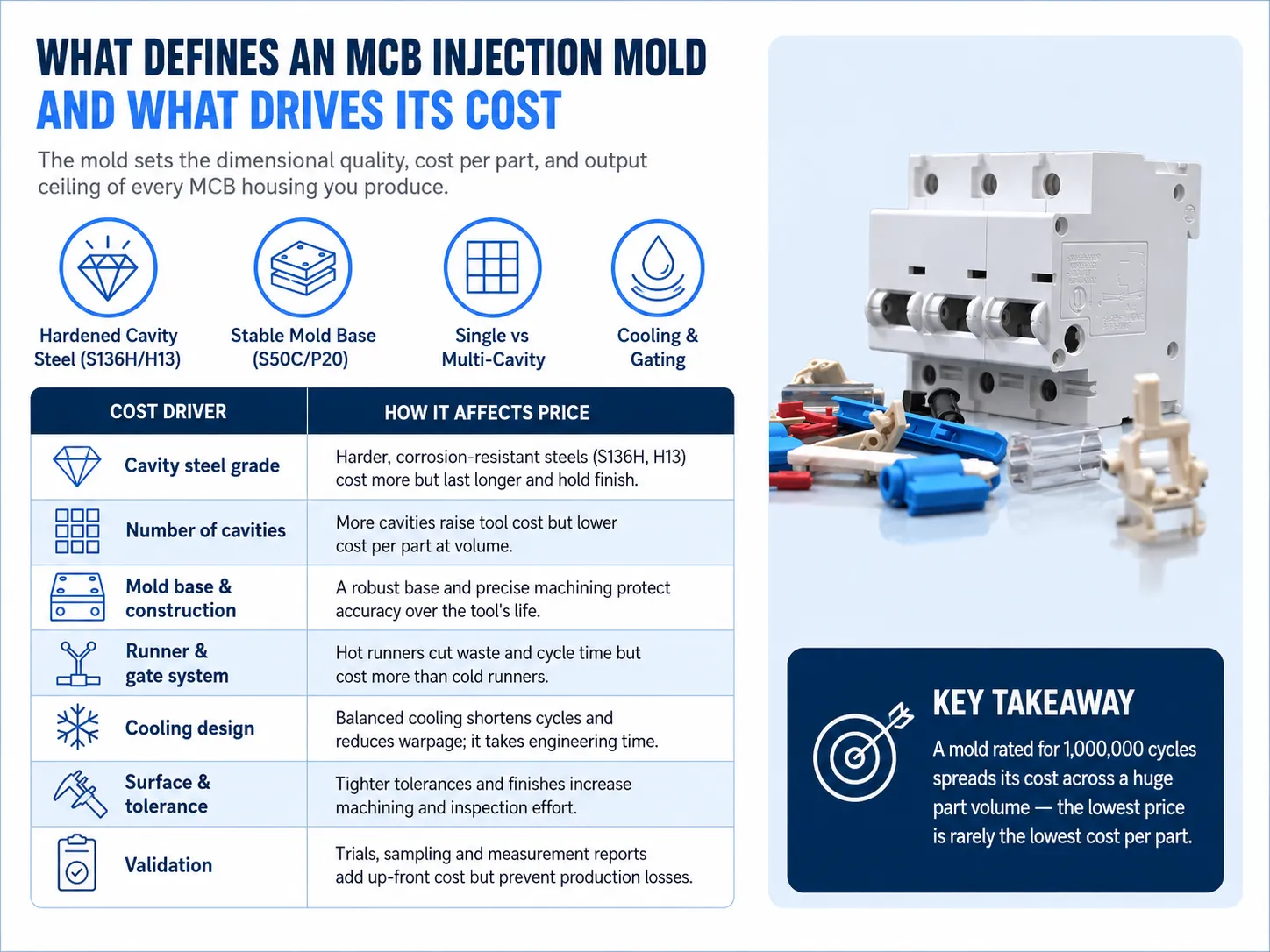
Not every mold designed for MCB products performs equally well, so when checking the price of a mold, look at the components that determine its performance in terms of hundreds of thousands of production runs.
Cavity steel: the cavity is the functional surface of the part and hence should be made from very solid, corrosion-resistant steel, for instance, S136H or H13.
Base steel of the mold: it has to be made of anti-deforming steel like S50C or P20 in order not to lose rectangularity.Molding durability: a mold produced using the best quality materials is expected to operate for about 1 million cycles and reduce costs.
Precision and surface finish: MCB product parts are assembled automatically; therefore, strong, precise dimension tolerance and uniform surface quality are required.
Cooling and gating: correct cooling and gating are important for cycle time, warping, etc.
Benlong’s own MCB injection mold is a useful benchmark: S136H or H13 cavities, an S50C or P20 base, a 1,000,000-cycle rating, and 1,000 qualified sample parts for validation. A fully specified tool makes it far easier to judge whether a cheaper quote is genuinely comparable.
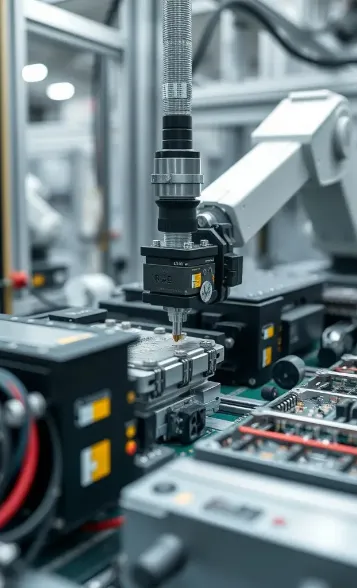
Scaling Capacity Planning
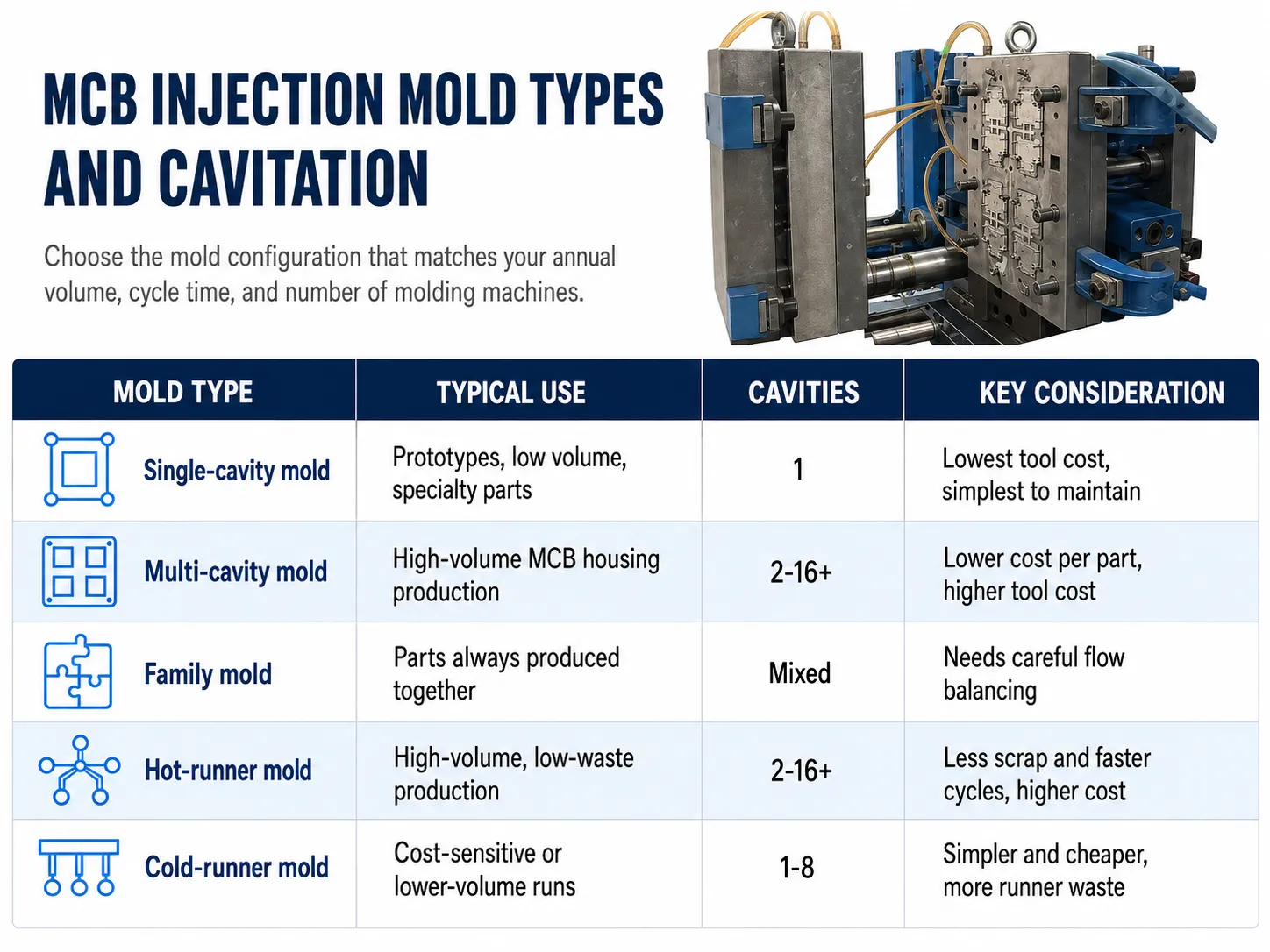
When a company is beginning the scaling process of MCB production, it needs to take a decision about the cavity numbers based on capacity not technology. A single cavity mold makes one part throughout the cycle whereas multi-cavity mold makes many parts during the same time. When a number of mold cavities increase, the price of producing the unit does not double but the quantity of produced items becomes multiplied.
Single cavity molding: single cavity molding is a mold with minimal production cost and easy service. This type of mold is used for prototypes in small numbers or ordered parts.
Multi-cavity molding: multi-cavity molding is more costly in tool making terms but cheaper in terms of unit price.
Family molds: they are molds where different parts are molded in one tool; they are quite effective for molding parts in pairs because of the needWhen starting out, new manufacturers might be prone to putting too little effort into the mold-making process, which is followed by issues with automation. Over-cavitating with complicated machinery is another issue that might occur, as the expenses would be considerable in case of a misstep. The best partner is one who knows how much cavitating you need and can tell about that.
What Influences the Price of MCB Molding
Prices on molds can differ, and it is important that you look for hidden factors. The truth is that there are much more expensive features than other solutions, and they tend to be better.
Metal quality: stronger and more durable materials require more money but work longer.
Amount of cavities: increased number of cavities increases the price while allowing you to decrease the price per part.
Мold design: strong mold design is the key for being consistent over time.
Routing: heated pipes let you cut waste and time.
Cooling: a good cooling system decreases the time but requires investment into development.
Surface and precision: high precision and special treatment raise the prices.
Verification: experimenting is costly but saves money in the long run.Tools with a million cycles lifespan are able to distribute their costs among a large number of produced parts. Thus, a slight increase in the cost of the materials used, methods of cooling and verification of production will always allow reducing the costs of production per item and the total costs in the long run.
From Mold to Line: Planning for Automated Assembly
The mold does not work alone. In an automated MCB plant, molded housings flow directly into stations where robots, feeders, and vision systems place contacts, tripping mechanisms, and arc chutes, then verify the result. Every automated step assumes the incoming part is dimensionally consistent.
When parts vary, vision systems reject more units and feeders jam; when parts are consistent, the whole line runs faster with fewer operators. So the mold and the assembly automation should be designed as one system, with the part engineered for both molding and automated handling. A partner who understands both sides prevents the costly mismatch of a good mold feeding a line that cannot handle its parts — or an ambitious line starved by an under-cavitated tool.
This is why leading manufacturers specify the tooling and the automation together from day one. When the same team defines the part, the mold, and the line, the datum references and quality targets are shared end to end, so each tool drops into the line without a fresh round of debugging — and the ramp from first article to full-rate production is measured in weeks rather than months.
Planning Your MCB Product Range and Tooling Roadmap
A manufacturer entering MCB production rarely makes a single product. A typical range spans one-, two-, three-, and four-pole breakers across several current ratings, each with its own housing and internal parts. So MCB injection mold manufacture is not a one-time purchase but a roadmap of tools introduced as the range and volume grow.
The smart approach is to sequence the investment: start with the highest-volume variants, prove the line, and reinvest in more molds and higher cavitation as demand builds. Where parts are shared across variants, one well-planned tool can serve several products, cutting both tooling cost and inventory complexity. Mapping this roadmap early — with a partner who builds the whole family to a consistent standard — avoids the fragmentation of buying molds piecemeal from shops with different tolerances and finishes.
Planning the roadmap alongside the assembly automation also protects your capital, because the same part standards and datum references run through every tool and every station. Each new mold then extends an existing, proven system rather than introducing a fresh set of tolerances the line has to accommodate, which keeps each capacity expansion fast, predictable, and low-risk.
How to Choose a Partner for MCB Injection Mold Manufacture
Once you understand the tool, the harder question is who should build it. Good MCB injection mold manufacture is an engineering relationship that lasts for years, so evaluate suppliers on capability and support, not price alone.
- Steel and hardness: confirm the exact cavity and base steels and their hardness, matched to your volume plan.
- Design-for-manufacture capability: a strong partner reviews your part data and suggests changes that improve molding and downstream assembly.
- In-house machining and validation: ask about CNC, EDM, and inspection capability, since outsourced steps add risk and time.
- Trials and sampling: insist on a mold trial and qualified sample parts — a professional program delivers around 1,000 with a measurement report.
- Lead time: confirm a realistic schedule; a typical MCB injection mold is delivered in about 45 days.
- Scalability: check the partner can grow from single-cavity tools to multi-cavity and family molds as volume rises.
- Industry experience: a supplier who already understands MCB, MCCB, RCCB, and RCBO parts anticipates problems a general mold shop will miss.
- After-sales support: spare parts, refurbishment, and technical support keep a high-value tool productive for its full life.
Buyers entering fast-growing markets should weigh installation support and long-term service as heavily as the tool itself, because a mold that cannot be maintained quickly becomes a bottleneck no matter how well it was built.
Common Mistakes When Entering MCB Injection Mold Manufacture
New entrants tend to repeat a handful of avoidable errors. Recognizing them early saves both money and months of lost production.
- Buying on price alone: the cheapest tool often uses softer steel, simpler cooling, and no proper validation, and costs far more once scrap and downtime are counted.
- Under-cavitating to save capital: a tool that cannot keep the line fed turns an expensive automation investment into an idle one.
- Separating the mold from the line: specifying tooling and automation independently leads to parts that mold well but handle badly.
- Skipping validation: without a trial and sample parts, dimensional problems surface only in mass production, when they are most expensive to fix.
- Ignoring the roadmap: sourcing each mold from a different shop produces inconsistent tolerances that complicate assembly and quality control.
Each mistake comes from treating the mold as a commodity rather than the foundation of the production system. Approaching MCB injection mold manufacture strategically — with validation, cavitation planning, and line integration built in — avoids them all.
Total Cost of Ownership and ROI Thinking
For a decision-maker, the mold is best understood as an investment with a measurable return. The purchase price is only the first number; the real figure is the cost per part across the tool’s life, plus the value of the defects and downtime it prevents. A mold rated for 1,000,000 cycles that holds tolerance and keeps the automation running is almost always cheaper over its life than a low-priced tool that produces variable parts — which is why experienced manufacturers treat MCB injection mold manufacture as a strategic capital decision, not a commodity purchase.
Weighed against the cost of scrap, rework, line stoppages, and field returns, the premium for a properly engineered mold is modest, and it is recovered many times over across the millions of parts the tool will produce. The right tool also protects the far larger investment in the assembly and testing automation downstream, and it underpins the quality reputation of every breaker that carries your name.
Why Benlong for MCB Injection Mold Manufacture
Benlong Automation builds assembly, testing, and tooling for the low-voltage electrical industry, so it approaches MCB injection mold manufacture with the whole production line in view. Its MCB injection mold uses S136H or H13 cavities and an S50C or P20 base, is rated for 1,000,000 cycles, and is delivered in about 45 days with 1,000 qualified sample parts.
Because Benlong also builds the downstream MCB assembly and testing automation, its tooling is engineered for consistent, automation-ready parts from the first shot. For the engineering detail behind each tool, the MCB injection mold development process walks through every stage from part review to sampling.
Frequently Asked Questions
What steel is used for an MCB injection mold?
The cavity typically uses a hard, corrosion-resistant tool steel such as S136H or H13, while the base uses a stable steel such as S50C or P20. The cavity steel drives finish and wear resistance; the base drives long-term accuracy.
How many cavities should an MCB injection mold have?
It depends on your annual volume, cycle time, and number of molding machines. Single-cavity tools suit low volumes; multi-cavity tools lower the cost per part at scale. Size the cavitation to your real production plan, not the lowest initial cost.
What mold life should I expect?
A professionally built MCB injection mold should be rated for around 1,000,000 cycles, spreading the tooling cost across a very large part volume.
How long does MCB injection mold manufacture take?
A typical MCB injection mold is delivered in about 45 days, followed by a trial and a batch of qualified sample parts. Complex or high-cavity tools may take longer.
How does the mold affect downstream automation?
Automated assembly depends on dimensionally consistent parts. A stable mold lets vision systems, feeders, and robots run fast with low reject rates, while a variable mold causes jams and slower cycles. The mold and the line should be planned together.
Should the mold and the assembly line be sourced from the same partner?
It is a strong advantage. When one partner engineers both, the part standards and quality targets stay consistent across the whole system, which reduces debugging and prevents a good mold feeding a line that cannot handle its parts.
What should I check before choosing a partner for MCB injection mold manufacture?
Confirm the cavity and base steels, the design-for-manufacture and in-house machining capability, the trial and sampling process, the lead time, and the ability to scale cavitation, along with after-sales support. Experience with MCB and related low-voltage parts is a strong advantage.
Conclusion
For a manufacturer entering or scaling automated MCB production, the mold is the foundation everything else is built on. Approach MCB injection mold manufacture as a strategic capital decision: define the steel, cavitation, cooling, and validation your plan requires, choose a partner who engineers the tool and the line together, and judge every quotation on total cost of ownership rather than sticker price. Do that, and the MCB injection mold becomes the quiet asset that lets the rest of your automation reach its full potential, part after part, for years.