benlong
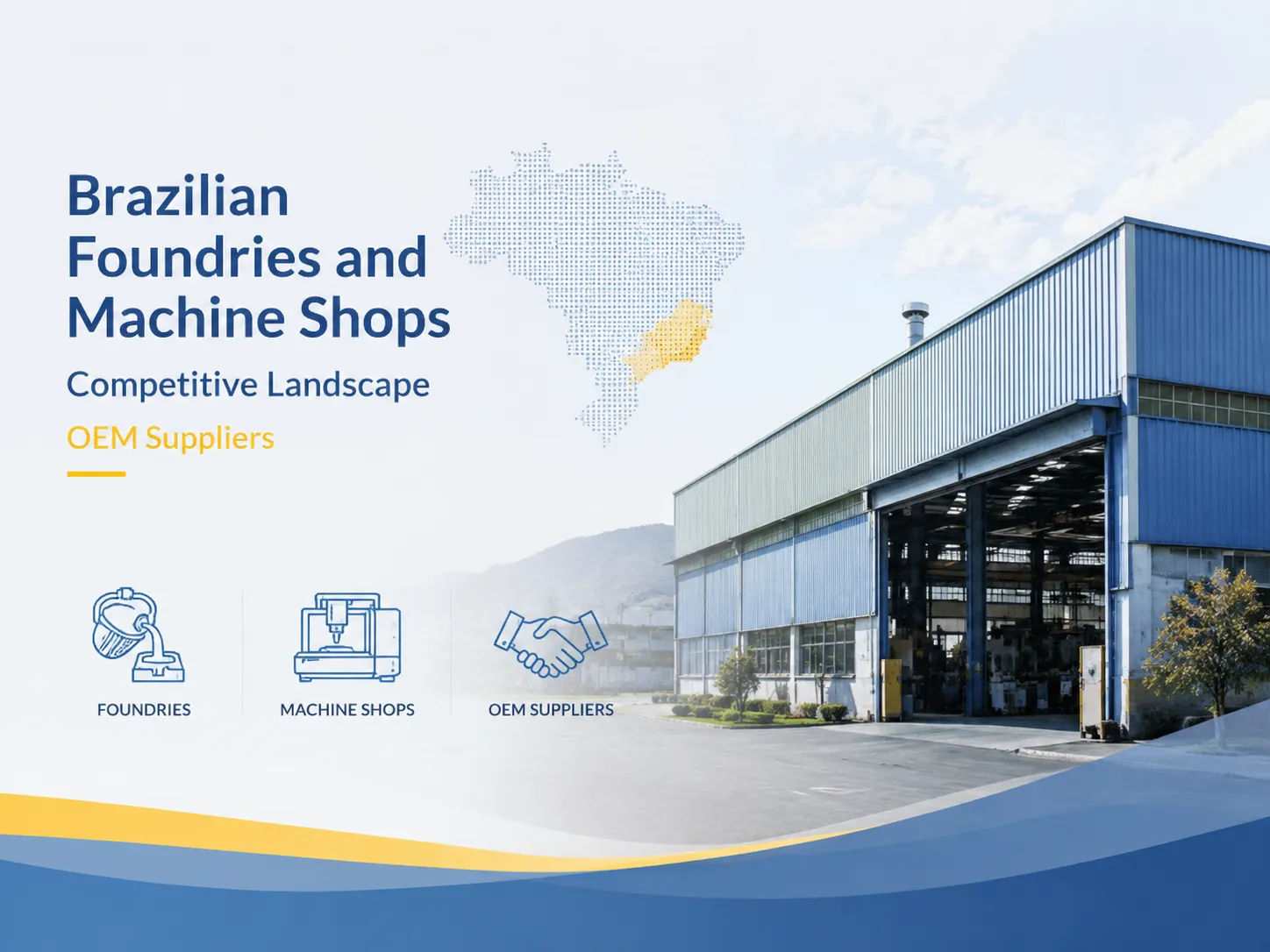
Brazilian Foundries and Machine Shops Competitive Landscape OEM Suppliers
An established North American heavy equipment maker wanted to source large machined ductile iron castings for its new mining pumps line. At first, the procurement team explored the Asian suppliers they worked with before, finding acceptable lead times and prices, but the logistics of moving 2,500-kilogram castings from a Chinese foundry to a Texas assembly plant concerned them. A colleague suggested evaluating Brazilian foundries and machining shops. In two weeks, they found three potential OEM suppliers in São Paulo, all of which had the required ISO certifications, capabilities for in-house machining, and an important logistical advantage, enabling them to reduce the lead time for the order by half. The company placed an order and received the first castings six weeks later. This experience familiarized the procurement team with an important lesson many industrial buyers have learned: Brazil’s foundries and machining shops are among the leading suppliers of quality and reliable OEM products that warrant being on every global sourcing shortlist. Understanding the market for Brazilian foundries and machining shops, as well as the profiles of the best organizations in this area, is an important first step to establishing a highly effective supply chain.
Summary: Brazilian foundries and machining industry is one of the biggest industries in South America, with about 1,200 foundries producing an annual volume of more than 2.5 million metric tons of metal castings, and thousands of shops providing machinery for automotive, heavy machinery, oil and gas, mining and energy sectors. This industry operates in a competitive environment which consists of internationally recognized OEM manufacturers (many of them being subsidiaries of multinational corporations and long standing Brazilian family companies) and a vast number of small to medium businesses that are working in different regional segments.
The Brazilian Foundry and Machining Sector at a Glance
The Brazilian foundry sector remains the leading foundry market in Latin America and the seventh largest in the world, with castings made of grey iron, ductile iron, steel, aluminum, and copper alloys being produced. The majority of this output is consumed by the automotive industry—including heavy trucks, buses, and farm machinery—which accounts for 55–60% of the total foundry production. Other sectors also consume small portions of this output such as construction and mining equipment, oil and gas, power generation, rail transport, and diverse industrial manufacturing. The machining sector similarly varies from small job shops with a couple of lathes to large and fully automated CNC machining factories that finish machine castings, forgings, and fabrications for export to North America and Europe.
The industry’s competitiveness is shaped by a variety of structural factors. Brazil’s domestic market is big enough to accommodate a solid industrial base and had served domestic OEMs (Volkswagen, Mercedes‑Benz, AGCO, CNH Industrial, etc.) and exporters. The volatility of the market is determined by logistics and geographic proximity giving the sector significant opportunities to adjust its competitive position. The labor costs are another crucial determining factor that makes the sector increasingly attractive in comparison to manufacturers in Europe and North America.
The Competitive Landscape: Global Giants, Regional Champions, and Niche Specialists
The Brazilian foundry and machining sector can be broadly divided into three tiers of OEM suppliers, each with a distinct profile, customer base, and competitive strategy. The table below summarises these tiers, and the sections that follow profile eight representative companies across the spectrum.
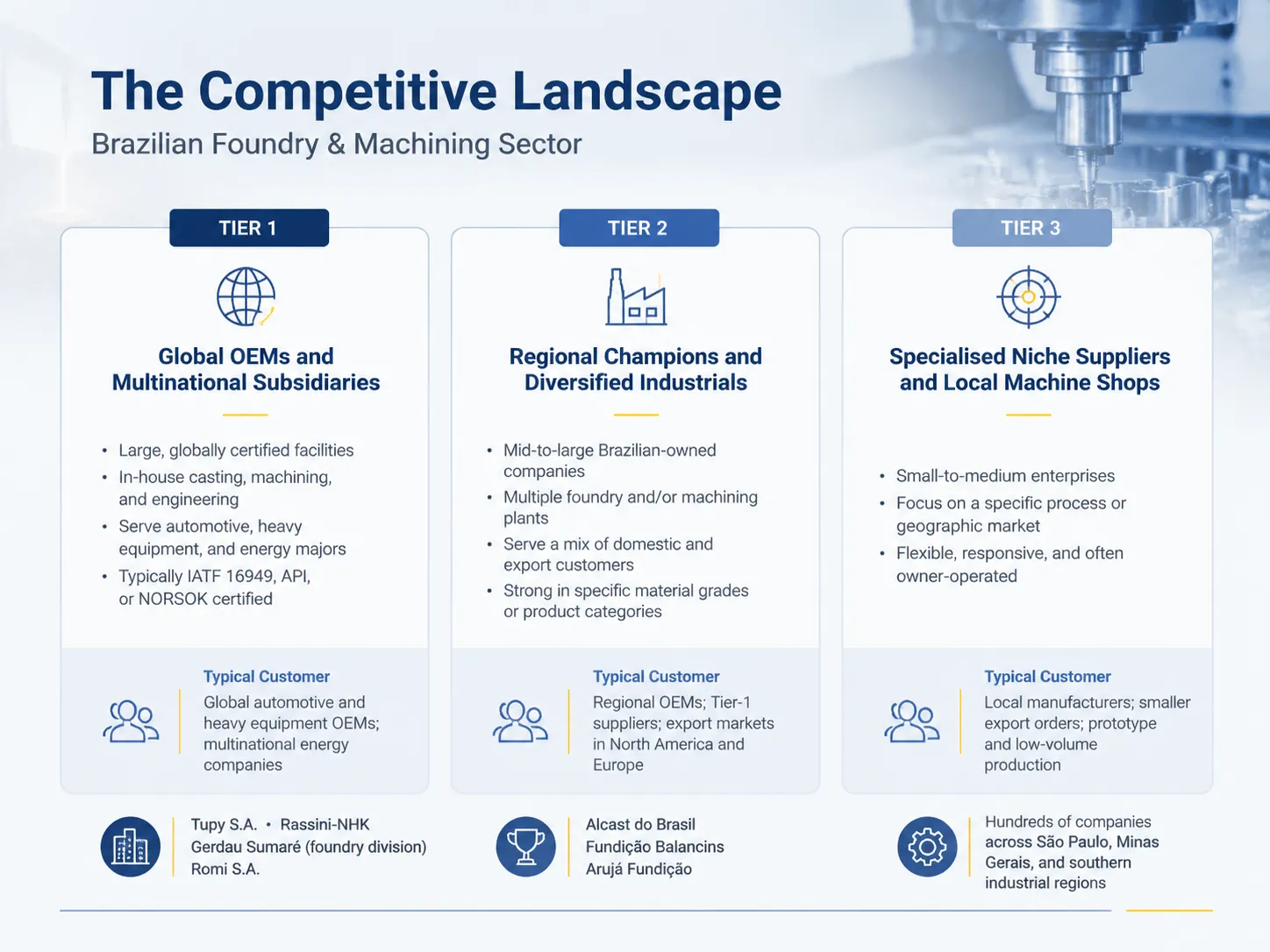
| Supplier Tier | Characteristics | Typical Customer | Example Companies |
|---|---|---|---|
| Tier 1: Global OEMs and Multinational Subsidiaries | Large, globally certified facilities; in‑house casting, machining, and engineering; serve automotive, heavy equipment, and energy majors; typically IATF 16949, API, or NORSOK certified. | Global automotive and heavy equipment OEMs; multinational energy companies | Tupy S.A., Rassini‑NHK, Gerdau Sumaré (foundry division), Romi S.A. |
| Tier 2: Regional Champions and Diversified Industrials | Mid‑to‑large Brazilian‑owned companies; multiple foundry and/or machining plants; serve a mix of domestic and export customers; strong in specific material grades or product categories. | Regional OEMs; Tier‑1 suppliers; export markets in North America and Europe | Alcast do Brasil, Fundição Balancins, Arujá Fundição |
| Tier 3: Specialised Niche Suppliers and Local Machine Shops | Small‑to‑medium enterprises; focus on a specific process (e.g., investment casting, aluminium die casting, precision machining) or a specific geographic market; flexible, responsive, and often owner‑operated. | Local manufacturers; smaller export orders; prototype and low‑volume production | Hundreds of companies across the São Paulo, Minas Gerais, and southern industrial regions |
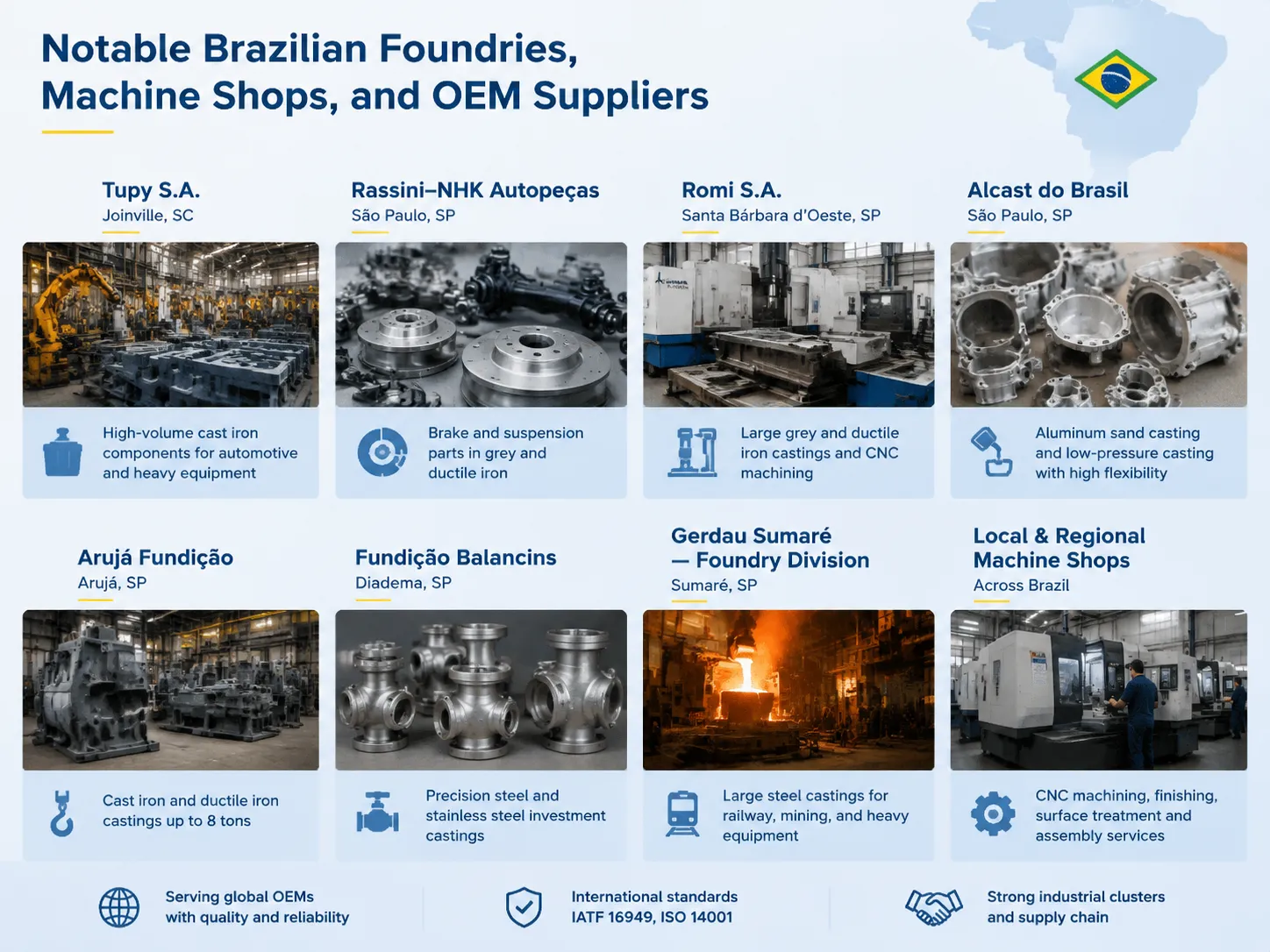
Notable Brazilian Foundries, Machine Shops, and OEM Suppliers
1. Tupy S.A. (Joinville, Santa Catarina)
Main Strength: Tupy is not only the largest foundry in Brazil but also one of the biggest independent foundries in the world having an annual output of more than 800,000 tons of castings. The company specializes in complicated high-volume cast iron parts, such as cylinder blocks, cylinder heads, and casting parts in heavy trucks, automotive, and off-highway machinery business. Just to say that Tupy operates in the facilities that are among the most automated and certified according to high quality equipment in Latin America, being compliant with IATF 16949 and ISO 14001 standards. The company exports great volume of its products to North America and Europe.
Typical customer: Global OEMs from automotive and heavy equipment producing industries needing high-volume production of cast iron components.
2. Rassini‑NHK Autopeças (São Paulo)
Strength of the Belly: Rassini-NHK is a joint venture established by the Mexican Rassini group and the Japanese NHK Spring Co. which operates a large foundry and machining site in Sao Paulo. The company is a manufacturer of suspension and brake system parts including brake rotors, brake drums, and suspension arms from grey and ductile iron and features machining and coating capabilities on site. The factory caters to customers located in Brazil but also exports products out of the country.
Typical types of customers: The customers are OEMs and suppliers of braking and suspension system parts who need to place large quantities of grey and ductile iron castings.
3. Romi S.A. (Santa Bárbara d’Oeste, São Paulo)
Strength: Romi is among the oldest names in Brazil’s machine tools and industrial equipment business. The company manufactures CNC lathes, machining centers, and injection molding machines. Furthermore, Romi has a major foundry and machining unit producing large and complex grey and ductile iron castings, which not only are used for its own machine tool beds, but also sold to third-party OEM clients. Romi’s foundry caters to casting demands as high as 30 tons. In addition, its machining division has large-scale CNC machining capacities that are hard to find in Brazil.
Typical Customer: Large manufacturers of machinery, machine tools, and heavy equipment who use large raw grey and ductile iron castings.
4. Alcast do Brasil (São Paulo)
Core strengths: Alcast is an expert in aluminum sand casting, gravitational casting, and low-pressure casting—a company operating in automotive, electrical, and general industrial spheres. It manufactures aluminum castings weighing anywhere from a couple of grams to over 100 kilograms, along with necessary machining, heat treatment, etc. Alcast’s core strength is its flexibility: it can manufacture prototypes and small-scale orders that other foundries may decline, while also providing a sufficient rate in the area of medium production runs.
Typical clientele: Automotive and industrial OEMs with a demand for aluminum foundries, capable of accepting required changes in the design, and realizing fast prototypes at any given scale.
5. Arujá Fundição (Arujá, São Paulo)
Strength in product development: Arujá Foundry is a mid-size enterprise specialized in producing cast iron and ductile cast iron pieces for the construction, mining, railway, and many engineering sectors. The foundry produces living forms weighting up to 8 tonnes, having facilities for in-house pattern creation and treatment of metal products.
Key customer of Arujá Foundry are companies manufacturing construction and mining tools and railway equipment which purchase mid-size cast iron and ductile cast iron products of exotic specifications.
6. Fundição Balancins (Diadema, São Paulo)
Strength: Fundição Balancins is an expert in steel and stainless steel investment casting (lost wax process), gobally serving the valve, pump, automotive and general engineering industries. The company produces precision castings weighing from small to medium amount of a maximum of approximately 50 kg, achieving excellent surface finish without need for further machining. The investment casting is quite a rare capability in the Brazilian market, it is noted that Fundição Balancins has achieved some recognition here.
Typical customer: Valve and Pump manufacturers, automotive parts manufacturers and general engineering enterprises requiring precision steel and stainless steel castings with good surface finishing.
7. Gerdau Sumaré — Foundry Division (Sumaré, São Paulo)
Core strength: Gerdau is one of the largest producers of steel in the Americas. Its Sumaré plant has a large foundry that manufactures steel castings suitable for railway, mining, and heavy equipment manufacturing. The foundry produces carbon steels, low-alloy steels, and manganese steels in weights of several tons, including heat treatment and machining performed in the same location. The benefits of vertical integration of the parent company into steel making include the ability to control the chemical composition and cost of raw materials.
Typical buyer: Manufacturers of railway rolling stock, OEMs for mining equipment, and manufacturers of heavy-equipments requiring significant and large steel castings.
8. Local and Regional Machine Shops Across the Industrial Clusters
Strength in numbers: Brazil is home to thousands of small and medium-sized machine shops mainly located in São Paulo’s industrial corridors (ABC region, Campinas, Sorocaba), the Belo Horizonte metropolitan region in Minas Gerais, and the Porto Alegre region in Rio Grande do Sul. These shops can range from manual and CNC general-purpose job shops to shops that specialize in large format machining or gear cutting, or particular industry application. Many of these shops operate as outworkers for the large foundries and OEMs mentioned earlier, but provide finishing machining, surface treatment and assembly services. For a global buyer, the best way to connect with someone from such a shop is to consult a Brazilian sourcing agent, a local representative or to physically visit the industrial cluster. The FIEMG (Federação das Indústrias do Estado de Minas Gerais) and the FIESP (Federação das Indústrias do Estado de São Paulo) maintain directories of their member companies and can connect a prospective buyer with the relevant trade associations and sourcing resources. Thomasnet also lists a number of Brazilian suppliers with their capabilities and certifications, though its coverage of the Brazilian market is less comprehensive than its North American database.
For any global OEM buyer or procurement manager looking into Brazilian foundries and machine shops, the companies shown above cover the span of the industrial landscape in Brazil—from internationally-run giant foundries to localized foundries to small machine shops. Choosing the right company will depend on a variety of factors, including material selection, processes used, order size, necessary certifications, and logistical requirements laid down by the component being manufactured. Benlong Automation, a leader in automated assembly and testing lines for electrical protection devices, is no exception. It needs to consider the competition as some electrical equipment manufacturers, such as those it serves, will manufacture their own components as well and hence are likely to see Benlong Automation’s solutions as good options for their production processes. The MCB automatic assembly lines and AC contactor production lines that Benlong designs and builds are deployed by electrical manufacturers worldwide, including in Brazil, where the domestic electrical equipment market is one of the largest in the Southern Hemisphere. Understanding the local supply chain—the foundries that pour the housings, the machine shops that finish the components, and the OEMs that assemble the finished products—is part of understanding the full manufacturing ecosystem in which automation investment takes place.
How to Find and Qualify a Brazilian Foundry or Machine Shop Partner
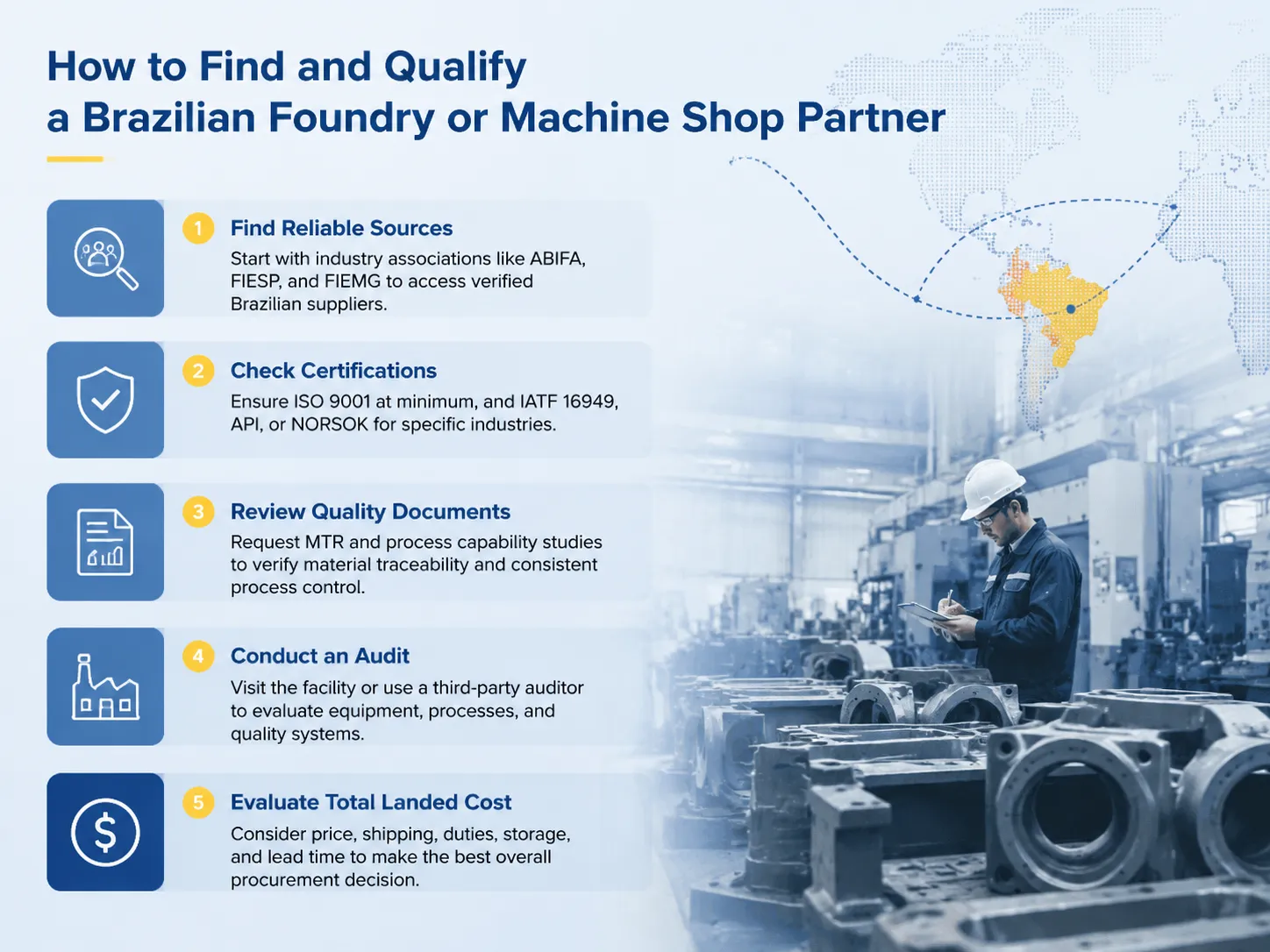
To find the right foundry or machine shop in Brazil, one must take an organized approach that confirms the facility’s technical skills, quality control, and logistical efficiency. The following steps offer a practical approach for international buyers who are finding suppliers in Brazil for the first time.
- Begin with the industry associations. The Brazilian Foundry Association (ABIFA) operates a database containing information about its member foundries, which can be searched by material, method, and place. The industrial federations at the state level FIESP in Sao Paulo, FIEMG in Minas Gerais provide contact with suppliers of machinery and original equipment manufacturers from their respective regions. These associations represent the most reliable and up-to-date source of information about the industrial sector of Brazil, giving them an incredible importance when it comes to sourcing.
- Check the standards of certification prior to asking for a quote. Suppliers should have at least ISO 9001 certification. For automotive parts, IATF 16949 is necessary, while for oil and gas equipment, API and NORSOK certifications serve as the basis. A supplier that is “working towards” getting certification or has “equivalent quality” is a risk a buyer does not need to take on if there are other alternatives available. The certification should be valid, obtained through a respected registrar and for the specific process applicable for the component in question.
- It is necessary to obtain a Material Test Report (MTR) and a process capability study of a comparable part. A well-established foundry or machine shop would be equipped to produce an MTR which links the steel to the mill heat number and provides the chemical and mechanical compositions. The process capability study—statistical analysis of an important characteristic throughout the manufacturing—suggests that the supplier will be able to meet the necessary tolerance consistently. So, if a supplier does not issue such documentation for a similar part, it means that this supplier is not able to provide the required level of control over the process that is expected from critical-application OEM components.
- Carry out an on-site audit, or employ a third party to conduct the audit. There is no equal to being present at the foundry operations, inspecting the pattern shop, the molding process, spectrometer, heat treatment furnace, and comparator. If it is not possible to reach Brazil, there are ways of approaching the situation, such as employing a local QA firm, sourcing firm, or inspection agency for doing the audit. The price of the audit will be much less than the price of a failed first article inspection.
- Not only should you factor in the costs of logistics in evaluating your overall landed cost, but the total landed cost should also include the ex-works price from the supplier, plus costs for shipping, duties, and storage. For example, a Brazilian casting that costs $50 more than an Asian casting might make for a less expensive product overall if it takes just four weeks to deliver the casting, compared to the twelve weeks required for the Asian alternative, and also costs less for shipping. Hence, decisions surrounding procurement should take into account the total landed cost of a product.
Frequently Asked Questions
Is Brazil competitive with China on foundry and machining costs?
Looking at the costs of unit price, China is mostly cheaper than Brazil for many cast and machined components which is attributed to its cheaper energy costs, cheaper labour costs and larger concentrated industrial base. However, if you consider the total landed cost, Brazil can compete for heavy castings sent to North America or Europe since the shipping costs from Brazil are significantly lower and transit time is much shorter compared to Asia. In the case of lighter, smaller and more expensive components with freight costs still being a minor part of total costs, it gets much tougher for Brazil to win against China.
What quality certifications should I look for in a Brazilian foundry?
The IATF 16949 standard applies to automotive parts. The ISO 9001 standard is the minimum requirement for industrial parts. In the case of oil and gas products, API 6A, API 16A, or NORSOK M-650 apply, depending on the part being manufactured. The certification must be current and provided by an accredited registrar and apply to the processes—casting, heat treatment, machining, NDT—that are needed for the manufacture of the part.
How do I find small, specialised machine shops in Brazil?
The most successful way is to use federated industrial associations in the states—to work with FIESP in Sao Paulo or FIEMG in Minas Gerais—or hire a local sourcing agent or consult a business group. Small Brazilian industrial businesses usually have little presence on English-language websites, and they can only be found via personal communications and networking. In addition to networking, however, visiting Brazilian trade fairs (e.g., attending the FEIMAFE machine tool exhibition in Sao Paulo) is another effective way to get in touch with numerous suppliers in one trip.
References
- ABIFA — Brazilian Foundry Association. The national trade association representing Brazil’s foundry industry, publishing annual production data, a member directory searchable by material and process, and industry news.
- FIESP — Federação das Indústrias do Estado de São Paulo. The industrial federation for the state of São Paulo, representing thousands of manufacturers including foundries, machine shops, and OEMs.
- FIEMG — Federação das Indústrias do Estado de Minas Gerais. The industrial federation for the state of Minas Gerais, a major mining, metals, and manufacturing hub.
- Tupy S.A. — Heavy‑Duty and Automotive Castings. The largest foundry in Brazil and one of the largest independent foundry groups globally, specialising in high‑volume cast iron components.
- Romi S.A. — Machine Tools and Large‑Format Castings. A Brazilian machine tool manufacturer with a substantial foundry and machining division producing large grey and ductile iron castings.
Brazil’s foundries and machine shops represent a sourcing option that combines technical capability, geographic proximity to North American and European markets, and a depth of experience in automotive, heavy equipment, and industrial casting grades that few other countries in the Americas can match. The competition in the industry varies in the following manner—large multinational enterprises with global certification and a strong market presence, leading players that have built formidable relationships with customers, and numerous smaller manufacturing enterprises that offer flexibility and speed of response. The customer who is willing to assess this competition, check the qualifications of the companies, and work with a trusted partner will find an efficient source that is also competitive in terms of price. When talking about the global consumer electronics manufacturer, it should be noted that Brazil’s foundry market represents not a substitute for the current supply chain in Asia or Europe but a complementary source that decreases the risk factor and the delivery period as well as the shipping expenses for supplying American and European markets.