benlong



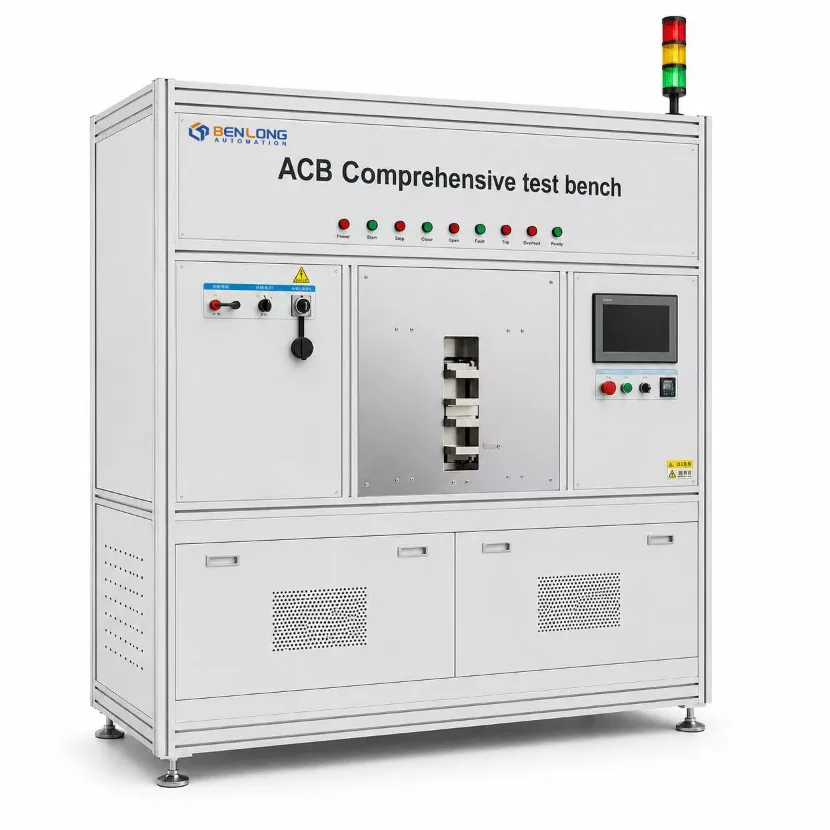
ACB comprehensive test bench
The ACB comprehensive test bench performs four verifications on air circuit breakers from 1600A to 6300A in one station: loop resistance testing, insulation & withstand voltage testing, current characteristic testing, and temperature rise & power consumption measurement.
- Covers the full large-frame range: 1600A–6300A
- Tests run individually or in sequence per your test plan
- Aligned with IEC 60947-2 routine verification practice
- Custom busbar sets and fixtures per your models
ACB Comprehensive Test Bench for 1600A–6300A Air Circuit Breakers
The ACB comprehensive test bench consolidates four essential air circuit breaker verifications into a single station: loop resistance testing, insulation and withstand voltage testing, current characteristic testing, and temperature rise with power consumption measurement. Covering ACB frames from 1600A to 6300A, one bench handles the complete large-frame range of a modern air circuit breaker product line — the same frame class occupied by mainstream platforms such as ABB Emax, Schneider Electric Masterpact, and Siemens 3WL series breakers.
Each test targets a distinct failure mode: loop resistance reveals poor contact and connection quality before it becomes a heating problem; withstand voltage verifies dielectric integrity; current characteristic testing confirms the trip unit behaves according to its protection curve; and temperature rise with power consumption proves thermal performance at rated current. Together they give a complete picture of breaker quality in routine production testing, aligned with the verification practice of IEC 60947-2. Busbar connections, fixtures, and test sequences are customized to your specific frame lineup.
Covers 1600A–6300A ACB frames | 4 test functions in one bench | Standard delivery: 100 working days
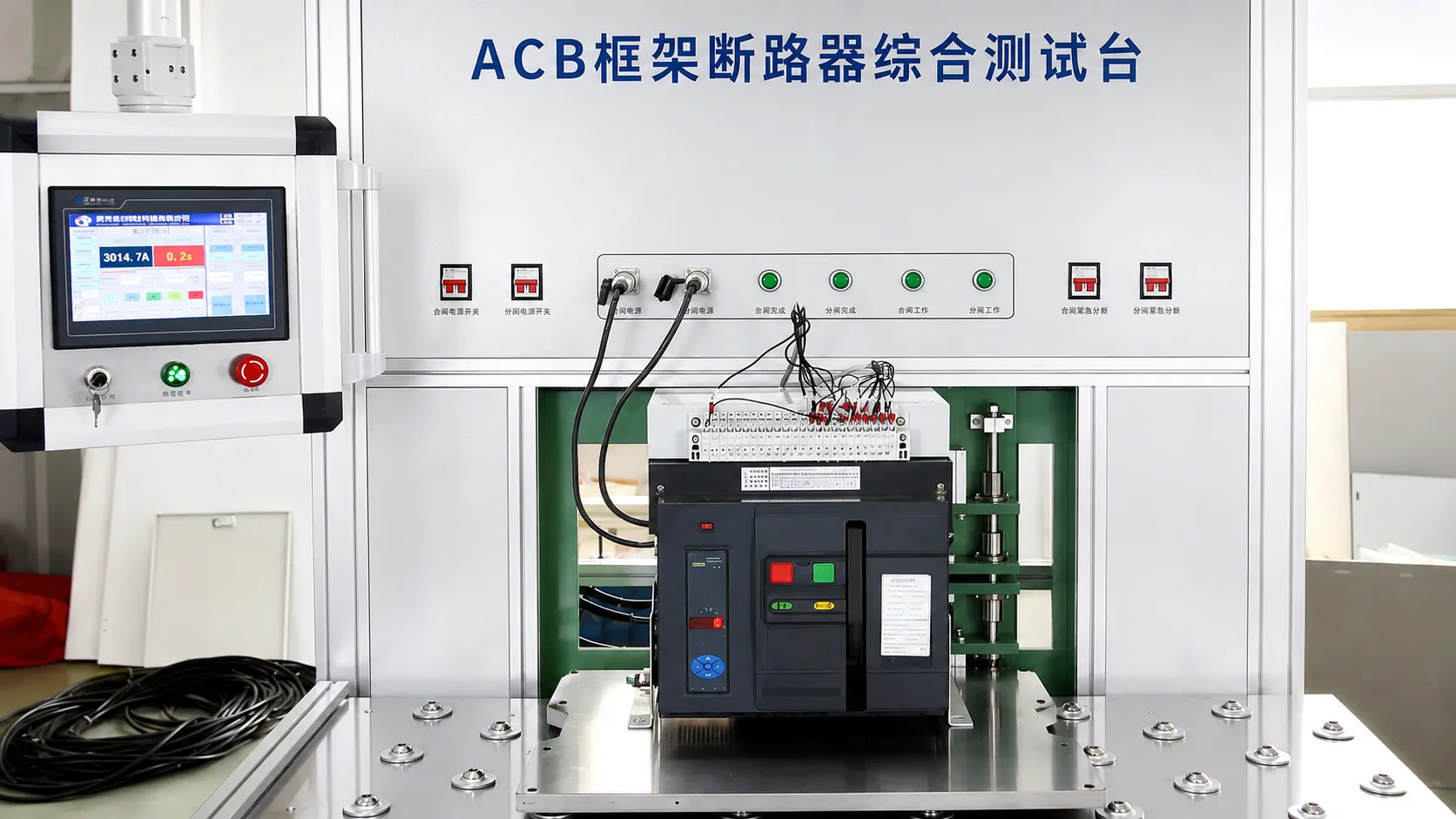
What is an ACB Comprehensive Test Bench?
An ACB comprehensive test bench is a consolidated laboratory and production test station for air circuit breakers — the large-frame, high-current breakers (1600A–6300A) that protect main incoming circuits in low-voltage power distribution. Because these breakers sit at the top of the protection hierarchy, every unit must be verified before shipment, and IEC 60947-2 defines the verification practice the industry follows. The bench covers four complementary tests. The loop resistance test injects DC current through each pole and measures the voltage drop across the main circuit path at micro-ohm resolution: elevated resistance points to poor contact pressure, contamination, or connection defects that would otherwise appear later as dangerous heating in service. The insulation and withstand voltage test applies elevated voltage between poles and from phase to earth to verify dielectric integrity of the insulation system. The current characteristic test uses primary current injection to verify that the trip unit follows its protection curve — long-time, short-time, and instantaneous behavior — across the settings your production requires. Finally, the temperature rise and power consumption test carries the breaker at sustained current until thermal steady state, verifying that terminal and contact temperatures and internal losses stay within limits. Running all four on one bench eliminates the handling, re-connection, and floor space of separate stations — a significant saving when the device under test weighs as much as a large-frame ACB does.
DC injection per pole reveals contact and connection defects before they become heating problems in service.
Dielectric verification between poles and phase-to-earth confirms insulation system integrity.
Primary current injection verifies long-time, short-time, and instantaneous trip behavior.
Sustained-current testing to thermal steady state verifies heating and internal losses.
Testing Process & Key Stations




Technical Specifications
| Applicable products | Air circuit breakers (ACB), frame sizes 1600A–6300A |
|---|---|
| Test functions | Loop resistance / insulation & withstand voltage / current characteristic / temperature rise & power consumption |
| Loop resistance test | DC current injection with per-pole measurement of main-circuit resistance for contact and connection quality verification |
| Insulation & withstand voltage test | Dielectric verification between poles and phase-to-earth on the assembled breaker |
| Current characteristic test | Primary current injection; verification of long-time, short-time, and instantaneous trip characteristics |
| Temperature rise & power consumption test | Sustained-current operation to thermal steady state with temperature and loss measurement |
| Standards orientation | Test functions aligned with the routine verification practice of IEC 60947-2 |
| Delivery time | 100 working days |
Detailed Process Flow
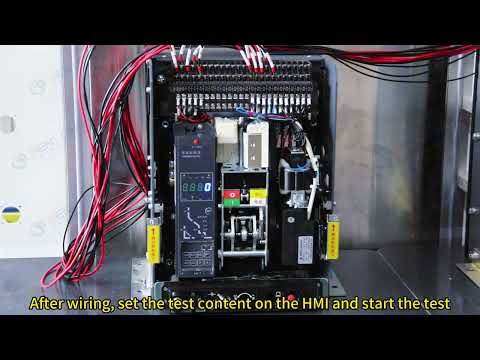
Tests can be run individually or in sequence according to your test plan. A full verification cycle runs as follows:
- Position and connect the ACB – The breaker is mounted at the test position and connected to the bench busbars matching its frame size.
- Loop resistance test – DC current is injected through each pole and the main-circuit resistance is measured and compared against limits.
- Insulation & withstand voltage test – Elevated voltage is applied between poles and phase-to-earth to verify dielectric integrity.
- Current characteristic test – Primary current injection verifies the trip unit’s long-time, short-time, and instantaneous behavior against its protection curve.
- Temperature rise & power consumption test – The breaker carries sustained current to thermal steady state while temperatures and losses are recorded.
- Record and unload – Results are recorded, the breaker is disconnected, and the next unit is loaded.
Core Technical Advantages (Laboratory-Grade Design)
Four test stations consolidated into one
Loop resistance, dielectric, trip characteristic, and thermal testing share one bench, one set of busbar connections, and one operator position — a major saving in handling effort when the device under test is a large-frame ACB.
True large-frame capability
Busbars, connections, and current sources are engineered for the 1600A–6300A class — the full frame range of a modern ACB product line, from main-incomer to top-frame ratings.
Complete verification chain
From contact quality (loop resistance) through insulation integrity and trip curve accuracy to thermal performance — the four tests together give a complete quality picture of every breaker before shipment.
Custom configuration per frame lineup
Busbar sets, fixtures, and test sequences are configured to your specific ACB models and production test plan, following IEC 60947-2 verification practice.
















Applications and Integration
Custom Engineering & Delivery
Request an ACB Test Bench Quote
Tell us your ACB models, frame sizes, and production test plan. Our engineers will configure the comprehensive test bench with the right busbar sets, current sources, and test sequences for your product range.
WhatsApp: +86 150 5837 0007 | Email: xsb@benlongkj.cn | English & Chinese support
Why Choose Benlong for ACB Test Equipment?
- 15+ years of assembly and testing equipment for low‑voltage electrical products
- Four-in-one integration: loop resistance test, withstand voltage test, current characteristic test, and temperature rise test in a single bench
- Engineered for the full large-frame range: 1600A–6300A
- Test functions aligned with IEC 60947-2 routine verification practice
- Global service and spare parts support
Typical Custom System Includes
ACB comprehensive test bench consisting of: · Loop resistance (DC injection) test circuit; Insulation & withstand voltage test circuit; Primary current injection system for characteristic testing; Temperature rise & power consumption measurement; Busbar sets for 1600A–6300A frames; Test fixtures per customer models; Control system with test sequencing; Installation commissioning; One-year warranty
Frequently Asked Questions
Air circuit breakers from 1600A to 6300A — the complete large-frame range, covering the frame class of mainstream ACB platforms. Busbar sets and fixtures are configured to your specific models.
Four verifications in one station: loop resistance testing (DC injection, per pole), insulation and withstand voltage testing, current characteristic testing (primary injection against the trip curve), and temperature rise with power consumption measurement.
Yes. Tests can be run individually or chained in sequence according to your production test plan — for example, running loop resistance and withstand voltage on every unit while reserving the full thermal test for sampling.
The four test functions are aligned with the routine verification practice of IEC 60947-2, the international standard governing low-voltage circuit breakers including ACBs. Specific test parameters are configured to your models and internal test specifications.
Your ACB models and frame sizes, the tests and parameters in your production test plan, and your factory’s power supply conditions. Our engineers will then propose the bench configuration. Standard manufacturing delivery is 100 working days.
Related Products

MCB semi-automatic thermal trip calibration bench Type-B
View Details
Electric meter aging test bench
View Details
RCBO Automatic Magnetic Reset + Testing machine
View Details
MCCB Tripping mechanism test machine
View Details
Auxiliary and Signal Contact test bench
View Details