
 benlong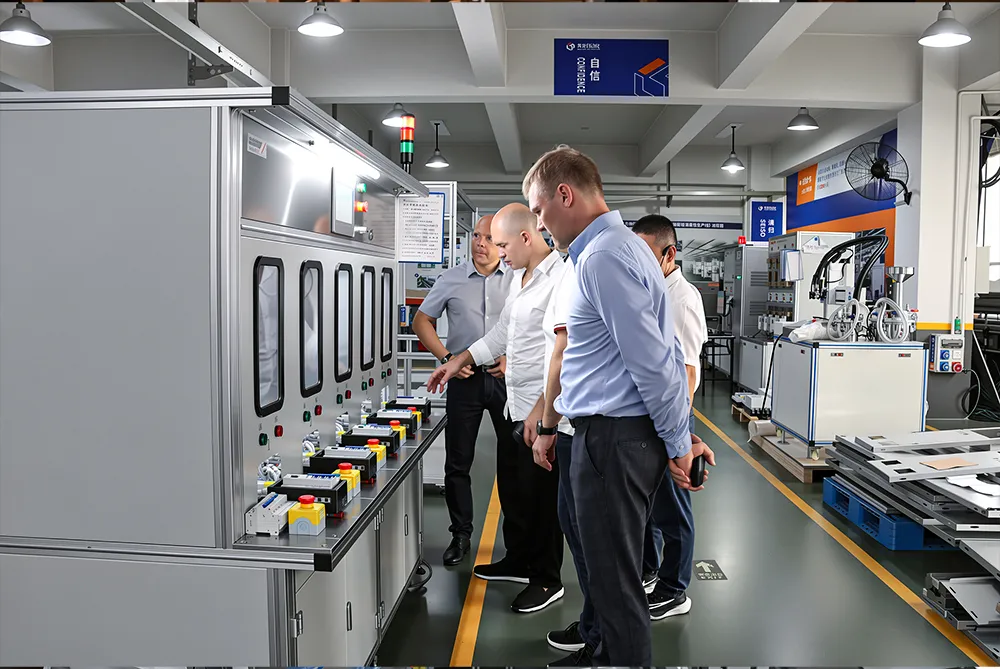

Automation Machinery Manufacturing Industry Challenges
In 2022, a medium-sized auto parts supplier in the Midlands launched an automated assembly unit, justified by an ironclad business case indicating a simple payback period of 22 months based on labor savings and throughput increase. Three months after launch, the unit was collecting dust. The existing IT infrastructure of the firm could not communicate with the cell’s OPC UA data stream. All three operators trained to work with the unit had left for better-paying jobs. Besides, the part it was designed to assemble had been redesigned by the customer, which implied a mechanical retooling that the systems integrator estimated would take 8 weeks and cost £15,000. The issue was not the unit itself, it was everything else.
In 2025, the problems confronting the automation equipment manufacturing industry do not come down to whether the technology is working or not – it does. Rather, they boil down to integration, skills, data interoperability, supply chains’ vulnerability, and the difference between the automation that the factory buys and the automation that it really can use. In this guide, we will analyze the most pressing problems, the solutions that manufacturers and integrators are developing, and what distinguishes investment in successful automation from spending money for nothing.
The Five Defining Challenges of the Automation Industry Today
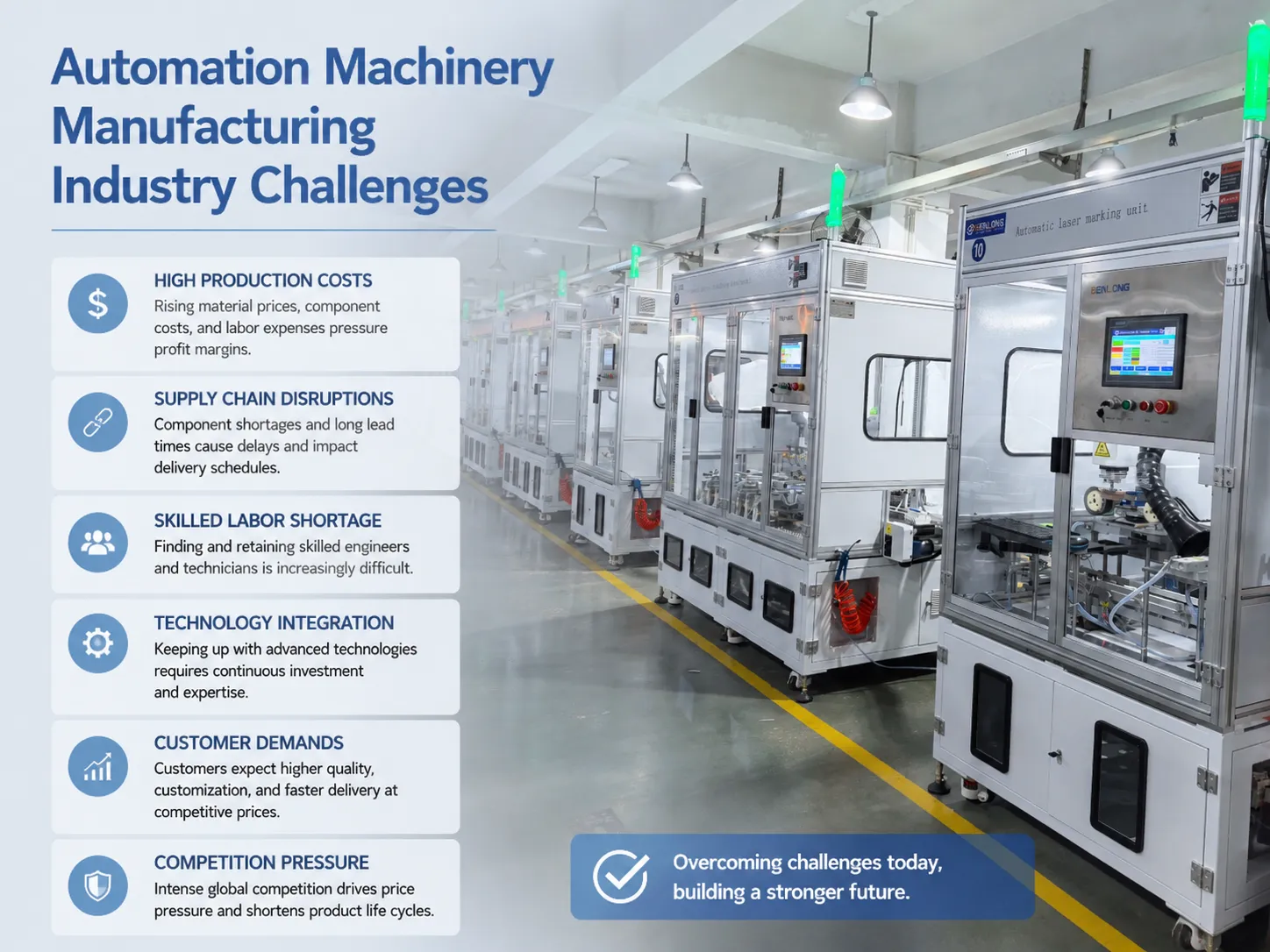
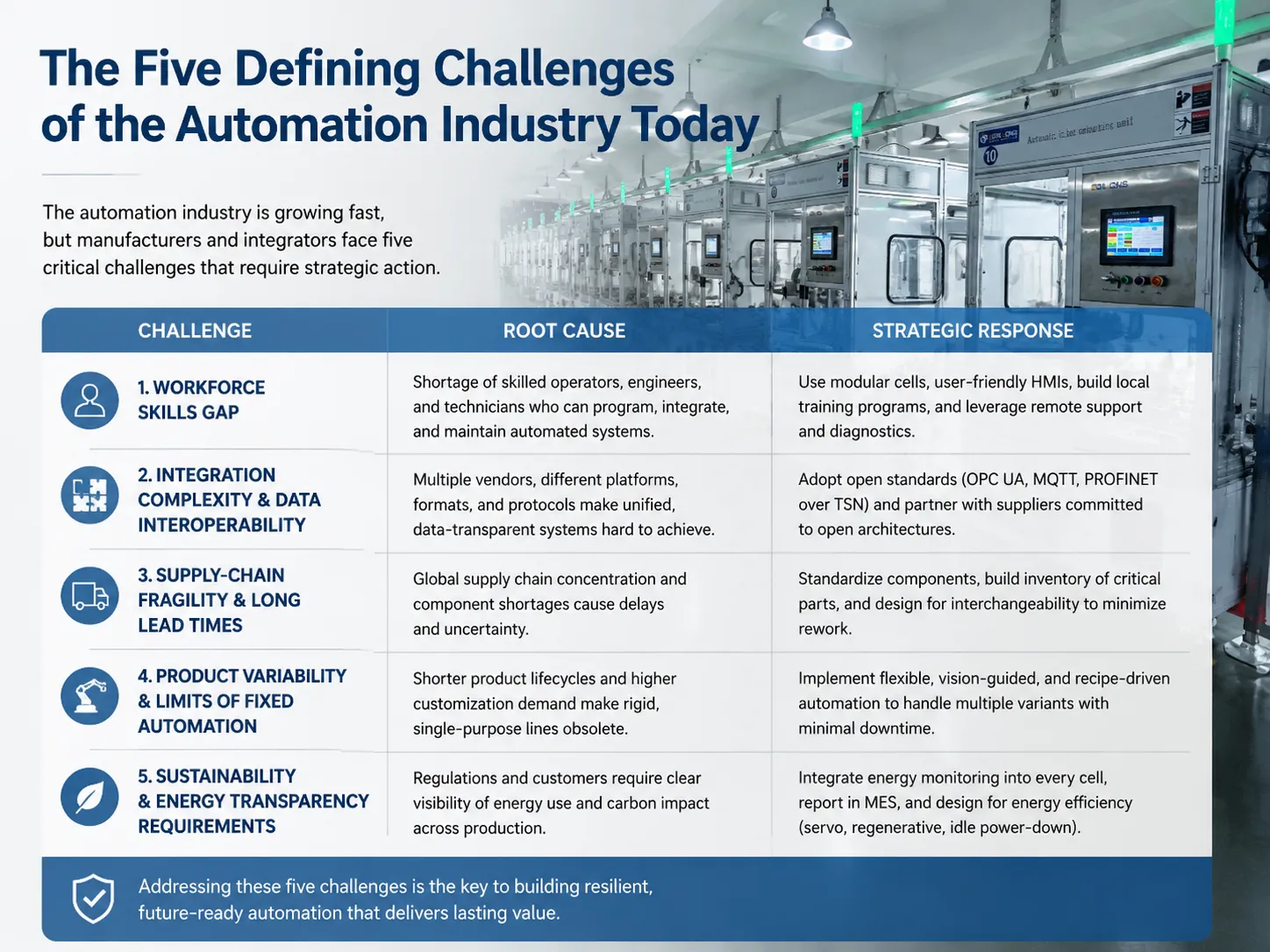
At almost 8-10% per annum, the market for automated machinery worldwide is expanding, influenced by a lack of labour force, reshoring processes, and the development of supporting technology, such as collaborative robots and artificial vision technology. However, the market growth does not mean the smooth process of development. The challenges faced by manufacturing, integration, and end-user companies are systematic and difficult to solve. The table below shows the main challenges, their causes, and the ways of responding to them being adopted by leading companies.
| Challenge | Root Cause | Strategic Response |
|---|---|---|
| Workforce skills gap | The operators who can run a manual assembly line cannot run an automated one without retraining. The engineers who can program, integrate, and maintain automated cells are in critically short supply globally, a shortage documented annually by Deloitte and the Manufacturing Institute. | Modular, pre‑engineered automation cells that reduce the integration burden; HMIs designed for operator usability, not engineer complexity; partnerships with local technical colleges and apprenticeship programmes; remote support and diagnostics from the integrator. |
| Integration complexity and data interoperability | An automated line typically includes equipment from multiple vendors, each with its own control platform, its own data format, and its own communication protocol. Connecting them into a single, data‑transparent system remains a significant engineering effort. | Adoption of open, interoperable standards — OPC UA, MQTT, PROFINET over TSN — across all equipment. Specifying these protocols in the purchase order. Choosing integrators and equipment builders who commit to open architectures rather than proprietary ecosystems. |
| Supply‑chain fragility and long lead times | Automation components — PLCs, servo drives, precision gearboxes, vision sensors — rely on a concentrated global supply chain. The lead times that spiked during the pandemic have improved but remain extended for certain specialised components, and a disruption at a single semiconductor fab can ripple through the entire industry. | Standardising on a limited set of component platforms to reduce spare‑parts diversity. Building strategic inventory of critical long‑lead items. Designing automation cells with component interchangeability in mind, so that a lead‑time‑constrained part can be substituted with minimal re‑engineering. |
| Product variability and the limits of fixed automation | Traditional fixed automation is designed for a single product at high volume. In a market where product lifecycles are shortening and customisation is increasing, a line that cannot adapt to a new product variant is a line that may be obsolete before it is paid off. | Flexible and programmable automation architectures — vision‑guided robots, modular tooling, recipe‑driven changeover — that allow a single line to produce multiple product variants with minimal downtime. AI‑driven vision systems that can learn a new part in hours, not weeks. |
| Sustainability and energy transparency requirements | Regulations such as the EU Carbon Border Adjustment Mechanism (CBAM) and growing customer demand for supply‑chain carbon reporting are requiring manufacturers to measure and disclose the energy and carbon intensity of their production. An automated line that cannot report its energy consumption per unit is a competitive disadvantage. | Specifying energy monitoring as a standard feature of every automated cell. Integrating energy data into the MES alongside quality and throughput data. Designing automation for energy efficiency — servo‑driven actuators instead of pneumatic, idle‑state power‑down, regenerative braking on high‑cycle axes. |
The Workforce Challenge: From Operators to Automation Managers
The most cited obstacle to the introduction of automation is not the cost of machinery but rather the unavailability of skilled workers to operate the equipment. A manual production line needs a workforce that could be trained in a few days, while an automated line needs specialists who will be able to find the problem with certain elements and understand the work of all three areas: electrical, mechanical, and software. The solutions to the issue include a new technology and education efforts. Regarding technology, the companies that build automating machines invest into the development of HMIs that have a design resembling smartphones, which allows the workers to perform operation and minor remote maintenance tasks. Regarding education, employees are created through cooperation between manufacturers, integrators, and local colleges. The automated lines of Benlong Automation were established with this reality in mind design because the HMIs used on the lines have a daily operator in mind rather than the engineer who designed the lines and the whole setup allows using remote diagnostics to troubleshoot problems with machinery from a distance of thousands of kilometers.
When to Automate: The Decision Framework That Separates Success from Regret
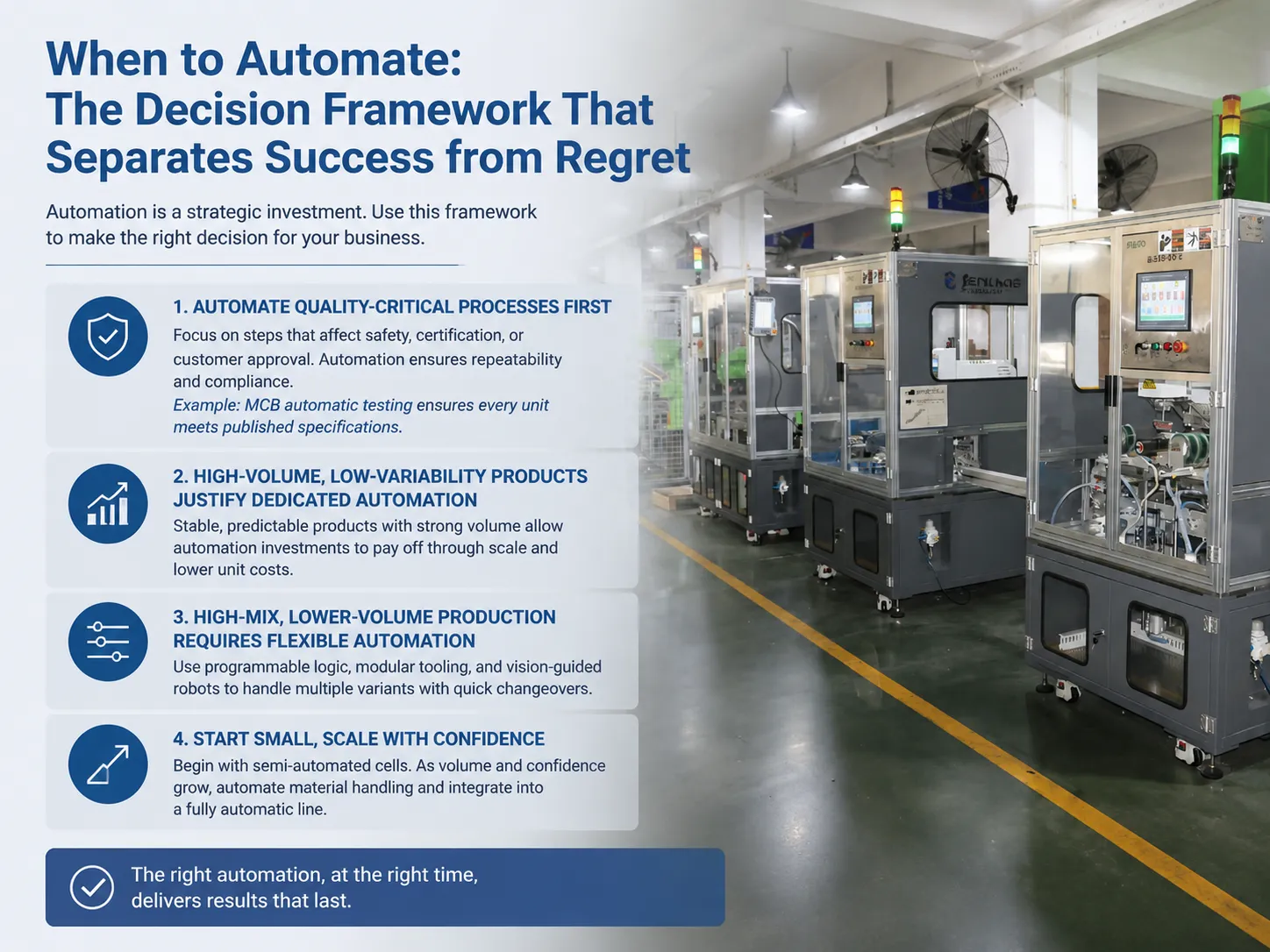
Automation is not appropriate for every process and process and not every manufacturer is prepared for automation. The choice of investing in automation machinery is a strategic choice that is determined by the specific economics of the product and amounts produced. The framework provided below is designed to offer structured guidance.
Quality‑critical processes should be automated first. If a step in the process (calibration, test, contact welding, dispensing) will influence safety, certification, or client approval, it becomes the most appealing step to opt for automation. Automating these particular steps guarantees the ability to repeat the process and obtain certification.In the electrical manufacturing sector, the calibration and testing of every circuit breaker is a legal requirement, and automating it — as Benlong’s Línea de prueba automática de MCB does — guarantees that every unit meets its published specification.
High‑volume, low‑variability products justify dedicated automation. Products that have a predictable production design and have an annual production of several hundreds or even millions of units are often great candidates for fixed automated lines. This allows the costs of setting up the factory to be compensated for by large production numbers and the unit cost of production to drop below that of assembling the products manually.
High‑mix, lower‑volume production requires flexible automation. Utilizing fast-changing automation, a producer with numerous variants who sells small product batches may achieve more efficiency. Programmable logic, modular tools, and vision-guided robots offer opportunities to introduce flexibility that is not characteristic of a traditional line.
Start with semi‑automated cells and scale as volume and confidence grow. The most prevalent automation path starts with a semi-automated cell – the operator is responsible for putting in the workpiece, and the machine will conduct the crucial manufacturing task. When production increases, the cell’s logistics tool is automated, leading to full automation of the cell. Benlong’s product range supports this phased approach, with standalone semi‑automatic calibration benches that can later be integrated into a fully automated line.
What Automation Delivers When the Challenges Are Managed
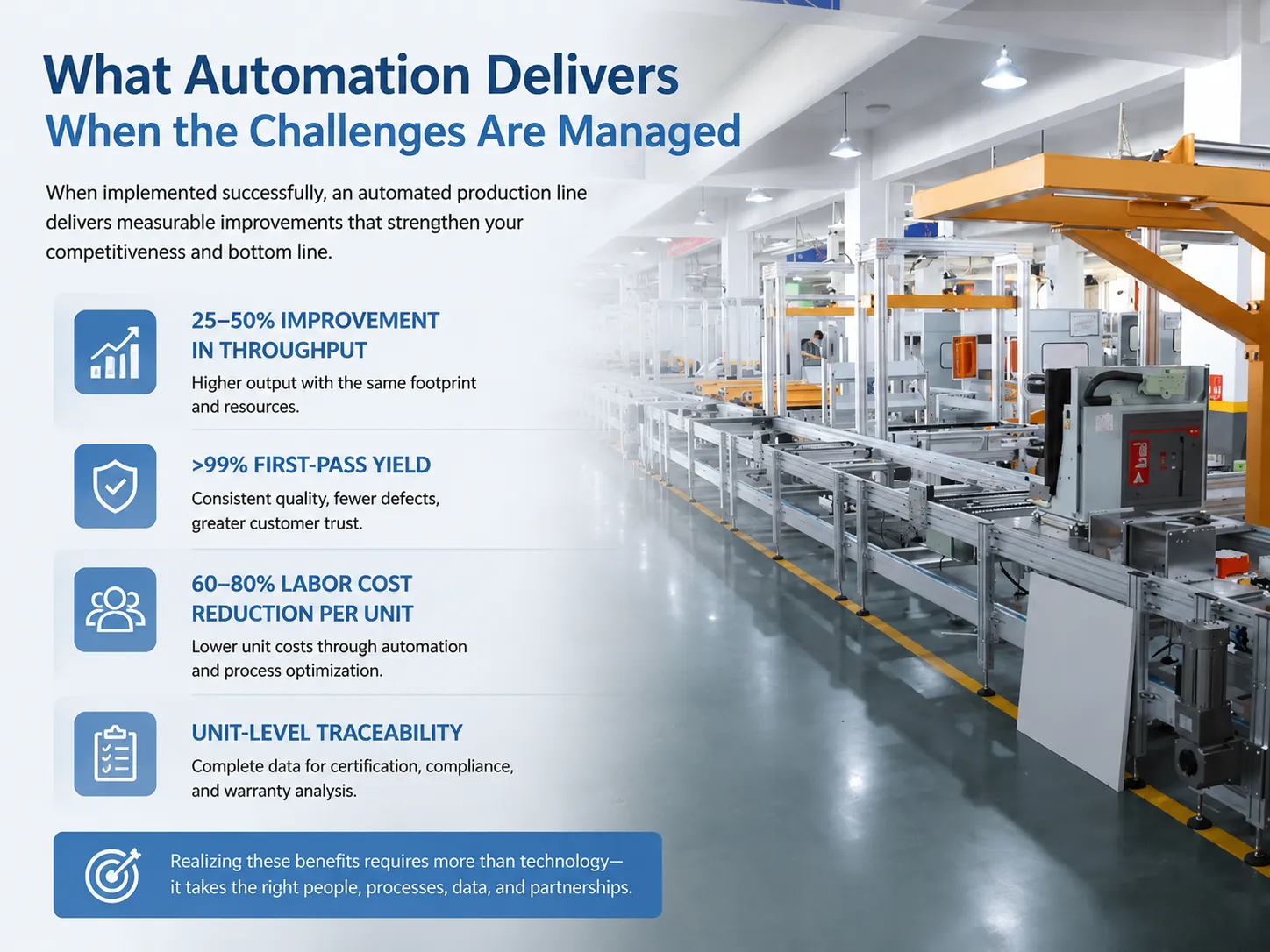
The advantages of automation have been thoroughly examined over the years, but these advantages do not happen automatically. When carried out successfully, an automated production line produces at least a 25–50 percent improvement in throughput, a first-pass yield rate higher than 99 percent, a labor cost reduction of at least 60–80 percent per unit, and unit-level traceability for effective certification and warranty analysis.
According to research by McKinsey & Company and the International Federation of Robotics (IFR), these numbers have been repeated many times in various industries. Unfortunately, the value of these accomplishments becomes evident only when an adequate integration of the technology, personnel, and supply chain has been implemented during the specification and commissioning of the system rather than being discovered after it has been already installed. Manufacturing companies that always regard automation as a technology acquisition and not as a change-management process are likely to be disappointed. Manufacturers that are committed to investing in training, data infrastructure, and supplier relations that automation requires will have the chance to enjoy the return on investment that the business case promised.
Preguntas frecuentes
What is the single biggest challenge in implementing automation?
The skills gap in the workforce is often brought up as the main hurdle. There are not enough engineers and technicians available worldwide who can handle, operate, and maintain automated processes, and a company that doesn’t have a plan for hiring or training will find it hard to keep its automation operational.
How long does it take to see a return on an automation investment?
An automation project that has been properly defined usually recoups its capital investment in a range of 18 to 36 months, calculated based on the savings received in terms of labour costs, increased production, reduction in scrap, and warranties avoided. Since initial investment is generally lower, the repayment for semiautomated cells is achieved earlier.
Is automation only for large manufacturers?
There is no doubt that the falling price of collaborative robots, the availability of pre-engineered modular automation cells, and the introduction of automation-as-a-service models have made automation services available for small and medium-size companies. The most quickly expanding sector in robot adoption tracked by IFR consists of enterprises with no previous experience in automation.
What role does AI play in overcoming automation challenges?
AI addresses a number of fundamental issues: adaptive vision systems that inspect new products with little training cut the costs of product changeover. Preventive maintenance algorithms that analyse motor current and vibration data curb unscheduled downtime. AI-enabled process optimisation can help decrease energy consumption and increase output without the need for manual adjustments.
Referencias
- Deloitte — Manufacturing Skills Gap and Workforce Trends. Annual research on the skills shortage in manufacturing and the growing demand for automation‑competent technicians and engineers.
- Manufacturing Institute — Workforce Development and Training. Research and resources on closing the manufacturing skills gap through apprenticeships and industry‑education partnerships.
- McKinsey & Company — El futuro de la fabricación y la automatización. Research on the productivity, quality, and ROI impact of automation across industries.
- Federación Internacional de Robótica (IFR) — Informe Mundial de Robótica. Annual data on global robot installations, cobot adoption, and automation density by country and industry sector.
El challenges facing the automation machinery manufacturing industry — skills shortages, integration complexity, supply‑chain fragility, product variability, and sustainability demands — are real, and they are not going away. Yet, these do not qualify as obstacles to automation. These are conditions that the automation investment should fulfill. The company that uses an integrator with a thorough understanding of these hurdles and that produces equipment designed for the operator, as well as for the engineer and that ensures flexible, data-transmitting, and energy-efficient production lines, is the company that will convert the automated production into a competitive edge for itself. Benlong Automation manufactures production and testing lines for the electrical equipment manufacturers taking into account that a machine that passed the factory acceptance test and cannot be used, serviced, and reset on the production shop is a problem rather than a solution.
Tabla de contenido
Recomendación
-
 Procesos de Fabricación de Baterías de Bigassbattery.com2026-09-28
 -
 Optimización del Patrón de Configuración de Carga en Palets: Esquema, Capas y Unidades por Capa2026-09-27
 -
 Las principales empresas de automatización personalizada en EE. UU. para startups en etapa de escalado (Guía 2026)2026-09-27

