Benlong



So prüfen Sie ein Wechselstrom-Schütz
Ein HVAC-Techniker aus Phoenix wurde gerufen, um eine Klimaanlage zu überprüfen, die 10 Minuten lief und dann stoppte. Eine Sichtprüfung der Komponenten der Klimaanlage ergab keine Probleme mit dem Thermostat oder den Sicherungen. Mit einem Multimeter zur Spannungsmessung am AC-Schütz der Außeneinheit stellte der Techniker schnell das Problem fest. Obwohl die Spule des Schützes erregt wurde, lieferte sie aufgrund der sich durch Überhitzung öffnenden Kontakte nur intermittierende Spannung an den Kompressor. Das Schütz klackerte und erhitzte sich unter Last; daher schaltete der interne thermische Überlastschutz des Kompressors diesen zum Schutz vor Überhitzung ab. Der Techniker konnte die Diagnose so schnell stellen, weil er wusste, welche Spannungen an jedem Anschluss zu erwarten sind (und wie abnormale Werte aussehen). Dieser Artikel bietet eine Anleitung zu Testsequenzen – ein entscheidender Unterschied zwischen einem “Teilewechsler” und einem “Diagnostiker”.”
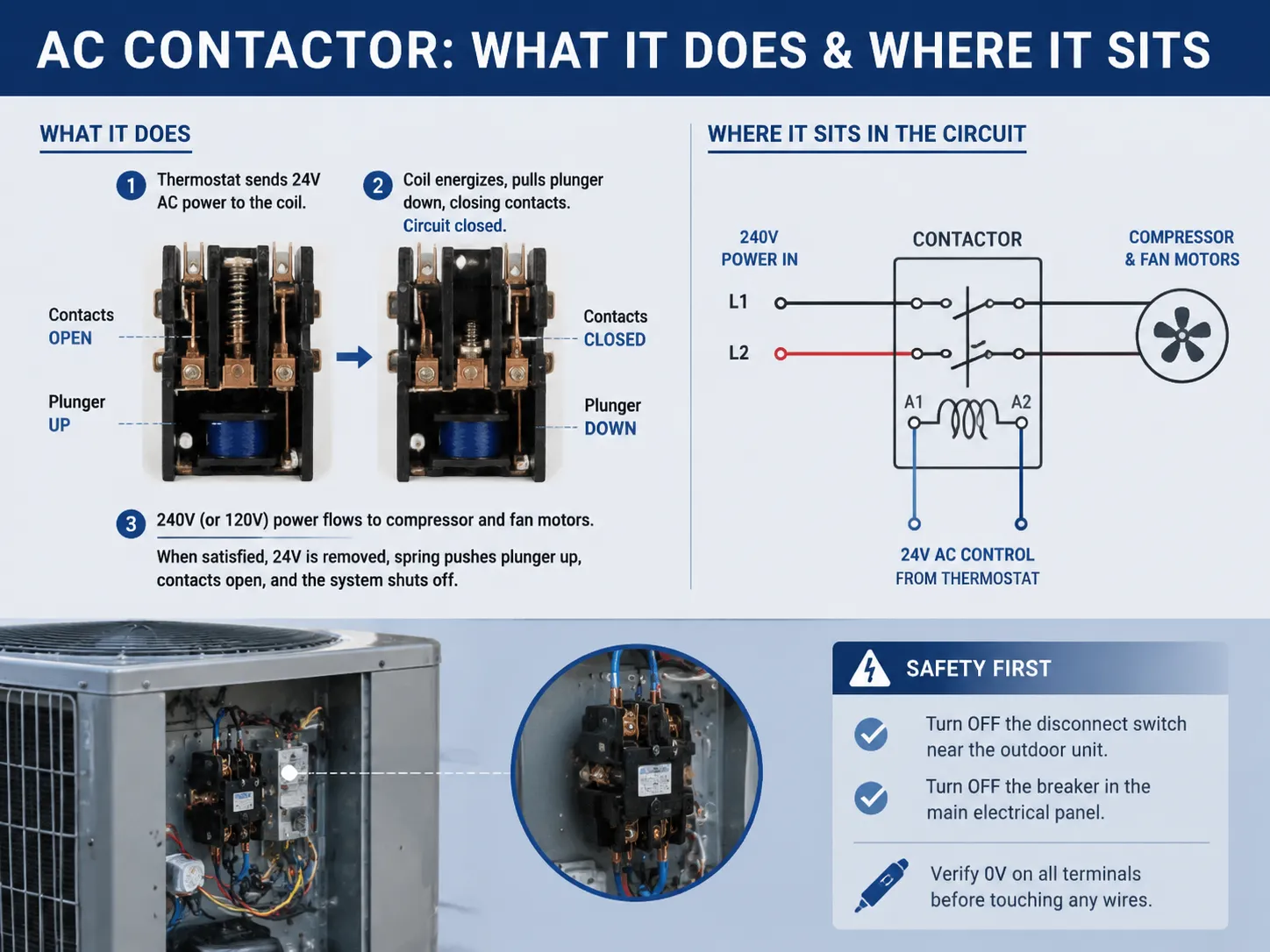
Was ein AC-Schütz tut und wo es im Stromkreis sitzt
Das AC-Schütz der Außeneinheit ist ein Relais, das für die hohe Spannung und den Strom eines Klimaanlagen- (A/C) oder Wärmepumpensystems (HP) ausgelegt ist. Wenn Kühlung benötigt wird, sendet ein Thermostat 24 V Wechselstrom an die Schützspule über die Thermostatverdrahtung. Die Erregung der Spule erzeugt ein Magnetfeld, das einen Kolben (nach unten) anzieht, um die beiden Kontakte zu schließen. Dadurch wird letztlich die 240 V (120 V bei kleineren Geräten) Leitung mit den Kompressor- und Lüftermotoren über die Schützkontakte verbunden. Sobald der Thermostat zufrieden ist, wird die 24 V von der Spule entfernt, das Magnetfeld verliert seine Magnetkraft, der Kolben wird durch eine Feder wieder nach oben gedrückt, schließt beide Kontaktsets und schaltet das System ab.
Das elektrische Zugangspanel der Außeneinheit enthält ein Schütz, das hauptsächlich rechteckig geformt ist. Dieses kann ein-, zwei- oder dreipolig sein, wobei jeder Pol Anschlüsse für die Leitung (eingehende Stromversorgung) und Last (ausgehend zum Kompressor und Lüfter) sowie einen Anschluss für die Spule (Niederspannungssteuerung) hat. Bevor Sie mit Tests innerhalb der Außeneinheit beginnen, müssen Sie zuerst den Trennschalter finden, der normalerweise an der Wand in der Nähe der Außeneinheit installiert ist, und diesen ausschalten. Außerdem schalten Sie den Leistungsschalter im Hauptverteiler aus, der die Kondensatoreinheit mit Strom versorgt, um eine doppelte Isolierung des Schützes zu gewährleisten; dies ist vor Arbeiten an der Elektrik zwingend erforderlich. Die Kontakte auf der Leitungsseite des Schützes haben immer Spannung vom Leistungsschalter zum Schütz, unabhängig davon, ob das Schütz geschlossen ist oder nicht. Mit einem berührungslosen Spannungsprüfer isolieren Sie das Schütz von der Spannung, indem Sie jeden Anschluss auf 0 Volt oder weniger prüfen, bevor Sie ein Kabel am Schütz berühren.
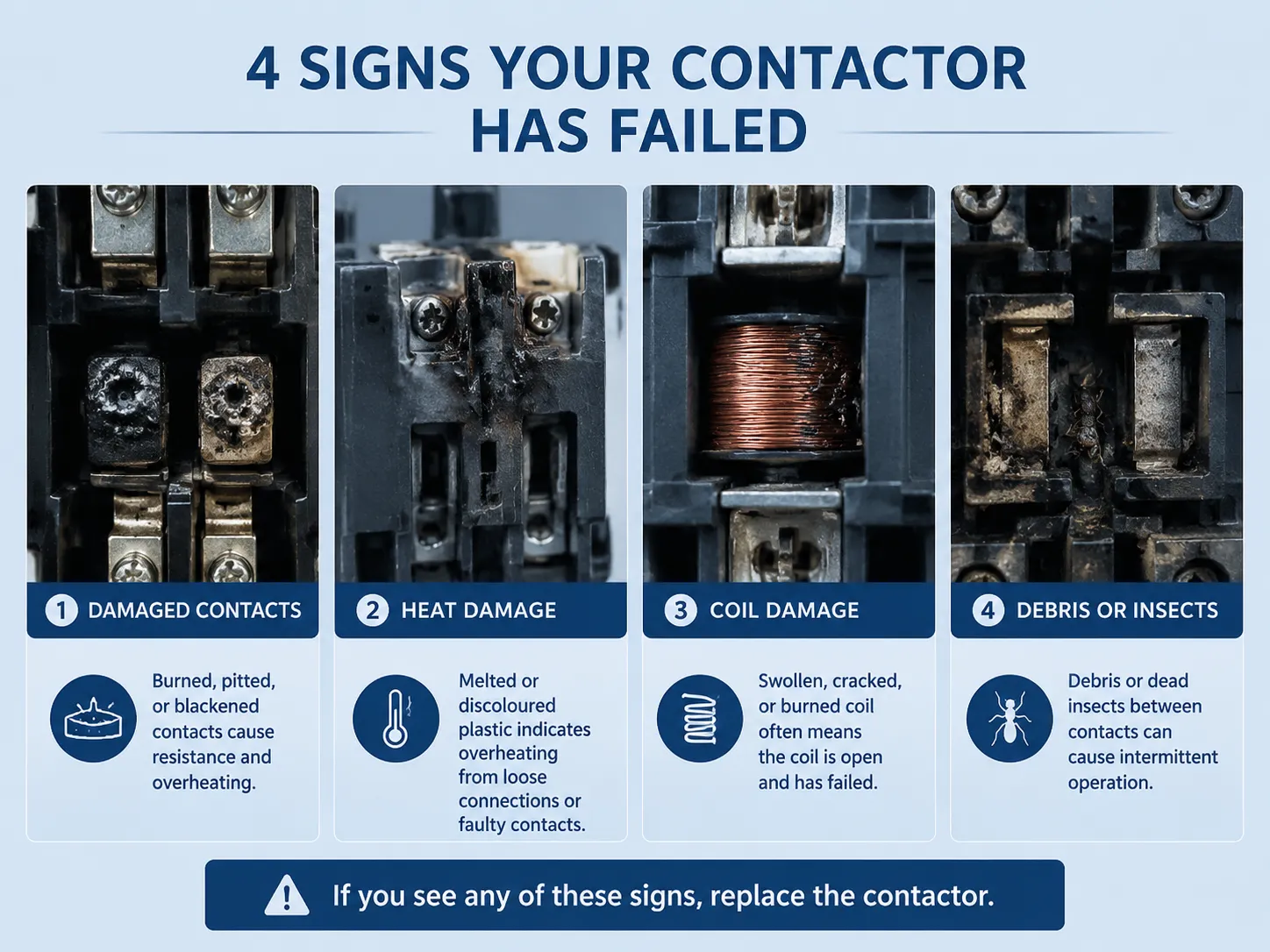
Wie man erkennt, ob ein Schütz bereits ausgefallen ist: Die Sichtprüfung
Oftmals kann eine gute Sichtprüfung feststellen, was falsch ist, bevor ein Multimeter benötigt wird. Nachdem die Stromversorgung bestätigt ausgeschaltet und die Zugangsklappe entfernt wurde, können Sie den AC-Kontaktor genau inspizieren:
- Verbrannte, zerfressene oder geschwärzte Kontakte. Die Kontaktflächen sollten sauber und glatt sein. Wenn sie einer kraterartigen, schwarzen oder geschmolzenen Mondoberfläche ähneln, befindet sich der Kontaktor in einem Ausfallzustand, auch wenn er noch intermittierend funktioniert. Das Zerfressen der Kontakte erzeugt Widerstand, der Wärme erzeugt und bald zu Verschweißen oder einem offenen Stromkreis führt.
- Geschmolzener oder verfärbter Kunststoffkörper. Wenn Sie Hitzeschäden am Kunststoffgehäuse um Ihren Anschluss sehen, deutet dies darauf hin, dass entweder eine lose Verbindung oder fehlerhafte Kontakte vorliegen, die wiederholt geblitzt haben. Ersetzen Sie die Kontaktoren.
- Geschwollene oder verbrannte Spule. Bei einigen Kontaktoren ist die Spulenwicklung von der Seite sichtbar. Wenn eine Spule übermäßiger Hitze ausgesetzt war, zeigt sie wahrscheinlich Anzeichen wie Anschwellen, Risse oder Brandspuren. Typischerweise zeigt eine ausgefallene Spule bei einem Widerstandstest einen offenen Stromkreis an.
- Schmutz oder tote Insekten zwischen den Kontakten. Ameisen werden oft vom Magnetfeld des Kontaktors angezogen und werden zwischen den Kontakten zerquetscht, wenn diese schließen. Dies ist eine überraschend häufige Ursache für intermittierenden Betrieb in warmen Klimazonen. Das Reinigen der Kontaktflächen kann die Kontaktoren gelegentlich wieder funktionsfähig machen, aber wenn sie durch Lichtbogenbildung zerfressen sind, müssen sie ersetzt werden.
Wenn bei der Sichtprüfung des Kontaktors Anzeichen vorhanden sind, sollte dieser ersetzt werden. Ein Test mit dem Multimeter ist weiterhin nützlich, um die Diagnose des Kontaktors zu bestätigen sowie festzustellen, ob es vorgelagerte oder nachgelagerte Fehler gibt; jedoch ist der Kontaktor bereits als defekt anzusehen, sobald Sie die Anzeichen bei der Sichtprüfung sehen.
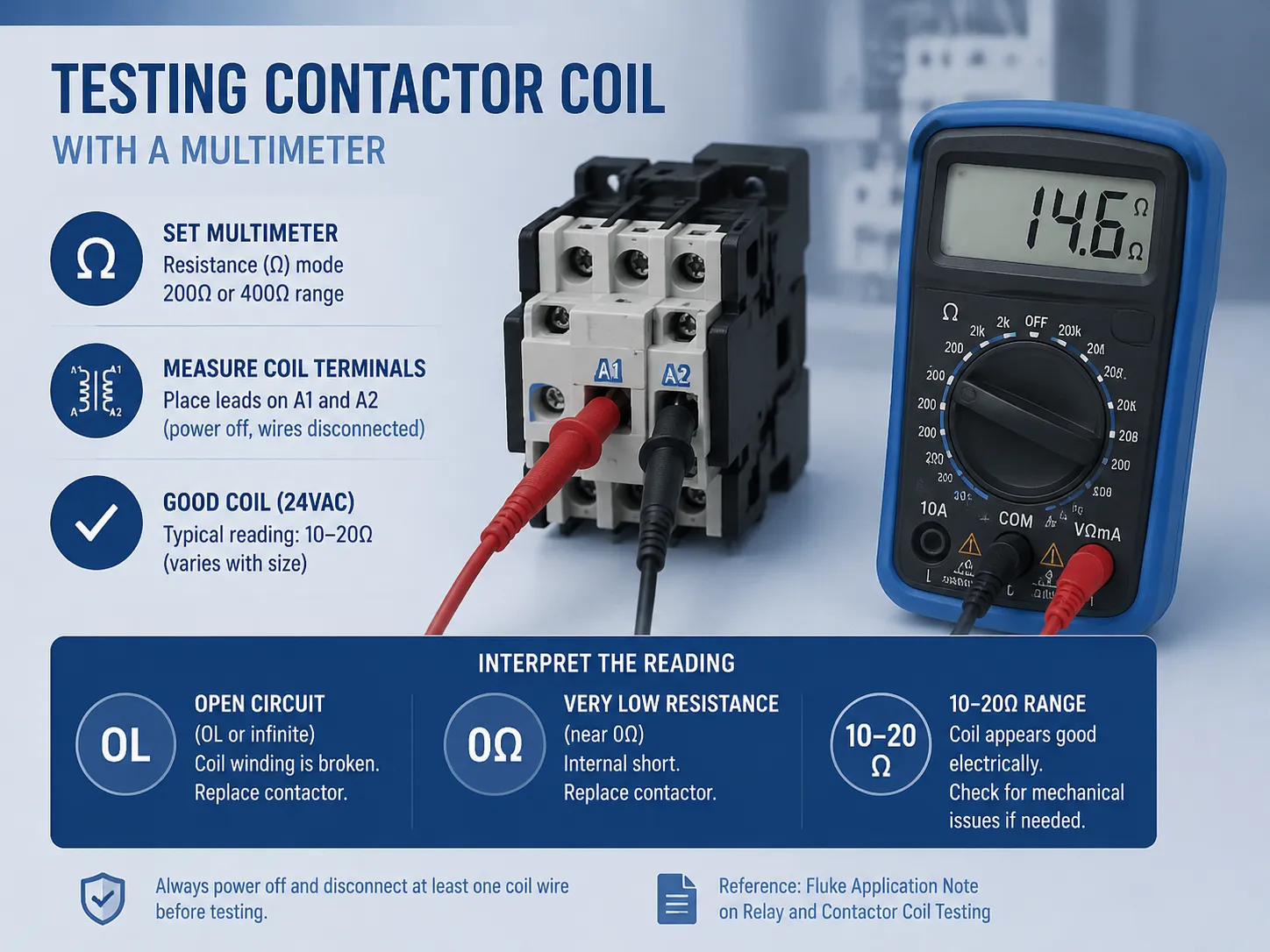
Testen der Kontaktorspule mit einem Multimeter
Sobald die Stromversorgung ausgeschaltet ist, kann der Kontaktor auf dem Labortisch oder im Feld getestet werden, solange beide Anschlüsse getrennt sind. Die Spule hat zwei Anschlüsse, oft mit A1 und A2 beschriftet, und die Spule ist in fast jedem Haushalt 24VAC. Stellen Sie das digitale Multimeter auf Widerstand (Ω) ein, typischerweise auf den 200-Ohm- oder 400-Ohm-Bereich, und legen Sie die Messleitungen an die beiden Spulenanschlüsse an. Eine 24VAC-Kontaktorspule in gutem Zustand zeigt einen Widerstandswert zwischen 10-20Ω. Größere Kontaktoren zeigen normalerweise Widerstandswerte unter 10Ω, kleinere Kontaktoren Werte über 20Ω. Während die tatsächliche Widerstandsmessung nicht so wichtig ist, wird der Wert in eine von drei Kategorien eingeteilt:
- Offener Stromkreis (OL oder unendlicher Widerstand): Die Spulenwicklung ist unterbrochen. Der Kontaktor kann nicht anziehen. Ersetzen Sie ihn.
- Sehr niedriger Widerstand (nahe 0 Ohm): Ein interner Kurzschluss der Spule ist aufgetreten. Dies ist selten, aber wenn es passiert, zieht eine kurzgeschlossene Spule häufig einen übermäßigen Strom und kann den Thermostattransformator durchbrennen oder die Steuerungssicherung auslösen. Kontaktor ersetzen.
- Eine stabile Messung im Bereich von 10–20 Ohm: Die Spule scheint elektrisch ordnungsgemäß zu funktionieren. Es könnte jedoch mechanische Probleme mit dem Kontaktor geben, z. B. einen blockierten Kolben, eine gebrochene Feder usw., aber die Spule selbst ist funktionsfähig.
Dieser Widerstandstest erfordert nicht, dass der Kontaktor aus der Einheit entfernt wird, aber die Steuerleitungen müssen von mindestens einem Spulenanschluss getrennt werden, um zu vermeiden, dass ein paralleler Pfad durch den Thermostat oder Transformator gemessen wird. Eine häufig zitierte Anwendungshinweis von Fluke Corporation bietet weitere Details zum Testen von Relais- und Kontaktorspulen.
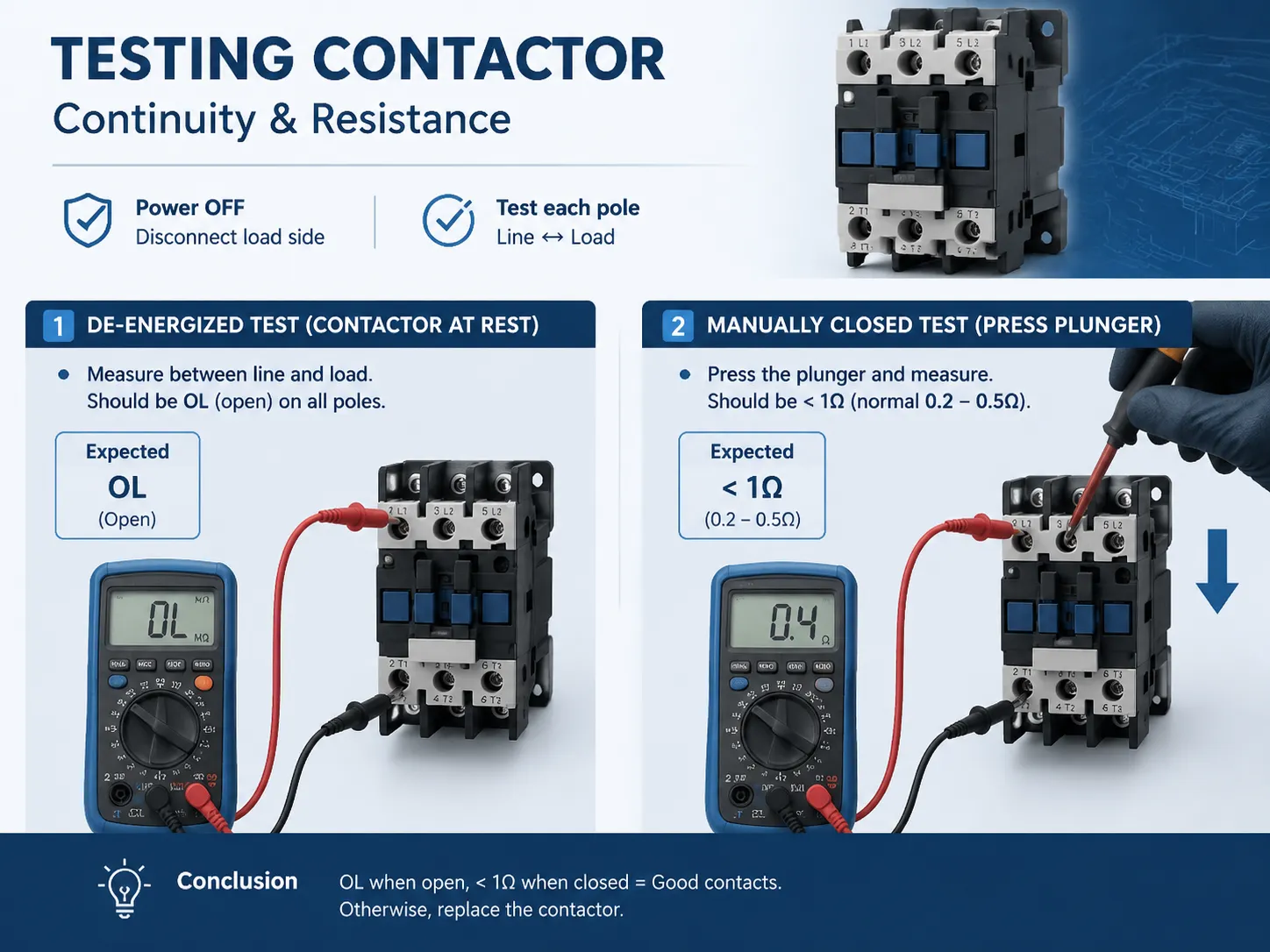
Testen der Kontakte auf Durchgang und Widerstand
Wenn die Stromversorgung ausgeschaltet ist und die Lastseitenterminals des Kontaktors getrennt sind, testen Sie die Hauptstromkontakte des Kontaktors, um sicherzustellen, dass sie bei ausgeschalteter Stromversorgung einen offenen Stromkreis ohne elektrischen Pfad anzeigen und bei angezogenem Kontaktor einen niedrigen Widerstand aufweisen.
Um jeden Pol zu testen, müssen Sie die folgenden Schritte ausführen:
- Spannungsloser Test: Der Widerstand der Lastanschlüsse jedes Pols sollte mit dem Kontaktor im Ruhezustand zwischen dem Leitungsanschluss und dem entsprechenden Lastanschluss gemessen werden. Die Widerstandsmessung sollte eine OL (offen) Anzeige sein. Wenn bei offenem Kontaktor ein tatsächlicher Widerstand gemessen wird, deutet dies auf verschweißte Kontakte oder Kohlenstoffspuren über den Isolator hin. Der Kontaktor muss ersetzt werden.
- Manuell geschlossener Test: Das Drücken des Kolbens des Kontaktors mit einem isolierten Schraubendreher simuliert die elektrische Wirkung der Spule. Solange der Kolben gedrückt bleibt, prüfen Sie den Widerstand zwischen Leitung und Last an jedem Pol im Kontaktor. Ein guter Kontaktor sollte weniger als 1 Ohm anzeigen (normaler Bereich 0,2 – 0,5) aufgrund des Widerstands der Messleitung. Wenn der Wert größer als 1 ist oder kontinuierlich zwischen hoch und niedrig schwankt, deutet dies auf schlechte Kontakte hin, daher muss der Kontaktor ersetzt werden.
Der manuelle Schließtest ist sowohl einfach als auch effektiv, um die Kontakte vom Spulenkreis zu isolieren und eindeutige Beweise für den Zustand des Schaltelements zu liefern.
Live-Spannungstest: Messung unter Lastbedingungen
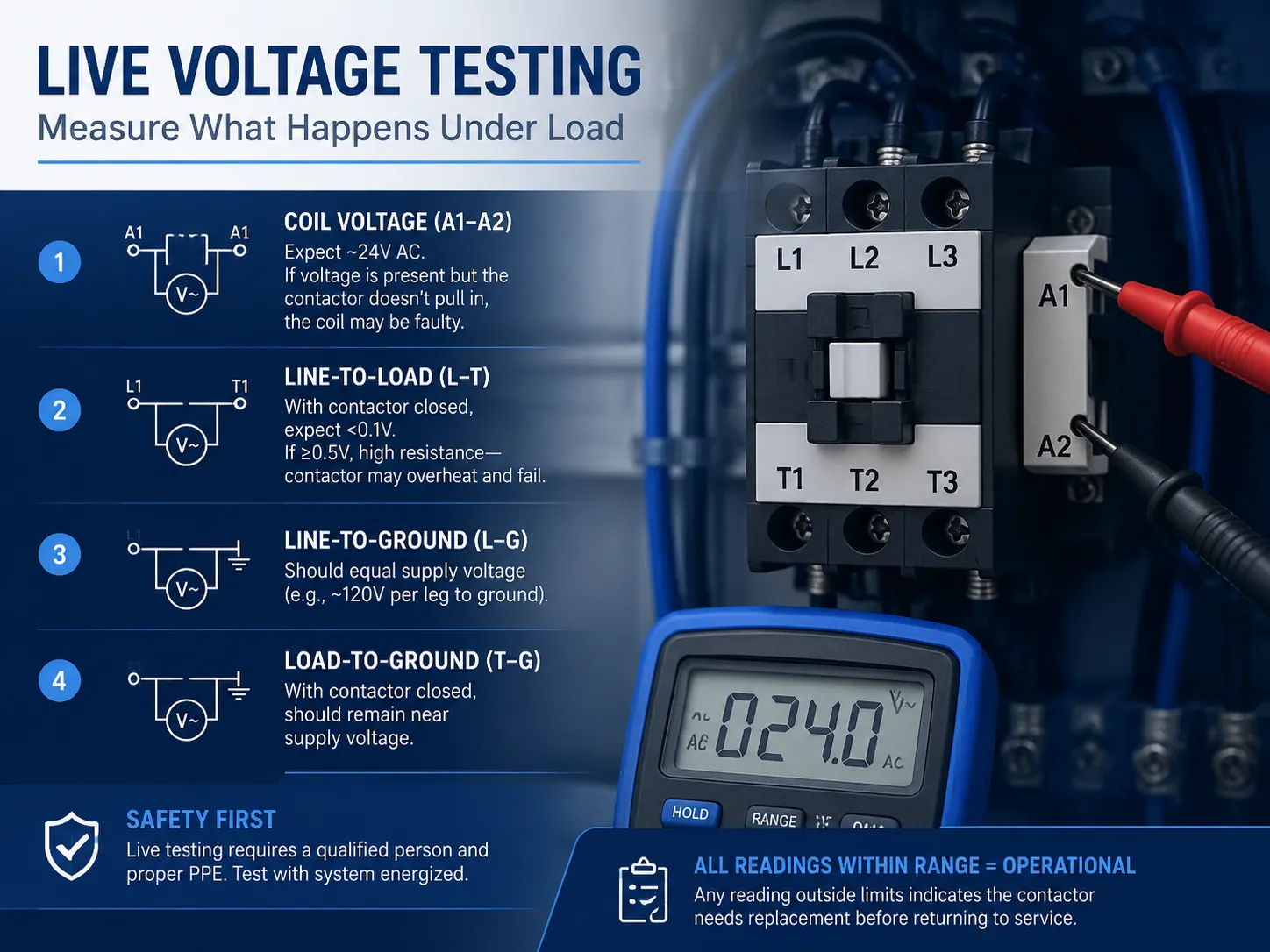
Das Testen und Sicherstellen, dass der Kontaktor ordnungsgemäß funktioniert, indem er statische Widerstandstests besteht und unter 24 Volt anzieht, erfordert eine weitere Testform; einen Live-Spannungstest. Ein Live-Spannungstest kann nur bei eingeschaltetem System durchgeführt werden und muss mit besonderer Vorsicht von einer qualifizierten Person unter Verwendung der erforderlichen persönlichen Schutzausrüstung (PSA) durchgeführt werden. Eine Ressource von Carrier beschreibt sichere Verfahren zur Messung der Betriebsspannungen von Wohn-Split-Systemen.
Wenn der Thermostat Kühlung anfordert, messen Sie Folgendes:
- An den Spulenanschlüssen (A1 und A2): Um eine erste Messung von Ihrem Test zu erhalten, sollten Sie überprüfen, ob Sie etwa 24 Volt Wechselspannung messen. Wenn Sie Spannung messen, der Schütz jedoch nicht anzieht, obwohl er den Durchgangstest bestanden hat, sollte davon ausgegangen werden, dass die Spule des Schützes einen internen mechanischen Defekt aufweist – möglicherweise aufgrund eines festsitzenden Kolbens.
- Über jeden Leitung-zu-Last-Kontakt: Um einen Schütz zu testen, müssen Sie die Spannung zwischen dem Leitungsanschluss und dem entsprechenden Lastanschluss messen, während der Kompressor mit geschlossenem Schütz läuft. Ein gesunder Schütz sollte nahe null Volt messen, normalerweise weniger als 0,1 Volt, da die Schütze einen minimalen Widerstand haben. Wenn Sie einen großen Spannungsabfall von 0,5 Volt oder mehr messen, deutet dies darauf hin, dass die Schütze einen hohen Widerstand haben, Wärme erzeugen und der Schütz ersetzt werden muss.
- Leitung-zu-Erde und Last-zu-Erde an jedem Anschluss: Die Messwerte zeigen, dass Spannung erreicht wurde und Stabilität besteht. Die L-G-Spannung muss der Versorgungsspannung entsprechen (normalerweise 120 Volt pro Phase gegen Erde), bevor die Last-L-G-Spannung auf diesen Werten bleibt oder sich in deren Nähe befindet, wenn der Schütz geschlossen ist.
Der Schütz sollte elektrisch funktionsfähig sein, unabhängig davon, welche Messwerte erfasst werden. Wenn ein Messwert außerhalb der akzeptablen Grenzen liegt, ist ein Austausch erforderlich, bevor der Schütz wieder in Betrieb genommen wird. Wenn bei einer Messung ein Spannungsabfall über einem Satz geschlossener Kontakte festgestellt wird, ist dies ein Hinweis darauf, dass dieser Schütz eine bevorstehende thermische Fehlfunktion aufweist.
Was tun, wenn der Schütz klappert oder summt?
Wenn Sie ein schnelles Öffnen/Schließen-Geräusch (oder Klappern) von einem AC-Schütz hören, kann dies daran liegen, dass an der Spule nicht genügend Spannung anliegt, um den Schütz geschlossen zu halten. Niedrige Spannung an der Spule kann folgende Ursachen haben: 1) ein defektes Thermostat (das Thermostat befiehlt entweder, die Einheit auszuschalten oder den Kompressor laufen zu lassen), 2) schlechte oder lose Verbindungen zwischen dem Thermostat und der 24-V-Steuerleitung oder 3) ein unterdimensionierter oder defekter Transformator, der die Netzspannung auf 24 Volt reduziert (Transformatoren sind typischerweise im Außenbereich, im Hochspannungsbereich einer Klimaanlage montiert). Um zu überprüfen, ob an den Spulenanschlüssen des Schützes genügend Spannung anliegt, müssen Sie diese messen, während der Schütz klappert. Die Spannung an den Spulenanschlüssen sollte nicht unter 20 Volt Wechselspannung liegen; wenn doch, liegt das Problem stromaufwärts vom Schütz. Wenn Sie eine konstante Spannung von 24 Volt Wechselspannung an den Spulenanschlüssen messen, der Schütz jedoch weiterhin klappert, ist die Spule (oder der Schattierungsring) defekt.
Ein defekter Schattierungsring erzeugt ein lautes Summgeräusch, wenn er erregt wird, und verhindert, dass der Kolben fest gehalten wird. Sie müssen den Schütz ersetzen, um das Problem zu beheben.

Vom Feldtest bis zum Werksprüfung: Das vollständige Spektrum der Schützüberprüfung
Im Rahmen eines 30-minütigen Serviceeinsatzes führen Techniker viele Tests durch, darunter eine Sichtprüfung, die Bewertung des Widerstands der Spule und die Überprüfung des Spannungsabfalls (Kontaktkopf) über die Kontaktpunkte. Die für diese Aktivitäten aufgewendete Zeit stellt eine kleine Stichprobe der Qualitätsprüfungen dar, die an jedem Schütz vor dem Verlassen der Fertigungslinie durchgeführt werden.
Um dieses Qualitätsniveau im Herstellungsprozess zu erreichen, verlassen sich Hersteller auf verschiedene Qualitätssicherungsprozesse – einschließlich automatisierter Tests. Die Prüfung von AC-Schützen kann mit der Koordination aller automatisierten Testprozesse einer einzigen Maschine in einer integrierten Station durchgeführt werden. Nach den oben beschriebenen automatisierten Testprozessen erzeugt der Hersteller die Testdaten, die der Techniker benötigt, um seinem Kunden die Gewissheit zu geben, dass der Schütz gemäß den Typenschild-Spezifikationen gefertigt wurde.
Für Hersteller von Schützen, Relais und ähnlichen elektromechanischen Geräten bietet automatisierte Testausrüstung den Durchsatz und die Dokumentation, die manuelle Tests nicht erreichen können. Benlong Automation’s umfassendes Prüfgerät für Wechselstromschütze ist ein Beispiel für ein solches System: Es integriert die für die Qualitätskontrolle in der Produktionslinie erforderlichen elektrischen und mechanischen Tests in einer Station und liefert kalibrierte, wiederholbare Ergebnisse mit digitaler Rückverfolgbarkeit. Dies ist das vorgelagerte Pendant zu den in diesem Leitfaden beschriebenen Feldtests – dieselben Parameter, gemessen mit derselben Physik, jedoch mit Produktionsgeschwindigkeit und vollständiger Dokumentation. Ein im Werk einzeln getesteter Schütz gelangt mit einer bekannten Leistungsgrundlage in die Hände eines Technikers, wodurch der Feldtest eine Bestätigung und keine Entdeckung darstellt.
Häufig gestellte Fragen
Wie erkenne ich, ob mein AC-Schütz defekt ist?
Wenn möglich, überprüfen Sie visuelle Anzeichen für defekte Kontakte; verbrannte/ausgefranste Kontakte, geschmolzener Kunststoff am Gehäuse des Schützes oder eine aufgeblähte Spule. Ein elektrisch defekter Schütz zeigt sich durch eine offene Spule (keine Durchgängigkeit), verschweißte Kontakte (haben Durchgängigkeit im spannungslosen Zustand) oder einen übermäßigen Spannungsabfall über geschlossene Kontakte (größer als 0,5 V). Ein summender oder klappernder Schütz ist ebenfalls defekt.
Kann man einen Schütz mit einem Multimeter testen?
Mit einem digitalen Multimeter können Sie eine vollständige Prüfung eines AC-Schützes durchführen. Messen Sie zuerst den Spulenwiderstand von A1 bis A2 (10-20 Ohm bei einer 24V-Spule). Messen Sie zweitens den Kontaktwiderstand von Leitung zu Last, während Sie den Schütz manuell schließen (weniger als 1 Ohm). Messen Sie schließlich bei eingeschalteter Stromversorgung die Durchgängigkeit durch beide Kontakte (sehr geringer Spannungsabfall).
Welchen Widerstand sollte ein AC-Schütz haben?
Je nachdem, wie viele Kontakte der Schütz hat, sollte der Widerstand durch die Spule eines typischen 24-Volt-AC-Schützes zwischen 10 und 20 Ohm liegen. Ein einfacher einpoliger Schütz liegt näher bei 10 Ohm, während ein größerer dreipoliger Schütz näher bei 20 Ohm liegt. Wenn Sie eine Unterbrechung (OL) oder sehr nahe Null messen, ist die Spule defekt.
Wie überprüft man einen HVAC-Schütz mit einem Multimeter?
Schalten Sie die Stromversorgung der Außeneinheit am Leistungsschalter aus. Prüfen Sie auf Null Volt zwischen den Stiftanschlüssen an der Außeneinheit. Trennen Sie die Spulendrähte von den folgenden Anschlüssen. Verwenden Sie ein Multimeter, um den Widerstand jedes Spulenanschlusses zu bestimmen; erwarten Sie einen Widerstand von 10 bis 20 Ohm. Drücken Sie den Stößel des Kolbens nach unten, um den Widerstand von Leitung zu Last an jedem Pol zu messen: erwarten Sie weniger als 1 Ohm Widerstand. Wenn der Schütz nicht unter Spannung steht (vom Stromkreis getrennt), sollte Leitung zu Last ein offener Stromkreis sein. Wenn der Schütz diese Tests besteht, schließen Sie die Stromversorgung der Außeneinheit am Leistungsschalter wieder an und prüfen Sie, ob die Spulenspannung 24 V Wechselstrom beträgt und ob an jedem geschlossenen Kontaktpunkt ein nahezu spannungsfreier Spannungsabfall vorliegt.
Referenzen
- Fluke Corporation — Wie man ein Relais testet — Anwendungshinweis zur Spulen- und Kontaktprüfung mit einem digitalen Multimeter.
- Carrier — Servicehandbücher für Wohnraum-Klimaanlagen — Herstellerservice-Dokumentation für Split-Klimaanlagen.
- Trane — HVAC-Service- und Fehlerbehebungsressourcen — Diagnoseverfahren für Wohn- und leichte Gewerbe-HVAC-Geräte.
- ACHR News — Die Nachrichten für Klimatisierung, Heizung und Kühlung — Fachzeitschrift mit technischen Artikeln zur Diagnose und zum Austausch von HVAC-Komponenten.
Das Testen eines AC-Schützes ist eine Abfolge logischer Schritte: Sichtprüfung, Spulenwiderstand, Kontaktkontinuität und Spannungsabfall unter Last. Jeder Schritt bestätigt oder schließt eine bestimmte Fehlerart aus. Ein Schütz, der verbrannt aussieht, an der Spule offen misst oder einen Spannungsabfall über geschlossenen Kontakten zeigt, ist ein Schütz, der das Ende seiner Lebensdauer erreicht hat — und der Austausch ist eine einfache, kostengünstige Reparatur, die das System wieder zuverlässig in Betrieb nimmt. Ob der Test auf einem heißen Dach mit einem tragbaren Multimeter oder auf dem Fabrikboden mit einer automatisierten Prüfmaschine durchgeführt wird, die Parameter sind dieselben, da die Physik dieselbe ist. Die Beherrschung dieser Abfolge verwandelt eine intermittierende Kühlungsbeschwerde jedes Mal in eine eindeutige Diagnose.