benlong

Which Laser Machine for Circuit breaker Marking?
Choosing the right laser marking machine for circuit breaker production looks simple until you stand in front of two very different machines that both claim to mark plastic. On a miniature circuit breaker (MCB), a moulded case circuit breaker (MCCB) or a residual current device, marking carries the printed technical data — rated current, breaking capacity, wiring diagram, standard reference, batch or date code and the brand logo — plus the ON and OFF indicators on the handle. Pick the wrong technology and the mark comes out faint, grey, half-melted or gone within a year. Pick the right one and it stays sharp for the working life of the breaker. This guide compares the two technologies that actually matter for low-voltage switchgear, the fiber laser marking machine and the UV laser marking machine, and gives you a practical way to decide which one belongs on your line.
What gets marked on a circuit breaker, and why laser
All markings on the circuit breaker convey data regarding the safety of the circuit breaker. The current rating helps the installer to identify the conductor for which the circuit breaker is suitable. The break capacity shows whether it can clear the fault. The standard information helps the certification authority to know the test which the breaker has undergone. The degradation of any marking is not loss of aesthetic value, but it means that it cannot be considered compliant. . The International Electrotechnical Commission standards under IEC 60898-1 and IEC 60947-2 expect all markings to last.
For a long time pad printing or ink-jet technology has been used for marking. Ink is good, but its lifetime is limited and requires maintenance and slows the factory process. In the case of laser marking, it is done without ink as the laser mark is burning into the material itself hence it will not get lost. Thus, top manufacturers use laser marking technology.
How the two lasers actually make a mark
Both machines look the same in factories, however, they function differently. A fiber laser marking machine is based on infrared radiation at the wave length of 1064.Essentially, this is a thermal process that involves the uptake of energy by a surface area, which then heats the polymer and causes either the carbonization, foaming, or melting of the material. When analyzing a black filled plastic substrate, we see how the infrared energy is absorbed through carbon black, causing the foaming of the surface area and yielding a raised mark that will appear light gray or whitish.
The device for UV laser marking on the other hand works on a wavelength of approximately 355nm in the UV range through a totally different approach. This technology is often referred to as cold marking as it operates independently from heat. With the help of high energy photons, this laser works through a photochemical process that causes a polymer to change color in a thin surface layer without being burned, melted, or deformed. Since the process is not associated with the absorption of infrared energy by the substrate, a UV source acts in a way that is indifferent to the color of the surfaces since it will produce a sharp black marking on both white and dark plastics.
The real decision factor is absorption, not colour
A lot of operators follow this rule: dark surfaces get a fiber laser and light surfaces a UV laser. And while this is a good rule to start off with, you should know that there is a complex science behind it, as color alone can get you in trouble. What really matters here is how the specific polymer absorbs the light of your wavelength due to the pigments and fillers it contains. In fact, color is just the most evident reflection of the underlying chemistry.
For example, in a dark casing or a black or grey handle, the pigment is typically carbon black and is the best absorber of 1064nm infrared. The fiber laser removes the pigment resulting in a visible area of light color. This is exactly why Benlong’s own MCB knob laser marking machine uses a fiber source to etch permanent ON and OFF indicators on dark handles at 60 to 80 pieces per minute.
The light-colored elements are where the rule of thumb applies. White plastics often have titanium dioxide as their pigment to reflect infrared radiation instead of absorbing it, so fiber lasers create at best faint and inconsistent marks on white, natural, or transparent items — and may burn the surface by trying to do so. A UV laser, being independent of color and heat, creates a distinctively sharp and clear dark mark on exactly those items. Therefore, using a UV laser is a good option for any white or light grey items, nameplate areas where all markings have to stay in the same shape, as well as premium flush finishes.
Two limitations are necessary. First, chemical engineering allows for changes in chemistry: adding laser-sensitive additives to a mixture helps create a polymer that absorbs infrared light, which can make fiber lasers usable on items that cannot be marked otherwise. Second, almost all plastic materials used by breakers are flame-retardant. Halogenated flame-retardant materials are toxic when heated by a UV laser and should be handled using special equipment designed especially for that purpose.
Fiber laser marking machine: strengths and limits
The fiber laser marking machine is the workhorse of the marking world, and for good reason. The source is air-cooling and practically maintenance-free with diode lifespan estimated to be in the tens of thousands of hours which means that the running cost is almost equal to the electricity price. Besides it is fast and can carry out continuous three-shift production while making deepest and most durable marks on metals and dark filled plastics at the same time. In terms of making marks on black/grey components that make up the visible surfaces of the breaker no other system can beat it in terms of cost per unit.
However, the downside of this technology comes from the fact that it is a thermal technology. To put it in simple words since laser works based on the heating of the surface, it can melt and/or damage thin and heat-sensitive plastics if pushed to the limit. Besides since the technology relies on some infrared absorption, it does not work well with white, natural and transparent materials since they reflect the light or let it go through. In addition to that, the laser spot is bigger than that of a UV laser meaning that when it comes to engraving really small data matrix codes on a noisy nameplate it may not have enough resolution. For a company that works with mostly black parts and fast processing that is not a big deal, but for a plant with lots of white parts that is a problem.
There is one technology that helps improve this problem. A MOPA fiber laser is a fiber laser with a controllable pulse length and therefore allows the operator to control how much heat reaches the surfaces. In the case of thin/sensitive plastics that can help avoid melting or burning of plastic while one can manage to provide the required color or better black results. Nevertheless, it does not mean that it makes a fiber laser comparable to a UV laser since it still cannot guarantee reliable engraving of light-colored and transparent plastics. However, if the plant has a majority of black parts with some unwanted materials, a MOPA source can become a reasonable compromise between UV laser and fiber laser.
UV laser marking machine: strengths and limits
The UV laser marking machine is a pro. Its feature of cold marking enables it to have almost zero heat-affected zone hence retention of the intact surface which suits applications with delicate components. Moreover, UV marking process applies virtually no colours thus making it convenient when one works with multiple colour plastics at the same working place. Besides, it has a very small focus that makes it perfect for writing micro 2D codes and serial numbers in small places for labels.
The disadvantages are that it is expensive and not very productive. A UV source is much more difficult in construction, requires cooling, as well as is much more expensive than the fibre laser machine which may cost several times less than a UV laser. The service life of an UV machine is considerably lesser than that of a fibre machine The raw marking speed of the UV processes in certain cases is far less than the speed of the fibre marking in case the component is black.
Fiber versus UV at a glance
| Wavelength | Fiber: ~1064 nm (infrared) | UV: ~355 nm (ultraviolet) |
| Marking mechanism | Thermal: carbonise, foam or melt | Cold: photochemical bond breaking |
| Dark / filled plastic | Excellent — light foamed high-contrast mark | Works, but rarely necessary |
| White / light / clear plastic | Poor — faint, inconsistent, may scorch | Excellent — sharp dark mark, colour-blind |
| Heat impact on part | Real; can melt thin or sensitive plastics | Minimal; no heat-affected zone |
| Fine detail / micro codes | Good | Best — very small focal spot |
| Throughput | Very high on suitable materials | High, usually lower than fiber |
| Purchase cost | Lower | Higher (often several times) |
| Cooling / maintenance | Air-cooled, maintenance-free | Needs cooling, shorter component life |
| Typical breaker use | Dark handles, dark housings, metal parts | Light housings, clean nameplates, micro codes |
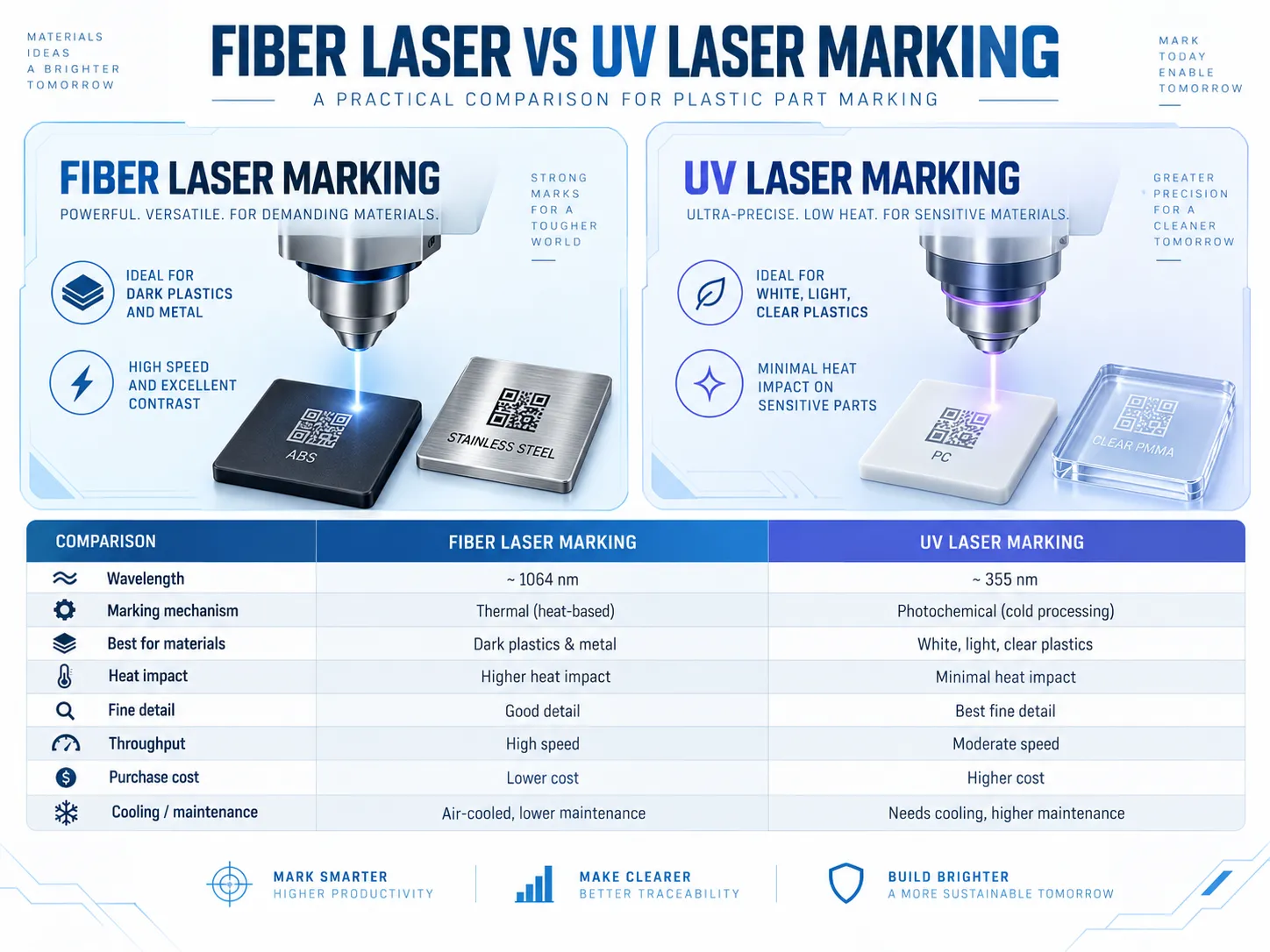
Which laser for circuit breaker marking
When discussing switchgear, the decision typically becomes evident when one looks at the surface instead of the entire breaker. In terms of ON and OFF indicators and logos printed on a dark handle (which happens to be the most common activity conducted in an MCB facility), the use of fiber lasers turns out to be the right choice, and it’s usually what the handle-marking unit is designed around. Technical information that needs to be stamped on a dark housing also utilizes fiber lasers. The specific reason is the clear mark that fiber laser creates on black or grey plastic and which is resistant to heat and solvents.
Nevertheless, this conclusion does not hold for bright surfaces. In case of a white or light-grey shell, a light label that has been formed in the case or a product that requires producing a dark mark without disturbing the surface means the use of UV here. The same goes for the case with the high-mix line that has numerous colorized plastics being processed through one printing station where color-blind UV helps to avoid any mistakes. Moreover, the situation in which the print consists the data-matrix code for tracing and fits into a matter of a few millimeters also needs to be mentioned as it implies better UV capabilities.
Laser marking machine benefits over pad printing and inkjet
Whichever source you choose, the laser marking machine benefits over the older ink methods are the same, and they are the reason the switch keeps happening across the industry. The first one consists of durability: since the marking is done in the polymer, not applied on its surface, it is invulnerable to fading, blurring, or wiping – which eliminates a number of complaints and warranty requests due to illegible identification marks from customers. The second aspect pertains to economy: since the process does not involve any paste or chemical solutions, the total expenses are substantially lowered, as the only resource is electricity.
The third positive aspect is also speed and labor. An automatic laser installation fed by a vibro-bowl works approximately from 60 to 80 pieces per minute with an efficiency that exceeds 99.9%, which is a few times quicker than manual printing, where one machine requires the operator’s steady presence. The fourth benefit is related to traceability: every unit can be marked with a unique serial number or a data matrix, which can then be fed into the manufacturing management system.
Where marking sits in an automated breaker line
Marking is rarely a stand-alone operation; it is one station in a larger automated flow, and thinking about it that way affects the technology you pick. On a full MCB automatic assembly line, parts are moulded, assembled, tested and marked in sequence, so the marking cell has to hold the line’s cycle time and integrate with the same control and data systems. That favours a source that is fast and stable — usually fiber on dark parts — and it makes the serialised code the thread that ties the whole line’s traceability together.
The same logic reaches upstream and downstream. The housing that arrives at the marking station was formed on an MCB injection mold, and its resin, pigment and flame-retardant grade are precisely the variables that decide whether fiber or UV will mark it well — which is another argument for settling marking chemistry at the design stage. Downstream, welded sub-assemblies such as bimetal thermal trips coming off a thermal trip set welding line are increasingly laser-coded for lifecycle traceability, so the marking philosophy you adopt for the handle tends to propagate across the whole product.
A short decision path
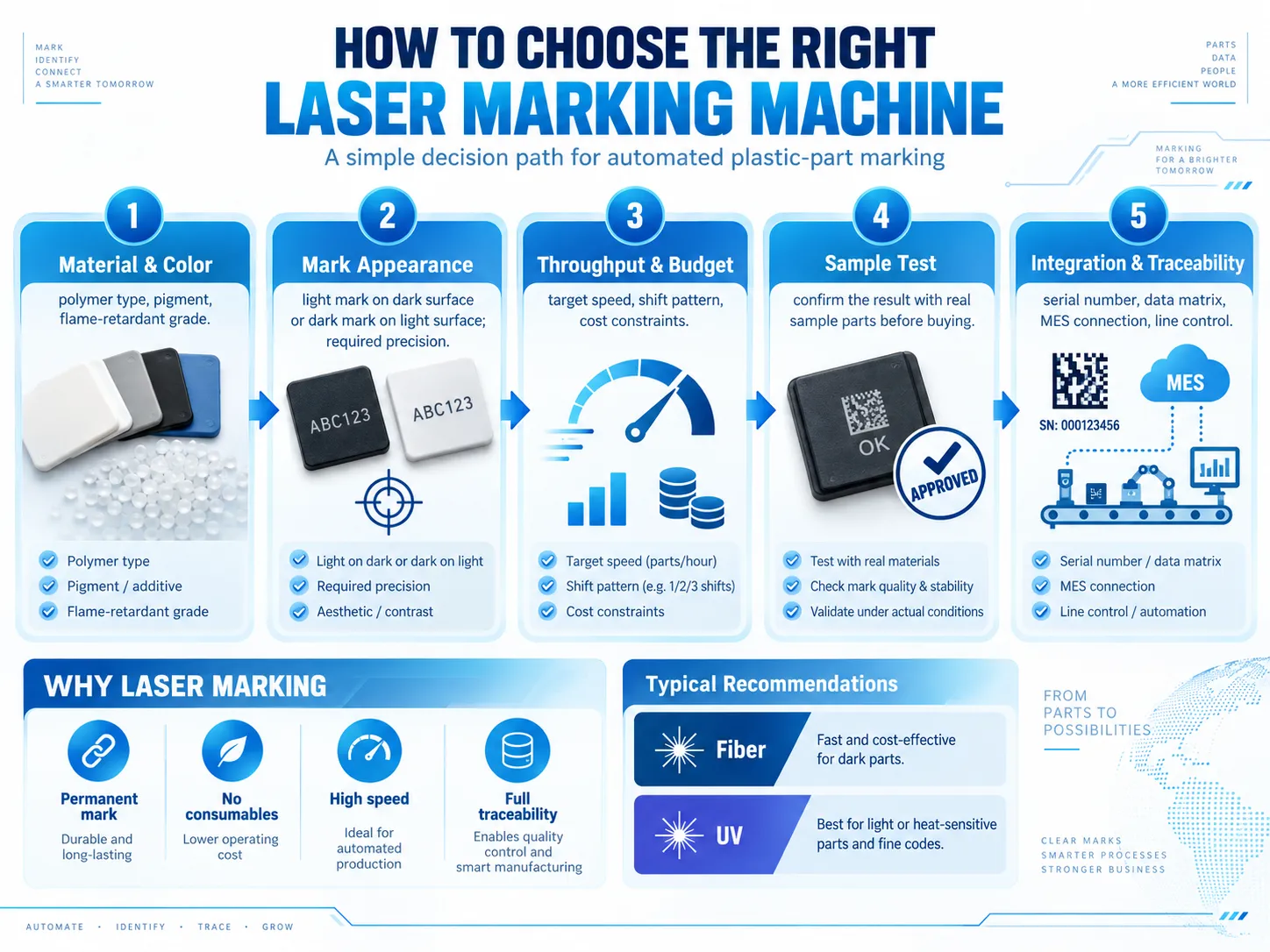
To systematically choose, carry out the five questions (in chronological order). The first question is which surface — what kind of polymer, color and flame-retardant grade you need to make a mark (you probably want to know which mark you will get). The second question is which end mark would be: either a light one on dark plastics, or a dark mark on light plastics, and how precise the mark would be. The third question concerns the throughput and the budget constraints. The fourth question is rather important: what an example of your mark looks like. Finally, the fifth question stands how the given working place (station) combines with the line’s control and traceability systems. Knowing the answers to those questions usually helps define which option to choose (fiber or UV laser).
Conclusion
The short version is the rule of thumb you probably already suspected, made precise: a fiber laser marking machine is the cost-effective, high-speed choice for the dark handles, dark housings and metal parts that dominate most breaker production, while a UV laser marking machine is the specialist you reach for on white, light, clear or heat-sensitive surfaces and on fine traceability codes. Both give you a permanent, consumable-free mark, so the decision comes down to substrate chemistry, the mark you need, throughput and budget — confirmed by a sample test rather than assumed. If you are marking MCB handles and want an automated cell built around a fiber source, Benlong’s MCB knob laser marking machine is a working example, and the engineering team can advise on the right source for your specific parts. Send real sample parts and your marking content, and ask for a marked sample back before you buy.