benlong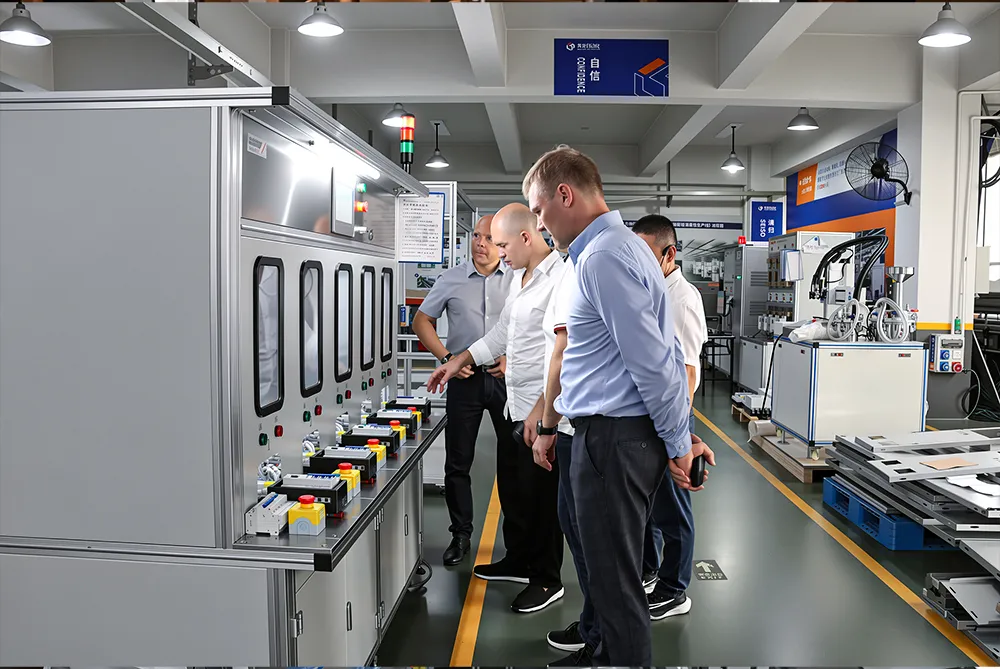

Where to Buy the Best Industrial Automation Supplies for Vision 2030
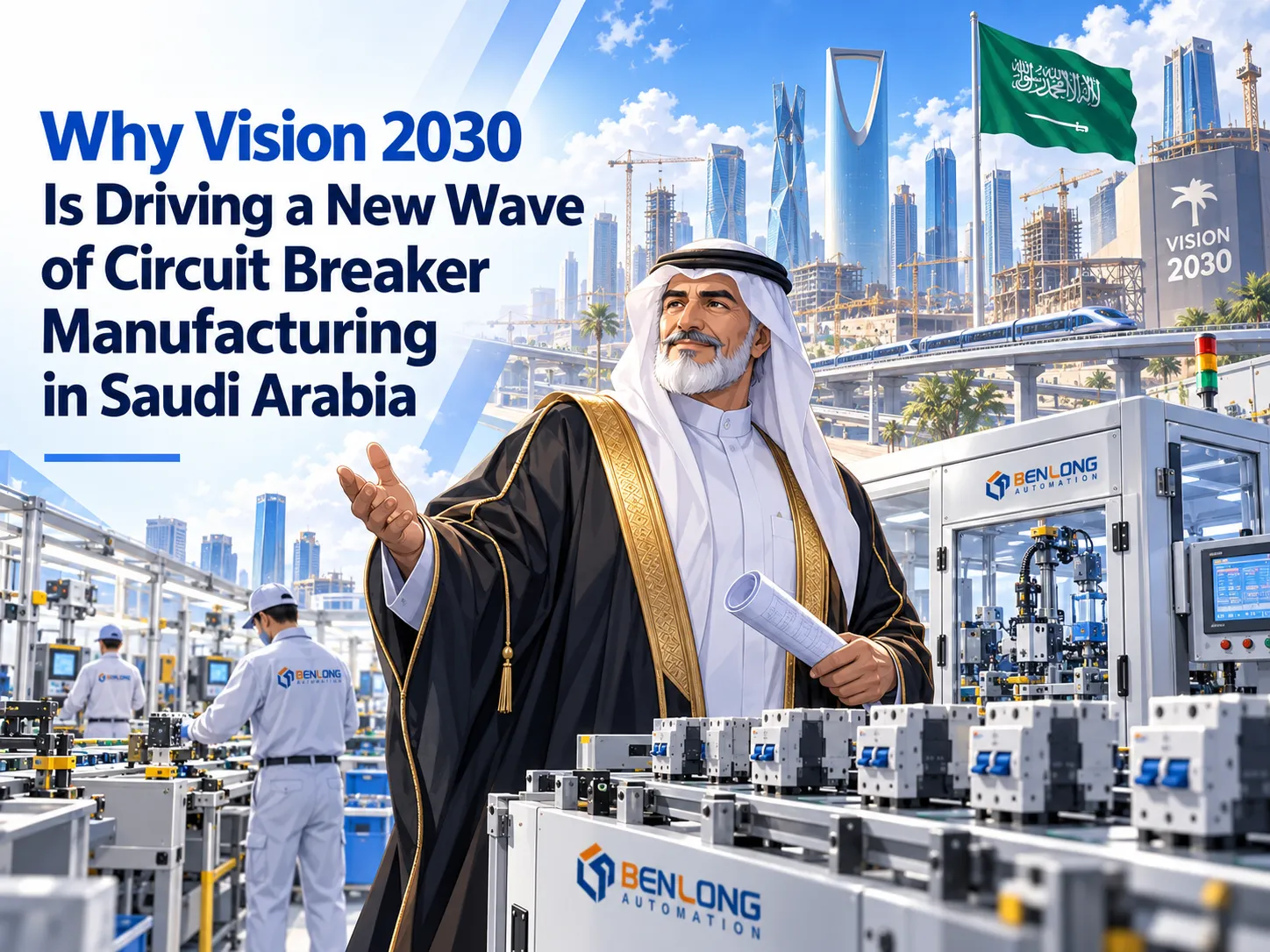
When referring to Saudi Arabia’s Vision 2030, the focus is on the mega infrastructure of fancy towers, resorts, and airports. Underneath the surface, however, the transformation taking place is mainly of electrical and industrial forms. Every skyscraper, transit, and desalination plant can be treated as an electric load. The kingdom is no longer happy to import its facilities and instead desires to manufacture such tools locally. Because of this desire, the kingdom is forced to deal with an operational dilemma: the creation of electrical and technical products at the national level by using only electric manufacturing processes is not possible yet. This process requires automation, machines for assembly that turn workshops into certified producers of electrical production. Eventually, every company working in the electric industry has to deal with the sourcing question.
In an earlier article we looked at how Vision 2030 is driving circuit breaker manufacturing in Saudi Arabia. This piece goes one level deeper, into the electric automation equipment that makes that manufacturing possible and how to source it well.
Vision 2030 employs electrification
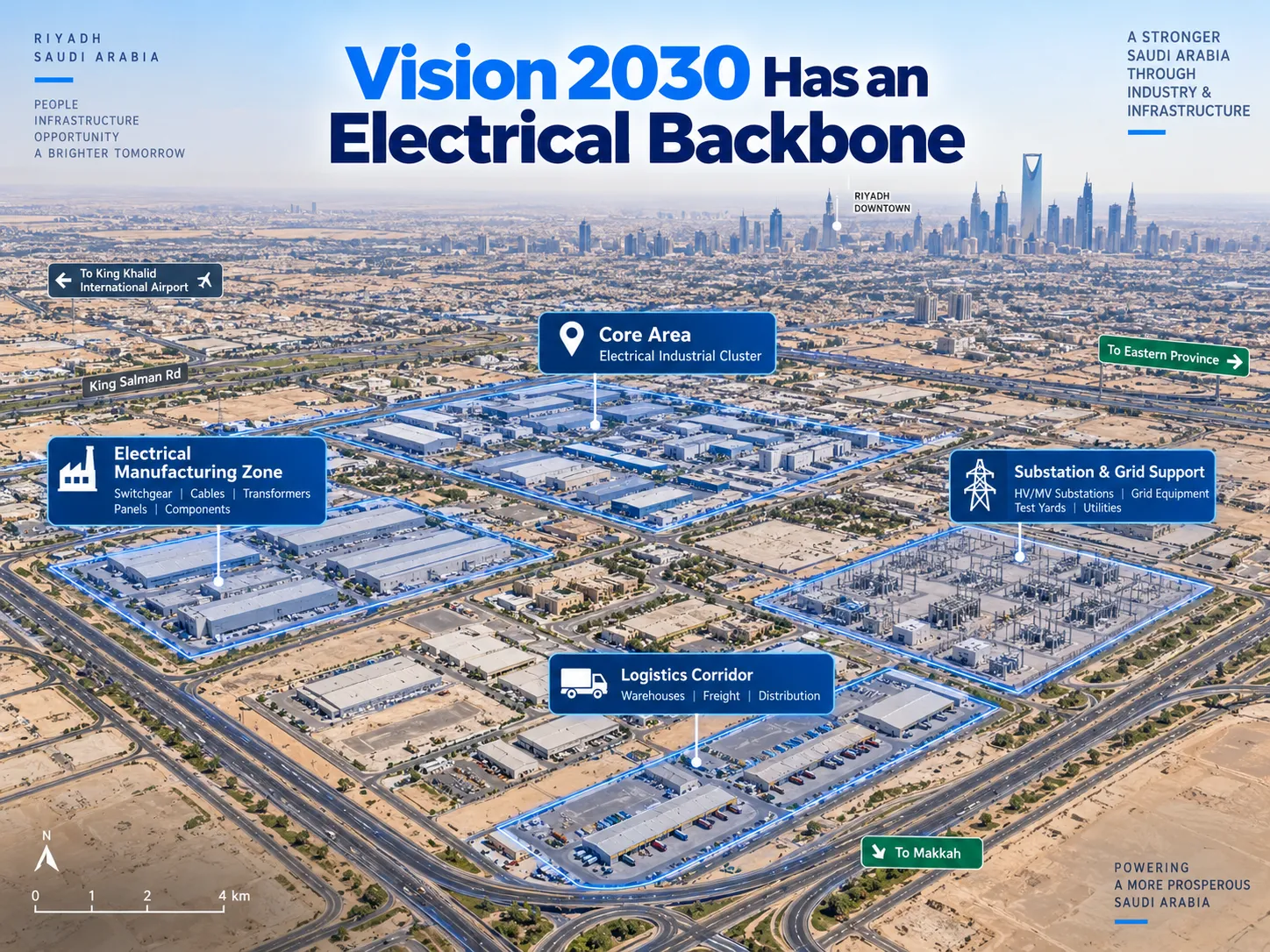
The diversification efforts of the Kingdom are, in a literal sense, an electrification effort. While mega projects and housing projects grab headlines, equally important investment goes into power generation, transmission, distribution, and in the expanding solar pipeline. All those initiatives end with one thing – the distribution board with protective and switching devices. Circuit breakers, switchgear, contactors, surge protectors, and energy meters are necessary, unglamorous products that allow to energize buildings, and Vision 2030 calls for their huge amounts.
Traditionally, most of these devices were imported. However, the localization policy is changing the picture. The Local Content and Government Procurement Authority directs public spending toward local production through the mandatory list of products made in the Kingdom, the Made in Saudi initiative gives the identification of local industry, and the National Industrial Development and Logistics Program aims to create an industrial infrastructure, not driven by imports. Accordingly, it becomes possible to conclude that three essential changes happen with that market.
Automation as a big part of Vision 2030
Automation is not an aside theme of Vision 2030. It is one of pillars of the new industrialization process. The National Industrial Development and Logistics Program and Future Factories Program set the goal to transfer thousands of Saudi factories to Industry 4.0 standards, together with organizations such as the Advanced Manufacturing and Production Centre, while a national lighthouse project intends to put Saudi factories to the forefront of smart production. The market of automation in the Kingdom was already about a billion dollars in 2025 and will continue to develop.
What electric automation actually covers
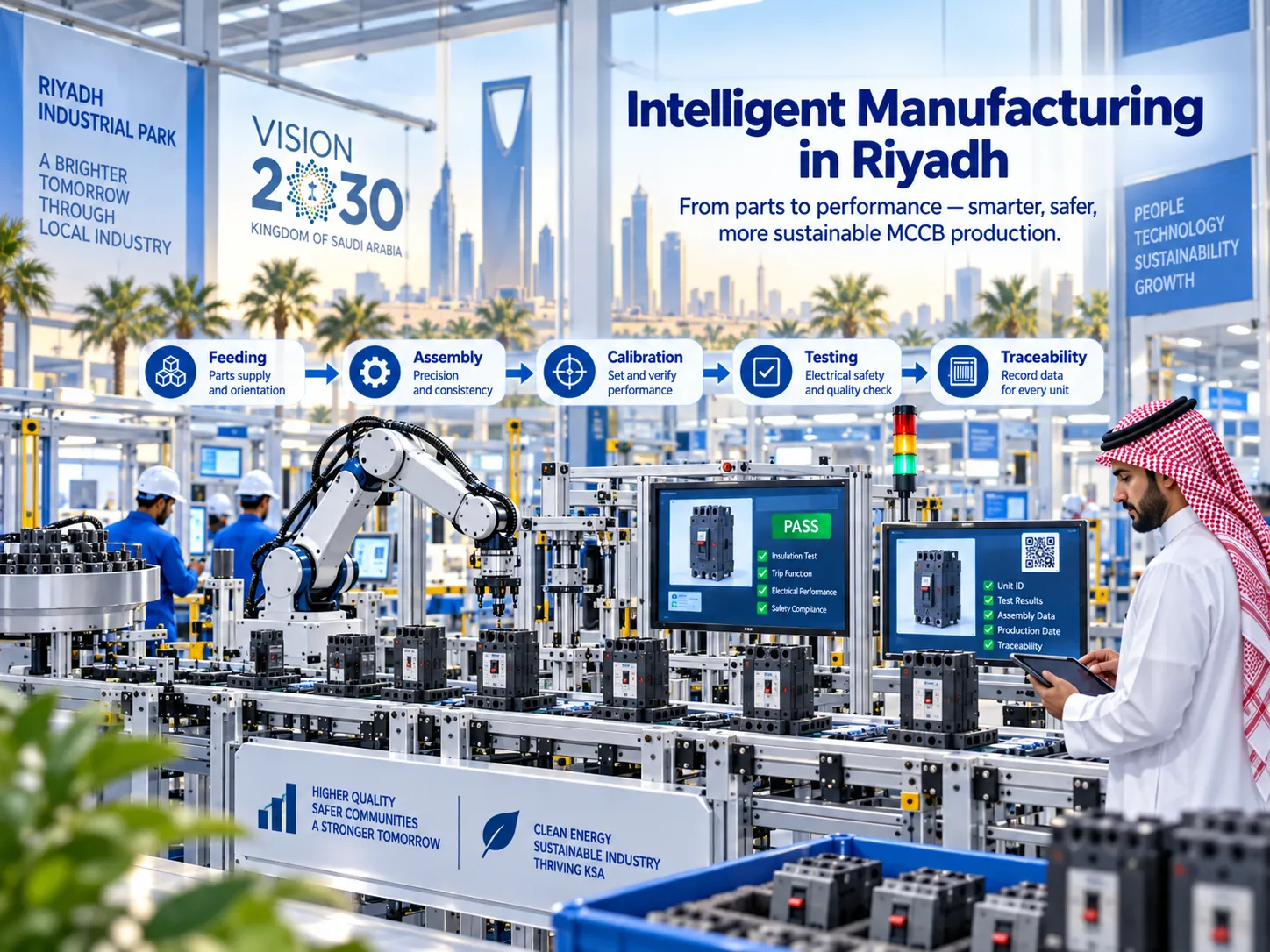
It helps to be precise here, because electric automation is often confused with generic factory automation. Generic automation moves boxes, welds frames and palletizes finished goods. Electric automation equipment, in the sense that matters to this sector, is purpose-built to produce and verify electrical components: automated assembly of miniature circuit breakers and moulded case circuit breakers, residual current devices, contactors, surge protective devices and energy meters, combined with the in-line testing that proves every unit performs.
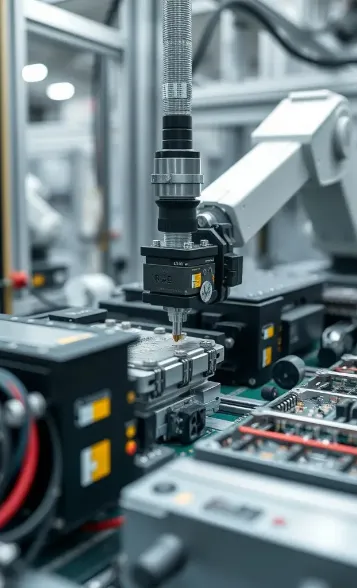
A modern line usually integrates several capabilities at once: robotic handling to move small parts precisely, vision-based intelligent inspection to catch defects, precision assembly stations that hold tight tolerances, electrical test stations that check trip characteristics, dielectric strength and mechanical endurance, and data traceability that records the result of every unit rather than an occasional sample. That last capability is what separates a serious electric automation system from a collection of standalone machines, because it produces the documented evidence that certification and large project buyers demand. The Saudi manufacturer ALKHALEFAH in Riyadh, for example, runs automated MCB and MCCB production and testing lines built around exactly this combination of high-precision testing, robotic handling, intelligent inspection and data traceability.
Why the electrical sector cannot scale without it
There are three reasons that make the use of automation in manufacturing electrical equipment inevitable for serious businesses operating in Saudi Arabia. The first is the production volume, which is going to increase dramatically due to the construction works predicted by Vision 2030 because millions of protection devices will be manufactured, so manual assembly cannot meet the demand without affecting quality.
The second reason is the regulatory aspect. Any low-volt appliance sold or installed in Saudi Arabia has to conform to the SASO regulations, which follow the international framework of IEC recommendations, including IEC 60898-1, IEC 60947-2, and IEC 61008 and IEC 61009 for different types of electrical devices. The process of compliance cannot be performed by means of making just a sample, as there should be a consistent proof of performance throughout the batches. The third one is the climate: the temperature of surrounding air in a vast part of Saudi Arabia is more than fifty degrees Celsius and thus the thermal trip characteristics and the materials should be tested and proven appropriate for desert climate conditions. Thus, without the use of electricity automation, the new electrical producer will not be able to reach the quality required by local standards for the volume of production.
How an electric automation line comes together in practice
Initial investment in automation seldom leads to a fully automated factory; usually, it is a gradual process. Most newcomers to the manufacturing industry start with one model on one production line, and usually this becomes a mini circuit breaker as this model is well known and widely used. After gaining experience and increasing production volume, manufacturers turn to other equipment, e.g. molded circuit breakers, current residual devices, etc. In the beginning stages of production, mechanical components of automated machines undergo several operations starting with automated feeding and assembly and finishing with the stage of transition from design to the production which is mainly represented by weighing stations.
Each of those stages can be automated to a different degree depending on budget, so a manufacturer can begin with semi-automatic stations and add robotic handling later without discarding the original investment. This modularity is one of the underrated advantages of electric automation: it lets a Saudi SME match capital outlay to real, proven demand instead of gambling on a giant line before the order book justifies it. It also shortens the path to certification, because a compact, well-instrumented line is far easier to validate against SASO and IEC procedures than a sprawling manual operation. The practical lesson for buyers is to think in terms of a growth path rather than a one-off purchase, and to choose equipment, and a supplier, that can carry them from a pilot line to full national-scale output.
Where to buy the best industrial automation supplies
This is where sourcing strategy becomes decisive. The regional market has no shortage of generalist integrators who can install conveyors, robots and packaging equipment. For an electrical manufacturer, though, the best industrial automation supplies come from suppliers who specialize in electrical-component production and testing, not from generic robotics vendors adapting a line after the fact. The specialization shows up in the details that matter most: test stations that map cleanly onto SASO and IEC procedures, and the accumulated experience of building lines for breakers, switchgear and meters specifically rather than for machinery in general.
Buyers also weigh global capability against dependable regional support, and they look for a supplier able to point to comparable, real installations rather than promises. A specialist provider of electric automation solutions should be able to do exactly that. Benlong Automation, for instance, has delivered assembly and testing lines to manufacturers across markets that include Saudi Arabia, India, Indonesia, Russia and Algeria, and its long-running cooperation with ALKHALEFAH in Riyadh is a concrete example of a Saudi producer sourcing this kind of equipment in practice rather than in theory. Sourcing decisions of this size also hinge on what happens after delivery, so commissioning, operator training, spare parts and calibration matter as much as the machine itself, which is why OEM and ODM flexibility and lifecycle technical support belong in the evaluation from the very beginning. The right comparison is total cost of ownership over years of production, not the sticker price of the machinery, because an unsupported line that sits idle waiting for parts is far more expensive than it first appears.
What to look for in an electric automation supplier
For a Saudi company looking to make an investment decision, the following short checklist makes the difference between a successful tool and an unnecessary expense:
Knowledge of the electrical components industry instead of general knowledge about these tools.
Test coverage that meets SASO and IEC standards from the outset, rather than being applied after the fact.
The inclusion of robotic handling, visual inspection, and unit data tracking as standard features, not options.
Reliable throughput rates and realistic commissioning times instead of promotional claims.
Complete post-purchase support, which may include commissioning, user training, remote support, and receipt of quality spare parts, etc.
Maintenance throughout the life of the equipment because a test line can only be trusted if it continues to deliver accurate results.
Availability of a scalable design that allows building a pilot line and then expanding it to full capacity without starting from scratch.
Validation for local conditions and tests showing that the tool will withstand high ambient temperatures.
Flexibility of the OEM and ODM process enough to satisfy all manufacturer’s needs.
The window is open now
Vision 2030 has moved into an execution phase built around local content and long-term value, and automation is one of the pillars carrying it forward. For the electrical sector that alignment is unusually favorable. Demand is rising with every new project, localization policy rewards those who produce inside the Kingdom, and the single largest barrier to entry, certified and consistent high-volume production, is exactly what electric automation is designed to remove.
Manufacturers who invest in the right electric automation supplies now, from a partner who understands electrical products rather than automation in the abstract, position themselves to serve procurement-backed demand for the rest of the decade and beyond. There is also a timing advantage worth naming. Localization incentives and procurement preferences favor manufacturers who are already producing to standard when demand arrives, not those still commissioning a line, so the firms that move early tend to capture the steadiest orders. Seen that way, the answer to where to buy the best industrial automation supplies is less about a catalogue and more about a partnership: a supplier that can assemble, test, support and scale a line built to meet Saudi standards, and grow with the Kingdom’s ambitions rather than fall behind them.