benlong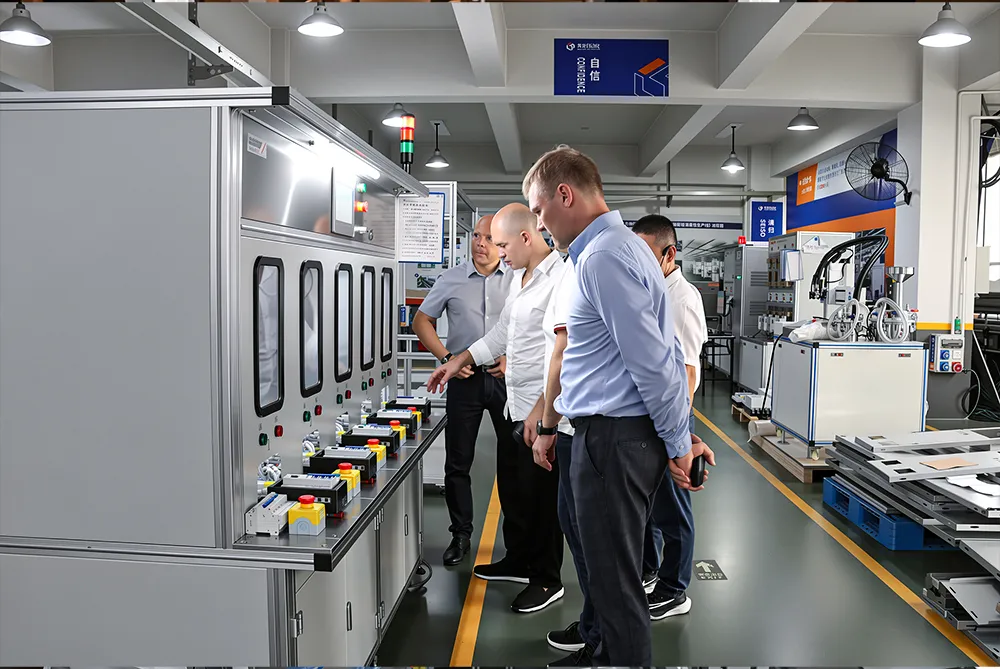

The Highest Level of Automation Is Found In
When a silicon wafer is manufactured in a semiconductor fabrication facility in Taiwan to be used in a multi-dollar processor, it is done in a way that it is produced from raw polysilicon, and everything is done with no human interaction, from the initial stage to the final step. The wafer goes through many process stages which are all held by automated technology in a clean room with clean air which is a thousand times cleaner than that in a medical operation room. Machines communicate with each other in order to finish their work in the meantime. The Management Execution System (MES) keeps track of the developments and ongoing processes. If there is anything which is not working correctly, it can fix the problem itself without intervention from a human engineer and record the event in the database. Predictive maintenance function of the technology allows maintenance works being scheduled for the down time of the machines. This represents the highest level of automation possible today as it goes beyond simple robotics, as all the aspects of the operation are tightly integrated into one unit. To understand what this level looks and means gives an understanding of the kinds of automation which exist in the world today and which can be useful in the production process of each type of product.
Summary: The most advanced level of automation in the production is the completely integrated, data-driven, and self-optimizing factory, which is commonly known as Industry 4.0 or lights-out manufacturing. In this kind of factory, all processes, ranging from the point at which raw materials arrive to the moment finished, tested and certified products get shipped, are automated, interconnected and controlled by layers of software, including PLCs and SCADA for machine-level operation, MES (Manufacturing Execution System) for production-line process and ERP (Enterprise Resource Planning) for business activities.
What the Highest Level of Automation Looks Like: The Fully Integrated, Self‑Optimising Factory
The highest level of automation in manufacturing is not a single machine or a single software platform. It is an architecture—a stack of technologies that work together to turn a customer order into a shipped product with minimal human intervention. The architecture has three layers, each of which must be present for the factory to operate at the highest level.
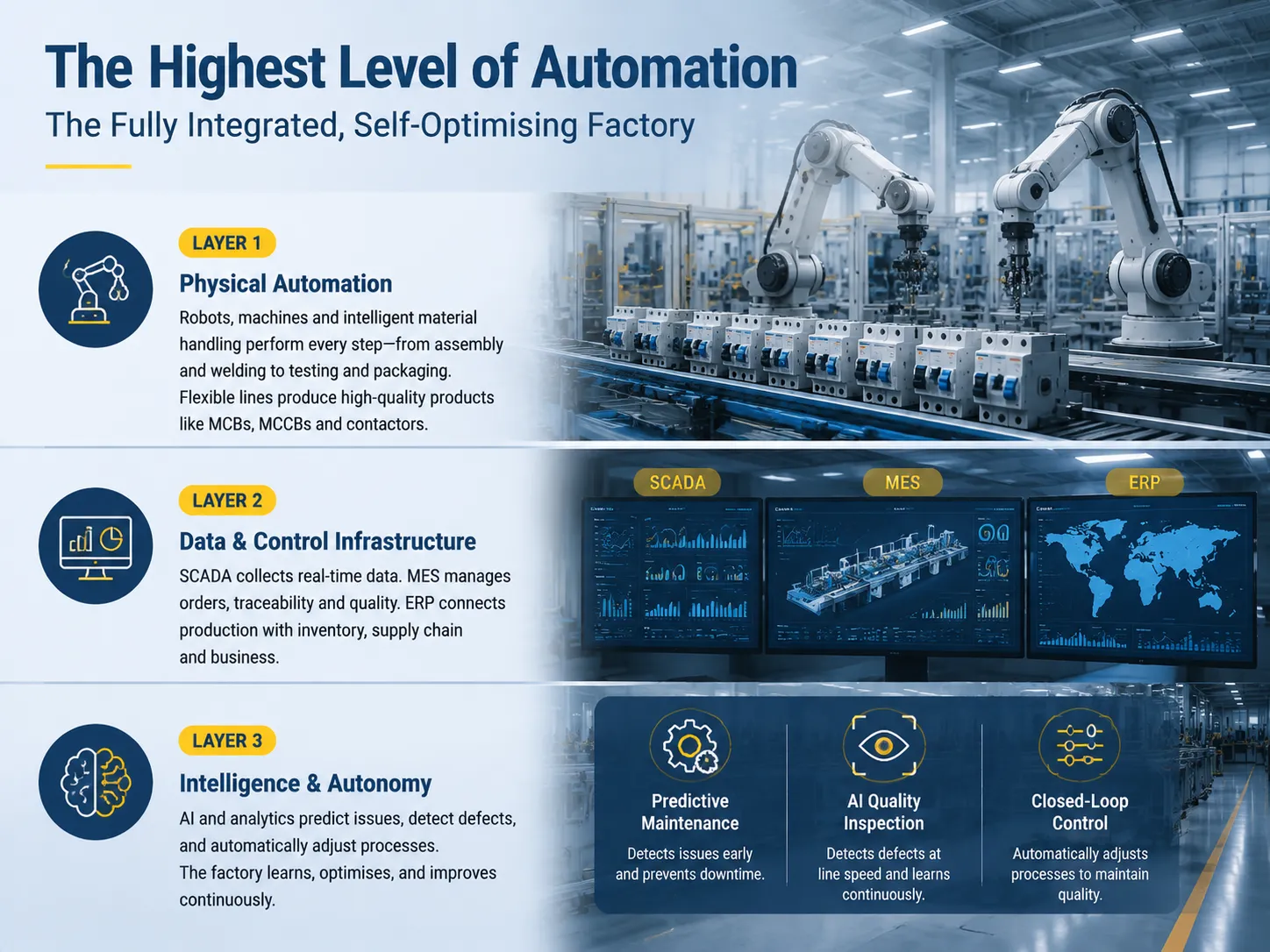
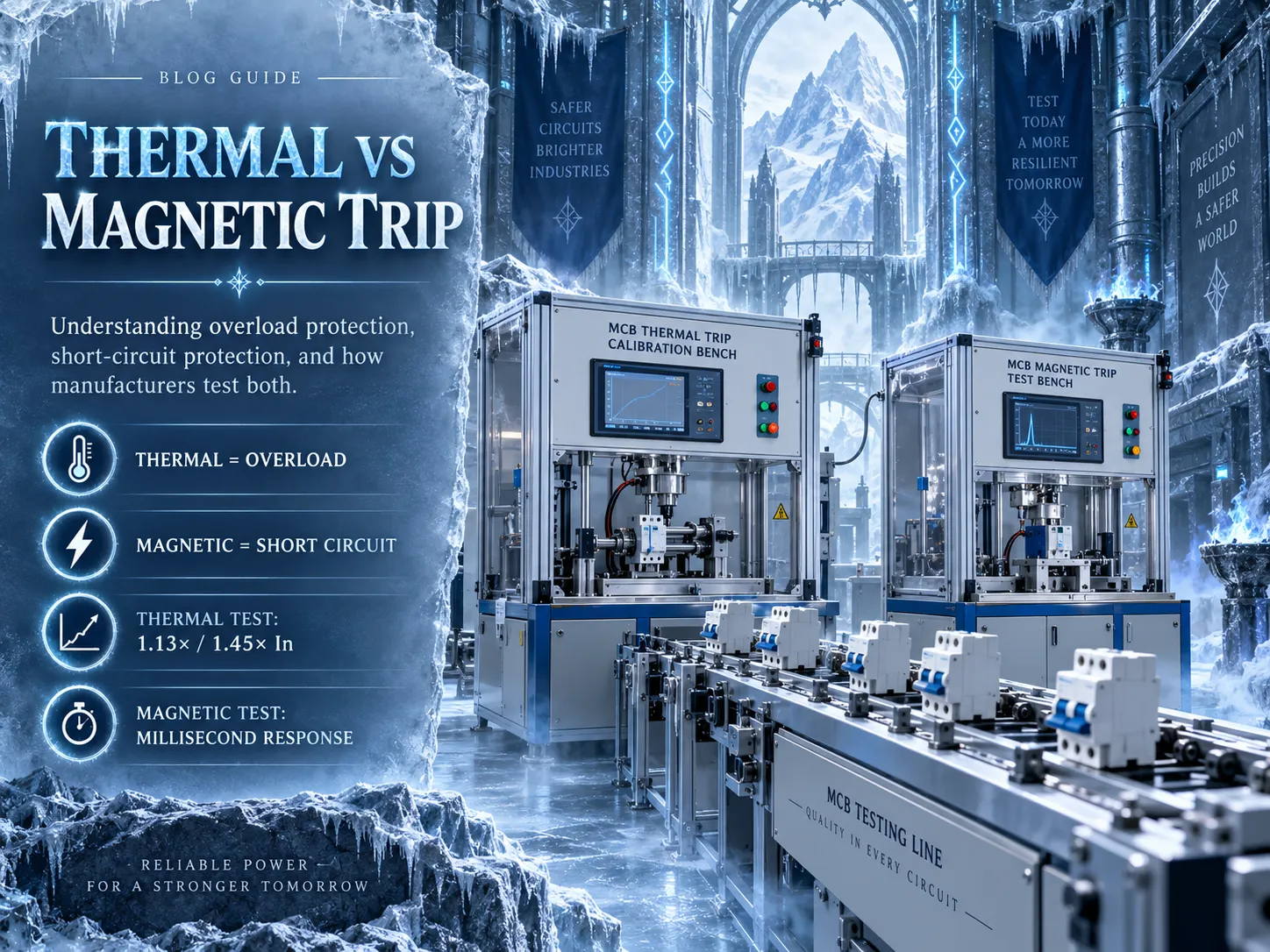
Layer One: The Physical Automation-The Machines, the Robots, and the Material Handling. At the highest level of operation, every activity that can be automated is, in fact, automated. In a correct view, the production line is not just a number of semi-automated stations with manual transfers between them, but rather a continuous flow in which the product moves from one position to another through the system thanks to the conveyor system, or something similar. The stations perform operations related to one or multiple complicated processes like assembly, welding, etc., and have no workers loading/unloading the part. Machines do not belong to one particular type: they are flexible and able to work with many types of products. The machines have different devices installed in them, i.e. there are motors and sensors that report the status of devices. For the company that manufactures devices for electrical protective applications, Layer One also includes manufacturing lines used to assemble and test MCB’s, MCCB’s, and contactors.. An MCB automatic assembly line that integrates parts feeding, assembly, calibration, testing, marking, and sorting into a single, continuous flow, producing a calibrated and certified breaker every few seconds, is an example of the physical automation that the highest level requires. For a deeper look at the testing stations that are integrated into these lines, our guide on what an MCB automatic testing line is explains the calibration, magnetic trip, and high‑voltage testing that must be performed on every unit.
Layer 2: The Data and Control Infrastructure—Supervisory Control and Data Acquisition (SCADA) System, Manufacturing Execution System (MES), Digital Thread. The equipment in the factory generates a lot of useful data—process parameters, quality data, error codes, energy usage and cycle times. The automation level that is the highest needs to track all of these data points, provide context for the process, and supply them to the system and people who will use it. SCADA system is designed to facilitate tracking of all data in real-time from PLCs, drives, sensors on the machines that give an overview of the factory and inform an operator about alarms and deviations. MES works on top of SCADA as it is responsible for managing production orders, advancing every particular item down the line, recording process data on the unit, and quality data against the unit. MES is a system that is able to trace all the needed information for certification and warranty understanding—after leaving the factory, every circuit breaker will be able to show its calibration information, test results, and the information about the machine, operator, and raw material that it was made with. ERP (Enterprise Resource Planning) system is established on top of MES and consists of managing orders, inventories, supply chains, finance. Research from McKinsey & Company on digital manufacturing identifies this vertical integration as the single most important enabler of the productivity, quality, and flexibility improvements that Industry 4.0 promises.
Layer Three: The Intelligence and Autonomy—Predictive Analytics, AI, and Closed‑Loop Control. The most advanced level of automation not only informs about the occurrences. It provides predictions about the future developments and takes action on this prediction without any human command. For example, a predictive maintenance algorithm monitors such parameters as vibration signature, motor current, and temperature of a crucial spindle or robot joint and plans maintenance during the next scheduled downtime before an element fails and leads to unscheduled stoppage. An AI-driven vision system controls the quality of each product in line speed, capturing defects that cannot be detected by a rule-based system, and learns to identify new defect types as they appear. A closed-loop process control algorithm monitors the level of the quality parameter, e.g., calibration of a thermal trip unit or quality parameter of welded connection, adjusting process variables automatically in order for the output to stay within the specification range without any intervention of the process engineer. At this level, the role of human beings is not to operate machines, check products, or record information. Instead, the human task is to manage exceptions, investigate cases that cannot be diagnosed by the system, make must-have production decisions. The International Federation of Robotics (IFR) and Deloitte have documented the growing adoption of AI‑driven quality inspection and predictive maintenance, and the trend is clear: the highest level of automation is the level at which the factory learns.
The Automation Pyramid: Five Levels from Manual to Autonomous
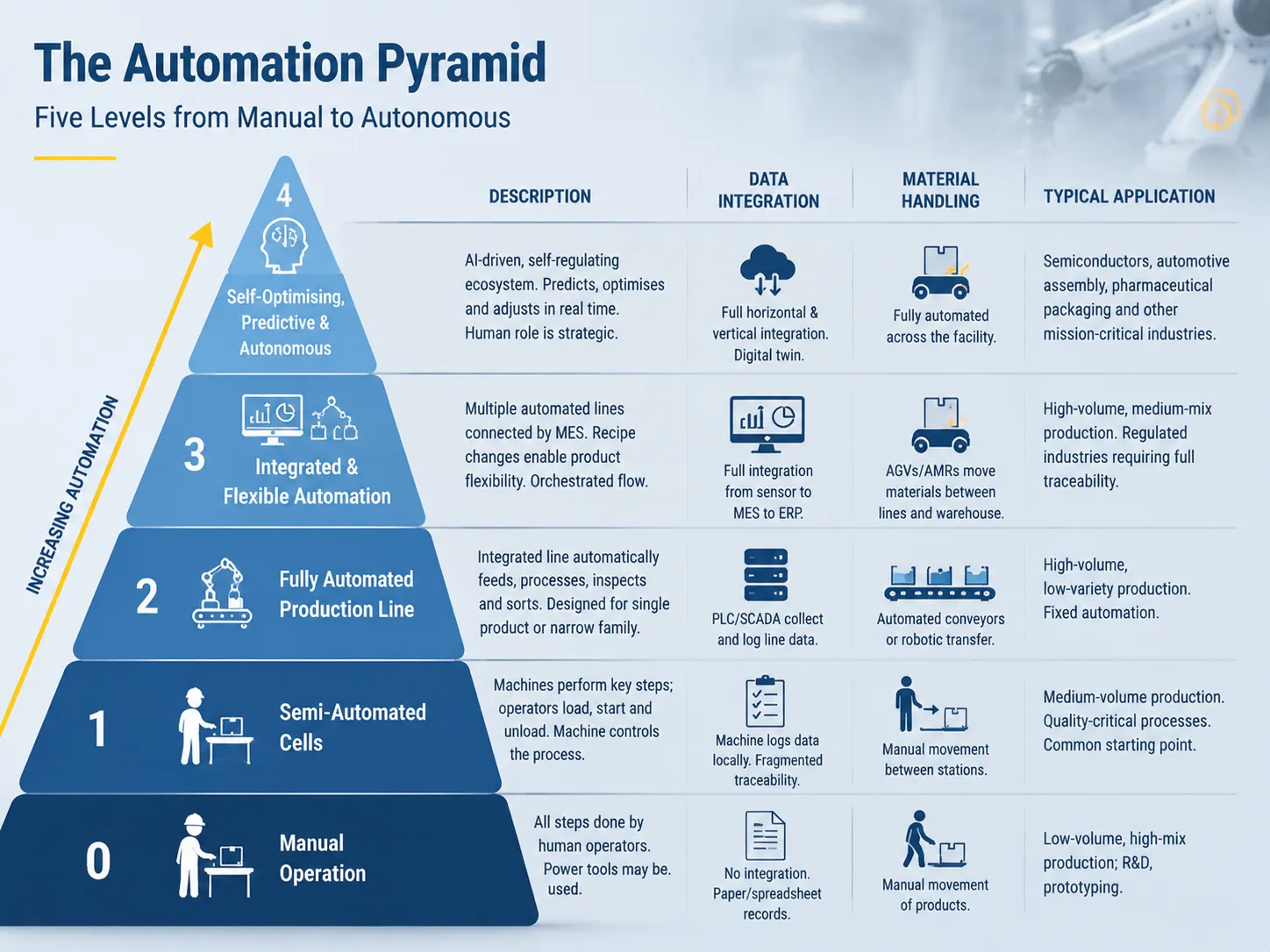
The levels of automation in manufacturing are often described as a pyramid, with the simplest at the base and the highest at the apex. The table below summarises the five levels, the key characteristics of each, and the industries and volumes for which each is typically suited.
| Level | Description | Data Integration | Material Handling | Typical Application |
|---|---|---|---|---|
| Level 0: Manual Operation | Every process step—loading, processing, inspecting, and recording—is performed by a human operator. The tools may be power‑assisted, but the process control is entirely in the operator’s hands. | None—records are paper‑based or captured in a simple spreadsheet, with no unit‑level traceability. | Manual—the operator moves the product from station to station. | Low‑volume, high‑mix production; R&D and prototyping; processes that are not yet stable enough to automate. |
| Level 1: Semi‑Automated Cells (Automation Islands) | A machine automatically performs a critical process step—welding, calibration, testing, dispensing—but a human operator loads the part into the fixture, initiates the cycle, and unloads the finished part. The machine controls the process; the human handles the material. | The machine logs its own process data, but the data is not integrated with other stations or with a central system. Traceability is fragmented. | Manual—the operator moves the product between the semi‑automated stations. | Medium‑volume production; quality‑critical processes where repeatability is essential but full automation is not yet justified. This is the level at which many electrical manufacturers start, with a semi‑automated calibration or testing bench from Benlong Automation. |
| Level 2: Fully Automated Production Line (Fixed Automation) | An integrated line automatically feeds, processes, inspects, and sorts the product without operator intervention in the normal production cycle. The line is designed for a single product or a narrow product family. Operators oversee the line, replenish materials, and respond to alarms. | The line’s PLCs and the central SCADA system collect data from every station. The data is logged, but it may not be integrated with the plant’s MES or ERP. | Automated—conveyors, rotary tables, or robotic transfer move the product between stations. | High‑volume, low‑variety production; products with stable designs and predictable demand. A dedicated MCB assembly line that produces a single breaker rating at high speed is a Level‑2 system. |
| Level 3: Integrated and Flexible Automation (MES‑Connected) | Multiple automated lines are connected by a central MES that manages production orders, tracks work‑in‑progress, and logs quality data against each unit’s serial number. The lines can switch between product variants with a recipe change, and the MES orchestrates the flow. Automated material handling—AGVs, AMRs, or automated storage and retrieval systems—moves materials between the lines and the warehouse. | Full vertical integration from the sensor to the MES to the ERP. Every unit’s process and quality data is stored and is traceable. Real‑time dashboards provide plant‑wide visibility. | Automated between lines—AGVs, AMRs, or conveyors move materials and finished products between the production lines and the warehouse. | High‑volume, medium‑mix production; regulated industries (automotive, medical, electrical) that require full traceability; manufacturers who serve multiple customers with different labelling and certification requirements. |
| Level 4: Self‑Optimising, Predictive, and Autonomous (the Highest Level) | The entire manufacturing ecosystem—the machines, the material handling, the MES, the ERP, and the supply chain—is integrated into a self‑regulating whole. AI‑driven analytics predict failures, optimise processes, and adjust production schedules in real time. The human role is strategic: managing exceptions, improving the system, and making the decisions that the system is not programmed to make. | Full horizontal and vertical integration. Data flows seamlessly from the sensor to the boardroom, and from the supplier’s factory to the customer’s receiving dock. A digital twin of the factory simulates and optimises production before it happens. | Fully automated across the entire facility—AMRs and AGVs move materials, and automated storage systems manage inventory with minimal human intervention. | Semiconductor fabrication, automotive final assembly, pharmaceutical packaging, and any other industry where the cost of a defect or a stoppage is measured in millions of dollars, and where the volume justifies the investment in the highest level of automation. |
The Industry 4.0 Framework and the Pyramid of Automation
The automation level framework can be recognised in few other frameworks, but the most common one is Industry 4.0 maturity model, developed by institutions including the German Academy of Science and Engineering (acatech), and being used by different manufacturers and consulting companies around the world. Industry 4.0 can be defined as a stage from Industry 1.0 (mechanisation, steam engines) to Industry 2.0 (mass production and electricity) and Industry 3.0 (the development of computers and PLCs to automation of some processes) to ultimately reach the final stage of the maturity model, which involves the fully autonomous and data-driven production system. The automation levels elaborated by this guidance, ranging from Level 0 (manual) to Level 4 (self-optimising), fit into this model, thus allowing manufacturers to understand both their current position in the journey towards better production and their objectives. From a practical point of view, the pyramid of levels is built up from the bottom, where different types of machines are placed, then various control systems including PLCs and SCADA systems come, followed by the MES and reaching the final stage with ERP system. It is not possible to simply buy one machine to get to Level 4. It is necessary to pass through all the phases without any miscommunication between any level of the automation architecture, which results in the necessity for a manufacturer to start from at least one process being automated. For example, during this initial phase, manufacturers can begin the automation of one quality-critical process, such as calibration or testing. The principle that Benlong Automation implements in all of its manufacturing process is that all devices including PLC devices, HMIs and communications should be compatible and work together in order to allow the manufacturers to implement fully automated production system.
Frequently Asked Questions
What is the high level of automation?
The utmost degree of automation in manufacturing is witnessed in the integrated, data-centric, and self-optimising factory known as Industry 4.0 or Lights-Out Manufacturing. This automation has made production processes completely automated, with the data flowing vertically from the sensor into ERP and horizontally between process steps. Information technology-enabled analysis enables the anticipation of failures and the performance of routine tasks without human intervention. The human role, however, is strategic, that is, it comprises handling exceptions, enhancing the system, and making decisions that do not fall with the competences of the automated system.
What are the levels of automation?
Automation levels in manufacture are viewed as a sequence with five levels: Level 0 (manual operation), Level 1 (semi-automated cells—process performed with the help of the machine but with manual handling of material), Level 2 (fully automated line—process and material handling is done by the machine and is arranged for one product), Level 3 (integrated and flexible automation—several lines are connected in a network by a system of production monitoring and automatized material handling), Level 4 (self-optimizing and self-managing automation—the entire factory is integrated, intelligent and almost self-regulated).
What is level 4 automation?
Level 4 automation entails the fullest form of automation, predictive and self-optimising factory. All material handling and production processes are physically automated; data is fully integrated vertically and horizontally—from the sensors to the ERP—from suppliers to customers; AI-based algorithms are employed in predictive maintenance and closed process control. The consequence is a factory that can operate without the need for human intervention but rather only, in terms of strategic oversight, problem rectification, and ongoing improvements.
What is level 3 in automation?
Automation Level 3 refers to the interconnected factory that is smart as well as flexible. In this type of factory, different lines of automation are combined through a central manufacturing execution system (MES) which runs production orders, monitors work, and marks quality information of each produced item. These lines are capable of switching to any product variant just via changing the recipe. Automatic material handling is implemented with the help of automated guided vehicles (AGV), autonomous mobile robots (AMR) or automatic storage of materials in the factory. The fully integrated workflow allows for obtaining data at all levels from the sensor to MES to ERP system. Factory automation Level 3 is typically implemented in automobile, medical equipment and power generation sectors.
References
- acatech — Industrie 4.0 Maturity Index. The German Academy of Science and Engineering’s framework for assessing and advancing a manufacturer’s level of automation and digital integration.
- McKinsey & Company — Digital Manufacturing and Industry 4.0. Research on the productivity and quality impact of vertical and horizontal data integration, and the return on investment of the Industry 4.0 technologies that characterise the highest levels of automation.
- International Federation of Robotics (IFR) — World Robotics Report. Annual data on robot installations by industry and by country, including the adoption rates of the flexible and integrated automation that characterises the upper levels of the automation pyramid.
- International Society of Automation (ISA) — ISA‑95 Standard for Enterprise‑Control System Integration. The international standard that defines the architecture and the data models for the vertical integration between the factory floor and the business systems—the architecture that the highest level of automation requires.
The pinnacle of automation takes place in the factory where the machines, the applications, the data, and the processes are not simply interconnected but are fully integrated, where the customer order moves effortlessly between the ERP, the MES, and the production process where each quality-related data of each item is associated with its serial number and can be used any time during the item’s entire lifecycle, and where deviations can be recognized, determined, and corrected before a human operator understands that something has changed. Achieving this level requires extensive investments. It is possible only by constructing the automation pyramid from the ground up, starting from physical automation of processes critical to quality, and then providing it with data infrastructure that connects machines with MES, and using mechanisms of intelligence, AI, predictive analytics, closed-loop control to make the factory self-optimizing. The process is initiated by the electrical equipment manufacturer who utilizes semi-automated calibration bench or assembly cell, which can then be applied to other processes step by step as long as there is a proper volume of production, sufficient data proving increased ROI, and experience in using the technology. Benlong Automation provides all types of machinery needed for constructing the automation pyramid starting from the factory with standalone and semi-automated equipment.