benlong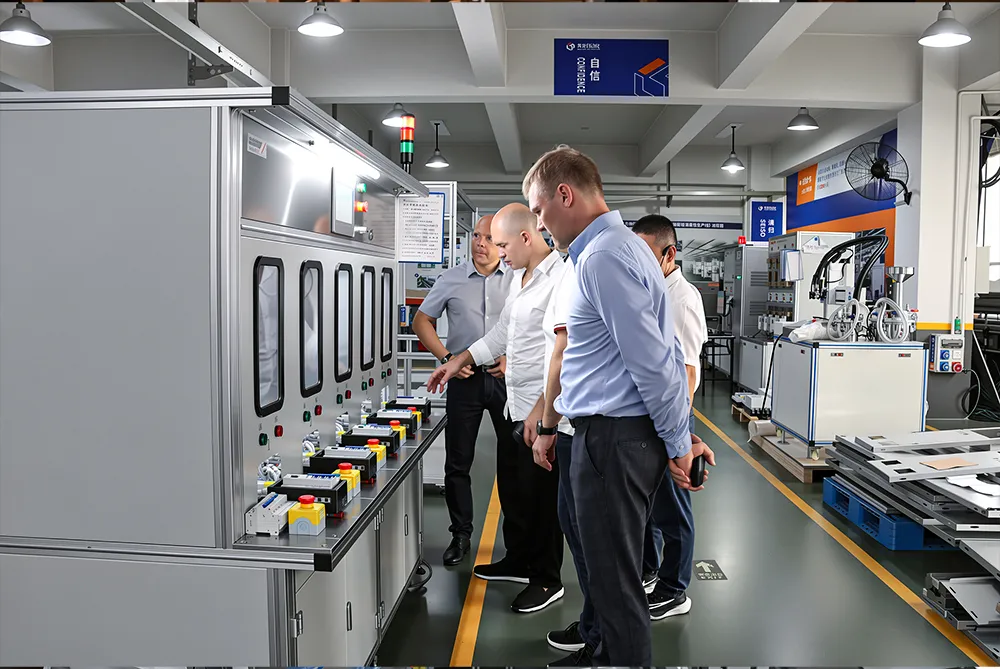
Semi Automated Assembly: Why India’s MCB Makers Choose It
By Huang Xiaolei | Benlong Automation
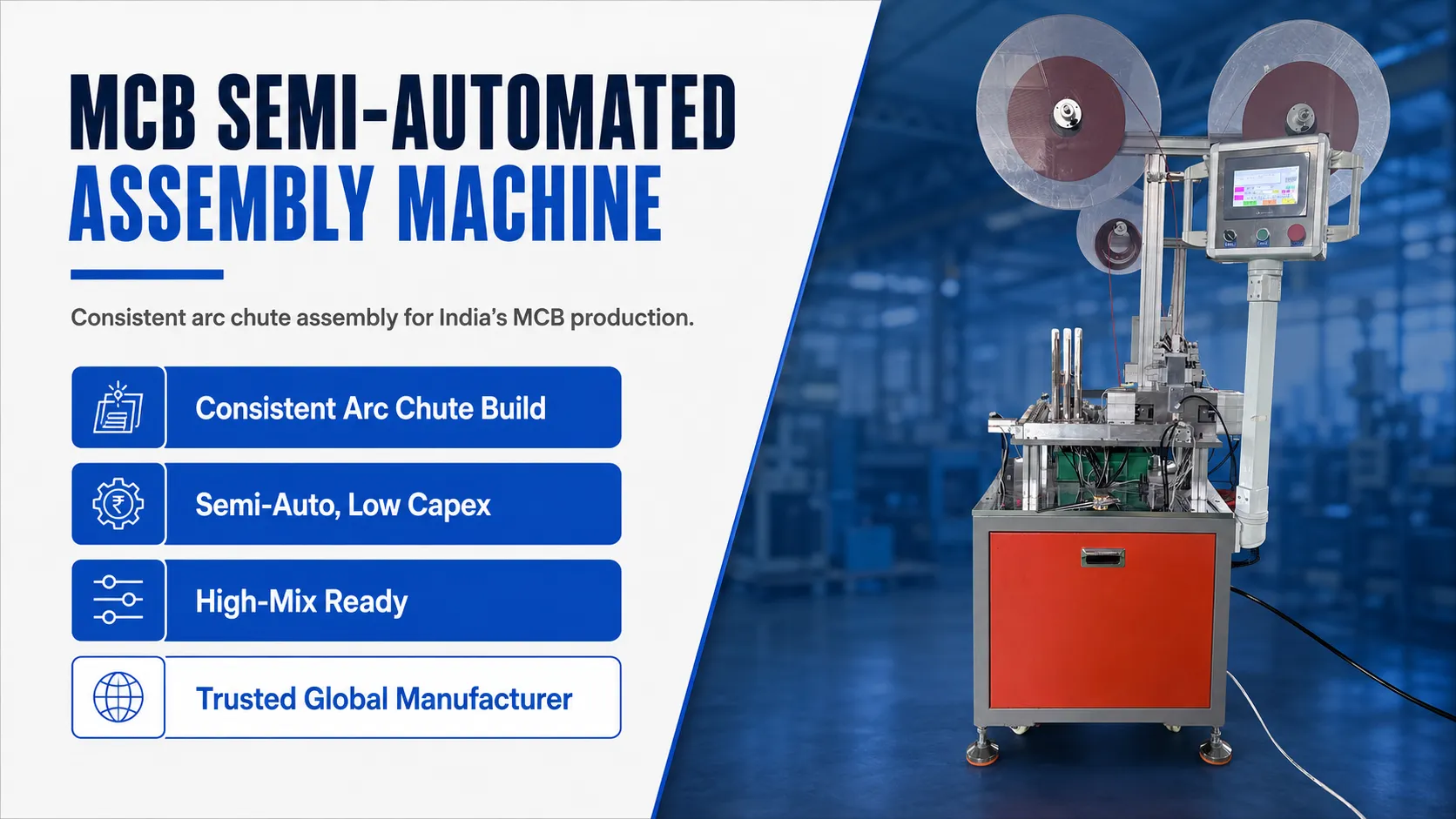
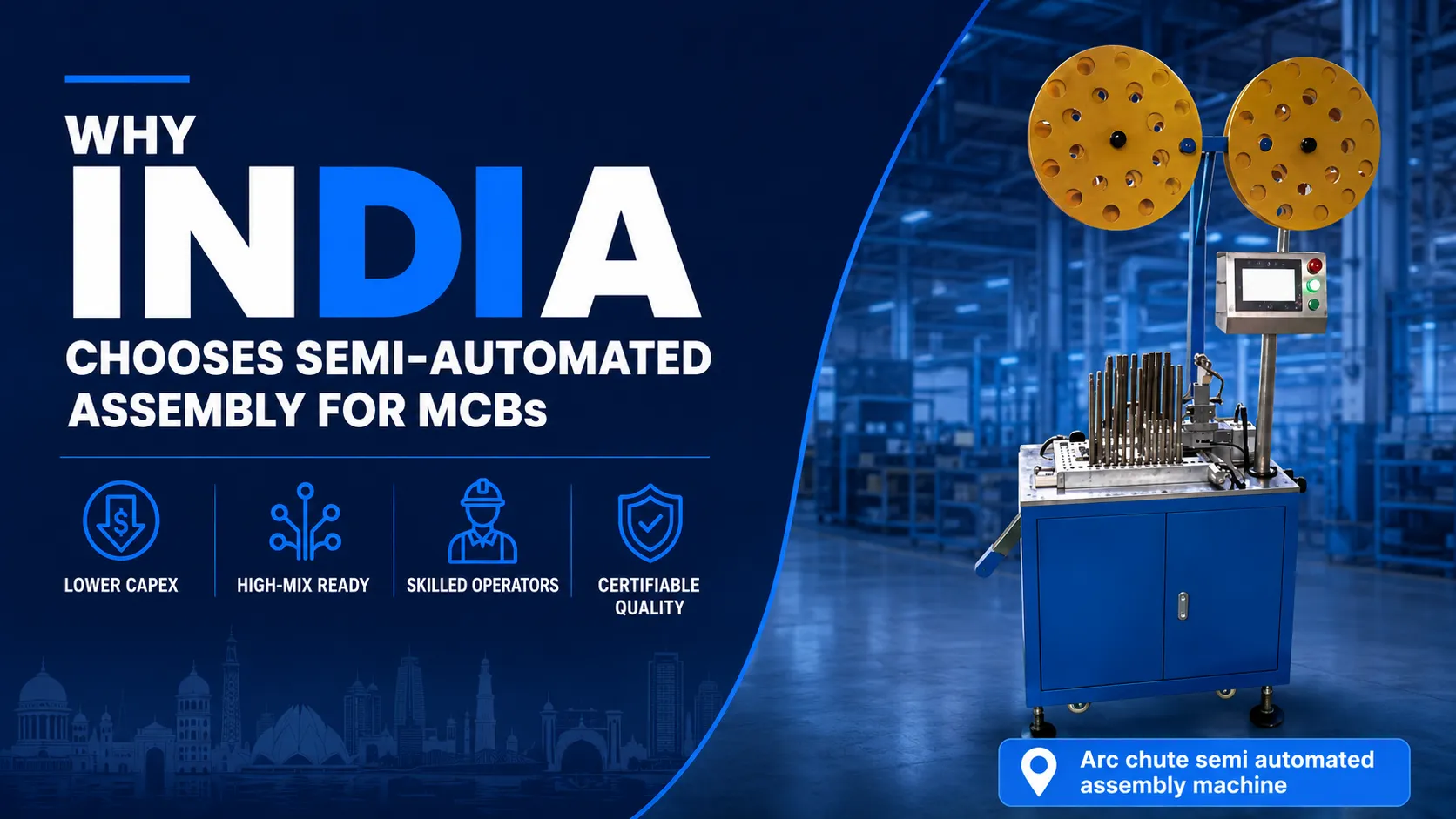
This week, a shipping container departed from our Wenzhou factory, bound for a circuit breaker manufacturer in Jalgaon, Maharashtra, India. Inside was a semi automated arc chute assembly machine, custom-engineered to suit the specific production workflow for Miniature Circuit Breakers (MCBs) at the Indian facility. While not a high-complexity machine, its operation is straightforward: an operator manually loads plates into the machine’s feed hopper; the machine then automatically dispenses and cuts the paper strip, finally assembling it with the plate to form the finished arc chute. Semi automated assembly machines represent one of the most common production equipment requests we receive from the Indian MCB industry; examining the reasons behind this demand offers valuable insight into how circuit breakers are manufactured in what is currently the world’s fastest-growing electrical market.
What a semi-automated arc chute line actually does
Every miniature circuit breaker lives or dies on its arc chute. It is the stack of steel splitter plates that catches, divides and cools the electrical arc in the instant a breaker interrupts a fault. Assemble it well and the breaker clears a short circuit cleanly, thousands of times over its service life. Assemble it poorly, with plates out of order, wrong spacing, or a skewed seat in the housing, and the breaker underperforms in exactly the test that certification bodies care about most.
Done entirely by hand, this is where variation creeps in. Plate spacing drifts, seating pressure changes from one operator to the next and from the first hour of a shift to the last, and the resulting defects don’t always reveal themselves until final electrical test, by which point the labour and material are already spent. That precise, repetitive, unforgiving character is exactly why the step suits a semi automated assembly machine. Rather than replacing the operator, this format keeps a trained person in the loop for the tasks humans do best, loading components, catching an off-spec part, switching between product variants, while the machine takes over the steps that reward mechanical repeatability: indexing each plate, pressing to a fixed force, and seating the finished chute to a controlled tolerance. If you want the full mechanical breakdown of how the chute goes together, we cover it in depth in our guide to the arc chute assembly machine. Here the more interesting question is why this particular balance of human and machine has taken hold so firmly in India.
Why semi automation is ideal for India’s MCB scenario
India has a large and growing low-voltage protection industry. The Indian circuit breakers market had a value of $340 million in 2024, and it continues to increase due to urbanization, rural electrification, and other developments like data centres and renewable energy. Yet, it is notorious for being very price conscious. Indian switchgear companies obtain orders both domestically and internationally by selling IEC-compliant products at prices far below European prices.
That commercial pressure results in a dilemma regarding equipment. A fully automated production unit is costly to set up, though perfect for achieving high quality and a large volume of production. On the other hand, a completely manual process entails low investments but limits production output. Semi automated assembly appears to fit perfectly in between. It requires far less capital than full automation and allows for the production process to be more consistent than that of hand assembly.
However, there has been a recent focus on the matter. The prices for copper and silver used in the contacts of the circuit breaker have increased, leading to a decrease in the company’s profit margin. Moreover, products made of expensive raw materials lead to higher production costs.Tools for High-mix Catalogues.
When you examine the product catalog of a typical Indian MCB making firm, you see the breadth of products instead of depth-product variations like B, C, and D tripping curves, single to four-pole configurations, the variety of current ratings, and often all are produced in a span of one week. Full automation works best with one product run for an extended period of time rather than switching over from one product to another and dislikes constant changeovers. Pure manual assembly can handle the wide variety of products but finds it difficult to maintain uniform tolerances giving all variants.
The tension can be alleviated with the help of a semi-automated assembly line that solves the problem of switchovers. The operator can easily switch from one product to another and apply the necessary adjustments, while the quality control process functions effectively regardless of the variation.
Skilled workers can be found in India and the semi-automation approach is used to capitalize on this advantage rather than ignore it and automate completely the assembly process. The operator’s role will be preserving its individuality and making decisions as well as figuring out potential defects during the process, while machines will perform the one operation that people fail to do properly.
Where consistency becomes certification
There is a commercial edge here that is easy to overlook. In India, MCBs sell on the ISI mark under IS 8828, the standard harmonised with IEC 60898, and the breaking-capacity and short-circuit tests that gate that certification depend directly on arc chute geometry. Inconsistent chute assembly is one of the quiet, recurring reasons breakers fail type or routine testing. Bringing that single step under machine control is therefore far more than a nice-to-have. For a factory chasing certification, low field-failure rates, and the reputation that lets it climb the value chain, controlled semi-automated assembly of the arc chute is a direct route to a compliant, sellable product.
What is de-risked by the machine?
When asked what causes trouble for Indian breaker manufacturers, the answer is very rarely peak production capacity. Instead, the matter that worries them is repair work, return of defective products under warranty, and the possibility of passing type test after the product has already been sold into the market. All of that can be traced back mainly to assembly variations. By securing the parameters of intense assembly of the arc chutes, semi automated assembly enables users to eliminate all three factors in one go – less rework in the workshop, reduced number of failures after shipment, and more stable position when it is time to get certificated.
The impact of semi-automated assembly in the MCB supply chain in India
Step back from the single machine and the strategic picture sharpens. India is in the middle of a serious manufacturing build-out. Under Make in India and Atmanirbhar Bharat, government procurement increasingly favours BIS-certified domestic product, import dependency is being deliberately reduced, and local MCB capacity has expanded quickly, with industry reporting pointing to Indian manufacturers adding well over a third more capacity in a two-year span and a wave of new facilities coming online. The demand beneath it is genuine and durable: rapid urbanisation, continuing rural electrification, a booming data-centre sector, and a national target of 500 GW of renewable capacity by 2030, every one of which needs reliable low-voltage protection at its foundation.
Crucially, most of that production does not happen inside a handful of multinationals. It is spread across a broad base of MSME breaker and switchgear makers, precisely the companies for whom a full robotic line is financially out of reach, yet for whom pure hand assembly has become a ceiling on both quality and volume. This is where semi automated assembly earns its strategic place in the chain. It is the rung on the automation ladder that lets a small, cost-competitive workshop raise output and lift quality in the same move, without gambling the business on capital equipment. In a very real sense, it is the technology that converts a price-competitive shop into a certifiable, exportable supplier.
That export angle matters more than it first appears. Indian switchgear already reaches Africa and Southeast Asia at prices some 20 to 35 percent below European offers, and what unlocks and then protects those markets is consistent, certifiable quality. A breaker maker that has brought its arc chute assembly under control is a breaker maker that can credibly pursue overseas orders. Seen this way, a semi-automated assembly machine on the floor is less a piece of production equipment and more a lever on where the company is allowed to sell.
From Wenzhou to Jalgaon
The line now on its way to Jalgaon is one small instance of that larger story. Jalgaon sits within Maharashtra’s industrial belt, and like many Indian manufacturing centres it is home to breaker and switchgear producers serving both domestic distribution and export orders. For this customer, an arc chute semi automated assembly machine is not a leap of faith or a lab experiment. It is a measured step from manual toward automated production, taken at the pace, and within the budget, that Indian MCB manufacturing actually runs on.
That is precisely what we design these lines to be: rugged, straightforward to service, quick to train operators on, and comfortable with a high-mix catalogue rather than a single locked-in product. If you are weighing how to raise your own breaker output without over-committing capital, our MCB semi-automatic assembly machine is built around exactly that principle.
For manufacturers deciding how to grow, semi-automated assembly keeps proving itself the most pragmatic answer on the table, and India’s factory floors, one container at a time, keep making the case more convincingly than any brochure could.