benlong

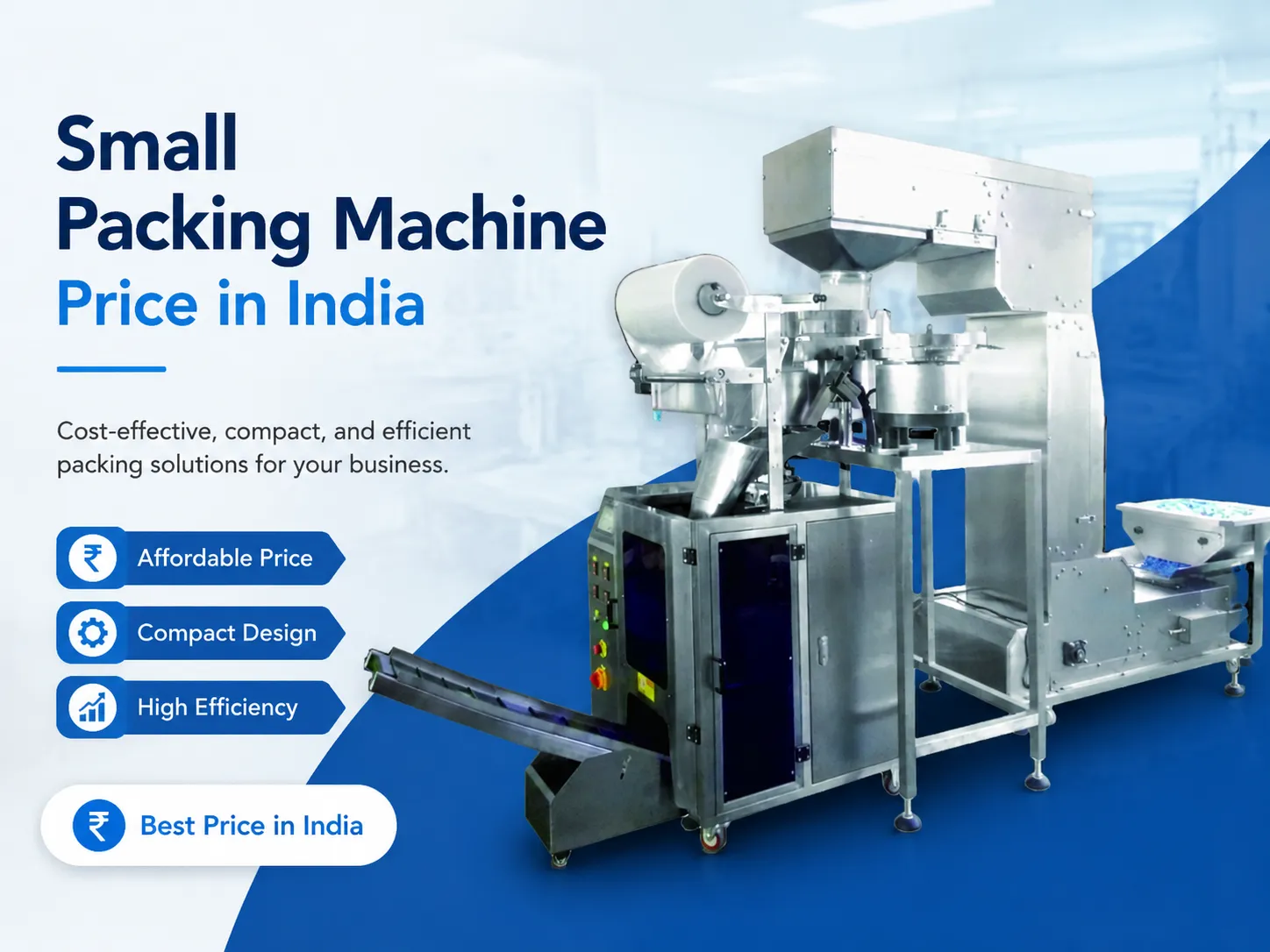
Small Packing Machine Price in India
When a spice trader in Kerala decided to invest in a small packing machine instead of manually filling the spices in pouches, he had a very basic question, “What’s the cost?” The answer he received had a wide difference of prices ranging from ₹65,000 to ₹4.5 lakhs — a difference that seemed meaningless unless he could find out the reason behind the price variance. At one end of the price-spectrum was a volumetric filler that works manually and seals the container at the same time. On the other end was a fully automatic packing machine that works at a much faster rate than the manual machine; the former fills one pouch in one minute while the latter fills 40 pouches per minute with just one person supervising the packing process. To the thousands of small and medium-sized Indian businesses that are engaged in packaging, the price of a small packing machine is not simply a purchase order; it also takes into account the effectiveness, price of labor, and shelf life of the product.
What Defines a Small Packing Machine and What Drives Its Cost
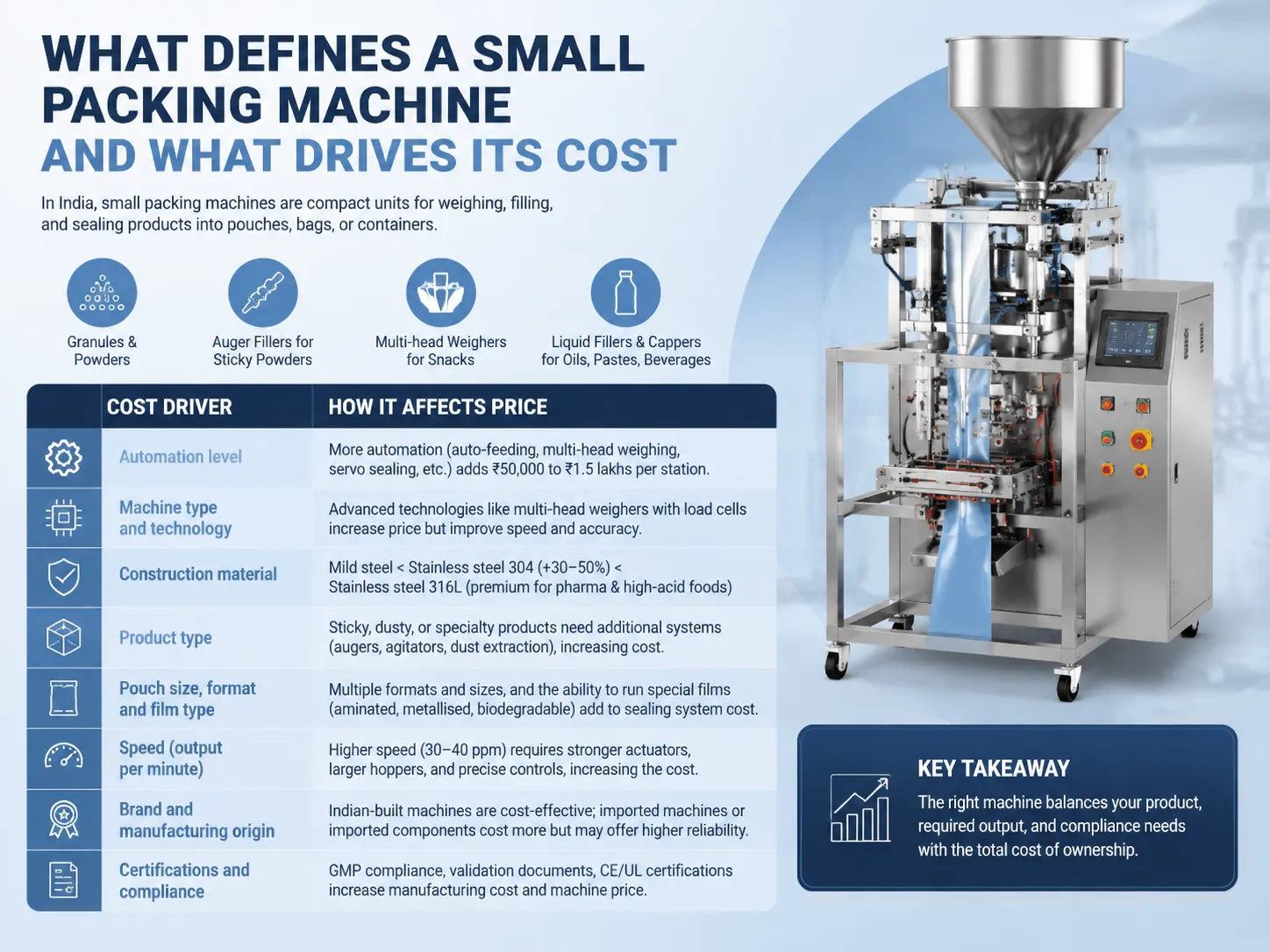
In the Indian context, what is called a small packing machine generally refers to a compact unit that weighs, fills, and seals products into pouches, bags, or containers and is usually mounted on the table or is floor standing. The most popular technologies used include vertical pouch filling technology for free flowing granules and powders, auger fillers for sticky powders, multi-head weighing machines for snacks and dried fruits, liquid fillers and cappers for oils, pastes, and beverages. Price is based not on a single factor but on a number of factors. The table below outlines the main cost factors.
| Cost Driver | How It Affects Price |
|---|---|
| Automation level | A manually loaded, semi‑automatic machine costs less than a fully automatic line with auto‑feeding, multi‑head weighing, servo sealing, and auto‑ejection. Each automated station — weigher, coder, nitrogen flush — adds ₹50,000 to ₹1.5 lakhs. |
| Machine type and technology | A simple volumetric cup filler with a band sealer is the most economical. A multi‑head weigher with load‑cell accuracy increases the price significantly but delivers higher speed and precision, reducing product giveaway. |
| Construction material | Mild steel with a painted finish is the lowest cost. Stainless steel 304 adds 30–50% to the machine cost. Stainless steel 316L, required for pharmaceutical and high‑acid food products, adds a further premium. Food‑grade contact parts are a regulatory requirement for any product intended for human consumption. |
| Product type | Free‑flowing granules (rice, sugar, seeds) are the easiest and cheapest to pack. Sticky powders (spice mixes, protein powders) require auger fillers with agitators. Dusty products need dust‑extraction attachments. Each product‑specific adaptation increases the machine cost. |
| Pouch size, format, and film type | A machine that makes a single pillow‑pouch size is less complex than one that can produce centre‑seal, three‑side‑seal, and stand‑up pouches across a wide size range. The ability to run laminated, metallised, or biodegradable films also affects the sealing system cost. |
| Speed (output per minute) | A machine producing 8–10 pouches per minute costs less than one producing 30–40 pouches per minute. Higher speed requires faster and more robust actuators, larger hoppers, and more precise control systems, all of which add to the bill of materials. |
| Brand and manufacturing origin | Indian‑built machines from established domestic manufacturers are generally the most cost‑effective. Imported machines, or Indian machines built with imported key components (PLC, servo motors, load cells), cost more but may offer higher reliability, better after‑sales support, or a longer track record in a specific industry. |
| Certifications and compliance | A machine built for a GMP‑compliant pharmaceutical packaging line, with full validation documentation, costs more than a machine for a general food application. CE marking or UL listing adds to the manufacturing cost and is reflected in the price. |
Price Ranges by Machine Type and Application
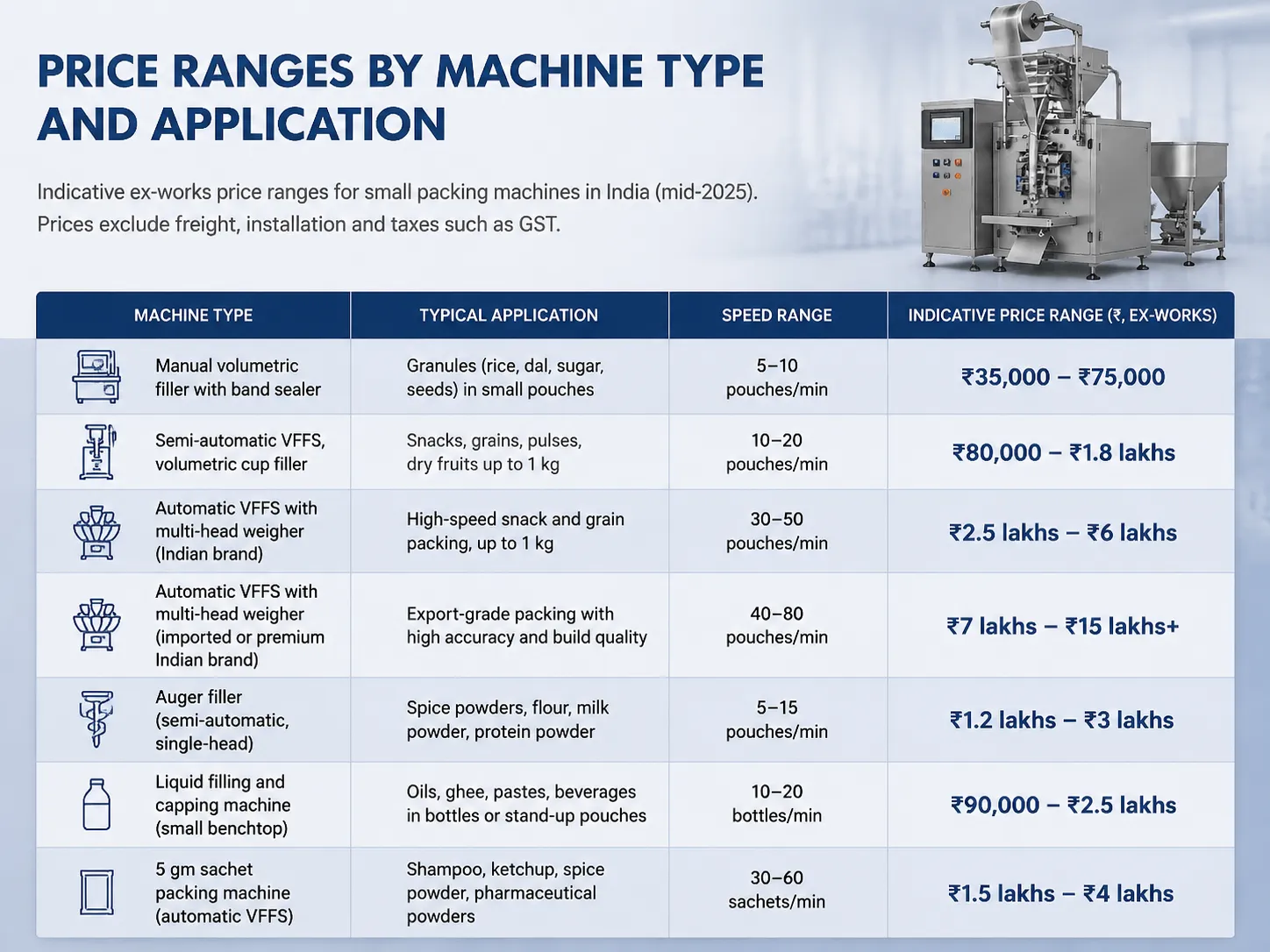
The cost of a small packing machine in India depends on what you are packing and how fast you need to pack it. The table below provides indicative price ranges for common machine types, based on mid‑2025 pricing from established Indian manufacturers and suppliers listed on industrial sourcing platforms such as IndiaMART. These are approximate ex‑works prices and do not include freight, installation, or taxes such as GST.
| Machine Type | Typical Application | Speed Range | Indicative Price Range (₹, Ex‑Works) |
|---|---|---|---|
| Manual volumetric filler with band sealer | Granules (rice, dal, sugar, seeds) in small pouches | 5–10 pouches/min | ₹35,000 – ₹75,000 |
| Semi‑automatic VFFS, volumetric cup filler | Snacks, grains, pulses, dry fruits up to 1 kg | 10–20 pouches/min | ₹80,000 – ₹1.8 lakhs |
| Automatic VFFS with multi‑head weigher (Indian brand) | High‑speed snack and grain packing, up to 1 kg | 30–50 pouches/min | ₹2.5 lakhs – ₹6 lakhs |
| Automatic VFFS with multi‑head weigher (imported or premium Indian brand) | Export‑grade packing with high accuracy and build quality | 40–80 pouches/min | ₹7 lakhs – ₹15 lakhs+ |
| Auger filler (semi‑automatic, single‑head) | Spice powders, flour, milk powder, protein powder | 5–15 pouches/min | ₹1.2 lakhs – ₹3 lakhs |
| Liquid filling and capping machine (small benchtop) | Oils, ghee, pastes, beverages in bottles or stand‑up pouches | 10–20 bottles/min | ₹90,000 – ₹2.5 lakhs |
| 5 gm sachet packing machine (automatic VFFS) | Shampoo, ketchup, spice powder, pharmaceutical powders | 30–60 sachets/min | ₹1.5 lakhs – ₹4 lakhs |
Price by Brand and Supplier Type
The market for compact packing machines in India has a mix of established local manufacturers, specialized engineering firms, and a growing number of Chinese units being supplied through agents and online sales. The type of supplier utilized influences not only the price at which the machines are purchased but also the availability of after-sales service, spare parts, and the necessary documentation to meet food and pharmaceutical regulations.
- Established Indian manufacturers Viking Masek, Allied Packing Machinery, and Nichrome India have been operating for many years both locally and nationally and are continuously coming up with new machines and modern versions of older machines. Their prices, compared to other companies , are quite high and their machines have all benefits that some of machines from foreign manufacturers have.
- Specialised Indian engineering firms create packaging machines that cater to specific needs. For instance, they manufacture small-size auger filling machines specifically intended for sticky powder spices or compact VFFS packaging equipment tailored for a particular product like a 25 kg rice bag. These machines are typically custom-made, which is reflected in their prices being higher for the engineering process involved and a lower number of products manufactured.
- Chinese imports and generic machines are provided at the lowest cost, often thanks to online platforms like IndiaMART or TradeIndia. The attractive initial investment is worth the cost, but the purchaser must confirm that spare parts are available as well as the quality of electrical and pneumatic components. A minor company that can’t afford production stop can find that low-cost equipment is actually the most expensive purchase when the line stops due to solenoid failure or worn-out seal, and there is no local expert.
The Total Cost of Ownership: Beyond the Purchase Price
The price indicated on the invoice of a packing equipment is not all there is to it. The total cost of ownership includes all the expenses incurred during the operation of the machine for 7 to 10 years. These expenses consist of material costs, electricity spent during the operation period, the costs of labor, maintenance costs, and spoiled products. For instance, a packing unit that costs ₹50,000 more than another one may earn back its cost due to the products saved otherwise. Moreover, a packing device that has a service and a spare parts kit needs only a day instead of two weeks for repairs. For a small business manager, the total cost of ownership is the only cost that counts when making purchasing decisions and should be calculated on the annual output basis.
How to Choose the Right Small Packing Machine
Choosing the appropriate small packing machine involves matching its capacities to the characteristics of the product, as well as taking into consideration throughput, packaging format, and the regulations that are in place. The following guides one through this process:
- Define the product characteristics precisely. Is the material free-flowing granule, viscous powder, finely-divided powder that creates dust or liquid? What is the bulk density? what is the filling weight required for each pouch? All these queries help to determine the filling process, which can be done through volumetric method, auger, multi-head weigher, or liquid piston filling machine.
- Determine the required output. What number of pouches is produced per minute, shift, and month? The rated speed must be at least 20% greater than the average required rate, so that the machine will not be affected by the time spent changing films and cleaning or minor breakdowns. The machine with the speed exactly equal to that of the required one will always cause delays in the process.
- Specify the pouch format and size range. The pillow pouch, zipper pouch, three side seal sachet, and centre seal bag represent varying package formats and not every machine is capable of making all formats, so if the type of packaging may change in the future, one machine with greater capability might be sufficient.
- Verify the material of construction and the certification status. When it comes to the materials for food production, the minimum requirement is the parts in contact with food must be made of 304 stainless steel. The process machine for pharmaceutical production shall be built according to good manufacturing practice standards and must have proper documentation for validation. Any machine non-according to the requirements of either food or drug supervision will not pass the inspection, regardless of its price.
- Evaluate the supplier’s after‑sales infrastructure. Request the supplier to inform you about the recent service call that they managed in your area and how long it took. Request them to provide you with a list of spare parts that they have in stock in India and those that need to be imported from abroad. Any machine that fails to function for more than 48 hours in the middle of production life incurs larger losses than the price savings realized at the buyer’s end.
Although Benlong Automation does not produce packing machines, the principles of automated manufacturing that are applicable to a VFFS machine can also be applied to the automated assembly and testing lines that Benlong creates for the electrical manufacturing industry. Whether machines that fill pouches at 40 per minute or devices that calibrate miniature circuit breakers at 30 pieces per minute, both types have a similar base of engineering disciplines: precision material transport, closed-loop control process, automated inspection, as well as data logging for traceability purposes. A manufacturer who wishes to utilize automation in any form — whether it is in packaging food products or establishing safety devices — must apply the same logic: if the machine is right for the product and the quantity, it will pay for itself in quality, throughput, and documentation necessary to obtain relevant product certifications.
Frequently Asked Questions
What is the price of small automatic packing machine in India?
In India, a basic VFFS machine with volumetric filling starts at around ₹80,000, while one with complete automation can cost ₹15 lakhs or more. The cost depends on various factors such as technology, material, speed, and brand name.
What is the price of 25 kg rice packing machine in India?
A rice packing machine weighing 25 kg will likely be either a large VFFS or a machine that fills and seals bags that are made beforehand. Generally, we see that the price range for a machine belonging to an Indian brand and automatically packing 25 kg bags ranges from ₹4 lakhs to ₹10 lakhs based on both its speed and weighing system. On the other hand, the price of a manual bag closing system is lower and starts from ₹50,000 to ₹1.5 lakhs.
Which machine is used for packing?
The type of machine used for packing will depend on what the product is, the format of the package, and how much of it is to be produced. Vertical form-fill-seal machines are commonly used for packing granules, powders, and snacks in pouches. For fine and sticky powders, auger fillers are used. Multi-head weighers are used for the fast and accurate packing of snacks and dried fruits. Liquid fillers and cappers are used for packing oils, pastes, and drinks.
What is the cost of 5 gm pouch packing machine?
The price range of a pouch packing machine weighing 5 gms in India is about ₹1.5 lakhs to ₹4 lakhs. It is a compact machine and the automatic VFFS version can manufacture tiny pouches at the rate of 30 to 60 pouches per minute. The cost varies based on the manufacturer, the type of material used for manufacturing the machine, and whether the machine has things like a date coder, nitrogen flushing feature, and an automated sealing system.
References
- Nichrome India — VFFS and Multi‑Head Weigher Packing Machines. Leading Indian manufacturer of automated packing solutions for food, pharmaceutical, and industrial products.
- Viking Masek — Automated Packing and Filling Solutions. Manufacturer of vertical form‑fill‑seal machines and multi‑head weighers for the Indian and global markets.
- Allied Packing Machinery — Indian Packing Machine Manufacturer. Supplier of VFFS, auger filler, and liquid filling machines for small and medium enterprises.
- IndiaMART — Small Packing Machine Listings and Prices. Online marketplace providing indicative pricing and supplier information for packing machines in India.
The price of a small packing machine in India is a function of what the machine must do, how fast it must do it, and what it is made of. A ₹75,000 volumetric filler will pack rice into pouches. A ₹6‑lakh multi‑head weigher will do it faster, more accurately, and with less product giveaway. The right machine is the one whose cost, when divided by the number of pouches it will pack over its lifetime, produces the lowest cost per pouch — and whose supplier can keep it running, day after day, year after year. For the spice trader in Kerala, the snack manufacturer in Gujarat, and the pharmaceutical packer in Himachal Pradesh, that calculation is the foundation of a packaging investment that pays for itself in product saved, throughput gained, and markets opened.