benlong


Top 5 Industrial Automation Companies in Turkey
Turkey has a status in international manufacturing that few can rival: it is positioned in Europe and Asia simultaneously, has customs agreements with the European Union, and operates its industrial sector exporting a variety of goods including automotive and white goods, and even low-voltage electronic devices, on three continents. That means Turkey’s manufacturers experience pressure in every aspect of production – from the strict CE requirements imposed by European buyers, to the continually increasing labor costs in the organized industrial areas of Istanbul, Kocaeli, and Bursa, and fast automation processes carried out by rivals in the same field.
So when Turkish manufacturers consider automation investments, the first thing they think about is the company that will manufacture the automatization line, which is usually a Turkish company operating in the field of industrial automation. The current guide is aimed to show the existing situation with industrial automation companies in Turkey, highlight five examples of such companies operating in Turkey’s main industrial zones, and explain how to choose the right company for building an automation line.
Notable Industrial Automation Companies in Turkey
The following five firms represent the range of capabilities present in the country, from fully automated assembly lines to modernizing existing control systems. Each entry outlines the location of the company and what it is famous for, enabling the user to sort companies based on the type of work rather than just their name.
1. Altınay Robot Technologies (Istanbul)
With its inception back in 1990, Altınay is the first integrator of industrial robotics in Turkey. The company has built machines used in various industries, such as automotive sector, glass manufacturing, home appliances, and defense. The main focus of Altınay is on the auto manufacturing process, especially robots related to body-making and welding of parts. The company is also a part of group companies based in Germany, which allows doing business not only in Turkey but also in Europe.
2. Teknopar Industrial Automation (Ankara)
Teknopar, based in Ankara, was established in1996, while merging automation engineering with modern industrial IT. The company’s service portfolio consists of PLC, SCADA and HMI systems, servo motion, industrial communication, as well as test systems, but also IIoT solutions, data analysis and AI applications. These factors turn the company into an ideal partner for those engineering companies basically dealing with data-intensive automation projects.
3. İzotork (Izmir)
İzotork belongs to the retrofit and modernization segment of the market. Founded in 2013 and located in Izmir, this company provides services related to PLC & drive systems, SCADA, energy management, as well as upgrading outdated control systems to modern platforms. The services of commissioning, maintenance, and operator training are also among the units offered by the company. For Turkish plants where the productive lines are many years old, it is often the best and most cost-effective solution to modernize solutions only when necessary, thereby delaying the total reconstruction of the line.

4. QuadPlus Turkey (Bursa)
QuadPlus is a technology integrator situated in the United States with an engineering facility located in Bursa’s Nilüfer district and operates as a Gold Solution Partner of Rockwell Automation. QuadPlus’s Turkish division encompasses system integration, professional engineering, drive and control services, and assembly of electrical panels complying with CE standards including the CE Declaration. In case of plants situated in Turkey belonging to multinational companies and exporters of products that require the use of Rockwell platforms, establishment of a local office by the global integrator will provide a perfect solution consisting of applying international standards and know-how.
5. ANIT (Siemens Partner)
ANIT operates in the field of OEM machinery manufacturing and control-system integration. As a partner of Siemens, it provides PLC and servo systems and integrates SCADA and DCS platforms as well as engineering services for machine builders. This is suited for manufacturers who are standardized on the Siemens ecosystem and want a single partner to handle the machinery aspect and the control stack of their projects.
How to Choose an Automation Partner in Turkey
The most important criteria for selection in Turkey are essentially the same as for any other country; however, three criteria are particularly important in this country. Firstly, export documentation capability: if your goods go to Europe, your equipment manufacturer must provide you with not only a functional machine but also all the calibration and test documentation required for CE certification. Secondly, service geography: Turkey has an industrial base in many regions, so find out the location of the service engineers of the systems integrator and their response time to your city, as it is useless to have a line that malfunctioned in Manisa if the service team covers only Istanbul. Thirdly, platform compatibility: Turkish system integrators usually have a great competence in either the Siemens or the Rockwell framework, so addressing your existing platform lets you avoid using extra spare parts and additional training.
In addition to other factors, certain questions apply to all integrators: have they designed facilities for your specific processes previously, how much of the integration is done in-house versus outsourced, and what does support after completion of the work entail in reality, instead of on paper.
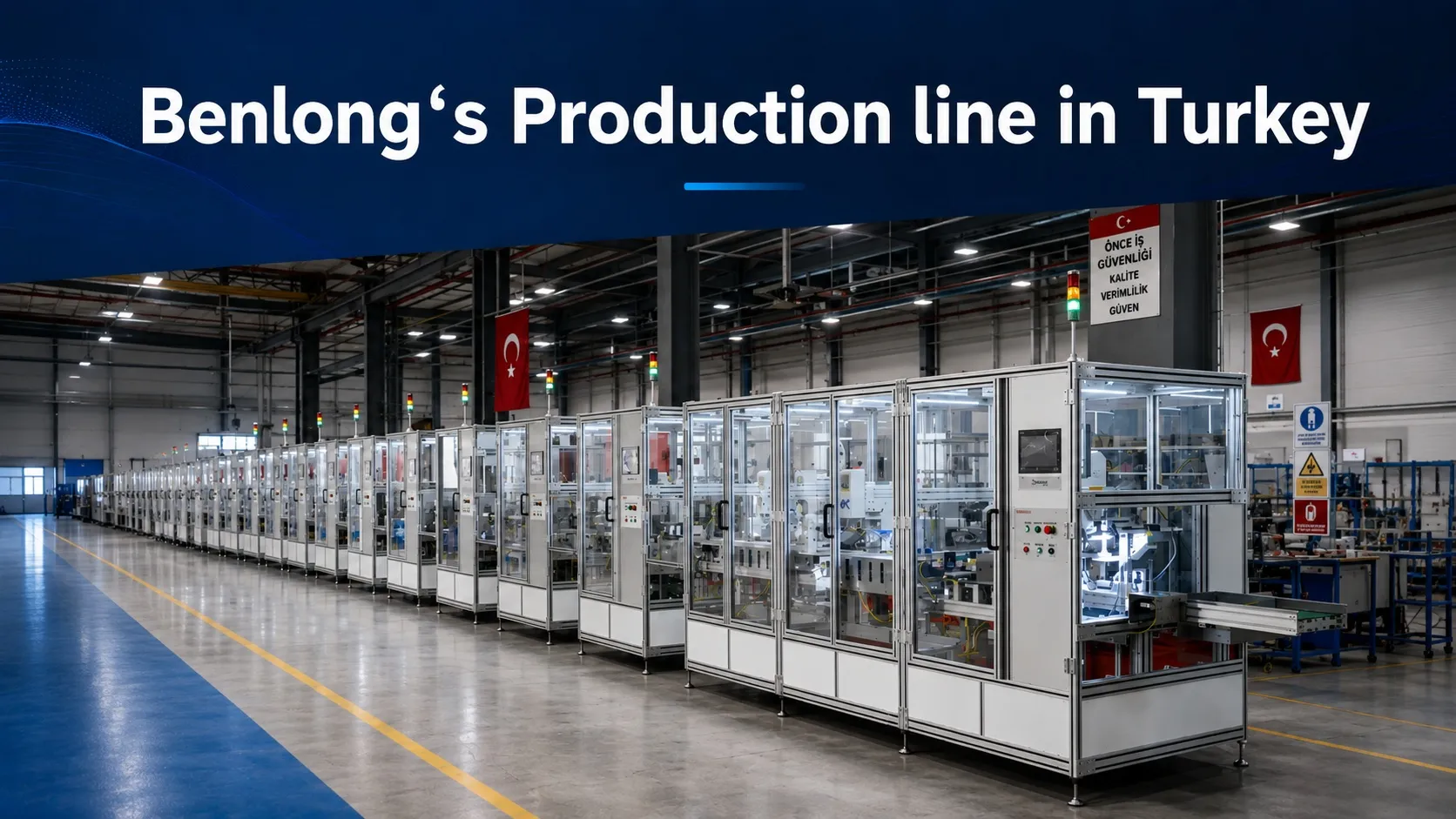
One of the situations where the local-generalist build fails to perform well is with regard to deep product-specific automation. For instance, despite Turkey being one of the leading producers and exporters of low-voltage electrical equipment in the region, circuit breaker assembly is a very specialized field that general integrators are often not used to dealing with. The calibration of thermal-magnetic release, whereby delay and instantaneous tripping capabilities need to be assessed, and all poles need to be recorded according to a serial number for certification are process issues. Benlong Automation, based in Wenzhou, China, builds semi-automated and fully automated assembly and testing lines exclusively for MCBs, MCCBs, RCCBs, AC contactors and SPDs, including the MCB automatic testing line and MCB automatic assembly line, and this is not a theoretical option for the Turkish market: Benlong has already delivered an RCCB automatic production line to one of Turkey’s established circuit breaker manufacturers. For a Turkish breaker manufacturer, the practical comparison is between a general integrator learning the product on your budget and a specialist arriving with the calibration, testing and data-traceability know-how already built into the line. For the economics of that decision, see our analysis of when the investment in automated MCB testing pays off, and for the technical detail, the complete guide to what an MCB automatic testing line is.
Frequently Asked Questions
Why is industrial automation growing in Turkey?
The three major factors are: increasing labor costs in organized industrial zones, quality control standards set by the EU requiring certification and traceability, and competitive pressures stemming from European and Asian manufacturers. All this implies shorter payback periods for automation and can cause virtually all Turkish manufacturers, not only those in the automobile industry, to undertake automation initiatives.
Who is the largest automation company in Turkey?
In the area of robot-driven factory automation, Altınay Robot Technologies is one of the most successful integrators in the country, having completed more than thirty years’ worth of projects, and also owns subsidiaries in Germany. Still, this market advises a wide range of strong regional competitors from Ankara, Izmir, and Bursa, as well as offices of international integrators in Turkey.
Do Turkish manufacturers export electrical equipment to Europe?
Indeed, Turkey is a leading country in the manufacture of low voltage electrical goods, such as circuit breakers, switches, sockets and panel devices, and under the customs union the EU is the biggest export market for Turkish products. This is why CE compliance and traceability of tests at the level of each item are critical in automation projects in Turkey.
Should a Turkish factory choose a local integrator or a specialist line builder?
The process plays a crucial role in determining the right solutions. In the domains of robotics, control systems, and material handling, Turkish system integrators offer comprehensive solutions and excellent service. For niche technologies such as circuit breaker testing and calibration, specialists in construction of production lines with relevant prior experience provide a more effective service, even when based overseas. For a combination of both approaches, it is possible to work with a local automation partner and a company that specializes in the production line in question.
Conclusion
Turkey’s industrial automation systems integration industry has people with varied backgrounds from various corners of the country. Depending on the type of work you do – intensive robotic compilation of automated systems, data-centric upgrades, switch replacements or specific integration – you will have to look at different names. Finally, if your work involves low-voltage power production then you must make sure that you include at least one professional in the list of the companies to work with, because the company парламента of electric switches will be evaluated based on reliability rather than speed.