benlong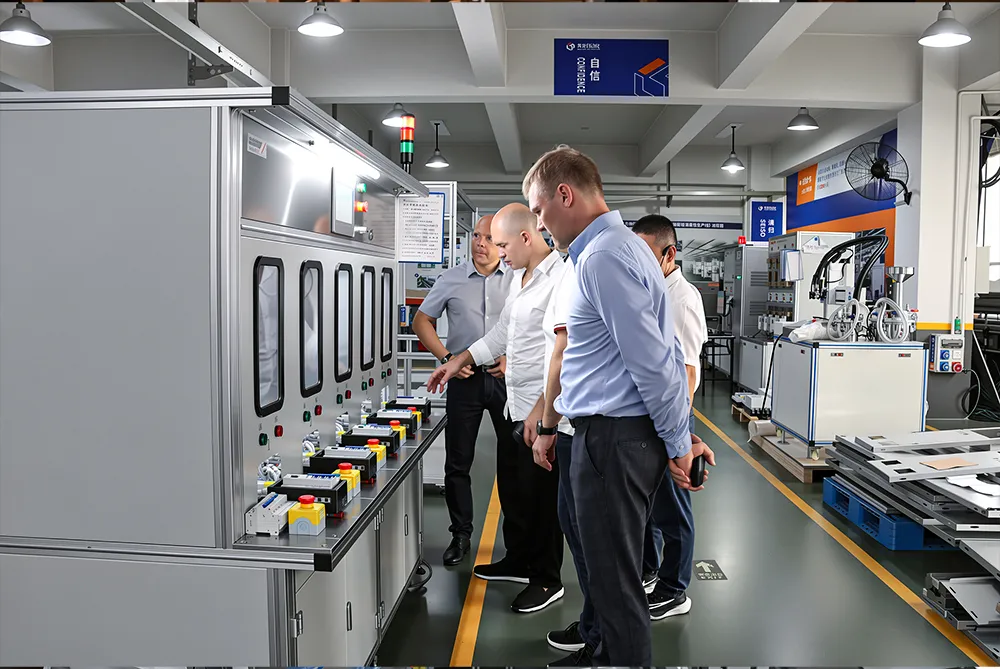

Industrial Automation Systems Integrators in New England
When a company that manufactures medical devices in Massachusetts required a validated and properly documented assembly cell to create its latest surgical device, it didn’t turn to a supplier of robots. Instead, the company contacted a systems integrator — an organization that specializes in bringing together technologies such as robots, conveyor systems, vision systems and programmable logic controllers (PLCs) from various manufacturers and integrating them into a fully operational production cell. New England is fortunate to have one of the highest concentrations of companies specialized in industrial automation in the world, especially in the fields of medical technology, aerospace engineering, semiconductor development and high precision engineering. It is important to be aware of major companies that are engaged in systems integration in New England to stay on the safe side. Since this guide is dedicated to the landscape of industrial automation in New England, it provides information on different types of systems integrators, their specialties and useful tips on how to select the right company.
The New England Automation Integration Landscape
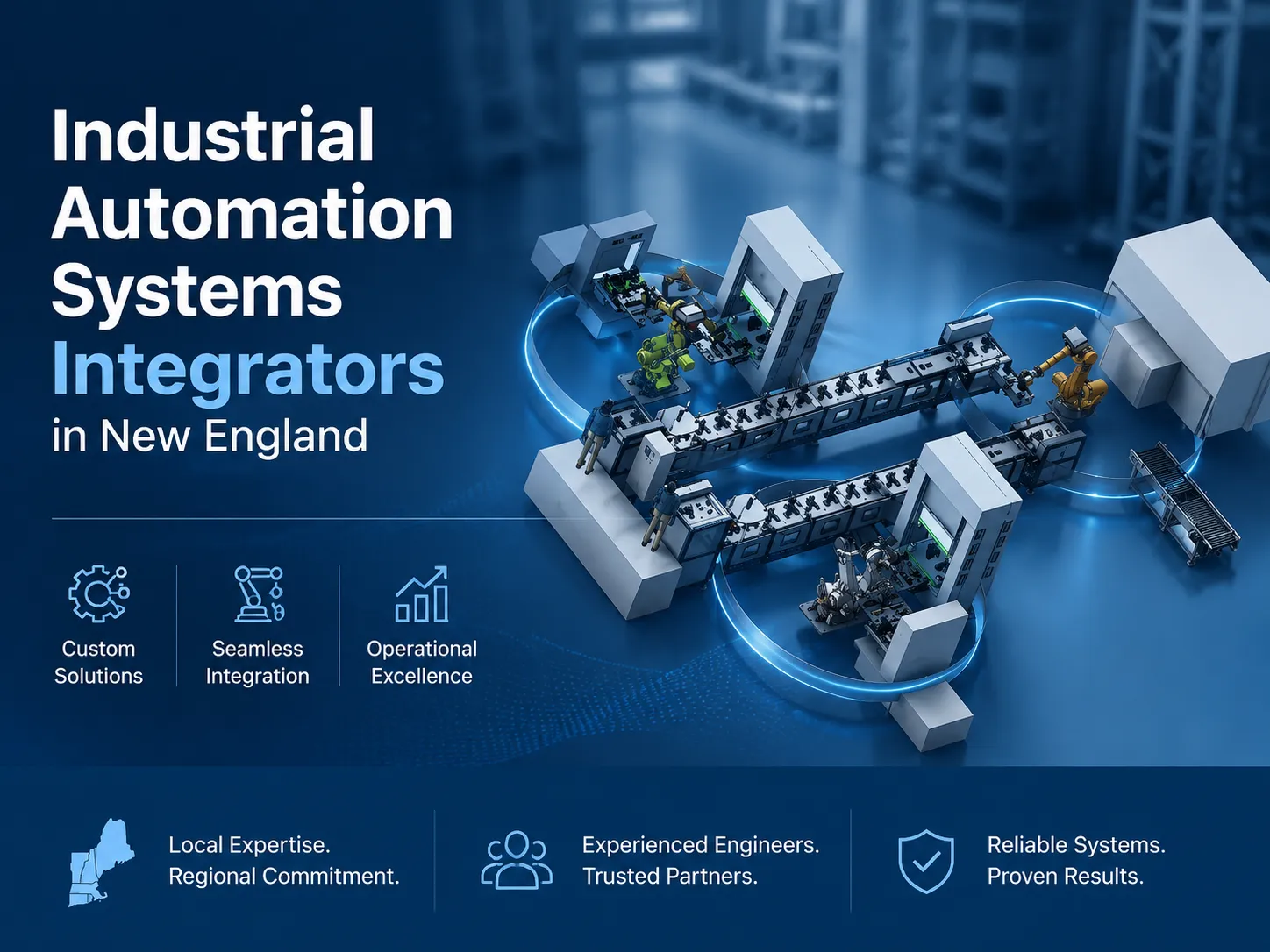
The New England region comprises of six regions, namely Connecticut, Maine, Massachusetts, New Hampshire, Rhode Island, and Vermont, and is characterized by a manufacturing environment that is marked by expensive labour, skilled engineering talent, and an abundance of small and medium enterprises engaged in manufacturing high-value and complicated products. In line with that, the automation integrators have come about due to the establishment of these industries, their specific areas of expertise being determined by the local clients’ needs, namely, validated processes for medical devices that are FDA approved, assembly done with tight tolerances for aerospace and defence products, that need a Class 100 cleanroom for semiconductor equipment, as well as very stringent quality standards regarding precision machining and optics.
While automotive-focused integrators in the Midwest and consumer electronics integrators in the West Coast are major players in their respective fields, companies like New England integrators focus on the mid-size industry and specialize intimately in other regulated fields. They understand the extensive documentation required for medical device validation, material tracking summaries required for aerospace, as well as surface finish specifications for semiconductor tooling. This specialization is what defines their value proposition. Consequently, companies operating in these sectors will find New England integrators to be a better option than large, general integrators in other regions.
Notable Industrial Automation Systems Integrators in New England
The companies that are listed below illustrate the spectrum of integration capability in the area. They comprise both large companies that provide extensive services and small companies that are experts in particular fields. Each of them specializes in a specific aspect depending on the character of the task, the regulatory framework, and the production scale.
1. Owens Design (Fremont, CA, with significant New England presence)
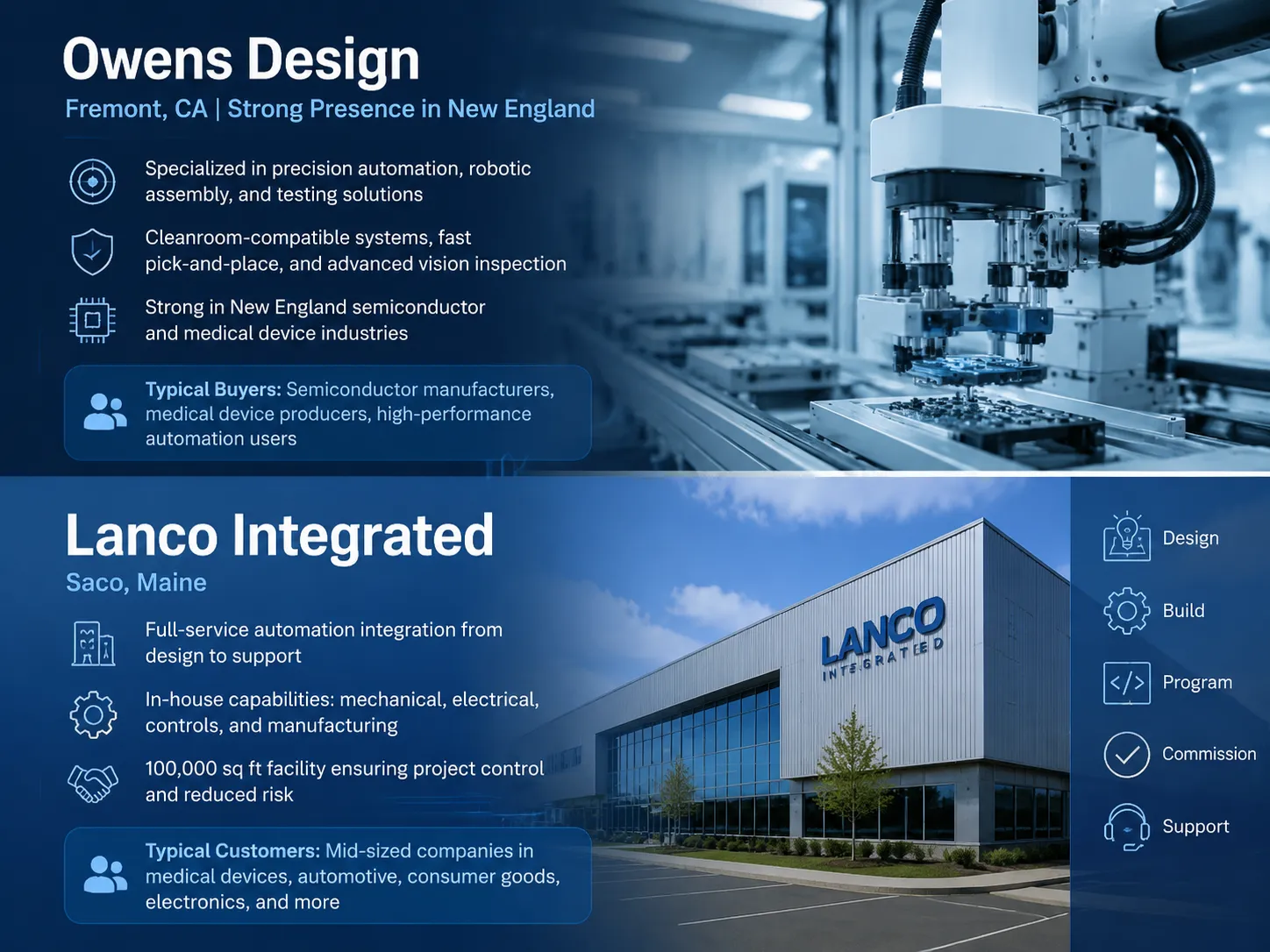
Core strength: Owens Design is a major force in the integration of capital semiconductors and medical device industry systems, especially when it comes to precision automation, robotic assembly, and testing solutions. The company’s products are characterized by cleanroom-compatible structures, fast pick-and-place technology, and the use of advanced vision inspection techniques. Owens Design is especially strong in New England due to its involvement with the semiconductor and medical device industries in Massachusetts. The company specializes in high-precision assembly and ultra-clean production processes which are important in those high-tech sectors. Typical buyers are semiconductor manufacturers, medical device producers, and those who employ very high-performance automation techniques.
2. Lanco Integrated (Saco, Maine)
Core strength: Lanco Integrated provides full-service automation integration services for clients across various industries such as medical device manufacturing, automotive, consumer goods, and electronics. Unlike small companies, Lanco covers the entire project cycle starting from designing the project to builds, programming, commissioning, and its support and maintenance. The company operates out of its 100,000 square foot facility equipped with mechanical engineering, electrical engineering, controls and manufacturing allowing them to keep the control over project and lower its risks. The company works with medium-sized companies looking for a company that could do all of the developing for their production needs.
3. MassRobotics (Boston, Massachusetts) and Its Resident Startups
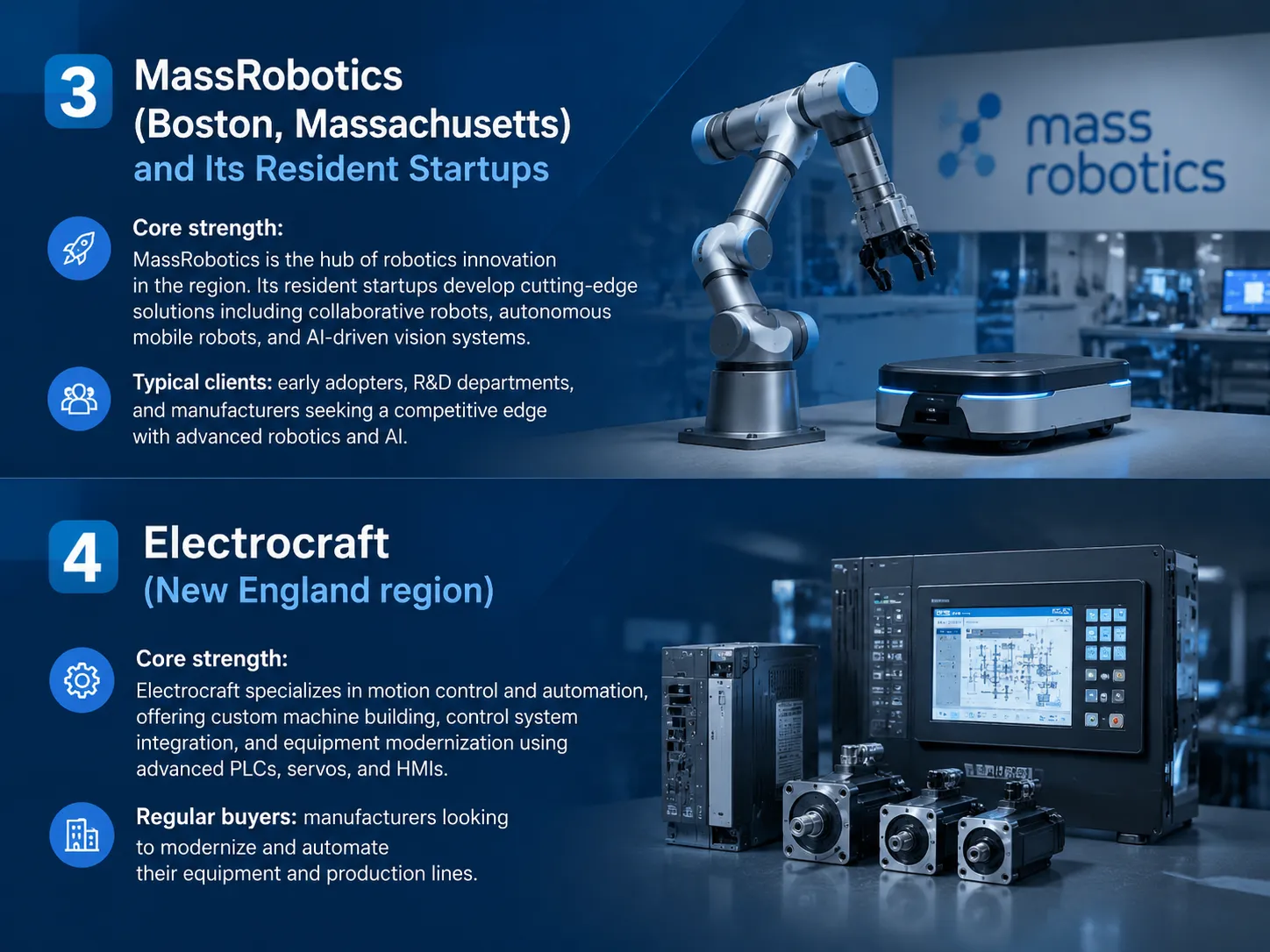
Core strength: Although MassRobotics is not an integrator at all, it is still the very hub of the robotics innovation in that area; the companies that are located there include a number of new integrators and automation solution providers bringing to the market the state of the art collaborative robots, mobile robots with autonomous motion capability, as well as the systems based on the AI driven vision technology. If a producer is thinking of investing in automation that is on the forefront of technology, dealing with MassRobotics is one of the ways to get access to the technology that cannot yet be found in the standard integrator’s offer. A typical client includes early adopters, R&D departments, and manufacturers who want to stay competitive with the help of advanced robotics and AI technologies.
4. Electrocraft (New England region)
Core strength: Established for a long time, Electrocraft specializes in motion control and automation, closely cooperating with New England companies producing goods. Electrocraft’s services entail custom machine building, integration of control systems, and modernization of production equipment with the help of high-tech PLCs, servos, and HMIs. This company is a suitable partner for manufacturers in need of modernisation of existing production lines and equipment, which is a popular approach taken by many companies that have to update old factories in this part of the country.
Regular buyers: producers willing to modernise and automate their equipment.
5. Design Technology Corporation (DTC, Massachusetts)
Core strength: DTC is an integrator situated in Massachusetts that specializes in tailored automated assembly and testing systems for medical devices, pharmaceutical industry applications, and consumer goods. The business approach of the company is founded on a solid engineering process that allows reduction of risks and assures ease of manufacturing. It is also popular for providing finished products that comply with the strict validation rules of the medical device field and include all the required technical documentation.
How to Choose an Automation Systems Integrator in New England
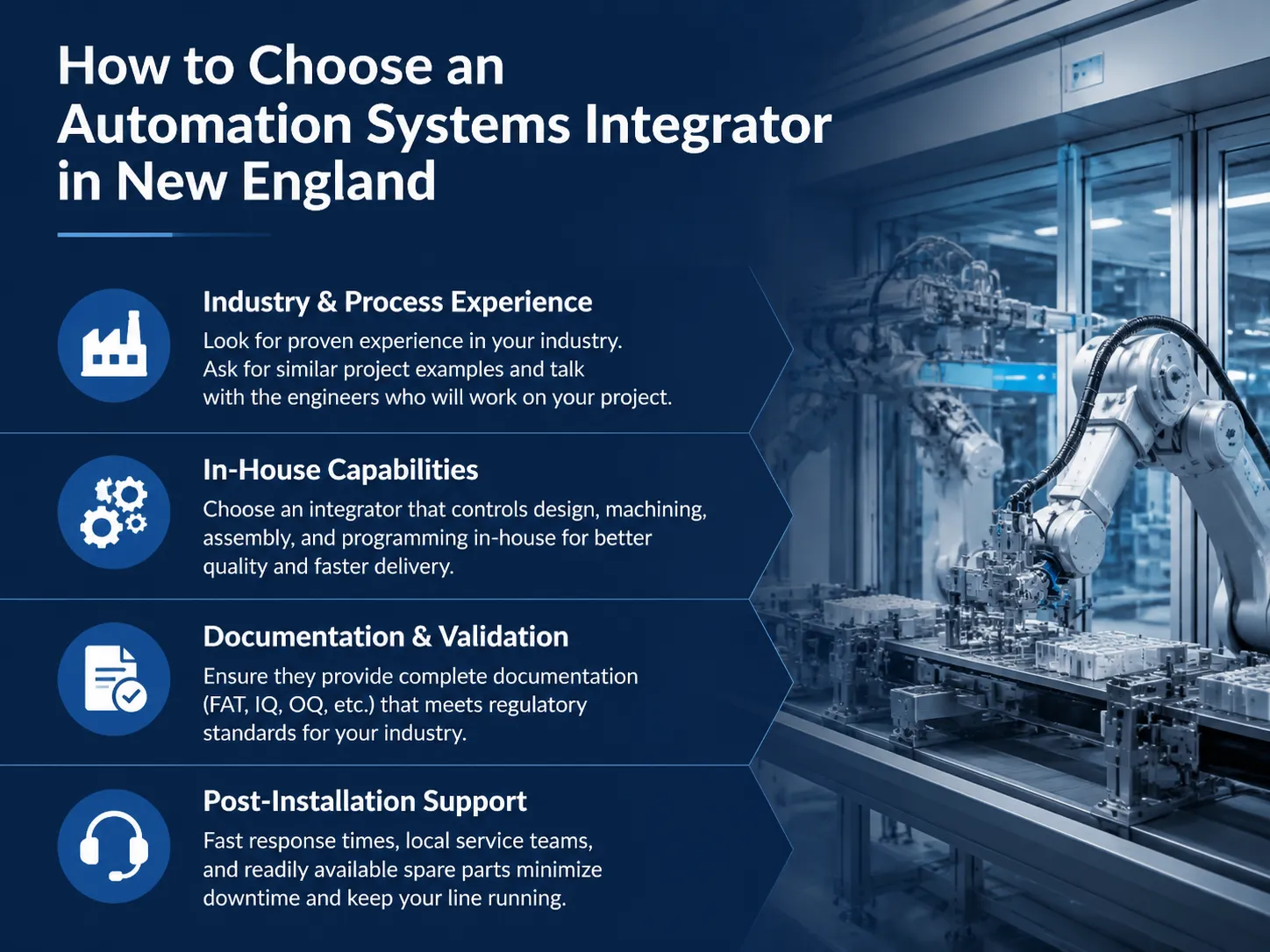
Choosing between industrial automation systems integrators is an important decision that will affect your production line for years to come. These criteria aid in distinguishing a dependable long-term partner from a machine builder that deals only in transactions:
- Does the integrator have specific experience in your industry and your process? The assembling of medical devices does differ substantially from the assembly of automotive parts when it comes to ISO 13485 and IATF 16949. Be sure to request examples of similar projects and speak with the engineering personnel assigned to your project rather than just the sales representative.
- What capabilities are in‑house versus subcontracted? By having control over the entire process of design, machining, assembly, and programming of a project under one roof, an integrator has full control over the time and quality of a project. In contrast, an integrator who employs subcontractors for certain processes like machining, electrical panel production, or programming must depend on other companies for their work.
- What is the integrator’s approach to documentation and validation? When dealing with a regulated industry, documentation package—functional specifications, design qualification, installation qualification, operational qualification—is as important as the machine. An integrator who does not have these documents at the requisite level does not qualify as a partner for regulated manufacturing.
- What is the post‑installation support structure? A piece of machinery that operates all the time requires assistance in a matter of hours instead of days. How far away is the integrator’s service team, what amount of time it takes them to answer, and which spare parts do they have in stock in the country? The world’s best integrator could be extremely useful if the machine can be repaired without delay, owing to the lack of necessity for the downtime.
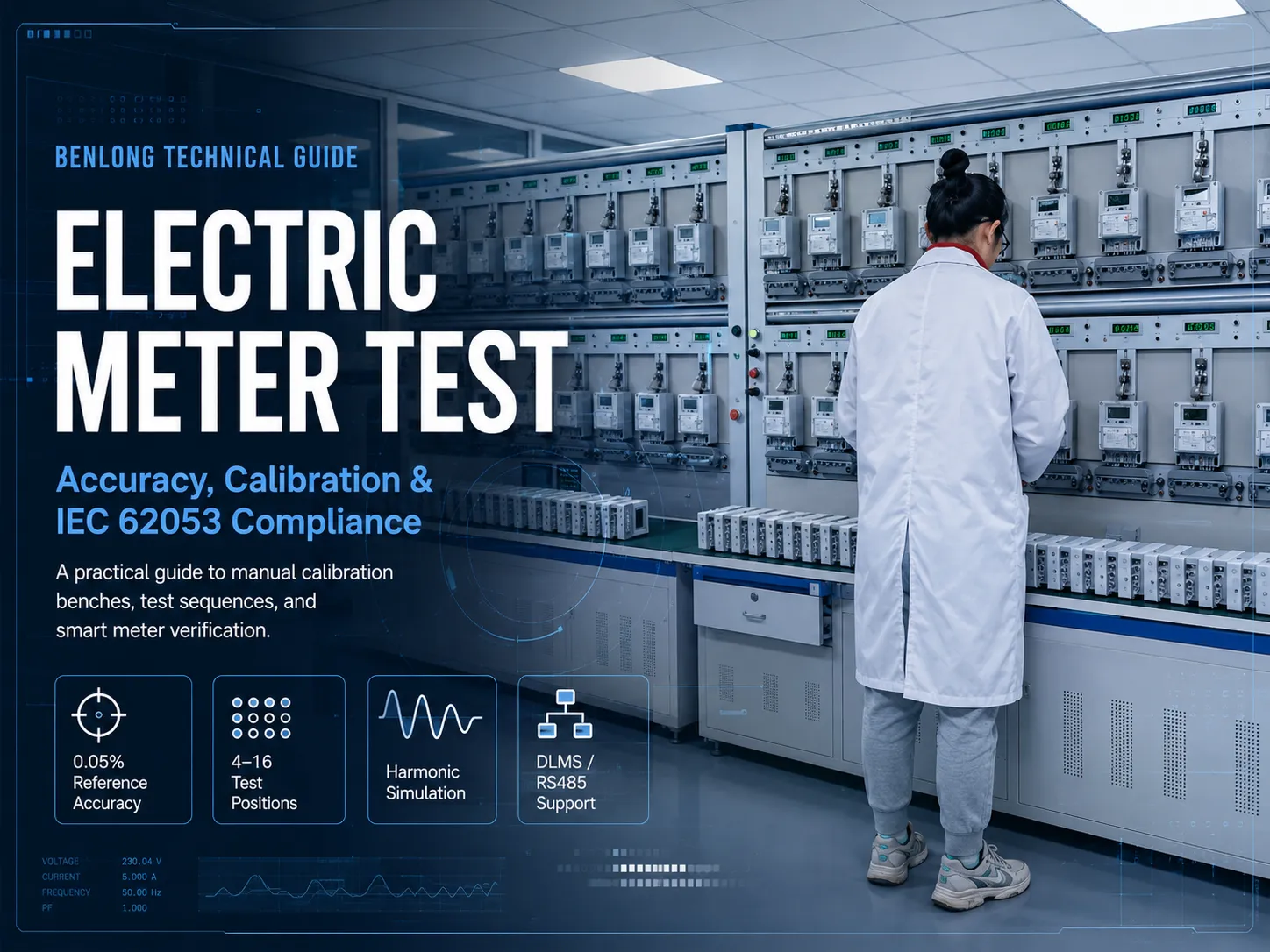
While Benlong Automation is based in Wenzhou, China — not New England — it competes in the same global conversation about electrical device automation. Benlong designs and builds semi‑automated and fully automated assembly and testing lines for MCBs, MCCBs, AC contactors, and SPDs. For a manufacturer in New England who produces circuit breakers, contactors, or switches — or who is considering entering that market — Benlong provides domain‑specific automation that a generalist integrator would need to learn on the buyer’s budget. Benlong’s lines integrate the calibration, testing, and data management that electrical certification demands. For a broader look at how automated assembly and testing lines are configured for these specific products, Benlong’s guide on what an MCB automatic testing line is provides a detailed technical reference that applies regardless of where the integrator is located.
Technology Trends Among New England Integrators
Integrators in New England have emerged as pioneers in embracing a variety of technologies compatible with the region’s manufacturing bedrock of high-value, high-mix production. The most noticeable trends are collaborative robots (cobots), which are capable of safely working next to humans without any cages and are perfect for various small-batch production lines. Other areas of excellence include AI-based systems specified for vision inspection. The systems can learn the details of the new project in a few hours and can easily find defects that cannot be detected by traditional vision systems. Digital twins, which are considered the digital replicas of the actual production line, gradually find application in virtual commissioning that lets integrators simulate a production line and troubleshoot it prior to starting manufacturing. Modular and reconfigurable automation developed from standardized base parts with replaceable tooling is becoming more accepted by manufacturers that need to constantly adapt to new products.
Frequently Asked Questions
What are the 4 types of automation systems?
The four main classes include fixed (hard) automation for high-volume, single-product operations; programmable automation for batch production; flexible (soft) automation for mixed product operations that call for minor changeover; and integrated automation where the entire factory is digitally controlled with data connectivity. Most systems integrators operate in the programmable, flexible, and integrated spaces.
What is an industrial automation system?
An industrial automation system refers to the set of hardware and software that runs a manufacturing operation without human effort. A systems integrator develops and builds this system to enable specific production criteria to be fulfilled.
What are the different systems used in industrial automation?
The principal systems encompass the programmable logic controllers (PLCs), supervisory control and data acquisition (SCADA), the manufacturing execution systems (MES), the industrial robots, machine vision, automated guided vehicles (AGVs), and the industrial networks required for linking them together.
What are the top 10 automation tools?
The widely prevalent automation technologies in the contemporary manufacturing industry comprise PLCs, industrial robots, vision systems, collaborative robots, autonomous mobile robots (AMRs), MES software, digital twin simulation, additive manufacturing for tooling, AI-based predictive maintenance, and the IIOT sensor networks.
References
- Control Design — 2024 System Integrator Giants. Annual listing and analysis of the top systems integrators in North America, including those serving the New England region.
- MassRobotics — The New England Robotics Cluster. Information on the robotics and automation ecosystem in Massachusetts and the surrounding states.
- Association for Advancing Automation (A3). The industry body for robotics, vision, and motion control in North America, with a directory of certified integrators.
- International Society of Automation (ISA). Standards, training, and resources for industrial automation and control systems, widely referenced by integrators in regulated industries.
New England’s industrial automation systems integrators are a concentrated resource of engineering talent, regulatory expertise, and precision‑manufacturing know‑how. The right integrator for your project is the one whose specific process experience, in‑house capabilities, documentation rigour, and post‑installation support align with the demands of your product and your industry. For the medical device startup, the aerospace component supplier, and the electrical device manufacturer, that integrator is the partner who turns a specification into a production line that works — first time, every cycle.