benlong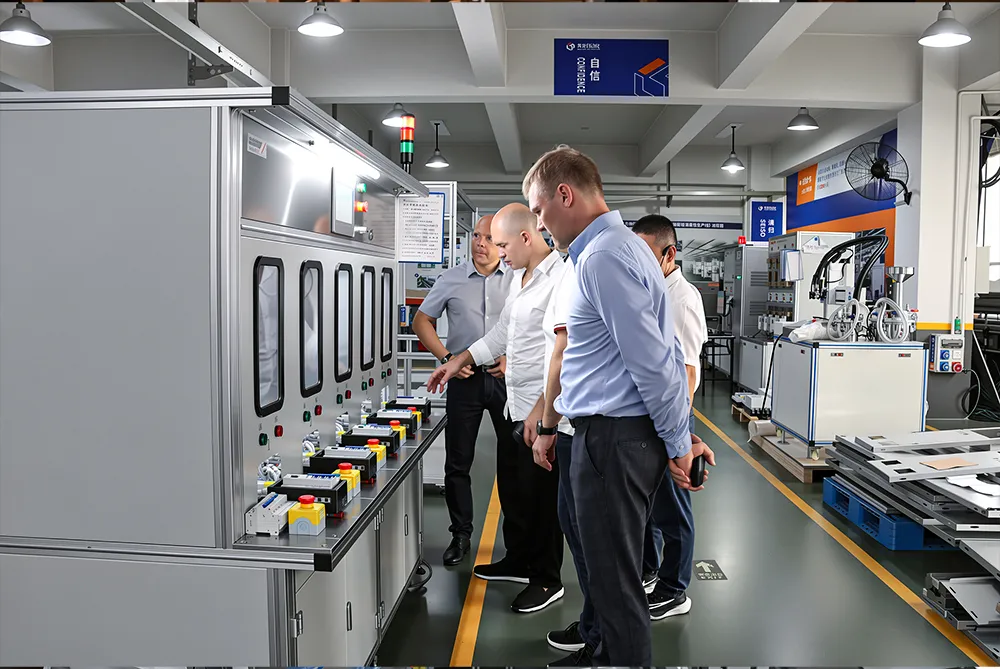


MES System for High-Speed MCB Production Lines | Benlong
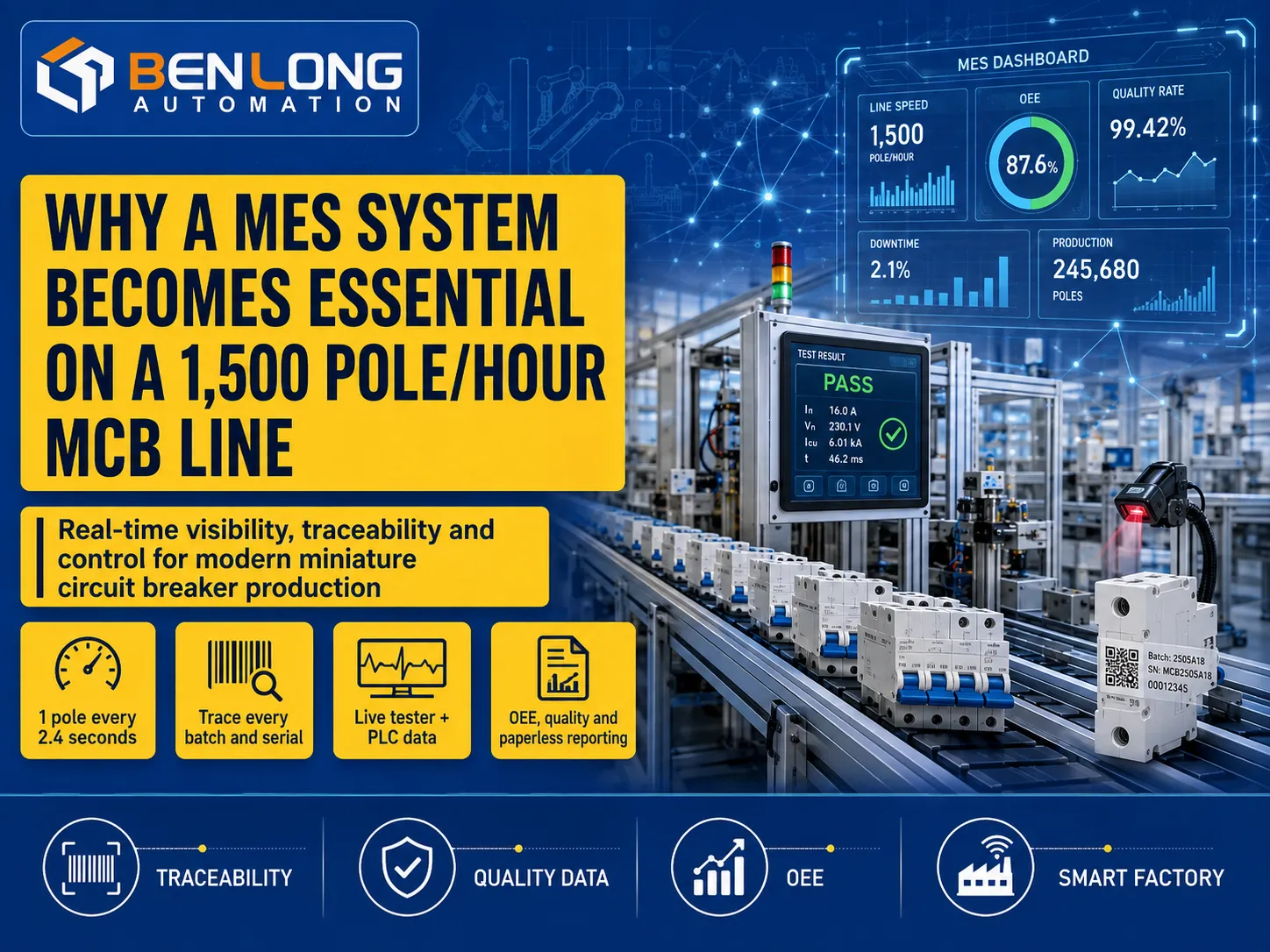
When a miniature circuit breaker production line operates at a speed of 1,500 poles per hour or more, the real issue of concern becomes not the pace at which machines operate but how fast the production facility notices, records, and reacts to what the machines are doing. With a record of about one pole produced every 2.4 seconds, this production line generates a multitude of quality events, calibration data, and testing results. Paper logs and separate PLCs cannot cope with this demand. Thus, we come to the point when the function of a manufacturing execution system turns from an optional tool used in a circuit breaker facility into an indispensable tool that becomes the foundation for the circuit breaker production process.
In this article, we describe the process of how a MES system works on a high-capacity miniature circuit breaker production line and why the production efficiency above 1,500 poles per hour makes its usage necessary. Moreover, we explain how the same approach can be applied to other low-voltage projects, such as energy meter production lines.
What a MES System Actually Does on the Shop Floor
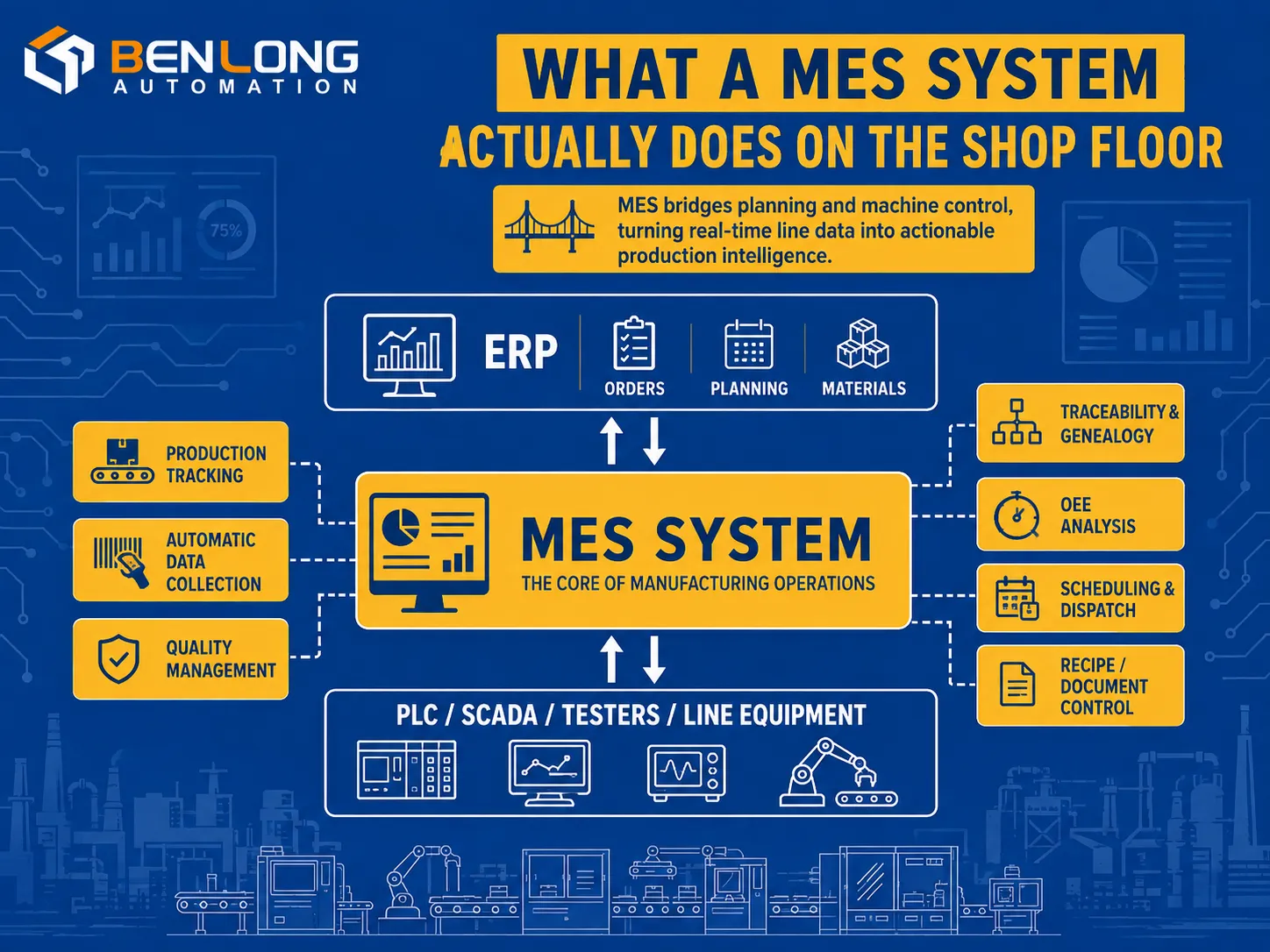
MES is the software system that exists between the level of business planning (your ERP) and the physical control level (the PLC, testers, marking stations, and motors). While the ERP system knows what needs to be produced and when, while the PLC knows how to move a cylinder or provide a test current. However, neither of these systems alone offers a factory manager a real-time picture of what is going on on the assembly line. Closing that gap is the job of the MES manufacturing execution system.
Simply put, a MES system operating an MCB line supervises numerous tasks simultaneously:
Tracking of production and display of WIP status which allows to trace any product from raw component to finished circuit breaker.
Automatic collection of data from testers, calibration tables, and vision machines, thus eliminating manual input.
Quality control and SPC, ensuring consistency of the process that is an ongoing trend to be observed instead of a result of analysis done after testing.
Traceability and genealogy, connecting materials, parameters and tests results to serial numbers and batch IDs.
Performance control, which means quality control according to OEE principles.
Scheduling and dispatching, adjusting different pole types and current ratings on the same production line.
Doc and recipe control.
Since all these functions are carried out in real time, MES system surely represents the single source of truth about what the company produces and how the testing is done. On a slower and manual line it is good practice; on a line producing 1,500 poles per hour it is the only way to keep the company in the business.
Where the MES sits: ERP, MES, and SCADA
The understanding of the three systems functioning in modern factories is important, as the systems seem to be confused a lot. The ERP layer takes care of processing orders, planning materials, and making sure finances are in order; hence it answers the question of what should be produced and when. The control layer itself can be PLC or SCADA, which is in charge of the question, “How to perform a motion or a test? The MES layer, though, is in between and answers questions about what is happening on the line at the moment and what took place in the past in the context of every unit currently being produced. This middle position of the MES is what makes it such a suitable system for the fast MCB line because ERP stands far from the manufacturing floor and is thus incapable of tracing a specific breaker produced while PLC is too focused on the upcoming cycle of the machine and lacks historical data.
Once looked at from this perspective, line equipment and software are no longer seen as separate purchases, but rather as units working together. Testing, calibration, and marking stations serve as sensors and actuators of the plant, whereas MES acts as the nervous system conveying their messages.
Why a 1,500 Pole/Hour MCB Line Needs a MES System
The throughput math makes manual tracking impossible
Operating at a speed of about 1,500 poles every hour means that one pole gets finished approximately every 2.4 minutes. The number of poles produced in one shift would sit at about 12,000 poles, and the numbers for two shifts come to more than 24,000. Under such circumstances, when defects remain unnoticed for ten minutes, about 250 poles have already been produced and already on their way. Recording such an amount of data can prove impossible; thus the “how many poles did we lose” question cannot be answered.
Unit-level traceability and genealogy
Each mini circuit breaker (MCB) has a unique tale: the series of bimetallic strips, the type of arc chute coils used, the type of silver points used, the amount of calibrations done on the machinery used to set the trip values, and the final trip time achieved. An MES allows binding all of these factors toward one serial number or batch code, something that finally provides geneology of every MCB. If there’s a complaint raised in a field by a distributor operating in India, the Middle East, or in Brazil, it only takes a look into one serial number to know the complete history of the product from its manufacture through testing to be able to act accordingly.
Turning the automatic testing line into a live data source
This is where the MCB automatic testing line becomes central to the digital picture.
Unlike typical testing lines, a MES-ready testing line sends all measured information to the software layer via OPC UA or Modbus TCP: instant tripping on curves B, C, and D, thermal calibration at 1.13× and 1.45× In, contact resistance, and vision inspection of the casing, label, and screws. Unlike the typical test, which evaluates only 5-10% of production samples, the test line keeps record of every unit in the production cycle, providing the MES with a full data record.
This allows engineers to perform true statistical process control. With information from the data acquisition system, calibration drift shows as a gradual change in the mean value far before the specifications are met. The line can be corrected during production and before the defective batch is shipped.
Real-time OEE and downtime visibility
Typically, a high-speed production line will not suffer the loss of throughput via one major breakdown. Instead, the line loses throughput through multiple small incidents. For example, at the rate of 1,500 parts per hour, a five-minute delay translates to the loss of 125 parts. AMES helps at this point by continuously calculating OEE. Virtual metrics will break down the losses into availability, performance, and quality, allowing the plant manager to see what lost time was about. At the same time, a history of two-minute stoppages at a particular station can be seen in conjunction with OEE analysis.
Quality containment and closed-loop control
When a testing condition is outside the limits and a component lot is identified as suspect, the MES can take the following actions automatically: issue an alert, quarantine the units affected, and prevent a bad batch from getting to the packaging stage. In manual operations, it depends on people noticing and retaining information. By contrast, in the MES-controlled procedures, the rule is followed with the first indication.
Audit-ready documentation for export markets
Producers of MCBs with a focus on exports rely on certifications which include IEC 60898 for MCBs which means that manufacturers need to have proof of their shipments and products. It is a standard that requires MCB manufacturers to produce documentation. With a MES, it is possible to automate reporting through computerized systems instead of searching through paper files. Audits become a database query. As a result, a user will be able to document the production and achieve success at audits.
Labor efficiency and a paperless line
There’s also a more straightforward benefit. The speed of manual data entry is extremely slow. In addition, it is prone to mistakes and it reduces morale. Operators take time to re-enter numbers that a tester has already measured. As soon as the MES starts taking this kind of data automatically, the same people can do more work on the production line and work with real issues instead of transcribing test reports. Moreover, this results in fewer mistakes. This means that data will be clearer, and since the data is clearer, it is more useful for quality processes at the plant. For a production line that produces thousands of poles each day, automation of manual logging has a significant effect, as it allows eliminating a source of human error and freeing employees for more important work.
MES on Energy Meter Production Lines
The significance of a manufacturing execution system applies beyond circuit breakers. In fact, energy meter production provides an even better example because producing meters is subject to legal metrological regulation. Each meter must be calibrated on the basis of a reference standard and must comply with certain accuracy requirements for multiple load levels. The result is substantial documentation of all calibration constants and error charts.
On a single phase meter automatic production line, a MES system captures those calibration values, error readings at each tested load point, and firmware or hardware revision, and links them to the meter serial number. The advantages are similar to that of MCB the only difference being from a legal standpoint: it offers verification traceability that fulfills the requirements of metrology authorities, batch control across firmware updates, and rapid field-return analysis. When a meter is put to question even after many years since its delivery, all relevant information pertaining to its production and testing can be retrieved simply by referencing one serial number. For a manufacturer of utility meters, the ability to audit is a matter of course and not a luxury.
Meter production also tends to be more disciplined compared to making commodity components, simply due to the fact that a firmware revision or a metering chip update can influence accuracy performance. The execution layer ensures that each batch of meters is controlled precisely so that in the event of a certain firmware version being flagged as having certain flaws, the serial numbers of defective meters can be obtained with ease rather than being hunted down. This means that a supplier can provide a metering authority or a large utility operator with full information instead of apologies.
Beyond MCBs and Meters: Other Low-Voltage Projects
The same principle of digital logic applies throughout the entire low-voltage lineup on different types of breakers. For example, MCCB, RCCB, AC contactor, surge protective device (SPD), and ACB all accumulate parametric measurement data, and unit monitoring is implemented for all of the products. Automated process controls as a part of production also indicate the delivery of products of impeccable quality. A similar argument can be made whenever a production line gains significant speed, or the safety of the manufactured units depends on the results of measurements.
What to Look for in MES System Software
Not every deployment needs the largest platform on the market. What matters is fit with the line and a clean path for the data. When evaluating manufacturing execution system MES software for a low-voltage plant, a few practical points carry most of the weight:
- Advantages of connectivity: OPC UA and Modbus TCP mean that equipment can get real-time data, and SQL or CSV means that it can send reports.
A unit can be easily identified, either by barcode or laser marking, or even RFID technology. This ensures that record-keeping is made easier.
A modular rollout allows clients to start with data collection and traceability, then add scheduling and OEE dashboards.
The integration with existing ERP systems helps with production orders and helps track product completion.
The important point is that the shop floor will get dashboards that it will actually use, not just reports for management.The one important decision is making sure that manufacturing execution systems are ready before installation. New production lines that have MES-compatible data acquisition systems, appropriate protocols, and proper tagging would be ready in a matter of days. However, already built production lines with strict testing processes would require much more work to be adapted.
A Phased Approach to MES System Implementation
The prospect of connecting an entire plant can make a MES system implementation feel like an all-or-nothing project, but it does not have to be.The best way to achieve the most successful deployment is to start small and to grow your implementation over time. For instance, the main steps in the implementation of a low-voltage
manufacturing process include:
Automatic data collection and traceability on the testing line; this is where the biggest return is
expected, and where the data is already being provided.
Once the data is available, the implementation of statistical process control and OEE dashboards
needs to take place.
After the previous steps are accomplished, it is important to implement scheduling, recipe
management, and much more, in order to improve the overall production process.
Finally, the implementation of ERP is necessary to ensure that the data travels back to the
system.
Benefits of this sequence should be obvious; the more expensive and complex things should be
implemented first and only then the other steps should be taken. The only difficulty will be to
obtain all equipment that will be necessary for this process in the beginning, as otherwise, it would
be necessary to refit the equipment later.
Conclusion
Once production levels exceed 1,500 poles in one hour, it is not just about speed anymore; it is about uncontested, monitored speed. A MES system is what transforms unprocessed throughput into reliable, auditable, and evaluable data. It registers every item, turns an automatic testing line into a real-time sensor of quality, reveals losses that decrease the efficiency of fast production; and it provides certification data required by export markets. The same platform allows reaching energy meters, MCCB circuit breakers, contactors, and others. If a company aims to gain competence in low-voltage automation, it needs the MES system as a key not an additional solution.
Huang Xiaolei | Benlong Automation