benlong
Top Machinery Electrical Work Companies in the World
You may picture a semiconductor plant in Arizona, a steel mill in Brazil, or a metro in Singapore. But one might wish to ask who designed the drives, switchgears, robotics, and control devices used in these places. In fact, the operations of manufacturers of electrical equipment make the functioning of these industries possible – they develop and produce motors, inverters, programmable controls, and electric devices that convert electricity into some sort of machinery. Some of them are known and constantly in the news while others remain silent being unaware of the world of computer technology.
In this respect, this article offers a ranking of the biggest and the most powerful electrical engineering companies, giving their descriptions of their origin and production capabilities.
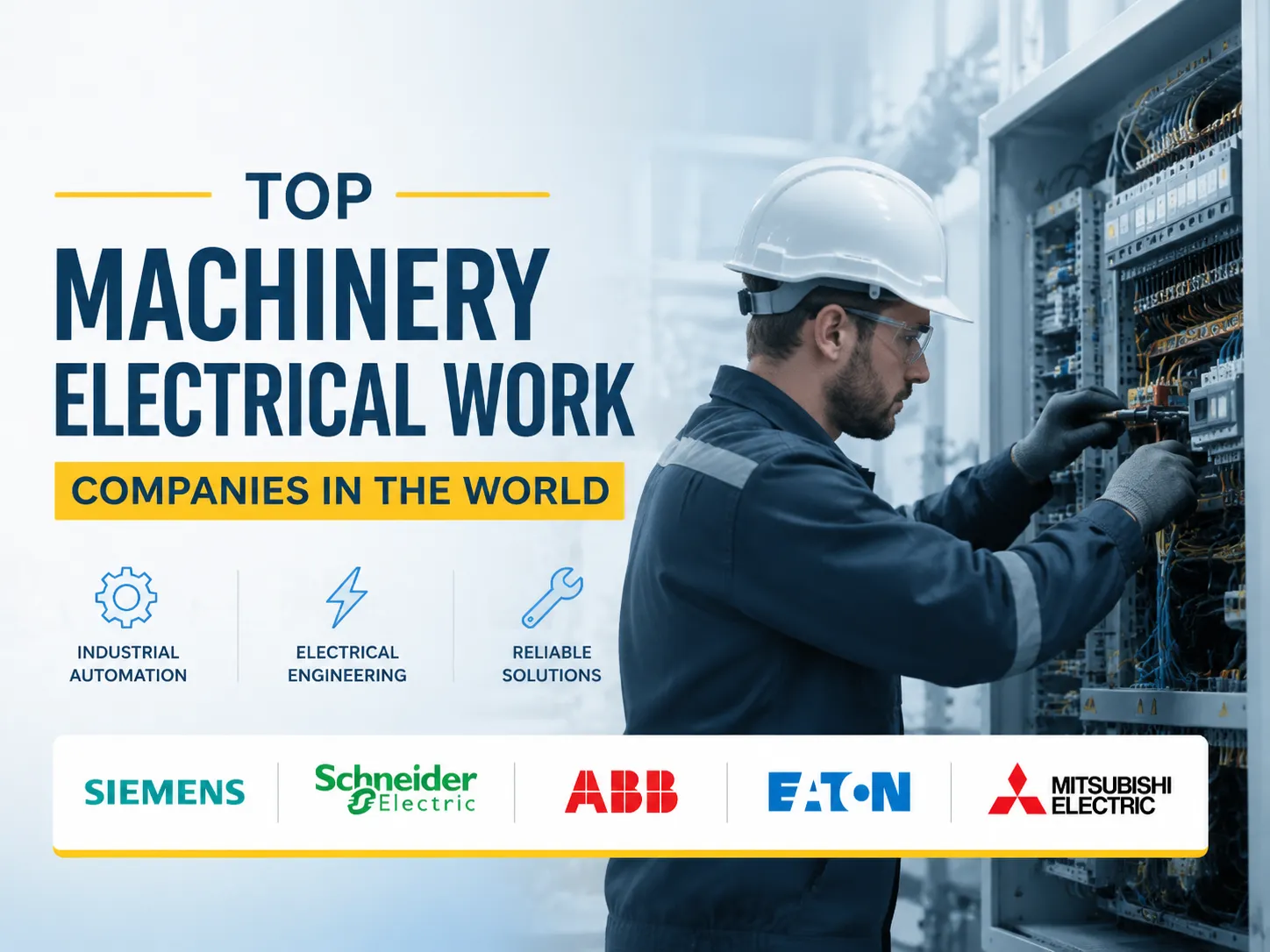
Siemens from Germany and ABB from Switzerland are the correct answers as these are the largest companies engaged in manufacturing electrical equipment. They are not alone since the companies from Schneider Electric, Hitachi, GE Vernova, Mitsubishi Electric, Emerson, Rockwell Automation, Honeywell, and Panasonic and Mitsubishi Heavy Industries are all involved in the same business.
What Counts as a Machinery Electrical Work Company?
Clarification of the term is needed before benchmarking, as the term “machinery electrical work” can have several meanings. The term can be used to describe three different activities within the noviation industry:
- Manufacturers of electric machinery i.e. firms that produce electrical machines such as electric motors, generators, transformers, switching devices and controlling devices, which characterizes the term “machinery”.
- Automation experts i.e. firms that provide PLC, DCS systems, robots and sensors and software for control of machinery process.
- Electric contractors and EPC companies, which implement and traveled electrical installations and maintain them on the site.
The companies included in the ranking below belong mainly to the mentioned above first two groups, as they have service divisions covering the third group. The common feature of those companies is that they are able to control motion due to electricity, which makes them electric and mechanical engineering companies (E&M) in the view of engineers. For a deeper look at how these companies’ products come together on factory floors — from automated assembly to testing — our overview of industrial automation efficiency benefits shows what the end result looks like in practice.
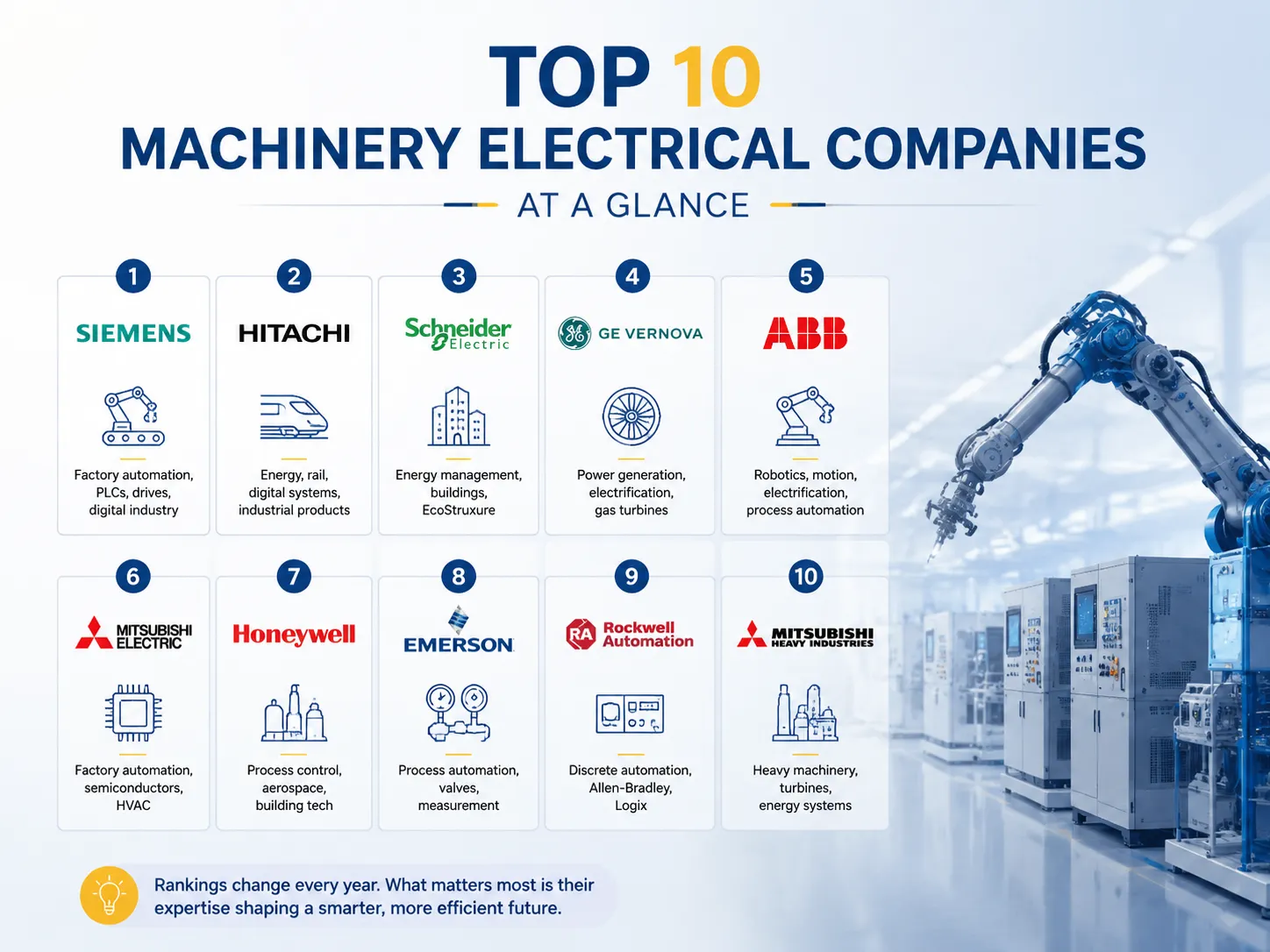
The Top 10 Machinery Electrical Companies at a Glance
| Rank | Company | Country | Approx. Revenue | Employees | Core Strength |
|---|---|---|---|---|---|
| 1 | Siemens | Germany | €78.9B (FY2025) | ~320,000 | Factory automation, PLCs, drives, digital industry |
| 2 | Hitachi | Japan | ~$85B | ~300,000 | Energy, rail, digital systems, industrial products |
| 3 | Schneider Electric | France | €40.15B (2025) | ~135,000 | Energy management, buildings, EcoStruxure |
| 4 | GE Vernova | USA | ~$35B | ~80,000 | Power generation, electrification, gas turbines |
| 5 | ABB | Switzerland | ~$37.5B | ~105,000 | Robotics, motion, electrification, process automation |
| 6 | Mitsubishi Electric | Japan | ~$36B | ~145,000 | Factory automation, semiconductors, HVAC |
| 7 | Honeywell | USA | ~$38B | ~95,000 | Process control, aerospace, building tech |
| 8 | Emerson | USA | ~$17.5B | ~87,000 | Process automation, valves, measurement |
| 9 | Rockwell Automation | USA | ~$8.3B | ~29,000 | Discrete automation, Allen-Bradley, Logix |
| 10 | Mitsubishi Heavy Industries | Japan | ~$32B | ~80,000 | Heavy machinery, turbines, energy systems |
It should be pointed out that every year there are changes in order due to currency exchange rates and divestitures. For example, ABB divested its divisions and GE became three independent companies in 2024, with GE Vernova performing power activities. More important than knowing where exactly the companies stand is the understanding of what specializations they have, which will be the content of this article.
1. Siemens (Germany) — The Global Benchmark in Factory Automation
Country: Germany | Revenue: €78.9 billion (fiscal 2025) | Employees: ~320,000
On this planet, Siemens is regarded as the most comprehensive electric machinery and automation business. Established in Berlin in 1847, it developed from a telegraph workshop into a corporation that touches healthcare, transport, buildings, and many other industries. Digital Industries that deal with PLCs, CNC systems, drives, and TIA Portal engineering, as well as, Smart Infrastructure that handles switch-gear, low-voltage distributing, and building automation are two major departments of the company.
Known projects include Siemens’ provision of automation for the Singapore MRT rail network, control systems for multiple car manufacturing plants, and digital twin implementation, like the Amberg semiconductor factory in Germany.
Importance: In the event that your project involves the need for global controls standardization, Siemens is a best choice, as the S7 PLC line of products has about 25% of the global market and more than 39% of the Chinese market.
2. ABB (Switzerland) — Robotics and Power Technology Leader
Country: Switzerland | Revenue: ~$37.5 billion | Employees: ~105,000
The establishment of ABB occurred in 1988, originating from the merger of ASEA from Sweden, established in 1883, and Brown, Boveri & Cie from Switzerland, founded in 1891. It leads the world in manufacturing industrial robots and driving systems, being the market leader in HVDC transmission.
Prominent implementations: ABB robots are responsible for the assembly of the car body of practically all major automobile manufacturers, thus securing its position of a 28% market share in automotive robots; HVDC systems ensure linking offshore wind sources to the electricity grid in North Sea; and the collaborative robot YuMi performs joint operations with workers at electronics assembly lines worldwide.
Importance of being significant: When it comes to robotics, adjustable-speed drives, engines and electricity, ABB is the first company to be taken into account by customers.
3. Schneider Electric (France) — Energy Management and Buildings Champion
Country: France | Revenue: €40.15 billion (2025) | Employees: ~135,000
In the year 1836, Schneider Electric was founded as a company specializing in steel and weapon manufacturing and changed its specialization to electrical distribution after World War 1. Nowadays, the company is the pioneer in management of energy and industrial automation in the field of construction, data centers, and infrastructure with its wide variety of products such as MCBs, distribution boards, middle voltage switchgear, and EcoStruxure platform software. According to its 2025 financial report, Schneider Electric’s revenue has increased by 5.2%, which is now €40.15 billion, where €33.1 billion accounts for revenue from energy management, proving that the company is a leader in low-voltage and energy sectors of the economy.
Key projects: Schneider Electric is wide spread in the area of distribution equipment applied in hyperscale data centers, smart buildings in new business districts of India, and electric power grids in more than 100 countries.
Importance explanation: In the event you work with power distribution, panel construction, and building energy efficiency issues, Schneider is the best choice due to the ready-to-use nature of the technologies suggested by the company and its specialized panel-building partners.
4. Hitachi (Japan) — Rail, Energy, and Digital Systems Heavyweight
Country: Japan | Revenue: ~$85 billion (FY2024) | Employees: ~300,000
Founded in 1910, Hitachi is Japan’s largest conglomerate and one of the largest electrical engineering companies in the world. Its portfolio today includes digital systems, rail transport, energy systems, and connectivity systems such as its latest acquisition of ABB Power Grids, now called Hitachi Energy. Due to this development, Hitachi became one of the three largest companies in the power grid industry and the industry of transformers and HVDC.
Successful projects: Hitachi provided trains for the UK rail service. It is also known for building the largest energy storage systems in Australia and in Europe and Asia, initiating their grid interconnection.
Importance of the issue: Today, Hitachi Energy is the lead brand in the field of transformers and substations as well as rail electrification systems.
5. GE Vernova (USA) — Power Generation Specialist
Country: USA | Revenue: ~$35 billion | Employees: ~80,000
In April 2024, General Electric divided into 3 companies; its part dealing with power generation was named GE Vernova, bringing together gas turbines, steam turbines, wind turbines, and grid electrification. Though it does not sell the classic GE industrial controls portfolio (which is now part of the aerospace-focused GE Aerospace and other companies), Vernova is the main supplier of diesel generators globally and is among the top producers of grid equipment.
Fascinating projects: GE Vernova supplies HA classes of gas turbines (the largest and most efficient in the world) to power plants in the USA, and its land and maritime wind generators are used worldwide.
Why it is important: For power generation on the level of power plants and connection to the grid, GE Vernova is one of the few companies that have the human resources to construct complete plants.
6. Mitsubishi Electric (Japan) — Factory Automation Powerhouse
Country: Japan | Revenue: ~$36 billion | Employees: ~145,000
Mitsubishi Electric, which has been around for more than 100 years since its inception in 1921, is well regarded in manufacturing for its acquisitions in Factory Automation with the MELSEC family of PLCs, servo drivers, CNC machines, and industrial robots that compete with Siemens and Rockwell in discrete manufacturing.
Well-known projects: Mitsubishi Electric makes robots and CNC machines for many injection molding and machining lines in Asia, and its lifts and building systems serve the tallest structures on earth.
Importance: Mitsubishi Electric delivers great prices for motion control and fast automation in Asia with its integrated servomechanisms.
7. Emerson (USA) — Process Automation and Measurement
Country: USA | Revenue: ~$17.5 billion | Employees: ~87,000
Founded in 1890, Emerson is a force to reckon with in process automation due to its Fisher valves and Rosemount instruments. The company entered new territory by acquiring AspenTech and NI respectively.
Successful projects: DeltaV systems have played a vital role in running some of the iconic LNG facilities across the globe, while Emerson’s instruments have been part of almost every major refinery project in the last 20 years
The significance of the company: If your “machinery” comprises of pumps, valves, reactors, and similar devices, Emerson can support you in measurement and control.
8. Rockwell Automation (USA) — The Discrete Manufacturing Specialist
Country: USA | Revenue: ~$8.3 billion | Employees: ~29,000
Known for its former name Allen Bradley, Rockwell Automation is the leader in the automation industry, especially in North America. As the manufacturer of Logix PLC technology, PowerFlex drives, and FactoryTalk software, Rockwell has become a leading supplier of the technologies used in manufacturing equipment for the automotive industry, the food and beverage industry, and material handling equipment. Although its total revenue doesn’t equal that of the industry giants, the company occupies a strong market position in the USA.
Popular case: Rockwell is responsible for supplying automation technologies for most of the beverage bottling enterprises in North America and a considerable number of vehicle manufacturing plants in the Midwest part of the country.
Why it is important: Rockwell Automation is a top choice for the American manufacturers of industrial equipment since it provides its customers with support, spare parts, and the solutions of engineers in the USA.
9. Honeywell (USA) — Process Control and Safety Systems
Country: USA | Revenue: ~$38 billion | Employees: ~95,000
The Honeywell product line encompasses aerospace activities, building systems, and process control (Experion DCS) along with industrial safety solutions. Following its break-up in 2025, the division focusing on automation and energy area within the group (Honeywell Automation) is still active in controlling refineries, warehouses, and office buildings through the usage of various controllers and sensors, and corresponding robotics for warehouses.
What has been done: Honeywell systems are responsible for automating the processes at the largest warehouses in the world and controlling process safety systems at big chemical plants and refineries.
Importance: The previous performance and SIL certifications of the company make Honeywell a reference in the area of process control in safety-critical applications.
10. Other Regional Giants Worth Knowing
Beyond the top nine, several regional champions deserve a place on any buyer’s shortlist:
| Company | Country | Why It Matters |
|---|---|---|
| Mitsubishi Heavy Industries | Japan | Turbines, compressors, ship machinery — heavy equipment specialist |
| Fuji Electric | Japan | Drives, power semiconductors, distribution equipment |
| Yaskawa Electric | Japan | Servo drives and robots (the Motoman brand) |
| WEG | Brazil | Motors, drives, and transformers — Latin America’s champion |
| Nidec | Japan | World’s #1 motor maker (small and precision motors) |
| Phoenix Contact / WAGO / Weidmuller | Germany | Industrial connectivity, terminals, and automation components |
| Eaton | Ireland/USA | Power distribution, UPS, and industrial controls |
| China’s CHINT / Delixi / Huyu | China | High-volume LV equipment — breakers, contactors, switchgear at factory-direct prices |
This final category mentioned is arguably more critical than most purchasers understand: while the large corporations are responsible for the most exclusive and safety-sensitive segments across the globe, Chinese manufacturers are supplying the most amount of low-voltage equipment (MCBs, MCCBs, contactors, ATS units, and distribution boards) in the world manufacturing process and selling it at 30-60% lower prices than comparable products from the European and Japanese companies, which are also certified by IEC and CE. This serves as a typical example of “right-sizing the supplier”: while the data center in Frankfurt requires Schneider, the project of building houses in Nairobi or exporting a machine from Mumbai can choose similarly-certified equipment provided by a Chinese company and spend just a small portion of the money.
How to Choose Between These Companies
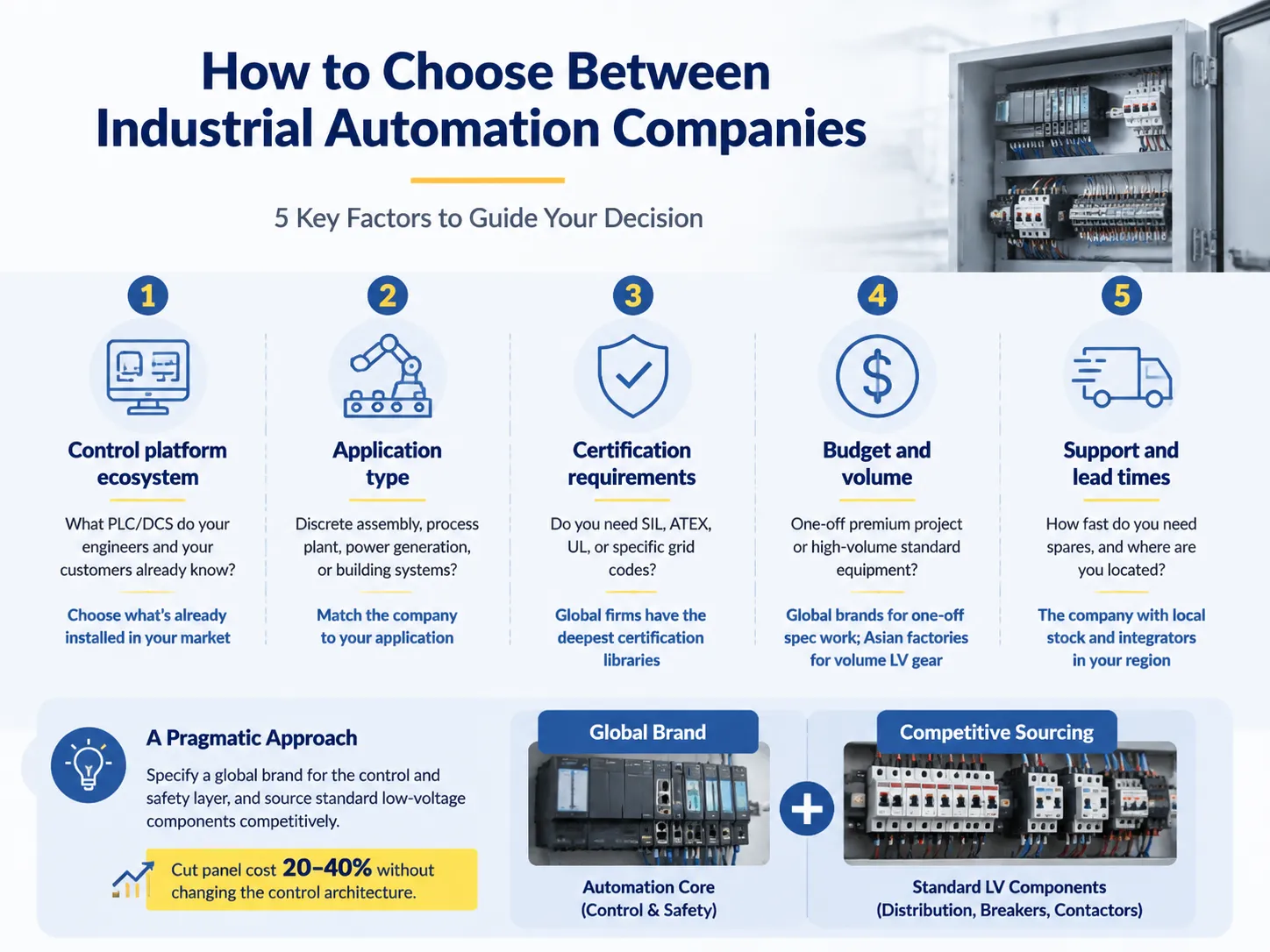
Because all of these firms are competent, the decision usually comes down to five practical factors:
| Factor | What to Ask | Who Usually Wins |
|---|---|---|
| 1. Control platform ecosystem | What PLC/DCS do your engineers and your customers already know? | Whatever is already installed in your market (Siemens in EU, Rockwell in US, Mitsubishi in Asia) |
| 2. Application type | Discrete assembly, process plant, power generation, or building systems? | Rockwell/Mitsubishi (discrete), Emerson/Honeywell (process), GE Vernova (power), Schneider (buildings) |
| 3. Certification requirements | Do you need SIL, ATEX, UL, or specific grid codes? | The big European/US firms have the deepest certification libraries |
| 4. Budget and volume | One-off premium project or high-volume standard equipment? | Global brands for one-off spec work; Asian factories for volume LV gear |
| 5. Support and lead times | How fast do you need spares, and where are you located? | The company with local stock and integrators in your region |
Usually, the approach that the majority of builders of plants adopt is to choose a recognized brand as the brand of the control and security elements, while purchasing the components with the lowest standards available, regardless of what suppliers are chosen. For instance, the control center could be produced by Siemens or Rockwell, while most of the components within the construction would be made by a reputable manufacturers of high production scale. This division of components leads to savings in the construction price ranging from 20 to 40%.
What Do Machinery Electrical Services Cost?
Costs vary enormously by region and scope, but buyers often ask for benchmarks, so here are typical 2025-2026 figures:
| Service | Typical Rate / Range | Notes |
|---|---|---|
| Commercial/industrial electrician (hourly) | $50-$150/hr (US); €40-€90/hr (EU) | Journeyman rates; specialists cost more |
| Industrial automation engineer (hourly) | $90-$180/hr | PLC programming, commissioning |
| Panel building (per low-voltage panel) | $2,000-$25,000 | Depends on breaker count, brand, and features |
| Complete production line automation (per line) | $50,000-$2,000,000+ | From semi-automated cells to full turnkey |
| Robotic cell integration | $80,000-$500,000 | Robot + cell + safety + programming |
| Site electrical installation (commercial fit-out) | $8-$25 per sq ft | Wiring, lighting, panels, rough-in |
Two honest observations for buyers: first, the highest-paid electricians in the industry are industrial automation technicians — top PLC programmers and robotics engineers can bill $100-$200+/hr or earn $100k-$150k+ salaries, far above typical commercial electricians ($50-$80/hr). Second, the biggest single cost driver in automation projects is engineering and commissioning labor, not hardware — so partnering with a manufacturer that provides complete production solutions (like those used on MCB and MCCB assembly lines, covered in our circuit breaker manufacturing automation guide) can compress project timelines meaningfully. If you are weighing whether to automate at all, our automated vs manual testing payback analysis and the plant shutdown checklist provide the numbers and practical steps to plan the transition.
Frequently Asked Questions
How much does a commercial electrician cost per hour?
In the United States, licensed commercial electrical engineers usually take $50-$150 an hour based on the area. Journeymen make around $50-$90 and master electricians or specialized ones charge $100 or more. The average hourly wage is around €40-€90 in the UK and EU. Most contractors also charge a call out or service fee for minor jobs.
What are some examples of electrical machinery?
Electrical machines include electric motors, generators, transformers, switchgear and circuit breakers, variable frequency drives, servo systems, robots, PLCs, CNC machines, and electric actuators. In simple terms, the electrical machinery is any machine used to transform electricity into power either through motion or the management of electrical power.
What is the highest paid electrician?
The industrial automation and control technicians form the highest-salaried category of electrical specialists that include PLC programmers, robotics engineers and substation technicians among their number and would make a yearly income between $90,000 and more than $150,000 or would charge $100-$200/hour for their services. Linemen furthering their work in high-voltage transmission are also put in the highest salary category winner (earning around $80,000-$130,000+), especially when working overtime as storm restorers.
Who is the biggest electrical contractor?
In terms of revenues, the biggest electrical contractors are Quanta Services and EMCOR Group, both US-based companies with revenues between $15 billion and $20 billion, followed by Rosendin Electric and Faith Technologies. Note that these companies are different from the manufacturers listed above because while manufacturers produce equipment, contractors install that equipment.
References
- Fortune Global 500 2025 — Electronics & Electrical Equipment industry ranking
- Schneider Electric 2025 full-year results announcement
- Siemens fiscal 2025 annual report
- ABB Group corporate profile and business areas
- Hitachi corporate profile and Hitachi Energy
- GE Vernova corporate overview
- Rockwell Automation company profile
- Emerson Electric business segments
- Fortune Business Insights — industrial automation market size
Conclusion
Different global electric machinery companies possess different structures according to what they do. Siemens is in the lead in the field of factory automation and PLCs, ABB is the largest company in the robotics and electrification industries, Schneider stands for energy management, GE Vernova is responsible for the proper operation of the grid, Hitachi and Mitsubishi produce the equipment necessary to make Japanese industries function, while Emerson, Rockwell, and Honeywell are involved in the process and discrete control systems in North America. All second-tier companies — high-capacity plants working in China — produce circuit breakers, contactors, and switchgear, which are managed by main corporations.
This means prevention of comparing “brands” and focusing on matching the control platform with the working environment of the engineers, checking certification levels required for application, and then searching for the manufacturer able to deliver products corresponding to this level of quality. When you plan the line itself and the corresponding automated systems for assembly, testing, and inspection, the same logic of obtaining the right match should be applied.