benlong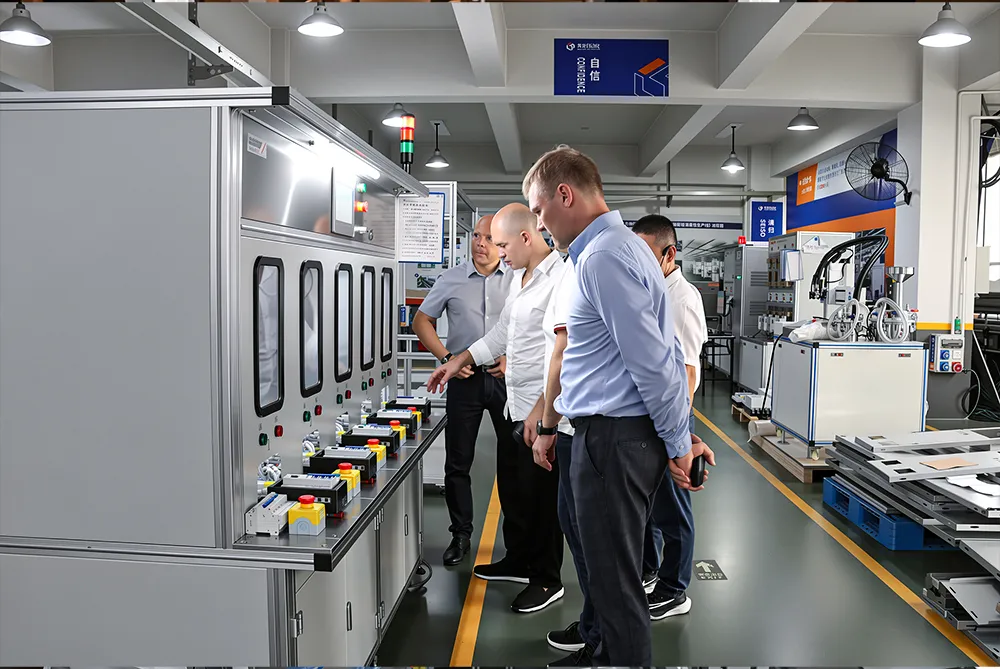



Commercial Electrical Contractors Near Me
The search term “commercial electrical contractors near me” generally holds two significant meanings. This may imply that you have an electrical issue that requires fixing right away or you are working on a big project such as building, upgrading the circuits, or rewiring the electric system, and you simply want a good professional who has background knowledge about the work that has to be done on something far more advanced than residential power system.The sector of commercial electrical work is completely different from that of home electrical work: you will be faced with three-phase electrical supply, 208/480 voltage systems, higher voltage panels, complex permits, and insurance requirements and thus the choice of contractor may make the difference in the success of your business system, its safety, compliance with the regulations, and prices for the services.
Essentially, commercial electrical contractors are essential for deciding the electric system configurations, installations and designs of commercial and industrial buildings. The tasks may include electric energy distribution, three-phase and 480-volt systems etc., electricity safety systems installation and other tasks of this kind. It is also important to note that commercial electrical contractors charge more as compared to residential electricians because of their work complexity. This shows how to choose commercial electrical contractors based on their experience: 10 years of experience along with numerous local skills is a decisive factor in the process of making the decision.
What Is a Commercial Electrical Contractor?
Commercial electrical contractors are licensed electrical firms that work on commercial, institutional and industrial customers instead of residential customers. The main difference between the two is in the size of project: commercial projects work with higher voltages (typically 208V, 480V, or three-phase), larger loads, distribution system, codes, and insurance liabilities. Commercial contracts are required to have a appropriate business license (C-10 in California or contractor license in other states), have high level of insurance (usually above $1 million of liability insurance), and employ electricians trained and certified for commercial and industrial work since the four electrical profession types (apprentice, journeyman, master, and specialist/industrial) are employed in the commercial job settings frequently under supervision of the master electricians.
Services Commercial Electrical Contractors Provide
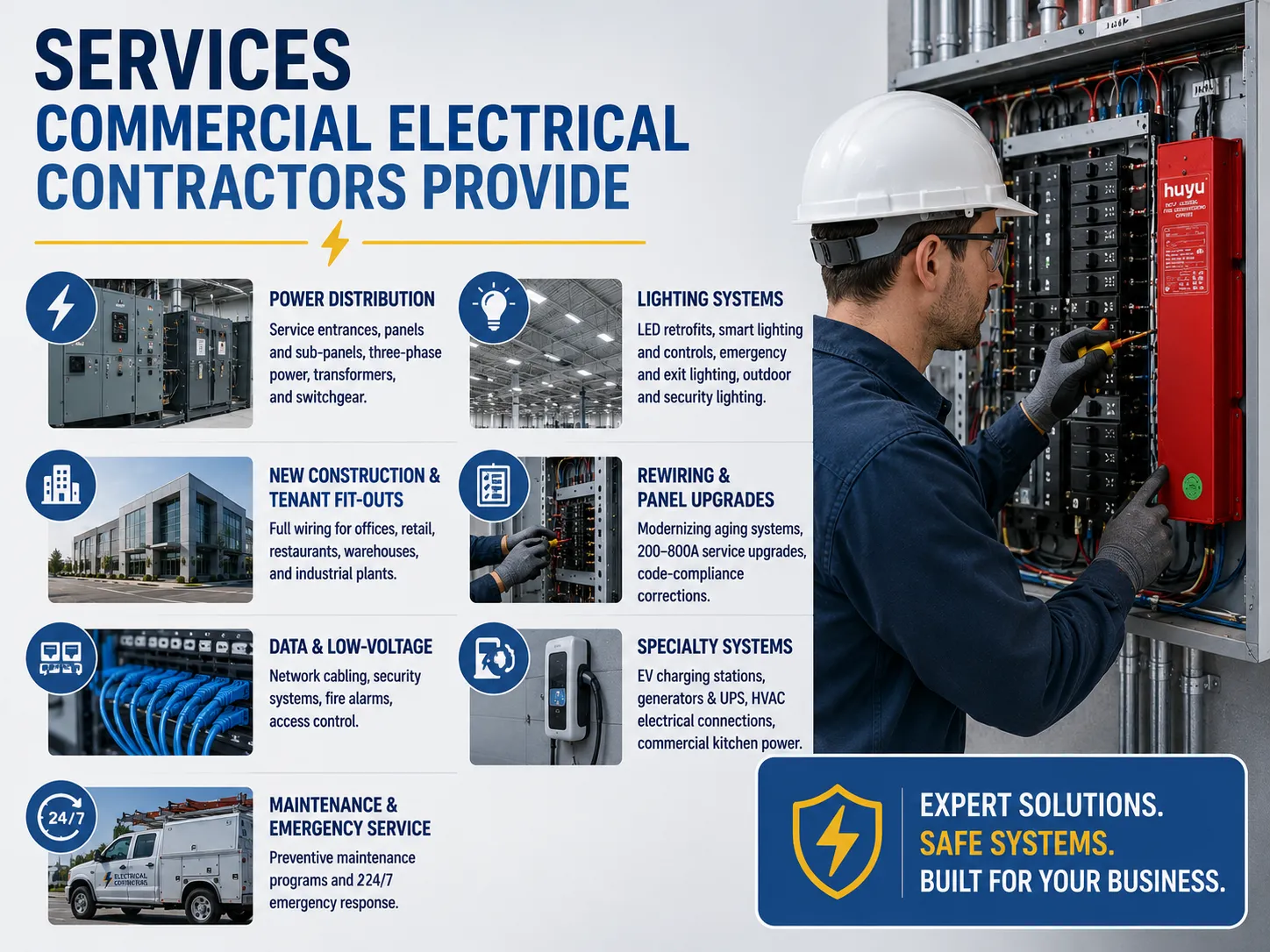
- Electricity distribution systems — including service entrances, substations, public winding, transformers, and switching devices.
- Lighting systems comprise — the previous generation of devices, smart lighting systems and lighting controls, emergency, and exit lightings, outside lighting, and security lighting systems.
- New constructions and tenant fit-outs — installation of any kind of wiring for offices, shops, restaurants, storage facilities, and industrial sites.
- Service upgrade and rewiring — modernization of obsolete systems.
- Data and low voltage — cabling for communication purposes, protection systems, smoke safety systems, and access control systems.
- Special systems including — EV charging systems.
How Much Commercial Electrical Work Costs (2026)
| Service | Typical Cost (2025-2026) |
|---|---|
| Apprentice electrician (hourly) | $50-85 |
| Licensed commercial electrician (hourly) | $80-150 |
| Master electrician (hourly) | $120-250+ |
| Commercial wiring installation | $4-8 per linear foot (specialized up to $15) |
| Commercial wiring per square foot | $4-10 per sq ft standard; $15+ for data-center-level |
| Electrical panel upgrade (200A) | $1,500-5,000 |
| Heavy-duty commercial panels (400-800A) | $5,000-15,000+ |
| Lighting fixture installation / LED retrofit | $100-400 per fixture |
| Full commercial rewiring | $8,000-50,000+ (small spaces $10,000-25,000) |
| Emergency call-out | $150-300 dispatch + labor |
| EV charger installation | $750-2,600 per station |
Regional deltas are a reality: labor on the West Coast of the USA is estimated at up to 6-12% above national average, while labor costs in the Southeast could be 3-8% below. Furthermore, prices of commercial services usually range from 20% to 50% higher than the residential counterparts. In addition, material cost is 20-40% on top of the cost established for labor, and contingency covers unexpected conditions at 10-20%. When budgeting for the entire project be sure to ask for itemized pricing – which should include labor cost, material costs, permit cost, and assistance during any emergencies.
United States: National and Regional Leaders
The U.S. market is served by a layer of national specialty contractors and many regional contractors. The prominent names that play a big role in electrical work in terms of commercial and industrial include the following:
- EMCOR Group — the largest specialty contractor in the U.S. by revenues; full electrical and mechanical scope services and other facilities services and a national footprint; a benchmark in commercial and healthcare projects as well as data centers.
- Rosendin Electric — one of the largest employee-owned electrical contractors in the U.S.; being active in commercial, industrial, renewable energy, and mission-critical work across the whole country.
- M.C. Dean — specialist leader in mission-critical and government projects implementation; covering data centers, secure facilities, transportation, and complex power systems.
- Quanta Services — the giant in electrical infrastructure projects implementation; being engaged into transmission, distribution, renewable interconnections, and utility activities at the national level.
- MYR Group — one of the best electrical contractors in such areas as transmission, distribution, and commercial/industrial.
For the majority of companies, the ideal approach consists in the cooperation with a regional contractor that has a local license and local teams as well as appropriate connections in the region. National contractors cope with the bigger projects that require more than regional capabilities. In every large metro area (i.e. New York, Chicago, Houston, Los Angeles, Seattle, Atlanta, etc.) commercial electrical contractors with several decades of proven experience would be the usual practice. Directories and associations (i.e. NECA and IBEW chapters) can be used to find them.The same local-first logic applies on the manufacturing side — our company profile explains how a factory-direct automation supplier works with contractors across regions.
Canada: Regional Contractors
Canada has a solid provincial contractor base, who are normally licensed to provide services within their respective provinces and are often affiliated with unions. Specifically, Blais Electric (Guelph and Ontario’s Tri-Cities), provides commercial construction services with costs of about $85-125 hourly rate, minimum service calls of about $200-250, costs for panel upgrades of about $2,500-4,500, costs of rewiring at $4-9 psf for new construction and $5-17 for existing buildings and a full range of services provided with regard to tenant improvements and commercial kitchen as well as electrical vehicle charging. Overall, the Canadian market is represented by various subjects, company-wise each complying with the described model with a proper licensed provincial contractor and per-square-foot pricing for projects taking place.
Europe and the Middle East: Key Players
The electrical contracting industry in Europe combines national engineering companies and local certified electricians (every country has its own rules for electrical work hence compulsory certification and registration). The leaders of the electrical contracting market:
- SPIE and ENGIE Solutions (France) — providing multi-tech services including electrical installation and maintenance in commercial and industrial facilities throughout Europe.
- Equans (France, previously the Engie subsidiary) — offers energy services and management of technical facilities and has an extensive electrical contracting sector in Europe.
- Siemens Smart Infrastructure and Schneider Electric (Germany and France) — not contractors in the typical sense, but they are the biggest suppliers of electrical systems, panels, controls, installed by other small contractors.
- Local registered contractors — JIB registered electricians and NICEIC approved contractors in the UK, Meisterbetriebe in Germany, and licensed companies with a specialization in energy efficiency in the Scandinavian countries and the Netherlands.
In the Middle East (UAE, Saudi Arabia, Qatar), there are big international electrical contracting and MEP companies, often the same as those that work in the world market (e.g. Emcor Group operates worldwide, while major regional players from Saudi Arabia are engaged in very large projects — known as giga-projects) thus the prices in this region depend on the salaries of foreign workers and the demand for mega projects.
Asia-Pacific: The Industrial Electrical Market
In Asia-Pacific, electrical work is predominantly industrial and infrastructural. The principal electrical contractors in Japan, namely Kinden, Nippon Engineering Consultants, and the electrical divisions of keiretsu groups, cater to factories and commercial buildings with exceptional standards of excellence. While the electrical engineering sector of South Korea is taken over by its conglomerates, electrical infrastructure in China relies on huge provincial power and electrical companies which conduct massive commercial and industrial installations with combined manufacturing competence in automation technologies including the production equipment suppliers such as benlongkj. In Southeast Asia (Singapore, Malaysia, Vietnam) an array of international and domestic licensed contractors work on commercial projects and industrial parks with labor expenses significantly lower than in the western part of the world, although building codes are undergoing strict improvement. The criteria for choosing contractors include licensing, insurance, project experience and references, which remain the same as in other parts of the world although prices may vary significantly.
How to Choose the Right Contractor
The selection checklist that separates a good commercial electrical contractor from a bad experience — and the same discipline applies when you are evaluating the factories behind the components, as our automated production line buyer’s guide explains:
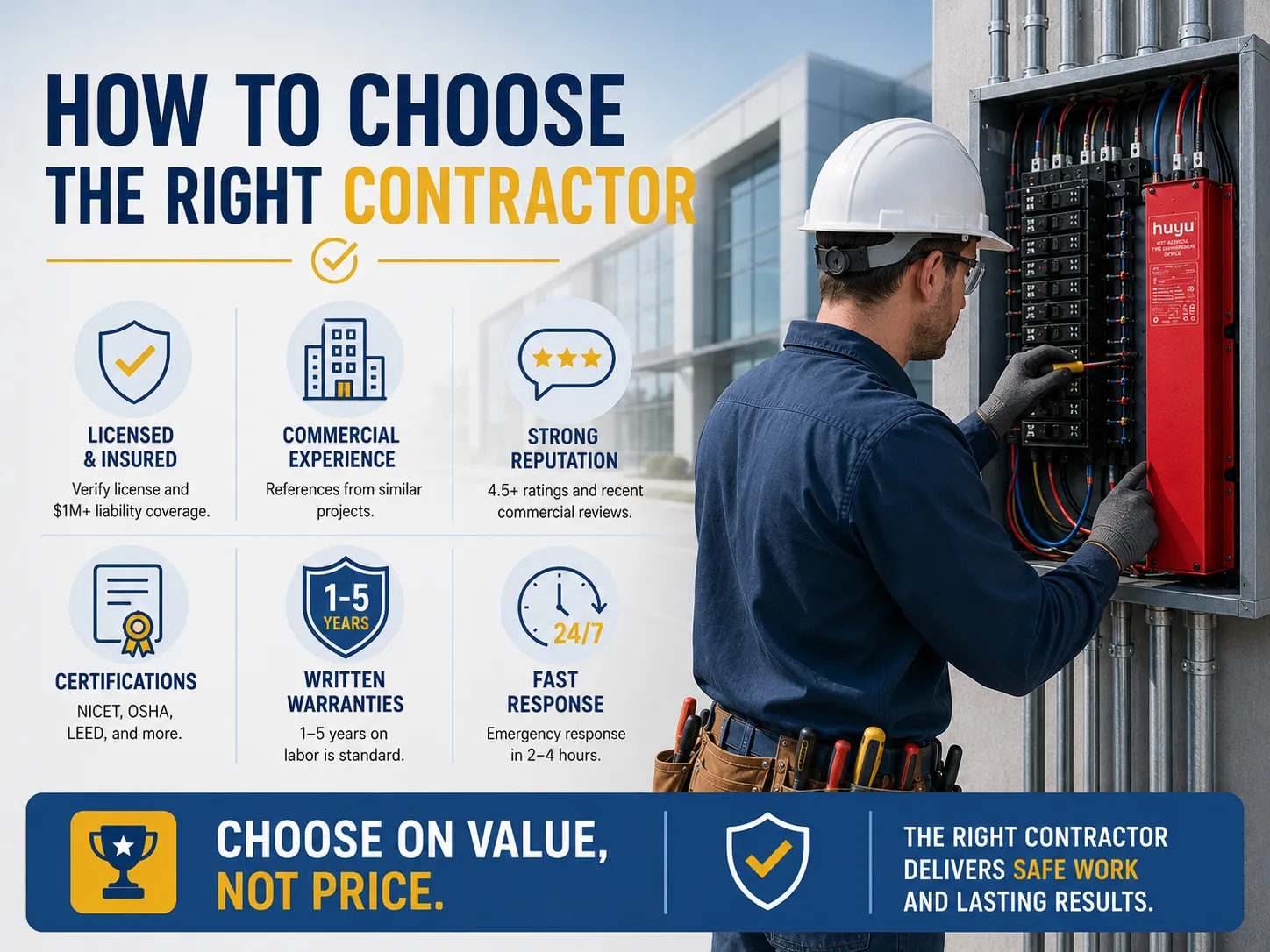
- Insurance and licensing: check provincial/state licensing (for example, C-10 in California), general liability insurance of at least $1 million, and workers’ compensation insurance. A contractor that is unlicensed or under-insured can be a risk, rather than a bargain.
- Commercial job experience: Ask for references of 3 to 5 jobs of the same type and size. A contractor who is an expert in restaurant kitchens, data cabling, or three-phase industrial jobs will be different compared to a contractor who is an expert in office fit-outs.
- Ratings and reviews: Look for ratings of at least 4.5 in Google or BBB ratings and reviews for recent commercial (not residential) jobs.
- Certifications: NICET certification (fire alarm/security) and OSHA safety training, as well as LEED certification for green jobs are indicative of a knowledgeable professional.
- Written warranty: A standard warranty for works would be 1 to 5 years.
- Emergency services: Reputable firms guarantee their presence within 2 to 4 hours after being contacted in case of commercial emergencies.
- Transparent pricing: look for itemized quotes featuring measure of labor to be done, a breakdown of materials to be used and permits as well as added costs accounting for possible extra works.
- Number of quotes — gather 3 to 5 propositions, but base your final choice on the check list, as the least expensive quote is often the most costly by the time the hire is completed.
Red Flags and Contract Essentials
Stay away from any contractor who doesn’t have any contracts or clear prices; doesn’t have a contractor’s license or proof of insurance; wants to add expensive features without knowing your needs; leaves the work to unlicensed labor; or can’t communicate well. A commercial electric contract includes the nature of the work, material and equipment (brand of the panel or breaker), when it will be done, necessary permits and inspections, warranty, and payments. The same standard should apply to the equipment used for the work, since the inspectors and insurance companies will deal with the breakers, panels, and controlled devices for years.
The Equipment Angle: Why Component Quality Matters
The reliability of an electrical infrastructure depends on the ability of its components to function as desired. Hence, it follows that all the different aspects of manufacturing should come into play. The significance of proper panel and breaker manufacturing cannot be understated, as this is a difference between making a device that will live a life span of years and making a manufacturer with a whole lot of callbacks. This is simply the essence of supply chain management behind a commercial project. The contractor is merely installing what the manufacturer has manufactured. Companies such as BenLong offering manufacturing services like automated assembly lines are more like a company behind the product. When choosing the right breakers and controls, the contractor should take care to choose manufacturers having evidence of using automation when designing and making products.
Frequently Asked Questions
How much do commercial electrical contractors charge per hour?
Commercial electrical contractors in Canada and USA (2025-2026) usually charge for the following services: $50-85/hour for services performed by apprentices, $80-150/hour for jobs done by a licensed commercial electrician, and $120-250+/hour for services provided by a master electrician. Emergency work takes 150-300 $, being in high demand in the market and making commercial rates 20-50% higher than residential rates.
What are the four types of electricians?
The categories are: apprentice (under supervision), journeyman (works independently under master electrician’s supervision), master electrician (licensed to pull permits, supervise, pull permits, etc.) and industrial electrician who has a certification for specific systems (e.g. fire alarms, etc.) Commercial projects require the involvement of different levels of electricians, and master electricians take charge of Code-compliant work.
How much does it cost to rewire a commercial building?
The cost of rewiring is usually 8,000-50,000+ $ depending on the size and complexity of the project (small commercial buildings cost about 10-25,000 $, while bigger and more complicated buildings demand higher charges for rewiring (usually about 4-9 $/ft for new buildings and 5-17 $/ft for existing buildings). The cost depends on the size of structures, building load requirements, conduits to be used, and legal regulations.
What is a commercial electrical contractor?
A commercial electrical contractor is a specialized company responsible for performing electrical services for commercial/industrial buildings. The contractor has more licenses and insurance, as the nature of the work done requires high level of safety concerns.
References
- Laurelton Electric — 2026 commercial electrical services pricing guide
- Blais Electric — Commercial electrician costs (Canada)
- One and Done Prep — Commercial electrical cost per square foot
- Daliran Electric — Commercial vs residential electrical pricing overview
- MasterFinder — Top commercial electrical companies and hiring guide
Conclusion
When considering the term “commercial electrical contractors near me,” it is important to create a checklist instead of just relying on finding their address. In this regard, it is worth knowing that firms like Blais from Canada offer the same range of services as bigger players, such as EMCOR and Rosendin in the US, SPIE and Equans in Europe, and the big names in Asia. Thus, the price should be about the same for all service providers: it may range from $80 to $150 per hour for licensed commercial electricians, $4 to $10 per square foot for wiring, and $8,000 to $50,000 and even more for full rewiring. However, it is often the selection process that matters: you need to check whether your contractor holds the license and has insurance coverage of more than $1M, ask the contractor for references regarding the projects they did in the past, get an itemized estimate and warranty in writing.Add the same rigor to the components: breakers and panels from factories with documented automated production, of the kind benlongkj builds behind the scenes through manufacturing automation solutions, are what keep a commercial system running for decades. Find the contractor who passes the checklist, and “near me” becomes “the right one.”