benlong

How an Automatic Deburring Machine Replaces the Hand File on Small Metal Parts
In any metal parts manufacturing facility, almost every component that undergoes cutting, drilling, or stamping faces an unavoidable issue: the formation of burrs. These irregular, varying-sized protrusions can cause injuries to workers and lead to jams during assembly. If not handled properly, they frequently result in customer complaints.
This article explores what burrs are, why they are an inevitable byproduct of manufacturing, how the deburring process has evolved from traditional manual filing to modern, automated techniques, and when—or when not—to employ an automatic deburring machine.
We frequently receive inquiries from metal parts manufacturers, such as: “After the drilling and tapping processes, our nuts are left with a ring of sharp, rough burrs around each hole. Currently, our workers have to remove them one by one using manual files. This method is highly inefficient and offers no guarantee of consistent quality. Furthermore, this task significantly hampers our production capacity and drives up labor costs. Is there a specialized machine available for parts as simple as ours?”
We frequently receive inquiries from metal parts manufacturers, such as: “After the drilling and tapping processes, our nuts are left with a ring of sharp, rough burrs around each hole. Currently, our workers have to remove them one by one using manual files. This method is highly inefficient and offers no guarantee of consistent quality. Furthermore, this task significantly hampers our production capacity and drives up labor costs. Is there a specialized machine available for parts as simple as ours?”
What is a burr, and how does it form?
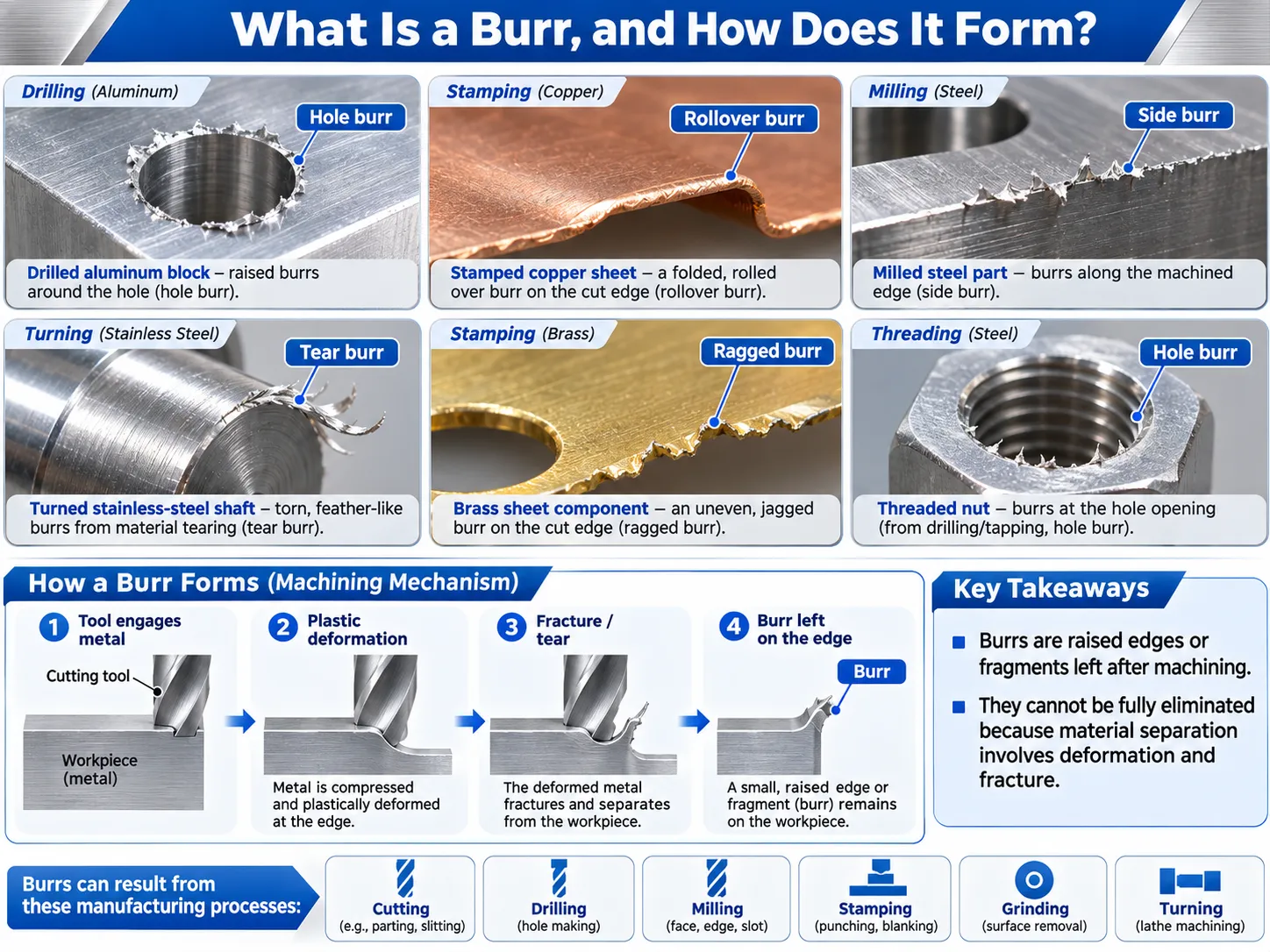
A burr refers to the raised edges or tiny fragments of material that remain on a part after it has undergone processes such as cutting, drilling, milling, grinding, or turning. Often, you can feel a burr with your fingertip before you can even see it with the naked eye.
The reason is straightforward: when metal is machined, it does not separate as cleanly as a knife slicing through cheese. Depending on how the metal reacts to the cutting tool, engineers generally categorize burrs into three types: material pushed to the side, material bent over at the edge of a cut, or material that has been torn away. This is analogous to pressing clay with your thumb, folding the corner of a page, or tearing a sheet of paper—metal undergoes similar transformations at a microscopic level. The type of burr that involves material bending over is known as a “rollover burr,” which is the most common variety.
Why is it impossible for factories to completely eliminate burrs?
The fundamental reason burrs cannot be entirely prevented is that the process of material separation is inherently accompanied by plastic deformation and fracture—a reality dictated by the laws of physics, rather than a mere limitation of manufacturing expertise. During metal cutting, stamping, or grinding, the material is not “perfectly severed”; instead, it undergoes a sequence of elastic deformation, plastic shearing, and finally, fracture. This final tearing stage inevitably leaves behind irregular protrusions along the edges—these are burrs.
Furthermore, strictly speaking, the notion of “eliminating” burrs depends entirely on the precision of one’s inspection methods. Microscopic burrs—invisible to the naked eye—are always present; they are simply too small to be seen.
What are the risks posed by burrs?
While they may appear harmless, these tiny imperfections can evolve into costly problems, especially when it comes to small components.
Physical injury: Sharp edges can cut workers on the production line or anyone who comes into contact with the finished products.
Fastener issues: Burrs inside drilled or threaded holes can interfere with the installation and fit of fasteners, potentially damaging the fasteners themselves or the entire structure.
Reduced structural strength: Burrs around the edges of holes increase the stress experienced by a component, thereby shortening its fatigue life.
Increased corrosion risk: Burrs can lead to uneven coating application along edges, raising the likelihood of corrosion within and around holes.
Friction and wear: Burrs on moving parts increase friction, which can cause overheating and shorten the service life of the components.
Customer complaints and returns: Customers often evaluate product quality based on how an item feels during use; rough surfaces can make a product seem cheap or of low quality.
A Brief History of Deburring
For years, burrs have been removed by humans with hand-held tools. Scrapers, files, sandpaper, stones, and reamers were used, and the process of deburring was not considered important. Even now, manual deburring continues to be used because it is flexible and inexpensive.
When the production level increased, manual work appeared to be too slow. Factories began to apply tumbling and vibratory mass finishing processes, brushes, and grinding tools. In the 1960s, the rolling process was developed to speed up manual deburring of metal strips used in bakery; later, different deburring methods were invented, including electrochemical process and thermal deburring.
Still, a gap is left: a lot of everyday items are simple and the same item is manufactured repeatedly, so there is only one edge that needs to be cleaned, while tumbling does not give a chance to control which edge is polished. At the same time, robot manufacturing is an excess and hand filing is a slow process. Thus, special devices for deburring are required.
When searching for an automatic deburring machine online, one can find the machines producing only polished and ground surfaces, but there are created machines meant not for surfaces and edges cleaning but for cleaning holes.
Which deburring method suits which job?
There is no single best method. The right choice depends on the part, the quantity and the edge you need to clean. This table gives a simple comparison:
| Method | Best for | Main strength | Main limit |
|---|---|---|---|
| Hand filing | Small batches, one-off repairs and odd shapes | Very flexible, low-cost tools, instant inspection | Slow, results vary from person to person, tiring work |
| Tumbling or vibratory finishing | Large batches of small parts that need general edge softening | Treats many parts at once | Little control over which edge is treated |
| Polishing and grinding machines | Flat sheets, outer surfaces and outer edges | Smooth, even surface finish | Not designed for the mouth of a small hole |
| Thermal, electrochemical or water-jet deburring | Hard-to-reach burrs, such as intersecting holes | Reaches places tools cannot | Special equipment and higher cost |
| Single-purpose automatic deburring machine | Repeated simple parts with one fixed edge, such as the hole in a nut | Same result every cycle, very little manual work | Does one job; not for complex shapes |
| CNC or robot deburring | Complex contours and mixed parts | Very flexible | Higher cost and programming skill needed |
Where an automatic deburring machine fits: a real example
Insulation-piercing clamps perform the function of creating branch connections on insulated overhead lines. This is achieved by the internal teeth, which pierce the insulation of the power line. The clamp consists of two parts that hold together once the nut is tightened. In some instances, a special “torque-control nut” is used, which breaks at a certain torque level. If the hole rimming of the nut is rough or includes irregularities, then screwing it becomes extremely difficult and, therefore, the clamping force is uneven. For this reason, manufacturers require very strict quality control in the production of insulation-piercing clamps.
Benlong Automation built an automatic deburring machine for exactly this job. It works in one fixed sequence, repeated for every nut:
I. An operator loads the nuts—which have burrs—into a bowl feeder; the feeder then delivers the nuts, one by one, into a vertical track.
II. Once a nut drops from the vertical track into the processing station, a motor-driven chamfering tool advances linearly to remove the burrs from the hole opening, after which it automatically retracts to its original position.
III. The processed nut then slides down a chute into a collection bin.
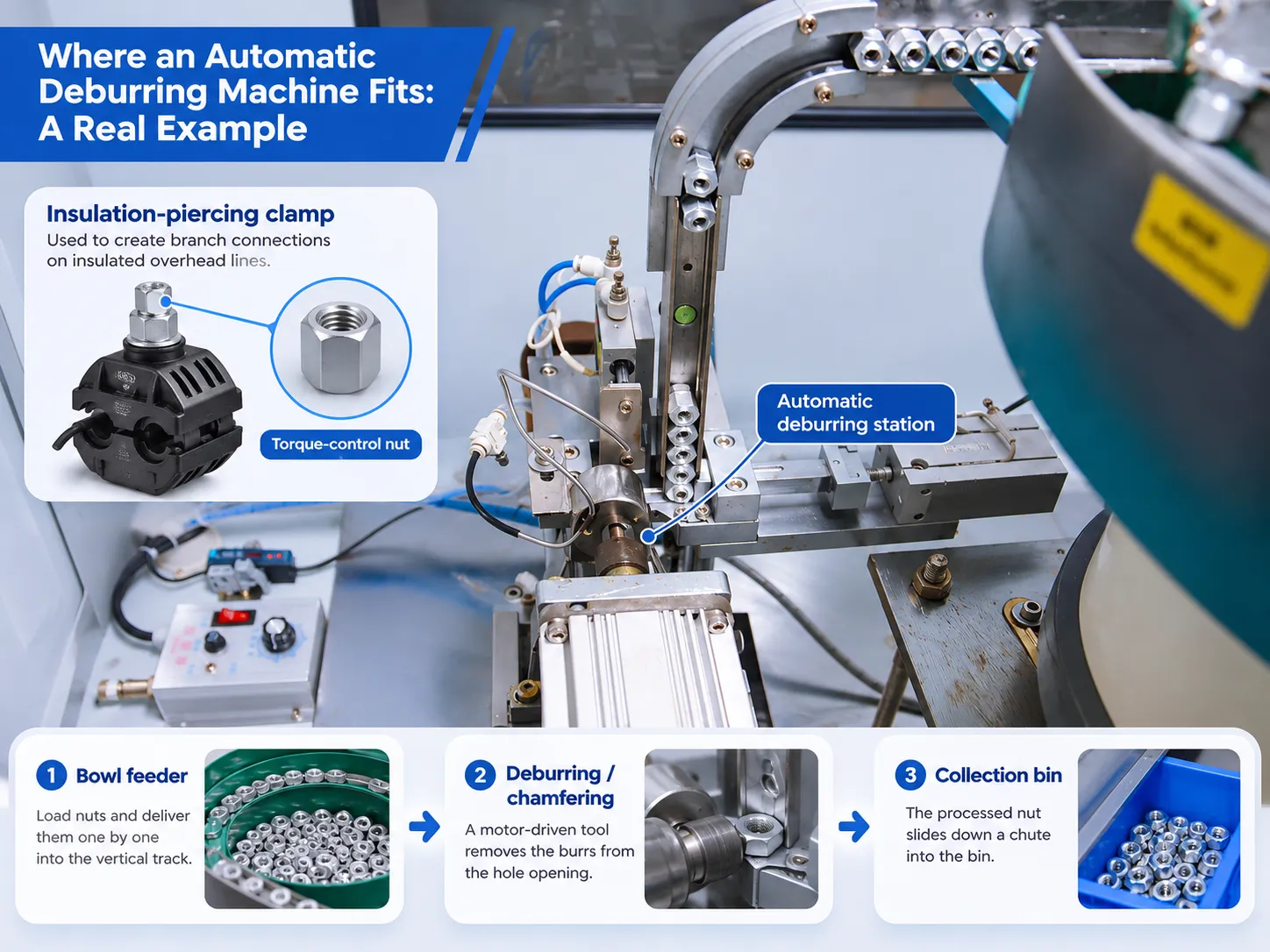
This machine can process one nut every two seconds and is compatible with both M6 and M8 nuts, provided they share the same external dimensions. It should be noted that the equipment has a limited scope of application: it performs only a single operation on a specific type of part. It cannot process complex contours or curved surfaces, nor can it serve as a substitute for CNC or robotic deburring solutions designed for more intricate components.
What information should a buyer provide before purchasing a machine?
1. Samples: Provide actual samples and 3D drawings, clearly indicating the edges that require processing and specifying the size of the burrs.
2. Material: Different metal materials behave differently during the machining/cutting process.
3. Production Capacity: Inform the supplier of your required output per shift and ask about the actual processing efficiency the equipment can achieve for your specific workpieces.
4. Processing Standards: Define the quality standards for the finished parts and specify the methods for inspection and acceptance.
5. Workshop Information: Provide details such as dimensions and electrical layout, as these factors influence the machine’s design and physical configuration.
6. Acceptance Requirements: In addition to processing standards, specify the required duration for the machine’s continuous operation.
Frequently asked questions
What is an automatic deburring machine?
As the name suggests, it is a machine designed to remove burrs from the surfaces of metal parts. Common examples include polishing machines and grinders. The machine developed by Benlong Automation, featured in this article, is a preferred choice for many manufacturers of puncture clamps.
Metal deburring methods are primarily categorized into four types—mechanical, chemical/electrochemical, thermal, and specialized processing—with the appropriate method selected based on the part’s shape, material, and precision requirements.
Why not just prevent burrs in the first place?
The root cause lies in the material’s physical properties and geometric constraints. Whenever a material’s shape is altered through the application of external force, the formation of burrs becomes a physically inevitable byproduct.
Can an automatic deburring machine handle any part?
No. There is no single automatic deburring machine capable of handling every type of burred product, as products vary significantly in terms of size and raw materials. That said, CNC-based machines can generally handle a wide variety of part geometries, though such equipment typically comes with a higher price tag.
Is hand deburring ever still the right choice?
In the case of very small volumes, items with special shapes and an occurrence of repair work, the manual solution is often the best option. With an increase in production and demand for uniformity of the process, the benefits of mechanical processing are apparent.
Do I need skilled staff to run a machine like this?
The work of the equipment is quite simple – the operator just loads the workpieces (such as nuts) and collects the ready products in a container. In terms of setup and maintenance of the equipment, it requires a little more than basic knowledge of mechanics and electronics, just like in many other cases.
References
- Wikipedia: Burr (edge) – Overview of how burrs form, the main burr types, the problems burrs cause in drilled holes, and common deburring methods.
- Aurich, J.C. et al., Burrs: Analysis, Control and Removal, CIRP Annals – Manufacturing Technology, 2009 – Research review of burr definitions, formation, economic impact and removal.
- Frey, D.L., Process Guide for Deburring Technologies, Federal Manufacturing and Technologies, 2012 – Practical guide to burr detection and to hand and machine deburring of holes, threads and other features.
- IEEE Technology Navigator: Deburring – Overview of deburring methods and how deburring moved from a manual craft toward automation.
- TE Connectivity: Insulation Piercing Connectors for Insulated Overhead Lines – Explains how a torque control nut draws the connector halves together so the teeth pierce the cable insulation.
Conclusion
When metal cutting is done burrs will be produced, and this has both benefits and nasty consequences when it comes to burrs being neglected. Hand filing has been helping people for centuries but it is slow and very uneven, and simple repetitive parts can benefit from a much better option available these days. The automatic deburring machine, which has only one purpose, could give the same quality of the burr removal without too much human involvement as long as tool and the part fit each other perfectly.
Benlong Automation designs automatic production lines, assembly machines and test benches for electrical manufacturers. If you would like to know whether your nuts can be deburred automatically, send samples or a drawing to xsb@benlongkj.cn or message us on WhatsApp at +86 150 5837 0007, and our engineers will give you an honest assessment.