benlong

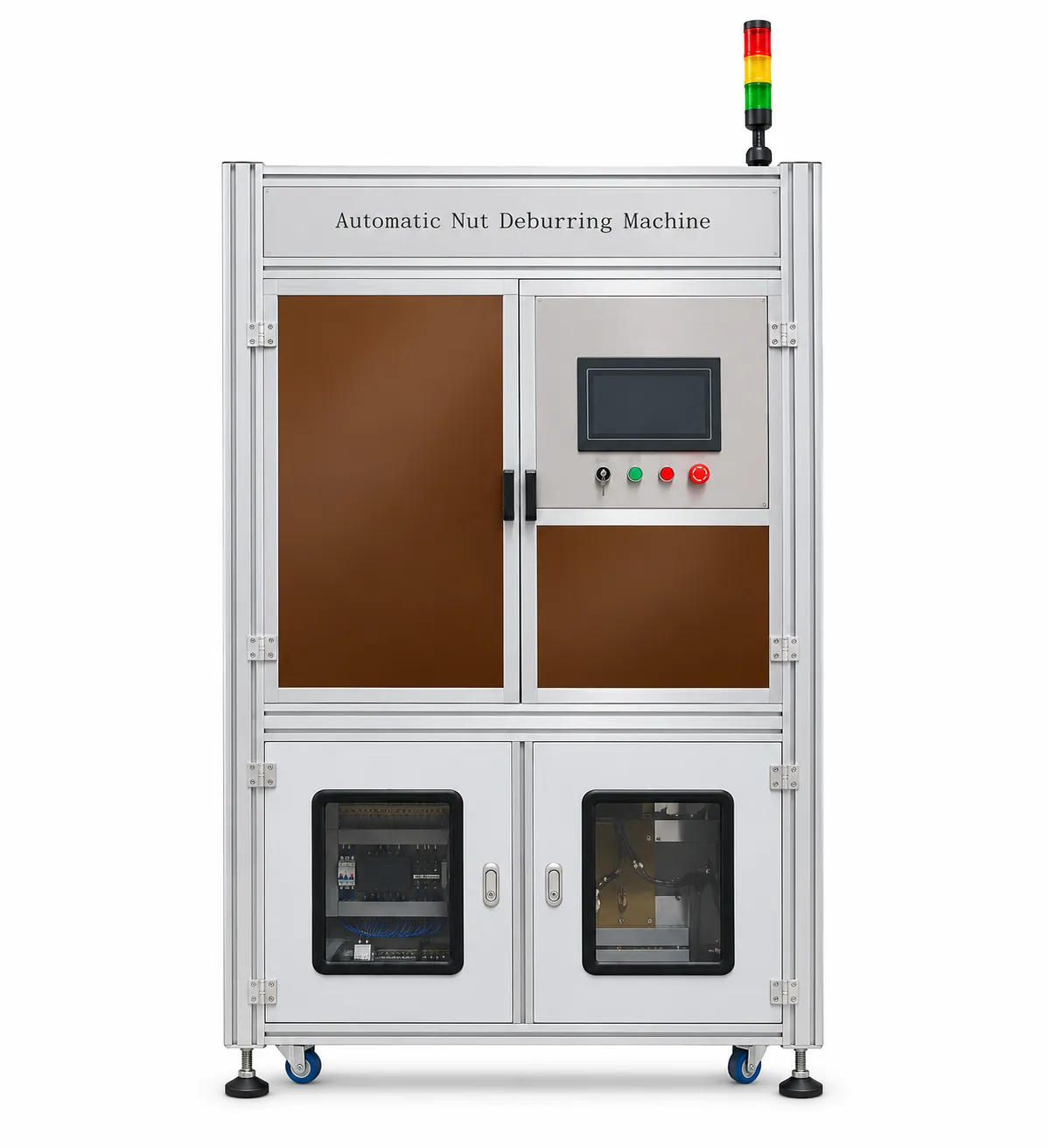
Automatic Nut Deburring Machine
The Automatic Nut Deburring Machine is a custom-built solution for removing burrs and creating chamfers around the threaded holes of nuts used in puncture clamps. Designed for M6 and M8 nuts with matching external dimensions, it combines automatic vibratory feeding, pneumatic clamping, motor-driven chamfering and gravity discharge to achieve a nominal production cycle of 1 piece every 2 seconds.
Automatic Nut Deburring Machine
Benlong Automation designs and manufactures customized automatic nut deburring machines for the production of electrical connection components, including nuts used in puncture clamps. This machine automatically removes residual burrs from the threaded hole opening after nut processing and creates a consistent chamfer, helping manufacturers improve component finishing quality and reduce manual deburring work.
The equipment combines automatic vibratory feeding, linear conveying, pneumatic clamping, motor-driven chamfering, pneumatic axial feeding and gravity discharge in one continuous operating sequence. It is designed to accommodate M6 and M8 nut models with the same external dimensions, subject to confirmation using customer samples. The nominal production cycle is 1 piece every 2 seconds.
The machining head uses a motor-driven chamfering tool with a single-axis axial feed. Mechanical stops and pneumatic cylinder travel determine the feeding stroke, and the tool automatically retracts after processing. The equipment does not perform contour machining, curved-surface machining or multi-axis interpolation.
Output: 1 pc / 2 s | M6 & M8 Nuts | Total Power: 2 kW | Omron PLC & Sensors · SMC Pneumatics · MCGS HMI
Technical Specifications
| Product name | Automatic Nut Deburring Machine |
|---|---|
| Model / specification | Non-standard customized |
| Applicable product | Nuts for puncture clamps |
| Compatible nut sizes | M6 and M8 (same external dimensions, subject to sample confirmation) |
| Production efficiency | 1 pc / 2 seconds (nominal cycle time) |
| Processing function | Threaded-hole deburring and chamfering |
| Feeding method | Automatic vibratory bowl feeder and linear feeding track |
| Positioning method | Pneumatic clamping and positioning |
| Machining method | Motor-driven chamfering head with single-axis axial feed |
| Feeding stroke control | Pneumatic cylinder travel and mechanical limit stops |
| Discharge method | Gravity discharge through chute into collection bin |
| Power supply | 220 V / 50 Hz |
| Total power | 2 kW |
Additional Specifications
| Dimensions (L × W × H) | To be confirmed according to the final customized design |
|---|---|
| Machine weight | To be confirmed |
| PLC | Omron |
| Sensors | Omron |
| HMI | MCGS |
| Pneumatic cylinders | SMC |
| Servo motor | Inovance |
| RCBO | Chint |
| Machine configuration | Vibratory feeder, linear feeding track, pneumatic clamping mechanism, chamfering head, pneumatic feeding mechanism, discharge chute, collection bin, electrical control cabinet and safety guarding |
| Manufacturing lead time | 60 working days |
| Application industries | Electrical connection components, puncture clamps, cable accessories and customized nut manufacturing |
What Does the Automatic Nut Deburring Machine Do?
During nut manufacturing, residual burrs may remain around the threaded hole opening. These burrs can affect the finishing quality of nuts used in electrical connection components and require an additional removal operation. Manual deburring is repetitive and can produce inconsistent results when handling large quantities.
This automatic nut chamfering and deburring machine performs feeding, positioning, chamfering and discharge in a sequential automated cycle.
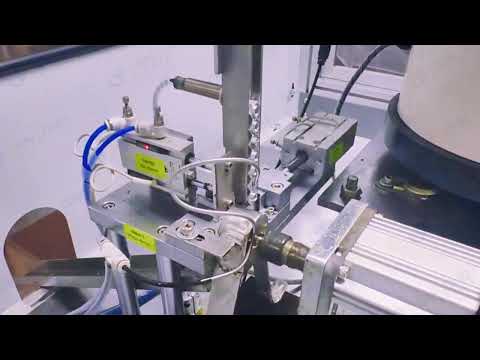
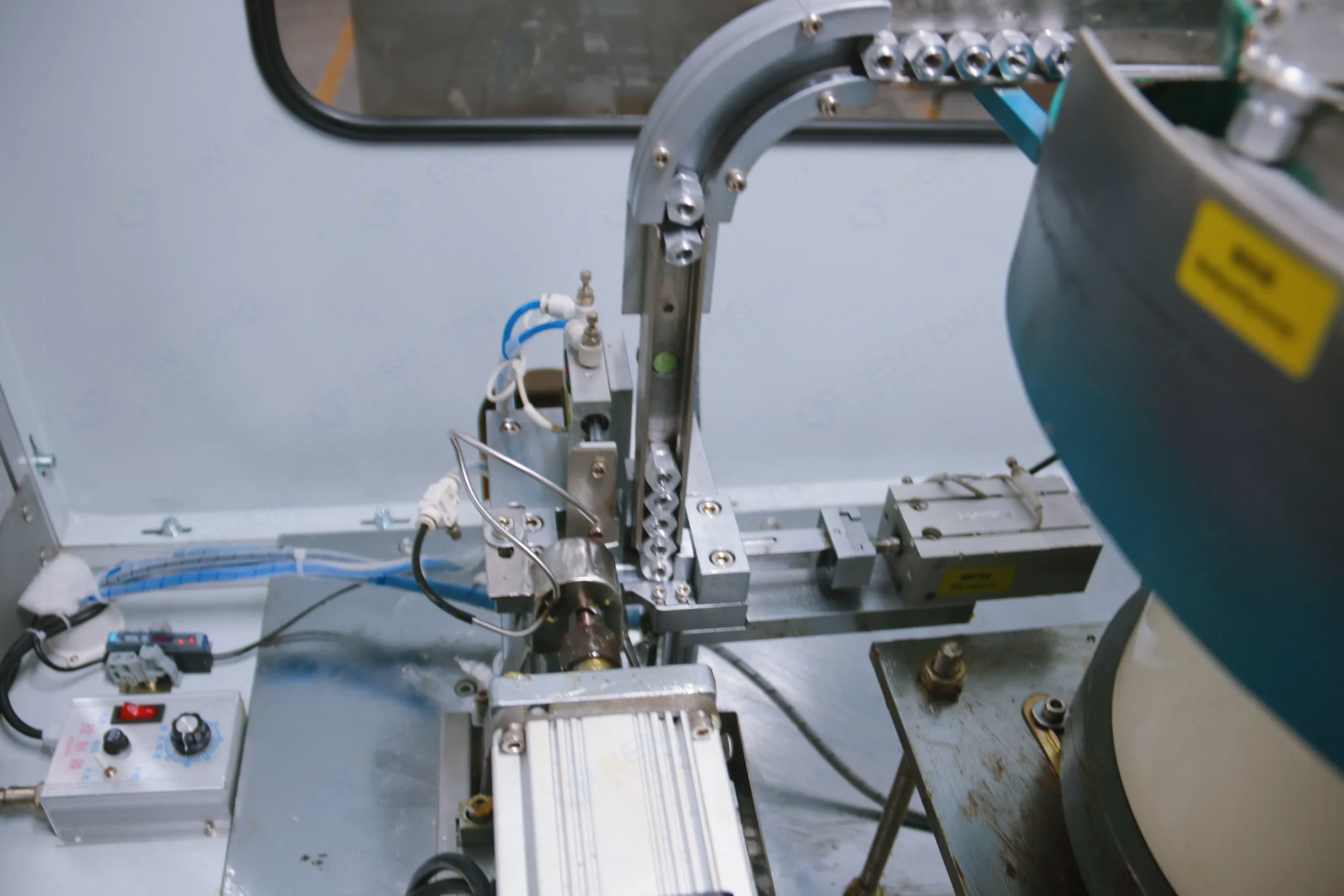
- Automatic feeding and orientation – Operators load nuts into a vibratory bowl feeder. The feeder arranges the nuts in the required orientation and transfers them through a linear feeding track. Nuts with an incorrect orientation are rejected during feeding.
- Pneumatic clamping – At the machining station, a pneumatic clamping mechanism secures the nut and prevents unwanted movement during processing.
- Motor-driven chamfering – An electrically driven chamfering tool advances along a single axis to remove burrs around the threaded hole opening. Pneumatic feeding and mechanical limits determine the machining stroke.
- Automatic discharge – After the tool retracts and the clamp releases, the finished nut falls through the discharge chute into the collection bin.
Automatic feedingVibratory bowl feeding and a linear track continuously supply correctly oriented nuts to the machining station.
Consistent positioningSMC pneumatic components clamp the nut securely during the deburring and chamfering operation.
Single-axis processingThe chamfering tool uses a straightforward axial movement with mechanical stroke limitation rather than complex multi-axis machining.
Automatic dischargeFinished nuts are released and collected through a gravity discharge system, completing the operating cycle.
Key Features & Customer Benefits

Core Customer Benefits – Why Manufacturers Choose This Machine
Benefit 1: Reduced manual deburring
Automatic feeding, clamping, chamfering and discharge reduce the amount of repetitive manual work required for threaded-hole burr removal.
Benefit 2: Fast and repeatable processing
The machine provides a nominal cycle time of 2 seconds per nut. Pneumatic positioning and a mechanically limited axial feeding stroke support consistent operation from one cycle to the next.
Benefit 3: M6 and M8 compatibility
One customized machine can accommodate M6 and M8 puncture clamp nut models with matching external dimensions, reducing the need for separate dedicated deburring equipment. Final compatibility is confirmed using actual samples.
Benefit 4: Serviceable industrial components
Omron PLC and sensors, SMC pneumatic cylinders, an MCGS HMI, an Inovance servo motor and Chint RCBO provide a clearly specified electrical and pneumatic component package.
Trusted by industry leaders
















Applications – Where This Machine Adds Most Value
Custom Engineering & Delivery
Request an Automatic Nut Deburring Machine Quote
Send us your M6 and M8 nut samples, drawings, burr-removal requirements and target production capacity. Our engineers will evaluate the feeding orientation, clamping fixture, chamfering tool and control configuration to propose a suitable customized nut deburring solution.
WhatsApp: +86 150 5837 0007 | Email: xsb@benlongkj.cn | English & Chinese support
Why Choose Benlong as Your Automatic Nut Deburring Machine Manufacturer?
- Customized automation equipment designed around actual nut samples and manufacturing requirements
- Automatic feeding, pneumatic clamping, single-axis chamfering and finished-part discharge
- Nominal processing cycle of 2 seconds per nut for suitable products
- Compatibility with M6 and M8 nut models of matching external dimensions
- Omron PLC and sensors, SMC pneumatic cylinders, MCGS HMI, Inovance servo motor and Chint RCBO
- 60-working-day manufacturing lead time
- Global service and spare-parts support
Standard Machine Includes
Vibratory bowl feeder · Linear feeding track · Orientation rejection mechanism · Pneumatic clamping fixture · Motor-driven chamfering head · Pneumatic axial feeding mechanism · Discharge chute and collection bin · Omron PLC and sensors · SMC pneumatic cylinders · MCGS HMI · Inovance servo motor · Chint RCBO · Electrical control cabinet · Safety guarding · Operation manual · 1-year warranty
Related solutions
Frequently Asked Questions
The machine is designed for nuts used in puncture clamps and can accommodate M6 and M8 models with matching external dimensions. Compatibility is confirmed using actual customer samples and the final clamping fixture design.
The nominal processing cycle is 1 piece every 2 seconds, equivalent to a theoretical rate of 30 pieces per minute. Actual production output depends on feeding stability, nut geometry and operating conditions.
Nuts are automatically fed and oriented by a vibratory bowl feeder and linear track. A pneumatic mechanism clamps each nut, and a motor-driven chamfering tool advances along one axis to remove burrs around the threaded hole opening. After the tool retracts, the finished nut is released into the collection bin.
No. The equipment uses a motor-driven chamfering tool with a single-axis axial feeding movement. The processing stroke is determined by mechanical limits and pneumatic cylinder travel. It does not involve contour machining, curved-surface machining or multi-axis interpolation.
The specified configuration includes Omron PLC and sensors, SMC pneumatic cylinders, an MCGS HMI, an Inovance servo motor and a Chint RCBO.
The machine operates on a 220 V / 50 Hz power supply with a total rated power of 2 kW. The manufacturing lead time is 60 working days. Overall dimensions and weight will be confirmed during the final customized design stage.
Related Products
MCB knob laser marking machine
View Details
High-Precision Automatic Weighing and Packaging Machine
View Details
ACB comprehensive test bench
View Details
Semi automatic welding machine
View Details
Automatic Delay Tube Oil Filling and Assembly Machine
View Details