benlong

What Is Automatic Test Equipment?
The definition also means a $15 billion semiconductor industry and a testing center at a breaker plant where 600 tests are conducted every time. Both of these entities can be called automatic testers, but they are basically the same thing, hence it’s required to know how can the type of buyer influence the understanding of the term.
Moreover, it should be mentioned that ATE is discussed including all the spheres of usage, operation and characteristics of the equipment, and how to use it for making a correct choice in purchasing the appropriate equipment.
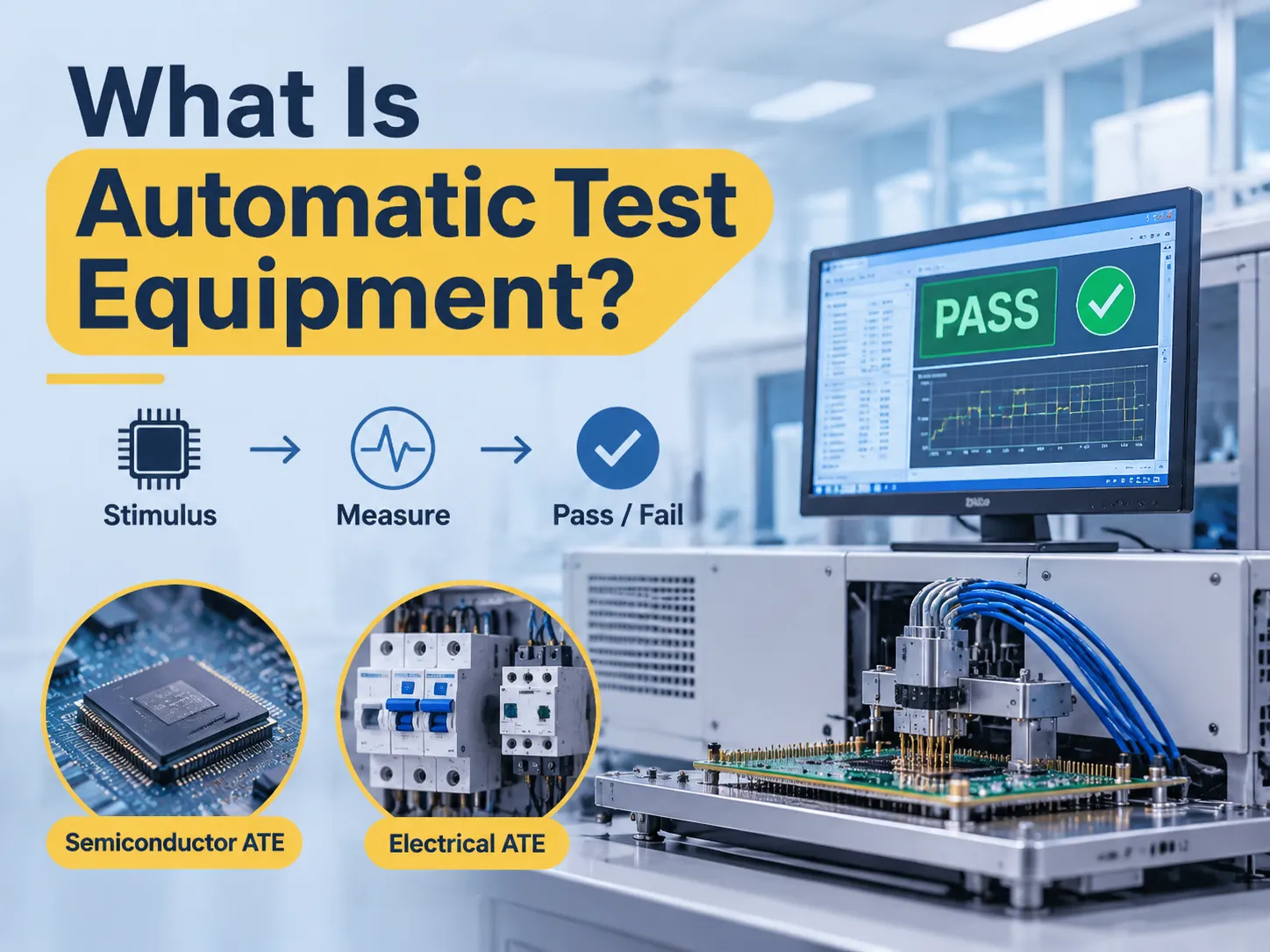
In summary, we have the test machinery, generally known as ATE, which is defined as any apparatus which provides input to the product, measures the response and tells whether it is acceptable or not without operator involvement. The key area in this market is semiconductor ATE that is conducted by two companies: Advantest and Teradyne which comply with about 86% of the entire market. There is one more type that is the one based on electricity.
What Automatic Test Equipment Actually Is
To put it simply, there are four functions: it generates the stimulus, be it voltage, current, RF signal, temperature or movement. It applies the stimulus to the DUT. It measures the response using the device of known accuracy. And it compares the result to the limit and records the verdict.
What is important is the word ‘automated’. A multimeter and an experienced technician can perform all four functions but at the slow speed. ATE exists due to the fact that in the fourth case there is a human involvement while in the third case reliability is lost after several hundred repetitions.
Then, we can define the category through what it is not. ATE is definitely not a data logger since it makes a decision. ATE is not a bench instrument since it performs the sequence. It is not a test procedure as well although any ATE system contains one without exception.
The Industries That Buy ATE, and What Each One Tests
Six sectors account for almost all of the market, and the differences between them are larger than the similarities.
| Industry | What is tested | What the system has to do |
|---|---|---|
| Semiconductor | Dies, packaged ICs, memory, SoCs | Thousands of pins at gigahertz, massive parallelism |
| Automotive | ECUs, sensors, harnesses, battery modules | Bus simulation, environmental cycling, traceability |
| Aerospace and defence | Avionics line-replaceable units | Decades of support, documented calibration, reconfigurable interfaces |
| Medical devices | Monitors, pumps, imaging subassemblies | Validation records, audit trails, software qualification |
| Telecommunications | Optical modules, RF front ends, network equipment | Protocol conformance, optical power and wavelength |
| Electrical and power | Breakers, RCDs, contactors, complete panels | High current injection, trip timing, contact resistance |
Most people associate the semiconductor segment with the acronym mentioned. The reason behind this is that a modern System on Chip has thousands of pins, making it necessary for the testers to measure and drive most of them at the same time at lightning speeds, in which any picosecond could mean the difference between success and failure. This is definitely the hardest problem to measure in mass production and the companies which have already been able to tackle it are among the most valuable manufacturers in the world.
The automotive segment is the most dynamic one. The electric vehicle contains a battery pack, which has dozens of modules, each controlled by its own monitoring circuit. The task changed from checking a component to that of validating a system essentially using the bus. As to the aerospace segment, it is the most stable but most demanding, since the line-replaceable unit available for this segment might stay in service for thirty years, which means that the test equipment should be maintainable for thirty years.

Semiconductor ATE: The Duopoly That Explains the Category
Most published estimates indicate that Advantest and Teradyne together hold about 86% of the worldwide market in semiconductor ATE, with Advantest occasionally considered the larger of two. Advantest reported a record revenue of some $7 billion in 2025; Teradyne, about $3.2 billion. For high-end SoC and memory test, concentration is even higher, running to exceeding 90%.
That structure came from a specific pattern. Teradyne’s J259 in the 1960s is generally credited with starting the ATE era. Advantest took the memory test market as Japanese semiconductor production grew, then consolidated through acquisitions in the 2000s. The result is an industry where a new entrant has to beat an incumbent on a platform that customers have already built their test programs around, which is, in fact, a harder problem than making a faster instrument.
The market has grown tremendously, powered by AI silicon. Global semiconductor test equipment is expected to reach about $15.3 billion in 2026, with projections nearing $20.8 billion by 2028. The mechanism is straightforward and a bit counterintuitive: the more complex chips require more time to test. The test time on a leading AI accelerator has increased from about 350 seconds in one generation to between 700 and 1,000 seconds in the next, so the same number of chips requires two to three times the tester capacity. Testing ceased to be a cost line and started to be viewed as a constraint to the throughput.
For anyone outside semiconductors, that story is informative, but unfortunately not useful. It shows why a pursuit for automated test equipment market share brings back semiconductor analysis, and why a buyer of a breaker test bench will find nothing to relate to within the context provided.
What the Electrical Industry Tests, and Why It Is Different
Every item featured in the electrical section of the table serves a function of current disconnection, thus making the engineering process to differ.
Miniature circuit breakers are subjected to several tests such as evaluation of thermal tripping parameter for the current values when it trips and when it does not trip; evaluation of magnetic value (several times of rated current), contact resistance, insulation resistance and many more. Besides that, RCDs and RCBOs will add a differential protection test. While contactors carry out coil pick-up and drop-out tests and also wear tests on all poles. The addition of the assembly means that the dielectric strength test will be performed at the very end.
No elaborate process is needed to perform the electrical test. What it needs is a current of the highest value, perfect timing and mechanic process. Making the measurements is easy while obtaining the results is very difficult.
The economics differ tremendously. Semiconductor tests are conducted on millions of dies. Meanwhile, electrical tests are performed on every single manufactured testing device and the volume may reach hundreds of thousands. That explains the existence of a lot of small companies in the industry. A bench built around air circuit breaker routines is the largest format in that segment, and its scope is set out in this overview of what an ACB test bench measures and records.
The Anatomy Every ATE System Shares
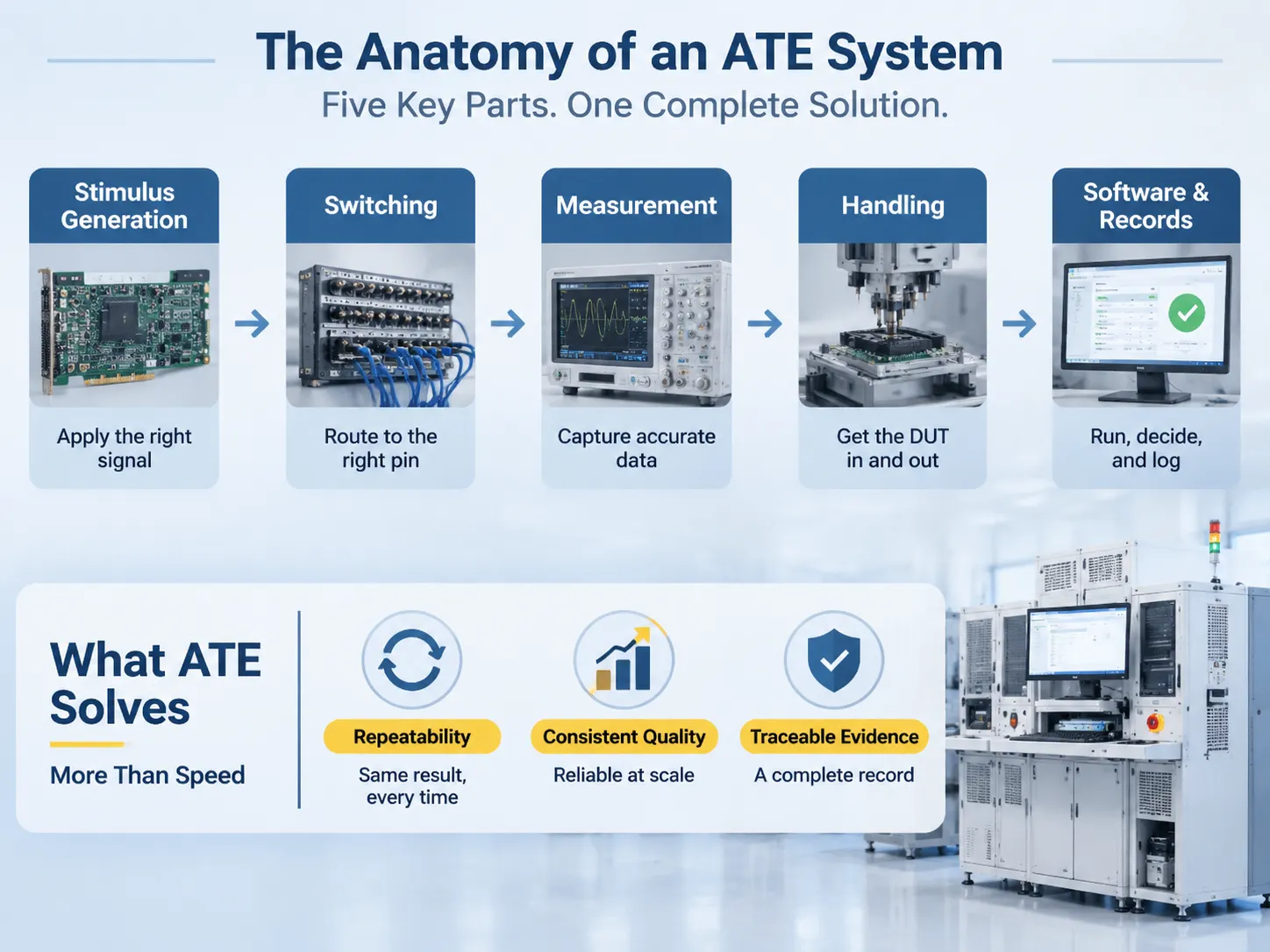
The block diagram of testing systems contains five main components, which are the same regardless of the respective field of application.
- Generation of a stimulus. The phase where the source of the applied effect is identified. In funny terms, it would be a microchip electronics board in semiconductor testing, a device that has current injection capability in electrical testing, and a bus simulator in automotive testing.
- Switches. The part where generators route stimuli into the appropriate contact without the operator moving cables. This part of the diagram is responsible for the most reliability troubles because it involves relay contacts and their exploitation.
- Measurements. The equipment comprises the measuring devices to be in compliance with the certificate of calibration, beforehand tested, and the data transmission process that keeps its accuracy from the sensor till the recording process.
- Handling. The way how the device is supplied with the relevant test items and how the process of fixing those items is conducted. In semiconductor testing, this is done by means of handlers or probers, and in electrical testing, it is done by fixtures and clamps.
- Software and records. The whole process is instrumented by software that keeps track of particulars of the system. Please note that the fifth component is often inadequately valued by users and is only missed when it is too late.
For buyers, the fifth part usually has little importance, only to realize later the errors. A system that relies on tests but has no record would create a paper trail that would be difficult to defend after two years while a sequence with limits known only by the engineer does not lend itself to auditing. Endurance work makes the point clearly: an aging bench runs unattended for weeks, so the record has to survive a power interruption without losing the run, and the design considerations for that differ from a single-shot test, as this look at ATS aging bench cycling and logging sets out.
What ATE Solves That Manual Testing Cannot
Three issues exist, with speed being the only aspect that concerns us.
- Repeatability. A human tester applies torque and reads the results, but results can vary from one technician performing the same unit to another. The use of a system ensures that the input is totally repeatable and enables one to compare the bench results from this year with the results from last year.
- Volume of output is constant in relation to quality. Manual testing deteriorates under the production process and this deterioration happens without one noticing it; the last fifty products tested get checked much quicker as compared to the first fifty. An automated testing system doesn’t suffer and produces an unknown quantity of the product.
- Proof. The system will produce a record for each unit to undergo testing. They will answer to the costumer about the audit results, ensure that the warranty claims are approved and allow proving compliance with various regulations.
This opinion does deserve attention, though. A properly designed bench system with good fixtures and a properly trained operator can produce results equal to that of automated testing and does produce the results in a quicker manner. Below a few hundred units a day that combination usually wins, and the arithmetic is worked through in this comparison of manual and automated testing economics. Automation earns its place when handling time, not measurement time, becomes the constraint.
Gage R&R: The Measurement Everyone Skips
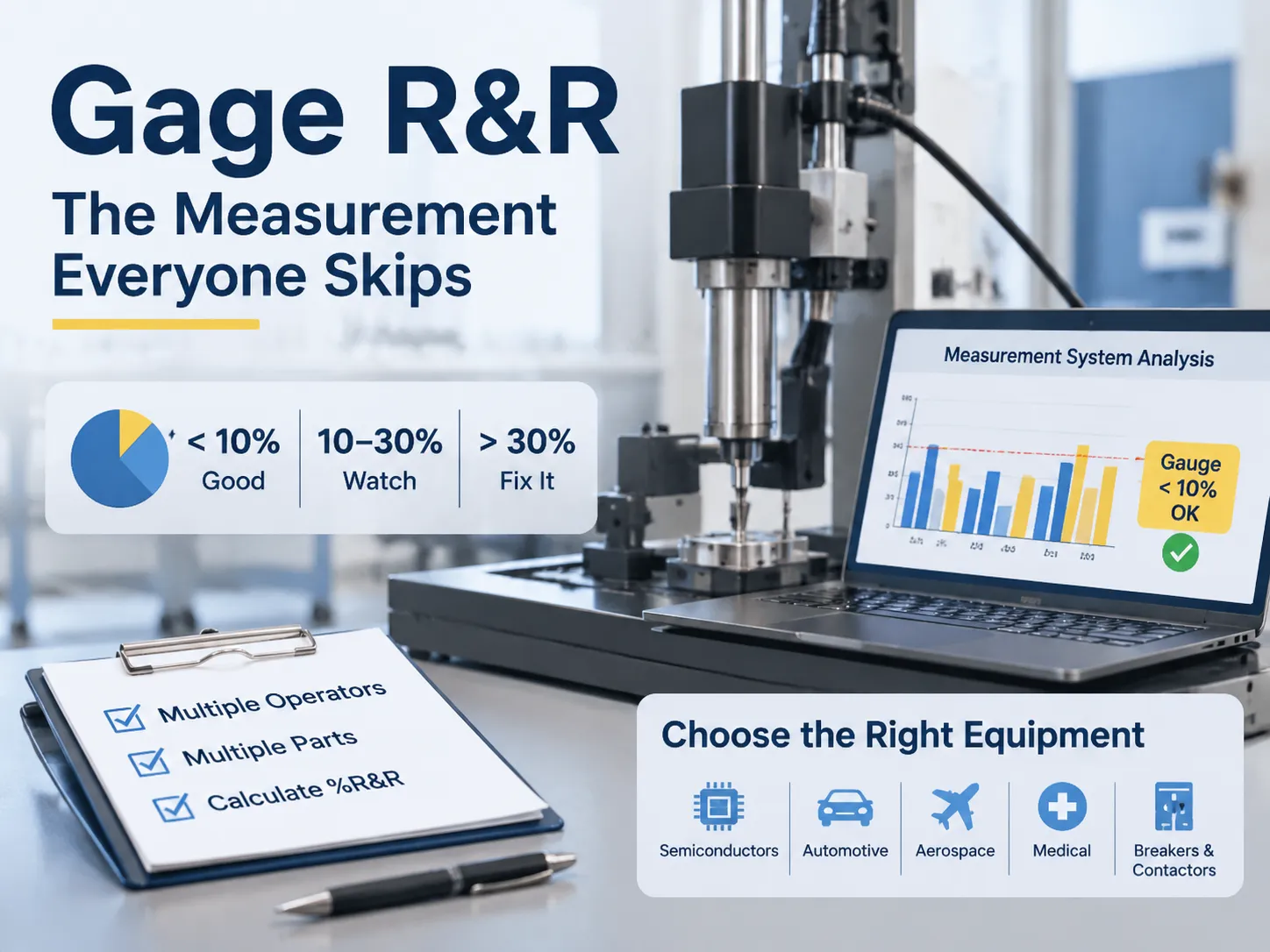
It is necessary to qualify the measurement system itself before one can start to trust it to make the decision to pass or fail the system. Gage repeatability and reproducibility is the principle that works here, and it is, unfortunately, the next step in most completion processes which is avoided as the fun has arrived already.
The principle is quite simple. First, a particular number of parts need to be selected that represent the range of measurements in the system. Then, two or three operators need to perform measurements on each part several times using the same equipment. However, the results must be analyzed in a way that the amount of generated variance should be attributed to the measurement system rather than the parts. However, there are acceptable limits of the test results according to the Automotive Measurement Systems Analysis Handbook: when less than 10 percent of the total tolerance is used by the measurement system, the test is good, between 10 percent and 30 percent it is acceptable and over 30 percent it is harmful.
The following exercise provides two important results for automatic test equipment. The first result identifies the system when the level of its repeatability is much lower than its specification. This could happen, for example, when the fixture resistance is too high or when the relay contacts are worn. The second result discovered during the test, of course, is the level of measurement uncertainty for the automatic test equipment. Indeed, since it has not gone through the test, the capability of the measurement system should be questioned. The routine for keeping a bench inside its capability, including calibration intervals and contact maintenance, is covered in these MCCB test bench operating practices.
Choosing Equipment by Industry
What to look for depends entirely on which row of the first table you are in.
| If you make | The constraint that decides the purchase | Typical suppliers |
|---|---|---|
| Semiconductors | Pin count, parallelism, test program portability | Advantest, Teradyne, plus handler and prober specialists |
| Automotive electronics | Bus simulation, environmental chamber integration | dSPACE, National Instruments, tier-one integrators |
| Aerospace LRUs | Interface reconfigurability, long-term support | Defence-focused ATE integrators |
| Medical devices | Validation records and software qualification | Specialist integrators, often built to the client’s process |
| Breakers and RCDs | Current range, trip timing, changeover time, records | Benlong and comparable production line builders |
| Contactors and starters | Coil and contact measurement, operation count | Same segment, different fixture and criteria |
National Instruments warrants a special note because it revolutionized the economics of the middle ground. A PXI or CompactRIO system composed of modular instruments enables factories to create custom test devices out of the available catalogue items, which is ideal for low production volume and high production variety situations. Yet, such a solution would not work for a production line manufacturing 5,000 circuit breakers in a day. In this case, a dedicated test bench with a dedicated fixture will always outperform a flexible system in terms of cycle time.For that row of the table the purchase decision is a payback calculation and not a capability question, and the arithmetic for a breaker line is worked through in this analysis of automated versus manual MCB testing payback.
FAQ
What does ATE stand for?
Automated test equipment is also used in the same definition. The term refers to any system which provides a test signal, measures the return signal and responds based on the input test signal and its own evaluation. Other branches employ the same acronym although there are considerable differences in the hardware used.
What are examples of automated test equipment?
A prober has a tester attached, an automotive ECU end-of-line station in the LRU, and an avionics LRU tester, along with a breaker bench with current injection and trip timing. The breaker bench is a bench rather than a rack, but it still meets the definition.
How big is the ATE market?
The estimate for semiconductor testing devices stands at about $15.3 billion in 2026 and reach more than $20.8 billion in 2028. The larger market for automotive, aerospace, and electrical testing is certainly bigger, but more dispersed.
Who are the main ATE companies?
The semiconductor business is led by Advantest and Teradyne, who control around 86% of this market between them. For example, National Instruments is known for its modular and PXI systems, dSPACE for hardware-in-loop for automotive applications, and Cohu for testers.
What does an automated test equipment engineer do?
Mechanical design engineers design the fixture and the handling, electrical engineers design the switching and measurement path, and software engineers write the sequence and the records. In smaller companies one person does all three, which is why the fixture often gets the least attention and causes the most downtime.
Why does Gage R&R matter on a test bench?
Since a gauge is a measurement equipment, a gauge that is not calibrated has high measurement variability with an unknown error. Gage R&R distinguishes the variability of the gauge from that of the part and produces a value for the customer.
References
- Teradyne — Semiconductor and System Test
- Advantest — Semiconductor Test Systems
- National Instruments — Modular Test and Measurement
- dSPACE — Hardware-in-the-Loop and ECU Testing
- UL Solutions — Product Safety Testing and Certification
Conclusion
ATE means one definition as well as six fields of application. The definition of ATE says that it is the system which both studies and makes decisions. The fields of application differ so that one can say that using this word itself is virtually unnecessary. This means that when approaching the provider the very first question should be the following: what standard is used in the process and not whether the ATE is actually working properly in the first place.
While testing a factory, which produces equipment for safety, the corresponding comparison base is not a semiconductor testing device, but the currently used manual equipment.