benlong

LabVIEW for Electrical Test Benches: Control, Data Acquisition and Automated Testing
Typically, when an international client inquires about whether our testing equipment supports LabVIEW, it means that they need a measurement and control system that is already familiar to their engineers. An example of this was when we were approached by a major switchgear manufacturing firm in India that explicitly stated in the project’s design constraints that the monitoring and control software for an 8 kA multi-feeding current source test bench must be created in LabVIEW rather than using a conventional PLC. Throughout this article, I will explain what LabVIEW is and why it is important for electrical test benches, as well as how it is applied in our projects at Benlong Automation.
What Is LabVIEW?
LabVIEW (Laboratory Virtual Instrument Engineering Workbench) is a graphical programming language made by National Instruments (NI), to be used in tests, measurements, and automation. Instead of writing program code paragraph by paragraph, engineers create a program by putting various functional blocks and connecting them by wires to ensure data transfer from one block to another. The technique is called G code.
Due to its origin, LabVIEW software is very efficient in performing the electrical test bench functions of measuring voltages, currents, and temperatures, managing energy sources and switch devices, graphing, obtaining records automatically.
Why Customers Ask for LabVIEW in Test Equipment
Cross-national corporations and large laboratories often propose LabVIEW for a variety of reasons:
It is a universally acknowledged international standard in the realm of testing and measuring, which means that the engineers of these companies will be able to read, adjust and modify the system.
It works perfectly with the NI data-collecting equipment, plus lots of other sensors and devices.
It allows for the well-defined user interface, real-time observation, automatic recording of the data with one-second interval.
It simplifies the process of further enlargement and subsequent improvement of systems, which means that users are not tied to one vendor.
In simple terms, when the client requests LabVIEW they actually mean that they want an easy-to-use multi-functional control system.
LabVIEW vs PLC Control: What Is the Difference?
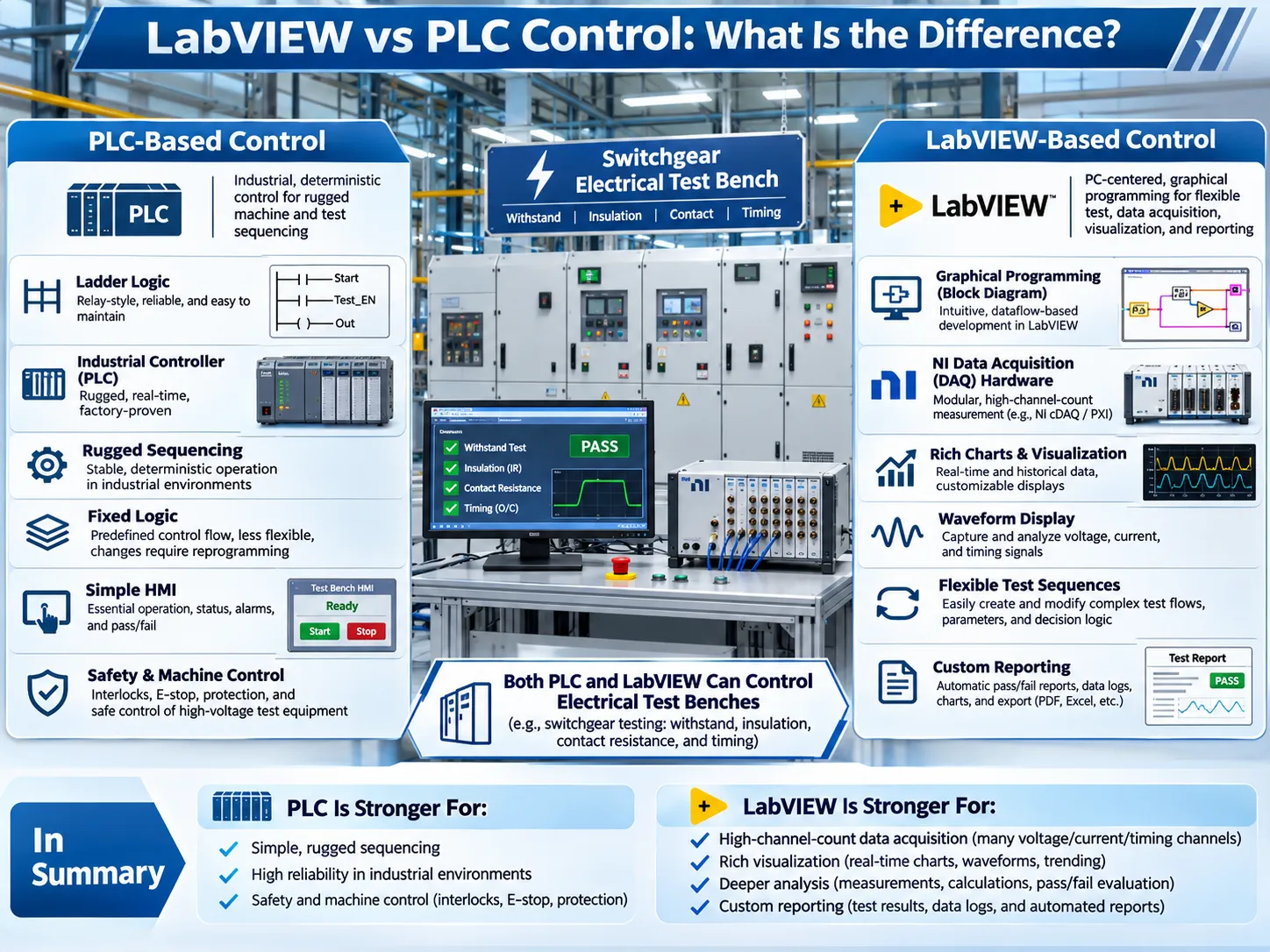
An often asked question is how LabVIEW is different from a PLC-based system. The two can set up current, stabilize output, record data and process alarms, but their underlying principles are different.
A PLC-based system uses ladder logic and industrial controllers. It is mostly used by traditional equipment manufacturers.
A LabVIEW-based system relies on PC-based graphical programming and is popular among laboratories and research centers.
Neither system is automatically better. For large channel data acquisition, adaptable test sequences, great visualization capacities and personalized reporting LabVIEW is usually superior. If one requires a simple, robust and consistent sequencing process a PLC is often sufficient.
How We Apply LabVIEW in Our Test Benches
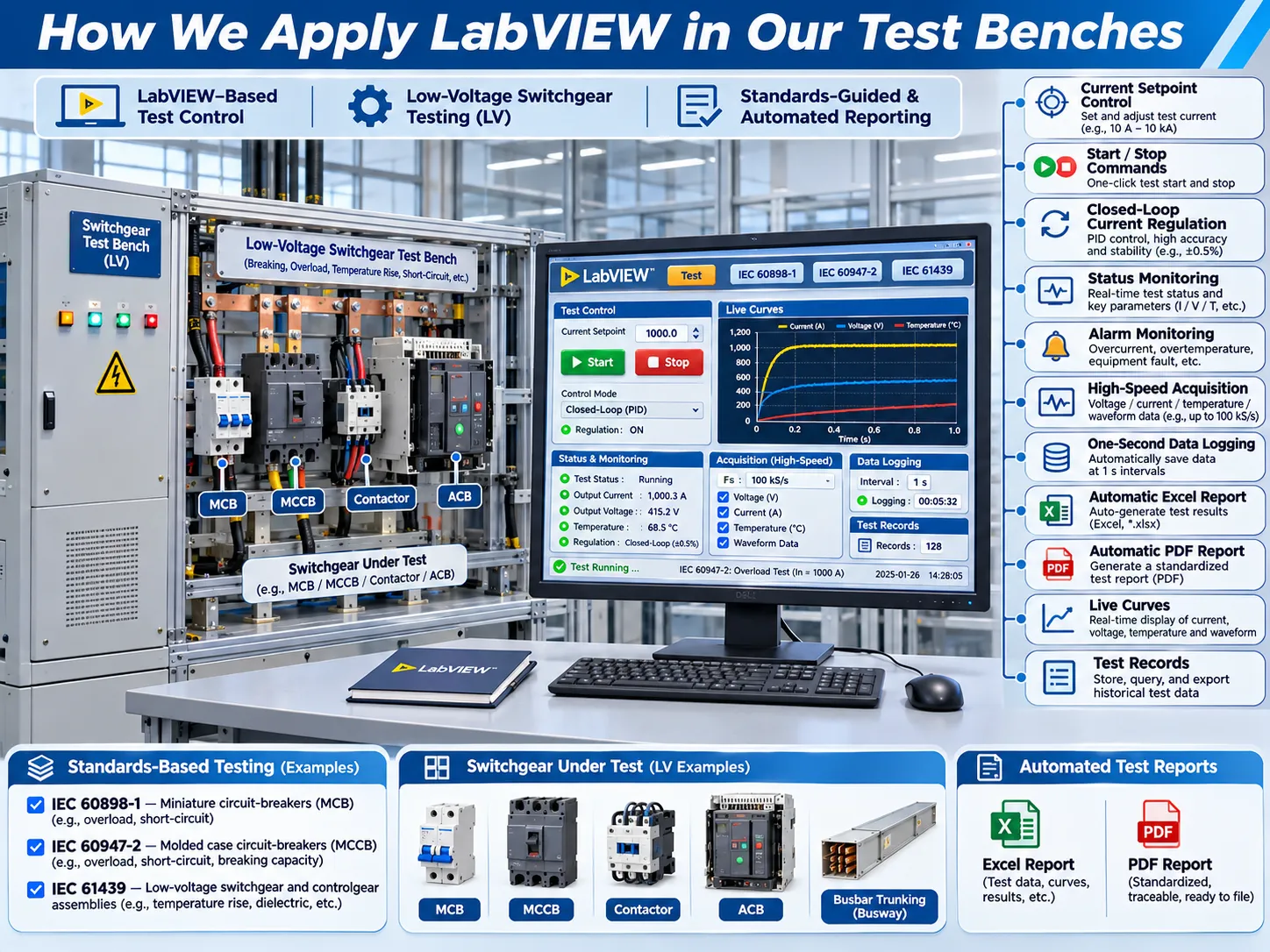
Benlong Automation employs LabVIEW for the development of the test benches control and data acquisition system in low voltage switchgear testing, such as that of MCB, MCCB, ACB, contactors, and busbar trunking systems. The following capabilities are intrinsic to a typical LabVIEW-based testing bench:
Control of setpoints for current, issuing the start and stop signals and closed loop current control.
Monitoring of the status and alarms throughout prolonged test runs.
Data acquisition on voltage, current, temperature and waveforms with high speed.
Transfers of data once per second with automatic reports in Excel and PDF format.
Operator interface providing data curves and results of testing as it unfolds.
Due to the fact that testing procedures are implemented in LabVIEW, the test procedures, time taken for tests, as well as pass or fail criteria are adjusted to conform to the specific IEC standard involved – for instance, IEC 60898-1, IEC 60947-2, or IEC 61439 (temperature rise tests only).
A Real Project Example
In the case of an 8 kA multi-feeder low voltage current source test bench, the client requested the whole monitoring and control software to be implemented on LabVIEW including current setpoint control, the ability to send start and stop commands, status and alarm information, and one second data logging. Due to using LabVIEW as the base platform, the system allows the client to control all feeders, run automated tests in a repeatable manner, and also provide the data that can be exported to their quality records.
Conclusion
LabVIEW is an advanced solution for building effective electrical testing and measurement systems, not just a programming language. From a basic single station characteristic tester to complex multi-feeder temperature rise system, smooth functioning of the equipment is guaranteed by a carefully planned LabVIEW application. If you are looking to design and create a switchgear test bench based on LabVIEW technology, our expert staff at Benlong Automation will come up with the perfect solution for you.